Strolling a promenade of small shops, you duck into a tiny, softly lit spot where the chef-sommelier greets you, welcoming you to one of only eight seats. From there, you begin a multicourse journey into the region’s finest seasonal ingredients, interpreted by a mind obsessed with discovering exactly the right wine pairing for each innovative dish.
Is it a scene from beside the Seine, the Thames or the Hudson? No, it’s beside the Deschutes, along the Brooks Street promenade. It’s FERM & fare, the charming 450-square-foot wine bar of chef and sommelier Dave Bodi, who in March brought his intimate, Wednesday-night, five-course chef’s table experience to the downtown space which he and his wife Amy opened in 2020.
Chef Dave Bodi
“This has been an evolution for a long time for my wife and me, how do we take the chef’s side of my career and the sommelier side and bring them together?” said Bodi. On a quest to give guests the highest level of cuisine and service, a fixed menu for eight hit the sweet spot, offering control over the variables in traditional restaurants, such as the number of guests, when they arrive and what they order, which all translate to demands on the kitchen. It also frees up his creativity, allowing him to choose ingredients at their seasonal peak. “We’re able to deliver perfection every time,” he said.
The control over timing also lets Bodi flex his passion for hospitality. “I love the guest experience,” he said. “I love not just cooking, but touching tables and talking about the wine or the food, or engaging in random conversation. Having that time to get out there [and mingle with guests] has been super important.”
This allows guests to not only absorb the flavors and textures of Bodi’s inventive dishes, it’s a chance to gain insight into the precise wine pairings, informed by years of knowledge and experience amassed by Bodi, who is on the cusp of achieving the highest rank of master sommelier. For example, he recently uncorked 20 wines, seeking the right pairing for the pork cheek and mole negro, a small plate served at the wine bar.
He went with a vintage rioja, La Rioja Alta S.A. Vina Arana Gran Reserva 2015. “It’s got a lot of intentional oxidation to it, so the fruit is still beautiful on it, but it also has these wood notes. You get vanilla, you get spice, you get all this barrel complexity from this wine,” said Bodi. His mole negro is Oaxacan-style, made with high-quality bitter chocolate, one of more than 30 ingredients, which he adapts seasonally with items such as local Comice pears and wildflower honey.
“(The mole is) really complex on the palette, and most wines are just obliterated by it. But the complexity and the depth you can find in these old riojas, and (the wine’s) softness, too, works really well,” Bodi said.
On the tasting menu, expect dishes such as charred octopus basted with a bit of chili jam served on Bodi’s culinary version of a beach: Rustic tahini mimics wet sand and Japanese shirasu (dried sardines), kombu (seaweed), panko breadcrumbs and garlic, all crispy fried, dressed with garlic confit oil and pounded into a powder, represent dry sand. The final element: an edible “sea foam” involving kombu, shiitake mushrooms, jalapeno and cilantro, aerated into bubbles that rest on the “sand.”
Growing up in Eugene, Bodi has been enamored with food since childhood, especially the fresh tomatoes on his grandmother’s farm. In 2015, after their son, Ramsey, was born, the Bodis left the Willamette Valley for Bend. Here, he opened Bangarang, a farm-to-table food truck, and served as executive savory chef at the former Foxtail Bakeshop.
Chef Dave Bodi putting the finishing touches on a Burrata Dish at FERM & fare Restaurant in Bend
Burrata Recipe
Ingredients
4 burrata balls, 4 ounces each
1 pint strawberries, cut into ¼ inch pieces
¼ cup shelled pistachios
½ tablespoon honey
Pinch of ground Tellicherry peppercorn
1 crusty baguette
Flaked sea salt
Emulsion
¼ cup olive oil
2 teaspoons wildflower honey
1 tablespoon dried lavender
2 sprigs of lemon thyme
¼ bay leaf
5 whole peppercorns
1 tablespoon whole coriander, toasted
1 clove garlic, smashed and skinned
Instructions
Heat oven to 250 degrees. Place the pistachios on a sheet pan and warm them in the oven. Meanwhile, heat the honey and ground peppercorn in a small nonstick pan. When the pistachios are warm, remove the honey from the stove and add the pistachios, gently coating them in the mixture. Spread nuts evenly on a sheet pan and return to the oven. Bake for two hours, agitating every 30 minutes to keep them from sticking together. Remove from the oven; cool to room temperature.
For the emulsion, combine all ingredients in a small sauce pot and heat on low or medium until the oil begins to bubble. Remove from heat and steep for five minutes. Repeat two more times. Strain the mixture through a fine mesh into a squeeze bottle or container with an airtight lid. Discard the solids. The emulsion will hold for a week in the fridge.
Get Bend Magazine in Your Inbox
Weekly highlights, local guides, and new stories. Just your email address.
No spam, just weekly highlights. Unsubscribe anytime.
Slice baguette into ½ inch slices on the bias, drizzle with oil, flake salt and pepper. Place on a sheet pan in the oven on the middle rack. Broil on low until deep brown and caramelized, slightly burnt around the edges. Remove from the oven.
To assemble:Drain burrata from its liquid and pat dry with paper towels. Place one burrata ball in the center of each of four plates. Shake the emulsion until it is emulsified and homogenous. Add enough emulsion to the diced strawberries until they are evenly coated, but no more. Place berries around each burrata ball, mounding them high along the sides. Spoon the remaining honey emulsion over the burrata. Add a generous pinch of flaky salt to the top of each plate. Crush or chop the pistachios and sprinkle over the burrata. Enjoy with crusty bread.
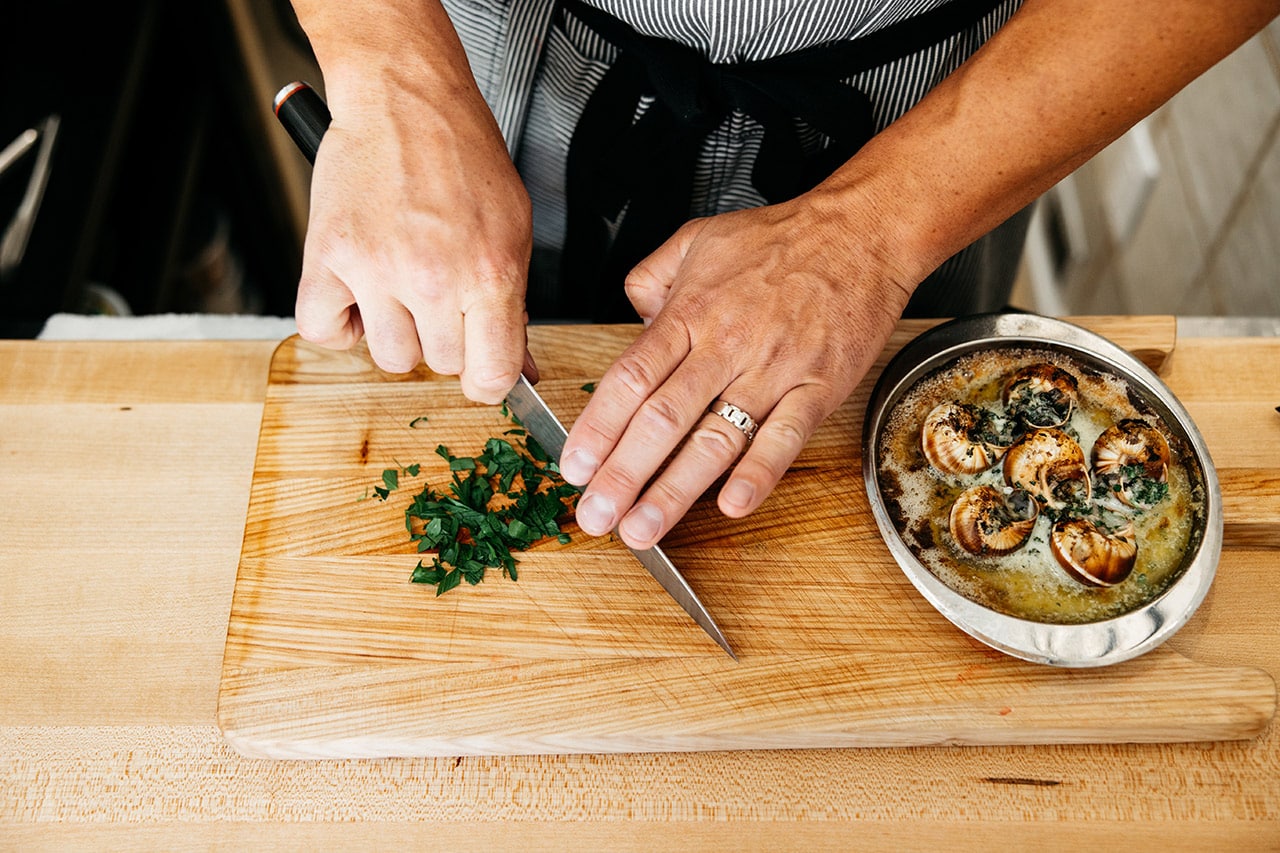
Escargot Dish at FERM & fare in Downtown Bend
Escargot Recipe
Escargot with Burgundy mother butter, fine herbs and crusty baguette | Yields approximately 24 escargots
Ingredients
24 extra large Burgundian snails
24 extra large Burgundian shells
1 pound butter, room temperature, diced into 1-inch cubes
1 medium shallot, finely diced
1 large garlic clove, finely diced
2 ounces aromatic white wine such as Chablis
3 tablespoons flat-leaf parsley, finely diced
½ teaspoon white pepper
Sea salt to taste
1 tablespoon tarragon, finely chopped
1 tablespoon chives, finely diced
1 crusty French-style baguette
Getting Started
Quality is key here. Wild Burgundian snails are harvested in the spring, purged, blanched and canned for later use. They are creamy, earthy and mineral-driven at their finest. Start by removing 24 snails from the can and placing them into a fine-mesh strainer. Gently run warm water over them while slightly agitating to remove any residue. Lay the cleaned snails on a paper towel to absorb excess water.
In the meantime, prepare the mother butter by placing the softened and cubed butter into the bowl of a stand mixer with the paddle attachment. A hand mixer will suffice if you do not have a stand mixer. Whip the butter on medium-low until it starts to cream, then increase to medium-high, incorporating air to lighten it dramatically.
Finely chop the shallot and garlic. Halfway through, add a pinch of kosher salt to the cutting board to help soften the alliums. Turn the mixer on low speed and add the shallots and garlic, chopped parsley, ground white pepper and a few heavy pinches of sea salt. Bring the mixer back to medium and whip until homogeneous. Slow the speed again to low and drizzle in all the white wine. Then, slowly increase the speed to medium-high to achieve full emulsion of the liquid.
Taste and add salt as necessary until proper seasoning is achieved. This dish should have a touch of extra salt as the snails themselves are not salted and will absorb the excess, leading to the perfect seasoning in the shell.
To fill the shells, use piping bags or a simple offset spatula. Pick up a snail shell, ensuring no broken bits lie within. Load the backside of the offset spatula with enough butter to nearly fill the shell and scrape it into the shell using the shell’s edge to help force the butter mixture in. You cannot have too much butter here. Repeat with the remaining shells. Use your pinky finger to make an impression in the butter, forming an entry point into the shell. Hold a rinsed and dried snail by the foot and gently feed it into the shell, twisting back and forth if necessary to completely press it back into its home. No part of the snail should extend past the edge. Be gentle during this process–plenty of delicate fat can be easily lost with its delicious flavor. Continue until all the snails are tucked away.
Grab your piping bag or offset spatula again and use the backside to mound a heaping tablespoon of the butter mixture onto the shell’s entry point. Push any excess air pockets out of the shell to avoid micro butter explosions while cooking. There should be an excessive mound of butter atop each shell. Place the shells butter side up in a high-sided container, using the sides of each shell to support the one next to it. Use right away or place in the fridge, covered, for later use. Stuffed shells can be stored for a few days under refrigeration as the butter protects the shells from oxygen.
When you are ready to cook, place the rack in the lower third of the oven and turn the broiler on high. Load the indentations in your escargot plate with the stuffed shells upside down so the butter can’t escape during cooking. Do not let them fall over, or they will leach the cooking medium. If you do not have an escargot plate, you can use a mini muffin pan.
Cut the crusty baguette into manageable sections, typically a third for each person. Bisect the sections lengthwise as if for a sandwich. Place the baguette on a sheet pan, cut-side down and loosely drape foil over the top to avoid browning. The goal is to heat them up and maintain their beautiful crunch.
Place the escargot on the sheet pan next to the baguette pan and put it on the oven rack. It will take 10 to 15 minutes to cook. Keep a close eye on the escargot. Once the shell butter begins to boil, let the escargot cook for another three to five minutes. (If left for five minutes, the butter’s milk solids caramelize, adding a nutty flavor.) Alternatively, you can use clarified butter for a more delicate flavor profile. Also keep a close eye on the baguette. You just want to reheat it, not dry it out.
Remove the sheet pan from the oven and garnish the snails with the chopped tarragon and chive and a final pinch of flaked sea salt. Serve with the crusty bread within 60 seconds. The butter will maintain its boil for about a minute after it is removed from the oven, and the dramatic presentation of the still-cooking escargot is worth the hustle!
Tip on salt: Adding the proper amount of salt is difficult for new cooks, who often undersalt, leading to blandness. Salt is not a seasoning but a flavor enhancer. You’ll reach the ideal amount by tasting as you cook–from five to 15 times after adding pinches of salt. This dish should have extra salt as the snails aren’t salted and will absorb the excess, leading to the perfect seasoning in the shell.