Hiking the Pacific Crest Trail in Oregon: Where to Go and Why Hikers Return
By Renee Patrick, September 9, 2026
Photo by Christian Murillo
An experienced thru-hiker is continually called back to Oregon’s stretch of the Pacific Crest Trail.
Remarkably, one of the first things I noticed at the Oregon-California border of the Pacific Crest Trail was a weathered, wood-burned sign nailed to a ponderosa pine: CA/OR. Just south of Ashland, that humble marker represented far more than a state line. It marked 1,699 miles of metamorphosis: My calves were swollen to the size of Cosmic Crisp apples; my thighs resembled Superman’s, bulging and clearly defined. Months of sleeping on the ground and moving with earth’s rhythm had reshaped how I saw the world.
The Pacific Crest Trail(opens in new tab) didn’t begin my transformation—it deepened it. Four years earlier, a thru-hike on the Appalachian Trail had introduced me to the freedom of long-distance backpacking. But the PCT promised something bigger. The trail winds through deserts full of rattlesnakes and waterless miles, plunges into snow-filled valleys and peaks in the Sierras, and touches volcanoes—real volcanoes that, to a Midwestern girl raised on adventure novels, felt almost mythical. Hiking the PCT wasn’t simply another trail but was the next step in my quest to live a life full of adventure.
The Pacific Crest Trail spans 2,650 miles from Mexico to Canada across California, Oregon and Washington. Several people are credited with conceiving the trail in the late ’20s and early ’30s, including avid outdoorswoman Catherine Montgomery(opens in new tab). The route connected existing trails and was designated as a National Scenic Trail in 1968 before being officially completed in 1993.
The 455-mile-long Oregon portion starts near Donomore Pass and ends at the Bridge of the Gods at Cascade Locks. I finished my Pacific Crest Trail thru-hike in 2006, years before Cheryl Strayed introduced millions of readers to the trail through Wild: From Lost to Found on the Pacific Crest Trail. By then, thru-hiking was still a relatively quiet pursuit. I shared the trail with roughly 300 fellow hikers. Today, thousands set out each year, drawn by the same promise that captivated me: the chance to discover just how much a long walk can change a person.
I moved to Bend in 2008 to keep hiking. The PCT was in my backyard now, and I’ve gone back to it time and again. Thirty-three miles of the PCT pass through Crater Lake National Park. An alternate route diverges from the main route at the Dutton Creek Trail junction and traces the rim of the caldera, allowing hikers to take in views of the lake and Wizard Island.
I realized the only part I had skipped on my thru-hike—a 57-mile gap due to the Black Crater fire—was now easily accessible. This section of the trail, arguably the best part, ushers hikers along the shoulders of volcanoes including Mount Washington, Three Fingered Jack and the hulking Mount Jefferson.
Other Central Oregon highlights include huckleberry bushes that bulge with fruit in late summer and deep-blue lakes that provide a cool respite after miles and miles of hot hiking. Curious hikers who want to experience the quintessential volcanic section of the Oregon PCT will need a Central Cascades Wilderness Permit(opens in new tab) for a day hike or short backpacking trip.
From Santiam Pass, hikers can embark on a 10-mile hike below the summit of Three Fingered Jack. Look for backpackers when driving over Willamette Pass. From the Willamette Pass Trailhead, a three-mile hike leads visitors to the clear blue waters of Rosary Lakes where they can camp, swim and give high-fives to passing hikers on their way to Canada. Elk Lake is only a mile off the PCT. Lunch at the resort will likely lead to meals shared with hungry thru-hikers that can’t resist a slight detour for a cheeseburger and a cold beer.
In the years since moving to Oregon’s high desert, I’ve discovered every season has its draw on the trail. The native creeping Oregon grape turns multiple shades of maroon in the fall, and well-trained hikers can forage for golden chanterelle mushrooms (peak season is September through November)—a welcome addition to any trail meal. The cooler temperatures mean fewer bugs, and when permit season ends in mid-October, it’s easy to do a day hike from Sisters Mirror Trailhead or McKenzie Pass.
In the winter, Ray Benson Sno-Park, about 30 minutes northwest of Sisters, provides access to cross-country ski trails that cross the PCT; I’ve made it a New Year’s Eve tradition to welcome the new year by sluicing through the snow or, at the very least, taking a photo with a PCT sign. Skiing into Mount Thielsen’s shoulder to set up a snow camp is a thrilling backcountry adventure. Skinning South Sister from the Obsidian Trail junction is a rigorous day-trip near the PCT.
Emma “Goldfish” Lawson at camp while on the trail
Finding Community and Connection on the Pacific Crest Trail
The power of the PCT lies largely in people. The community is welcoming, vulnerable and playful, qualities I think we all embrace more when we’re away from screens and the demands of modern life. One year, I set up a grill to make burgers and veggie dogs for hikers along the trail. I met a couple from Arizona, who became packrafting, rafting and southwest-hiking buddies.
Get Bend Magazine in Your Inbox
Weekly highlights, local guides, and new stories. Just your email address.
No spam, just weekly highlights. Unsubscribe anytime.
I’ve met lawyers, doctors, college students and housekeepers on the trail, but you’d never know what they do because dirt is the great equalizer. While on the PCT we fantasize about hot water and describe the incredible sunsets we were able to witness. We are united in the miles we’ve walked and the conversations about life we’ve had. I find folks to be their most authentic selves on the trail. We are all united in a love of nature.
Along the trail, hikers can learn about history, geology, flower identification and how Indigenous peoples lived on this landscape for thousands of years. Kiosks illuminate details about the areas you walk through, while listening to audiobooks about what interests them along the trail or using iNaturalist or Seek apps to find out the names of flowers and trees around them help to continue the education.
The Pacific Crest Trail reminds us that we don’t always need centralized heat and running water. Some of my favorite moments on the trail have been the simplest: laying under ponderosa pine trees and listening to the wind sway the heavy branches overhead, feeling the warm sun on my face as I drifted to sleep, smelling the tangy berries of the manzanita shrub. In these moments, I became a part of the forest floor. The PCT was home.
Photo courtesy of Oregon Field Guide
The Heart Behind The Hike
One of the Pacific Crest Trail’s long-standing traditions is a network of volunteers known as trail angels. This informal program of residents near the PCT helps hikers with everything from a ride into town or a hot meal to a shower or a place to spend the night.
In Oregon, trail angels are especially active during the summer months, when northbound thru-hikers (the typical direction) move through our PCT-adjacent communities. Trail Angel Central(opens in new tab) is an online community focused on connecting hikers with volunteers offering transportation, lodging, resupply assistance, laundry facilities, trail updates and other support, and local Facebook groups can also offer the same.
Many angels also provide “trail magic,” unexpected treats like cold drinks or fresh fruit at road crossings and trailheads that can lift spirits after long days on the trail.
Interested in becoming a trail angel? The PCTA encourages starting with simple acts of generosity, whether that’s offering a ride into town, sharing local knowledge, offering refreshments or doing trail maintenance. Volunteers can also add their services to Trail Angel Central’s directory or join regional Oregon angel groups to connect with hikers.
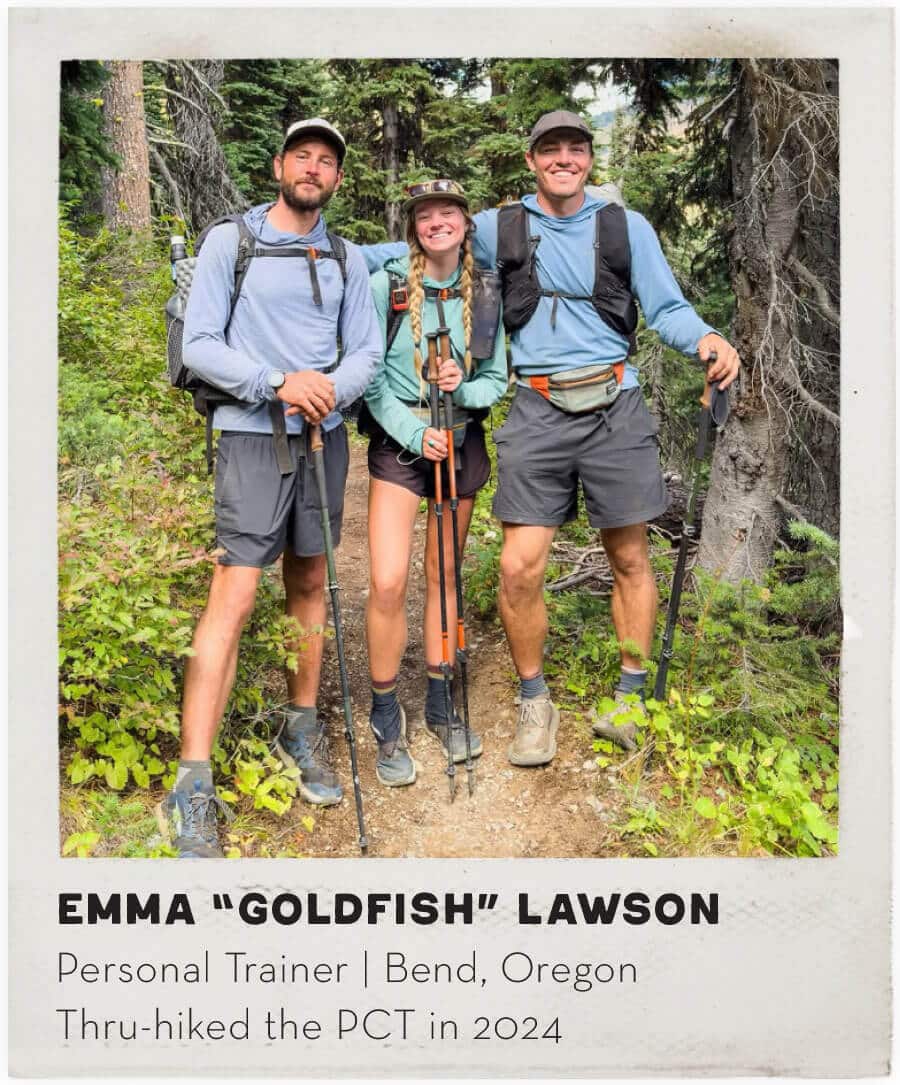
“An unforgettable adventure was completing a 24-hour challenge, hiking from midnight to midnight through the Mount Jefferson Wilderness. One of the highlights was seeing Mount Jefferson glowing under a full moon. After the PCT, I know how strong I am and that I can move through whatever life brings my way.”
Fun Fact: “I actually met my husband on the PCT! We ended up hiking most of the trail together, and now we get to explore trails all over the world.”
“Hiking the PCT taught me mental clarity, adaptability and persistence even when I felt burnt out. As a BIPOC hiker on the PCT, I had to learn to trust my inner instincts without relying on social validations. For BIPOC hikers, the trail becomes a space to challenge stereotypes and internalized limitations.”
Fun Fact: “My trail name is ‘Chef.’ A lot of hikers cold-soak, but I prefer hot meals like ramen noodles in a spicy peanut butter sauce.”
“I have a bad habit of reading too heavily into situations. Not all suffering is in service of something greater. You can do everything right on the trail and still get the blister, still snap the hiking pole, still not make it to the finish line. Sometimes, it just isn’t your day. ‘That’s okay.’”
Fun Fact: “I can’t pass those single-serve packets of tuna in the grocery store without gagging. I consumed over 80 on the trail.”
“When I think back on my time on the PCT, I remember nearly six months’ worth of sunrises and sunsets and the locals who pulled over for me as I threw up my thumb to hitchhike into town. I also learned just how capable my body was of doing hard things. When I am 80 years old, I want to look back on a life where I chose to experience all the things it had to offer.”
PCT Hack: “Add a cup of dehydrated minute rice and an extra pinch of salt to any of those expensive freeze-dried backpacking meals. It’ll stretch one single-serving pouch into two to three meals.”
Bianca “Bee” Corrado
High School Spanish Teacher & Content Creator | San Diego, California Just finished hiking Instagram:@beeswildlife(opens in new tab)
“Hiking the PCT has been the most difficult, rewarding and liberating thing I have ever done. You will learn about yourself, experience the most beautiful wild spaces and become part of the most wonderful community. Hiking the PCT will change your life.”
Frequently Asked Questions About Hiking the Pacific Crest Trail in Oregon
Do I need a permit to hike the PCT in Central Oregon?
It depends on where you’re hiking. Many day hikes and overnight trips in the Central Cascades Wilderness require a Central Cascades Wilderness Permit between late May and mid-October. If you’re thru-hiking the entire PCT with a long-distance permit, different rules apply. Always check current permit requirements before your trip.
What is the best section of the PCT in Central Oregon?
Many hikers consider the stretch between Willamette Pass and Santiam Pass one of Oregon’s highlights. The trail passes beneath Mount Washington, Three Fingered Jack and Mount Jefferson, with access to alpine lakes, lava landscapes and sweeping Cascade views.
When is the best time to hike the Oregon PCT?
Most hikers visit from July through September, when snow has melted from higher elevations. Fall offers cooler temperatures, vibrant foliage and fewer mosquitoes, while winter provides opportunities to cross-country ski or snowshoe where the PCT intersects winter trail systems.
Where can I see Crater Lake from the PCT?
The official PCT passes west of Crater Lake National Park, but hikers can take the Rim Alternate Route to enjoy spectacular views of the lake and Wizard Island.
How difficult is the Oregon section of the PCT?
Compared with California and Washington, Oregon is generally considered one of the more moderate sections of the trail. Grades are often gentle, though hikers should still prepare for long distances, high elevations, changing weather and exposure to sun.