The glitz and glam of the roaring twenties are alive and well just behind the doors of Redmond’s Gompers Distillery. Walking into the prohibition-themed speakeasy, with its vintage decor of comfy leather couches, hidden rooms behind bookcases and delicious cocktails, transports visitors to another era. This cozy hideaway is the perfect spot to warm up this winter.
Photo Jakub Dziubak
After being unable to find the perfect gin, Michael and Jessica Hart decided to take matters into their own hands and craft their own. Gompers Distillery was founded in 2012 and opened its tasting room in 2019.
The distillery’s name is in honor of Jessica’s grandfather, a Holocaust survivor who hailed from Holland, the birthplace of gin. “My grandfather was a very outgoing, fun person to be around, and even after all the things he had gone through in life, he never let it get him down,” Jessica said. “No pun intended, but we were trying to bottle his spirit.”
Inside each bottle of Gompers small-batch, hand-crafted spirits—which now include gin and vodka—you’ll find high-quality local ingredients and unique flavor profiles. Juniper berries and lavender are handpicked on a farm in Central Oregon, and the golden pears are sourced from Hood River; the result is smooth spirits perfect on the rocks, straight up, or in a cocktail.
A cocktail such as the Bee’s Elbow, Gompers twist on a Bee’s Knees, is a classic prohibition-era creation. Be transported with this refreshingly smooth drink made with Gompers Gin, lavender honey and mint leaves. Or pick up a bottle of Gompers Gin and bring that roaring twenties spirit home this holiday season with the Bee’s Elbow recipe below.
The globe-trotting odyssey of 81-year-old Marda Stoliar and her Bend-based International School of Baking would easily fill the countless number of cookbooks she has studied, gathered and reviewed during the past four decades. Since opening the school in 1985 from her Awbrey Butte home with its state-of-the art kitchen, Marda estimates that several hundred aspiring or professional bakers from across the globe have benefitted from her expertise. She has flown around the world as a consultant with the U.S. Dairy Export Council and the U.S. Wheat Associates, plus has taught baking classes at Central Oregon Community College.
For years she read and judged hundreds of cookbooks for a national contest. Her advice for buying the right cookbook? “Read the section on equipment and everything else that comes before the ingredients list—that’s the expertise you are paying for,” she said.
Raised in Portland, her initial ambition was to be a shoe designer. A fashion design degree from the Pratt Institute in New York led to her start her own successful shoe design company, followed by marriage in 1968 to businessman David Stoliar, and a move to Tokyo. World War II history buffs may recall Stoliar’s name from the book “Death on the Black Sea.” David was the lone survivor of more than 800 Jewish refugees aboard the Sturma, a ship that exploded and sank near Istanbul, Turkey. For several years, the shoe business took the Stoliars throughout Europe where Marda also learned about European pastry baking in Paris and breads in Venice.
The lure of Central Oregon’s clean air and bucolic environment brought the Stoliars to Bend in 1972, eventually leading to Marda opening Breads of France in 1979 in the downtown building now occupied by Toomie’s Thai restaurant. A serious bout with arthritis in her hands forced her out of the bakery in 1983.
Two years later, Marda opened the doors to her International School of Baking, and attracted professional chefs, bakers and “wannabes” from four corners of the globe. Her school mantra says a lot about Marda’s dedication to baking: “A bakery school is only as good as how successful a person is after they leave,” she declared. From bread makers in China to cheesecake chefs in Italy, clients from around the world come to Bend to be taught by Marda. What sets her school apart from the hundreds of baking and culinary schools throughout the world? She would point to the one-on-one interface and mentorship she provides to each student. “I work with students one-on-one to help them achieve the results they desire and deserve as bakers. Our program is founded on three core components: custom-tailored education, side-by-side implementation and improvement through mentorship,” she explained. One of her favorite success stories was the catalyst for “Marda’s Gift,” a recently-released film documentary on her career as told via the success of one of her students who opened a family bakery in Wyoming.
The staff of Breads of France on opening day, 1979. Original glass etchings remain on the storefront windows in downtown Bend.
In 2013, Dr. Ezdan Fluckiger, an emergency room physician in Torrington, Wyoming stood at the intersection of three critical paths: professional burnout, the future facing his teenage daughter with Down’s Syndrome, and a passion for baking. That’s when Fluckiger Googled “how to start a bakery,” and found Stoliar’s website. After investing four intense weeks of hands-on learning with Marda, Fluckiger returned to Torrington and two years later opened his own bakery: The Bread Doctor. Both his daughter and wife are involved in the bakery and both are featured in the film. Fluckiger acknowledges that without Stoliar’s mentoring, none of this new life adventure for his family would have been possible.
The story doesn’t end there. The Fluckigers now consider Marda part of the family, and the feeling is mutual. “The whole family is just wonderful, and they treat me so well…even inviting me to join them in Wyoming every Christmas and Easter,” Marda said. It’s this type of personal apprenticeship and learning intensity that has impacted so many of her students over the years as she now moves into yet another phase of her career. This phase involves another one of her former students. Veronica Flefil de Bueso came to Bend from Honduras twelve years ago to learn how to open a bakery. Today, not only does she run a her thriving baking school, but, in Marda’s words, “She’s one of the best baking teachers I have ever worked with.” Marda is so impressed with Veronica that she’s taken her on as an active partner, even entrusting her with the more than 4,500 formulas and recipes that Marda has cataloged over the years. Marda Stoliar has become totally involved with aspiring bakers from different cultures across the globe over the years. “This is my life and I love it.” she said.
Broadcast outlets for “Marda’s Gift” documentary may include Oregon Public Broadcasting, Wyoming Public Broadcasting, as well as local independent film festival, BendFilm in 2023.See schoolofbaking.com and mardafilm.com.
When Sherry Ortega drops into the Old Mill District off Reed Market Road, she sees stunning views of the mountains, the sparkling blue sky, the iconic smokestacks above REI, people throwing frisbees, kayakers and stand-up paddleboarders, families walking dogs and outdoor diners and she wonders, why wouldn’t she want to live here? As a principal broker with Bend Premier Real Estate and a longtime Bend resident, she believes people come to Bend for the lifestyle.
photo courtesy Old Mill District, photographer Nate Wyeth
“When I have clients from outside the area, I take them to Bend’s downtown area along Wall and Bond Streets and then to the Old Mill,” she said, adding that she doesn’t know of another place with so many lifestyle activities packed into one district. But it wasn’t always like that.
A Bit of History
For most of the twentieth century, Bend’s life and economy revolved around two rival sawmills that both opened in 1916, helping fuel America’s growth. After the city incorporated in 1905, Bend grew outward from the early soul of the city—Mirror Pond and Drake Park where founding families arrayed their homes, and essential millworkers built homes closer to the mills.
The city prospered in the 1980s. Besides lumber, the city had Mount Bachelor, destination resorts such as Sunriver, Inn of the Seventh Mountain (now Seventh Mountain Resort), a community college and first-rate regional medical care that drew people to the area. But by century’s end, the collapse of the timber industry in the Northwest idled Bend’s last mill and frayed the economic fabric of the area. With the old economic power base gone, the city searched for a new identity.
photo courtesy Old Mill District & courtesy Deschutes Historical Museum
William “Bill” Smith, who moved to Bend in 1970 while attending Stanford’s MBA program, had an idea; a really big idea that would add a thumping new pulse to Bend’s economy. As the former president of Brooks Resources Corp., and later head of his own development company, he was inspired after seeing how other cities had transformed blighted areas into lively new space for retail shops, restaurants, art galleries, parks and walking trails for public use.
He formed a partnership to purchase 270 acres on the site of the former Shevlin-Hixon and Brooks-Scanlon mills and spent years cleaning up eroded riverbanks long forbidden to the public. An interpretive sign in the Old Mill details the timeline of restoration: 1994 public access to 14,000 feet of riverfront; 1995 river trails created for public use; and 1997 a fish ladder installed in the Colorado Street bridge for fish migration.
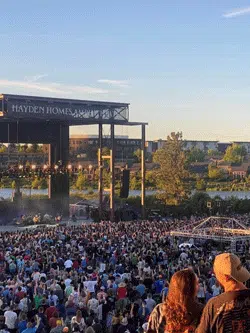
In 1998, he gained approval of Oregon’s land use laws and city zoning requirements to develop the site, which opened in 2000 with Regal Cinemas and Ben & Jerry’s ice cream. Today it’s an entertainment hub and river-centric mecca with the recently remodeled Hayden Homes Amphitheater for outdoor concerts and events, shopping, dining, lodging, businesses, residences and miles of scenic river trails. A former air-polluting mill burner has been converted to a flower feature, joining thousands of flowering landscapes throughout the Old Mill—another flourish of Smith’s to beautify the area.
Photos courtesy of the Old Mill District, Truman Miller
Urban Life in a Playground
Longtime Bend resident Dennis Oliphant, who built Sun Country Tours into a major whitewater adventure company—owning it from 1978 to 2016 when he sold to Mt. Bachelor—calls the Otter Run neighborhood in the Old Mill District home. “I lived out of town on acreage before moving into the mill,” he said. “It didn’t take long for me to appreciate the conveniences.”
“I seldom drive my car. I ride my bike everywhere, which is a huge advantage because it’s hard to find parking in Bend. We live on the water behind the Hayden stage, which is awesome. I really enjoy the music from our deck,” he said, referring to the home he shares with his partner Traci Porterfield.
He notes that Otter Run has no short-term rentals and 90 percent of residents live there year-round. There’s a perception that the Old Mill District has many second or vacation homes, but Oliphant said that property is expensive and “it’s not like a summer cabin.”
Principal realtor Ortega provided information showing that in August, the Old Mill District had only two active residential real estate listings and two pending sales, with prices ranging from $1 million to $2.3 million. She said condominiums and townhomes are highly sought after.
There are more than 150 residential units in the Old Mill District with more townhome and apartment projects proposed in the future.
Today’s mill residents may be better off than the millworkers who lived nearby in modest homes, but their legacy endures a century later, carefully preserved by Smith and others who incorporated elements of both mills into the vibrant new district.
In 1910, engineer and surveyor Robert B. Gould came to Central Oregon to plot out the townsite of La Pine. He loved the area so much he never left. Gould was a key figure in plotting out the early footprint of many of the Central Oregon townships and in 1916 was credited with creating the first map of Bend.
Photo courtesy of Deschutes County Historical Society
Though the maps of the area have changed considerably since Gould plotted them more than a century ago, much of their purpose remains the same. We use maps to navigate roads and highways, locate a store or restaurant and even find our way around the Old Mill shopping district. Maps also play an important role in the booming tourism industry in the area, from navigating single-track trails at Phil’s to ski runs at Bachelor. The creation of maps, called cartography, has a long history of helping us get from point A to point B and today helps us map the future using geographic information systems.
Start with a paper map
For centuries, paper maps have played a pivotal role in navigation, exploration and understanding the world. Though technology has now changed the breadth and way we interact with some maps, the role of paper maps is still vital. “Bend is a perfect example of why paper maps will continue to play an important role in people’s lives,” said Taylor Monroe, a cartographer at Benchmark Maps in Medford and a 2022 graduate of the Central Oregon Community College (COCC) GIS program. “Tourism and recreation are such a huge focus in the area and maps play a big part of that for so many people.”
Joe Milbrath, a Sisters resident and cartographer for the National Park Service for the past seven years, agrees. Paper maps are just more user-friendly. “The world is trending toward digital maps and interactive maps but the traditional maps are a tool you can’t replace,” he said. “They’re easier to plan with—you can mark them up and personalize your trip,” he said. According to Milbrath, “Each has its own uses, and they can work hand-in-hand, whether navigating or wayfinding or otherwise. Nothing sets yourself up in a landscape better than a paper map.”
Milbrath should know. As one of only four cartographers on staff, he has designed hundreds of maps for parks, monuments, battlefields and historical sites around the country. Though his maps are integrated into various formats from trailside kiosks to roadside signs, the bulk of his time is spent on the maps included in the physical brochures given upon entry at most parks. Milbrath said he loves this aspect of his job and sees it as a rewarding path. “It’s hard to beat creating a map that’s read by millions of people,” he said. More than that, though, Milbrath said he feels his role is important to convey the accurate history of the park. “We’re creating maps for some of the most beautiful places, but also some [with the most troubling history],” he said. “You have to ensure [information] is conveyed in the right way and honors the right people.”
Mapping change
Jared Hanley, co-founder and CEO of mission-driven tech company NatureQuant, said the speed at which technology can process data has changed the way maps can operate. “Maps are one of our best tools at conveying massive amounts of data in a simple, digestible format,” he said. “And because technology is exponential, what would have been impossible to synthesize five-to-ten years ago, is now possible.”
It’s this access and ability to crunch large amounts of data that helps fuel NatureQuant’s signature program, NatureScore, with the simple but poignant goal: to drive home the positive impacts of nature on human health. “When we’re creating our NatureScore we’re taking billions of data points—health tags, geo-tagged objects, satellite imagery—putting them together, and then creating a heat map out of these data points in a single image to tell a story,” said Hanley.
NatureQuant feeds into its algorithm natural elements such as green spaces and water, combines it with human-created elements such as traffic, noise, light and air pollution, and ultimately creates a score to provide an idea of how much access a location has to nature. By working with city planners, municipalities and nonprofits, NatureQuant hopes to use its data and heat maps to drive change. “We want to improve public health by providing access to nature,” said Hanley. “And we create heat maps to do that.”
Blair Deaver, a GIS software solutions architect for international geospatial solutions company Locana, and part-time instructor at Central Oregon Community College, said that technology has also helped to make cartography more accessible and user-friendly to the public. “The big challenge was you used to have to download all the data,” he said. “Today with open data, cloud-based data, it’s much easier.” Deaver added that this accessibility, along with more user-friendly software, is helping to create more maps. “GIS software is much more approachable than it used to be. This allows people who want to dabble with data the ability to make maps,” he said. “Now, especially designers can style maps to create customer experiences and tell deeper stories.”
With the overload of data, however, framing a map in the right context is key, according to Deaver.
“Maps are a natural way for people to see patterns and showcase location intelligence,” he said. Maps tend to tell a story in a much quicker and efficient way than other mediums. To this point, Deaver gave the example of the pandemic’s beginnings. “When COVID-19 first broke, everyone was looking at maps to follow the spread of the disease. This would have been much more difficult in a spreadsheet.”
Deaver said he believes that GIS and the data analysis that comes along with it will help us solve some of the biggest challenges we face today. “Locally, Central Oregon has seen tremendous growth over the past thirty years,” he said. “Looking at issues like land use, water quality, wildfires—being able to analyze data on these topics will allow us to tell a relatable story to the masses and enact change.”
Recent COCC GIS graduate Taylor Monroe believes she and other young cartographers can play a big role in this process. “The younger generation can help champion these key societal issues,” she said. “With the speed of technology and digital, we can reach more people.”
Whether using the latest app, or a trusty paper topographical map, the role of maps will continue to serve as an important tool for navigating the future. Bend’s original cartographer Robert B. Gould would be proud.
Jim Niehues has painted more than 150 ski resorts throughout North America.
Art of the Ski Map
If you’re a skier or snowboarder, chances are you’ve utilized maps created by artist and illustrator Jim Niehues. His hand-painted, beautifully illustrated maps have served as a trail guide for more than 150 ski resorts around North America, including Mt. Bachelor. He is the subject of 292-page hardcover coffee table book, “The Man Behind the Maps,” that compiles maps he has created during his 30-year career.
Bend Magazine sat down with Niehues to talk maps, art and Mt. Bachelor.
BM: You’ve quietly become an icon in the ski world and have been inducted into the Ski Hall of Fame. How does this make you feel?
JN: It’s been thirty-five years of ski maps! I really had no thoughts of such recognition until [I was] nominated. It’s really an honor and very gratifying to know that you may have made a difference in [the] ski industry.
BM: Your maps and illustrations are known for their brilliant color and detail—down to every tree even. Why is it important to you to capture each detail?
JN: Detail is important in several ways: first, it’s a map that guides you around the mountain. I want skiers to be able to know where they are by recognizing their surroundings on the slope and relating it to the map they hold in their hands. This means showing deciduous or conifer trees where they are, or showing rock features and slope inclines in detail.And second, I want to add credibility that this map is correct and they can rely on it.
BM: Mt. Bachelor offers 360-degree skiing—what was the process like to map that?
JN: Mt Bachelor was a challenge. The “satellite” perspective was necessary over the traditional view that includes a horizon. The secret is simply not to show the horizon, and turn all side slope runs as vertical as possible so the viewer knows they are looking down on the mountain and not horizontally to it. I also used color in some instances with warm colors toward the summit and cool colors in the valleys; warm colors are perceived as near and cool colors further away.
BM: Your artwork is unique in the sense that many carry it with them on their person, referencing it before, during and after their visit on the mountain. What does this mean to you?
JN: I think the fact that skiers review the map over a beer at the end of the day is the most gratifying accomplishment an artist could ask for.They are reliving exploration, excitement, exhilaration, achievement…and some spills, hopefully not too serious. Ski maps are doing more than getting a skier around the mountain. They are collected to reflect the experience or dreamed over for the next adventure.
The secondhand market has seen significant growth in the past few years amid growing concerns about the environmental and ethical impact of what we buy. Experts don’t think this trend will disappear anytime soon, with the resale industry expected to double by 2026, making it an $82 billion market.
This shift in consumer habits becomes abundantly clear around the holidays. With supply chain issues, tightening wallets and rising prices potentially transforming holiday joy into a season of stress, it’s no surprise that more and more people are opting to shop secondhand for their holiday gifts. ThredUp, a prominent secondhand retailer, reported that 49 percent of consumers are interested in gifting thrifted items this year.Central Oregon has a community of business owners who are making sustainable shopping accessible, affordable and stylish.
Fashion
With the fashion industry sitting right behind big oil as the second largest polluter worldwide, evaluating what’s in your closet is an excellent way for someone to begin living a more sustainable lifestyle. Sped-up trend cycles and giant fast-fashion retailers are driving forces behind the increasingly devastating repercussions, with the average consumer buying 60 percent more clothing than they did fifteen years ago and wearing them for just half as long.
Shopping at local vintage shops increases the lifespan and decreases the carbon footprint of an article of clothing item while offering unique fashion options.
Gathered Wares of Bend, located in the Old Ironworks Arts District, is a goldmine of curated pre-loved clothing and home goods. Shop owner Lauren Cooley, who opened the store in March of 2021 and can often be found making jewelry behind the counter, said,“I just had this vision of a beautiful creative space that would foster community and encourage people to think about how they can adorn their bodies and homes in ways that aren’t detrimental to the environment.” Walking into the shop, it’s evident that she’s done just that. The space is filled with colorful fabrics, beautiful wooden furniture, brass details and eclectic home decor. “There’s a lot of color. There’s a lot of texture. There’s a lot of different things to look at,” said Cooley. “It takes about five times through the shop for people to see everything because pretty much 90 percent of the things in here are one-of-a-kind.” Prices range from $5 and up, meaning almost anyone who walks into the store can walk out with a unique vintage item.
Cowboy Cash
More vintage fashion
Old Boy Vintage gives older garments a new life, with most items made before the 1970s.
Revival Vintage presents a curated collection of eclectic vintage clothing. The racks are adorned with colorful velvet, silk, flannel and denim fabrics.
Cosa Cura specializes in high-quality clothing sourced sustainably. It sells on consignment while also working with local artisans to stock handmade jewelry.
Cowgirl Cash offers an array of vintage boots and buckles, clothing, sterling silver jewelry, accessories and home goods with in-store partner Arrange.
The passion for outdoor recreation is strong among Central Oregonians, so it only makes sense for us to have that same level of passion for finding ways to better care for the environments where we enjoy spending time. Much of the gear and clothing used when heading into the mountains or floating down a river are constructed of plastic-based fabrics, such as polyester, that can take anywhere from 20 to 200 years to decompose. Shopping second hand is one way to lessen the negative environmental impact.
Walking into Gear Fix feels like walking into a shiny outdoor retailer, except all the items are used. First opening its doors in 2006, Gear Fix is a local source for secondhand goods. It joins the ranks of global brands such as Patagonia, a company that take sustainablility seriously with its repair program and a self-imposed earth tax to support activism. At Gear Fix, there are racks full of puffer jackets and hiking pants, mountain bikes and skis that have already been on a few adventures and are now available for purchase.
“If you boil it all the way down, our baseline value statement is that we think it’s better to buy the good stuff used than to buy the lesser quality stuff that’s going to need to be replaced,” said Matt Deacon, general manager of the consignment shop. Not only does shopping second hand keep gear out of the landfill, but it also makes outdoor recreation more accessible. With lower price points, there is a lesser barrier to entry for people who want to gear up to go outdoors.
More GOODS
Latitude 44 Sports is a snow sports consignment shop where you’ll find great gear for great prices. Everything from boots and apparel to goggles, helmets, skis and snowboards are available.
REI Garage gives their returned and pre-loved items a second chance through their garage sales. Co-op members can shop and trade in used gear anytime.
TruNorthwest Exchange is an online consignment shop based in Bend that facilitates the rental and sale of second-hand outdoor gear. Locals can visit their warehouse for consignment drop-offs and gear pick-up by appointment.
If a single word could sum up a visit to The Ale Apothecary tasting room, it’s “wood.” It starts with the beer—owner and brewmaster Paul Arney’s founding vision was to “combine age-old techniques alongside modern ones” by brewing small-batch handcrafted beers with a unique profile. Wood is an integral ingredient in all of them, and is present in nearly every step of the brewing process. The beer is fermented and aged in barrels with a native wild yeast cultivated from the Deschutes National Forest. As a result, all of the beers exhibit various levels of sour, and sometimes funky, character. The tasting room has an eclectic charm that exalts wood and meets Arney’s goal of “familiarly exotic.” Located in an industrial brick building off Century Drive, the interior fuses the wood with industrial and iron elements into an attractive and functional space. It feels like a museum to brewing and family history, with handcrafted artwork, vintage decor, historic photographs and furniture from repurposed barrels. “It’s important for me that the environment helps to support the beer we make and the stories we are telling,” said Arney. “Just like the beer I make tells a story about history, food production in our modern age, Oregon farms and the importance of nature and artisans, I am also trying to share the story of my family history in small business.” Most beers are available by the bottle only, with a few available for individual pours and flights. The bottle list is extensive and showcases Arney’s creativity and versatility as a brewer; you may find beers brewed with wine grapes, apple skins, pine needles, lilac blossoms and more. “My suggestion is to go for the flight of available beers as we have quite distinct differences between our brands,” Arney said. First-time visitors unsure about sour beer and what to order should ask which beer is “best for initiation,” he said. See thealeapothecary.com.
While it’s natural to think of heat and melting as a solution to icy, wintery conditions, when it comes to ice dams, warmth is the culprit.
An ice dam is a chunk of ice that forms along the outer boundaries of your roof. As long as the entire roof stays frozen, the dam is no problem. But when the roof warms, higher points may melt away ice and snow, while the lower overhangs stay frozen. This can cause water to pool behind the dam, eventually soaking into your roof, ceilings and walls. That’s when the real problems begin, including costly damage that is difficult to repair. Avoid disaster this winter by following these tips.
Keep It Cold
As thawing and refreezing is the cause of an ice dam, keeping a cold roof can prevent ice dams from forming in the first place.
Close up Attic Bypasses
Warm air leaks from our homes into the attic and to the roof a variety of ways. Be mindful of cracks around lighting fixtures and in drywall, uninsulated access hatches and undampened chimneys.
Insulate Your Attic
Make sure you have at least twelve inches of insulation in your attic. If you measure less than that, consider hiring a company to blow in more insulation. This will keep your home more energy efficient and help lower your heating bill, too!
Add or Maintain Roof and Soffit Vents
The vents you see under the eaves around your house are another piece of the puzzle in terms of keeping your attic and roof cold. These vents draw in cold outside air, keep circulation moving and maintain cool temps in the attic. Make sure your roof has vents for every other roof rafter, or one square foot of vent for every 300 square foot of attic floor area.
Addressing Problem Areas
You’ve done all you can to keep your roof cold and you still can’t seem to prevent ice dams? That can happen, in long, extra stormy winters, and on particularly tricky roof sections, like roof valleys or segments that absorb a lot of warming sun during the winter. How do you prevent ice dams under these circumstances?
Rake the Snow off Your Roof
A snow rake is an aluminum scraper on a telescoping aluminum pole, available at most hardware stores. Use a snow rake to pull snow down from the roof, before it has the chance to melt and refreeze into an ice dam. You need to rake soon after snowfall, and this method only works with single story homes, but can be very effective.
Heat Cables
Sometimes, heat is the answer. Tough spots like roof valleys might call for the installation of heat cables, which warm consistently to melt snow and ice and prevent an ice dam before it even starts.
Ice Dam 911
You’ve done everything you can to prevent an ice dam and yet—here you are, with ice dams. If you note no leaks in your house, you may not need do anything. If you do see signs of water damage, and you can’t safely remove the ice with a rake, you may have to call a roofing company for assistance. Climbing on your frozen roof to try to deal with the situation yourself is just plain not safe!
Editor’s note: This story was originally published February 2020.
Through the expanse of picture windows stretching across the western wall of the Sunriver Resort Lodge, the changing season paints a view like no other. The landscape’s vibrant reds, yellows and golds fade to a muted palette against the bright blue sky. The sun, which shines more than 300 days per year here, glints off the frost-covered trees and reflects bright against the freshly fallen snow dusting the ground. In the distance, Mount Bachelor, South Sister and Broken Top hint at the area’s volcanic past.
The view overlooks an adjacent meadow revealed when an ancient lake slowly dried and disappeared. Things have always moved a little slower down here in Sunriver, known as the granddaddy of destination resorts in Central Oregon after it debuted half a century ago. Since then, it’s been setting the standard for family-friendly vacation destinations in the Northwest.
More than seventy-five years ago, the Sunriver area was home to Camp Abbot, a U.S. Army engineer training center where more than 90,000 citizen-soldiers lived and worked.After it shut down, the army razed all but one of the camp’s structures. The officers’ club survived and later served as a cattle shelter and lives on today as the resort’s historic Great Hall, home to wedding receptions and special events.
When a wintry blanket (the resort gets almost a foot more snow than Bend in an average year) envelops the meadow and golf courses, children and adults alike bundle up and delight in an array of snowy pursuits. Snowmen take shape and snowballs fly. Some visitors don snowshoes, others Nordic skis. They traverse along plowed pathways or make fresh tracks as they set out to explore a piece of the more than 3,300 acres that make up the resort and surrounding community.
Honoring founder John Gray’s vision when he, along with Donald V. McCallum, brought the resort community to life in 1968, Sunriver strikes a balance between nature and development. Though there are more than 4,500 residences and lodging units in Sunriver today, the area boasts dark skies that, when paired with clear air and elevation, makes for perfect stargazing.
Sunriver’s fun, however, encompasses much more than being immersed in nature. The indoor pool at SHARC — Sunriver Homeowners Aquatic and Recreation Center — has a zero-entry area with bubbling fountains, a spinning water flower and a dumping bucket that elicits endless laughter as kids (and adults) take turns being doused from above. Water volleyball and basketball pit swimmers against one another, while the vortex water feature sends kids floating in dizzying circles.
Beyond the pool, adventure seekers race down SHARC’s seasonal tubing hill, especially when the lanes are illuminated on Black Light Blast nights.
“When people inquire about what there is to do in Sunriver during the winter and holiday season, it’s hard to know where to begin. There are so many festive and fun things that make this resort a destination for everyone,” said Denease Schiffman, operations manager for The Village at Sunriver.
The Village bustles with activity as Sunriver’s commercial hub and, come winter, has a genuinely enchanted feel. Visitors enjoy strolling between boutique shops and art galleries interspersed with restaurants, including the always hopping Sunriver Brewing Company. It’s all quaintly situated around the village center and ice-skating rink, where skaters glide, or in some cases wobble, around the rink as music drifts beyond the pavilion walls.
Each year, Sunriver Resort kicks off the holidays with the Grand Illumination, a rite of winter in Central Oregon. Holiday spirits soar as friends and family spend the day dancing to live music and indulging in delectable bites. Children whisper their wishes to Santa and hustle between craft projects, bounce houses and train rides. Horse-drawn sleigh rides and visits to Gingerbread Junction fill the hours as everyone awaits the resort’s lighting ceremony.
“We’ve had so many families come back year after year for the Grand Illumination event, sleigh rides and elf tuck-ins. We are ramping up this year with a light show featuring more than one million bulbs and choreographed to holiday music,” said Joshua Willis, Sunriver Resort’s director of operations.
When it’s time to slow down after all the adventures, schedule a visit to Sunriver’s Sage Springs Club & Spa. Here you will find the perfect escape in a selection of signature and seasonally inspired treatments. Stars twinkle like diamonds in the dark above the hydrotherapy spa, an ideal way to relax in conjunction with a massage or facial, or only as a long soak after a long day.
With so much to see, it shouldn’t come as a surprise that so many guests are return visitors.
“When you find a place as beautiful and family-friendly as Sunriver, it draws you back time and again,” said Sara Bittner, who has been coming to Sunriver for more than forty years. “My parents started the tradition of coming to Sunriver from Portland in 1978 when my mom was pregnant with me, and my brother and sister were both under five years old. They fell in love with the beauty and peacefulness of Sunriver, and the opportunity to relax and enjoy the outdoors.”
Bittner lives in Bend with children of her own now and, despite being just fifteen miles away, continues the Sunriver tradition with her family.
“All these years, Sunriver has been a place of beauty and rest for us. It’s allowed our family to bond and create memories that will be treasured forever.”
Editor’s note: This story was originally published November 2019, and has been updated to reflect current information about the Grand Illumination and Snowblast Tubing Park.
Years after first meeting at work in the tech industry in San Francisco, Brittany and Kyle Lindquist were married and eyeing a move to Oregon to raise their growing family. Brittany, a native Oregonian from Newport, and Kyle, who grew up in Chico, California, initially chose Portland for their new home base, moving to Oregon’s largest city in 2019 with their first son, Jack. They found a beautiful house they liked without fully considering how the surrounding neighborhood would play into the quality of living. “We learned from that experience that it’s more about choosing the neighborhood, and less about the house,” said Brittany of the ten months the family spent in Portland. After bouncing back to the Bay Area in 2020, the Lindquists zeroed in on Bend, the Central Oregon city where Brittany’s brother lived. “Every time we would come visit, we knew this is where we wanted to be,” Brittany said. By fall 2020, they had moved to Bend as renters and identified northwest Bend as the area where they’d like to purchase a home. During a home tour on Awbrey Butte in 2021, the couple watched as a yellow school bus drove by, sensing they were in the right neighborhood for the next chapter of their lives. “You don’t see yellow school buses in San Francisco,” said Brittany, who explained that kids take public transit, are dropped off by parents or nannies or take a ride-sharing service for kids. Because both Kyle and Brittany grew up in smaller communities where riding the bus to school was a part of life, they loved the idea of living in a community of families where kids would do the same. “We wanted a neighborhood that you could see kids running around in,” Kyle said.
Moving In
The Lindquists closed on their new home in the spring of 2021, knowing they would have their work cut out for them. The 1998 Craftsman-style home was in need of some modernizing, after spending years as a rental property. “We’ve never been bombarded by more brown in our entire lives,” Kyle said. “But it had great bones.” Before moving in, the couple removed the shaggy brown bedroom carpets, which were stained from past tenant pets, including cats and turtles, replacing the floors with luxury vinyl plank. Hardwood in the main living areas and kitchen were kept, but the entire home was refreshed with new paint, new outlets and lighting fixtures, door handles and appliances. While Kyle led the way on initial updates in the house, Brittany packed up the family’s Bend rental, with toddler Jack and newborn son Beckham in tow. “It was a good example of what not to do—having a baby and buying a house at the same time,” Brittany said.
Brittany and Kyle Lindquist with sons Jack, front, and Beckham.
Project Mode
Once moved into the new home, the Lindquists set their sights on more significant updates, tackling the kitchen, laundry room and smaller projects throughout, such as painting the tile around the living room fireplace and reimagining the front yard landscaping. In the kitchen, the cabinets and island were painted, and a new hexagon tile backsplash added character. In the laundry room, white subway wall tile, repainted cabinets and accessories brought new life into the space. Kyle did many updates himself, along with the help of Brittany’s dad and brother, who were passed down carpentry skills, specifically electrical work, from Brittany’s grandfather, a craftsman and former chief electrical inspector for the State of Oregon. “We did the work to modernize the home, little by little,” Kyle said.
PARADISE AT HOME Fresh foliage, including a bird of paradise plant, soaks up the sun from windows high and low in the Lindquist dining room.
Tucked below the laundry room is the garage, which the family has converted into a downstairs living space and hangout zone. There’s a couch, workout equipment, a makeshift wine cellar and kegerator. Off the “garage” is a home office with space for Kyle, who works remotely for a farming technology company, and Brittany, who works remotely as a marketing director. Back upstairs, now 5-year-old Jack has settled into his bedroom at the front of the house, which is furnished with a Hot Wheels bed and plenty of race car toys. “Hot Wheels are life for that kid,” Brittany said.
As a heatwave blazed through Bend this summer, the Lindquists were busy with outdoor projects, including fresh exterior paint and a complete rebuild of the upstairs deck and front porch. Dated wood boards and railings were replaced with Trex decking, and the back deck wood railings were swapped with sleek glass panels.
Remodel Reflection
With much of the remodeling behind them, the Lindquists are able to reflect on their style and the updates made over the past eighteen months. “The remodel itself was about simplifying, and having a neutral palate on the inside, allowing us to build upon the design in a few years,” Brittany said. Kyle said his biggest lessons from the process were that remodeling is really problem solving, and that it always takes longer than expected. “I use the ‘times three’ rule,” Kyle said. “If you think it’s going to take an hour, it will take three hours. If you think it’s going to take a week, it will take three weeks.” Despite the frustrations that come with more than a year of home renovation projects, the Lindquists said the work has helped them build a relationship with the house, which now feels more like home. The couple will spend the coming years personalizing, and they have a shortlist of projects for the future, including a remodel of both bathrooms.
After a health scare with Jack that had the family at St. Charles Medical Center for more than a week last fall, Brittany said the family was even more grateful for having their home, and all the quiet, mundane moments they’re able to enjoy in it. “I want to roll out of bed, snuggle my kids, go downstairs to work, come back up, do dinner, bedtime routine, rinse and repeat daily,” she said. That everyday routine lately includes activities such as listening to records (Disney tunes, The Beatles and Elvis are favorites), tending to a growing collection of plants and the unpackaging of the latest Hot Wheels offerings. And when the winter snow rolls around, the family will be found at the side of their house, which they learned is home to a popular sledding hill, packed with children who call their neighborhood home.
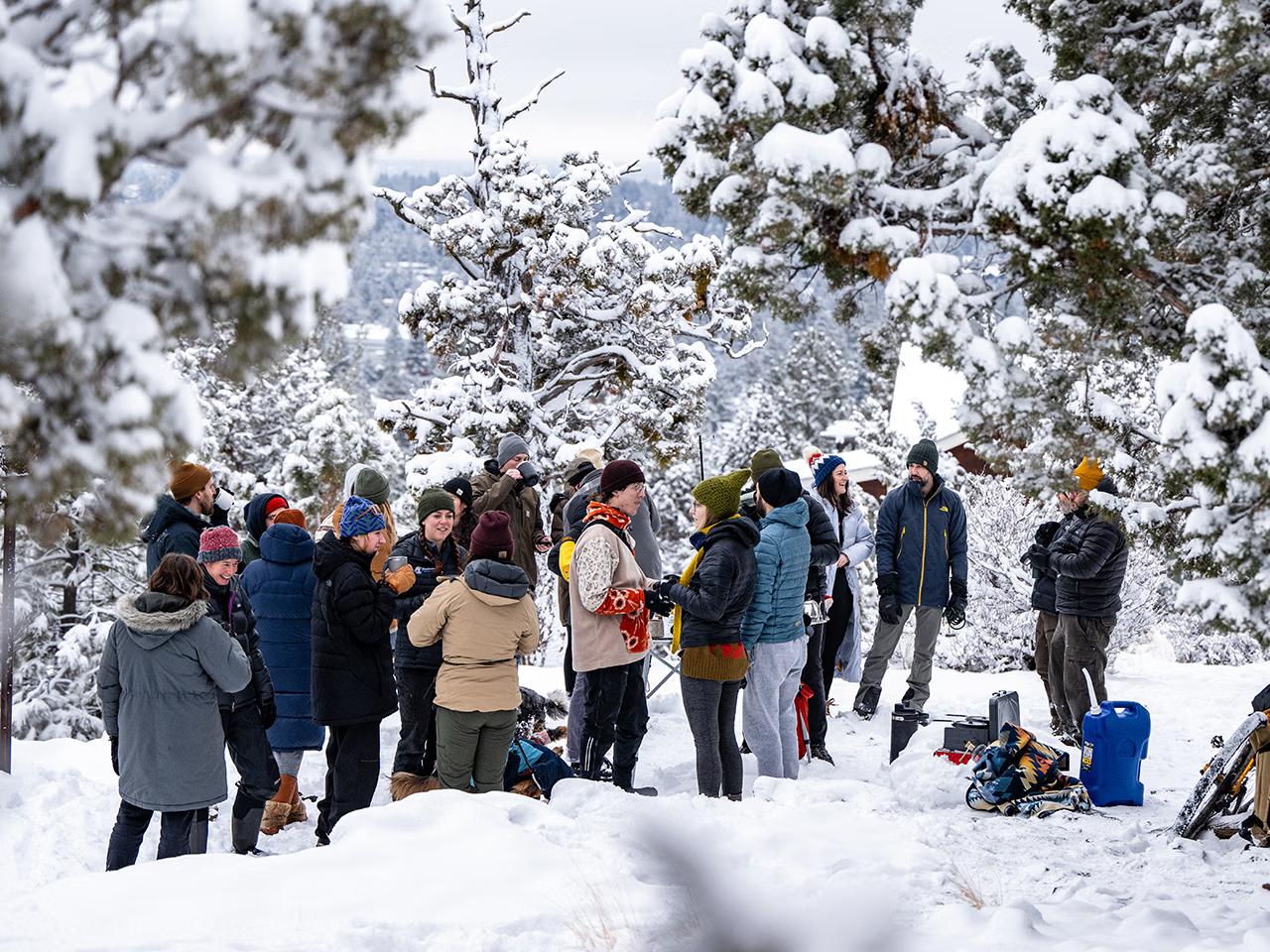
Sure, Bend’s proximity to Mt. Bachelor is a major benefit to life in Central Oregon. But great cross-country skiing is even closer to town at a trio of snow parks: Swampy Lakes, Wanoga and Meissner. These parks, set amidst the scenic beauty of Deschutes National Forest, provide well-groomed trails catering to skiers of all levels. Whether you’re a novice seeking gentle slopes or an experienced enthusiast craving challenging routes, there’s something for everyone.
Virginia Meissner Sno-Park is the first you’ll encounter on Cascade Lakes Highway. A mere thirteen miles from downtown Bend and you’ll be clipping into your skis and gliding through a magically wintry alpine forest. Volunteers with the nonprofit Meissner Nordic groom forty kilometers of skate skiing and classic skiing trails that vary in length and degree of difficulty. The warming hut is the community gathering place—a spot to rest, snack and chat with other skiers. Virginia Meissner is also where the annual Luminaria gathering is located.
Just up the road is Wanoga Sno-Park, one of the most popular winter recreation areas off Cascade Lakes Highway for its sledding hill. Wanoga is also the place to take your furry friend. As one of only a few sno-parks open to dogs, Wanoga is your destination for skijoring or just taking Fido out for a romp in the snow. There are groomed trails for skate skiers as well as ungroomed trails for classic Nordic skiers here as well. Designated trails for fat bikers and snowmobilers are in the park, and snowshoers share trails with skiers. Glide along on short and relatively flat loops, great for those who are new to Nordic skiing.
Of all the parks, Swampy Lakes Sno-Park is where to find solitude. Venture deep into the woods and you might just find yourself all alone. There is nothing like the silence and cold of a winter day, with only the shush-shush of your own skis to sing to you on a journey of your choosing. The Swede Shelter—one of three warming huts at Swampy—offers views from the ridgetop down into Tumalo Creek below that are outstanding on a clear day.
If you use any of these trails, be sure to say thanks to the Central Oregon Nordic Club (CONC). The nonprofit is the primary caretaker of the ungroomed trails in the area. They work year-round to update trail signs and maps, maintain the shelters and stock firewood, and more. Their work keeps the backcountry safe as well as accessible.
Update 2/26/2019: This article has been updated with information about the Central Oregon Nordic Club.
Editor’s Note: This story was originally published in January 2019
When 14-year-old Genesis Marlowe speaks about being a part of Ujima, the youth group in Central Oregon, her enthusiasm is palpable. Born in Bend, Genesis has often been the only Black student in her classes or on her sports teams, and that can feel isolating. “There’s so much happy and positive energy whenever I go to Ujima after school,” said Genesis, a freshman at Mountain View High School. “It’s been a great program to meet other friends who have the same skin color as me, and we’re learning about the civil rights movement, and there are also volunteers at Ujima who have helped me with my math and science classes.”
Ujima is a program of The Father’s Group, a Black affinity group formed in 2017. Affinity groups link communities through a common purpose, and they play a key role in ensuring inclusive environments where members are all valued and empowered to succeed.Executive Director of The Father’s Group, Kenny Adams, said the group was formed after the father of a Black student sought community to help navigate the racial incidents his son was facing. Together, they wondered what they could do to address the issues and this is when talk about forming Ujima first began.
“At one point, I pulled out my kids from the public schools,” said Adams, an IT professional, documentary filmmaker and father of four. “It’s not easy being an African American here, there’s only 0.6 percent of African Americans living in Central Oregon. That’s less than one percent.”
Ujima leader Marcus LeGrand, a father of two, said it’s imperative African American students understand their culture, especially in white spaces.
“Ujima in Swahili means working collectively, that’s what we are trying to do—working together to help our children—and we want our parents involved, too,” said LeGrand. “They need to know about their own rich culture, their history and learn leadership skills. I want every single child who walks in here to feel welcome and safe, and know they matter.”
LeGrand explained many of the students at Ujima have felt marginalized and/or bullied in their schools, and he feels Ujima can give their students agency and empower them with foundational learning to know they have options.
Ujima’s multicultural identity-based group was formed to protect its students from racism and isolation in a predominantly white community. LeGrand uses the term “safe space,” and feels Ujima’s work is to provide a respite from always being marked as different. While Ujima does provide that safe space with a nod to academic and leadership skills development, there are also fun activities planned.
Fodeliche Syzzla leading a drum session at a Juneteenth Celebration in downtown Bend, Oregon, put on by The Father’s Group.
Highland Elementary school student Nick Adams has found Ujima a safe space that is engaging every week. “We got to go to [Native American volunteer] Dark Horse Warrior’s Tumalo Ranch and learn archery and see all the horses there,” said Nick, 10, who has enjoyed making new friends as part of Ujima since it began last year. “We’ve also got to do some woodworking, and took some Swahili language classes, and we also got to learn West African drumming.”
Daniella Wilson, 13, is a student at Pilot Butte Middle School who just moved to Central Oregon from Jamaica last year, and with the help of Ujima she has navigated from her former warm island life, to the snowy cold weather in the area. “I feel happy at Ujima, there are more people with my skin color, and it’s interesting to learn about the Black history here, where things weren’t equal,” said Wilson, who explained she’s still getting used to life in Central Central.
The Father’s Group Co-founder and President David Merritt said their affinity groups—which are all nonprofits—have already helped its several dozen students gain access to educational and cultural resources, and are also working to strengthen community advocacy.
“It blows my mind every day the good things that are coming down to help and support us,” said Merritt, who explained they are able to award educational scholarships to some of their students because of that support. “My hope is that we continue to grow, and that the community embraces us. From what I’ve heard from the kids is that we are changing lives, and my hope is that we can continue to get bigger and grow.”
Kenny Adams said proof of The Father’s Group growth was their festival at Drake Park this past June that drew more than 11,000 people to celebrate and learn about Juneteenth. “I want to encourage parents to send their kids to Ujima, it’s a free after school program on Wednesdays and the school buses will get them to our place in the [Bend-La Pine School] District Office,” explained Adams. “Really, there’s nothing else like this in Central Oregon, where we get to emphasize an Afro-centric lens to learning together in a safe space, while building an open and welcome community.We want to break down the barriers.” See thefathersgroup.org.