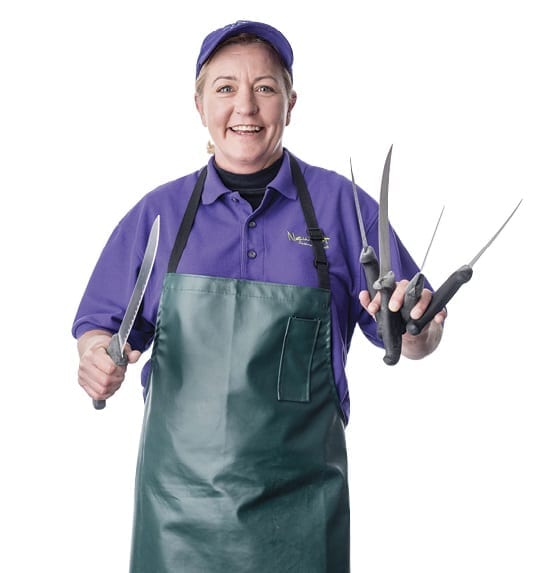
Johanna Wallace, a butcher for twenty-five years, recently took over as the head butcher at Bend’s Newport Market.
Written by Cathy Carroll
Craft butchery has been a top trend in the food world recently, with boutique butcher shops opening in cities such as New York, New Orleans and San Francisco. The latest trend within that trend is female butchers breaking through the well-marbled ceiling. When Bend’s Newport Avenue Market hired Johanna Wallace to run the meat department, however, it was not kowtowing to trends.
Wallace has been a butcher for twenty-five years, having worked her way from the sawdusted ground-floor up. As with most male-dominated jobs, it wasn’t handed to her on a silver platter. She’d been working at the seafood counter at Ray’s Food Place in Brookings, and less experienced men were being promoted to meat-cutting ahead of her.
“I took the initiative and I’d go in on my own time to shadow them,” said Wallace, 49. “I’m 5-foot-3-inches tall … and I had to show them I could handle carrying big, long boxes of whole pork loins of ninety to 100 pounds.”
She learned most of the craft on the job, and moved on, working at Ray’s and Albertsons grocery stores around Central Oregon. At the end of 2015, when Newport Avenue Market was looking for a new manager for its meat department, one of its meat cutters who’d previously worked with Wallace recommended her.
“When someone recommends a person who would be their future boss, that means a lot,” said Randy Yochum, Newport’s director of fresh food.
The biggest question wasn’t one of gender. Rather, it was whether Wallace could successfully transition from a corporate environment to an independent, employee-owned market catering to discerning tastes.
Wallace has embraced her new autonomy. She works with her five-member team to decide what dishes to offer as samples, and she knows the origins of her products. Last spring, she traveled with staff to visit McCormack’s Ranch in Brothers, the fourth-generation family ranch that supplies lean, antibiotic- and hormone-free meat through the Country Natural Beef cooperative. She observed the care given to the cows, the seven types of grasses they eat and the restoration of trout habitat on the ranch’s Bear Creek.
This all prepares Wallace to fulfill the level of service her job requires. Being a woman butcher may be gaining cache as a modern development, but it is not anything new in Wallace’s family. Wallace is the youngest of eleven children, and, at one point, she and six of her sisters were working in the meat industry—despite the fact that their mother was a vegetarian.
Although Wallace has been a role model to her 18-year-old daughter, she doesn’t expect her child will follow in her footsteps. She wants to be a vegetarian, like her grandmother.
“It’s killing me,” said Wallace.
Sex trade survivors form the backbone of an international fashion collaboration based in Bend.
INTERVIEW BY KELLY KEARSLEY
At first glance, you might assume that Shannon Keith’s mission is to sell exotic pajama pants to women and girls. But the founder of the Bend-based e-commerce company Sudara has a much loftier goal: to free women who have been victims of India’s sex slave trade. The fashionable pajama pants, known as Punjammies, are proving to be just the means.
The social enterprise company, which just relocated its headquarters to Bend last year, employs about a dozen people stateside. Keith, however, is most proud that over the past eleven years, her nonprofit turned social enterprise has also employed more than 300 Indian women, giving them the economic means to leave broth-els and provide for themselves and their families.
We sat down with Keith to learn more about Sudara’s beginnings, the jobs it creates and the significance of its transition to a B Corporation.
What prompted you to start Sudara?
I had visited India as part of a service project with our church in 2004 to help orphans, and went back the following year to dedicate a freshwater well as a gift to my in-laws. The well happened to be in the Red Light District, and I started to meet women and children who were modern day slaves. There were young girls who had been sold in the sex trade, young women who were trying to feed their families and orphans with no other option.
Through that experience my heart swelled and broke at the same time. I realized that while they needed a lot of services, at the most basic level what these women needed was a job so that they didn’t have to sell their bodies. I started Sudara as a nonprofit that year.
Can you explain how Sudara’s job creation works?
We work with nonprofit partners in India to identify sex trade survivors as well as girls who may be at the highest risk. For instance, a young girl whose parents may have died or girls who have grown up in brothels and are getting ready to work. We then work with Indian partners who have sewing and vocational training programs, where women can come to learn to sew our products as well as receive other services. We pay them a living wage that is twice as high as the fair trade baseline.
How did you land on pajamas as your first product?
I knew that if I could sell something that the women could make, then we could have some sustainable job creation. India has beautiful, high-quality textiles, and a pajama-style pant is simple and something that the women can succeed at. For consumers, we are slow fashion, which means we want to create good quality products that will last, and not turnover in a few months.
You transitioned to a for-profit, B Corporation in 2015. What prompted that decision?
The nonprofit form became a hindrance to our growth; and the more we grow, the more women we can offer jobs. A business is a tool to create jobs—that’s what they’re set up to do. Also with my background in sales, that’s where I’m more comfortable. By becoming a registered B Corp, we preserve our nonprofit values and set ourselves up to scale. It’s a way to say that we’re committed to aligning our business and values with our operations. I also think it’s a great litmus test for people. We’re transparent with how we do everything, and people can look at us and see that our business truly reflects our values and heart.
You moved to Bend in 2006, and brought Sudara here last year. What drew you here?
Yes, I moved to Bend when the nonprofit was still in California. My husband and I had visited and thought about retiring here, but we realized that we didn’t need to wait until retirement to build the life we wanted. After we transitioned Sudara to a business, then I became CEO and Oregon was a great fit. Oregonians are more socially conscious as a group, and the entrepreneurial spirit here is robust and very collaborative.
Longtime Bend resident Erika Kightlinger, who has a honey and honey bee business, is one of the “water protectors” who spent months working to block the Dakota Access Pipeline (DAPL). She was one of many Central Oregonians who donated money or other resources to the protest encampment on the Standing Rock Sioux Reservation in North Dakota. Kightlinger raised more than $130,000 in resources and helped construct and deliver 70,000 pounds of supplies. She told Bend Magazine a bit about the cause and her experience supporting it.
Starting in September you spent four months as an active protector, organizing and implementing supply deliveries. How did this role come about?
While participating in a Native American church ceremony I was shown that I was to take woodstoves to Standing Rock. My helpers and I worked directly with the stove crew on the ground at Standing Rock and all three onsite camps to deliver the supplies that were needed. We transported more than 70,000 pounds of supplies during five trips between Bend and Standing Rock. We transported 131 wood stoves, 119 tipis, and 150 cords of wood, in addition to thousands of pounds of food and gear for the water protectors. We raised more than $30,000 to fund the efforts, plus more than $100,000 of in-kind donations.
What was the primary purpose of the encampment at Standing Rock Reservation?
To protect the Missouri River and the surrounding water sources for the [up to] eighteen million people—plus the animal and plant life—who depend on these water sources. The goal was to stop the Dakota Access Pipeline from being built, due to the high probability of an oil spill.
How did you see people mobilize for the cause?
Everything I accomplished was due to others helping. I couldn’t have done it alone. Many people in Central Oregon donated time, funds, support, food, and clothing and helped build the stoves. It took all of us stepping up to help. That is progress! That is a movement! United, people came from more than three hundred indigenous North American tribes. People came from across the globe, working for the earth to keep the water safe for all people and the next seven generations. We stepped up to demand change.
Given the federal government’s recent decision to grant the final pipeline easement, what is the general reaction within your network?
There are many layers to the movement. We made progress at the level of awareness, helping people to see that they are powerful when united. They can step up, work together and divest from systems and companies that do not support humans, health and life more than profit.
Partners in Care wants to educate the Central Oregon community about end-of-life care.
“We’re trying to make the community aware of all the things Partners in Care can do and to get rid of the mystique of dying.”
From Madras to Christmas Valley, Partners in Care provides hospice care to people all over the region. With 60 percent of the tri-county area’s population over 65 years old—that’s more than 45 percent higher than the national average, according to the last U.S. census—the organization has its fill of requests for care.
“We’ve emerged into a regional leader because we’re the oldest and probably the most experienced, and we have welcomed that,” said President and CEO Eric Alexander.
The hospice service began in 1979 when a group of nurses started volunteering their time and services to provide end-of-life care. It was the first organization of its kind in the state.
Today, the nonprofit provides in-home hospice and palliative care to about 100 people a day. The main campus at Partners in Care includes a specialty hospital with six
suites for patients who need care that can’t be provided at home.
“It’s a real active form of compassion,” said Marlene Carlson, the director of development. “When you come onto our service, you have a whole team available to you.” This patient-centered care practice aims to provide an authentic sense of presence for patients and their families.
Partners in Care’s mission extends to more than just end of life care. It also encompasses a community education component that includes a camp for children who have experienced loss.
“Our vision is to make sure that people are aware of end of life issues,” said Alexander. “Aware of the issues of aging as people grow older and approach the end of their lives and really be mindful and how to plan for those things instead of it being a sudden shock.”
LINDA COHEN VOLUNTEER
Linda Cohen, often along with her service dog, Zultan, has been a volunteer with Partners in Care for nine years. She visits patients and their families, giving companionship and comfort to them while they work with Partners in Care. Cohen is also on the board of Friends of Hospice, an education and awareness organization under Partners in Care. “We’re trying to make the community aware of all the things Partners in Care can do and to get rid of the mystique of dying,” she said.
Get Involved
ABOUT PARTNERS IN CARE:
Partners in Care is a nonprofit organization that provides hospice care and services to Central Oregon. Learn more at partnersbend.org
BY THE NUMBERS:
Operates three branches in Bend, Redmond and La Pine
Provides a specialty hospital in Bend with six suites
One of four hospice houses of its kind in Oregon
HOW YOU CAN HELP:
Individuals and businesses can donate money that supports the care and services. Volunteer opportunities range from spending time with patients to educating the community on hospice care.
Recharge Sport is a new athletic recovery lounge in Bend’s Old Mill District.
Written by Cathy Carroll | Photography by Alex Jordan
It’s common to associate Olympians and elite athletes with the notion of using high-tech equipment and sophisticated techniques to recover from workouts. In Bend, however, everyday athletes as well as those striving to get back into shape are discovering that these methods can help them, too. Austin Baillie, a recovery specialist, trainer and massage therapist at Recharge athletic recovery lounge in Bend, said a range of people are increasingly tapping into the professional athletic recovery methods they offer. Baillie co-owns Recharge with, Renee Metivier, a professional distance runner and personal trainer. They created Recharge after living at the Olympic Training Center in Colorado Springs, where they realized that recovery is a crucial and often overlooked component of fitness.
The lounge in the Old Mill District is in some ways like a traditional gym, offering training and fitness classes, but with much of roughly 4,000 square feet devoted to massage, acupuncture and a spacious lounge with innovative recovery tools such as an infrared sauna, ice compression wraps, massage boots and sleeves, cold and hot tubs and cold lasers for electrical stimulation of muscles. These things can be used for recovering from injury, preventing the risk of future setbacks or increasing training potential.
Although these methods may be new to the general public, they have been around for a decade or two, said Baillie, adding that doctors have the technology to force blood flow to vital organs of their patients. “It takes a while for these things to move from the medical, military, and tech community to professional sports, then to college athletes and down to weekend warriors, as they become more accessible and affordable,” he said.
At Recharge, NormaTec leg boots, hip shorts and arm sleeves use a sequential pulse system for external compression aimed at speeding the athletic recovery process. The sleeves mimic muscle pump and push out inflammation, old blood and lactic acid. “It feels like you’re getting a massage with big gorilla hands,” said Baillie.
He likened the therapy to a road crew after a crash, “It’s clearing the debris so that workers, supplies and fuel trucks can get in to repair.” Clearing out the metabolic waste helps alleviate muscle soreness and helps the body heal exercise-induced micro tears in muscle fibers.
On a recent Friday morning, people ranging in age from 20- to 60-something came through the lounge. Several relaxed in spacious, comfortable recliners while watching big wave surfing on a large flat-screen as the compression equipment went to work on them. Nearby, a couple of people sweated in the infrared sauna, which heats the muscles three inches deep to stimulate the immune system.
Amid it all, there was nary a sense of elitism. “Everybody with a body is an athlete,” said Baillie. “It’s about acknowledging that you have a body and it’s a huge gift, and there’s a responsibility to take care of it.”
Expert Advice
An Ounce of Prevention Austin Baillie—a recovery specialist, trainer and massage therapist at Recharge athletic recovery lounge in Bend—offered these easy recovery tips:
PREVENTATIVE MAINTENANCE
Do a simple, preventative maintenance routine, which can enhance recovery. Two times—or at least one time—a day, do a routine of squats, lunges, jumping jacks and push-ups (ten each), plus a plank for core strength. It’s old-school, Jack Lalanne stuff, and that’s why he stayed so healthy for so long.
HYDRATE
Stay ahead of thirst. The body is mostly water and the more you have, the more your body can eliminate waste. It helps with digestion, stress and sleep. It’s like the oil of a car.
SELF-MASSAGE
Do self-massage with a foam roller. Or, have a massage therapist do gua sha, (a Chinese technique of scraping the skin). You can also use your own thumbs or have a partner use their thumbs to do this, moving muscles away from the bone and loosening scar tissue
Marijuana has gone mainstream in Central Oregon, and savvy entrepreneurs are cashing in on a fast-growing industry.
WRITTEN BY DAVE SEMINARA
PHOTOS BY RYAN CLEARY AND ADAM MCKIBBEN
In the November 2016 election, the biggest winner wasn’t Donald Trump or even the Republican Party—it was good old Mary Jane. And she won big. Voters in California, Massachusetts, Maine and Nevada approved recreational marijuana initiatives. Measures to legalize medicinal marijuana passed in Florida, North Dakota and Arkansas. Voters in Montana voted to roll back restrictions on medical marijuana use. A proposal to legalize possession and consumption of marijuana in Arizona, which failed by two percent, was the lone defeat for a product that’s clearly been on a roll for the better part of the last decade. Newly pot friendly states joined a party started by Colorado, Washington state and Oregon voters who had already shredded marijuana laws and turned America’s clandestine cash crop into a main street cash cow.
Beau Whitney, a Portland-based economist, has estimated that the legal and illicit cannabis industry in Oregon will have a total market sales of $750 million in 2017, with an overall economic impact of $3 billion. Recreational marijuana sales, which have been legal in the state since July 1, 2015, come with a 17 percent sales tax, and voters in the City of Bend approved an additional 3 percent tax on sales within the city limits. (There is no sales tax imposed on medical marijuana.) The Oregon Department of Revenue said that the marijuana tax generated $54.5 million in revenue from January 1, 2016 through November 30, close to $5 million per month.
The money continues to roll in. Early indicators show that 2017 should be another strong year for marijuana sales in the state. We talked to a host of local marijuana entrepreneurs about the past, present and future of an industry that has taken Oregon by storm.
The Boutique approach
Oregonians no longer need to speak in code or meet dealers in dark alleys to buy cannabis. But while the industry is booming in Central Oregon, it still exists in a kind of limbo—embraced by many, but still shunned by banks and in some corners of polite society.
David Ordonez said that he and his wife, Serena, had to max out credit cards to start their cannabis retail business because no bank would give them a loan.
“We get doctors, lawyers, some of the most important professional people in the city are our customers,” said Ordonez. “But some of them still park around the corner because they don’t want to be seen coming in or out of our shop.”
I visited Top Shelf Medicine, Ordonez’s recreational and medical dispensary, on a mild, clear Tuesday morning in December, six days after a snowstorm coated the city streets with a foot of snow. If some of Top Shelf’s customers feel the need for discretion, it isn’t based on the store’s exterior, which betrays no hint of what they sell, just an illuminated sign featuring three prominent red crosses and a caduceus—a symbol from Greek mythology that is used to represent the medical profession.
Inside the waiting room were white leather couches that wouldn’t look out of place in a posh Danish furniture store, warm mood lighting and an artificial Christmas tree with wrapped presents that presented a balmy contrast to the wintry scene outside. Save for the state-mandated bilingual warning signs on the door, the vibe is more high-end Beverly Hills plastic surgery clinic than Central Oregon weed purveyor, and this is exactly as Ordonez prefers.
“Every Tom, Dick, and Harry is growing pot nowadays, but we’re trying to be the Nordstrom of the industry,” he said as I complied with state law by signing in and placing a visitor’s badge around my neck.
Ordonez led me into their cannabis showroom, which has security cameras, motion detectors, bars on the windows and Christmas stockings next to the cash register. All the weed, the edibles, the pipes, and accessories save for the shop’s own swag and a fridge full of cannabis edibles are kept behind well-polished glass counters.
Jars of cannabis—including strains such as Gorilla Glue, Girl Scout Cookies and his own creation, Jenke Kush, which Ordonez said won a High Timesmagazine award—are on display behind the counter, along with their THC (tetrahydrocannabinol) and CBD (cannabidiol) scores. (THC essentially signifies potency, while those in search of pain relief look for a high CBD score.)
Regular customers Natasha Newby and her fiancé, Ray Atkinson Jr., both of Bend, said they typically looked for high CBD score strains, which helps her cope with fibromyalgia, and gives him relief from the rheumatoid arthritis that is at times debilitating.
Atkinson, who is in the process of trying to qualify for disability, said that before cannabis was legal, he had to buy from dealers he met on the street.
Ordonez said that a big chunk of his customers are people like them: technically recreational users but ones who could qualify for medical cards if the cost and red tape were less prohibitive. For him, bringing customers like Atkinson and Newby out of the shadows and into a safe, regulated retail environment is a reward that makes all the hassles and frustrations of running a marijuana business worthwhile.
Now that all Oregonians have a right to access to marijuana for recreational and medical purposes, Ordonez said, “I want to be the guy who sells them the very best stuff.”
The Next Generation Farmers
When Jocelyn Anderson quit her job as the principal of a K-8 charter school in Chico, she declined to mention that she was planning to open a farm-to-table cannabis business in Bend. When her husband, Andrew—a fifth generation farmer who had specialized in growing almonds, walnuts and rice—broke the news to his grandparents that he was shifting to cannabis, they weren’t exactly encouraging.
“Their generation lived through the reefer madness era—they were misinformed,” Andrew, 30, said. “But once we educated them, told them it was legal, they started to understand.”
Nearly two years after the Andersons took the plunge into the marijuana industry, by purchasing a forty-five-acre farm in Alfalfa, they no longer worry about what people think of their new vocation. Her colleagues are mostly supportive, his grandparents have come around, and most of their friends are impressed by and envious of their new career. Business is good—their Plantae Health dispensary opened in Prineville in July 2015, they expanded to Madras three months later and their third location, a new retail outlet on the east side of Bend, opened in January.
But they’ve also discovered that running a cannabis business presents a unique set of challenges. The couple, who met on a blind date at an Italian restaurant in 2010, said that the staggering startup costs, the ever-changing regulations and the local politics surrounding marijuana make producing cannabis a lot more complex than the traditional crops they used to grow in California.
With the end of the transitional recreational marijuana phase on December 31, consumers can now buy one ounce of cannabis—quadruple the previous daily limit of seven grams. The Andersons are optimistic that their investment and sweat equity will pay off in what could be a record-setting year for cannabis sales in Central Oregon.
On a blustery Saturday afternoon in January, Andrew, who handles the farming end of their partnership, looked the part as he inspected their new location prior to its grand opening. Dressed in a pair of work boots and overalls, with an oversized smartphone protruding from a breast pocket, Andrew also sounded a lot like any farmer who is passionate about his crop, and his right to grow and sell it.
As a former teacher and school principal, it’s come natural for Jocelyn to offer tours of their locations in order to educate locals and attempt to dispel misconceptions, such as the notion that one could get high inadvertently from living near someone’s cannabis greenhouse or that the plant’s roots contaminate the soil. Most people, she said, have been receptive to her message.
Nearly a year after they started these efforts, the Board of County Commissioners voted in August 2016 to repeal the “opt out” moratorium that prohibited marijuana-related businesses in rural Deschutes County. Andrew said that most of their neighbors in Alfalfa are farmers, so they’ve had fewer conflicts than growers in Tumalo, where cannabis farms are much closer to residential dwellings. He insists that the biggest problems facing the industry aren’t neighborly relations but rather over-regulation, licensing issues and the fact that banks won’t work with marijuana businesses.
Despite the obstacles, the Andersons think that the cannabis industry is slowly but surely gaining respect and acceptance in the region.
“Bend is built on breweries and cannabis,” said Andrew. “With our elevation, the water, the air quality, this is one of the best places in the country to grow [cannabis]. And it helps drive our economy.”
Jocelyn, 29, is thrilled to be part of a movement of young cannabis entrepreneurs striving to change how the public perceives the drug.
“We’re changing the image of this industry—turning it into something people perceive as legitimate and professional,” she said.
The connector
Kelly Martin is one of Central Oregon’s most innovative marijuana entrepreneurs, but you wouldn’t know it from walking into the office building he shares with four attorneys in southwest Bend. There are no Bob Marley or Grateful Dead tunes piped in from the ceiling, no patchouli incense wafting through the air and no dreadlocked interns preparing spliffs. Martin has a firm handshake and the build of a wrestling coach. On a wintry Friday morning in December, he was clean-shaven and his medium-length brown hair was neatly parted on the side.
“The stereotype of people in this industry being hippies is grounded in reality, but there are clean-cut types like me, too,” he said. “It’s becoming a business just like other businesses.”
Martin, a self-described “serial entrepreneur,” has a strong basis for comparison. Before founding Dakine 420, a Redmond-based marijuana fertilizer company, in 2013 and a website about all things cannabis called CannaFo in 2015, the Portland native tried his hand at a host of business ventures. He was a builder; he owned a landscaping company and a sporting goods store; he bought and sold cars; and for fourteen Christmas seasons he sold some of Central Oregon’s most beautiful trees to Hawaiians on the Big Island.
“Some trees fetched as much as $150,” he recalled. “I was like the Neiman Marcus of Christmas tree sellers.”
Martin also grew marijuana before it was legal and lost three years of his life behind bars as a consequence. Unlike his other business ventures, CannaFo is more personal. The website aims to connect people in a stigmatized industry, where sharing information and ideas in a transparent forum has been more of an exception than the norm.
“I want to be the Google of the cannabis industry, a resource, kind of like an encyclopedia,” he said.
Martin launched CannaFo in late 2015. It has 165,000 Facebook followers. The site’s CannaFo Connect feature is essentially a trade platform that allows producers, processors and retailers to connect. Producers can share photos, lab results and other data about their products, dispensaries can post their menus, and consumers can rate strains and retailers.
Subscriptions are free for at least ninety days, and the site now has more than 4,000 dispensaries listed. CannaFo is also a sort of clearinghouse of information, where consumers and industry experts alike can learn about different strains, growing techniques, industry news and more.
Clearly there’s money to be made in the industry—researchers have estimated that legal, domestic sales of marijuana in 2016 may have reached $7 billion—but Martin says the so-called “Green Rush” isn’t what motivates him. In prison, he lived among plenty of other non-violent marijuana offenders, and he’s passionate about changing the nation’s drug laws and the public perception of cannabis.
Even as an outspoken advocate for the decriminalization of pot, Martin recognizes that legalization has also taken a little of the cloak and dagger, countercultural appeal away from buying marijuana.
“I think some people do miss the old days,” he said, a smile creeping across his face. “How cool and rebellious is it to simply walk down to the store and buy your pot?”
A maverick scientist and a teenage ditch-digger once changed the course of Bend’s economy, while staying true to their roots.
It is 1974: Rod Ray is a 17-year-old, cooking at a former general store in Tumalo where loggers, mill workers and ranchers kick up their boots for a sarsaparilla, or something harder. The sign by the road simply reads: Eat.
He asks out the busgirl, Karen Lonsdale. This teen romance in Bend, a town of about 16,000 people and four stop lights, couldn’t seem more unremarkable, except that it would lay the groundwork for one of the most significant parts of Central Oregon’s business scene today.
The girl’s father, scientist Harry Lonsdale, had been doing biomedical research for a company in the Bay Area, and sought to flee the growing congestion to start his own company. He bootstrapped the endeavor with fellow chemist Richard Baker, with a plan to garner government research grants.
Ray, who was being raised by his single mother, naturally gravitated to the men. “For me, as a senior in high school, to have these mentors who were hatching a company out of Harry’s living room, while I was there to see my girlfriend, was really cool,” said Ray. “It gave me a view of what you can do. I was just basically really lucky.”
Rod Ray (left) on a backpacking trip in the Cascades with Bend Research co-founder Richard Baker. Trips like these helped to cement the company’s identity and Ray’s role.
Lonsdale and Baker built a headquarters that looked more like a ski chalet, with a plan to sell it as a house if the business didn’t pan out.
“I remember climbing Broken Top, just Harry and I, and he was talking about what the company would be like,” said Ray. “I talked him into giving me a job with the same salary as my cook job. I dug irrigation ditches, painted, built fences and took trips to town. I was the second employee besides the founders, them, me and a secretary doing some lab work. I couldn’t believe it. I was in some ways their mascot.”
Bend Research started operations on April, 1, 1975, with methods for getting drinking water from seawater and water pollution treatment. It was the first research company of its kind in Bend, a timber town amid a sea of sagebrush.
After graduating from Bend High School, Ray took a year to work, ski and take some classes at Central Oregon Community College in preparation for going to Oregon State University in Corvallis. His mother, Nancy Zahl, the head of the nursing program at COCC, worried that her son’s college career might get derailed. She needn’t have.
“What those two guys [Lonsdale and Baker] did was make it unacceptable to think about going to college for anything other than a technical subject,” said Ray. Ray’s father and grandfather were civil engineers. His first lessons in hard work and problem solving came from his grandfather, who took him along to help him on surveying work.
At OSU, Ray studied chemical engineering, a blend of his father’s and father-figures’ professions. During every school break, he’d work at the fledgling research company in Bend. He and Karen were no longer dating, but remained friends. The bond he’d formed with her dad and his business partner was much stronger.
“As I got close to my BA, they [Lonsdale and Baker] started working on me to go to graduate school,” Ray said. “I didn’t ever think of myself as Ph.D. material.” He applied his philosophy that hard work could compensate for most shortcomings, left Oregon for the first time for the University of Colorado, Boulder, earned a Master’s in chemical engineering and returned to Bend Research.
A photo from 1984 depicts Ray, with a thick, chestnut-brown mustache and side-combed hair, conferring with the company’s founder and two subsequent CEOs. Looking at it, Ray cites sheer luck. “I was 28, with a brand new Ph.D., and there I am helping them run this company,” he said. “I wasn’t that good. We just all had a good, close relationship. They were very trusting. It was magic, being part of that group at such a young age. It just doesn’t happen very often, and what it did was make me work really, really hard.”
Work Hard, Play Hard and Survive, Too
In the subsequent years, the company grew, securing scores of patents in a range of industries: natural gas and oil recovery, power plant emissions reduction, pheromone-based pest-control, home medical-oxygen concentrators, transdermal and controlled-release drug delivery systems, technology for NASA space stations—and even a way to make orange juice less bitter.
One client, pharmaceutical giant Pfizer, grew to dominate, offering the best and most profitable work, and by mid-1990s, Bend Research had an exclusive contract with them.
The company was thriving, based on values established by the founders and CEO Chris Babcock, said Ray. “The goal was always: Do the right thing in business; look for the win-win; don’t take advantage and hard work prevails. That’s how I was brought up in business and science. Truth in science. Keep talking. Keep working the problem until you and your colleagues feel you’ve reached the truth, the real scientific conclusion. Stay focused. Relentlessly get to the truth.”
To bolster that, the atmosphere had to be one in which it was safe to be wrong. “Risk must be ok,” said Ray. “Our clients really liked that we would be honest with them about what worked, what didn’t, and what mistakes we made. It’s in our values: integrity and honesty. We told clients what we meant by those values. We would keep them informed about how the science worked, and any positive or negative result, and not cover anything up, and clients really came to trust us.”
A core asset of the employee-owned, self-insured company was the people. Ray, a believer in the rejuvenating power of exercise, also knew the business benefits of having a fit staff, so he created a culture to promote that. At lunchtime, on the sprawling, roughly fifty-acre Tumalo campus, people would be playing ultimate frisbee, running, riding bikes, Nordic skiing, working out with trainer Kyle Will or doing yoga.
Ray’s wife, Lori, the company’s former corporate vice president, said, “R & D isn’t easy. You fail many more times than succeed, and creativity can’t be forced. Being active would give us all a reset. My afternoons were way more productive, and I’d often get great ideas while running which I couldn’t access at my desk.”
The ideas, bolstered by the truth-in-science mantra, came to fruition, with the company’s intellectual property stacking up to more than 100 patents. A major innovation was technology that allows certain drugs to be absorbed in the body, solving Pfizer’s dilemma of promising drugs that didn’t perform.
By 2008, Bend Research had 175 employees and annual sales of about $40 million with Pfizer as its sole client. In April, Ray became CEO. Two weeks later, New Jersey-based Pfizer called Ray to a meeting—the company wanted to continue working with Bend Research, but wanted to end its exclusivity agreement. Bend Research had a new imperative: survive.
Everything to Lose
Bend Research’s Pfizer revenue was slated to drop during the next eighteen months, from about $35 million to $8 million by 2010. “So my first act as CEO was firing about 25 percent of my pals, which was really fun,” Ray said with sarcasm. He cut the staff from 175 to 135.
Ray and core team members embarked on a gauntlet of business trips, pitching prospective clients and feeling a keen awareness of his tone and body language. “It had to be positive,” he said. “Our goal was to get them to visit us. If they toured our facility, that would make the sell for us. My job was just to get them here. It was up to us to tell the story.”
It involved Lori and General Counsel Bruce DeKock, too. “It would be me and Bruce across the table from five blue suits with collectively twenty times my experience,” said Lori. “We were all operating up against our limits. Everyone in the company was doing things they’d never done before.”
Ray signed the Pfizer deal that ended exclusivity on September 30, 2008, the day his granddaughter was born and just as the stock market and Bend economy were crashing. Pfizer still wanted Bend Research to thrive, giving it the roughly 100 technology patents the Bend company had developed for them and a share in royalties.
Bend’s economy was floundering by January 2009, and Bend Research’s annual holiday party approached. Ray knew that what he would say that night was critically important for morale. “I was scared to death, although I never showed it, that I know of,” he said. “It was my chance to pull the company together and aim it toward the next vision.”
Ray stood in front of the crowd, wearing a white shirt, bolo tie and black cowboy hat, a more formal version of his usual Western attire, this time with notes in hand, a rarity for him. The nervous energy in the room was palpable. He promised to speak for only as long as it took for a young woman staffer in the front row to finish her beer. He said:
“You guys are going to walk out on your porch and one of your neighbors is going to have lost their house. It’s not going to happen to us. We’re going to win.”
One advantage was that the pharmaceutical industry was faring well, and it became easier to hire workers and keep them. “Our [employees] didn’t want to leave, no matter what happened,” said Ray. “Those early few months were the most intense leadership experience I have ever had.”
As they approached their goal of bringing in about $32 million in sales by 2010, Ray knew the company had weathered the storm. By the end of 2012, sales were on track toward a goal of about $60 million. The next logical step would be to build a commercial manufacturing facility. To raise the capital to do that, Ray began to think about selling, but it went against the company’s strategic plan, and flew in the face of Lonsdale’s vision. “He didn’t found it to sell it, he founded it to be in Bend forever,” Ray said of Lonsdale.He didn’t need to have his mentor’s approval, but he wanted it.
He did a strategic analysis of other options, but concluded that selling part of the company or taking on more debt weren’t the answers. “It’s one thing when you think you’re not going to make it, but it’s another when you think you have something to lose, so I was getting pretty skittish,” said Ray. “We had this great brand, and we were seeing a lot of new competitors—companies that could copy what we did, but not develop what we could.”
Ray wrestled with the idea of selling. Every month, he had routinely gotten together with a trusted group of ten local business leaders. The informal gatherings allowed the opportunity to talk, knowing that everything was strictly confidential. Ray brought his dilemma to his coterie of confidants—how will Bend perceiveus if we sell? Ray said he was surprised by the response: The town will trust you; they will trust that you’re doing the right thing. “That key input from my hometown mattered a lot,” he said.
The company’s board of directors got behind him and the idea of a sale bringing a $25 million commercial manufacturing plant to Bend. In 2013, global pharmaceutical company Capsugel came with an offer. Ray had four criteria. “Price was last,” he said. The top priority was opportunities for the employees, followed by capital to build the commercial manufacturing plant and for the business to stay and grow in Bend. Capsugel agreed, and while not disclosing the selling price, Ray called it “very fair.” In another twist that speaks to the grow or die mentality of the industry, Capsugel was itself acquired earlier this year by a Swiss-based firm, a move that is not expected to impact the relationship between Bend Research and Capsugel or to affect Bend Research’s workforce locally.
The Roots of an Economic Ecosystem
Today, Bend Research, a division of Capsugel, has more than 250 employees and six state-of-the-art facilities in Bend. Its economic impact, however, extends well beyond that business, having paved the way for the high-tech ecosystem. Companies that followed Bend Research included Orcom in 1976, Advanced Power Technology (now Microsemi) in 1984 and Grace Bio Labs in 1986. “Bend Research was a turning point, in many ways, for Bend developing what it would be after wood products,” said Roger Lee, executive director of Economic Development for Central Oregon.
The company has attracted engineers, chemists and Ph.D. scientists, and was the source of five direct local spinoff companies: IdaTech, VR Analytical, Agere Pharmaceuticals (now part of North Carolina-based Patheon), Green Ridge Consulting and Amplion. Of the area’s roughly twenty-five local biotech companies, about a dozen startups can be traced to Bend Research, said Dino Vendetti, general partner of Seven Peaks Ventures in Bend.
Ray’s support of OSU-Cascades amplifies the synergy that he and Bend Research have had within the region. He’d always sought to hire qualified people from Bend and the new university aids that. “You’re organically developing a talent pool,” said Vendetti. “You can only recruit so many from elsewhere in an economic cycle. Local companies need to hire local talent to fuel growth of those companies.”
One example of the ripple effect includes the Oregon Translational Research and Development Institute Bioscience Incubator’s plan to expand to Bend, in collaboration with OSU-Cascades. “That’s the beginnings of critical mass and it started with Bend Research,” said Vendetti. “It took a crazy entrepreneur like Harry to build it in Bend, and look what it led to. It takes early visionaries to blaze the trail that other entrepreneurs will follow.”
Not Run-of-the-Mill Values
This past fall, Ray sat in a conference room at the new OSU-Cascades campus. The room is named for him and Lori, longtime advocates and donors to the effort for Bend’s first four-year university. He was meeting individually with some of the leaders of small businesses in Central Oregon enrolled in his six-session seminar, The Principles of Leadership, offered through Opportunity Knocks, a local nonprofit which helps steer area businesses toward success. In the seminar, Ray details what he learned during his twenty years as president and CEO of Bend Research, applying it to the participants’ businesses, from healthcare, digital marketing and banking to garbage removal.
“This town was really good to me as a kid…and I’m in a position now to try and make it better,” he said. “I decided to go out to companies and find out about them from the ground up as opposed to the top down. I’m more of a ditch-digger. It’s my nature to go in one-on-one with as many organizations as I can, and ask…‘Can I help?’”
He’s collaborated with the City of Bend and St. Charles Medical Center, where his daughter, Mary, is a nurse in the intensive care unit, something that would have deeply satisfied his late mother, he said.
In the first session of Ray’s seminar, he covers business principles and values. He recalls how, when he was 11 years old, his mother would drop him off at Green Mindt Market (now Newport Market) on her way to work at COCC on Saturday mornings. He’d have his .22 rifle with him, hunting rabbits on the wooded, undeveloped butte for half the day, as he made his way to meet up with her on campus. The guys who took him hunting and fishing would later have COCC buildings named after them (Fred Boyle, longtime COCC president, and Orde Pinckney, a professor and theater advocate). Local firemen took him skiing. “In a logging town, it was unusual to have a single mother, much less a professional single mother, so the community sort of wrapped itself around us,” said Ray.
Not every small town in America might have done that, but Bend was different. “Everyone was working at the mill; they were one big team,” said Kirk Schueler, president and CEO of Brooks Resources, a Bend real estate development firm that began as a lumber company. “If you were not at the mill, your business and life were somehow tied to the mill, serving meals or selling supplies to the mill. Everyone knew they were connected…Rod lived it, and still lives that.”
Today, as Ray guides others in leadership and creating meaningful work cultures, he emphasizes that “place” is as vital as vision, values, practices, people and narrative. For Ray, it was the Bend of his youth that shaped him and, by extension, his company. The people from that era truly have a shared set of values, he said. “You can count on them.”
Driving along Central Oregon’s rural highways, fields of golden wheat or green alfalfa are a common sight. So the spots of purple, in perfect lines, that appear between Culver and Madras can’t help but catch your attention. And if the sight doesn’t do it, the aroma will.
The purple oasis is Cascade Lavender, an organic lavender farm owned and run by Terry and Wayne Pearson and their daughter, Holly.
Terry and Wayne had no farming experience when they purchased the property in 2007. “This was a brand new adventure,” said Terry. “That’s what’s great about retirement. Sometimes it’s overwhelming—where am I going to live if I could live anywhere? What am I going to do? The nice thing is that you have the opportunity to reinvent yourself.”
Photo courtesy of Cascade Lavender
Reinvent themselves they did, becoming lavender experts and learning how to run a successful agritourism farm in the High Desert.
“They are the perfect partnership, mom and dad,” said Holly. “She’s got this wonderful vision, and my father is the hardest working man I know.”
Together, the family transformed the property, digging the irrigation and rebuilding the house and barn. The farm has three acres with hundreds of varieties of lavender, as well as horses, alpacas and chickens running around the forty-acre property that backs up to an unobstructed view of the Cascade Mountain Range. The Pearsons also created a line of products made from the lavender, including essential oil, lotion, bath salts, culinary lavender and more.
The work, from watering the plants and hand cutting the lavender to distilling the oil and making the products, is all done by the family. Like the lavender itself, the work is therapeutic, they said.
“I wouldn’t do all this just to raise a beautiful flower,” said Terry. “It’s because it’s such a beneficial, useful plant that really motivates me, and [it] makes me happy to share that with others.”
Photo courtesy of Cascade Lavender
In the arid, warm climate of Central Oregon, lavender has an early growing season. The plants are in full bloom in June and July and are harvested by August. At the peak of bloom in late June, the farm hosts an annual lavender festival for the community.
Though the plants are only in full bloom for a short time, the fragrance lingers year-round thanks to the dried lavender scattered throughout the property. Especially when they are distilling the lavender to make the farm’s signature oil, the aroma can reach neighbors a mile away.
Whether hitting the trails or the town, Sisters has plenty to offer, including world-class singletrack, road bike routes, dining and entertainment.
Written by Cathy Carroll
The trails that Native Americans made as they gathered huckleberries, fished and hunted were followed by fur trappers and explorers before becoming settlers’ wagon roads through forests surrounded by the Three Sisters peaks. When the first post office was to be established here in 1888, it was to be named for those mountains, but postal officials went with, simply, Sisters. In this spot where the McKenzie and Santiam roads meet, itinerant sheep men passed through for sustenance and supplies en route to grazing pastures in the Cascades. It later thrived as a timber town until 1963, when the last mill was shut down.
Today, the spirit of its history remains, with the old West-style down-town façades, and the same mountain vistas and towering pine trees that call for breathing deeply the forest-scented air. Spring is a great time to soak it in, before the peak season kicks off with annual traditions—the Sisters Rodeo in June, followed by the Sisters Outdoor Quilt Show in the second weekend of July. An entrenched community of artists and outdoor enthusiasts mingle with small-town friendliness to form the atmosphere. Don’t be surprised when you’re walking into a local brewery on a busy Friday night and the person behind you says, “Howdy—we can share a table if you like.”
The slower pace and open spaces inspire a range of artists, especially folk musicians and singer-songwriters. The Sisters Folk Festival, held every year on the first weekend of September, is the apex of this folksy spirit. Not to worry, live music is easy to find year-round at intimate venues such as Angeline’s Bakery and Café or at The Belfry, a performance space created in a 100-year-old church. Picturesque trails and quiet, country roads beckon, too. Trails begin just six blocks from the downtown streets lined with galleries, shops and restaurants. At just a fraction of the size of Bend, Sisters offers the pleasurable option of being car-free and carefree, inviting the calm that comes with exploring on foot, as did its earliest residents.
Photo by Christopher Boswell
eat
Photo by Alex Jordan
Cottonwood CaféPacific Northwest and traditional breakfast fare served in a quaint, family-friendly cottage and backyard with a fire pit and heaters. Well-behaved pups are welcome on the patio, too. Sisters Meat and Smokehouse Grass-fed, hormone- and antibiotic-free Oregon meats, cheeses, and a knowledgeable staff that can offer advice on how best to prepare their ingredients. Serving sandwiches, wine and beer. Cascade Street Distillery Family-run, small-batch distillers of bourbon, gin and vodka. Latigo Fine dining inspired by ingredients from the ranches and farms of the Pacific Northwest.
Photo by Alex Jordan
stay
FivePine Lodge & Spa The main lodge blends modern and rustic architecture, incorporating the design elements of historic forestry stations. A thirty-foot rock fireplace is at the center of the lounge with eight suites. Twenty-four modern, craftsman-style cabins wind through a sprawling pine forest. Shibui Spa taps Asian elements to create a serene atmosphere. Relaxation rooms have fireplaces, and a thermal soaking tub is adjacent to a private sun deck. The FivePine “campus” includes a conference center, Three Creeks Brewery, Sisters Movie House and Sisters Athletic Club.
Photo by Benjamin Edwards
Sisters Bunkhouse An intimate inn with four rooms, each with a queen bed and private bathroom, and innkeepers who strive to offer exceptional service.
arts
For live music, check out Angeline’s Bakery and Cafe or The Belfry. Looking to kick up some dust with a more raucous crowd? Try Hardtails, a “biker” bar that doesn’t require patches and hosts plenty of live rock and roll bands.
Photo by Talia Galvin
Galleries throughout Sisters stay open from 4 p.m. to 7 p.m. every Fourth Friday for the Sisters Arts Stroll. Each month, galleries feature artists, serve light refreshments and sometimes host live music.
play
HoodooSpring skiing typically lasts until mid-April at this uncrowded, affordable, family-friendly ski resort with three high-speed quad lifts, thirty-two runs, and 806 skiable and rideable acres.
Photo by Benjamin Edwards
Biking Once the snow melts, excellent singletrack for mountain biking abounds, along with premier road biking. Eurosports offers free maps and information about nearby trails and scenic road rides for all abilities. The Peterson Ridge trail system has more than twenty-five miles of singletrack that begins a few short blocks from downtown. The Sisters Stampede mountain bike race on May 28 is Oregon’s biggest mountain bike race with 500 participants tackling the Peterson Ridge trail system. It begins and ends at FivePine Lodge.
Other rides, flat to rolling, range from the fifteen-mile Indian Ford Loop to a fifty-mile jaunt around Camp Sherman. For an epic climb, the thirty-mile McKenzie Pass ride is a state jewel. Climb 2,000 feet through ponderosa pine forests, follow an 1860s wagon road and emerge above the tree line to reveal a staggering view of Mt. Washington and a 2,000-year-old lava flow. This ride runs along state Highway 242, which is on the National Register of Historic Places. The pass is closed during winter, but the state Department of Transportation briefly opens the pass only to cyclists for a short but glorious window after they plow the roads in spring. Check tripcheck.com or rideoregonride.com for updates.
The mere mention of instant coffee elicits strident reactions from many coffee drinkers. Caffeine connoisseurs tend to believe that great instant coffee is a contradiction in terms. Out to prove the naysayers wrong, Bend entrepreneur and self-proclaimed coffee geek Kent Sheridan has developed Voilà Coffee using his proprietary freeze dry production method.
“We’re inventing a new way of brewing coffee that doesn’t compromise taste,” said Sheridan. “Voilà has a low barrier to entry for people looking to expand their palate and find what types of roasts they like, but we also cater to the seasoned coffee drinker because everyone is on the go these days.”
Sheridan and his business partner, Nick Holmboe, source beans from top roasters such as Portland’s Upper Left Roasters. They purchase overstock coffee at a discount when it’s two weeks off-roast, just before the sell-by date. Voilà can brew large batches in a day, turning soon-to-expire roasts into a crystal form that has a significantly longer shelf life.
Coffee servings comes as a five-packet set in flip top boxes reminiscent of a cigarette pack. The packaging play is both humorous and functional. Committed to transparency from farm to consumer, Voilà prints the roaster and its location on every label. This may sound obvious, but “you would be appalled at how other instant coffee is made and sourced,” said Sheridan.
The company came out with a bang last fall with a fully funded Kickstarter campaign. Order fulfillment for backers came in March after some production delays due to continued testing and adjustments on the new equipment that was needed to bring production to scale. Now, Voilà is taking one-time and subscription-based orders through its website, where customers can pick the notes they would like to see in their coffee: Structured, Complex or Lively. The coffee is also available at the cafés of their roasters.
Sheridan said the product has been well-received so far. He is working with tastemakers to spread the instant coffee gospel as he seeks an investor who can “help us take the company to the next level.” voila.coffee
Tosch Roy puts a lot of thought into the backpacks he makes—and not just in the product development sense. Roy openly wonders if his business, Free Range Equipment, and his work are essential, or if he’s just producing one more product in an oversaturated outdoor gear market.
It’s a lot of weight on the shoulders of a 26-year-old.
“One of the biggest hurdles for me is that, at the end of the day, you’re manufacturing a new product for people who don’t really need it,” Roy said from his studio in Bend’s Maker District. “That’s been really hard for me.”
For now, he’s staying the course and letting consumers decide whether his Free Range packs are more than just another sack.
“I realized that there are things that you can’t stop doing even if you try, and those are the things that keep coming up in your life. For me, I love creating stuff, I like making things more efficient and I love being outside,” said Roy. “This was a really good match for me, because it brought all those together.”
Free Range started out of necessity. Roy, then 20 and in college in Montana, needed a skimo (ski-mountaineering) pack for a backcountry race. Not willing to shell out the money to buy a new pack, he designed and made one himself. Soon, he started making them for friends. Within a year, he decided to leave school to pursue the business full time.
Six years later, he’s created a range of packs for climbers and backcountry skiers and brought his sister onto the small team. Roy designs the packs, and works with a local production sewer to manufacture each product. Each pack is made to order.
Instead of letting himself get burnt out on the constant work needed to make a startup successful, he’s finding a way to make the work inspiring to him again. Partnering with local artists, he’s created a line of urban commuter backpacks featuring local artwork. “It gives me a lot of motivation in that it’s hopefully helping other people, or helping these artists,” said Roy. The packs will be available to order in April. freerangeequipment.com
To walk into Kimberly Kinney’s two-car garage turned sewing shop is to experience the antithesis of America’s disposable culture. Outside, a string of Tibetan prayer flags greets visitors along with a modest sign for her business, Rugged Thread. Inside, racks of coats, ski jackets, pants and other pieces of gear flank a cluster of sewing stations, each of which is centered around a mid-twentieth century cast iron sewing machine. These are little relics of the era’s industrial engineering, and bear more resemblance to the streamlined fenders of a 1953 Buick Skylark than to the plastic contraption my mother occasionally trotted out to the dining room table. The machines are the engine of Kinney’s burgeoning gear repair business that she runs out of her Westside Bend home with one part-time employee and another on-call resource.
In a town that is obsessed with outdoor gear, Kinney is the gear equivalent of country doctor and emergency room surgeon rolled into one. Her specialty is zippers, that critical but often prone to failure wonder of industrial technology that has cut short the life of many a tent and jacket. But zippers are just the beginning: Kinney also works on any piece of fabric you can find in the outdoors, including sailboat sails. Her work is driven as much by personal philosophy as profit.
“I think there is an ethical component to keeping things in their life cycle,” said Kinney, who began her career in outdoor apparel business after dropping out of college in Minnesota and chasing her passion for mountain living out West.
Kinney landed in Utah where she apprenticed with an experienced seamstress at Snowbird. Within a year or two, she had taken over the business, Wasatch Designs. Kinney sold the business at 26 years old and has worked off and on as a garment designer and consultant in the ensuing years. She came to Bend in 2004 when her husband’s work brought them here, and dedicated the next few years to raising her kids. She decided to get back into the gear repair business five years ago, and has been growing her business gradually since then. She now counts REI and Giant Loop as clients. She also does most of the gear repair for Mt. Bachelor employees.
It’s labor-intensive work and the margins are slim. Still, there is room to scale up with more warranty contract work and improved efficiency. Just as importantly, said Kinney, is the need for an increased awareness that a broken zipper or even a fabric tear doesn’t mean the end for an otherwise functional piece of gear, adding that “education is the biggest component of gear repair.” ruggedthread.com
Like many great entrepreneur stories, Ericka Rodriguez’s started at home. Specifically, in her kitchen. Over the last four years, what began as a passion project for natural and organic lipstick has grown into Axiology, a nationally distributed product on the path to becoming a full makeup line. Even more impressive, its impact reaches far beyond Central Oregon.
Rodriguez, 30, graduated from California Polytechnic State University with a business degree in 2009. She was working odd jobs before taking the leap to start her own business.
“It was a dream to have my own business, but when I started [making lipstick] I didn’t know this was it,” said Rodriguez during an interview at her Southeast Bend studio. In 2012, she started making her own lipstick with organic and natural ingredients, developing recipes in her kitchen. “I just became obsessive about it and I was wearing it for me, and then slowly but surely along the way I thought, ‘Oh, was this it?’”
Rodriguez has practiced a vegan diet since she was a teenager, and is also dedicated to using beauty products that are vegan, cruelty-free, natural and organic. Products that check all those boxes are hard to find in the beauty business.
“I not only wanted something vegan, I wanted something that was cool and hip and represented who I was,” said Rodriguez. “I found that a lot of the natural vegan products either didn’t perform well—like left my lips feeling really cakey—or I wasn’t happy with the ingredients, or they didn’t have the color selection.”
Building the business took Rodriguez from Brooklyn to Bali and, finally, Bend. She spent six months in Bali, an international hub for startups and entrepreneurs. While living there, she stumbled upon a packaging solution in a female-owned company specializing in recycled paper products. The factory employs mainly female workers, and is focused on making the packaging with sustainable practices.
“Everything we do is with intention,” said Rodriguez. “Everything that we do should have an ethical standpoint behind it. We try to be a very ethical company.”
Rodriguez moved to Bend in 2014, and Axiology quickly outgrew her kitchen. She worked out of Willow Lane, an artist’s co-working space, until moving to her own studio in the industrial district. Today, the Axiology team remains small, with two other full-time employees who make and package the lipstick by hand, but it won’t stay that way for long. Axiology has recently caught the attention of Free People and Sephora, and Rodriguez is figuring out how to increase production while keeping the company true to its roots.
“I stand strong in the fact that the product has to come first,” said Rodriguez. “There’s all these ethical bonuses that come along with purchasing our product, but I think that for us to be attainable and reach the mass market, the product has to stand alone”
NATURAL INGREDIENTS
Primary lipstick ingredients include avocado, castor seeds, orange, elderberry, coconut, candellila, grapes, vitamin E oil and mineral powder for pigment.
ETHICAL MISSION
Axiology is part of PETA’s “Beauty With-out Bunnies” program. A portion of profits is also donated to the Orangutan International Foundation.
GLOBAL IMPACT
The packaging is produced in Bali at a female-owned factory from recycled paper products that might otherwise end up in a landfill, or in the country’s water
Young baseball players gather at the Bend Ball Field, as Troy Field was originally known
Written by Kelly Cannon-Miller
Located amid the bustle of downtown Bend, unassuming Troy Field offers a glimpse into the history of Bend and a lesson in how a simple patch of land can evolve into an institution.
The name Troy Field comes from Troy Laundry, an enterprise once located along the east side of the field. It was an unofficial, if lasting, association created by geography rather than proclamation.
The first documented event on Troy Field occurred July 4, 1904, when it was just the Bend Ball Field. The Bend Baseball Association hosted the Deschutes Irrigation Project company baseball team and the City Slickers. The City Slickers won, 16 to 9. Additional community celebrations, ball games, and other events regularly appeared on Bend Ball Field over the next several years, including bronco riding and a football game against rival Prineville as part of Railroad Days in 1911, celebrating the arrival of the interstate rail line and the beginning of Bend’s sawmill era.
Troy Field was transformed into an annual winter skating rink for the community beginning in 1921. Learn more about the history of Troy Field at the Deschutes Historical Museum.
Famously, from 1921 to 1957, Troy Field transformed each winter to a community ice skating rink, thanks to the efforts of the fire department and the city. Less well known are the military drills and veterans events held on the field. During World War II, the city installed overhead lights for the military, an addition that also benefitted the ice rink.
In 1931, it became the official starting point for the city’s Pet Parade, now recognized as an Oregon Heritage Tradition. Perhaps the most unusual use of the field occurred in 1937, when the state held the first Oregon Driving School, a seven-week course that began with a car on jacks for learning the basics of starting and operating automobiles.
Looking back to 1911, the field and most of the adjacent area became the property of the Bend Townsite Company. Led by president Clyde McKay, the company earmarked lands south of downtown for sale at little or no cost to encourage the development of schools and churches, including community gathering spaces and the athletic field. As a result of this deliberate community planning, Troy Field is surrounded by eleven historic buildings: three schools and five churches, plus an athletic club, the library and a post office building. Troy Field itself was slated for a church development before plans fell through in 1937. Owners sold to the school district, which continues to own the field today.
Troy Field remains a gathering place for locals who continue to write its ongoing story. The field was on Bend’s civic planning radar when the school district recently entertained proposals for mixed use retail and housing developments on the site. Those plans have been shelved for now. In February, a group of preservationists nominated Troy Field to the National Register of Historic Places, which, if approved, could complicate any future development efforts.
A crash course in our favorite breakfast-in-a-glass cocktails and our favorite bloody marys in Central Oregon.
local icon: the victorian cafe
There are now dozens of bars and restaurants where discerning bloody mary connoisseurs can get their fix, but no tour of the region’s bloody mary scene is complete without a stop at the Victorian Cafe, where you’ll find the granddaddy of them all—The Proud Mary. It’s a 23-ounce statement libation that includes a grilled prawn and andouille sausage, and is good to the last drop—or bite.
tastemaker: the row
Principal bartender Donnie Eggers demonstrates proper mixing technique for the restaurant and lounge’s bloody mary. The from-scratch cocktail is the product of a trial and error formula developed three years ago at The Row. Eggers said he deliberately avoids a run-of-the-mill approach to this most regal of cocktails by incorporating non-traditional ingredients. The recipe begins with a basic tomato juice base and adds pineapple juice, wasabi and Sriracha to achieve a distinct and delightfully tangy profile.
The D&D Club (aka, The D) | Bend
Served up with little fanfare and plenty of gas, the D&D’s bloody mary proves that good things really do come in small packages, or, in this case, glasses. Served in a 12-ounce, rocks-style glass, this little-cocktail-that-could forgoes the window dressing favored by so many others. The down-to-business bloody starts with a house-infused vodka that provides a robust foundation. Add in a housemade mix; garnish with olive and these hangover-busters go down easy. Maybe too easy.
Cottonwood Cafe | Sisters
Bend might be the culinary and mixology hub of Central Oregon, but venture a little farther afield and you’ll find there are plenty of options worth exploring. Just a short drive west, you’ll find the charming and always welcoming town of Sisters with its Western-themed downtown and clusters of boutiques, delis and cafés. While options abound, those in the know make it a point to drop by Jen and TR McCrystal’s Cottonwood Cafe. The cozy, upscale nook is the successor to the revered Jen’s Garden, a fine dining favorite for years. Like everything else at Cottonwood Cafe in Sisters, the bloody mary is superb yet unfussy. It offers a classic mix with just the right amounts of horseradish, Worcestershire, pepper and heat topped with meaty olives and a cherry tomato. Enjoy it with any of the restaurant’s delicious breakfast or lunch options. From egg bennies to the excellent Reuben with house-smoked pastrami or ridiculously tasty truffle fries, you cannot go wrong.
The Bloody Mary
Then and Now
According to most accounts, the bloody mary made its first appearance at Harry’s New York Bar in Paris, a legendary hangout during the 1920s and ’30s frequented by famous regulars including Ernest Hemingway and F. Scott Fitzgerald. With the influx of vodka that arrived on the scene from Russians fleeing the Revolution and canned juices and other ingredients brought by American expats fleeing Prohibition, a new world of cocktails was discovered.
Originally simply half vodka and half tomato juice over ice, the bloody mary began to spread its wings at the St. Regis Hotel’s King Cole Room in New York City when its creator Ferdinand “Pete” Petoit returned to the United States after Prohibition was repealed. Then (and still at the St. Regis) called the Red Snapper, Petiot added salt, pepper, Worcestershire sauce and lemon juice to the concoction, and the modern Mary was born.
Fast forward a few decades and the variations are endless. From horseradish and celery stalk that have become standard in many recipes to house-infused spirits and elaborate garnishes that can amount to a salad’s worth of pickled vegetables or meals on a stick, riffs on the bloody mary are as many as the number of establishments that serve them on any given day. In Central Oregon, that certainly holds true. Light and tangy or thick and savory, whatever flavor appeals to you can probably be found right around the corner.
Café Sintra | Sunriver
There is a certain profile to a great bloody mary. It can be spotted by a keen eye across a crowded room. It’s a certain hue to the tomato juice base—a little closer to brown than cherry red with a tasteful, but not overly ostentatious, crest of garnish. That’s what caught our eye at Café Sintra in Sunriver during a recent visit that was supposed to include just coffee and eggs but took a welcome detour. Looks did not deceive. This is a cocktail that’s been refined, drawing out the subtleties in a drink that’s not known for understatement. Like the food at the Portuguese-themed café, the bloody mary mix is made from scratch daily. Owner Tracie Landsem swears that the only secret ingredient in the cocktail is love, but we think it could be the house-brined veggies that set it apart. Order it plain, or spicy with Crater Lake Mazama Pepper vodka, and combine it with any of Sintra’s delightful, Mediterranean-influenced dishes and you’ve got a recipe for satisfaction.
Victorian Cafe | Bend
A drink or a snack? Some mornings it’s hard to know which takes precedence. Enter the Proud Mary at the Victorian Cafe. A colossal 23-ouncer, the Proud Mary serves up a beauti-fully seasoned bloody made with house-infused pepper vodka, garnished with a skewer of shrimp, andouille sausage, Pepper Jack cheese and veggies with a garlic breadstick to boot. A double cocktail plus all four food groups in one giant glass? Problem solved. If you’re not ready to commit to a potentially itinerary changing cocktail, The Vic also serves up a more traditional version with all of the handmade goodness in a glass at a slightly reduced volume and price tag.
CHOW | Bend
If we had to pick just one cocktail on this list to recommend to the unabashed foodies in the room, it would have to be CHOW’s bloody mary. From the garden-fresh garnishes to the locally sourced ingredients, the CHOW Bloody Mary may be the healthiest vehicle you’ll ever find for drinking alcohol. Yes, there is vodka involved, but the mix of fresh-squeezed juices topped with a pile of housemade pickles almost makes you feel like you’re on a cleanse. Enjoy it in the cozy cottage dining room or, weather permitting, on the deck or in the garden. Whatever you choose, you’ll want to sample with a selection from CHOW’s extensive farm-to-table menu. Just make sure to arrive early. The word is out on CHOW. Locals and visitors alike arrive in droves to huddle in anticipation of grabbing a seat in this intimate Westside eatery. Thankfully we can recommend a good libation to help kill the time.
Bad Wolf Café & Bakery | Bend
A thoughtful balance of flavors makes the Bad Wolf bloody mary sing. Substantial citrus overtones are tempered by a healthy dose of horseradish and pepper. Add your choice of subtle infusions such as cucumber, basil, rosemary or serrano pepper to tailor it to your palate. Garnished with pickled vegetables, a bacon chip and a rim of savory seasonings, it’s the perfect match for one of Bad Wolf’s hearty meals made with fresh ingredients and housemade baked goods.
DIY
Infused Vodka
1. A good infusion starts with the right spirit. When it comes to vodka, specifically, it’s all about the “nose” said, Donnie Eggers, principal bartender at Tetherow’s The Row. It’s not necessary to spend a fortune on a bottle, because the flavor will largely be masked by the infusion. However, avoid a spirit that has an overly strong smell of alcohol. A good mid-level bottle will suffice, says Eggers. “That way, you’re not having an $18 cocktail.”
2. If you’re going for spicy, add in a mix of peppers, such as ghost chilis, to give your vodka a kick. If you want a smoky flavor, try roasting the peppers first to unleash that flavor found in hatch green chili infusions. If infusing with fruit, Eggers recommends using frozen fruit as the skin tends to break down more readily, imparting the desired sweetness and flavor.
3. Place the mixture in a sterilized container and store away from sunlight for at least two weeks for best results. Open and mix.
ENJOY!
The Row | Bend
Owing in part to its location just off Century Drive, The Row has become the go-to spot for skiers and boarders departing Mt. Bachelor and looking for a little après cheer. The Row, however, has more to offer than just commuter convenience. For one, the casual lounge atmosphere is not what one might expect from an establishment attached to one of the region’s premier destination golf resorts. Then there is the food: creative upscale comfort with a twist. The Scotch Eggs, two farm-raised eggs breaded in Carlton sausage, for instance are not to be missed. As with most things at the Scottish-inspired restaurant and watering hole at Tetherow Resort, the bloody mary is notable for its attention to detail. From the housemade mix that artfully blends the bold flavors of the Worcestershire sauce and horseradish to the house-infused vodka, this is a drink that will leave you probing the bottom of the glass for those last few drops of peppered goodness.
The Clearing Rock Bar | Mt. Bachelor
Full disclosure, this may not be the most artful cocktail on the list. (Mt. B uses an off-the-shelf mix and then redeems it with a liberal dose of Crater Lake’s pepper-infused Mazama Vodka.) Yet, some-times a drink is about time and space. In the case of Mt. Bachelor’s Mazama Mary, there is something borderline mystical about the first pull from the pint glass after a morning of surfing powder or carving corduroy. Take a look around at the cherubic, Gore-Tex clad faces and see if you can count on one hand the number of bloody marys in the room. Probably not. Raise a glass and know that this is your mountain, your drink and your tribe.
Have you ever heard of the Bend diet? It includes running, walking, biking, shredding and great food to satisfy any athlete’s hunger. Paleo Eats is a corporation born and raised in Bend with a specific goal of nutrition for everyone. The business began in 2012 through the zealous efforts of Debbie Fred, who at the time worked full-time as an MRI tech and baked on her one day off each week. Fred baked everything from granola to paleo bread at the start of Paleo Eats, but now she focuses only on her best selling product—certified Paleo bars. Paleo Eats has grown steadily since 2012, now claiming shelf space in fourteen natural grocers. Fred explained that Paleo Eats bars are, a “clean energy bar, no GMOs, wheat, corn, processed sugars. Best of all you won’t be hungry after you eat them.”
Paleo Eats’ recent expansion will increase distribution from Oregon to include Washington, Idaho, Nevada, Montana, Colorado and Utah. Fred explained her excitement humbly: “I’m just glad I still like to eat them.”
Originally, Fred explained that she made the bars with her children in mind—she has three and they each have a different kind of food allergy, from dairy to gluten. “It was difficult to find a natural bar to give them.” Now that Paleo Eats has expanded beyond her home kitchen, Fred hopes her bar will become a solution for many people on their path to healthy eating. Learn more at: paleoeats.com
Bend’s annual environmental exposition is an affair for the entire family, complete with costumed main street parade.
Think of it as a mini Mardi Gras of sorts, minus the booze, beads, and debauchery. A parade of animals and colorful costumes brightens downtown Bend’s streets on Saturday, April 22. Organized by The Environmental Center of Bend, the parade kicks off a day-long celebration in honor of Earth Day. The festive Procession of Species parade travels through downtown Bend, ending with a fair at The Environmental Center of Bend on Kansas Avenue. Interactive displays, local art, food and drinks, live music and activities for people of all ages—all committed to Zero Waste practices—will bring excitement and fun mixed with a message of civic and social responsibility. For inspiration and help with costumes, The Environmental Center will host workshops leading up to the event, now in its 28th year. Participants can get inspiration and access to recycled and down-cycled materials to help create costumes for the parade. envirocenter.org
Photos by Carol Sternkopf
The Forest Guardian will be premiering in the Earth Day Parade with The River Guardian this year. The parade starts at 11:30am downtown. People who want to join the procession are asked to start to gather at 11am. Envirocenter.org/programs/community/earth-day-fair/
Geological wonders abound in the Whychus Creek Canyon. the history of the region is on display in the rocks that wall the trail. get there at the right time, and find a burst of colorful wildflowers scattered on the hills.
Hike 1 (Alder Springs lite): A three-mile, round-trip hike will take you down Whychus Creek with glimpses of burbling Alder Springs, stunning geologic features, mountain views and early sagebrush plateau wildflowers.
Hike 2 (Alder Springs full): After you hike down to Whychus Creek, ford the creek and continue on the trail to the creek’s confluence with the Deschutes River. This seven-mile, round-trip hike is a great way to see more of everything: canyon, creek, and the raging intersection of the tributary and river.
Tale of the Trail: Alder Springs was a privately owned ranch within the Crooked River National Grasslands until 1998. The Deschutes Land Trust worked with many partners to conserve Alder Springs and transfer it to public ownership. Today, Alder Springs is owned and managed by the Crooked River National Grasslands. Because of the diligent work of the Deschutes Land Trust and others, Alder Springs is one of the most treasured hiking locations in Central Oregon.
Opens:April 1, when the annual deer winter range closure lifts. Location:Crooked River National Grasslands NE of Sisters via a fairly primitive road. Note: Rattlesnakes are native to the area. More details atdeschuteslandtrust.org
Photo by Jim Davis
may: Sutton Mountain’s Black Canyon
It’s hard to beat the John Day River Basin in all its spring glory. Colorful wildflowers—such as the hot-pink pop of hedgehog cactus blooms—punctuate the green that blankets the hillsides. Sutton Mountain’s Black Canyon offers an accessible yet adventurous way to experience the best of the region.
The Black Canyon Hike:Most hikes in the area ascend Sutton Mountain, which is a challenging classic. Black Canyon, however, offers a nice change of pace with its relatively flat bottom—perfect for a range of hiking abilities. Look for waterfalls, small offshoots from the main canyon and multiple access points to steep grassy hills that lead right to the summit. This out-and-back adventure is about five miles.
Photo by Tyson Fisher
Tale of the Trail:In 2015, Sen. Jeff Merkley introduced the Sutton Mountain and Painted Hills Preservation and Economic Enhancement Act.It would protect Black Canyon and surrounding Sutton Mountain as wilderness, conserving its wildlife habitat and creating a tourism draw for the region. Black Canyon is renowned for plants found nowhere else in the world, fascinating geology and ample wildlife.
Location:Two hours northeast of Bend in Wheeler County, with some services available in the nearby town of Mitchell.
More:Check out the Oregon Natural Desert Association’s John Day Visitors Guide at onda.org, for information on getting there, and where to stay and eat.
Photo by Jay Mather
may: whychus canyon Preserve
Come May, when spring is in full bloom, head to Whychus Canyon Preserve for a hike full of scenic vistas, wildflowers, local history and creek views.
Hike 1(Creek hike): Whychus Canyon Preserve is owned and managed by the Deschutes Land Trust and provides more than seven miles of hiking and walking trails. For a longer hike, head from the trailhead toward the canyon rim and follow trails down to Whychus Creek. Enjoy the cheerful, large, yellow blooms of balsamroot, the bright purple blooms of lupine, and the brief blush of green the desert takes on during this fleeting time of year. Eat a picnic lunch at a boulder-laden scenic overlook with views of the Cascades and soaring raptors.
Hike 2(History hike): The historic Santiam Wagon Road crosses Whychus Canyon Preserve, providing a glimpse into one of the main paths of commerce and settlement for Central Oregon. Walk the Wagon Road and enjoy a series of interpretive signs that tell the story of its creation and use.
Tale of the Trail:The Deschutes Land Trust partnered with the local community in 2010 and again in 2014 to purchase and protect Whychus Canyon Preserve. Today, the Land Trust manages the preserve’s 930 acres, which are home to a host of wildlife species, four miles of Whychus Creek, the historic Santiam Wagon Road, and juniper and pine woodland.
Open: During daylight hours, year-round with limited access during the winter months due to snow. Location: Between Sisters and Redmond, off Goodrich Road. More: Details at deschuteslandtrust.org
Hikers at sunset at Whychus Canyon Preserve. Photo by Tyler Roemer
Photo by John Williams (left) | Jay Mather (right)
june: metolius preserve
In June, as the sagebrush desert begins to bake, head to the Metolius Preserve for a forested, spring hike with an entirely different color palette.
Hike 1(Lake Creek Trail): The Metolius Preserve is owned and managed by the Deschutes Land Trust and provides more than ten miles of hiking and biking trails. The Preserve is a pine and mixed conifer forest with three sections of Lake Creek passing through it. In spring, wildflowers such as native columbine, lilies and rose abound. It’s also a great time to soak in the incredible soft, neon, spring-green needles of the Western larch. This tree is Oregon’s only deciduous conifer and its new needles seem to scream, “Spring!”
Hike 2(Suttle Lake Trail): For a longer hike, walk the Lake Creek Trail from the Land Trust’s North Trail head to nearby Suttle Lake. The trail crosses from Land Trust property to National Forest land and follows Lake Creek through pine and conifer forest. Once you reach Suttle Lake, dip your toes in the water, then return as you came.
Tale of the Trail:The DeschutesLand Trust acquired and protected the 1,240 acre Metolius Preserve in 2003. Today, the Land Trust manages the preserve, which is home to a host of wildlife species and a several-miles-long stretch of Lake Creek, and has some of the most diverse plant communities in the region.
Open: During daylight hours, year-round with limited access during the winter months due to snow. Location: Near Camp Sherman. More: Details at deschuteslandtrust.org
Silver Moon Brewing kicked off 2017 by introducing new beer to its packaged lineup and revamping the branding for its bottled beers. On shelves now are its year-round cans of IPA 97, Chapter 2 casual ale, and Get Sum and Mango Daze pale ales. New beers available by twenty-two-ounce bottle are the seasonal oatmeal pale ale called “Ahh…Freak Oat!” from the brewery’s Lunar Series and the Alpha Project series’ return of a favorite, Crazy Horse double IPA. We touched base with Silver Moon’s Head Brewer Jeff Schauland for a mini Q&A about the beers.
Crazy Horse is a popular double IPA. Can you tell us about the genesis of that beer?
Crazy Horse has been around Silver Moon longer than I have! From what I have been told, it is meant to be a throwback style PacNW Double IPA. It’s more bitter (higher IBU) than what we tend to brew and uses a whole lot of the classic “C” hops: Cascade, Centennial, Chinook and Columbus. I think that it was an effort to bring back a flavor from the earlier days of craft brewing when we didn’t have 100 different choices in hops.
What was the inspiration behind “Ahh…Freak Oat!” from the Lunar Series?
There really weren’t many oatmeal pale ales out there. We wanted something that was going to have some originality. It’s so hard to find anything brand new these days—we just wanted to make something that isn’t already plastered all over the market. We also wanted to make a beer that was true to the essence of Silver Moon and the Pacific Northwest.
Was “Ahh…Freak Oat!” a difficult recipe to get “right” or were you happy with it right away?
Honestly, we have been fairly lucky. This was done as a five-gallon homebrew batch that I brewed with the help of my neighbor. From there I brought a growler of the finished homebrew to work where the brewers tried it. We all gave our two cents as to what we thought and how it could be improved. From those notes, I re-wrote the recipes to be brewed on our thirty-barrel system in Redmond. I think we were all very pleasantly surprised as to how well they turned out, having been scaled up from a five-gallon system. It was better than what we had expected and has become a favorite among the brewing team.
Evocative art is the culmination of a life’s journey.
Written by Lee Lewis Husk
Photography by Alex Jordan
Fascinated by monsters and mythical creatures since childhood, Toby Putnam has evolved his art into bold, stylized, symbolic images. Like all artists, his work expresses a culmination of his life experiences.
In 2015, Putnam walked away from his nine-to-five life and auto upholstery business in Salt Lake City and road-tripped for seven months. He traveled across the West and up the California coast in a Sprinter van retrofitted for sleeping. He eventually came to Drake Park. “It welcomed me for the night,” he said, adding that a second night’s rest in Bend’s iconic park was scuttled by the city’s no camping laws.
Nonetheless, he decided to stay awhile longer in Bend. He gravitated toward other creatives at the Cindercone Clay Center and The Workhouse in Bend’s Old Ironworks arts district. Not long thereafter, The Workhouse commissioned Putnam for a series of large-format, mixed media works for its Last Saturday art walk in October 2016. Putnam titled the series “Love Monster” and evoked the words of Sylvia Plath: “I desire the things which will destroy me in the end.”
To prepare for the show, the self-taught Putnam isolated himself for two-and-a-half months, living on five acres near Sisters. “I spent a lot of time alone, listening to hawks and owls screaming at me. It was the perfect energy to create and be present with yourself.” One painting shows a powerful, geometric and stylized wolf with hearts in its eyes and one in its mouth. “I explore the duality of love,” he said. “I created a love monster that is ravenous and can devour and destroy you. I also created a softer creature, a bison, which has a more welcoming nature.”
Some of the love monster prints can be seen at Spoken Moto, a motorcycle-themed gathering spot in the Pine Shed near the Box Factory. Wearing a black denim jacket, the soft-spoken artist told of his own efforts to restore a 1975 Honda dirt bike. In the spring, he and tattoo artist Cheyenne Sawyer will collaborate on a show at See See Motorcycle in Portland.
Putnam was a featured artist at The 1 Moto Show in Portland in February. To create five flashy, graphic motorcycle-themed images, he first drew with an ink pen on paper, overlaid the resulting image with gold foil and then added more definition with ink. The next step involved cutting out the image and attaching it to a 14 square-inch board with gels and resins. To achieve a weathered look, he beat the boards with chains and even scorched them. The resulting images include creatures—a lion and a dragon among them—wearing motorcycle helmets. Another depicts a set of handlebars intertwined with flowers and a snake.
“All of us have a journey. I’ve had a lot of tragedy. But I’m surrounded by beautiful people, and it’s been very healing to be in this place,” the 39-year-old artist said of Bend.
Whether on the snow, dirt or soaring on thermals, no one charges harder than local adventure junkie Ari DeLashmutt. Ryan Cleary spent a day tracking his adrenaline-fueled itinerary.
It’s spring in Central Oregon. While many people are putting away the snow shovels and getting out the lawn mowers, Ari DeLashmutt is doing some gear prepping of his own. DeLashmutt, a native Bendite and consummate adventurist, is applying warm weather wax to his skis, tuning his bike, packing his highlining gear and prepping his paraglider. Yes, you got that right, paraglider. For a guy who does a little of everything, there may be no season in Central Oregon like spring. If you are motivated enough, you can carve through fresh snow in the morning, charge over hero dirt in the afternoon and watch the sunset from a few thousand feet up before returning to town for a well-earned IPA.
Spend a day (or even a couple hours) with Ari (pronounced “Air-ee”) and I guarantee you will be driving home with a few sore muscles, including one or two that you didn’t know you had. There’s also the lingering feeling that you’ve just been coaxed into taking a few steps outside of your comfort zone. His relentless sense of adventure and general stoke for life is infectious and hard to ignore.
Skiing at Mt Bachelor
“Life is too short to do anything other than what you really love. If we hold ourselves to high standards of chasing dreams, we’ll have a better idea of who we really are and how to be happy,” said DeLashmutt.
If he’s not on an exotic paragliding trip, he’s likely a couple hundred feet above the ground on a highline or chairlift wearing a grin that makes you wonder if you have missed out on a joke. As a writer and photographer, I figured there’s no better way to get a sense for this adventure-filled, Central Oregon lifestyle than through DeLashmutt’s lens. The catch: We would do it all in just a single day.
With a tentative plan and a bucketful of excitement, I picked up Ari at 7:30 a.m. We headed up the Cascade Lakes Highway toward a horizon framed by beautiful, bluebird skies. We would start the day by backflipping some prime spring conditions. This was Ari’s eighteenth season skiing at Mt. Bachelor, and to say he is completely comfortable carving through snow and ice would be an understatement. Watching him ski is like watching a dolphin swim. He moves with intrinsic confidence and an almost calculated recklessness that lets you know he’s probably having more fun than you are. During one of the rides up the chairlift I asked about the difference between a skier with five seasons of experience versus one with eighteen under his belt. The answer ultimately boiled down to insight and wisdom. Training the body to twist and flip is one thing, but gaining confidence in your ability to evaluate your surroundings and make wise decisions is something that only comes with experience. This seemed to be a common theme in our conversations throughout the day.
Highlining at Adam Craig’s house
After a few more trips down the hill we decided it was time to refuel and move on to phases two and three of the day: biking and highlining. An hour later, and one super burrito fuller, we arrived at the home of professional mountain biker and local legend, Adam Craig. His backyard is an adventure training camp equipped with a small pump track and a highline strung between two towering ponderosa pines thirty feet overhead.
Over the next few hours I learned the secret to surviving the pump track, watched Ari coerce his friends into facing their fears on the highline and I climbed a tree for the first time in about twenty-five years. Smiles were big and beers were cold. It was tough to leave this adult playground, but, as the sun began its hasty descent, we knew it was time to rally once again. We grabbed another serving of rice and beans and charged out of town for the day’s last agenda item: paragliding.
Of all the activities we sampled, paragliding was the one that most excited me, and not just for the photography. Of course, shooting in the late afternoon light with a vast and epic landscape for a backdrop is hard to beat, but flight in general is also something with which I’ve been slightly obsessed all my life. The thought of attaching yourself to a nylon wing, running down a hill and soaring off with the birds sounds so damn romantic. It’s also slightly terrifying, but the best things in life usually are.
Paragliding at Pine Mountain in Central Oregon
We arrived at Pine Mountain about an hour and a half before sunset. After a little storytelling and chatting about conditions with the other pilots, it was time to get after it. Within twenty-five minutes, Ari had unpacked his glider and kited his way up the hill as I awkwardly stumbled behind him firing off photos. Once I caught up, I asked him where he would lift off. He said, “Right here!” My response was, “Yeah, but where on this hill?” Again he said, “Right here!” Sure enough, a minute later he was lifted straight into the air without taking more than two steps. I watched, with awe and a bit of envy, as he simply drifted away into the warm, sun-soaked sky.
Paragliding at Pine Mountain in Central Oregon
If humans weren’t meant to fly, no one has told Ari. Whether launching off an oversized kicker at Mt. Bachelor or soaring over the Ochocos, Ari seems to be more at home in the air than most of us are on the ground. It’s a fact that hasn’t escaped his friends. “Part of me thinks that he lived a bird’s life at some point, or will someday,” said Craig.
Paragliding at Pine Mountain in Central Oregon
I spent the next forty-five minutes swapping lenses and running around the hill in search of different compositions. At times I caught myself just staring through the lens, wondering what it must be like up there. It was an incredibly quiet and peaceful experience with only the sound of the gliders cutting through the sky and my shutter opening and closing. As the light was fading and the exhaustion of the day was catching up, Ari made one last downward spiral and his colorful glider glowed softly against the already shadowed earth. I packed up my gear and headed down the hill toward the vibrant reds and oranges melting into the mountains while coyotes yipped in the distance. On the drive home I was thinking about the events of the day and wondering what the next adventure might be.
Paragliding at Pine Mountain in Central Oregon
After a few days had passed, I started digging through the images with fresh eyes and found myself thinking about the drive that fuels such an action-packed life. How is one 27-year-old so good at so many things? How do you stay inspired to keep pushing yourself when it’s so easy to become complacent? The first day I met Ari, he said something that stuck with me, “Get involved.” Simply step forward and see where it takes you—perhaps soaring over the Ochocos, or across a slackline over Smith Rock. Is it really that easy? Maybe. One thing is for sure: There’s no better time or place than spring in Central Oregon to test the theory. Just be sure to pick the right guide. Most likely, Ari will be up for it.
Bend resident Paul Clark is taking paddleboarding to the extreme.
Written by Mackenzie Wilson
If your impression of stand-up paddle-boarding is limited to the scene around the Old Mill where tourists and septuagenarian pitter about, you’ve probably never heard of Paul Clark, aka SUP Paul. A photographer by trade, Clark has become Bend’s unofficial ambassador of extreme paddleboarding. His idea of a day on the water often includes breaking trail to the launch site, slipping into a dry-suit and charging through Class IV whitewater. And that’s all before lunch.
Clark first stepped on a board back in April of 2013. It may not have seemed at the time like a life-changing event, but the intervening years have revealed it to be a defining moment. Clark now leads paddleboard expeditions to remote corners of the state and to overseas locations. A recent trip found him paddling in South America.
On any given day, Clark can be found on a river doing what he calls, “adventure paddle-boarding.” It’s a modest term. Piloting an
inflatable board not much bigger than his body, Clark charges through rapids that would evoke white-knuckled screams from most people.
Video by Mackenzie Wilson
It was just a few years ago that Clark discovered the sport on YouTube, where stand-up paddleboarders were posting vanguard videos of themselves charging rapids. Still, Clark wasn’t convinced he wanted to replicate what others were already doing. “I come from a long-distance sea kayaking background,” he said. “I didn’t want to drop waterfalls or surf necessarily. I wanted to do multi-day trips with my board.”
He started out doing day trips on the John Day River and the lower Deschutes River. He also practiced in Bend’s First Street Rapids and Big Eddy.
“I used to be the endless winter guy. I used to cry if I didn’t get 100 days on the snow,” he said. Now it’s time on the water that he treasures. “Last year, I had more than 200 days in a dry-suit on the river.”
In the past, Clark was always partial to solo trips. In 2014 he paddled 300 miles of the Sea of Cortez in the Gulf of California with only his paddleboard for company. Now he’s looking for community. Realizing that he could have a hand in expanding the popularity of the sport, he began hosting clinics for people whose curiosity is piqued. Something is working because Clark had enough interest to fill a winter in Patagonia, where he led eight-day paddleboard trips. Starting in Argentina, his groups crossed the Andes and ended up in Chile. He hopes adventure SUPing will attract a broader audience, shedding its reputation as a fringe activity.
“Every time I’m touching the water it’s an education that’s incalculable,” said Clark. “For the last four years I’ve been paddle-boarding, and it’s been like going to college. Now, I have my degree.”
Just like other college grads, he’s slowly learning to turn that knowledge and passion into a paycheck.