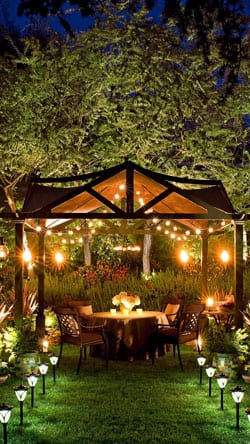
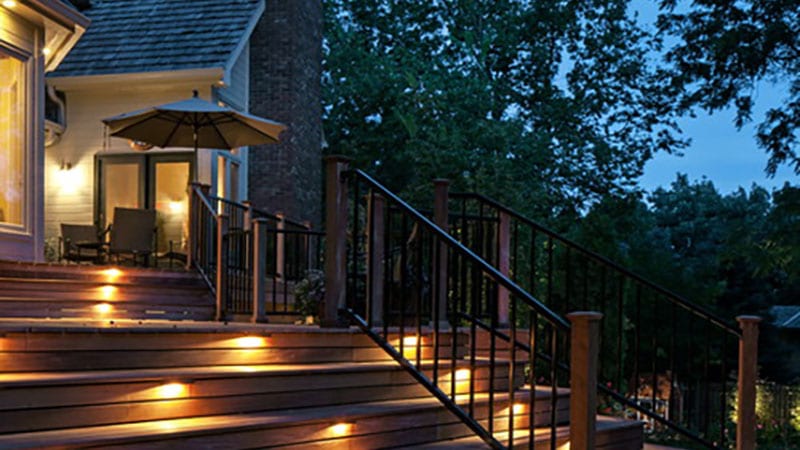
Last winter’s fury left many of us wishing we’d been better prepared. This year, season-proof your yard and garden before deep winter hits. Come spring, you’ll be all set to greet the sun and flowers of the season.
Protect the Garden
In your entire yard, pull up all dead plant materials, rake diseased leaves and remove all fallen branches. “This will prevent insects and disease from overwintering,” said Amy Jo Detweiler from the OSU Extension Service. On your vegetable garden, spread compost or mulch and plant a cover crop that will come up in spring. Consider winter wheat, cereal rye, winter rye, triticale, winter barley or winter peas. “Once it is up, turn it under to enrich your soil.”
Hydrate
Before winter and before turning off the irrigation, deep-soak newly planted perennials, trees and shrubs. What comes next depends on what sort of winter we have. “If we have lots of snow, enjoy the view from inside your cozy home. But if we have a break in the weather with a dry spell—where the sun is out, no snow has fallen and the ground is warmed up—you will need to drag out the garden hose and give all of your plants a deep soak.” If we have a long, dry, sunny winter (wouldn’t that be a change), water every six to eight weeks.
Save the Trees
Young trees are especially vulnerable in winter. For the first few years until the outer bark has thickened, wrap the trunks of thin barked trees like maples, aspen and ash with paper tree wrap to prevent sunscald. “Remove the paper in spring so it won’t harbor unwanted insects over the summer,” said Detweiler.
Tidy Up
Clean your garden tools with a bleach solution and allow them to dry thoroughly before storing. “Tuck them away, along with fertilizers, in a safe dry place out of the reach of children,” said Detweiler.
Pretty on the Inside
Want to brighten up your home with some color? Force bulbs indoors. Try crocus, hyacinths, paper whites, amaryllis, tulips, daffodils, miniature iris or scilla. Also consider planting a window garden of lettuce, chives and parsley.
Holiday Décor
Make holiday decorations from conifer trees, shrubs and ornamental berries from the landscape. Select a live Christmas tree for the holidays, but remember that live trees can only be kept inside for three to five days before breaking dormancy. Plant your tree as soon as possible after the holidays. “If the ground is too frozen to plant your tree, dig a hole the same size of the container on the east or north side of your home, and then sink the tree in the container into the ground to protect and insulate the roots.” Permanently plant the tree in the best location come spring.
Editor’s Note: Originally published November 2017.
It was a dark and stormy night…” goes the often-mocked cliché used by wannabe mystery writers. Yet, the chilling tales of Central Oregon’s haunted landmarks are far from jest or fabrication. Get spooked with the Historical Haunts of Downtown Bend Walk, an annual tour that interweaves local history with spine-tingling paranormal stories put on by the Deschutes County Historical Society and Museum building, a site steeped in bone-chilling legends. The walk involves no private homes because the museum makes it a practice not to include residences in its tours to respect homeowner privacy. If your house is haunted, it’s up to you to speak up about it … or not.
Deschutes Historical Museum
Built in 1914 as the Reid School, this was Bend’s first modern school, complete with central heating and indoor plumbing. George Brosterhous, one of the contractors, reportedly fell from the third floor through an open stairway and died. Ivey explains that many people believe that his ghost haunts the building. “We call them ‘George’ moments, as his spirit has been known to move objects, help staff find things, and even appear to a museum visitor,” she said. And there’s even a reported second ghost roaming the halls. “Margie” has been described as a 6- or 7-year-old, possibly a Reid School pupil, wearing clothing from the 1910s-1920s. She earned her name from a late-night recording by a museum intern that included a cryptic voice repeating the name “Margie.” She’s been heard giggling, turning water taps on and off and flushing ladies’ restroom toilets.
Café des Chutes
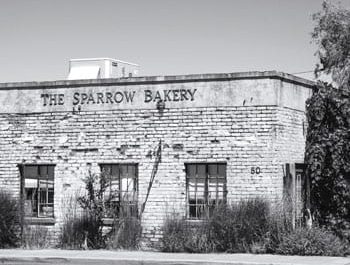
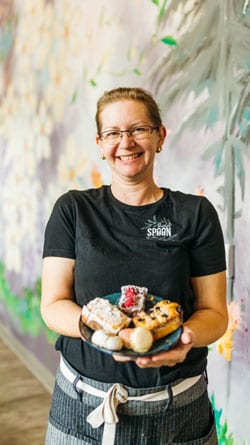
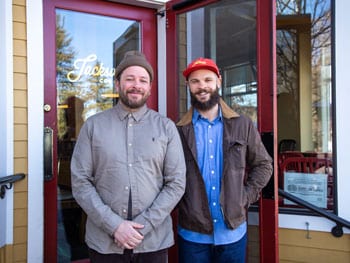
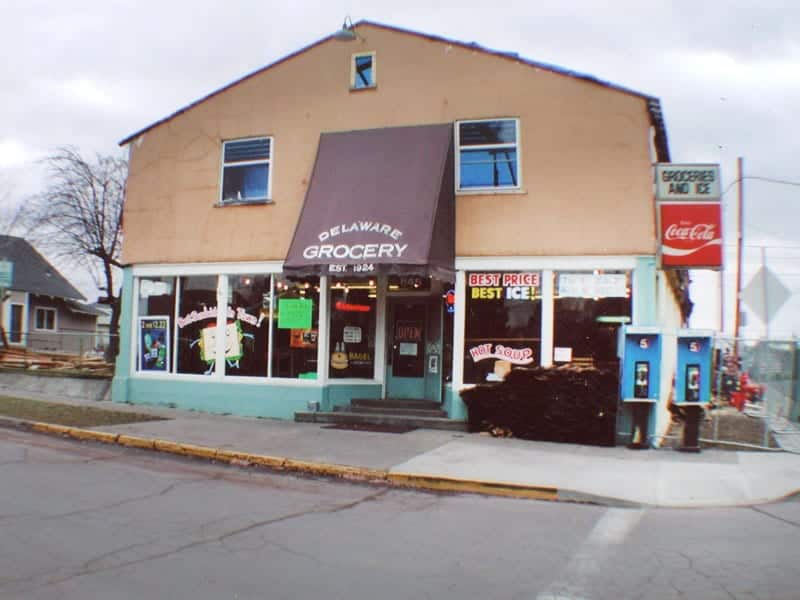
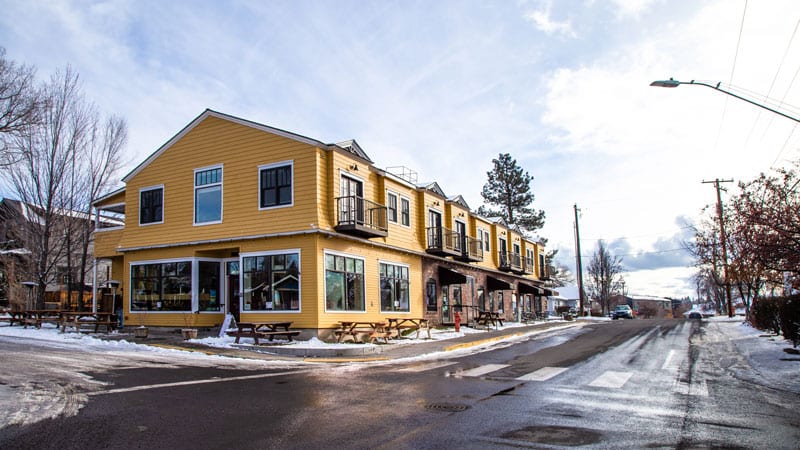
Another notable haunt, better known for its mouth-watering pastries than for its ghostly encounters, is the popular Café des Chutes (previously The Sparrow Bakery) in midtown. Built in the 1920s to house the payroll office for Bend’s Iron Works, previous Sparrow co-owner Jessica Keatman senses that the building is haunted by the office assayer. One story has it that the assayer does not like the door left open to the old safe that is still in the building, so he closes it. Bakery staff have reported hearing loud crashes coming from the back of the store, doors opening and closing by themselves, and even ghostly laughter—but nobody’s there. Keatman is more specific: “We call him Jackson, and sometimes we leave tea and a scone in there to make him happy.”
O’Kane Building at McMenamins
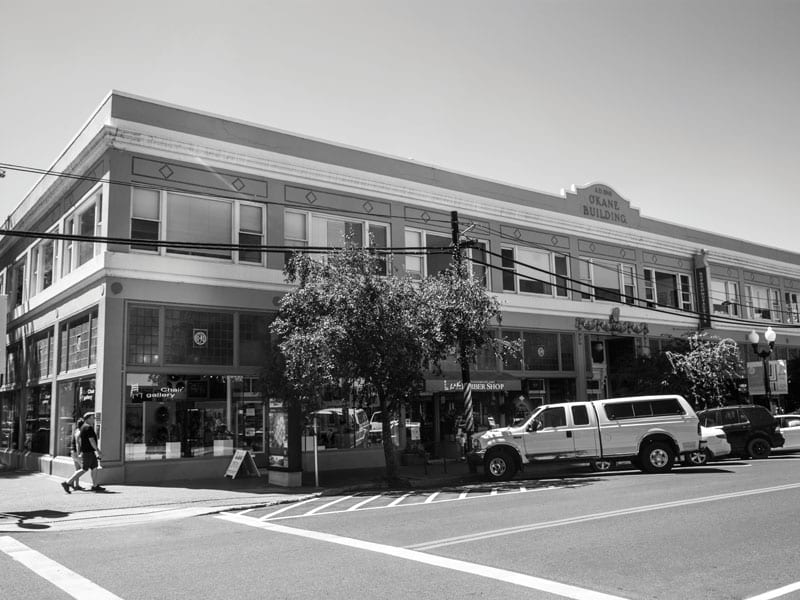
This historic downtown building, circa 1916, has had many owners, but its original builder, Hugh O’Kane, was reportedly a colorful character, having previously lost two other Bend buildings to fires. Over the years, there have been reports of ghostly smoke, strange lights, footsteps and voices. The apparition of an old man (O’Kane?) has been seen by some in the basement. Another tale told by a former third-floor office worker tells of “tug-of-war” experiences with “something or someone” preventing the opening of lock-less cupboard doors.
Lara House Lodge
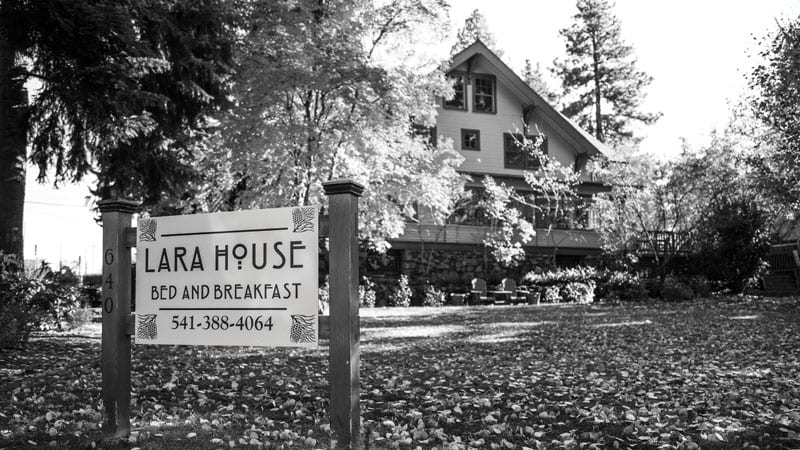
Another downtown haunt is the Lara House, a quaint craftsman-style home built originally as a lodge in 1910, and now, thanks in part to its paranormal reputation, a popular bed-and-breakfast inn. Guests have reported a ghostly visitor at night who apparently enjoys moving objects around and making eerie whispering noises. Also, there have been sightings of a ghostly image of a woman in the top floor window, though the floor is supposedly empty.
Other well-known Central Oregon buildings getting “honorable mention” for reported ghostiness include:
New Redmond Hotel
Paranormal activity: Strange orbs in the lobby, apparition of a lady, and “disembodied” footsteps in the hallways.
McMenamin’s Old St. Francis School
Paranormal activity: Guests reported hearing children running and laughing upstairs, even though it’s a one-story building. Here’s a particularly strange tale reported by a couple staying in one of the guest rooms: retiring for the evening, the couple placed one of their cell phones on the bedside table, only to wake up the next morning to find a photo on their cell phone of them asleep in the bed. Spooky!
Tower Theatre
Paranormal activity: Theatrical tradition calls for a “ghost light” to stay on inside the theater 24/7. Because many theaters have history of ghost sightings, the Tower’s ghost light is said to either keep them away or give them light to see by.
Downing Hotel
Paranormal activity: Often falsely reported as a former house of ill-repute, the Downing actually was a fashionable hotel/restaurant built in the 1920s by William Downing to bring fine dining to a turbulent, rowdy part of downtown. Now it is a lively nightclub and restaurant called Seven, said to be haunted by an attractive lady in a green velvet dress who roams the halls—reportedly the widow of Downing, who committed suicide after learning of his wife’s unfaithfulness.
Is it suddenly colder where you’re reading this story? Perhaps you’ll feel better knowing that, not surprisingly, many of these stories have been debunked. Old buildings are known for creaking and groaning floors and walls. Even so, it’s hard to ignore the abundance of unexplained energy roaming these places. It’s just that time of year. Happy Halloween!
Editor’s note: Originally published September 2020.
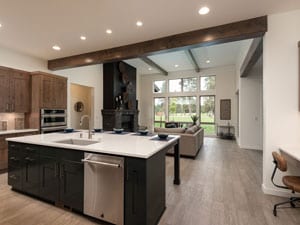
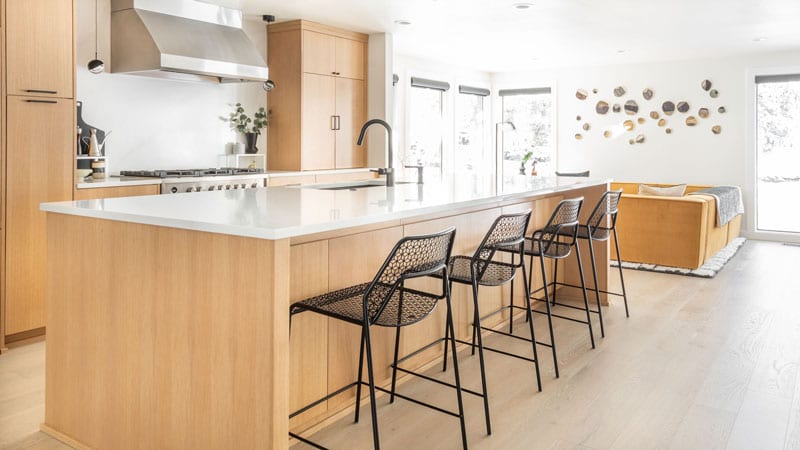
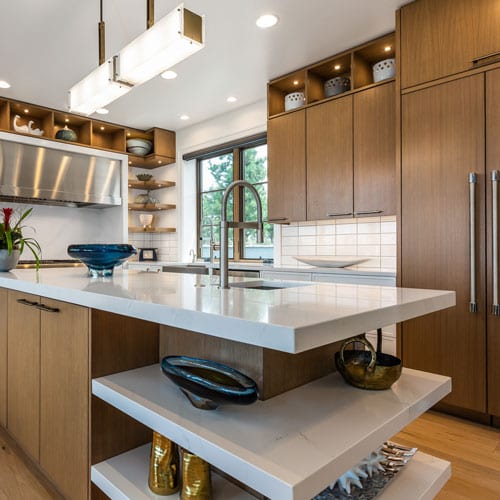
Led by Kirsti Wolfe of Kirsti Wolfe Designs, this kitchen renovation aimed to revitalize a dim, congested space into a blend of functionality and aesthetics. Focusing on natural light and personalized ambiance, the project incorporated artistic elements and strategic design features to transform the space. Client collaboration was key to ensuring all needs and visions were integrated, resulting in a cohesive kitchen. As an interior architect with 20 years of experience in Bend and 30 years in the industry, Wolfe specializes in creating personalized, timeless spaces, particularly in kitchen and bathroom remodels. The finished kitchen reflects her commitment to innovative design, exceeding the client’s expectations and celebrating individuality.
Q&A: An Interview with Kirsti Wolfe, Owner of Kirsti Wolfe Designs
What were the goals for the kitchen remodel in both functionality and aesthetics?
Our main goal for the kitchen remodel was to create a functional space that suited the client, with special consideration to the children’s active meal preparation routine. I had the opportunity to watch how the family operated in the kitchen, which influenced our approach. To improve functionality, we addressed the previous design’s shortcomings by implementing practical storage solutions and opting for better lighting. Aesthetically, our aim was to create a timeless style by using high-quality cabinetry and durable finishing materials.
Can you share the inspiration behind the design concept for this kitchen remodel?
We aimed to create a brighter ambiance by opening up the space to allow more natural light to flow in. Our design also focused on adding wall space for artwork and incorporating cabinetry with architectural details to transform the kitchen into a visual centerpiece. To maximize functionality without overcrowding the space, we used hidden storage accessories for a clutter-free environment. The layout prioritized the separation of workstations and appliances to accommodate multiple users simultaneously. Diverse materials such as quartzite, warm walnut wood accents and light-painted wall cabinets were used to add visual interest while still being cohesive. The island countertop served as a focal point, and touches of deep, slate-blue paint complemented the “Michelangelo” quartzite countertops.
Could you walk us through the collaborative process with the client?
I presented several floor plans to the client and refined them based on the client’s feedback to create the ideal layout. We then developed a design palette inspired by existing artwork and the island countertop to ensure cohesion and harmony within the space. To provide the client with a tangible sense of the final result, we used 3-D renderings to visualize different materials and color options in the context of the space.
Having been in business for 30 years, how do you tailor your designs to meet the evolving lifestyles and preferences of your returning clients?
It’s been so fun, and I feel very fortunate to work with new and several returning clients. Getting to know the clients over the years has been great, and as their needs evolve, the process remains new and exciting. I strive to create functional, fresh and timeless designs to fit their current and evolving lifestyles.
RESOURCES
Appliances: Sub Zero & Miele (Johnson Brothers Appliances)
541-382-6223 | jbbend.com
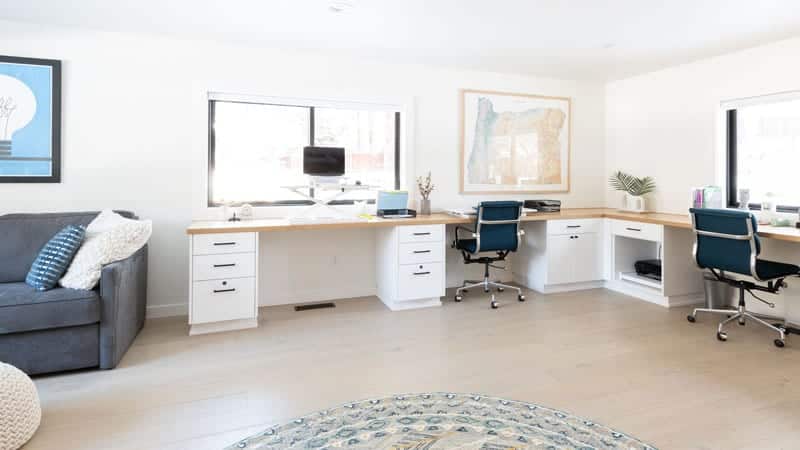
With more time at home over the past eighteen months, Central Oregon homeowners are looking at their environments with fresh eyes. “People wish to create and design a new sense of comfort and to make the most of their homes—whether they are starting from the very beginning as a sketch on paper, or a partial/full remodeling project,” said Kirsti Wolfe, owner of interior architectural design company Kirsti Wolfe Designs. Wolfe said she is receiving more requests for paired offices, spa-like bathrooms, larger kitchens (to accommodate more in-home cooking), cozy media rooms and new or converted exercise rooms. “People are choosing not to go out to do as many things, so they are thinking more about the experience of being at home. The pandemic has changed what people want. It is often referred to as: #covidconstruction,” Wolfe said.
Wolfe has worked in Central Oregon for seventeen years and in interior design for thirty years, watching firsthand as design styles and clients’ desires have changed. More recently, she has observed that homeowners are rethinking their time at home and how their spaces work—or don’t work—for them. Wolfe and her team work with local architects and builders to execute projects for homeowners, with more than half of Wolfe’s business coming from repeat clients looking for new builds, remodels or second homes outside the area. “Many of the clients I work with, now that they’re spending more time in their homes, realize there is something else they want,” Wolfe said. A current project on Wolfe’s docket is an indoor/outdoor bathroom with sliding doors that lead directly into a Zen garden outside. “It is going to be a relaxing atmosphere incorporating a water feature or an outdoor shower,” Wolfe said. “People want their homes to feel more comfortable and less isolated.”
photo Cheryl McIntosh photography
From residential to hospitality
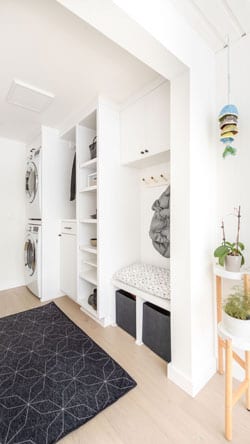
While Wolfe is known for designing gorgeous, functional kitchen and bathroom projects, her work is far from limited to just these rooms.She is spending more time addressing the auxiliary areas of the home, including media rooms, exercise rooms, mud/laundry rooms and offices. These projects reflect many design styles, from traditional to modern.
Nearly a decade ago, Wolfe’s company expanded into the hospitality industry, as vacationers and stay-cationers began to seek more comforts of home while on a trip. With the rise of Airbnb rentals and the growth in popularity of vacation home rentals, it has become clear to hotels and resorts that creating a home-like experience for lodging is critical. Wolfe assisted Bend’s Tetherow Resort by designing its guest rooms to include spa-like bathrooms and spacious mudrooms for dropping off skis and other outdoor toys and gear. “When you have a space for those things to land, guests can truly enjoy the rest of the room,” she said. She is now designing something similar at Sunriver Resort, by remodeling the Lodge Village guest rooms, modernizing the accommodations by upgrading mudrooms and bathrooms by adding lighter and more modernized aesthetic. The result generates a more user-friendly space that feels like home.
Interior architecture designer Kirsti Wolfe knows that good design starts with the bones of a house.
From luxury homes to west side bungalows to new construction, Interior Architectural designer Kirsti Wolfe knows that good interior design starts behind the paint color and before the tile is set and any lighting is hung. For Wolfe and her design business in Bend, Kirsti Wolfe Designs, creating a space that is both functional and beautiful starts with the bones of a house.
Wolfe has a master’s degree in Interior Architecture from California Polytechnic University in San Luis Obispo. That means she approaches her designs similar to how an engineer or architect would, focusing on the function and making the most of the space and resources. For almost 30 years, she has specialized in kitchens and bathrooms, two of the most used rooms in a home, because of the infinite technical details that go into making those spaces function for each home.
Wolfe begins by asking herself, “How is this put together architecturally, and how will it function? We start there, and grow function into a pleasing form for the client. We provide professional documents for builders and subcontractors which saves them time and money.”
Wolfe and her design team, Angela Newell and Tracy Pszczolkowski, work with a variety of budgets and styles in Central Oregon, offering many design packages. Wolfe describes her business as providing a positive and enjoyable experience from commencement to completion. Wolfe and her team design entire custom homes, new construction, remodels, hospitality destinations, restaurants and more.
Wolfe also has strong relationships with architects and builders in the region, often coming into a project before building has taken place to rework room layouts to allow for more function and utility. Her architectural background allows her to see the technical details in a space before the design details.
“When you see the layouts, you can see a difference from a typical design versus what we can provide,” said Wolfe. “It’s creating a one of a kind home with the client’s individuality showing through in the final design.”
Traditional Elegance
When Linda Lonergan was building her custom home in Bend, she turned to Wolfe to work out a space issue in the master bathroom. “I had plans in place, but I wasn’t very happy with the kitchen and bathroom designs. I didn’t feel that they utilized the space well,” Lonergan said. “I went to Kirsti and told her what my feeling was, and she immediately went to work with redesigning the spaces, which provided more storage, more usability in every aspect.”
In the original plans, when entering the master bathroom door one would look directly at the toilet, and angled walls didn’t allow for much counter space or storage. Lonergan brought Kirsti Wolfe Designs in before construction began. By moving interior walls and redesigning the layout, Wolfe was able to add more space to the master bathroom. In fact, the bathroom went from twelve square feet of storage to fifty-two square feet of storage.
“So much about interior design is listening to the client and their needs and wants. You want to make the space beautiful, but you need it to function and flow, too,” said Wolfe.
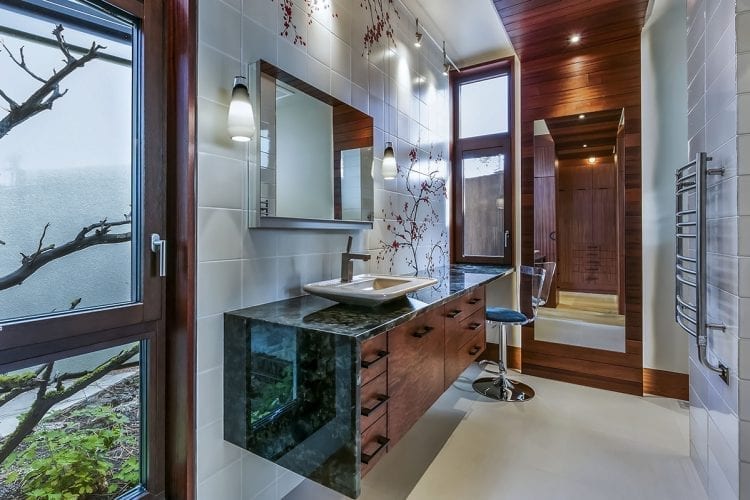
The finished bathroom has a dressing table in addition to the double-sink vanity. The alderwood inset cabinetry was custom designed by Wolfe and built by Bladt’s Custom Woodworking. The stone slab counters add contrast to the dark wood. Wolfe designed the custom tile layouts, and the selection of all plumbing and lighting fixtures too. The result is a master bathroom that functions beautifully, and looks beautiful, too.
“Kirsti’s very creative, very professional,” said Lonergan. “She comes up with options for you, but she’s decisive. She’s not afraid to go outside the box, and make it very custom.”
Contemporary Zen
For a new home on the west side of Bend, a recent client turned to Kirsti Wolfe Designs for her custom kitchen and bathroom.
“I was afraid of being intimidated by an interior designer, but she was very easy to be around. I had met with my builders Copperline Homes and met with my architect Al Tozer, but we hadn’t started building at all. It was a good time to bring her in,” said the client.
Wolfe and the client started from scratch and spent time figuring out exactly what she would want and need in the space. The homeowner wanted a calming and tranquil atmosphere in her home. Using elements of water, glass and wood in the kitchen and bathroom, Wolfe ensured that her vision flowed throughout the space.
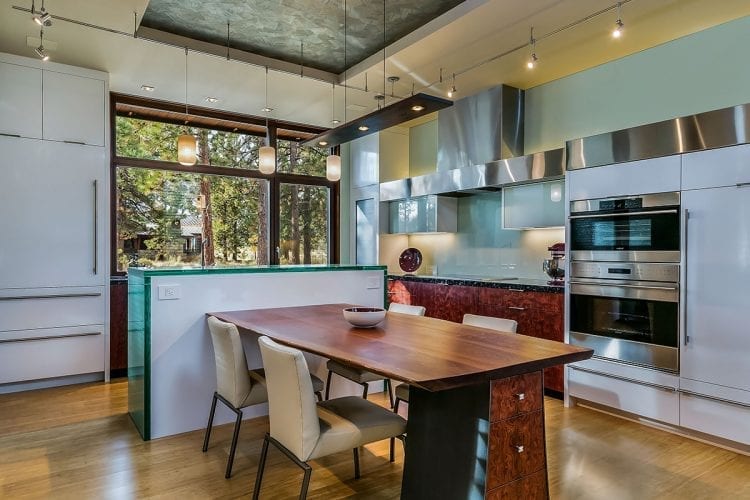
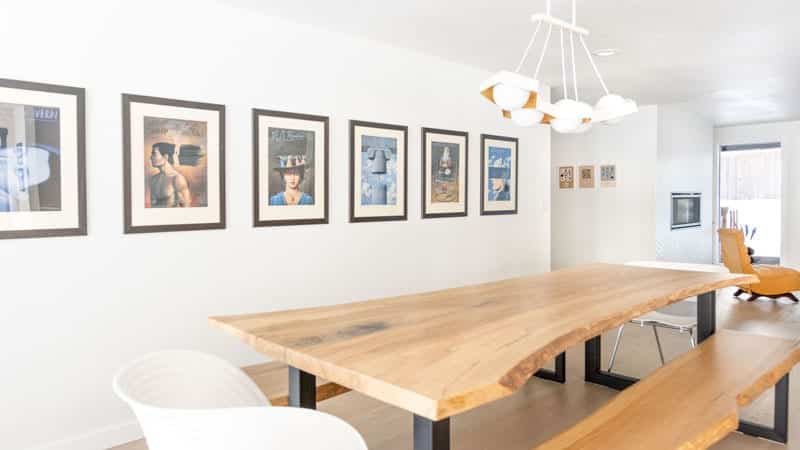
The aesthetic is also in play in the kitchen, with the contemporary European-inspired design that includes clean lines, and making use of every inch of the room. All the lines fall into place along the stainless-steel hood, and the two-inch-thick glass cabinets match above and below. The live-edge sapele wood table, custom made by Dansky cabinetry (which also made the rest of the cabinets in the home), functions as the client’s everyday dining table attached to the island, and was designed to suit her entertaining lifestyle.
“We took time to make sure every decision was thoroughly thought out,” said Wolfe.
The client was thrilled with not only the final product, but also the process of working with Kirsti. “If ever I had a question she was there to answer and help me through the process, and she let me be part of the process.”
The dramatic and vibrant colors of trees, shrubs and flowers brighten our neighborhoods and cities in the fall season. Even in the high desert, where leafy green hardwoods are not found in the abundance they are in other parts of the country, we still get our show. For a brief window in September and October, oranges, reds and yellows are all around us.
Fall is also the best time to plant trees and shrubs, ensuring years of color to come. Read tips here on the best plants and trees to choose, how to maintain your fall color as long as possible and planting like a pro.
Perennials, annuals and grasses
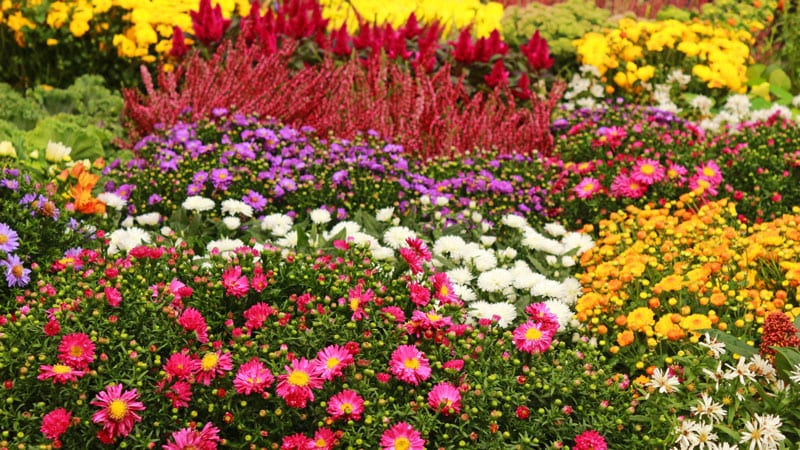
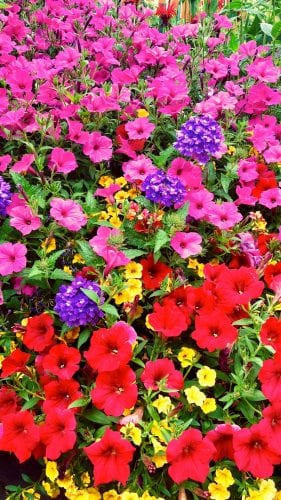
A smattering of grasses and flowering plants add variety and beauty to a yard. For fall color, plan to add a few perennial fall-blooming asters, mums, coreopsis and tall stately Garden Phlox. Annual plants and flowers such as purple Homestead Verbena, combined with the dramatic foliage of flowering cabbage and kale, will brighten every yard. Plant a few reliable violas and pansies in the garden as well as patio containers and hanging baskets, for added frost resistance. Don’t forget to deadhead the spent blooms of your annuals and perennials. This necessary task will ensure re-blooming right up to the last days of fall.
Shrubs and trees
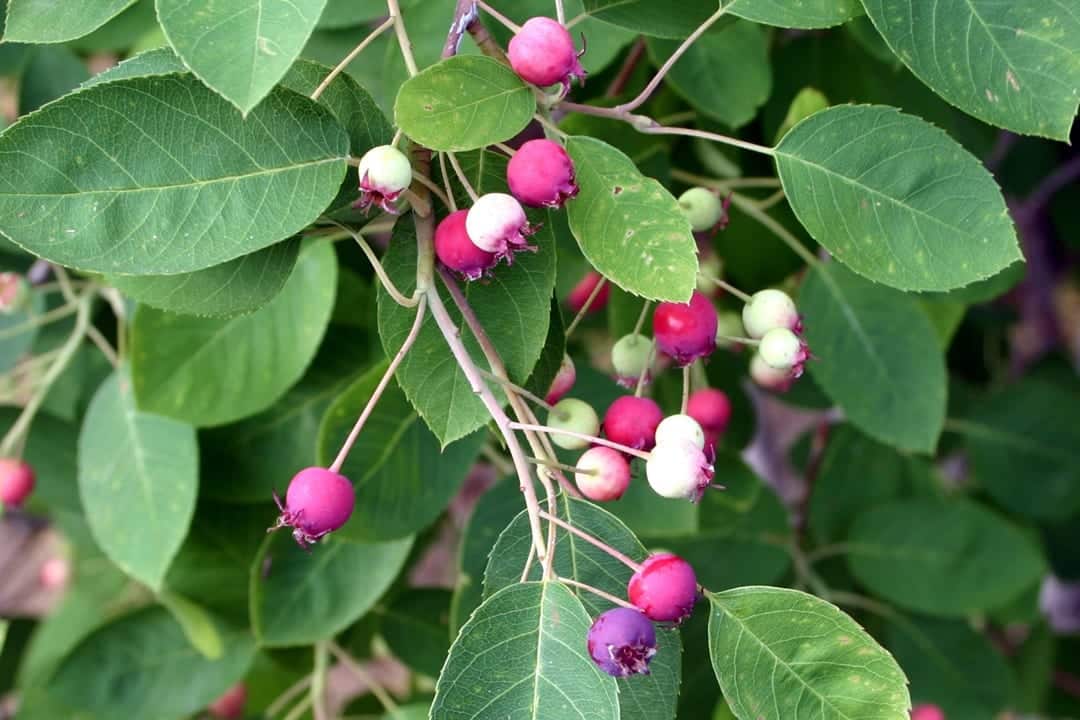
How do you know which trees will offer the best fall color? Try the reliable Red Sunset Maple, the amusingly-named Nannyberry tree, or the legendary king of reds, the Pin or Northern Red Oaks. When it comes to ornamental shrubs, the reliable Burning Bush will always be at the top of the list. Another great choice is the Chokeberry with its multi-color yellows, oranges and reds. This shrub offers wonderful white flowers plus berries to make the wildlife happy. The Serviceberry is a fantastic choice for our arid climate, with a variety of alluring smoky hues. The Amur or Flame Maple reveal the colors of the changing season.
Make the color last
As the season starts to wind down with shorter days and cooler temperatures, reduce your watering schedule and eliminate the application of synthetic chemical fertilizers. Attention to these two details allow for plants to better acknowledge the change in seasons, thus preparing them for their show of autumn colors.
Planting tips
If you act fast, you can get a few new trees and shrubs in the ground this season, in preparation for next fall’s vibrant show. Fall planting follows the heat of summer, when the weather cools but the soil is still warm enough to nurture the roots. Plant trees before winter hits and the ground freezes.
When planting, use liberal amounts of organic compost to yield a better acidity to the soil. A soil rich in acidic humus will influence vibrant fall colors. In contrast, alkaline soils can not only alter flower colors, but can rob you of the desired vibrant reds, oranges and yellows.
A little planning and your yard will look fantastic every season of the year.
Editors note: Originally published on September 25, 2020.
Food dehydration is one of the most ancient methods of food preservation, with evidence of Middle Eastern and Asian cultures dehydrating food in the hot sun more than 14,000 years ago. Luckily for beginners, this long history makes food dehydration a very well-researched and accessible method of food preparation and preservation.
Healthy Snacking
Dehydrated foods are naturally preserved (no unnatural additives), typically high in antioxidants and fiber. Self-preparation of dehydrated foods can also mean less plastic waste compared to store-bought varieties, making dehydrating an eco-friendly and healthy choice.
For Julie Mosier of Bend, dehydrating was a way to create convenient and light backpacking meals for herself and her son. Years later, Mosier has authored The Dehydrated Cookbook For Outdoor Adventurers. She has also taught classes at Central Oregon Community College on the subject of dehydration. Dehydrated meals are lighter to carry around, making them ideal for backpackers who don’t want to be weighed down. Preparing these meals on the trail requires very little equipment, so hikers can ditch the bulky propane stove and opt to carry extra water instead to re-hydrate meals. In addition to full meals, dehydrating is a great method to create trail-friendly snacks, such as beef jerky or dried fruits and veggies.
photo Bryan Stablewski
Fruity and Crisp: Dehydrating adds a fun crunch and can make fruits more palatable for kids and adults. Pay attention to portion size as it’s easy to over-consume.
Prepare and Preserve
So, how does dehydrating work? Depending on the resources at hand, dehydrating can be accomplished in a regular oven, but it’s preferable to use a dehydrator appliance. “I recommend trying to borrow a dehydrator, or find an inexpensive model,” Mosier said. “These can be found around town in stores like Sportsman’s Warehouse, Lowes, and Wilco.”
To avoid cooking your food instead of dehydrating, temperatures in a dehydrator are regulated to stay near 140 degrees fahrenheit; any hotter and the food might cook instead of dehydrating, locking in the moisture and preventing long-term preservation. “It’s the most efficient and best quality to have a dehydrator with both a fan and a thermostat,” said Glenda Hyde, associate professor of practice for Oregon State University’s Family and Community Health Program, specializing in food and nutrition for the OSU Extension Service. Hyde recommends getting an appliance certified by Underwriters Laboratories for food safety standards.
Depending on the amount and type of food being dehydrated, and the efficiency of the appliance, dehydrating can typically take anywhere from 8 to 24 hours. It often works out to begin dehydrating something in the evening and wake up to ready-to-eat dried fruits, meats and vegetables.
If an appliance isn’t readily available, dehydrating can be done in a regular oven, set to the lowest temperature possible. Since today’s ovens often only go as low in temperature as 170 degrees, this must be a careful process of trial and error, often done with the oven door propped open. Because spoilage is a risk using this method, it isn’t reccomended, Hyde said.
photo Fresh Off the Grid
Keep it Simple: One way to simplify the dehydrating process is by purchasing pre-chopped frozen fruits and veggies and using them on the dehydrator, according to Glenda Hyde of the OSU Extension Service. Hyde recommends using silicone grids below dehydrator racks to prevent small pieces of food from falling through.
Dry This
As far as ingredients, pretty much everything is on the table; local fruits, veggies and meats can be found at farmers markets and stores such as Locavore, Bend’s year-round, indoor farmers market. At first, Mosier recommends keeping things easy and familiar. “At its simplest, one can simply chop up some fruits and veggies, place them in a dehydrator and walk away,” she said. “Alternatively, you can start with meals you already make, such as soup or chili, spread some on the trays, and you’ll end up with a dried version of a meal you already know and like.”
Mosier spent time experimenting with dehydration and testing recipes that would work well as trail meals. “I spent a great deal of time figuring out how to create nutritionally dense meals for my son’s backpacking trip,” Mosier said. These experiments led to some delicious discoveries, including how to improve recipes by dehydrating each ingredient separately for different times, creating different textures once the meal is re-hydrated and avoiding a “homogenous blob.”
photo Fresh Off the Grid
Shelf Life: For long-term storage, dehydrated foods are best kept in an area that is cool, dark and dry, like a closet or drawer, according to the OSU Extension Service.
One beginner friendly dehydration recipe that utilizes garden leftovers is dehydrated zucchini chips. Hyde said these can be dehydrated plain, or spiced up with barbecue sauce, salts or other herbs and spices. “The flavor just really pops,” Hyde said. Unlike dehydrated fruits, which can be high in carbs and sugar if overeaten, dehydrated veggies, like zucchini chips, are healthier.
Explore a dehydrating guidebook from the OSU Extension Office, which serves Deschutes County, at beav.es/OSUFoodPreservation.
Amber shafts of sunlight illuminate the tips of prairie June grass. Junco birds dangle like trapeze artists on rabbitbrush feeding on the choicest seeds. A western fence lizard soaks in the late afternoon sun on a lichen-dappled lava boulder. A family of quail tumble among the sage, avoiding the watchful eye of the resident Cooper’s hawk. It’s an enthralling performance all happening right in our backyard.
Our postage-stamp-sized wildlife habitat wasn’t always such a welcoming haven for the local animals.When we purchased our home west of Tumalo State Park in 2012, we found a neglected, dying lawn losing its battle against a tide of cheatgrass and noxious weeds.
Having been raised by ecologically-minded parents not far from ecologist Aldo Leopold’s legendary shack in rural Wisconsin, I felt an immediate call to restore this damaged plot to its native state. The hope was to create a refuge among the manicured lawns that demand such intensive human intervention to survive in this arid environment.
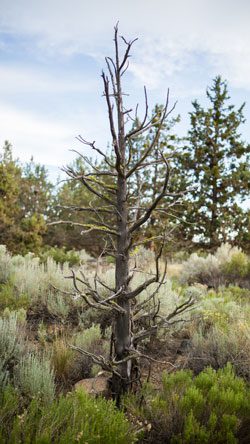
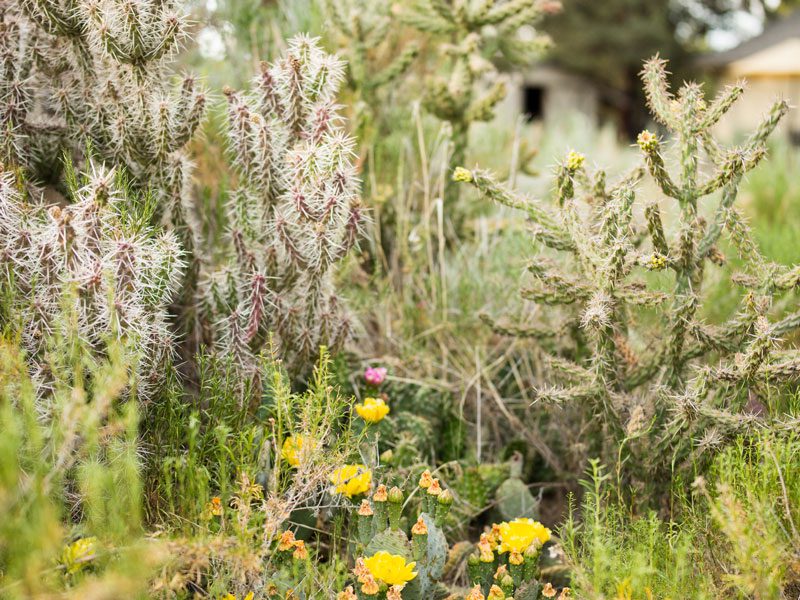
A juniper snag surrounded by green and gray rabbitbrush, interspersed with Wyoming and Great Basin sages.
The challenging part was figuring out just how to do so in Central Oregon, with little understanding of what truly belonged here. Initially, we naively believed that all that was needed were the “drought tolerant” plants offered at local box stores. We quickly discovered these plants require more water than the local climate provides. With some research and lots of trial and error, we were able to turn the once desolate view out our back window into one teeming with life using the rich plant diversity of the region.
It’s possible to bring the high desert into any yard in Central Oregon, and here are a few tips learned along the way to make the process easier.
Know Your Zone
Central Oregon offers a surprising variety of small ecosystems that are both subtle and distinct, from sagey juniper forests to ponderosa stands studded with manzanita. To be successful, first determine which ecosystem your home sits in to know what plants will flourish there. Not all species thrive together, or thrive in every neighborhood, so it’s worth taking a stroll in the natural terrain in your immediate area to take note of the grasses, trees, shrubs and wildflowers that grow near each other. To identify these plants, pick up some regional guidebooks such as Sagebrush Country by Ronald J. Taylor or the delightful The Nature of Bend by LeeAnn Kriegh.As an added benefit, these books provide interesting facts about the local flora and fauna—like the hibernating habits of the Great Basin spadefoot toad that can burrow in the sand for up to two years.
Make a Plan
The best time to plant is early spring or late fall when cooler temps and moister soil can encourage plants to better establish roots. A great way to get started is to pay a visit to a nursery that specializes in native landscapes, such as WinterCreek Restoration & Nursery in Bend. Or, for the more adventurous, visit a U.S. Forest Service office to get a free permit which allows you to collect up to sixteen native plants.
Consider minimizing the size of a backyard lawn to make way for more native plants that will not only endure drought conditions but will also feed and shelter wildlife. Accent with rocks and tree snags to reduce water usage and provide extra perches for birds.
Native local plants should be the foundation of a high desert landscape, while low water regional plant species should be used as accents.
Plant Like a Pro
For a natural look, plant the way things grow in the wild. Native bunch grasses are hardy and help protect the ground near shrubs while they get established. Plant complementary species in clusters, give plants enough space to avoid crowding and plant shrubs and trees away from the house to provide defensible space against wildfire. For help, seek out a landscaping service specializing in small spaces, such as Smallscape in Bend.
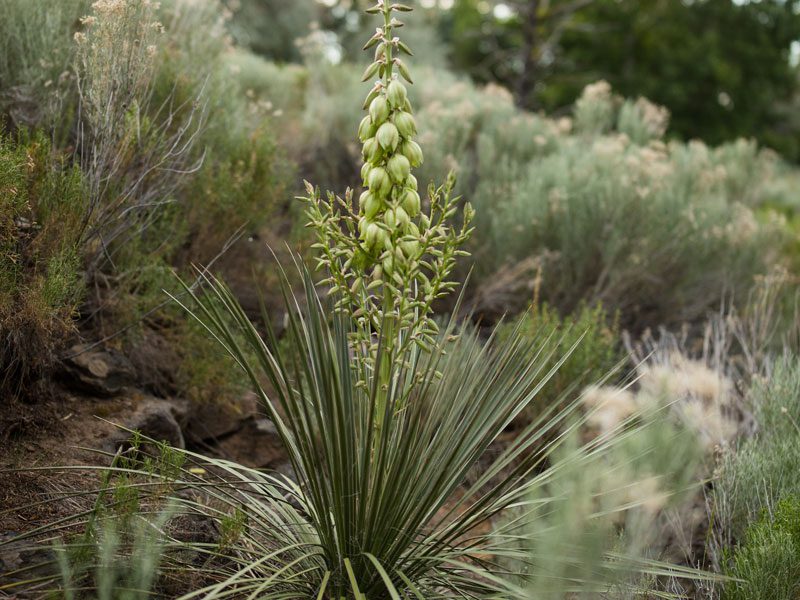
Soapweed yucca’s striking flowers and spiny leaves liven up a high desert landscape.
Be Patient
Once planting is done, allow time for the natural landscape to come into its own. Protect young plants by giving them water until they really take root. Remove weeds to allow plants to prosper. Weeds may return for a while but notably fewer each season as the natives quickly out-compete the invasives. Before long, the new plantscape will begin to thrive, propagate and invite the local animal life to play their specialized roles in your very own desert sanctuary.
It certainly was a surprise to us how readily even the cheatgrass gave up as the local plants regained their rightful place in our little patch of the high desert. The process isn’t without effort, but the desert rewards us by showing that our care translates to a landscape that is largely self-sustaining. Gone are the pesticides, heavy watering and fertilizer. In their place is the rich scent of sage, baby quail and an assortment of animal visitors native lands attract. You can’t help but feel a deeper connection with the local flora and fauna in the place we are lucky enough to call home.
When Neil Kelly Company senior designer Kathleen Donohue approached a remodeling project in northwest Bend earlier this year, she knew it would be a balance of the client’s wish list, budget and project logistics. And in the case of this Awbrey Glen home, it would involve a bit of problem solving and creativity, too. The company was hired by a couple who were preparing to return to the Bend home where they had raised a family, after years of renting it out while they focused on careers out of the area. The couple’s desired updates included a more modern kitchen that was better for entertaining, new dog-friendly rustic hardwood flooring throughout the main level, a more inviting downstairs powder room and a new “cellar” to house an impressive wine collection. “They had been living elsewhere for work reasons, and they came back to this home to get it ready for their retirement and to be their forever home,” said Donohue, who is a certified master kitchen and bath designer, or CMKBD, and certified aging in place specialist, or CAPS. Donohue has been with Neil Kelly, which specializes in design/build remodeling, for more than thirty years, so she’s well versed in remodels. She knew to keep the homeowner’s wish list in mind from the start, and set out to accomplish their goals with their budget in mind.
Opening up the kitchen
When it came to modernizing the kitchen, Donohue set out to brighten up the space, tweak the layout to feel more open and add new cabinets and flooring complementing the home’s existing woodwork. The kitchen had both an island and a peninsula, so the latter was removed to improve the flow of the room. “It was pretty crowded before, so it was important to keep things really simple,” Donohue said. New appliances were added, including a Bertazzoni range, accented with an ivory hood. The new cabinets are a mix of natural knotty alder, matching existing wood in the house, and some painted a grey green color that ties in well with the greenery outside. “The color really brings the outdoors in with that golf course right outside the window,” Donohue said. The island is topped with a wooden counter that helps warm up the space and keep it from feeling too industrial. “She said she’d never had a kitchen like this and never dreamed she would,” Donohue said of the homeowner.
photo Tim Cotter
Cellar Challenge
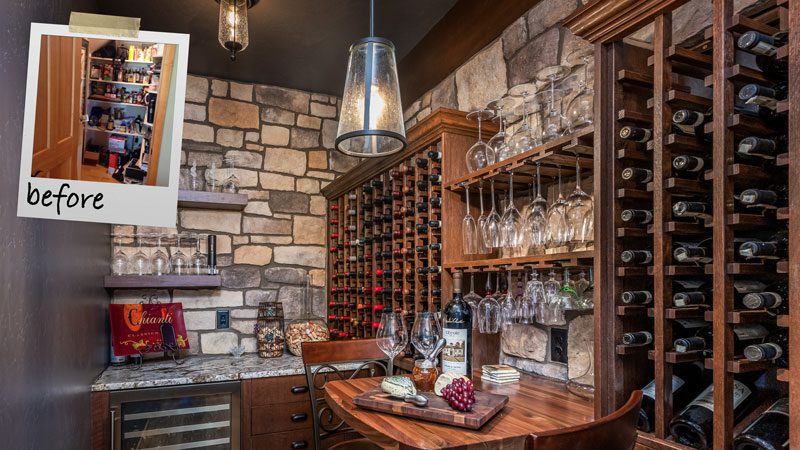
In early discussions about the remodel, the plan was to convert a small pantry underneath the stairs into a wine cellar, but after realizing the owner had a 400-bottle collection, Donohue knew more space was needed. “There was a little pantry, but it was literally a closet under the stairs, and wouldn’t be enough room on its own,” she said. An existing covered front porch area on the exterior just outside the pantry wasn’t used by the homeowners but was already underneath the house’s roof, while an adjacent laundry room had an angled area that was underutilized. Together these extra spaces would become the new cellar, offering the area needed to display the wine collection, as well as a bistro table and chairs for entertaining.
Refreshing Spaces
Simple updates to the existing laundry room and powder room helped to lighten up the areas visually and make them more inviting. The powder room was dressed up with fresh finishes, wallpaper and a new light fixture. The more compact laundry room was outfitted with the same grey green cabinetry as the kitchen and a bright white counter.
All the updates helped transform the home from a more traditional lodge style design into a more contemporary space. “The homeowners just really, really love it and are really pleased,” Donohue said. “It’s a beautiful home in a beautiful setting and this project finished all the things they wanted to do to bring it up to date.”
Neil Kelly Company | 190 NE Irving Avenue | 541-382-7580 | neilkelly.com/bend
When a fire ripped through downtown Bend’s Anjou Spa in 2016, owner Jenna Walden found the spa literally in a pile of ashes. It was a defining moment for the business, with Walden choosing to rebuild the spa back stronger, even finding a way to incorporate the business’s fiery past into the design of the new space in west Bend. “It was a total loss,” recalled Walden, “but I knew I was going to rebuild, and when I was thinking about it, I wanted to try and add shou sugi ban into the design. I was tired of all the mountain rustic and mid-century modern designs, I wanted to add something new here.”
photo Nakamoto Forestry
Though shou sugi ban is relatively new to the West, it is a centuries-old design technique from Japan known there as “yakisugi,” which translates to “charred cypress.” Walden chose to use this technique on a prominent wall at the entrance of the new building.
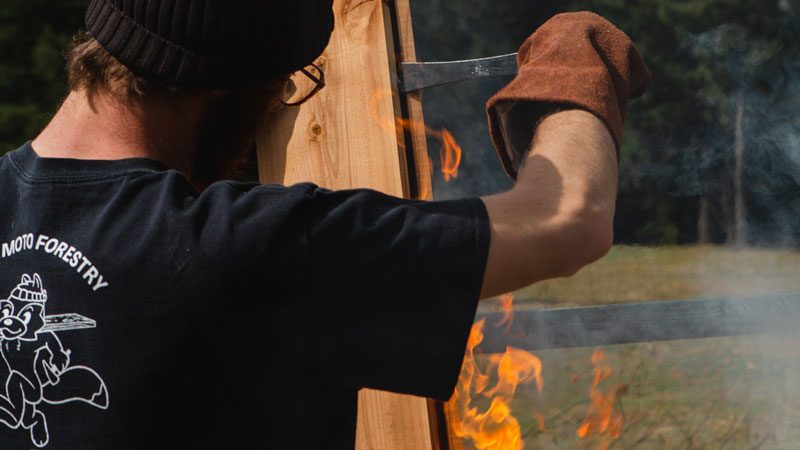
North America’s largest producer of shou sugi ban, or yakisugi, happens to be based in Portland, and is helping bring the unique technique to more Oregon homes and other buildings. “We take Japanese cypress trees, logged from our sustainable forests in Japan, and we burn, or char the wood, which enhances the color of the wood from black to almost a white and grey tone,” explained Aaron Davis, digital marketing manager for Nakamoto Forestry, which is also the oldest company in the world making yakisugi in the traditional method. “After the burning, we brush the wood, and add an oil, which enhances the textures and the grains.”
Shou sugi ban is used not only as a cool elemental design on interior walls, but it is also considered a premium exterior cladding because it holds up extremely well to the elements. “Burning or charring the wood makes it fire resistant,” said Allison Hall, Oregon sales manager for Pioneer Millworks, a reclaimed and sustainable wood product company with an office in Portland, and with projects in Central Oregon. “Raw wood will burn at 450 to 500 degrees, but the combustion point for the charred wood is 2,000 degrees. By heating the wood, you cook out the sugars, which case hardens the wood, and it also makes it pest-resistant from insects like termites and carpenter ants that feed off of those sugars and cellulose.”
photo Virtually Here Studios
According to both Pioneer Millworks and Nakamoto Forestry, case-hardened wood will last at least fifty years or for the life of the structure, with very minimal maintenance. “The Japanese also found that not only was charred wood pest and fire resistant, but that the carbon layer also stands up to wind, rain and snow,” explained Davis. “The Japanese have also found that the charred wood is naturally UV protected, and keeps it from wood rot.”
Shou sugi ban comes in a variety of textures from something like alligator skin to more of a silky-smooth variety, and various colors from black to toast to an almost white tone.
Pioneer Millworks has put its own American spin on shou sugi ban, by adding colors like red and blue, along with more traditional wood tones and grains. All the company’s timber comes from sustainable forests in the Pacific Northwest and is milled in McMinnville. “We can’t pinpoint exactly how yakisugi came about because Japan was a closed society for so long … but we know in rural areas they were using it for centuries for exterior home cladding, on fences, and storehouses that held valuables like rice and other food products, because of the fire-resistant properties,” Davis said. “It’s really quite ingenious charring wood to make it fireproof.”
photo Nakamoto Forestry
Perhaps the oldest example of shou sugi ban can be seen on Japan’s Buddhist Temple in Nara Prefecture. The five-story pagoda is one of the world’s oldest, built in 607 AD.The temple caught fire, but was eventually rebuilt in 1711 using old yakisugi lumber. “I think the Japanese celebrate the aging process and see the beauty of the patina in shou sugi ban,” said Hall, who has seen rapid sales growth, especially now in wildfire-prone areas. “Japanese aesthetic finds patina that comes with age desirable and unique. The imperfections are the point.”
Back at Anjou Spa, Walden found shou sugi ban so beautiful and captivating she studiously researched how she could do it herself and found a partner at the DIY Cave in Bend.After experimenting and practicing on countless pieces of lumber, she finally summoned the courage to control the fire and char the pieces that now make up the accent wall at the new spa, which opened one year and one month after the original spa burned down. “It is sort of like the Phoenix, rising out of the ashes,” said Walden, who now laughs at the irony. “It is very symbolic, isn’t it?”
Browse around internet apps like TikTok, Pinterest and Instagram, and it doesn’t take long to stumble across an aesthetic that’s seeing a rise in popularity among teens and young adults. Characterized by wicker baskets filled with wildflowers and fresh baked bread, rolling countryside hills and long linen dresses, the “cottagecore” style has taken hold.
Cottagecore is the romanticization of a rural lifestyle that gives specific nods to Victorian era English villages. As an aesthetic, it can influence fashion and food, as well as architecture and interior design. Despite all the different applications of the aesthetic, there is a common theme woven throughout—cottagecore is known to invoke warm, safe and nostalgic feelings from those who experience it.
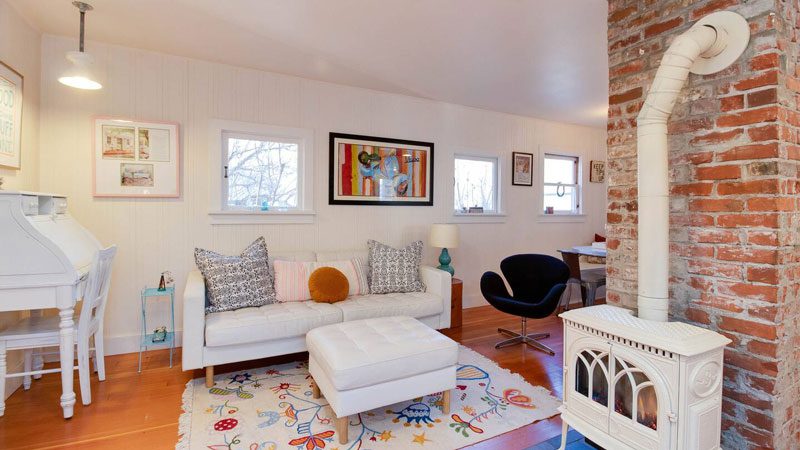
Translated into home design, a cottagecore home would include aspects that make people feel nostalgic and cozy, with a mix of old and new pieces. Neutral walls, old wooden furniture, a wood-burning fireplace, casement windows with light drapes, exposed wood and brick, vases of wildflowers and greenery, and small reading nooks with antique finds can all add cottage style to a home. Think of a grandmother’s house, but somehow trendy.
Bend-based designers Sarah Phipps and Anna Stringer worked together several years ago on a cottage remodel on Bend’s west side that Stringer now runs as an Airbnb rental. The 1934 structure was looking worse for the wear when the pair of friends first began revamping it. To begin the remodel, the two stripped the house down and discovered the original lap siding, still preserved, and an old brick chimney.
The interior was painted an off-white mascarpone color with a bright white trim and the floor was given new life with a hardwood upgrade. The furniture in the cottage is now a mix of old and new, a modern couch right next to the exposed brick chimney, as well as the old fireplace and an antique davenport, both painted the same white as the trim. A retro-style pink refrigerator from Smeg provides a splash of color.
While the finished space is a great example of cottage design, even Phipps and Stringer are still figuring out exactly what cottagecore is, and how it differentiates from some more established styles. Phipps describes her own style as “OG Cottage,” which can mean different things, depending on the age of who you’re talking to, she said. “Every generation has nostalgia for the past, but the dateline isn’t static,” Phipps said. “We have to realize each new generation takes up the reins and makes what is old their own.”
Cottagecore calls for neutral and soft color schemes. When furnishing, mix antique, thrifted and new pieces and keep the space fresh with flowers and plants. Photo Tara Donne
In short, what is considered cottage style to Phipps could be completely different from what her 17-year-old daughter considers cottagecore, based on what each generation considers to be nostalgic and comforting. Theories online suggest that more time spent at home last year because of the pandemic spurred the popularity of cottagecore, along with the idea that isolating yourself can be enjoyable. Many of the pandemic trends, from baking sourdough and experimenting with homebrewing to starting an herb garden or taking up sewing, can all be considered part of cottagecore.
While the cottagecore aesthetic overall is popular with Gen Z, the interior design style is enjoyed by all ages. Stringer said most of the guests staying in the cottage Airbnb love the interior, even if they don’t know what to call it. “I would say people seek it out even if they don’t realize it at the time. Demand has grown substantially over the last few years and renters love the uniqueness of a cottage style rental,” Stringer said.
While a wide variety of colors, textures and items can work as part of a cottage design, there are certain strategies to achieve the look, including a mix of older and newer items. Phipps recommends thrifting for interior decor, as well as checking Facebook Marketplace and antique stores for older pieces to accompany newer ones. She suggests local stores such Lark, furnish., Roundabouts Home Consignments and Iron Horse Second Hand. For inspiration, search for cottagecore on online platforms such as Pinterest, Instagram and Tumblr, and find ways to embrace the design in any space.
There are countless Central Oregon hikes with mountain views to choose from, these two higher-elevation hikes west of McKenzie Pass are some of our favorites. Both the Four-in-One Cone and Scott Mountain hikes are accessed off of Highway 242, also known as the Old McKenzie Highway, and have connections to Felix Scott Jr. In the summer of 1862, Scott hired fifty men to build a passage over the Cascades, something that previously did not exist. The rugged road was cut past Scott Mountain and alongside lava flows from Four-in-One Cone to crest the Cascades for the purpose of moving cattle and freight from the Willamette Valley to gold miners in Eastern Oregon.
THE FOUR-IN-ONE CONE TRAIL
The hike to Four-in-One Cone crosses the highway, passes the Obsidian Cliffs connector trail, then proceeds uphill skirting the edge of a “recent” lava flow. The trail follows the original Scott Trail, though these days, instead of bellowing cattle, hikers may hear the grating calls of Clark’s nutcrackers or the “Eenk!” alarm calls of American pikas.
Around the 4.5-mile mark, a short, steep climb leads to a ridge comprised of conduits that concurrently spewed ash and lava around 2,600 years ago. The lighter eruptive material built up the four overlapping cinder cones. As hikers gain the ridge, the rewards are outstanding views of both distant and nearby Cascade peaks.
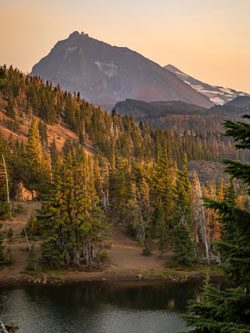
South Matthieu Lake with views of North Sister found off the Scott Mountain Trail, photo Brandon Nixon
Back on the main trail, hikers may proceed 0.8 miles to the wildflower-laden Scott’s Meadow at the intersection with the Pacific Crest Trail (PCT) and the turn-around point.
9.0 miles round-trip (additional 1.6 miles round-trip up to the PCT)
Elevation gain: 1,500 feet
THE SCOTT MOUNTAIN TRAIL
The hike up the 6,116-foot-tall Scott Mountain begins near the Scott Lake campground and proceeds counter-clockwise past stunning Benson Lake.
This beautiful lake sits in a basin gouged out by Ice Age glaciers that once cloaked the Cascades. Farther along, a side trip leads to Tenas (Chinook jargon for “small”) Lakes, a series of shallow ponds ringed with huckleberry bushes. The main trail curves up the flank of Scott Mountain, a glaciated shield volcano, to the summit from which provides a great lunch spot to soak up the views of the surrounding peaks.
From the summit, hikers may retrace their route or extend the hike through coniferous forests and open meadows before passing Hand Lake on the return to the trailhead.
8.2 miles out and back
9.7 miles via Hand Lake
Elevation gain: 1,300 feet
Pro Tips
A day-use Central Cascades Wilderness Permit is required in advance (available on recreation.gov).
Remember your federal recreation pass for the trailhead parking.
A unique framing style once reserved for barns and warehouses is growing in popularity and leading to a new wave of creative homes and structures. Pole barn, or post-frame construction, design allows for walls of windows and breathtaking views, something a conventionally framed home couldn’t easily support. And as the use of pole barn construction gains traction, traditional builders are seeing more demand for barn-inspired homes, including here in Central Oregon.
Metaphorically, the pole barn framing structure of poles and trusses are “tree-like,” said Steve Nuetzel, a Bend-based architect and general contractor who built a few pole barns for clients before deciding he’d like to build himself one as a home. “Pole sounds like it would be round, but they’re actually square or rectangular,” Nuetzel said, explaining that each pole in a pole barn structure is placed twelve feet apart and set four to six feet deep in concrete like a flag pole. Trusses are then bolted to each side.
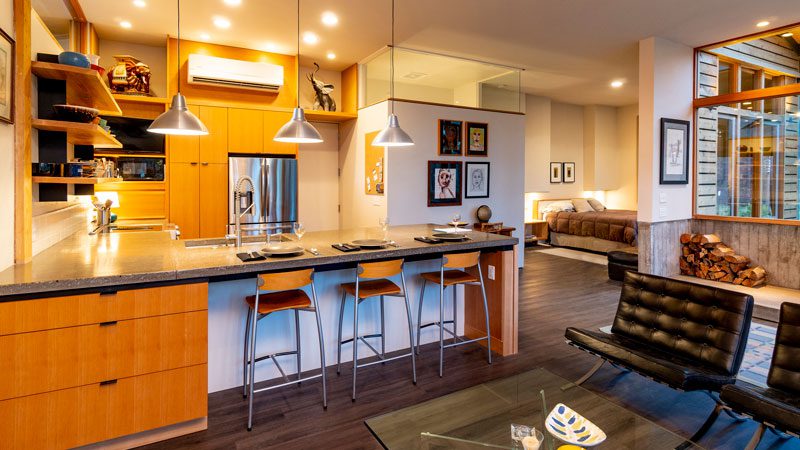
Nuetzel’s pole barn home vision comes to life just south of Sunriver near the Deschutes River, where the indoors transition seamlessly into the live lodgepole and ponderosa pines outside. The barn home is split into a residential side and a workshop area. The residential side includes 1,100 square feet of space with one bedroom, one bathroom, the kitchen and living room. An expansive covered deck just outside its glass doors offers an additional 1,200 square feet of outdoor living space perfect for lounging and dining. The workshop side of the home is the most barn-like, providing another 1,100 square feet for a combination workshop-office area complete with a 14-foot-high door where Nuetzel renovates RVs and trailers.
On the residential side, the home’s exterior is made up of red cedar siding and top-to-bottom walls of windows, interrupted only by the naturally stained Douglas fir poles that support the home, while the workshop side of the building has metal siding. Nuetzel carefully considered aesthetic and efficiency in building a home he would love, installing clear, vertical grain Douglas fir cabinets and concrete slab countertops, polished to a high sheen. The natural materials complement the light, organic feel of the home. “It’s a really uplifting space,” Nuetzel said, explaining the high ceilings, natural light, and views of the sky and treetops through an atrium over the living area make the home feel “almost spiritual.”
Many of the home’s design features are also energy saving, offering long-term cost-effectiveness, Nuetzel said. The roof’s deep overhang shades the home enough that he hardly ever uses his air conditioner, and in winter, an efficient wood-burning stove surrounded by a large concrete hearth absorbs and reflects heat so well, Nuetzel doesn’t use his heater much either.
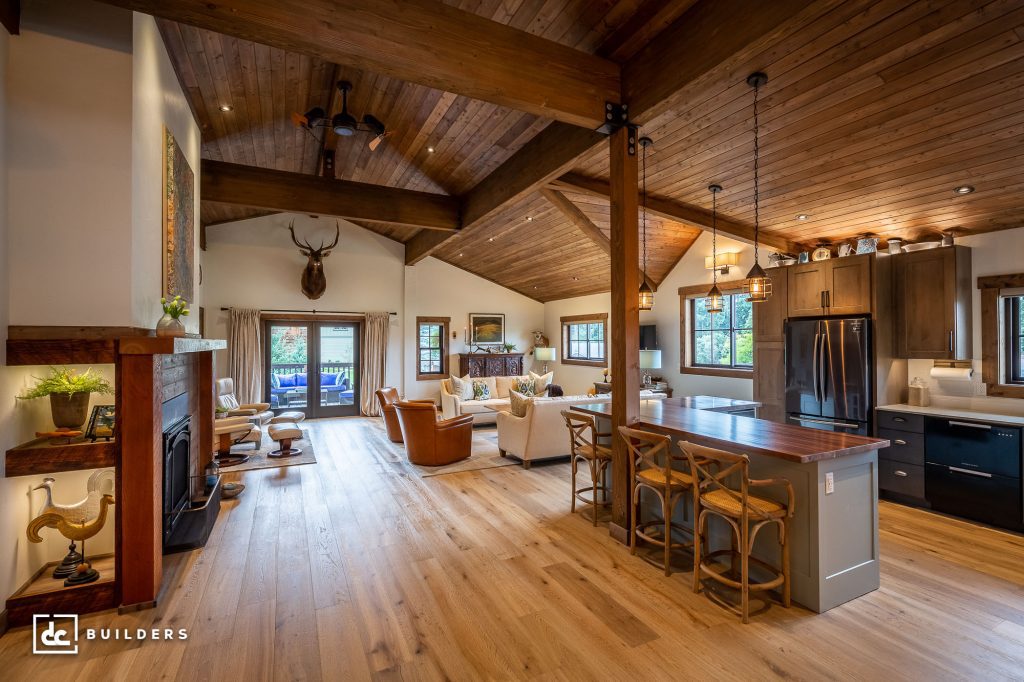
While not technically pole barn construction, DC Builders out of Damascus, Oregon, is known for building barn-inspired residences, which also offer wide open floorplans. One barn-inspired residence built in Central Oregon features a barn-style RV garage downstairs with a spacious living area on the second story.
Generally, pole barn construction is a little more affordable than for a conventional house, meaning homeowners can turn and invest those cost savings into higher-end finishes inside, or save the money altogether.
Cost was a concern for Amber and Josh Blount, who sold their Bend home to purchase a ten-acre property in Terrebonne, with plans to build a custom home. When faced with escalating prices along with labor and material shortages related to COVID-19, they decided to get creative with their construction plans. “We (were) standing at the property and looking at this forty-eight-foot by twenty-four-foot pre-existing (pole) barn at the top of the hill and thought to ourselves, ‘maybe we can make this work?’” Amber Blount said.
Bend-based PJ Hurst Design and PSE Consulting Engineers, Inc. of Klamath Falls were excited to guide the Blounts on their remodel for the home they’re calling “Terrebarn.” Having lived on a Portland floating home, a hobby farm and a unique hillside house in Bend, the family is at home in unusual spaces. And because they rent out their house when they vacation, the Blounts can appreciate the appeal of a one-of-a-kind abode.
photo DC Builders
That fits well with the design style of PJ Hurst, whose motto is to “do the unexpected.” Her design will showcase sweeping views of Smith Rock and local mountains via panoramic windows and incorporate nods to rock climbing throughout, including a climbing wall up to the Blount kids’ secret reading loft and a mural of Smith Rock. With two levels, the three-bedroom, two-bath home will boast high ceilings ideal for a hanging chair and acrobatic equipment hung from the trusses. A library ladder in the kitchen will allow the family to reach high cabinets designed to add storage space.
While construction hasn’t quite begun, Hurst is excited to support her clients in bringing the design to life. “It’s such a cool thing to see a modern family jump into this barn lifestyle and really absorb this as their life,” Hurst said. “It just kind of shows that it’s not just a concept, it’s a way of life.”
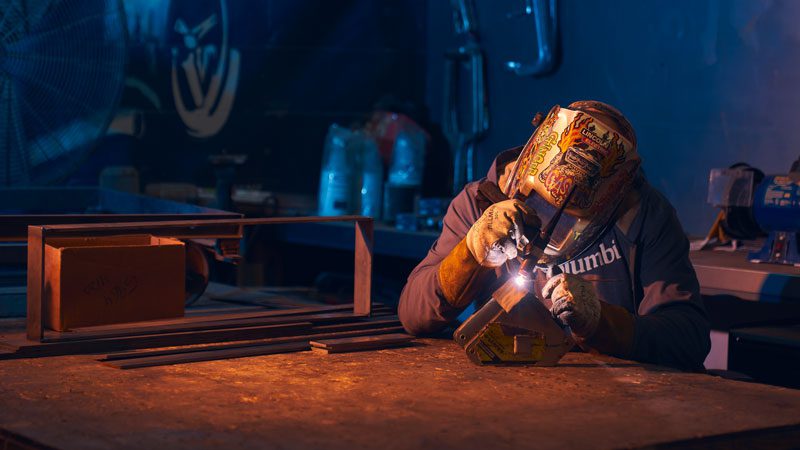
As a second-generation sheet-metal worker and owner of a Bend HVAC company, Paul Shepherd has long been comfortable welding and crafting metal to fit a purpose. But it was only five years ago that he truly let his creativity start shining, when he was asked to create a copper range hood for the new home of a Shepherd Heating & Air Conditioning client. With no interest in taking the easy route, Shepherd crafted an intricate and beautiful copper hood that well exceeded the expectations of the homeowner. “The range hood was a piece of art, which we knew as soon as we saw it done,” said Connie Perala, owner of the home in the Crosswater neighborhood of Sunriver. It wasn’t long before Shepherd was also forging hardware for the kitchen cabinets, welding steel brackets for the interior beams, and creating a custom tile backsplash behind the oven range. Unknowingly, Perala had become one of the first customers of Shepherd’s future business, Forged Elegance.
Building a business
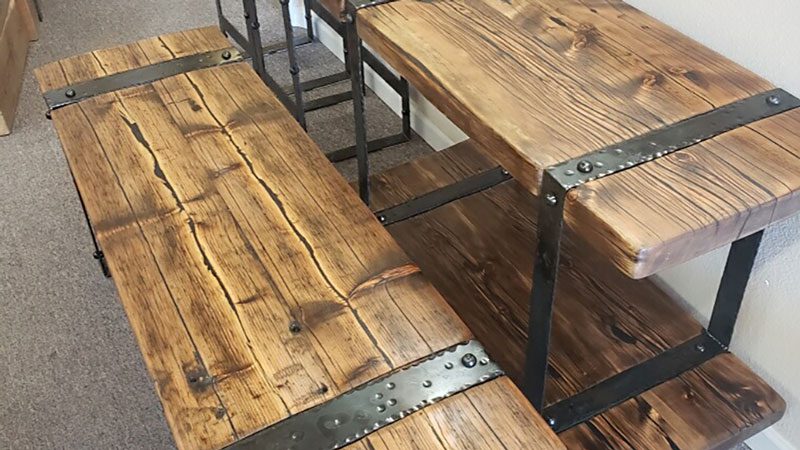
Today, five years after creating those first custom pieces in Perala’s kitchen, Shepherd has shifted his focus to crafting gorgeous wood and forged steel furniture, including beds, tables, chairs and mirrors. The wood is almost exclusively sourced from historic structures, which are torn down and given new life through Shepherd’s work. And the metal is hand-forged by Shepherd in his shop in Bend. Together the wood and metal come together in artistic elegance to create showpieces for homes near and far. While Shepherd is the man behind the magic, he also relies on help from his team, which includes his wife, Amanda Shepherd, who helps with design and finish work, full-time shop worker Shawn Allen, sub-contractor Brad Pinkert and Shepherd’s son, Jacob, who helps with steel work. Shepherd still operates the HVAC business he owns, but often spends his early mornings, between 4 and 7 a.m. at his Forged Elegance space in Bend, restoring and preserving aged woods or hammering out the details of steel accents. It’s become a labor of love for a craftsman always looking to design something new and different.
Barnwood revival
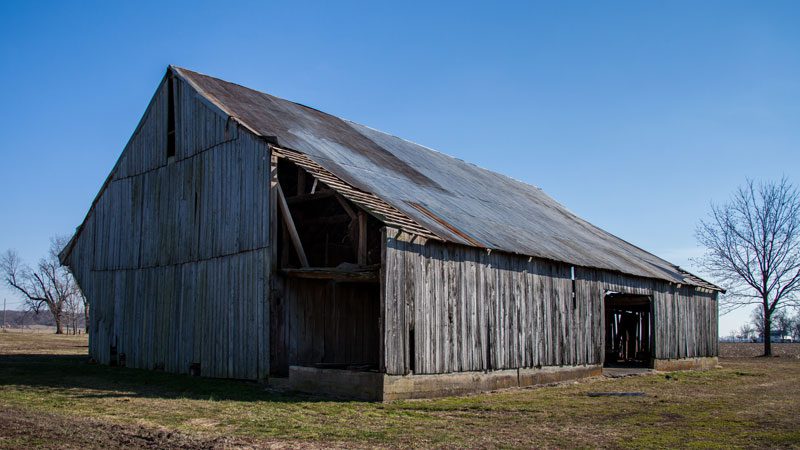
Wood for Forged Elegance’s projects comes almost exclusively from historic structures slated for demolition. Shepherd works with Brad Campbell of LongHorn Lumber in Powell Butte to source the aged wood, which has come from right here in Oregon and as far away as Missouri. One of Shepherd’s first hauls of barnwood was from a ranch in Spray, a town of about 200 people in rural eastern Oregon. The fir wood was 100 years old when it was used for construction on the Buffalo Ranch, where it existed for another 104 years, making the salvaged lumber more than two centuries old. “This barnwood holds a large amount of history in each piece, representing America through agriculture,” said Shepherd in a writeup about the wood collection, now being used to craft tables, bedroom furniture, benches and mirrors.
Another nearby salvage is that of a water tower built along the Umpqua River in Central Oregon in the 1970s by the Forest Service. The tower, made of beautiful 800-year-old redwood, fed water to the Steamboat Inn in Idleyld Park. The area was hit by a wildfire in 2018 and the water tower’s roof caught fire, rendering it unusable. But, the tower stayed intact and after coming down, Shepherd purchased all of the wood to reuse for his Forged Elegance pieces.
For Campbell, who acts as a lumber broker sourcing the aged woods for Shepherd, seeing the finished products is a special experience. “I’ve known Paul for several years, and I’ve got to see his work as it’s kind of progressed. I like the unique designs he comes up with and how he utilizes the material,” said Campbell. “Often times it’s 100-year-old wood and it’s not the easiest to work with. I’ve worked with it a bit myself.” Campbell has been salvaging and reclaiming wood for thirteen years and said most of the lumber he procures is supplied as raw material to builders. “Paul’s really been a bright spot in my business to see the smaller pieces that can’t be used in the construction of a home go towards furniture and things like that,” Campbell said. “The added value with the forge work is what really sets it apart. He’s blended together the wood and steel into almost artwork.”
One of the newest hauls of wood that Campbell helped connect with Forged Elegance is from an 1860s barn in Missouri with a unique story. At the time, wealthy plantation owners sometimes paid the less wealthy to fight in the Civil War in place of themselves or a son. In this case, the currency was a plot of land, which would only be given to the replacement solider if he returned from war. This individual fought in place of the plantation owner’s son, surviving the war and returning to get the land. He built a barn using bald cypress trees on his new property in 1865. More than 150 years later, the barn was torn down, the wood salvaged and transported to Oregon, where Shepherd began repurposing it. “Everything has a story behind it,” said Shepherd, while giving a tour of his Bend showroom in September. “Not only is that bald cypress piece over there absolutely beautiful, but it’s got an amazing story that you can tell your friends. It was built in 1865 and it will probably still be around another couple hundred years from now.”
Forging a following
As Forged Elegance has gained its footing over the past year, Shepherd has picked up many repeat customers who are using his furniture and décor to transform their homes into spaces that showcase his work.
Bend homeowner Kim Hogue is the owner of several Forged Elegance pieces, including a four-post bed, nightstands and an oak, bar-height dining room table. “Kim gave me the freedom to have full run over the design of all their pieces,” said Shepherd, who works with his wife to dream up and design just how the steel and aged wood come together for each item. “She fell in love with a coffee table first and bought it, and then started asking for more pieces.” Hogue’s nightstands use thin strips of salvaged wood, milled down from larger pieces. “It’s a very intricate piece,” said Shepherd, who finds uses for even the smallest bits of wood and shavings of metal around his shop. “We try to use everything.”
Paul Shepherd
For Perala, one of Forged Elegance’s first customers, time has only made her more enamored with Shepherd’s work. This summer, she commissioned him to create beautiful new furniture for a second home in Tigard, using the redwood salvaged from the water tower impacted by wildfire. She’s seeking more contemporary pieces for her home there, versus the more rustic work in her Sunriver home. “I like the history,” Perala said. “The tables he’s making for the Tigard house are the 800-year-old redwood he has. I just love the history behind the wood.”
Shepherd opened his Bend showroom, office space and shop in 2020, and uses it as a place to showcase bedroom sets, office furniture, multiple dining tables, mirrors and more. It’s open by appointment only but is a great place to see the vastness of what the company can create. For a smaller peek at Shepherd’s work, Bendites can pay a visit to the new Italian restaurant on Galveston Avenue, Bosa. Shepherd used chemicals to create a patina for the columns behind the restaurant’s bar, and then stuck around to make forged curtain rods on the wall of windows facing the street.
Customers new and old are also invited to follow Forged Elegance on Facebook, where Shepherd posts new pieces as they’re completed, sometimes selling them within minutes or hours to dedicated followers of the work, who appreciate the craftsmanship and history behind it. The combination of aged wood and forged steel is something Shepherd is proud to share with those interested. “Forging in general is probably one of the oldest trades and there are not as many people that are able to do it anymore,” he said. “It’s so unique and it’s so stunning when you pair it with this aged wood. It’s an art.”
When Sam Elcik and Sumra Zaidi relocated to Bend in 2020, they hoped to find a home in a quiet neighborhood, near green space, with easy access to downtown Bend. It seemed an impossible checklist until they toured a home for sale in the Boyd Acres Neighborhood, near Sawyer Park. “I was hesitant when our realtor suggested this area, but it checked all the boxes for us. We can get on the river, walk the dogs in the park and bike downtown. Most of all, we love the quiet,” Elcik said. The couple is far from the only new Bend residents settling into Boyd Acres. This neighborhood is among the largest in Bend, yet its livability is often overlooked.
One neighborhood, many options
Boyd Acres encompasses the northern tip of Bend, from Cooley Road and Juniper Ridge south to the Pilot Butte canals. The Deschutes River defines its western edge; Pine Nursery Park sits at the eastern boundary. Within those landmarks, locals find a lively mix of shops, parks, restaurants and industry. Those who hope to call Boyd Acres home will find a variety of home styles and sizes, from spacious lots in established subdivisions to newer streets with more modern construction.
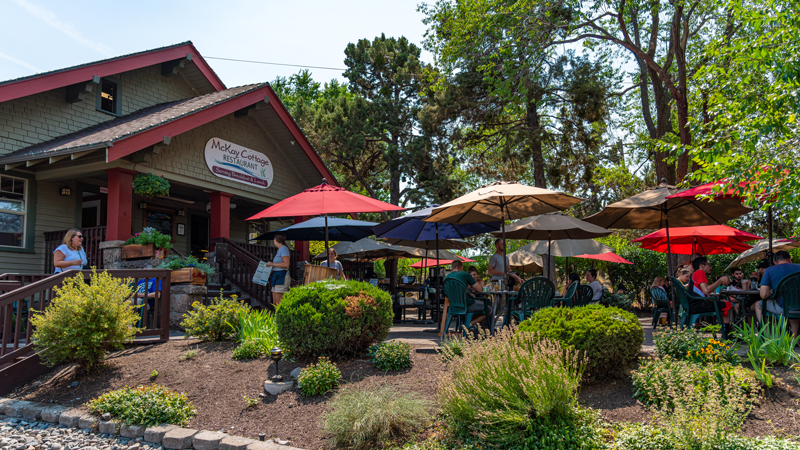
McKay Cottage
“Boyd Acres has long been considered more affordable, and the diversity of subdivisions attracts homebuyers,” said Lynnea Miller, principal broker at Bend Premier Real Estate. Lot sizes have changed over the years, as state regulations have encouraged greater density. “Older properties can have larger, family-friendly yards, but the homes might need updates. Newer homes are turn-key, with few surprises—perfect for those who don’t care for maintenance,” Miller said.
Because of the range of homes available and wide swath of town considered part of the neighborhood (the Boyd Acres Neighborhood Association lists seventy-five subdivisions within the neighborhood), defining an average home price is tricky. Generally, the area is attractive to buyers looking for more affordability than other areas of Bend, especially families. It’s also home to Bend’s newest and northernmost elementary school, North Star Elementary, which opened in fall 2019 to help alleviate overcrowding in the Bend-La Pine School District.
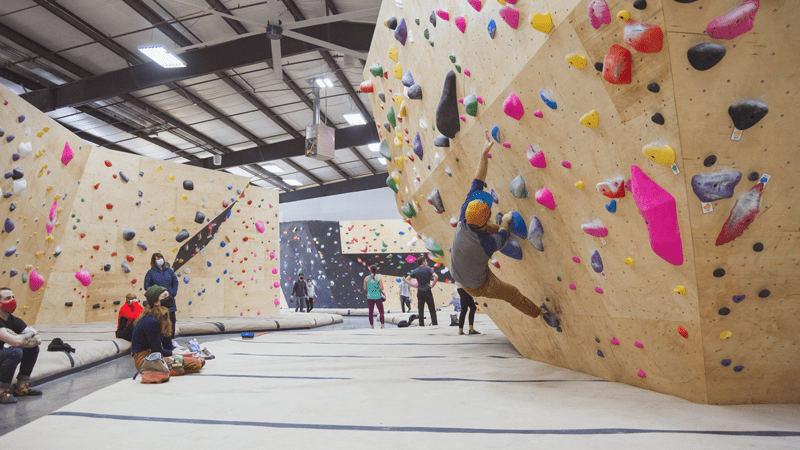
photo courtesy The Circuit Bouldering Gym
From Ranches to Restaurants
Despite the recent development boom, bits of history can be found throughout the neighborhood. The area is named after Charles and Anna Boyd, who moved to Bend from Montana in 1904. They built their homestead, the heart of their 600-acre cattle farm, on the site of the Bend River Mall. The original buildings still stand and are now home to Pomegranate Home & Garden.
McKay Cottage, a well-loved brunch spot, resides in another piece of Bend history. The restaurant was originally the home of Olive and Clyde McKay and was first located near Drake Park before the structure was relocated to OB Riley Road. Clyde McKay was a driving force behind Bend’s turn-of-the-century timber industry; McKay Park is also named after him.
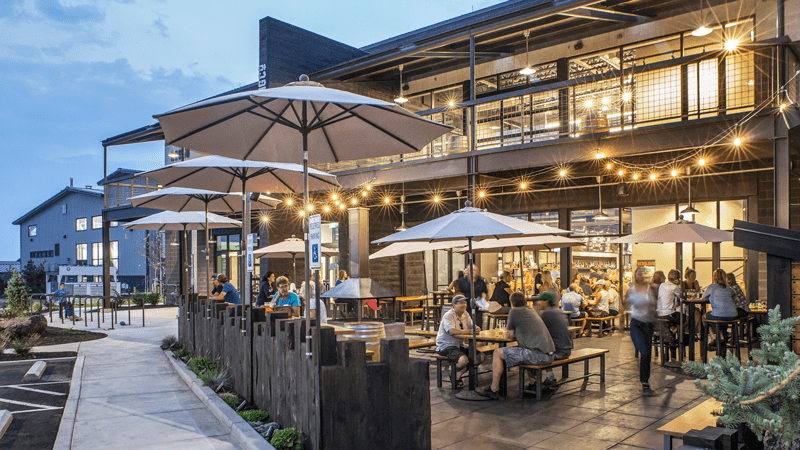
10 Barrel Brewing, photo Pete Eckert
Bend has long since grown beyond ranching and timber, and Boyd Acres is now home to a bustling business community. Most visible are the large retail clusters such as Cascade Village and Bend River Promenade (with its new WinCo Foods supermarket), which make Boyd Acres a shopping destination. Bend’s entrepreneurial spirit truly shows up in the mixed industrial spaces where small manufacturers such as SnoPlanks and Left Coast Raw mingle with traditional industry. Fitness and recreation businesses such as The Circuit Bouldering Gym, Cascade Indoor Sports and K1 Speed, an indoor go kart racing venue, also thrive here, making active recreation part of daily life for Boyd Acres residents.
Scattered throughout are brew pubs and restaurants, so local diners can stay closer to home. Some establishments, such as Chi Chinese and Sushi Bar and Craft Kitchen, have relocated from other Bend locales. Others are unique to the neighborhood, such as Bridge 99 Brewery, 10 Barrel Brewing East Side, Oblivion Brewing and Wild Roots Coffee.
K1 Speed, photo Alex JordanChi Chinese and Sushi Bar, photo Talia Jean
Parks, Trails, and Gathering Space
No neighborhood is complete without access to green spaces. Boyd Acres is flush with parks and trails. Local runners and dog walkers frequent the pathways alongside the Pilot Butte canals. These open canals, dug mostly by pickaxe and shovel more than a century ago, continue to bring water to farms outside of Bend.
In addition to small parks and playgrounds, several larger parks offer additional recreation options: Pine Nursery Park is primed for play, with 159 acres of sports fields, pickleball courts and an off-leash dog area. Rockridge Park buzzes with action on its lunarscape skatepark, bike skills course and log-scramble playground. For a quieter experience, the trails at Riley Ranch Nature Reserve amble along a Deschutes River canyon; the trails at Sawyer Park connect to the Deschutes River Trail toward downtown Bend.
More development is on the horizon in Boyd Acres, too. Second locations for Costco and Fred Meyer are planned for the north end of town, and the Deschutes County Central Library is slated for construction just beyond the northwest boundary of Boyd Acres. In addition to books and media, the library will serve as a community center for programs and events, and act as a general gathering space for community members.
Sometimes when there’s a product we wish existed, but can’t find, we settle for less. But what if it’s for something as personal as your skin? For four Bend beauty and skincare businesses, a lack of natural offerings led to innovation.
Forbes estimates the beauty industry is a more than $500 billion business worldwide. The skincare industry is growing too, expected to be worth more than $200 billion by 2026, according to a report put out by Fortune Business Insights. In huge global industries, how do Bend-based businesses stand out and find success?
“I think it’s a very holistic lifestyle here. People who move here want to get outside of big cities,” said Mandy Butera, owner and founder of Wren and Wild, a clean beauty boutique. “You have these people who are not only taking care of their bodies and their families, but they need the right products to put on their skin as well.”
Wren and Wild
Mandy Butera loved working for Estée Lauder, Clinique and Origins for decades, until discovering more about major brands’ product ingredients, some of which consumers question for being harmful. But with long ingredient lists full of complicated names, products can be difficult to research. Butera envisioned connecting people to the clean products she sought.
“Our goal is to find the best of the best for clean beauty,” Butera said, explaining that her company Wren and Wild offers products that involve no animal testing and ingredients that won’t harm the skin and body. After starting as a pop-up, Wren and Wild opened its own shop in 2018, doubling its sales from the year before, and doubling again every year since with wildly popular online sales driving numbers up. Wren and Wild curates products in one place where an expert team is excited to connect and consult with customers about their needs. So far, the boutique has sold a collection of clean beauty products, without offering its own brand. But Butera said a product line is in the works—something she’s excited but tight-lipped about.
Dwight Johnson and his wife Marilee couldn’t bear watching their son suffering from eczema ten years ago. Store products often had ingredients that irritated him even more. Then Johnson learned about goat milk’s healing enzymes and began experimenting in his home kitchen. Eventually, he landed on a goat milk soap formula that lathered well, binded to grime and easily rinsed off, leaving his son’s skin happy.
Since those humble early days, Bend Soap Company has grown into a $5 million business, with about 75 percent of sales made east of the Rockies. Never growing less than 50 percent year to year, the company has reached up to 100 or 200 percent growth. At the heart of it is still Johnson’s team, mixing up all-natural soap batches in Bend with milk from his own goat farm.
Johnson admitted people may ask why Bend would be a skincare or beauty center. “We’re not near a harbor. What it comes back to is we enjoy a natural lifestyle. We ended up in Bend because of that. The product we create is a solution to solve a problem.” Good solutions, it turns out, work anywhere.
Bend Soap Company | 63257 Nels Anderson Road #110 | bendsoap.com
Angelina Organic Skincare
Angelina Swanson had already been studying botany, working in a natural food store’s herb department and taking a salve class twenty-eight years ago when she developed cracked heels and hands from her part-time rafting guide gig. Unsatisfied with anything on store shelves, Swanson created her own formula—Skin Doctor Salve, which is still a bestseller today.
It was twenty years ago in Bend that Swanson decided to pursue skincare as a business, starting with a KitchenAid mixer in her log cabin before growing into a “results-driven farm-to-face skincare brand” with a store on NW Bond Street where products are made on-site.
Swanson is proud of some of the goals Angelina Organic Skincare has hit in the last few years, including matching retirement benefits for employees, offering a month of vacation and free health care; not to mention the vision she holds for her products. “We say ‘full circle beauty.’ Everything we do in our business has to create more beauty in the world than destruction,” Swanson said.
Ericka Rodriguez initially pursued making lipsticks she wanted—vegan products not tested on animals that wouldn’t dry out her lips. Now a planet-first, full-vegan color cosmetic company, Axiology is carried in stores including Ulta and has an international customer base as passionate as Rodriguez is about ingredients.
Rodriguez started in home kitchens in Brooklyn, then Bali and finally Bend, the perfect place to launch Axiology in 2014. Selling in national stores has been a huge accomplishment but brought with it the challenge of keeping products up to Rodriguez’s high standards, something she’s determined to do. When large-scale production didn’t offer the same attention to detail her team did, Rodriguez quickly took production back to small batches in Bend.
As Axiology transitions from lipsticks to various color cosmetics (the popular balmies launched on Earth Day 2020 can be used on lips, eyes and cheeks), Rodriguez said that trend will continue in 2022, with the launch of a new product like nothing the company has offered before.
When Sue and Scott Olson first entered the Vandevert Homestead in 2018, it was shuttered and inhabited by birds. But the couple saw past the crumbling structure to the clear views of Broken Top and Mount Bachelor, the sounds of the bubbling Little Deschutes River that meanders through the site and the historic importance of Vandevert Ranch.
Luckily for both the ranch and the Olsons, it was a classic example of the right people at the right time. They made an offer within an hour.
Saving a piece of history
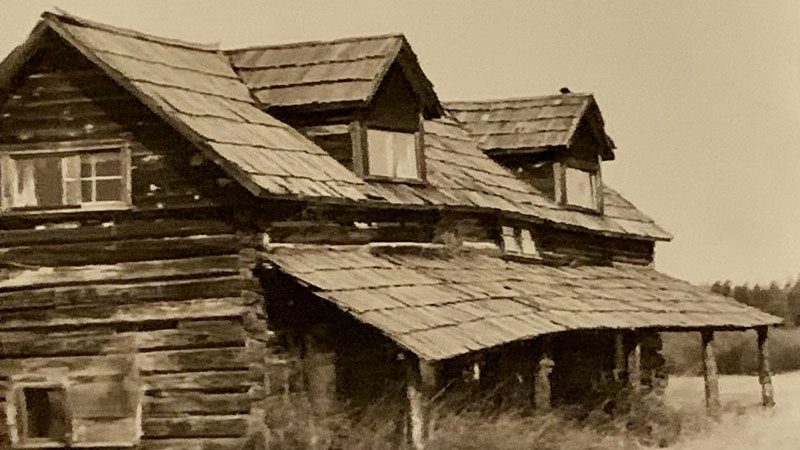
The Vandevert Ranch history dates to 1892, when William “Bill” Vandevert acquired 160 acres near today’s Sunriver, although at the time there was no Sunriver, no Bend and no Deschutes County. He built a log home and schoolhouse for his eight children and wife Sadie. Successive generations of Vandeverts lived in the homestead for nearly a century.
But by the 1980s, the home’s lodgepole and ponderosa pine logs were in rough shape. According to the 2011 book Vandevert: The Hundred Year History of a Central Oregon Ranch, by Ted Haynes and Grace Vandevert McNellis, the homestead was slated for auction in 1987. Just before the place landed on the auction block, Jim Gardner, the outgoing president of Lewis & Clark College, and his wife Carol, bought the property.
They had a vision for the ranch’s restoration, but soon realized the homestead was beyond saving. Their plan was to build a replica using some of the original logs. Instead, a contractor’s mistake led to an entirely new replica log cabin. The couple also acquired adjacent acreage and developed a 400-acre gated community around the replica homestead and its Sears and Roebuck kit guest house, which had been added to the ranch in 1953. The Gardners stipulated that any new home in the Vandevert Ranch development would have to be built of log construction.
The development flourished, and to this day, Vandevert Ranch is a neighborhood consisting of twenty-two individually owned lots and common areas, including stables, dog kennels and a fly-fishing pond. It remains true to its historic roots of 130 years ago, and is considered one of the country’s finest log cabin communities, prized for its scenic location and privacy.
Eventually, the replica homestead at the center of it all began its own period of decline. “We heard that one group had it under contract and planned to tear it down for another home,” Scott said. “But the neighborhood architectural committee denied this plan. The neighbors have always understood the importance of the homestead’s history.”
Restoration Begins Anew
The Olsons hired Bend architect Jeff Klein of Klein Architecture in 2018 to oversee the design and renovation of the home and a new barn, and to shepherd them through work with the neighborhood design review committee and the nine separate county approvals necessary to receive the building permit. The guiding tenet in the homestead was to save as much of the structure as possible and create a more livable environment.
While the look and style of the exterior would remain the same, the 3,200-square-foot interior would undergo several changes and upgrades. In 2019, they began by converting a small, unusable attached garage into a sunroom. The flat roof over the garage leaked, causing extensive damage to the log structure. They retained the flat roof, but to prevent further water damage, Klein worked with the framers on designing a sloping roof system with a waterproof membrane to channel water away from the building’s exterior. This also created an ideal space for a rooftop deck, accessible from the upstairs master wing and guest bedroom.
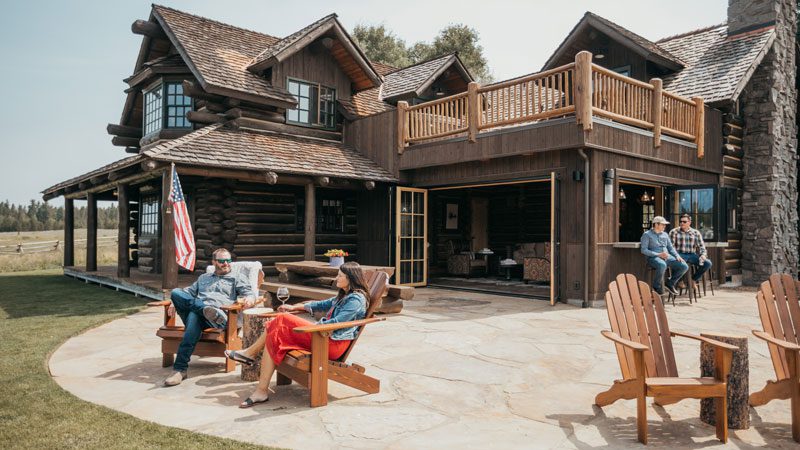
The main floor is rectangular with four quadrants—sunroom, kitchen, living room and dining room. The sunroom functions as a casual place to hang out. In a nod to modern design, giant windows and a door open accordion-style for indoor-outdoor living. The sunroom also filters more natural light into the home. “The sunroom opened up the house and gave us more interaction with the river,” Scott said, referring to the nearby Little Deschutes.
Unlike many owners who acquire an older home and can’t wait to remodel the kitchen, the Olsons left the 1980s-era kitchen intact, including a farm sink, concrete countertops, butcher-block-island and built-in seating. They converted a former sitting room and office into a dining room with a fireplace, and furnished it with a large custom-made wood table for hosting their extended family and friends.
Scott, Sue, Max and Michael Olson enjoying their back patio and the sunroom with its accordion-style doors and windows.
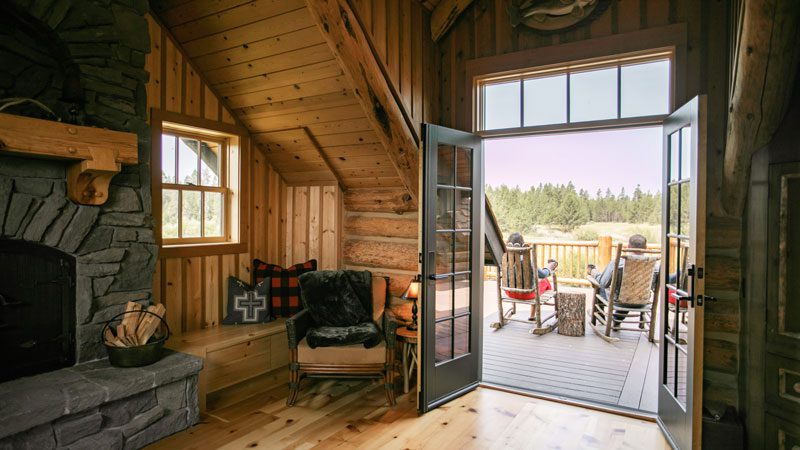
The crown jewel of the home can be glimpsed from the modest front entryway. An archway leads to the dining room on the left, while another is a gateway to the grand living room on the right. The wood-burning, stone fireplaces in each room, made with materials sourced from the property, face each other through the arches. Remarkably, Robin Zinniker, the mason who built the great room’s two-story fireplace in the 1980s, was still around to create the fireplace in the dining room, which shares a chimney with an upstairs guest bedroom fireplace.
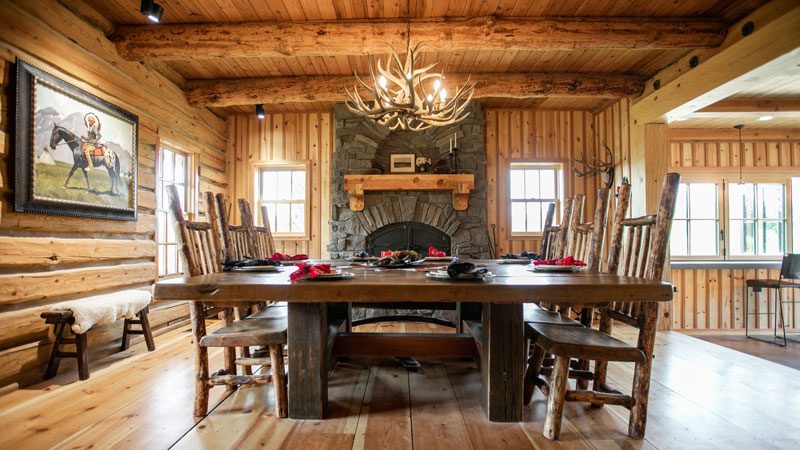
The living room’s vaulted space with exposed timber trusses includes a wrought-iron bottom chord to carry both the tension and bending of the trusses. A large authentic antler chandelier, an elk head over the mantle, a larger-than-life-size photo of a grizzly, and Western-themed artwork and furniture are perfect complements to the massive log walls.
The living room along with other parts of the house feature the Vandevert hash knife, a tool used to cut meat. It was incorporated as the ranch logo when the Gardners developed the ranch, in a nod to the Vandevert cattle ranching family history. “We put it everywhere we could, such as the front door knocker, fireplace door handles and light fixtures,” Sue said.
The original log cabin didn’t house people who owned cars, sports equipment like skis and bikes, or even laundry rooms, but they did have barns. So, Klein designed an entirely new structure near the homestead resembling an old-fashioned barn but with all modern amenities “hidden” inside. The two-story “barn” features a three-car garage, laundry, gear room, Scott and Sue’s office and an entertainment room with a covered outside deck and views of the mountains.
With the renovated homestead, the new barn and the Sears and Roebuck kit guest house comprising the Olson compound, the family is enjoying its lifestyle on the historic Vandevert Ranch. “We have a home for all seasons,” Sue said. “We love the roaring fires and snow in the winter, and in the summer, sitting at the river with people floating by our dock. We have many ways to enjoy nature. We feel honored to have had the opportunity to restore this property with its historical significance.”
Scott added that they have friends still searching for their special place, “But we’ve found our home. We’re here for the long-term and who knows? Maybe grandkids in the future.”
Resources
Project Planning, Entitlements and Approvals: Vandevert Ranch HOA Board of Directors, Vandevert Ranch Design Review Committee, and Deschutes County Historic Preservation and
Historic Landmarks Commission
Picture a chilly fall morning, the sun not yet above the horizon. The household is quiet, but the early riser knows the rest of the residents will be up soon, hungry and craving a treat. Dig into an early morning muffin baking session and make the whole household happy. Here we feature three tried-and-true muffin selections for the fall season.
Cranberry
Tart and sweet, colorful and tasty, cranberry is a standout choice for a fall muffin. Nearly 3,000 acres of cranberries are grown in Oregon, producing 40 million pounds of the berries each year. Most are grown on the Southern Oregon coast, where the temperate climate along the coast affords a long growing season, giving the berries a darker pigmentation than berries grown in other states. Oregon cranberries are harvested from mid-October to mid-December. Order some online from Cape Blanco Cranberries, fresh or frozen, and bake to your heart’s content.
Oregon grows more than twenty varieties of apples, producing a whopping 110 million pounds a year of the famous fresh fall fruit. Most are grown in the region around Portland, most notably the Hood River area. Make a trip north this fall and drive the Hood River Fruit Loop, featuring dozens of orchards and farmstands to shop from. Try Kiyokawa Family Orchards or Packer Orchard. Common apple varieties grown in Oregon include Jonagold, Granny Smith and Braeburn, but the Honeycrisp and Ginger Gold are great choices for baking. One of many advantages to the apple muffin is its moist texture. Dice the apples small for best results. Dig in—you’re getting your fruit for the day, too!
Making pumpkin muffins from scratch might sound impossibly difficult, but it isn’t really. Buy a pie pumpkin from your local grocer, pumpkin patch or a harvest market. Slice it open and remove the seeds. Bake it upside down in a baking dish filled with an inch of water. Scoop out the baked pumpkin and puree. Treat it just like the canned stuff, and follow your favorite recipe. Voila! You can freeze the leftover pumpkin puree for a year, and make tasty fall pumpkin muffins all year long.
This easy cinnamon and brown sugar pumpkin recipe looks irresistible!
Editors note: This story was originally published on September 29, 2020.
Brian Trottier was backpacking through Buenos Aires years ago when he met up with his sister, who worked at a Four Seasons. She put Trottier up in a room on the same floor as the hotel’s executive lounge. Trottier walked inside to find an endless supply of snacks and drinks, and ended up spending most of his stay right there, even inviting his friends from a nearby hostel over to reap the tasty “executive” benefits. “The term executive lounge has always been this moniker for pretending we’re fancier than we are,” said Trottier, who opened downtown Bend’s San Simón with his wife, Ashley, in October 2019. Tucked away in Tin Pan Alley, Trottier describes San Simón as a candlelit, romantic, bohemian bar, with no TVs, and “as a place for adults to actually talk to each other.” The menu features handcrafted cocktails, a few beers and other drinks and some cheaper options, like $3 PBRs, along with charcuterie boards to snack on. As fall approaches, stop by for a belly-warming mix of bourbon and ginger with the Executive Lounge cocktail. A visit to San Simón is as good of an excuse as any to pretend we’re fancier than we are.
Executive Lounge Cocktail Recipe
2 oz. bourbon
½ oz. ginger rosemary simple syrup
¼ oz. fresh squeezed lime juice
4 mint leaves, plus 1 sprig of mint
3 sprays of peated scotch
Shake together bourbon, syrup, lime and mint leaves. Double
strain over a big ice cube and use an atomizer or spray bottle to do three sprays of peated scotch. Garnish with a mint sprig.
Ginger Rosemary Simple Syrup
1 cup of fresh ginger juice
Fresh rosemary
1 cup boiling water
½ cup sugar
Steep fresh rosemary in hot water for three minutes. Remove the rosemary and add the sugar to the hot water. Mix the hot sugar water with the ginger juice to create ginger rosemary simple syrup.
Janessa Bork lived a childhood full of experiences that make her the self-proclaimed “wild child” she is today: an active competitive snowboarder, dirt biker and skateboarder. Born in Bend but raised in Bozeman, Montana, Bork spent her days running free, playing outside and absorbing all the beauty that exists in the abundant mountains and forests of Montana.
Janessa Bork in front of the mural she created at Dr. Jolly’s
Her family eventually moved back to Bend, where Bork graduated from Mountain View High School. Since then, she’s moved around but always manages to make it back to Bend. “This is my home, and I love it so much,” Bork said.
Being the child of a rug weaver and an artisan mason, Bork remembers having her creativity cultivated from a young age. “My mom used to help put on summer art camps when I was in grade school and it definitely helped shape my desire to make and create things with my hands,’’ Bork said. “I worked for my dad in the summers doing masonry and construction which taught me a lot about building.”
Fresh out of high school, Bork took a painting class at Central Oregon Community College and met her would-be husband, Josh Ramp. Ramp had just graduated from high school in Alaska and decided to make a new life in Oregon, where he had family. He had dabbled in painting and drawing in high school, and was exploring the subject in Bend in a traditional painting techniques class taught by Professor Bill Hoppe.
Close-up view of the mural at San Simon
“The second we met we were magnetized to one another,” Bork said. “We’ve been together through the thick of it, and it’s really shown our strengths and dedication. We’re far from the perfect couple but we have created our dreams from nothing and stuck to our guns, and I’m so happy it’s starting to pay off.”
The two fresh-faced grads moved to Portland in 2008 to pursue design school together, after Hoppe took note of Bork’s affinity to the arts. After graduating in 2011, the duo worked separately as freelance artists, illustrators and designers, eventually moving back to Bend in 2017 to live the quintessential Central Oregon lifestyle full of high adrenaline sports and ample time spent outside. Bork, in tandem to her art career, had become a snowboarder who is sponsored by Mt. Bachelor, BlackStrap and others.
Graphic design can oftentimes be a job that requires one to sit in front of a computer for hours on end; a stark contrast to an adrenaline-filled lifestyle. Bork decided that a desk job just wasn’t for her. “I realized the last thing I wanted to do for a career was stare at a computer all day,” Bork said. “After a few freelance jobs, I realized I could merge traditional painting techniques with modern design to create a unique quality aesthetic that stands out from the rest.”
To capitalize on that realization and create a career that isn’t exclusively relegated to a computer screen, Bork and Ramp founded VIVI DESIGN CO. in 2018. The company specializes in environmental design, product branding and hand-painted craftsmanship, which translates to designing and painting tons of murals for local businesses. “Our creative process includes analog and digital techniques,” Bork said. “We utilize digital programs and hand-drawn graphics to get that exact design we visualize for a seamless, distinct look.”
Just another day at work for Janessa at Josh
The name VIVI has a couple of meanings for Bork and Ramp. “The letters look so aesthetically pleasing next to one another, resembling two halves as one whole through compound words,” Bork said. “The word vivi is from Latin descent, meaning ‘to live, living and alive.’”
Bork goes on to explain how this Latin saying encompasses her and her husband’s daily life; to live with design, to feel alive through design and to live through habitual creativity.
VIVI DESIGN CO. can be found locally in many murals around Central Oregon, including murals done for local businesses such as Dr. Jolly’s, Backporch Coffee Roasters, Kefi Fresh, the Cottonwood Cafe in Sisters, Pioneer Cannabis Co. in Madras and many others. Currently, VIVI DESIGN CO. is designing a mural for a local plant shop, Somewhere That’s Green.
Nate Decker’s fascination with beautiful wood and the stories behind it started in Hawaii, when he was growing up on Maui and later living on Kauai. Highly revered and endemic to Hawaii, koa wood is strong and light, and Decker learned to make things like picture frames and paddles from it, while also experimenting with mango and monkeypod woods. After making the move to the west coast nearly six years ago, Decker landed in Bend, setting up his modest woodshop in the garage of his new home on the west side of town.
With Bend as a home base, he traveled to Montana, where he used his professional background in hotel sales and marketing to help develop a large cattle ranch into a “dude ranch” destination. It was there he saw how purposefully new life could be given to old wood through projects happening on the ranch. “I was very inspired by how they used this barnwood,” said Decker, who began sourcing his own barnwood back in Oregon.
Decker’s signature piece became a mountainscape of five peaks in the Cascade Range—Mount Bachelor, South Sister, Middle Sister, North Sister and Broken Top—created with repurposed wood from old Oregon barns or other structures. For each piece he creates, Decker can explain exactly where the wood originated, showing old pictures of structures and providing the history of how he came across the materials, whether it’s lath from a 90-year-old house being knocked down in Bend, wood from an old barn he helped tear down in La Pine or Lakeview or blue pine harvested on Santiam Pass after one of last summer’s forest fires. He spends hours carefully milling the wood, preserving details such as cracks, fading, weathering or bits of lichen that add subtle color. “Old wood has textures that you can’t recreate, that only sun, rain, wind or snow can (create),” he said.
Decker officially launched his company, Five Peaks Woodworks, in 2020. An outdoorsman and certified mountain guide, Decker has always been drawn to the mountains. “Mountains are very inspiring to me,” he said. “They’re beautiful. They humble you, and they test you.” In addition to mountainscapes of the Pacific Northwest, desert inspired scenes and other designs, Decker also creates live edge cutting/charcuterie boards. The boards are designed to showcase the unique features of each piece of wood, with epoxy used to fill in cracks, sometimes adding pops of color to rich wood tones. He works with Epilogue, a lumber mill south of Portland, to sustainably source lumber from trees taken down by tree removal companies in urban areas. The wood would otherwise become wood chips or firewood but is instead given new life by Decker and other customers.
Five Peaks Woodworks
Sustainability fits in with Decker’s lifestyle, which revolves around time outdoors, on ranches, in the mountains, tending to overflowing garden boxes just outside his workshop and exploring with his dog, Bambam. The mild-mannered American bulldog and boxer mix was the first dog rescued by Real Good Rescue, a nonprofit based in California that Decker co-founded. Bambam hangs around the shop below Decker’s house most days, but heads upstairs when things get too loud or dusty, or when projects last late into the night. Some pieces can take days to create, especially when factoring in the time Decker spends sourcing wood (often helping to tear down barns), traveling around the state, milling and then imagining a new life for the materials through his designs. That time spent becomes part of the story of each piece of wood, carefully repurposed on a customer’s living room wall. “Whenever I make something for someone, I’m able to share the story behind it,” Decker said. “I think the extra effort is worth it.”
See Five Peaks Woodworks latest creations at fivepeakswoodworks.com. Charcuterie boards are available at Newport Market, 1121 NW Newport Avenue in Bend.
Editors Note: This article was originally published September 2021
Rob Little knew the power of the outdoors. He spent his youth hiking and camping in the mountains surrounding the Southern Oregon town of Medford where he grew up. His passion for outdoor recreation never waned and while studying creative retail strategies during his MBA program at the Wharton School of Business at the University of Pennsylvania, Little and classmate Jared Peterson formed the seeds of what would later become Cairn—a subscription box service for outdoor gearheads, delivering curated products for camping, backpacking, hiking and other outdoor-related activities. Little and Peterson saw the success of companies doing similar concepts across the clothing, pet and food industries and modeled this same approach to the outdoors, which had not yet been done.
Cairn
Founded: 2014
A monthly and quarterly subscription box service for outdoor recreation consumers, delivering curated products for camping, backpacking, hiking and more.
Owners: Co-CEOs Rob Little and Jared Peterson
Fun fact: Since its founding, Cairn has partnered with over 300 outdoor brands to ship 3 million products to more than 75,000 outdoor enthusiasts around the U.S. Cairn was acquired by Outside in April 2021 and continues to be run by Little and Peterson in Bend.
Though Cairn was not much more than an idea at the time, when Little finished his MBA in 2013, he and his wife Betsey took the plunge and moved to Bend with the idea that a successful business and personal passions were not mutually exclusive.
“Bend checked all the buckets,” Little said. “The outdoors, the people and the spirit of the city were exactly what we wanted. At that point, it was the mechanics of quitting our jobs, packing up everything we owned in our car and making the trip.”
Like Little, most residents in Bend come to the area for one shared goal: to be surrounded by—and enjoy the fruits of—the outdoors. It’s no surprise this mentality blends into the business community as well. According to Brian Vierra, outgoing venture catalyst at Economic Development for Central Oregon, many entrepreneurs move to the area first, and then once settle, begin to establish roots in the business community. “People move here to take advantage of a lifestyle,” he said. “But once they’re here, they’re committed to an area, and they start to build relationships. If you’re entrepreneurial, eventually you start a business here, whether you originally worked in the [Central Oregon] area or not.”
It’s this combination of entrepreneurial and adventurous mindset that makes Bend unique. It’s also these factors—along with an amazing mentorship network—that makes Bend great for startups and early-stage companies.
Mentors and Talent All Around
Brian Vierra
Economic Development of Central Oregon
Founded: 1981
Helps with the economic development of Central Oregon through three key areas: Move (recruitment of companies to Bend); Start (startups); and Grow (helping with retention and growth through incentives and other means).
CEO: Roger Lee
Fun fact: In addition to putting on the Bend Venture Conference, EDCO also offers mentoring resources through its Stable of Experts program.
Van Shoessler
Bend Venture Conference
Founded: 2003
A multi-day conference put on by EDCO that brings together entrepreneurs and business owners to pitch innovative ideas in front of peers, angel investors and the Bend community.
How it works: Entrepreneurs and business owners across three categories—Growth Stage, Impact and Early Stage—compete to become a category finalist and earn the right to pitch their business idea for a chance to win financial rewards and services.
How to enter: Prospective applicants submitted throughthe BVC website in August 2021.October 21 to 22, 2021, Tower Theatre, Downtown Bend | bendvc.com
“Bend is the perfect place to begin or domicile a startup,” said EDCO’s Vierra. “It’s not as noisy as the Bay Area, not as much activity or competition.” But the biggest advantage, according to Vierra, is the small-town ability to make big time connections.
Van Shoessler, former VP of sales at insulated drinkware maker Stanley PMI, came to the area in the second half of his career and began to connect with like-minded outdoor industry veterans such as Gary Bracelin, who helped pioneer the snowboard sports category in the 1990s. With help from EDCO, the pair formed the Oregon Outdoor Alliance, with a goal to bring together outdoor industry employees to create vibrant communities. “We wanted to create the infrastructure here first, then attract the businesses and people,” Shoessler said. Eventually, bridges were built and pavement was laid to begin connecting existing outdoor industry employees together and new ones in. Now, the ease of connecting for this sector in this community is amazing, he said. “You have a beer with someone and the next thing you know you have six names,” Shoessler said. “If you come here as an entrepreneur and realize your gaps, you can find someone to help you fill those.”
Jesse Thomas, co-founder of Picky Bars, which was recently acquired by Laird Superfood, knows this firsthand. Thomas, his wife and co-founder Lauren Fleishman, and the team’s third co-founder Steph Bruce—three active professional athletes—moved the energy bar company to Bend from Eugene just three years into its short lifespan. Thomas sought to connect in the community quickly after moving to Bend. He joined Opportunity Knocks, an organization that matches like-minded business owners, CEOs, community leaders and key employees with a trusted team of peers who act as an informal board of advisors. Looking back, Thomas said that he feels fortunate to have landed in the group he did. “The people that played a part in Picky Bars’ growth were people from my Opportunity Knocks group who built successful businesses here,” Thomas said. “People like Scott Allan from Hydro Flask, Will Blount from Ruffwear, Meg and Dave Chun from Kialoa and Eric Meade—they were sounding boards for me early on. I was really lucky to be in that group and spend time with them.”
Gary Bracelin
Opportunity Knocks
Founded: 1996
Bend-based 501(c)6 nonprofit that brings together like-minded business owners, CEOs, community leaders and key employees with a trusted team of peers to act as an informal board of advisors to help achieve business goals.
OOA Co-Founder Gary Bracelin, who also launched an outdoor incubator called Bend Outdoor Worx, calls Bend a “one-and-a-half-degree of separation” town. “We have an incredible amount of talent and resources here,” he said. “Whether through OOA, EDCO, Opportunity Knocks, BOW—the support and infrastructure are there to bring the talent together. That’s the difference.”
Brian Vierra from EDCO said many of these key individuals are newly retired or winding down their career and looking for something to do in addition to recreation. “They tend to make themselves accessible and help people who ask,” he said. “There are no companies big enough to support them and so they help in other ways, which is often helping startups.”
Cairn’s Rob Little took full advantage of those willing to listen and give advice, gleaning knowledge from the vast outdoor industry experience available. “I took every meeting I could get,” he said. “If they’d talk with me, I shared everything and listened to what they had to say.” After Little prodded Gary Bracelin, he eventually landed Cairn in the inaugural class of BOW. “I wanted them all around the table to vet these things I was going through,” he said. The mentorship through BOW helped establish a firmer direction for the business and fill in the gaps for areas such as finance and accounting, among others.
Outside of the outdoor industry, the willingness to help can be hit or miss. According to Hunter Neubauer and Kevin Hogan, founders of cannabis producer and retailer Oregrown, the cannabis industry is about as cutthroat is it gets, though mostly due to law. “There’s not a lot of collaborative efforts in town,” Hogan said. “Nearly every other market nationwide is less competitive due to regulation. We’ve got the least barriers for entry, which creates more competition.”
Neubauer said he hopes one day this will change but for the moment, cannabis businesses need to look outside of their own industry for help. With a retail business, Neubauer and Hogan have worked closely with the Bend Chamber of Commerce, who the pair said has been very supportive. “In all honesty, I was shocked in the beginning,” Neubauer said. “They were extremely helpful to us and have been a huge advocate from the start.”
The positive impression eventually led Neubauer to join the Chamber board, on which he still serves. To his knowledge, the Bend Chamber of Commerce was the first in the country to have a cannabis business owner on the board.
Lauren Fleishman, Jesse Thomas, and Steph Bruce
Picky Bars
Founded: 2010
Real food energy bars and oats designed for athletes in mind, helping to fuel adventures with organic ingredients, plant-based protein and intentionally balanced nutrients and flavors. All products are gluten-free, dairy-free and soy-free while some are vegan.
Owners: Former professional athletes Lauren Fleishman, Jesse Thomas and Steph Bruce.
Fun fact: Picky Bars was sold in April 2021 to Sisters-based Laird Superfood for $12 million. Laird Superfood saw a 98 percent salesincrease of their primary businessin 2020, reaching $26 million.
Though Bend is rich with mentorship and business support, it’s not without its flaws and challenges. Geographic isolation makes it challenging for travel, both for employees and more importantly, for production. “It’s an extra leg anywhere you go when traveling, which makes it so much tougher,” said EDCO’s Vierra.
Cairn Co-Founder Jared Peterson said the company was forced to push their distribution out of Bend once they reached a certain threshold. “Distribution was by far the biggest challenge for us here, and probably something that can never get solved simply because Bend is so isolated.”
Thomas and Picky Bars still manufacture and ship from Bend,albeit at a cost. “We’ve always done our fulfillment from Bend,but it’s been a challenge,” he said. “It delays shipping both to us and our customers and it costs more. It’s more time and more money.”
A more recent challenge for companies has been housing and the impact on employee acquisition. Thomas believes that it could be one of the primary limiting factors in the economic growth of Bend in the foreseeable future. “People are getting priced out of homes, and it’s getting harder for companies to attract these employees,” he said.
In addition to the affordable housing shortage, general increased cost of living and the small market has negatively impacted employee acquisition as well. Cairn’s Peterson said the fear of “If it doesn’t work out with you guys, what else is there?” is something that looms in the back of many potential candidates’ minds. But for those that do work out, it’s a dream combination for everyone involved.
Kevin Hogan and Hunter Neubauer
Oregrown
Founded: 2015
A farm-to-table cannabis company headquartered in Bend offering consumers 21-years of age or older recreational and medicinal cannabis products.
Owners: Hunter Neubauer, co-founder and chairman of the board; Kevin Hogan, co-founder and president
Fun fact: With a flagship store in Bend, the company has expanded to open new stores in Portland and Cannon Beach, with a Eugene location slated to open later in 2021.
The slower pace of life and welcoming environment driven by the Bend lifestyle also bleeds into the investment circles of Central Oregon. Though by no means as affluent as larger markets such as Portland, Seattle or the Bay Area, there is money in Bend for those with a good idea and the willingness to work for it.
Cairn’s Peterson quit what he called his “dream job” at Apple for a chance to grow a successful business of his own. Peterson moonlighted for several years with Cairn before fully committing and leaving Apple to move to Bend in 2015. Though Peterson said moving to Bend was one of the toughest decisions he’d ever made, it was a risk worth taking. “The idea of living in Bend and building our own brand was appealing,” he said. “There was momentum and it was exciting.”
His previous experience in the heart of the tech industry gave him insight into how the traditional venture capital model worked. “Silicon Valley is go big or go home,” he said. “There’s a standard VC model, and it’s much more cutthroat. Here it’s more grassroots. You tap into angel investors who are a little more patient, and they help your business grow.” Peterson noted that nearly all the individuals who invested in Cairn were either from the area or connected to someone in the Bend community.
The Bend Venture Conference, which kicks off October 21, is a primary driver of funding for the region. The multi-day conference attracts angel investors to hear entrepreneurs and business owners from around the country pitch their innovative ideas in front of their peers and community. The competition is broken out into three categories—Growth Stage, Impact and Early Stage—with three to five finalist companies selected in each category. According to EDCO’s Vierra, the conference is the largest angel conference in the West and is now in its eighteenth year. “Over the past six years, the conference has invested over $11 million in thirty-eight companies,” said Vierra, who’s quick to add that this number doesn’t include the investments that happen outside the conference but were initially started or connected within the conference itself.
Affton Coffelt
Rob Little attended BVC prior to moving and said the spirit of the conference helped push him over the edge to relocate. The small-town setup is known for its energy and Little felt the buzz. Just over a year later, he was pitching the idea of Cairn on the stage and even walked away with a $15,000 Fire Starter Award, which is given to one of the conference’s concept or launch stage finalists.
“BVC gave us a lot of energy,” said Little, who also competed the following year. “I equate it to playing a sport in a big event—there’s a big audience, you want to do well, you want to hear a response. It’s inspirational.”
Broken Top Candles CEO and Founder Affton Coffelt pitched at BVC on two occasions and said each taught her something new about her business. “When I pitched the early stage, it allowed me to fully connect with the community and learn the resources available for entrepreneurs and startups,” she said. The second time, when pitching for the growth category, pushed her to look at her business in ways she hadn’t before. “It forced me to an uncomfortable place that really benefitted me in the long run. In the end, it gave me the confidence and courage to dive further and learn things both about myself and my business.”
Coffelt went deep in the rounds both years at BVC, and although she didn’t walk away with any awards, she said what came out of the experience was substantial for the business. “It was a flipping point,” she said. “I knew where we wanted to be, but when outside people start to acknowledge what you have, it gives your business validity.”
Little echoed these sentiments, saying BVC led to alignment with the community. “Our primary motivation was not being on the stage but trying to connect to the town. We wanted the community to embrace Cairn and have pride for us,” he said.
Broken Top Candles
Founded: 2015
Home and personal care products such as candles, linen sprays, lotions, soaps, sanitizers, diffusers and perfumes.
Owner: Affton Coffelt, founder and CEO
Fun fact: Currently in more than 2,500 retail locations around the country and employs twenty-three Bendites. The company is also a1% for the Planet member company.
Broken Top Candles’ Coffelt said that getting people behind you that understand your business is key. Coffelt said she has worked with or been involved in nearly every group Bend has to offer, from EDCO and pitching on the BVC stage to Opportunity Knocks, the Chamber and even state and national groups such as Business Oregon and Vistage. Each can serve a purpose depending on what you’re looking for and the stage you are in, she said. “Know your resources and stay connected,” Coffelt advised. “Even if you try something and it doesn’t work out, know there are other groups and people. Everybody in this community wants you to succeed.”
Jesse Thomas commented that even direct competitors can be willing to lend a hand. Andy Hannagan, the owner of energy ball company Bounce Bars, was one of the first people he met in Bend. “He had this big brand in Australia and was growing it in the U.S. He was so helpful and supportive,” Thomas said. “Even after the acquisition, he reached out and congratulated me.”
EDCO’s Viera said the business community has a “rising tide floats all boats” mentality. “You’ll see competitors helping each other out because they all want to see the community of Bend succeed,” he said.
Looking back now, Little said BVC, the mentorship and the abundant resources available through the Bend business community proved pivotal for the trajectory of Cairn. “If I had one piece of advice for budding entrepreneurs in Bend, it would be to go all in,” he said. “Commit and be vulnerable. Stealth mode in business is not constructive. So much of success is feedback.”
Walking into Sen, a new Thai noodle house that specializes in street food recipes and hot pot meals, feels a bit like walking into an art gallery. Visitors are greeted by chic white walls, modern light fixtures and high ceilings with towering windows that go nearly to the top—perfect for gazing out over the Deschutes River that flows outside. The décor is intentional; nothing is thrown together haphazardly, and everything has a purpose.
The same could be said about the food, and the ingredients used to create each dish. I ordered the tom yum boran, a noodle soup with ground pork, lime, cilantro, crushed peanuts and bean sprouts, while my friend and dinner date across the table ordered the pad thai goong, adding prawns (goong means “prawn” in Thai) to the classic stir fry dish.
Sen is owned and operated by Rosie Westlund, her parents Paul and Ampawan Itti, and her cousin, Bua Karoon. The same family, originally from Chaing Mai, Thailand, owns another popular Thai restaurant, Wild Rose, just a few blocks away. Westlund explained that Sen acts as an overflow for Wild Rose, and vice versa.
“When people call or walk in and we can’t seat them, they sometimes ask ‘are there any other Asian restaurants nearby?’ and now we can just direct them to our other restaurant,” Westlund said.
Rather than simply opening a second location for Wild Rose, Sen allowed for a diversity of flavors and a wider range of dishes.
“Wild Rose is exclusively a Northern Thai restaurant. Sen brings together flavors from across the country, but the menus don’t cross over,” Westlund said. “In Thailand, most people eat at food stalls that specialize in just one dish. We’ve taken our favorites from when we go to Thailand and decided to serve them all here, as opposed to sticking to one regional cuisine.”
I was delighted to see that each noodle soup came with five different presentations, made up of four different noodle types to choose from or an option to ditch the noodles for a bowl of rice, instead. Westlund mentioned that this is pretty standard in noodle houses across Thailand. Outside of the noodle soups, every entrée comes with the famous (or infamous, if you don’t prefer spice) question, “how spicy would you like that?” Guests can decide how brave they are, on a scale of one through five. Even further to the delight of the table, the waitress brought out a rack with various small jars filled with spicy combinations of peppers, brines, oils and spices—perfect for adding some additional flavor to any dish.
My tom yum soup came out of the kitchen begging to be photographed; each ingredient was placed piling over the edges of the bowl, showcasing contrasts of both color and texture. The broth was a sweet, sour and spicy medley, taken to another level with bites of fatty and savory ground pork with light, crunchy bean sprouts and cilantro. With the addition of a halved hard boiled egg and an entire fried wonton placed on top, this entree was well worth the price tag of $18.
Speaking of price, a night at Sen doesn’t have to break the bank. Guests have a full bar available and cocktails cost around $15 a drink, but there is always the option to opt for a Thai light beer, which only ran us $4 a bottle.
While Sen has upscale and fine dining qualities, the atmosphere of the restaurant strays closer to the establishments back in Thailand that inspire the menu, the Thai noodle shop. The Sen website says that these shops are “busy, bustling and vibrant institutions,” and in the best way possible, that is what dining at Sen feels like. Friends and family are talking and laughing, the employees are in good spirits and the entire building just feels full of life. Nothing felt stiff and everyone felt comfortable, so much so that the bartender was cracking some jokes with our table.
From left to right: Tyler and Rosie Westlund, Ampawan and Paul Itti, Bua Karoon and family.
Getting to this friendly, delicious place did not come without challenges. The owners spent about two years trying to open; about a year and a half was spent on construction, which took considerably longer to complete due to health and safety restrictions related to the pandemic. “Our forte is in the restaurant side of things, and we had to learn a lot about construction while the process was taking place. It was little things like picking door handles, hardware accents and lights that we’ve never done before,” Westlund said. “It was definitely a learning process.”
Sen walks the line between casual and fine dining; it is simultaneously where I’d take out-of-town friends to showcase Bend’s nicer side, and where I’d want to meet up with locals for consistently good food and cheap beer.
Sen Thai Hot Pot and Noodle House | 65 NW Newport Avenue, Suite 100, Bend | senhotpot.com
On the set of The Way West starring Kirk Douglas, Robert Mitchum, Richard Widmark, Sally Field, Lola Albright and Jack Elam, 1967.
Midway through 1955, polio vaccines finally made their way to Central Oregon, American military advisors began training troops in “Viet Nam,” the Confederated Tribes of Warm Springs commemorated the 100th anniversary of their treaty with the U.S. Government, and a windstorm just before July 4 swept through Bend and wrecked the Mirror Pond arch, the anchor piece to the iconic Water Pageant.
But no event garnered as much attention from the Bend media that summer as Kirk Douglas and his film The Indian Fighter, which was shot throughout Central Oregon.
The high desert had been used in movies before—Marlene Dietrich starred in Golden Earrings, a 1947 World War II spy/romance flick which filmed around the Metolius River—but The Indian Fighter put Central Oregon on the map as a location for big, wide-open spaces that were perfect for Westerns, adventure films and even an Animal House-meets-Porky’s-on-the-water comedy in the mid-1980s.
On The Indian Fighter film set with Kirk Douglas, 1955.
“You’ve got to remember, back in the 1940s, ‘50s and ‘60s, we’re still super rural,” said Kelly Cannon-Miller, executive director of the Deschutes Historical Museum, which currently has a cinema exhibit that features The Indian Fighter and other movies filmed in Central Oregon. “We have some nice, lovely landscapes where you don’t have to edit out power lines and a lot of other modern things, and you can still get sweeping vistas of a Western frontier. Film producers still had access to wild places pretty easily.”
Playing a key role in the area’s development as a film destination was the Bend Chamber of Commerce’s decision to fund Fort Benham for $30,000. A 200-foot-by-200-foot replica stockade by Benham Falls, Fort Benham was built specifically for The Indian Fighter but also with the goal of attracting other film productions.
“United Artists, not the U.S. Army, built the stockade known alternately as Fort Benham and Fort Laramie in 1955,” the Deschutes Historical Museum said in an exhibit devoted to Bend’s cinematic history.
Kirk Douglas and Elsa Martinelli on the set of The Indian Fighter, 1955.
“We’re really at a place where everyone is looking at what else is out there from an economic development standpoint,” added Cannon-Miller, who points out the Shevlin-Hixon Mill had closed five years earlier and Bachelor Butte’s transformation to the Mt. Bachelor ski area was still three years away. “Our shift to tourism is still very much in the planning stages. People wanting to make Bachelor Butte a world-class ski area are realizing you need more hotels, more gas stations, a better road up to the mountain. The area’s really looking to create a new industry following the loss of Shevlin-Hixon and the business community really stepped up. Hollywood took notice that Bend’s open and welcome (for film production), and businesses are willing to support this new emerging industry.”
The films Oregon Passage (1957) and Tonka (1958) both used the fictional fort, as did several episodes of the TV show Have Gun, Will Travel, which aired from 1957 to 1963. (The criminally underrated Day of the Outlaw was shot in the same time period, but didn’t use Fort Benham, and was instead filmed in the snow at Dutchman Flat Sno-Park and Todd Lake.) Unfortunately, a fire in 1962 damaged much of the area around the fort, and it was later demolished as it became a fire danger itself (and a bit of a house of moral disrepute, according to locals).
Despite the loss of Fort Benham, Central Oregon continued to attract major Hollywood pictures. Mara of the Wilderness (1964) (think female Tarzan set in the Cascades); Kirk Douglas and Robert Mitchum in The Way West (1967); the Disney comedy The AppleDumpling Gang (1974); and John Wayne’s True Grit sequel, Rooster Cogburn (1974) all staged scenes in and around Bend in the 1960s and ‘70s.
While Westerns initially dominated movie productions in the area, the 1980s ushered in an era of unintentionally hilarious, yet really bad films. St. Helens (1981) attempted to depict the 1980 Mount St. Helens eruption—yep, that’s the Pine Tavern doubling as the exterior of Whittaker’s Inn—but instead the volcanic ash looked more like the Nothing from The Neverending Story and the romantic storyline felt like something out of a rejected Northern Exposure episode.
Paramount Studios, Rooster Cogburn shooting in Shevlin Park with “The Duke” John Wayne and Katharine Hepburn, 1974.
Just as bad, but not nearly as serious, was Up the Creek, which featured a 36-year-old Tim Matheson, of Animal House fame, as a 12th-year college student who is essentially blackballed into entering the national collegiate whitewater championships by the dean of his school. (Yes, that is the basis for the entire movie.) Heavy on recycled jokes from Animal House and Porky’s (and light on plot), Up the Creek did not earn the adoration of the cinematic world.
“The only thing good about this movie is Chuck, played by Jake the Wonder Dog,” wrote Washington Post film critic Rita Kempley, who called the film a “moist smut movie.” “Chuck has all the best scenes. Still, that brave little pooch is Up the Creek without a dog paddle.”
Since Matheson guided fictional Lepetomane University to immortal whitewater rafting fame on the Deschutes, Central Oregon has seen Chance, Shadow and Sassy try to make their way home in Homeward Bound: The Incredible Journey (1993); Kevin Costner and Tom Petty trek through Smith Rock in The Postman (1997); Steve Zahn awkwardly pursues Jennifer Aniston in Madras in Management (2008); and Reese Witherspoon finds herself out of water in the Badlands east of Bend, which was transformed into the Mojave Desert for Wild (2014).
Stay tuned, as more films will surely make use of the beautiful and diverse Central Oregon landscape in the future.
When Whitney Keatman launched Sparrow Bakery in 2006, she got creative with her sourdough starter. “An old concord grapevine was thriving outside our building. I used the grape skins’ natural yeast to start the culture. Fifteen years later, we’re using the same starter for our breads,” Keatman said.
Sourdough starters, those gooey mixtures of microbes, water and flour, act as a natural leaveners. Starters require regular care and feeding; at Sparrow Bakery, the bakers replenish the large bucket of sourdough starter with flour and water daily, after the doughs are mixed and set to rise. During rise time, the complex blend of yeast and good bacteria digest the flour, releasing bubbles of carbon dioxide.
The benefits of sourdough go beyond an airy loaf, according to Keatman. This ancient method involves fermentation, when the microbes produce lactic acid that shifts the bread’s flavor and structure. “The starter brings that sour tang and breaks down some of the gluten, so the bread is more nutritious and easier to digest,” she explained.
Fermentation– it’s not just for beer!
Whether in beverages or food, fermentation happens when good microbes (probiotics) metabolize carbohydrates to create enzyme and acids that transform the food’s flavors and nutritional profiles. From sourdough and yogurt to kimchi and tempeh, fermented foods are found in cuisines around the globe. Before refrigeration, fermentation was essential to extend foods’ shelf life. Today, foodies appreciate the umami undertones of fermented foods, as well the impact of probiotics on digestive health, mental clarity and mood stability.
Super Belly Ferments’ Chive Lime Probiotic Dressing Marinade. Additional flavors offered are Balsamic Beet, Caesar, Goddess and Ranch flavors.
Paul Trendler and Sarah Frost-McKee, of Bend, became enamored with fermented vegetables when their son was born. “Our veggie ferments ramped up nutrition for all three of us. The diverse array of nutrients from the probiotics and prebiotics—they play a vital role in resiliency for the gut-mind connection,” Trendler said. Science backs up that connection: regular consumption of probiotic-rich food helps moderate blood sugar, boost liver function and lower cholesterol. Just as importantly, fermented foods influence the gut-brain connection. By supporting the production of neurotransmitters like serotonin, probiotics can lower anxiety and boost cognitive function.
Trendler and Frost-McKee grew their passion into two businesses: Local Culture Ferments, which offers a variety of fermented vegetables, and Super Belly Ferments, for their line of salad dressings made from fermented ingredients. “Drizzling a bit onto salad or vegetables makes it easy for any person, from toddlers to grandparents, to get probiotics into their diet,” Trendler said.
Bringing Protein to the Vegan Plate
Long before mass-produced meat substitutes landed in grocery store freezers, fermented soybeans known as tempeh provided a high-protein meat alternative. Tempeh is an Indonesian dish that involves soybeans wrapped in banana leaves, along with a type of fungus culture called Rhizopus. This process grows a mesh of mycelium around the beans, and binds them together. The lacto-fermentation process, started by the fungus, keeps undesirable microbes from thriving.
Super Belly Ferments’ Lemon Cayenne Probiotic Drink. The company also offers pomegranate, tumeric ginger and lime flavors.
Preserving the Flavor, Respecting the Land
Sauerkraut may be the most well-known fermented dish, but it’s spicier cousin kimchi has a growing fanbase. Kay Declercq, of Root Cellar Staples in Bend, makes both by hand in small batches. She slices napa cabbage for the kimchi and green cabbage for the sauerkraut, then salts the cabbage generously to draw out liquids. The salty brine supports the growth of lactobacteria on the cabbage surface, so no extra water or culture starter is needed.
After adding a slurry of spices and herbs, Declercq transfers the mixture to a fermentation vessel with a special lid that allows bubbling gases to escape. As the lactic acid concentration rises, Declercq monitors the pH carefully. “The right acidity is what keeps the food stable. It’s a beautiful way to preserve food in its natural state,” Declercq said. While pickling vegetables with vinegar and salt can produce a sharp acidity similar to fermented brine, pickling does not involve probiotics, she clarified.
Beyond the health benefits of fermented foods, Declercq views fermentation through a sustainability lens. “Preserving food through fermentation honors the work of the farmers that grew it. Instead of letting fresh veggies go to waste, fermentation makes them even more dense with nutrients. It’s a way to respect the farms and the soil,” she said.
DIY fermentation
Even with a wide range of probiotic-rich foods available in Central Oregon, making fermented foods at home appeals to many adventurous amateur chefs. As Declercq noted, any vegetable can be added to a batch of sauerkraut or kimchi, reducing the food waste at home. And as for the sourdough starter, Keatman advises people to worry less about the details, and just give it a try. As she said, “If it fails, just start over. The results are so worth the effort.”
In 2004, Arlene Gibson was working as a corporate lawyer and caretaking for her aging mother. Right before her mother passed away, she told Gibson to switch directions in her life and change career paths to something more involved with helping others. This set Gibson on a path that would eventually cross with that of Carol Oxenrider, who, after her husband died, yearned to spend her life helping others. Together, Oxenrider and Gibson founded Younity in Bend in 2006.
Younity is a local nonprofit that advocates for bullying and suicide prevention through educational services and programs for both kids and adults. The organization has reached nearly 10,000 kids in Central Oregon, helping them deal with issues such as bullying through an approach that is based around love and healthy communication. “We don’t fight, and we always preach nonviolence,” Gibson said. “That being said, we do teach kids how to deal with bullying on both sides of the issue.”
Co-Founder Arlene Gibson “There’s a quote hanging on my office wall from Gandhi that reads, ‘we must be the change we wish to see in the world.’ That perfectly explains why Younity is important to me.”
Younity teaches that bullying and other types of aggression come from some sort of pain or trauma from inside the bully. With this mentality, the organization has led seminars and assemblies in local schools where students who are bullied learn techniques to deal with the situation, while kids who bully are helped to understand why they bully, and what healthier ways there are to express emotions. “I’ve seen kids who you would never think would be friends, kids who have been bullying one another, stand up and apologize to those who they hurt,” Oxenrider said.
Through their programs, Younity teaches skills that kids will find valuable as they grow and mature, such as emotional maturity, healthy ways of dealing with trauma and conflict resolution. Take Younity’s Inspiration Day, for example. This program is set in school and is tailored for students, parents and all staff. Through assemblies, individually tailored classroom lessons and small group workshops, Younity provides people with the confidence and the know-how to recognize bullying, stand up to it and communicate about it in healthy ways. Aside from bullying, Younity also offers programs to support mental health in students and raise awareness for depression and suicide.
Co-Founder Carol Oxenrider “Younity’s own motto, ‘together we are stronger,’ encapsulates exactly why I believe Younity is important.”
Younity is able to do so because of the generous work of more than 2,000 volunteers and a dedicated board of directors; so dedicated to helping children that Younity is one of the only local nonprofits with no salaried employees, meaning that all money raised goes towards programs that help kids and families.
A board member who would prefer to keep her last name anonymous said she was excited to learn about a Central Oregon organization advocating for bullying prevention. “Bullying is an important issue in this day and age, especially with it becoming more pervasive thanks to social media,” Claire said.
On the future of Younity, the board is optimistic. Claire said, “I believe Younity will evolve with the changing needs of young people. We are always looking for more members to join this wonderful organization to help us further advance the impact Younity has on our community.”
Contact
To volunteer, donate or get involved with Younity in any capacity, reach out here: younityus.org | (541) 382-1093
Fall hikes in the Rogue Siskiyou National Forest offer an extraordinary opportunity to explore a 1.8 million-acre expanse of some of the most unique and biodiverse land one can find in the nation. It is the perfect place to immerse yourself in the beauty of autumn while traversing the magnificent mountains, rivers and lakes that dot and wind through the landscape. The incredible diversity of flora, fauna and landscape didn’t just spring about for no reason. This land has an ancient secret that has helped it become the enchanted forest it is today.
Like much of Oregon and the Pacific Northwest, the Rogue Siskiyou National Forest has a notable geological past. Unlike the rest of Oregon, the rocks in this forest are particularly old, and were not formed exclusively by volcanic activity. 200 million-year-old rock that was formed by underwater volcanoes and the constant shifting of both tectonic plates and the underwater currents themselves support the habitat of countless sensitive plant species that have a hard time surviving elsewhere. This explains why when Dr. Robert Whittaker, a giant in the world of ecology, explored the region in 1950, he named it one of the most biodiverse places in the nation, only rivaled by the Great Smoky Mountains of the American South.
The Rogue Siskiyou National Forest got its name when the Rogue National Forest was combined with the Siskiyou National Forest in 2004. The word “siskiyou” comes from the Indigenous Cree and means “bob-tailed horse.” The word became associated with the forest in 1828 when French Canadian workers of the Hudson Bay Company began to call it that.
Fast forward to now, and the modern Rogue Siskiyou National Forest is ripe for adventure and exploration by everyone. There are seemingly endless options for hikers in the area, so here are a few great spots to get you started.
A local favorite hike is the Raine Falls Trail, located an hour west of Medford and through Grants Pass. The drive might be a bit long, but the hike is so worth it. The out-and-back trail hugs the banks of the Rogue River for all 3.7 miles, providing constant views of the raging waters below. At the end of the hike, you’ll come across Raine Falls, a wide and short waterfall at a bottleneck section of the river where huge amounts of water are pushed through a small section, creating monumental whitewater rapids. Sometimes, you’ll even be lucky enough to catch an expert rafter or kayaker brave the falls. This trail is overall moderate in difficulty, with a few sections of uneven terrain.
For a longer day hike with breathtaking views of expansive forests and not-so-distant mountain peaks, try out the Wagner Butte Trail. A 40-minute drive south of Medford, this 9.4 miles out and back trail is considered one of the more difficult climbs in the region but well worth the effort. Much of the hike takes place in a shaded forest, offering relief from the sun. In this section, hikers will get an up-close look at the incredible biodiversity that lies within the forest and might even catch a glimpse of wildflowers if they hike early enough in the season. After climbing 2,300 vertical feet, hikers will get amazing views on clear days, catching glimpses of Mt. Shasta to the south, coastal range peaks to the west and many more hills and buttes that can be tackled in other hikes.
For a family-friendly hike that feels more like frolicking through a magical forest, check out the aptly named Enchanted Forest Trail, which breaks off into the Felton Memorial Trail. Another hike that lies about forty minutes from Medford via highway, the Enchanted Forest Trail is a 4.4 mile out and back hike that features a lush forest of madrone, fir and pine trees, wildflowers in the spring and summer, an antique and abandoned Chevy truck, and even a chance to witness wildlife like deer and wild turkeys. The hike itself is made mostly out of switchbacks but offers amazing views of the Applegate Valley. About three-quarters of a mile in, hikers will come across a fork in the road that leads to the Felton Memorial. Instead of switchbacks, this trail will offer a much more gradual climb until hikers reach a clearing where a helicopter crashed in 1993.
Rogue River flowing through Siskiyou National Forest
For serious backpackers looking to take in as much of the Rogue River as possible, there is a trail at the north end of the Rogue Siskiyou National Forest perfect for river exploration. The Rogue River National Recreation trail is not for the faint of heart but can offer a true taste of remote adventure. The trailhead is a two-and-a-half-hour drive northwest of Medford, but don’t worry about driving it twice in one day. The 40-mile trail typically takes hikers 4-5 days to complete as they hike the length of the river between Big Bend and Grave Creek. The trail includes uneven terrain and is considered one of the most difficult hikes in the region. Due to moderate temperatures, fall is an ideal time to attempt the hike. While the trail comes with risks, it also comes with great rewards; majestic and steep canyon walls, cascading waterfalls and idyllic creek after creek are just a few of the sights to behold along the wild Rogue River. Some hikers opt to have support via boat and have supplies delivered to them that way, while others choose to pack everything on the trail.
While some trails are more well maintained than others, all trails can be kept clean by following the simple principle of “pack it in, pack it out.” Simply put, hikers are expected to leave no trace as they take with them everything that they brought with them, including trash that would otherwise litter the trail.
These hikes are just a fraction of the adventure waiting for visitors in the Rogue Siskiyou National Forest. From family-friendly trails to days of overnight backpacking, this enchanted forest, filled with lush trees, vibrant wildflowers and some extreme biodiversity, will keep hikers wanting to revisit again and again.
Finding ways to alter one’s state of consciousness is human nature. For some, the gravity-assisted sport of downhill mountain biking does just that. When skill is matched with challenge, mind and body become one in an effortless ability to conquer jumps, ride berms and simply stay on the trail until the bottom of the hill; the rider enters a flow state.
Fifteen-year-old Arlie Connolly, a competitive downhill racer and free rider, describes this energized focus in one word: freedom. “I feel free to be able to do and explore whatever I want. I can push myself how I feel comfortable, and it just makes me feel super free,” said Connolly.
In the case of downhill riding, freedom comes with risk, and Connolly counters the inevitable risk of speed and aggressive riding by wearing ankle braces, knee pads, body armor, a neck brace, a full-face helmet and elbow pads. “When you’re going fast, lose control and start tomahawking down the mountain, and you can walk away from it, that’s nice,” said Connolly.
Great local shops including Pine Mountain Sports, Sagebrush Cycles and Project Bike sell protective gear, share tips on trail condition, and rent and sell bikes. Important bike features to consider include suspension, wheel size, frame materials, gears and brakes.
Depending on how much downhill riding you intend to do, you may consider a downhill bike, made exclusively for descents due to large suspension and heavier weight, or an all-mountain bike, a cross between a trail and downhill bike, which allows for a more well-rounded ride that can still handle steep drops. Other special features worth noting include a dropper post (allowing a rider to quickly drop their seat for a descent), wide and stable handlebars, and grippy yet light pedals.
Central Oregon is a bucket-list destination for mountain biking and breeds young talent like Connolly, who competes nationally, but especially enjoys the comradery of going head to head with passionate local riders at competitions such as the Gravity Race Series at Mt. Bachelor, which just had its seventh annual series this past summer. The local community of passionate riders is stoked to welcome newcomers to the trails. Ready to take the plunge? Here are some top regional downhill trails to consider.
Photo Arian Stevens
Advanced
Redline at Mt. Bachelor Bike Park
Open until October 3, Mt. Bachelor offers more than thirteen miles of lift-served, downhill bike trails ranging from green to double black diamond. A staff favorite, Redline is not made for the weak-hearted. Located under Red Chair, the advanced jump-line trail provides berms, rollers and jumps to create a truly magical riding experience for those ready for some high-intensity action. The trail is closed daily and watered to keep the dirt and features in prime condition. There will be whoops and hollers (and maybe some backflips) on the world-class trail.intermediate Farewell near Bend
Arlie Connolly takes flight at the Mt. Bachelor Bike Park, photo Jesse Polay
From the Tumalo Falls parking area (or Skyline Sno-Park if parking is full), climb North Fork up to Mrazek for this speedy and scenic descent. In just three miles, riders descend more than 1,200 feet in elevation. The backdrop of this trail includes incredible views of the Cascades. Don’t get too caught up in the scenery, though. While there are no mandatory drops, there is loose rock, tight switchbacks and a seriously steep descent. Also, remember the most technical obstacle is other humans—slow down for hikers enjoying the trail.
Intermediate
Funner Near Bend
The name says it all. Loaded with a variety of natural features including drops, jumps and skinnies (ridden wooden features), the trail does a beautiful job of showing riders the landscape and geology of the area. Funner rides well most of the year and, after the highly-trafficked summer months, fall is the time to hit this techy trail in the Wanoga trail system, located south of the Cascade Lakes Highway.
Intermediate
Lawler Near Oakridge
Head southwest and in less than two hours, the mountain bike capital of the Northwest awaits. Oakridge offers hundreds of miles through the Willamette National Forest. Lawler Trail is one of the classic, more challenging rides with steep descents through a deep green forest with jagged ridgelines, tight switchbacks and take-your-breath-away exposure.
Tips For the Best Possible Ride
With a shuttle service, it really is all downhill. Local shuttle companies, including Cog Wild and Trans Cascadia Excursions, will shuttle you to the top of the trailhead for a reasonable price. Plan ahead and shuttle to check several rides off your list—a great way to experience as much as possible in a day.
Do your part to love the trails like they love you. As trail use gains popularity and Central Oregon grows in population, the collaboration between the biking community and the organizations that support the maintenance and momentum of the area need support. Consider donating or volunteering with Central Oregon Trail Alliance, buying a Northwest Forest Pass or even just picking up some litter on each ride. Happy Trails!
The intoxicating combination of the McKenzie River and the Willamette National Forest is extraordinarily otherworldly. This sensory playground where rustic solitude meets outdoor adventure is conveniently located halfway between Eugene and Sisters on Highway 126, approximately fifty miles from each direction.
With twigs snapping underfoot as my husband and I unloaded the car at our Horse Creek Lodge cabin, I was entranced by the pure scent of dew-infused Douglas fir trees. I did what anyone should do; paused for a moment and took it all in. Horse Creek Lodge is surrounded by forest and has three cabins, a lodge and a budget-friendly campground. I watched the fluttering Northern Flicker birds land on one tree, then another, forever undecided which branch was best. It was time to shake off the week and enjoy what awaits at the McKenzie Bridge scenic area.
photo courtesy of The Tokatee Golf Club
After a quick rest, we drove a short three miles down the highway for our afternoon tee time. Nestled in the shadow of the Cascades and along the McKenzie River is the historic Tokatee Golf Club. Still thriving after fifty-five years, Tokatee Golf Club public course has a rich history and a loyal following of golf enthusiasts. The entire course is hidden among the trees and is barely visible from the road. While Tokatee does not offer lodging, it does have a restaurant serving snacks and burgers and a sizable pro shop where I immediately bought a new golf glove with the assumption it would absolutely improve my game. Soon enough, we were ready to tee off at hole one—using GolfBoards instead of using golf carts to zip around the course. The GolfBoards are similar to large skateboards with a handle, and we rode them over the grass with our clubs attached to the front. It took a hole or two for me to get used to moving the GolfBoard by leaning my body forward; I had no idea how much those little hills on a golf course could be so fun! Four hours later, we concluded that our favorite unexpected sight on the course was the goat pen located on hole 17.
Hiking the McKenzie River Trail, photo Buddy Mays
Craving post-match nourishment, we drove halfway back to our cabin—a whopping 2.8 miles—and stopped at the McKenzie General Store and Obsidian Grill. This small rural store, open since 1932, offers organic groceries, snacks, beverages, craft beer and live music on Friday and Saturday evenings in their well-appointed courtyard behind the store; a large (weather permitting) fire pit, several tables and Adirondack chairs are scattered around, creating opportunities to visit and make new friends. In no time, we were enjoying nachos, salmon tacos and a juicy burger as the sun was going down and the Edison string lights softly glowed over our heads and under the stars.
The garden at Belknap Hot Springs, photo Norman Barrett, Alamy Stock Photo
Day two was full of promise! I sipped coffee in the crisp morning air on the cabin porch, still wrapped in a blanket. Horse Creek Lodge and Outfitters is a full-service adventure hub as well as our lodging site. Owners Gary and Alyssa Brownlee are rafting guides, hiking and biking enthusiasts, and McKenzie area experts. We opted for a rafting trip and headed to the launch site on the McKenzie River. With life jackets on, waivers signed and instructions understood, we were soon splashing our way through class II and class III rapids. There are serene spots throughout the float that softly glide the raft downstream, and the highlight is to float under the Belknap Covered Bridge. Named for an early pioneer settler, Rollin Belknap, the bridge dates back to 1890 and is on its third reproduction—brightly painted white, fully encased, and situated in lush greenery; it’s a pretty sight.
After the cool water of the river and the physical exhaustion of rafting, we took a nice soak in the Belknap Hot Springs. This outdoor pool is located at the Belknap Hot Springs Hotel and is a short six miles east of Horse Creek Lodge. The relaxing, warm water was just what we needed to wrap up the weekend.
Belknap Covered Bride, photo Leon Werdinger, Alamy Stock Photo
The 2020 Holiday Hill Fire
The Holiday Hill fire burned more than 170,000 acres and destroyed more than 700 structures in the McKenzie Valley in 2020. The fire threatened, but did not take, Tokatee Golf Club and Horse Creek Lodge. Hiking trails, boat launches and many vacation lodgings have all been affected, as have the roadways. Use travel precautions and check the road forecasts for delays or closures. Do your part to give back to the local communities by supporting local businesses and recovery efforts. See mckenzierecovery.org for more information.
It was September 2014 when a UPS truck arrived at Sunriver Brewing Company with 200 pounds of fresh Mosaic hops from the Yakima Valley in Washington. The shipment took Brett Thomas, then one of Sunriver’s two brewers, by surprise; he’d been expecting the hops, but not for at least another day or two. Thomas wasn’t sure whether the delivery was due to a miscommunication, missed phone call, or lost voicemail—but when the shipment arrived at the brewhouse, he knew he needed to do something with the hops—and fast. Thomas immediately ruled out storing the hops overnight in the brewery’s cooler, lest they wilt and degrade. Setting them aside in the humid brewhouse seemed just as fraught. “It’s like, ‘Crap, what do we do?’” Thomas, now Sunriver’s director of brewery operations, recalls thinking. “I had to start making some decisions at that point.”
Brett Thomas, Sunriver’s director of brewing operations
Locked in a race against time, Thomas had his fellow brewer transfer another beer-in-progress to a different tank a day early, freeing it up to make use of the freshly delivered hops. From there, he cleaned the tank, started brewing, tossed in the hops, mainlined cups of coffee and—at age 40—pulled an all-nighter like an overworked college student. Thomas didn’t head home until 10 a.m. the following morning. “That was the longest day of my brewing career,” he said. “It was about a twenty-seven-hour day for me. It was exhausting but invigorating; I was going to make that beer regardless of what it took.”
The race to do it, and do it right, was partly because Thomas wasn’t just brewing any ordinary beer; he was brewing a fresh-hop beer—a style which, in recent years, has become the heartbeat of regional festivals, a mainstay at bars and breweries alike, and one of the most fun, if challenging, styles for brewers to craft. So as summer turns to fall in Central Oregon, here’s what the fuss is about—and why anyone would work all night to make such a beer—along with background on the phenomenon and how to enjoy the once-a-year fun that is fresh-hop season.
Fresh-Hop Beers, Explained
Most of the beers you’ve ever enjoyed—from Natural Lights in college-town dive bars to high-end sour ales and hazy IPAs from Central Oregon’s best breweries—have used dried hops as one of their main ingredients. The plant, with a cone-shaped flower, acts as a preservative that keeps beer fresh longer—and gives beer its aromas and flavors. So, if you’ve ever enjoyed a vanilla-tinged porter or picked out the pineapple flavor in your favorite IPA, you have the humble hop plant to thank.
Josh Yoker, one of Sunriver Brewing’s talented production brewers
These hops, actually a cousin of the cannabis plant, are generally picked and processed on farms, turned into small pellets (resembling rabbit food), placed into vacuum-sealed bags and stored for weeks or months in refrigerators. Hop farms can be found all over the United States, but the vast majority are in Washington, Idaho and Oregon—where hops have grown in the Willamette Valley for more than 150 years.
But when hops for fresh-hop beers are picked between mid-August and mid-September, they aren’t pelletized and stored for later use. Rather, the freshly picked hops are cleaned and immediately sent to craft breweries for inclusion in a brewing batch over the following 24 hours or so—a tight timeframe that ensures the hops retain their freshness and distinct flavor profiles before degrading over the following days.
The resulting beers boast intense flavors and stark aromas made possible by the specific hop variety used in that beer; maybe it’s a juiciness that lingers on the palate, hard-hitting notes of citrus or pine, or lasting resinous flavors that stand out. “The essence of the hop ends up in the beer,” explained Wade Underwood, co-founder and general manager of Three Creeks Brewing in Sisters. “They’re really unique in that we can only make them a few days each year when they’re physically harvested, and they make incredible beers with more delicate notes than most bigger IPAs.”
The beers generally start showing up around Oregon in early September, a few weeks after their hops are picked from the bine (not vine!), and can remain relevant well into October. And while IPAs and pale ales account for most fresh-hop beer styles, several breweries routinely churn out fresh-hop lagers, most commonly Oktoberfest-style beers, as the season unfolds.
The first fresh-hop beers showed up in the Pacific Northwest in the early 2000s and have been growing in popularity over the past decade. Early on, brewers saw it as a fun and pressure-packed challenge, along with a way to show off the fresh flavors of the hop. Our region’s collective love of hoppy IPAs made it easy for those brewers to find a receptive audience, and fresh-hop beers have become seasonal mainstays ever since.
Today, fresh-hop beers are ubiquitous at breweries, taprooms, and festivals around the Pacific Northwest. Thomas says Sunriver expects to brew seven or eight fresh-hop beers in 2021, for instance, and Bend’s Deschutes Brewery routinely churns out upwards of a dozen or more fresh-hop beers each year. But just why are fresh-hop beers the most sought-after seasonal release each fall?
Central Oregon hop growers and brewers alike teased out a few common themes in trying to explain the allure of the beers. First, there is the one-and-done nature of fresh-hop season, which is matched by the style’s short shelf life. These beers begin to lose their pungent, fresh flavors soon after getting brewed. Most beers rely on ingredients that aren’t nearly as fresh, but fresh-hop beers degrade a lot quicker once they get brewed and into kegs/cans. All of this, along with regional IPA-lust, increases the urgency to sample these unique ales and lagers.
Trever Hawman, Bridge 99 Brewing owner and managing member
But for many, the appeal gets beyond those explanations—and into what they say about our region’s roots in agriculture. “As an agricultural product, hops are so ingrained into Oregon’s culture,” Thomas said. “It is something that brewers specifically come to Oregon for. People come to Oregon for craft beer, and a lot of it is the connection to hops and that agricultural component.”
As a brewer, Bridge 99 Brewery owner and managing member Trever Hawman enjoys the season for the rare opportunities it provides—and the self-imposed pressure to get a beer right. After all, most brewers must wait a whole year for a second chance if their first fresh-hop beer misses the mark. “You’re using a whole bunch more hops than usual, and then you’re like, ‘I hope this works, that’s a lot of hops going in there,’” Hawman said. “That makes it a little more scary and a little more sketchy, but it’s super gratifying when it comes out, and it’s good.”
Fresh-Hop Close to Home
The Willamette Valley may produce the vast majority of Oregon’s hops each year, but Central Oregon is no stranger to fresh-hop season. At least one local farm produces hops for a Bend-based brewery, and several breweries throughout the region have put their own stamp on the style in recent years.
Tumalo Hops Company, for instance, was launched in 2006 and has been growing four varieties of hops just outside the community of Tumalo ever since. Husband-and-wife team Gary and Sue Wyatt run the small farm and process each year’s yield for local homebrewers, along with the Bend-based Bridge 99 Brewery.
For several years, the Wyatts have supplied Hawman with 100 pounds of hops for Bridge 99’s annual fresh-hop beer. Whenever the hops reach peak ripeness each September, after four to five months of steady growth, the Wyatts generally wake up around 4 a.m. to pick fifty bines and bring them into their shed for processing; by 8 a.m., the duo generally has 100 pounds of fresh hops sorted and ready for Hawman.
Gary Wyatt, Tumalo Hops Company
Meanwhile, Hawman and his crew start their fresh-hop brew day as early as 7 or 8 a.m. so they can be ready when the Wyatts arrive with the hops roughly three hours later. Most years, Gary Wyatt said the hops are poured into Hawman’s tanks just twenty minutes after they leave his farm. In a state beloved for its farm-to-table ethos, it doesn’t get much fresher.
Farther west, Underwood and his team at Three Creeks Brewing have earned acclaim in recent years for their annual Conelick’r Fresh Hop IPA. The beer earned a bronze medal for fresh-hop pale ales and IPAs at the 2021 Oregon Beer Awards—as well as a gold medal for fresh-hop beers at the 2020 Great American Beer Festival (the country’s largest beer festival). Fans will be able to pick up four-packs of the beer beginning in mid-September—and can likely try it at the tenth annual Sisters Fresh Hop Festival, returning on September 25, 2021, after a COVID-19-induced hiatus in 2020.
As for Thomas and that beer he stayed up all night to brew in 2014? That became D’Kine, Sunriver Brewing’s original fresh-hop IPA and, today, one of its best-loved releases every fall. The beer uses Mosaic hops from Coleman Agriculture in the Willamette Valley, giving it flavors of mango, blueberry, citrus and pine. Nearly a decade later, D’Kine remains a signature beer that invigorates Thomas each year—especially now that he’s not working overnight to make it happen. “Fresh-hop beers are a labor of love,” he said. “The entire process, from the guys picking the hops all the way to the brewers pulling the hops out of the [container], it’s a very labor-intensive style of brewing—but we wouldn’t have it any other way.”
With fresh-hop season upon us, the sheer volume of beers can feel overwhelming—so here’s what to know about the style, what to watch for and how to enjoy the beers all season long.
Your Guide to Fresh-Hop Season in Central Oregon
The Season Itself
The region’s first hops are generally harvested in mid-August, and the first fresh-hop beers begin showing up on store shelves, as well as in brewpubs and taprooms, by early September. Different hop varieties are harvested at different times through mid-September, however, so you might see fresh-hop beers on tap around Central Oregon well into October.
Not Just for Hop Heads
Even if you don’t love IPAs, you’ll find plenty to love about fresh-hop season. The bitterness most commonly associated with IPAs tends to get distilled in fresh-hop offerings, with those sharp notes replaced by a wide range of easier-drinking flavors. Brewers have also taken to brewing fresh-hop lagers, as well, that boast milder, more well-rounded flavors.
Where to Enjoy Fresh-Hop Beers
Most Central Oregon breweries either source fresh hops from local farmers or make the marathon trip to the Willamette Valley each fall to source their hops—so you’ll find fresh-hop beers at breweries and taprooms all over the region. For a sample of the season, though, the Sisters Fresh Hop Festival (in late September every year: sistersfreshhopfest.com) brings together roughly twenty-five breweries pouring their own fresh-hop creations.
Mary and Joe Ostafi are both trained architects, so they know a thing or two about building design. They’re also minimalists, who enjoy being purposeful about their possessions, their spaces and their lives. That’s why during the pandemic, as they sat working remotely from their 550-square-foot apartment in Oakland, California, they realized a change was in order. Mary had always dreamed of living in Oregon and both were eager to immerse themselves in the outdoors and escape some of the chaos of living in the city. “We’d never been here before, but I’d wanted to live in Oregon my entire life,” Mary said. “We were just looking to get closer to nature.” Joe had heard good things about Bend, and they liked that Central Oregon was less rainy than the Willamette Valley. “We took a chance and packed up a van and moved here,” Joe said.
Seeking sustainability
As the couple settled into a rental home in Bend, they began looking for a permanent space to live that embodied their values, including sustainability. Mary started her career as an architect focusing on sustainability, getting in early on efforts focused on green building. She traveled to Sweden to pursue sustainability in grad school in the late 2000s and returned to practice architecture along with Joe at a firm in St. Louis. Today she’s a high-performance coach who works with social and environmental entrepreneurs, guiding her clients to grow the sustainability movement. Meanwhile, Joe continues to practice architecture, designing mostly new research-and-development laboratories in Silicon Valley. When it came to looking for a home in Bend, they wanted something environmentally friendly, with a small footprint.
Luckily for the Ostafis, the new Hiatus Roanoke development was just underway, and their dream home wasn’t far out of reach. The west Bend development features ten two-bedroom homes perched on a hill, each 1,200-square feet in size (including a 350-square-foot finished garage) and expertly designed to be energy efficient—about 40 to 50 percent more efficient than current building codes require. It’s the second development by Hiatus Homes, following Hiatus Benham, a community of eleven studio-sized tiny homes in southeast Bend, which are also energy-efficient. As Joe said, the couple’s new home at Hiatus Roanoke is high-performance—a perfect fit for his wife, a high-performance coach, and himself, a high-performance architect. The home was built with non-toxic materials, features a ductless, high-efficiency ventilation system, wall-mounted tankless toilets and high-performance windows, all details that make the home more environmentally friendly. The Ostafis were first in line to buy, and moved into their new home in late March.
Home at last
All settled in, the home feels purposeful and not too confined, with the Ostafi’s furniture sliding into place just right. It’s a perfect amount of space for the couple, along with their 14-year-old rescue cat, Adison, who loves basking in the home’s plentiful natural light, but is still deciding what she thinks of the scruffy little dog that lives next door. The two-level home features a compact garage with entry into the downstairs bedroom, which is used as Joe’s office or a guest room, with its own full bathroom. Upstairs is the main bedroom (also used as Mary’s office), main bathroom and open concept living, dining and kitchen area. The highlight of the space is a massive folding glass door, opening up the living room to the upstairs outdoor patio and incredible views of Bend, including the Old Mill District. Peering to the right, the Ostafis can see Mount Bachelor in the distance, behind a towering Ponderosa pine tree that partially covers the snow-capped peak. The home’s unique angled roof is designed to complement the sunlight year-round, blocking harsh light in the summer evenings but still offering plenty of natural light for the winter. Down below the deck, the Ostafis can see the last few homes in the mini development taking shape. The first five homes have sold, with the remaining five, still under construction, expected to hit the market this summer. As the neighborhood fills up, the Ostafis expect to get along well with the new residents. “We all probably share similar values if we’re buying smaller homes,” Mary said.
The Ostafis adore the design of their new home, and Mary loves that the lower square footage encourages the couple to continue the minimalist lifestyle. “What we love about it most is that it’s a small house,” Mary said. “We love the modern, minimalist design. They really leveraged every inch of space.” Even if the Ostafis had used their own architectural skills to design something custom, the end result would have been very similar, Mary said.
Soaking in the sunshine from the patio on a late spring evening, the Ostafis said they’re eager to see more of what Bend has to offer, post-pandemic. They’re taking care of a gardening plot at Millers Landing Community Garden, and are regulars at the Bend Farmers Market, where they like to pick up fresh produce for Joe—a former sous chef—to use in home-cooked meals. They feel like they’ve just begun to explore the region’s culinary scene and are eager to meet more people in the community. They’ve already met their first two neighbors in the development, who have moved in on either side of their house—and are enjoying exploring the outdoors via biking, with plans to get kayaks or paddleboards in the future. Joe said, “We love the idea of being in this community of people with like-minded views.”
Tom Beans grew up in suburban Philadelphia and moved West in 1993, landing a job at Tower Books in San Mateo, California. He moved to Bend in 2011 and, after stopping by Dudley’s one day in 2014, happened to speak to the owner and suddenly had a new job. A few months later, Beans purchased the shop. Bend Magazine sat down with Beans to talk the rewards and challenges of owning a bookstore, and the future of print.
Rumors continue to fly about the death of books. What is your feeling on the future of the printed book industry?
First it was the big box stores that were going to wipe out indie bookstores. Then it was the combo of Amazon and the rise of eBooks. Amazon is the 900-pound gorilla in the room, but eBook sales continue to decline year over year. We all spend too much time on screens, and the resurgence of indie bookstores is in part due to screen-time backlash. Printed books aren’t going anywhere.
How did you survive the pandemic closures of last year?
Like just about everyone else we were closed from mid-March until the end of June. It was usually just me sitting in a dark shop fielding emails and phone calls. We had plenty of customers coming by for curbside pickup and we did (and still do) free local delivery. What was a real difference maker for us was the launch of our online sales platform partnership with Bookshop.org. Online sales paid our rent from April to June which was a huge relief. I can’t tell you how appreciative I am of our community rallying around us like they did at a time when we were all struggling.
Dudley’s has been mentioned in big media. How did that come about and what was the impact on your store?
I wish I could say I had a direct hand in that, but I think it’s just a factor of Bend growing into a national tourist destination or, in the case of The Guardian from the United Kingdom, a worldwide one. Those pieces came out as things were really taking off in Bend, but I still hear folks mention, “We read about you in TheNew York Times,” and that’s pretty cool.
How do you see your relationship to the Bend community?
Pre-Covid, Dudley’s was a meeting place for so many different members of our community, and we loved providing that space. I’m really proud that we’re the first bookstore in the country to join one percent for the Planet and all of that money goes to local environmental non-profits doing great work here in Central Oregon.
Tell us about your daily rewards and challenges.
There’s so much I love about this job. I get to talk to folks about books I love all day long. I get to meet interesting people, both locals and folks from all over the country. If there’s one single thing I had to choose, it’s deciding what books to bring into the shop. I spend just as much time reading about books as I do reading them and, almost daily, I get to apply that knowledge and try to choose titles that I think our customers will find interesting. We don’t just stock popular titles and I try to choose books that will push people a bit and maybe expand their horizons beyond their normal comfort level.
As for challenges, there’s this misconception that owning a bookstore is an easy dream job for any booklover, but the reality is the “business” part has to come first. What really made the difference for me was the two-year Small Business Management program at COCC. For any curious local small business owners, I can’t recommend the program highly enough.
Describe your dream future for indie bookstores.
The “Shop Local” message continues to spread and there’s a great little indie bookstore in towns all across the country.
Sterling and Kathy McCord have always been one step ahead. Sterling worked in sustainable construction when building green was just emerging within the industry. Meanwhile, Kathy opened up Bend’s first citywide takeout delivery service (Bend Takeout Express) years before Uber Eats was even a thing.
When the recession hit in the mid-2000s, the pair turned to their family for the inspiration for their next venture. With two young kids at the time, Sterling was looking for an easier and more sustainable way to commute around town and get the kids to and from school. One day while riding his recently converted electric hub scooter, the idea of an e-bike business emerged. “It came from a sustainability point of view,” he said. “Nobody at the time was doing e-bikes or looking at sustainable transportation so we saw an opportunity.”
With Kathy’s business savvy and Sterling’s vision, the pair set to work and in November 2008, Bend Electric Bikes was born.
Sterling and Kathy McCord
An electric bicycle, commonly referred to as an e-bike, is equipped with an electric motor powered by a battery that produces power for assisting propulsion. E-bikes range from small motors assisting the rider’s pedaling to a more powerful assist via a throttle.
E-bikes are a flexible, eco-friendly alternative form of transportation that’s risen in popularity not just in Bend, but around the globe. Many see e-bikes as a way to drive less, avoid traffic congestion and stay healthy, all the while barely breaking a sweat uphill on their way to work.
The Rise of E-Bikes
In the early days of Bend Electric Bikes, these now common fixtures on the road were only just beginning to gain a foothold. “We were a bit of a spectacle in the beginning,” Kathy said. “We would turn a lot of heads, answer questions and get a lot of stares.”
Early e-bikes were somewhat clunky with large batteries and less than desirable aesthetics, but that began to change when more reputable bicycle manufacturers such as Giant and Specialized started producing e-bikes in the late 2000s. E-bikes slowly became lighter, more cost-effective and equipped with more energy-efficient batteries, which meant longer range capabilities for riders. Eventually, Sterling believes, you may not even be able to tell the difference between an e-bike and a traditional analog bike.
Along with technological advances, the e-bike form factor has also expanded to meet consumer needs and now users can find everything from commuters and hybrids to cargo bikes, touring bikes, gravel and e-mountain bikes.
The McCords have seen the trend evolve firsthand at the Interbike International Bicycle Expo, the largest bicycle industry trade show in North America. “Each year the e-bike section would slowly get larger and larger,” Kathy said. “Until finally the last one we went to seemed more heavily skewed toward e-bikes than traditional bicycles.”
Sterling said customers of Bend Electric Bikes run the gamut of age and ability. “Some are looking for a substitute for a car or to commute to work, others are simply looking to spend more time outside and just want to have fun,” she said. Kathy said she also sees many couples come in for e-bikes, which can be an equalizer for varying abilities and allow one rider the ability to keep pace with another.
The boom in popularity of e-bikes over the last decade has helped propel the sales of Bend Electric Bikes and grow the company to seven full-time employees. This past year, the company saw its sales of e-bikes more than double due to a surging interest in bicycles during the pandemic, and Sterling said the company is on track for even more growth in 2021.
More than anything, however, Sterling and Kathy are just happy to see more people on bikes.
“As a 53-year-old female, I’m all about pushing past stereotypes of who rides bikes—e-bikes are for everyone,” Kathy said. “You can see people’s minds opening up about all the new options they have; all the barriers that can be eliminated—hills, distance, weather, arriving to work sweaty, overcoming injuries. It’s inspiring to see people walk through the doors and be excited about bikes.”
Note: The representatives of both Bend Magazine and Bend Electric Bikes strongly recommend always wearing a helmet when bicycling.
As Bend’s population booms and the housing market becomes more competitive, residents are increasingly turning to areas that may have been a little bit below the Central Oregon neighborhood radar. “Southeast Bend is the next area to appreciate in Bend” said Stephanie Ruiz, a broker with Cascade Sotheby’s International Realty.
Roughly bordered by Murphy Road to the north, Knott Road to the east and south, and Third Street/U.S. Highway 97 to the west, the area has long offered convenient shopping along Third Street and has been home to established neighborhoods and small ranches. The anchor of the area has been the oldest existing golf course in Central Oregon, the Bend Golf Club. Built in 1925, the club has since expanded to offer tennis, swimming, pickleball and other activities plus a modern clubhouse. In a juxtaposition of old and new, at the 10th Fairway the course also abuts the new 1925 Townhomes neighborhood.
Built by Arrowood Development, the townhomes are described as “luxury homes in a resort setting” by Femke Van Velzen, the firm’s brand and design director. They are an example of both southeast Bend’s growing popularity and Central Oregon’s popular golf scene. Once completed, 1925 will have thirty-four single-level homes, two two-story townhomes and two stand-alone single homes circling a green common area. While floor plans are established, buyers are encouraged to choose flooring, cabinets, finishes and colors to reflect their personal style. Arrowood will also contribute to a buyer’s golf or social membership initiation fee at Bend Golf Club. While several of the development’s homes have already gone under contract, remaining townhomes are priced in the high $700,000s to low $900,000s.
August 2020 saw the arrival of the community’s first residents, Tom Walklet and Cheryl Johnson, who moved from Triple Knot, an Arrowood development at Tetherow in west Bend. Both avid golfers, they liked the Bend course, were looking for a change and wanted to downsize in preparation for their eventual retirement. Once unpacked, they were quick to realize other benefits besides golfing to southeast Bend. “We are as close to shopping and healthcare as we were at Triple Knot and, with quick access to 97, it’s faster to get to Sunriver and even up to Highway 20 to get to the coast,” explained Johnson.
Closer to home, the couple enjoys being in an area with older neighborhoods and more mature landscapes. They acknowledge that with the old, the new is coming, and they note that the city is improving the area’s infrastructure to accommodate the growth. Currently in the midst of an extensive rework of Murphy Road, the city’s finished roadway will offer another route for east-west traffic between Third and Fifteenth streets. It will also provide easier access to the new Caldera High School at Fifteenth Street and Knott Road and to nearby Alpenglow Park. Named by students at Jewell Elementary and sited north of Caldera, groundbreaking on the new thirty-seven-acre park took place in February. The parcel will include a demonstration garden, playground and sprayground, event pavilion, off-leash dog area and trails and multi-use pathways that connect to the Larkspur Trail and the Central Oregon Historic Canal Trail. Opening is planned for summer 2022.
Vince Genna Stadium
Also close by is Vince Genna Stadium, where a summer highlight is watching the Bend Elks baseball team take on all comers. (At press time, the team had planned a full summer season for 2021. Visit bendelks.com for information.) Other quickly reached amenities and activities are the High Desert Museum to the south and the newly expanded Larkspur Community Center to the north. Scattered throughout the area are many parks offering youth and adult softball games, basketball, playgrounds, picnic shelters, pickle ball, skate parks, walking trails, off-leash dog areas, small bike pump tracks, and natural play areas.
Ruiz believes southeast Bend is an area worth examining, particularly if home buyers are looking at new construction rather than trying to buy an existing home. “People are willing to wait for new construction so it is not as competitive,” she explained. The 1925 Townhomes development sits south of the Stonehaven neighborhood, a fairly new development of single-family homes built beginning in the mid-2000s, and east of more new developments closer to U.S. Highway 97 built in the past two decades.
Back at 1925, the Walklet/Johnson household is well pleased with their new home. “We have met a lot of people here, and from all over,” Walklet said.
“People really use the club: it has very easy access, and it is much easier to get to play here than on the west side,” continued Johnson.“It’s a very active group, and it’s very easy to get assimilated.”
Noting the welcoming attitude, Walklet added that the couple had hosted a COVID-correct Kentucky Derby Party. “Everyone dressed up a little bit, and we hope to make it an annual event,” he said.
Gardening in Central Oregon can be a difficult, yet rewarding task. Weather patterns, the climate and even the soil itself can present challenges for gardeners to overcome, making the success of each plant all the more satisfying.
Amy Jo Detweiler, an Oregon State University professor and OSU Extension horticulturist, has some tips to share to help Central Oregon gardens survive and thrive this season. Detweiler manages the OSU Master Gardener program for Deschutes County; a volunteer-based program that trains and certifies Master Gardeners through the extension services of land-grant universities across the country.
Know the climate
A key mishap that Detweiler sees in Central Oregon gardening comes from lack of experience with the region’s climate. People moving in from regions with different climates often find that Central Oregon growing conditions are far different from what they are used to.
Many gardeners know to prune, or trim off certain parts of their plant, when the weather warms up, in order to maintain their plant’s health and air circulation, while also removing dead branches and leaves. But knowing when to do this can be tricky in Central Oregon. “A big thing is that people want to prune too early. We see that people who come from places like the Willamette Valley and California will trim their plants too early in the season, around January and February, because they are not used to Central Oregon’s climate,” Detweiler said. She recommends Central Oregon gardeners wait until March and April before trimming plants back, to avoid killing the plant or stopping its growth by exposing it to the cold.
Central Oregon’s somewhat unique weather patterns—with warm, sunny days and brisk nights—can take some getting used to for gardeners coming from both warmer and cooler climates. Because of the cool nights earlier in the growing season, the time it takes for a plant in Central Oregon to reach full maturity is longer when compared to other regions. “Gardens in Central Oregon don’t grow at night because of the temperatures. If you buy a bag of tomato seeds that claim to reach full maturity in eight weeks, they would likely take closer to ten weeks here. I tell everyone to add at least two weeks to your estimate of when the plant will reach maturity,” Detweiler said, adding that plants in the region can sometimes grow at around 70 percent their normal rate.
Understand the soil
Aside from the climate, the soil in Central Oregon can also cause some new gardeners to scratch their heads in frustration. “Central Oregon soil is neutral to basic, on the PH scale,” Detweiler said. “Some popular plants people want to grow, like blueberries, rhododendrons and more, all require more acidic soil.”
Making the soil in your garden more acidic might sound like an easy fix, but Detweiler warns against some of the more popular methods of acidifying your garden—like sprinkling coffee grounds or pine needles. Detweiler says that both of these methods are myths that don’t really do much. Sure, coffee grounds are acidic, but the amount you can dump in your garden won’t change the PH value of the soil by any discernible value; same goes for pine needles. There are real ways to acidify your garden’s soil, but these are all very expensive and complicated methods, and are not recommended for most home gardeners.
Instead, it’s better to choose plants appropriate for Central Oregon’s existing soil, or the soils and mulches you can add to a gardening bed, rather than trying to change the PH of what’s there.
Choose plants carefully
At the end of it all, gardening success truly lies in choosing the right plants. Having an understanding of each plant’s weather and climate, watering, soil and sunshine requirements will save any gardener trouble down the road.
Gardens in Central Oregon require plants that are cold-hardy enough to make it through our long and cold winters, while also being adaptable enough to make it through the summer heat. Otherwise, gardeners need additional equipment like a frost blanket to keep their more sensitive plants from dying in the cold.
Detweiler also recommends researching your chosen plant yield, and to try not to waste water on plants that will eventually be thrown away because they grew too much produce.
With a good grasp on the garden’s yield, the Central Oregon climate and the patience to do things a bit slower, any gardener can be successful in Central Oregon.
Salad truly is one of the most versatile dishes out there. With so many different ways to build a salad and so many flavors to pick from, getting started can sometimes be a daunting task. This simple guide will help you build your next favorite salad, and make sure that bland, boring salads are a thing of the past.
Add Veggies and Greens Galore
Try to match your raw greenery to your flavor profile. More delicate flavors go well with tender, leafy greens like butter lettuce and spinach, while more bitter greens like arugula pair well with dressings with stronger flavor profiles.
Once the raw greens are chosen, select an array of colorful in-season vegetables to add. Visit a local farmers market or join a CSA—community shared agriculture—program for a convenient way to have locally grown veggies available throughout the summer season. Slicing up fresh veggies raw is an easy salad addition, or try roasting or pickling to experiment with different tastes and textures. Don’t forget herbs—small additions like chopped cilantro, basil and mint can boost the flavor of a salad.
Pick the Proteins
Protein rounds out a salad’s nutritional value and keeps us feeling full longer, with options ranging from lean and tasty meats to nuts, eggs and other protein-rich toppings.
For animal-based protein, chicken, both breaded and fried or grilled, is a popular choice. Other options such as hard boiled eggs, salmon or steak can provide valuable protein, with many lean options. Outside of animal-based protein, there are even more possibilities. High-protein cheeses include parmesan and pecorino, while seeds and nuts, including hemp seeds or walnuts, also offer protein and healthy fats.
Many plant-based protein sources provide a good crunch to give the salad texture, especially when roasted. Roasting sunflower seeds or pumpkin seeds offers a protein-rich topping with an added crunch. Try experimenting with chickpeas, a protein-packed bean enjoyed raw or roasted, or quinoa, which is typically cooked like rice, but can also be roasted for a crunchy topping.
Dress it Up
Dressings typically come in two varieties: thick and creamy dairy-based dressings such as ranch and blue cheese, and lighter vinaigrettes. Both styles come in countless varieties, but even then, it’s tough to beat homemade.
A simple vinaigrette can be made with just fat and acid—traditionally, olive oil and vinegar. The fun part about homemade vinaigrette is how the flavor possibilities are endless. For example, using lime juice as the acid and adding in freshly chopped cilantro into a basic vinaigrette will create a light cilantro-lime vinaigrette.
Homemade Vinaigrette
Start the base with ½ cup of olive oil and 3 tablespoons of vinegar (add more for a tangier taste).Add a tablespoon each of Dijon mustard for flavor and maple syrup or honey for sweetness. Add two cloves of minced garlic and salt and pepper to taste. Shake it up! A tightly sealed mason jar is a great place for stirring and storing leftover dressing.
Find it Fresh – Fresh ingredients in Central Oregon
To find fresh ingredients in and around Bend, start with farmers markets, or locally sourced grocery stores like Locavore, an indoor farmers market open year-round on NE Third Street. The Bend Farmers Market runs from 2 to 6 p.m. Wednesdays in Brooks Alley downtown through mid-October, while the NorthWest Crossing Farmers Market is open 10 a.m. to 2 p.m. Saturdays from early June through September. Most Central Oregon cities, including Sisters, Madras, Redmond and Prineville, also offer a weekly farmers market.
Welcome to Bend, an adventurer’s paradise and cool kids’ hangout for culture, food and drink. With countless great shops, boutiques and restaurants popping up every year, and endless outdoor activities year-round, Bend has become the place to be. Add frequently sunny skies, the walkable shopping districts and some of the best local brewing in the nation, and it’s no wonder so many people come to visit every year—and then move here for good.
Now that you’re here, how do you make the most of it? We’ve rounded up a collection of fun facts about Bend—what visitors want to know, and locals think they should already know. Here you’ll learn everything from how to deal with a roundabout, how to float the river and what’s with that volcano in the middle of town?
Photo by Talia Jean Photography
Where am I?
Bend is near the middle of the state of Oregon, which is sandwiched between Washington and California on the West Coast. This town of around 100,000 is situated at the base of the eastside of the Cascade Mountains, in the rain shadow (Google it). Bend sits on the borders of the Deschutes National Forest and Central Oregon’s high desert, meaning we’re surrounded by a uniquely diverse array of outdoor activities.
Using the town as a home base, visitors and locals alike can get to some of the most beautiful spots in Central Oregon in less than an hour’s drive, like Smith Rock to the north, Mount Bachelor and the Cascades to the west, and the Newberry Volcanic area deep in the Deschutes National Forest to the south, just to name a few. Lots of people choose to remain in Bend, where there is more than enough to keep you occupied.
What’s with all the logging references?
In the beginning, there were trees. And then, there were lumber mills. The Old Mill District is called that for a reason—two huge lumber mills sat on the banks of the Deschutes River in the early decades of the 1900s, and their efforts fueled the town. Ranchers and farmers were here on the curve of the Deschutes River known as Farewell Bend then, too. (Did you catch that just now? That’s how Bend got its name).
Photo by Talia Jean Photography
These early workers were pioneers, laying the foundation of what would become an amazing little city. Their history and the history of Bend can be seen on the plaques that scatter our parks, as well as on the walls of some historic downtown buildings. To learn more about our pioneer past, check out the Deschutes Historical Museum downtown and the High Desert Museum just south of town.
Why is everyone so friendly?
Well, why not? The attitude you’ll find around town is reminiscent of Bend’s small-town roots. People are friendly and offer help when they think you need it. It would be a challenge to push a dead car through downtown without a crowd of people coming to push alongside you. We’re wary of big businesses, and, especially during this pandemic, we try to support locals as much as possible.
It’s the unique locals of Bend that make this place so great. This town is full of creative and hardworking people who are making strides in industries new and old, from the exploding brewery scene to local artisans crafting their art. We also care a lot about our landscapes and taking care of them, and we hope you will too.
photo Jill Rosell
So, is Bend rural or urban?
A little bit both. With rural roots, and a population explosion in the past twenty years, one can expect to find a uniquely blended culture around town. Visitors find steakhouses next to vegetarian restaurants, micro-breweries next to sports bars, and Western line dancing and axe throwing next to neon lit nightclubs. Bend is a little country, a little trendy, and we like it that way.
There are a lot of people in the river. How do I do that?
A) Rent or buy a floatie. B) Don water-friendly clothes including footwear and a personal floatation device. C) Get in the river somewhere in the Old Mill District (Riverbend Park is a great choice). D) Float, splash, laugh, safely navigate the water park! E) Use the convenient Ride the River shuttle, which loops between downtown and the Old Mill District in the summer, to return to where you started.
Safety first!
While you’re in the river, keep these things in mind. It is illegal to jump off bridges into water in Bend. It is equally illegal to drink alcohol or consume drugs—legal or otherwise—in the river. Leave no trace and take your garbage home. And wear a life jacket, for Pete’s sake!
Trails and Trails and Trails
photo Jules Jimreivat
The mountains are calling, and I must go. Are there trails up there?
So many! The trails in the Cascades are amazing! But here’s what you need to know—a new permit system has been put in place this year to cap the number of people on the trails in the Central Cascade region of the Deschutes and Willamette national forests. In this new system, which applies to all trails in the region from May 28 to September 24, visitors must purchase a day-use or overnight hiking pass. Don’t worry, it’ll only run you up to six dollars. There is a daily cap on hikers per trail, so check for a permit a week before your planned hike. Why is this new system in place, you ask? This is just one extra measure put in place to help make sure that we can all enjoy Bend’s nearby trails. Take a map, too, and food and water. We want you to come back safely.
And a word about poop.
Whether you are in the company of a horse, a dog or some other furry friend out around town or on the trails, be sure to have a plan to deal with their business when they answer the call of nature.
photo Kayla McKenzie
Okay, I’m ready to go play. Where shall I go for a walk?
This town was built with trail networks in mind. In town and out, trails can connect people with some of the most beautiful landscapes, views and parks around. Hiking to the top of Pilot Butte will give you a 360-degree view of Bend and the surrounding landscape, while the twelve-mile Deschutes River trail provides a look at how urban developments and the natural environment come together. Shevlin Park has 652 acres to explore with paved and unpaved trails. Finally, a stroll through Drake Park might be one of the most relaxing things you can do in town, and the Old Mill District is full of scenery and action alike.
Anything to know about trail etiquette?
Thanks for asking! Rules of etiquette exist on our trails to ensure that everyone can use the trails equally and fairly.
Mountain bikers are supposed to yield to hikers, but they are also often going much faster and it is sometimes safer for the hikers to yield. In the case of encountering a horseback rider, it is generally best to let the horse have the right of way, considering that it is the most unpredictable of the three modes of transportation.
Among just hikers, it is polite to yield the trail to the group going uphill, because many people can get into a hiking rhythm, and might not be in the mood to stop halfway up a steep climb. If you are caught behind a group of hikers and want to pass, feel free to give a little “hello” or “hey there” just to alert the other group of your presence.
And remember, when in doubt, just treat the other person (or animal) on the trail with respect. The golden rule goes a long way and can help preserve the trails—and Bend’s reputation for friendliness—for future generations.
Photo by Steve Heinrichs
I have a car. But I am terrified of roundabouts.
Don’t fret—you are not alone! First off, yield to those already in the roundabout, and then enter when there is a break in traffic. Then what? A roundabout is like an intersection; you can go straight, left or right. However, instead of being told to turn or go straight, most GPS systems will treat a roundabout like a highway, and tell the driver which exit to take, relative to where the car entered the roundabout. In general, drivers should treat roundabouts like a highway; they are expected to signal when switching lanes or picking an exit, and they should read road signs carefully to know which lane they need to be in to get to their chosen destination, if the roundabout has multiple lanes. Always signal on your way out, and you’re on your way to the next destination!
Where do I park?
There’s lots of free parking around town, especially around the Old Mill District and near area parks. If you’re near or in downtown, pay attention—at best, you’ll find two-hour free parking, and some lots allow you to stay longer for a fee. Tickets are steep, so read the signs before you walk away from your car.
Photo by Jules Jimreivat
I like to bike. Can I bike?
We love to bike, too! Bend is a bike friendly city and you’ll find plentiful bike lanes and access all around town. We have several districts that are accessible completely by foot, once you’ve parked your bike. The Old Mill, Downtown, and the Box Factory are all great shopping and dining districts that can be traversed by foot; a highly recommended option when enjoying Bend’s brewery scene.
Any public transportation around here?
Sure! Catch the bus around town with info at cascadeseasttransit.com. Catch a shuttle to Mount Bachelor via Navigate Oregon, Cascades East Transit and local resorts. Check out cobreeze.com for rides to Portland, Madras and more.
While we’re talking about transpo, a friendly reminder to please stay out of our jails.
The beer in town is incredible (we know), but there is no excuse to drink and drive. Yes, the cannabis here is legal for those over 21, but public consumption is a no-no. And just like with the booze, consuming weed before driving is no bueno. Bend has Uber, Lyft, multiple taxi services and even a randomly appearing party barge that drives through downtown and the Box Factory, completely for free. Be a smart kid, please.
Okay, I’m hungry. Where do I eat?
So many choices around here! Find clusters of restaurants and breweries downtown and in the Old Mill District. But don’t be afraid to seek out hidden gems, tucked away on the east side, west side and in NorthWest Crossing. From fine dining to quick bites on the go and everything in between, Bend has great food. Ask a local their favorite and you’re bound to get a different answer every time.
Photo by Erica Swantek
I like to party. I like to get down.
You are in good company. Before the pandemic, there was a festival and celebration in Bend pretty much every weekend. We’re basically that cool friend with the rich parents that everyone wants to host the party. Things are a little mellower events-wise this summer, but a few options remain on the calendar.
The Les Schwab Amphitheater, on the banks of the Deschutes River as it meanders through the historic Old Mill District, just got a remodel to add 1,840 square feet to the stage. Concerts are scheduled throughout the season—grab a ticket and kick back on the expansive lawn with a brew from the beer garden and a bite from the onsite food trucks. Munch & Music is a free concert series hosted in Drake Park that typically features a calmer atmosphere than other fests, as well as artisan craft booths. The first Friday of every month, the local businesses of the Downtown District put up art and serve free drinks to passersby. Around town, farmers markets offer the freshest local goods around. Meandering through these stalls might be one of the best ways to get to know the flavors of Bend and the surrounding area; it is not uncommon to see local chefs perusing the stalls to find fresh ingredients for nightly specials.
Photo by Alex Jordan Photography
I can’t find a food truck.
Oh, you’re a jokester, now, are you? Yes, Bend loves its food trucks. They pop up everywhere, from random parking lots to organized food truck lots to even the base of Mount Bachelor. Here’s your chance to experiment and try the creative solutions for take-out invented by some of our most artisan chefs.
You never told me about the volcano.
Oh, right! Look east from downtown. See that perfectly rounded small peak? That’s Pilot Butte. It’s named that because early settlers used it as a landmark on their overland migration west. It’s a cinder cone, which is a small volcano. One of the only volcanoes inside city limits in the United States, in fact. You can walk right up it if you want. Go ahead—it’s extinct. And the view up there is amazing.
Photo by Brandon Nixon
Where can I learn more?
For more modern updates on Bend, look up some of these Instagram accounts to see what locals are talking about: @bendmagazine, @thebestofbend, @visitbend, and if anyone is in the mood for some local humor, @memesofbend.
Editors Note: This article was originally published July, 2021
You’ve been skiing, hiking, rowing on the river or strolling through Drake Park when it’s time for a food break. Only, the meal you packed isn’t exactly exciting. A plain protein bar. A half-smashed sandwich. A browning banana. The food is bland, the texture is off or it’s just not enough calories. It’s tough finding food that checks all the boxes and adds to your enjoyment of the outdoors. A few local companies are working to change that, by creating enticing food options that offer flavor, fuel and a break from prep work.
Luckey’s Woodsman
Jackson Higdon
Jackson Higdon opened Luckey’s Woodsman, his new food truck offering “elevated backcountry cuisine,” on Mount Bachelor in December. Post-ski season, Higdon moved his truck to the new food truck lot at Silver Moon Brewing that he helped launch.
Luckey’s Woodsman was Higdon’s “pandemic lemonade.” In March 2020 he was laid off as chef and general manager at Riff Taproom. Higdon was sad to leave, but understood the company’s need for a new direction. He spent the summer backpacking, reflecting and scrambling to cook outdoors. As a chef, even Higdon has a love-hate relationship with cooking while camping. “I hate it, I make a big mess, it takes me a long time,” Higdon said. But he doesn’t believe he or anyone else should compromise good food to get outside. The basis for Luckey’s Woodsman was born.
“I talked to forest rangers, retirees doing big bike races, firefighters,” Higdon said. Many of them were cooking good food outdoors, but it took hours of planning and preparation. He found others running around last minute, overspending, and once outdoors, spending more time cleaning up longer than they had enjoying the food.
At the truck, Higdon offers dishes like the Italian Stallion sandwich to be savored onsite, meals to grab and go for the day and camper kits, available
as cold boxes or hot kits, like his mac and cheese with cured smoked salmon. “It’s the way to say yes to a weekend trip, it’s the way to have a better lunch when you’re doing a day trip,” Higdon said. If you’ve been designated as the trip chef but you’re not the most confident cook, consider giving Luckey’s Woodsman a go.
Tiffany Caston hopes to help people enjoy dining outdoors with less stress. Bend Agave is a pop-up picnic company, offering a service that sets up and breaks down luxury picnics. Book a session with Bend Agave, and Caston will plan, set up and clean up a chic picnic experience for you and your crew at your location of choice around Bend. Though the pop-up picnic experience is new to Bend, companies like Bend Agave have already blown up in popularity in California and Florida.
Caston’s pop-up picnics are what glamping is to camping, with plush seat pillows around a low-set table, real dishware, cozy blankets and aesthetic touches like pampas grass and candles.
Caston after experiencing a pop-up picnic herself on a beach in Florida and Failla by following a creative spark to turn her love for food creation into a full-time career. Pop-up picnics and charcuterie boards are the perfect way for people from all walks of life, outdoorsy or not, to enjoy time outside in Bend, whether that’s in Drake Park or your own backyard.
Asmart thermostat here, a doorbell camera there, a talking speaker on the shelf. Home technology is making its debut in a growing number of Central Oregon homes every day.
But without a custom, comprehensive plan, homeowners looking to incorporate technology into their spaces may end up buried in a variety of apps, mismatched technology and lackluster tech support. That’s where Matt Schaberg, partner in A&E Electronic Solutions – Bend, comes in. Rather than trying to DIY your way into home technology, Schaberg is here for homeowners from the start, listening to their needs and proposing a whole-home plan that strives for simplicity and usability. “We focus on making things easy to use for homeowners and their guests,” Schaberg said. “What people despise is when they push a button and their TV doesn’t turn on. We take proven technology and make it reliable and easy to use.”
Matt Schaberg
Schaberg, a former General Electric product designer and marketer, sees his new business as filling a gap locally, somewhere between unlicensed audio-visual techs and line voltage electricians. With the continued growth of low voltage in a residence, he and his team are licensed to take care of all the low voltage and technology a home needs to be “smart,” from lighting control and automated window treatments to home security, climate control, sprinkler systems and audio visual elements, like movie rooms and surround sound for music.
Individual aspects of the home can be controlled separately—like locking a door or turning on a light—or a variety of items can be paired together to create a “scene.” It can be as simple as pressing one button to draw the window shades, dim the lights and turn on the TV in the movie room. Scenes can be turned on with the press of a button, or be automated to happen at certain times, such as opening the shades along with the sunrise or gradually turning on lights as it gets dark at night.
After launching the new venture in March 2020 with partner Mike Elsberry, Schaberg said he’s been busy incorporating technology into many new homes in the region. He sits down with homeowners, interior designers, builders and architects to plan out their unique needs and wants, and when the project is complete, clients can easily control their home’s features from a touchscreen pad, by voice, remote or on their smartphone. “We take best-in-class technologies and add an automation aspect that people like and enjoy, which makes their lives easier.” Schaberg said he also focuses on developing long-term relationships with clients, to ensure the technology remains useful and up-to-date for a homeowner’s changing needs.
Schaberg, who enjoys Central Oregon’s outdoor offerings, including golfing at Tetherow, said it’s been fun working with homeowners in that development, many of whom are friends. “It’s been a great opportunity to work with many of my good friends to make their homes easier to use, to live in and ultimately shine.”
“Manuel Baptista knows his business,” said Steve Bennett, a long-time builder of luxury homes in Central Oregon. “Hands down, he and his people are good to work with and their work shows it, too.”
Photo Marvin Walder
The genesis for Baptista Tile and Stone Gallery started when company founder Manuel Baptista discovered he liked to work with his hands. While still at Redmond High School he learned the basics of tile and, after graduating in 1976, moved to Portland to master the many facets of the tile and flooring industry. In 1978 he returned to Central Oregon with his contractor license.
In 2003, he opened a storefront and hired a small installation crew and design staff. In 2007, the company opened the current showroom on Bend’s SE Business Way. The facility has since expanded to include tile installation and design areas, onsite fabrication and a warehouse. The team has also grown to a staff of almost fifty to address all aspects of tile, stonework (including granite, quartz and quartzite), hardwood flooring and carpeting. The company also offers complimentary design services to its customers.
Manuel Baptista | Photo Marvin Walder
“When I started in the business, contractors were hands on, working on each aspect of their projects,” Baptista said. “Now, the complexity of the work that’s involved—with construction so vast—a contractor has to have experts in every aspect of their business to oversee multiple projects. The number of liabilities that can happen on a project is critical to avoid, so you want to have good people handling your projects. My goal has always been to make our customers happy by providing the best materials and quality installation.”
The Baptista staff attends tradeshows and manufacturer sites to keep abreast of the latest developments in product offerings, trends and technologies. Baptista offers exclusive product lines, such as Portland-based Pratt + Larson. Pratt + Larson offers a wide range of tile designs, sizes and finishes. It manufactures tile specifically for each customer’s installation and even gives customers the opportunity to create their own colorways.
“We hold trainings for the Baptista staff here in Portland,” explained Arthur Moloian, director of business development and showroom at Pratt + Larson. “We also go to Bend to work with them. It’s a real back and forth,” he said.
Among the many benefits of working so closely with vendors is the range of products which Baptista carries or has access, including items manufactured in Portland or on the other side of the world.
When Ilene Smith and her husband returned to Central Oregon after living overseas for twenty years, they realized the home they had left behind needed a major update. Working with contractor Ed Arnold, owner of Bend Originals, and the design and installation crews at Baptista, the couple replaced existing Saltillo tile that ran throughout the first floor with a herringbone-patterned Italian porcelain tile. Other changes on the first floor included a new kitchen with Mt. White quartzite counters and an Italian blue-gray tile, Manhattan Smoke, on the backsplash. The new fireplace and television surround feature the same smoke tile. Elsewhere in the house, the couple remodeled the master bath to incorporate marble, Mont Blanc quartzite and a Japanese soaking tub set at one end of the new steam shower.
“I love the veining in the quartzites, and that we have pieces that no one else has, and I love how the smoke tile looks blue or gray depending on light,” Smith said. “Barbara’s [Baptista designer Barbara Souza] attention to detail was meticulous. The process was overwhelming at the start, but they were really good about explaining everything and providing very detailed information. I was in good hands, and it all went very smoothly.”
As he continues to run the business, Baptista said he’s most grateful for his staff, from the sales team to installers and others, who all play a role in the success of the company. That success becomes evident by the customers who return. “One of the best feelings is when a client comes into our showroom and says, ‘thirty years ago Manuel installed the tile in our home. We are working on another project and are glad you are here!’ Continually inviting us into your house to enhance your home says something.”
Baptista Tile & Stone Gallery | Open by appointment only to best address the needs of customers | 611SE Business Way, Ste. 101 | baptistatile.com | 541-919-6560
When Tom and Cyndi Harper were looking to make the move from San Clemente, California to Central Oregon, they knew the competitive market here would be a challenge to break into. “Our experience with Windermere was one of real success,” said Tom, who worked with a broker out of Windermere’s Bend office. “We knew it would take a locally respected Realtor to structure an offer in such a way that a seller would consider it; let alone find common ground and agreement with buying our Central Oregon home. There are so many competitors for each home today that we knew it would take the most savvy of Realtors to guide us to victory.”
Seeing brokers and clients work together to achieve their goals is what attracted Dave Feagans to the real estate business about twenty years ago. After an early career as a homebuilder in Portland, he decided to delve into real estate, getting his license in 1999 and relocating to Central Oregon in 2001, where he promptly began his new career as a Realtor. “To me, it felt like I was made for this,” said Feagans, owner of Windermere Central Oregon Real Estate. “There is no greater joy than seeing a family get their home—it’s really exciting to see people win in that way, and it’s fun to be a part of that.”
After thirteen years of previously owning/operating a local boutique real estate firm in Bend, Feagans welcomed the opportunity to join the Windermere family, where he’d have access to more tools, resources and talent for helping buyers and sellers, while still working for a company with a local feel and community pride. Windermere’s reach is substantial, with more than 300 offices and 6,500 agents across the western United States, with maximum international exposure and marketing through the company’s global platform. Brokers who come to Windermere are always more seasoned, with valuable experience and community connections that match up perfectly with Windermere’s standards.
Dave Feagans
Local leaders
In Central Oregon, the family-owned Windermere branch has five offices, including two in Redmond, one in Madras, one in Sunriver and a location in Bend. The Bend office recently relocated to the bank of the Deschutes River near the Old Mill District, from which events at the Les Schwab Amphitheater, ice rink, river rafting and surfing park are visible. The office’s new deck also offers beautiful Cascade Range views to enjoy. “We’ve got a lot of pride in our new location,” Feagans said. “We’ll be here for decades in this new space. We enjoy the visibility this unsurpassed riverfront location offers as well as the ease of access for our clients.”
With more than 100 seasoned Realtors with decades of experience, Windermere’s offices are well-connected throughout the community. Their brokers participate more within the local real estate association than any other firm, taking roles as executive leadership, board positions and as committee members. These attributes naturally create an advantage when advocating for buyers and sellers, particularly within today’s very competitive market in Central Oregon. “Our brokers are known across Central Oregon. Our names aren’t new, and so our ability to work together locally with others in the community is superior,” Feagans said.
Giving back
This spring, Windermere agents got their hands dirty, literally, as they took on yard work and other household maintenance for the elderly community as well as a food drive and civic beautification within the Redmond area as part of an annual community service day held company-wide. The event builds a sense of community between the brokers, and those in the region who can benefit from the extra help, and is just one example of Windermere’s commitment to philanthropy. Each Windermere agent contributes a portion of every closing to the Windermere Foundation to help give back to the community.
In Central Oregon, two committees decide how to grant the money each year, giving about $20,000 annually to local nonprofits, such as Bethlehem Inn and Habitat for Humanity, among others. In 2020, the company donated to wildfire relief efforts in Oregon, with some funds going toward stranded animals, displaced by the fires and sheltered at the Deschutes County Fair & Expo Center.
At its core, Windermere is a company focused on helping others, whether it’s through generous philanthropy, or the more everyday work of helping buyers and sellers achieve their real estate goals in Central Oregon.
“Having a local agent with extensive knowledge of the area was vital and made our transition to Central Oregon smooth and effortless,” said Cyndi, who has since settled into the couple’s new home in Bend. “We have been thoroughly enjoying our home and new life here and there’s just no other way we could have achieved this success without the help of our Windermere broker.”
A commissioned custom wall art piece crafted from the covers of the Harry Potter book series
Leela Morimoto was born in Honolulu, Hawai’i, but spent much of her childhood living in Japan. “My parents separated before I was 5, so I spent my childhood traveling between Osaka, Japan and Kamuela, Hawai’i, on the Big Island. Until third grade, I would spend six months in each place going to school, but when it became difficult academically, I opted to go to school in the States and then spent summers and holidays in Japan from then on,” Morimoto said.
Traveling between the two countries, Morimoto was steeped in Japanese culture. To keep her occupied as a young child, adults pushed her towards learning origami. “I’ve been folding origami since I was 3 years old. I was given packs of paper to occupy myself while the adults adulted, and what was a hobby eventually turned into much more,” Morimoto said.
She launched LeeMo Designs in 2008. Morimoto was attending the University of Oregon pursuing a degree in product design, interior architecture and Japanese at the time, and launched her design company during her summer break. However, it would take some time before the modern LeeMo Designs was realized.
“When I really started trying to turn some of my creations into profit would be 2012, when I worked on my photography and blogging skills to spread the word about my origami jewelry,” Morimoto said. “In 2013 I moved to Bend. In 2016 I left my full time job as a manager at Tate and Tate Catering to work part time so that I could pursue more creative hobbies, and about six months after launching my organizational product line, I was able to leave that part time job and commit to art full time.”
Leela Morimoto | photo Katie Sox
Now, LeeMo Designs is locally famous for producing jewelry, art and household products, made from modular origami designs. Morimoto recalls becoming obsessed with modular origami—where two or more sheets of paper are combined into a larger creation—when she was just 11 years old, cataloging hundreds of modular creations and keeping track of what she could create with different kinds and sizes of paper.
The origami jewelry creations produced by LeeMo Designs, like her tiny paper crane earrings, are one of a kind, literally. Each piece of origami is hand folded by Morimoto herself, who uses high quality origami paper, imported from Japan.
I’ve been folding origami since I was 3 years old. I was given packs of paper to occupy myself while the adults adulted, and what was a hobby eventually turned into much more.
It is this attention to detail and the uniqueness of the product itself that have made LeeMo Designs stand out in a saturated jewelry market. In an industry where heavy metals and precious stones reign supreme, LeeMo Designs offers colorful, lightweight and unique jewelry and accessory options that truly can’t be found anywhere else.
Beyond jewelry, Morimoto creates household products that follow the same philosophy as her origami; beauty and usefulness. “My focus has always been things that function and look aesthetically pleasing, so my line of organizational home products made so much sense,” Morimoto said.
These home products are created with a laser cutter, one of Morimoto’s more recent mediums. Of the products, many are organizational
tools—chore magnets, plant markers, laundry signs and more—that adhere to Morimoto’s standards of aesthetics and functionality.
Ken Marunowski likes the power of large canvases. On a big surface, he can immerse himself in an abstract expressionist (or AbEx) mode of painting, focused on mark-making and intuition. The AbEx movement gained prominence in the 1940s through an anti-figurative, non-objective style of painting pioneered by artists like Jackson Pollock, Willem de Kooning and Joan Mitchell, all influences on Marunowski.
Spring Willows Glow On The Deschutes, oil on canvas
“Until I moved to Bend and had a garage to paint in, I was never able to express myself in such a large format,” the artist said. “As soon as I started experimenting in this way, it became quite obvious that this is the kind of painting I am meant to make.”
Ken Marunowski
In April, Marunowski had his first solo exhibition of medium-to-large paintings titled, “Spirit of Play” at the LAURA VINCENT DESIGN & GALLERY in Portland’s Pearl District. “Because I don’t require myself to reproduce any degree of likeness, I am able to focus on fundamentals like value, hue, composition, texture and form,” he said about the paintings. “Without an external referent other than a memory or feeling to guide my decision-making, everything is left for me to discover, an open-ended process of creating something from nothing.”
A life centered on art, teaching and France
A passion for France, its language and the Impressionist movement influenced Marunowski’s art even as a youngster, when a French teacher opened his eyes to the world of arts and culture. As an undergraduate at Kent State University, he received degrees in studio art and French, and studied at the Marchutz School of Fine Art in Aix-en-Provence.
Marunowski’s background is awash in academic achievement, including a Ph.D. in literacy, rhetoric and social practice. He took a job as an assistant professor of advanced writing at the University of Minnesota Duluth in 2006. With summers off from teaching, he often studied at the Painting School of Montmiral in southwest France, which reignited his passion for making art. By 2015, he was tired of teaching and left the university to pursue his artistic calling.
Following a cross country trek of hiking, camping, painting and visits with family, he and his wife Carly arrived in Bend, where his sister lives. In 2016, he returned to Aix-en-Provence for a six-week artist residency at the Marchutz School.
A full-time Bend resident since 2016, Marunowski continues to pursue his lifelong passions of painting, teaching and writing. He taps into his extensive writing background as a regular contributor of Cascade A&E. He teaches painting and drawing classes at Layor Art + Supply and the Bend Art Station and exhibits his paintings at the Artists’ Gallery Sunriver, The Wooden Jewel and at various Bend businesses and organizations, including Eastlake Framing and the Cascade School of Music.
Abstract acrylic painting class at Layor Art + Supply
“Over the past two years, Ken has rotated paintings around the building,” said Robert Lambeth, executive director of the music school. “Often, I’ll stop by the lounge with its huge walls adorned with Ken’s paintings and catch a student staring into one of them, lost in reverie. Abstract art lends itself beautifully to that. It’s been fun to watch our students glean inspiration from a style they’re not readily exposed to, especially in Bend where we love our landscapes,” Lambeth said.
On any given day, you might find Marunowski at his part-time job at Eastlake Framing or guiding groups of families and friends in collaborative and individual abstract painting through his business, Spirit of Play Art.
Or you can catch him in his garage studio where there’s just enough space to let spontaneity present itself in explosions of color, marks and shapes. “People, myself included, want to return to feeling, sensation and emotion,” Marunowski offered. “All of these lie at the forefront of abstract expressionist painting. It is a form of personal expression, a way of letting go and exploring within, but always with a critical eye.”
Even Bendites can sometimes use a respite from the normalcy of everyday life. Paradise awaits without layovers or delays at Rapa Nui, located in the Old Mill District. One step into the tiki lounge and you’ve entered the land where the rum never runs dry, and if only for an hour, your problems fade away.
“A tiki bar is a style of bar that has been around since the early 1930s. Its beginnings were because Americans weren’t really traveling right after the Great Depression,” said Jared Schmidt, co-owner of Rapa Nui. “It was a way to escape our everyday lives without spending a fortune.”
Donn Beach, an American adventurer, opened the first “tiki” bar in Hollywood when Prohibition ended in 1933. He named the place Don the Beachcomber. The restaurant served potent cocktails in a tropical setting, and started a trend of tiki bars throughout the country.
At Rapa Nui, iconic Easter Island statue heads, also called moai, a bright red volcano and tropical flowers lend to the immersive experience that goes along with classic tiki cocktails and Asian-influenced tropical food. If it weren’t for the unobstructed views of the Three Sisters from the patio seating, you may very well forget you’re still in Central Oregon.
Make your own tiki cocktail at home. “The prep work for the ingredients in this cocktail can be a little intimidating,” said Schmidt. But you’re sure to forget that hard work after just a sip of an Island Old Fashioned.
Island Old Fashioned
2 ½ oz. coconut washed bourbon
¼ oz. house pimento syrup (an allspice dram)
7 drops pineapple infused bitters
Dash Angostura bitters
Combine all ingredients in a mixing glass with ice. Stir until chilled and combined. Strain into a rocks glass over a large ice cube. Garnish with an orange twist and pineapple frond. Put on your tropical shirt, unfurl a paper umbrella and enjoy!
What do a doctor, a math teacher, a diesel mechanic and an entrepreneur do when they want to change careers? Farm, of course. For a number of enterprising Central Oregonians, farming is a passionate second act.
While an older generation of local farmers have “aged out,” said Annie Nichols, farm and ranch support manager for the High Desert Farm and Food Alliance, younger (though not always young) farmers are emerging. Despite many challenges including the weather, the rising cost of land and contentious water rights, some people with big dreams and a spiritual draw to the land are changing careers and choosing to farm.
“To get started, new farmers need to believe that they are helping their communities and the land,” said Nichols. She noted that small farms “are an important way to combat climate change—and the new generation of farmers gets that.”
Here are the new farmers: romantics and realists, driven by a belief that cultivating something—amaranth or alpacas, honey or hay—is a meaningful way to contribute to Central Oregon’s vibrancy and self-sufficiency.
Naftaland
From Entrepreneur to Hemp and Alpaca Farmer
Dave Naftalin is as comfortable in a boardroom as he is on a tractor.
Naftalin came to Central Oregon after owning a Washington D.C. commercial real estate firm and working as a Maryland park ranger. Upon arriving in Bend, he became director of operations and director of the global supply chain for Humm Kombucha. After a few years, he looked around at his Tumalo land and asked, “What’s next?”
The answer arrived in the realization that “my purpose in life is to raise children, plants and animals.” Now in his third season, Naftalin’s farm (five of his own and twenty-five rented acres) includes sixty alpacas and 5,000 hemp plants.
“Central Oregon is the Napa Valley of hemp,” Naftalin declared, noting that the climate, water and soil are ideal. While half of all hemp farmers who entered the market when the law changed in 2015 have already quit, Naftalin has gone all in, raising hemp that produces CBG (cannabigerol), one of more than 100 cannabinoids whose significant medical benefits are emerging through ongoing research. Recently, both Japanese and Swiss government representatives flew in to investigate Naftalin’s approach to growing hemp which is, he said unapologetically, “producing some of the highest potency CBG crystals ever seen. When top European and Asian distributors are contacting a small farmer in Tumalo, you know this is huge.”
Naftalin and his full-time farm hand are “like mad scientists,” tending each plant every day, piping in classical music and using drip lines to transport live bacteria and amendments to the plants. And while he initially got into alpacas for the fiber, he’s now “breeding for the best genetics in the world.”
“I work this land and the land works me,” Naftalin said, noting this is the hardest he’s ever worked for the least remuneration. However, when the single dad takes a rare moment to look out on his flock, his fields and his three children, he says, “I’m living the life I’m meant to live.”
From Math Teacher and Therapist to Historic Ranch Owners
John and Renée Herman have run the Lazy Z ranch just south of Sisters since June 2020. Leaving behind their “cushy” (John’s word) life in San Diego and coming to Central Oregon to care for the eighty-three-acre iconic ranch is the culmination of a long-held dream.
“Farming was in our blood in different ways,” Renée said. John grew up on a northern California ranch and Renée’s Kirkland, Washington, parents were mad gardeners.
While living in California and starting a family, John worked as a math teacher and Renée studied to become a marriage and family therapist. Still, they knew they “wanted to tie down into the soil somewhere.”
What are their hopes for the Lazy Z? “A mix of a plan and surprise,” Renée said.
To create the plan, they spent months meeting with neighbors and experts to suss out practices to restore the soil, which John described as “compacted and dead” from years of flood irrigation, overgrazing and too many horses. They will spend their first growing season adding organic material to sixty-three irrigated acres, planting thirty different seeds for pollinators and waiting for the surprise. “We want to see what will grow here,” John said.
Their goal for the irrigated land? To create half a foot of organic material over the next five to ten years. They’d love to lease some land to other growers who share their farming and ranching values, which they describe as “regenerative.” Also already in place are hundreds of bees and a dozen bee boxes, which were colorfully painted by art students at Sisters High School.
The scope of their dream echoes the hopes of 19th century homesteaders. “We describe ourselves as a regenerative nectar and pollen farm, focusing on bee products, u-pick and potentially, someday, a small winery,” said John. They are already boarding horses, hosting cattle who are “massaging” and fertilizing the soil, planting berries and pumpkins, raising goats, and cultivating bee hives (John is the beekeeper). Soon they hope to brew honey mead, restore their impressive 100-year-old barn (could it become a farm brewery like those they saw in Belgium?) and, very importantly, turn the Lazy Z into a community resource for Sisters. “The reality of how the community has responded to our dream is so much more than we could have imagined,” Renée said.
They have no delusions about the Lazy Z supporting their family of four; Renée works as a therapist in Redmond. “Our goal is to have enough money to live and to give back to our community,” John said.
From Natural Resource Manager and Diesel Specialist to Indigenous Agriculturalists
The sign on Highway 20 just north of Tumalo says “Sakari,” which means “sweet” in Inupiat, the language of its owner’s Native Alaskan tribe. “There aren’t many words for farming or plants in the Arctic,” said Upingakraq “Spring” Alaska Schreiner with a laugh, “but many words for snow, whale and walrus.”
Spring is the indigenous agriculturalist, seed keeper, farmer, owner and educator at Sakari Farms. Ten years ago, she launched the Central Oregon Seed Exchange, growing on rented plots across the county. In 2018, she and Sam Schreiner bought a six-acre farm, and their work shifted into turbo.
The compact farm is humming with activity. Greenhouses burst with vegetables and specialty tribal peppers (Sam’s passion). Fields feature Native plants for ceremonial use as well as eating and dyeing. Flowers, squash and rows of lavender and thyme attract bees tended by a keeper. In the off-season, they prepare healing teas, hot sauces and other plant-based products and sell them through Sakari Botanicals. Additionally, the farm is home to a cold-climate seed bank, along with both educational courses and cooking classes. Outreach to Native populations throughout Central Oregon is part of Sakari’s mission. Organic and biodynamic growing practices guide their work. They hold the Intertribal Agricultural Council’s “Made by Native American” patent certification.
Before they turned all their attention to farming, Sam, a Camp Sherman native, was a diesel specialist, and Spring was working for the Deschutes Water Soil and Conservation District. In
the ultimate “meet cute,” they were introduced while Spring was running the county’s manure exchange program.
For Spring, farming is both a way of making a living and an act of social change. “With the social unrest last summer, I had an ‘aha’ moment,” she said. “Different voices were needed.” Serving on multiple regional and national agricultural boards and educational committees as an advocate for local farmers and tribal members, Spring was awarded the 2021 Na’ahlee Tribal Fellowship and the 2019 National Association of State Department of Agriculture Women Farm to Food Award. To reinforce her indigenous products and practices, Spring says she “hires BIPOC employees,” noting that her crew currently includes a turkey farmer with Navajo roots and a pig farmer from Peru.
Serving her neighbors and surrounding communities is in Spring’s DNA. “Farming is a brave act,” she said. “The more we can show healthy food-growing success in Deschutes County, the better quality of life we’re all going to have.”
Dr. Yvette Scott, a Los Angeles internist, and her husband Frank, a commercial real estate broker, had only spent time in Central Oregon on vacation until 2011. Then, they became owners of twenty beautiful acres between Tumalo and Sisters. They hired a caretaker to tend the land until realizing, five years ago, that they wanted
to do it better—and do it themselves.
“We were living to work in L.A.,” Yvette said. “We wanted to be able to work to live.” While Dr. Scott thought she would join the Central Oregon medical community after moving here, she reversed course. “Taking care of my family, the property and my animals became my new career, and I haven’t looked back since.”
When the Scotts took over the land in 2016, locals said their hay fields were so neglected they would have to be replanted. Instead, Yvette—who had spent some time on her father’s family farm in Georgia—tended the land with helpful input from nearby farmers, restoring the blue and orchard grass fields to health. Seeing the bounty from each cutting, and doling out flakes of her baled hay to her horses, gives her intense satisfaction. Still, she’s aware of ecological issues. “Using up our precious water to grow hay is a source of conflict for me.”
With Yvette in the lead, the team does almost all the work on the farm themselves—moving wheel lines, caring for horses, repairing equipment. The lone exception: cutting and baling hay.
Unlike Naftalin, Scott doesn’t consider farming her business. “We sell and trade hay, yes, but we are mostly stewards of this land.” Stewardship includes caring for two horses. Her mother’s family in Cuba were competitive horse jumpers, and she had boarded a horse in L.A. Now horses are integral to her life.
“Who would have ever thought, me, a Cuban-American doctor who has lived her whole life in cities, is now doing what I do? I pinch myself every day.”
Support LOCAL FARMERS
The High Desert Food and Farm Alliance has a great guide to buying local: getataste.org.
Editors Note: This article was originally published July, 2021
Sponsored Content
Waking up on a lakeside property, with mountain views out the window and hiking trails out the back door, is the stuff of vacation dreams for many. Throw in morning fly-fishing on the creek, afternoon water-ski laps on a private lake and a six-mile drive to downtown Bend for dining, culture and shopping, and it starts to sound impossible.
Believe it or not, a one-of-a-kind new development, just west of Bend proper, promises all these amenities and more. The 182-acre Tanager community offers twenty-one spacious waterfront homesites along one of two private lakes or Tumalo Creek, all situated out Shevlin Park Road just northwest of Bend city limits. “There will never be another place like this,” said broker Tab Howard, of LUXE Christie’s International Real Estate, who is the listing agent for the development.
Tanager’s first lots hit the market in May, with four two-acre waterfront homesites available for $1.4 million apiece. Three miles of asphalt-paved roads connect the homesites, common areas, trails and lakes on the property and seventy acres of irrigation rights offer pressurized water and irrigation capabilities to every lot. While there are just twenty-one homesites total, residents can expect to share the area with a wide variety of wildlife, with deer, elk, bald eagles and raptors calling Tanager home. Each homesite borders either the rushing Tumalo Creek, which runs through the property, or one of two private lakes.
Tumalo Creek flows year-round on the eastern border of the Tanager property for nearly three-quarters of a mile of private frontage, with waterfalls cascading down rimrock cliffs and some identified spots perfect for fishing for rainbow and brown trout. A tributary to the Deschutes River, the creek is a natural beauty with waterfalls, rapids and picturesque vistas. Tanager residents will enjoy Tumalo Creek’s changing landscape all year long.
The water-ski lake is a purposefully-designed waterway 2,100 feet in length, ready for endless glass-smooth water for water-skiing, wakeboarding and wake surfing. Kids and adults alike can play on the 120-yard long swimming beach with Oregon Coast beach sand.The lake’s size, depth and configuration were all designed to offer Tanager residents and their guests a competition-level experience on the water for both smooth water sports and wake sports. Turn islands on each end eliminate wakes from traveling down the length of the course, and the lake features a 10-foot deep trench down the middle for wake sports and a sinkable slalom course with one-touch control. There’s also a picnic area near the lake with a shelter, restroom and shower.
The second recreation lake on the property is for non-motorized activities—a serene setting perfect for swimming, kayaking, standup paddleboarding or canoeing. A community dock offers the perfect place for fishing in this stocked lake or for launching small watercraft. Careful design, planning and engineering went into creating this private lake that residents will enjoy for decades to come.
Eleven homesites surround Tanager’s water-ski lake, seven homesites perch on the rimrock along Tumalo Creek and three border the property’s recreational lake. The owners of the homesites are all afforded access to the 117 acres of common open space (nearly eighty percent of the development), including recreation facilities and ample lakefront green space to offer a balance of access and privacy.
Central Oregon Paradise
The homesites offered at Tanager are poised to become enduring, legacy properties for the buyers that choose to build homes in the new Central Oregon community. The new homes could serve as primary residences for couples or young families, a breathtaking paradise for empty-nesters or retirees or a second-home ready for memory-making vacation visits.
The property is likely to welcome not only water-ski enthusiasts, but outdoor recreation lovers of all varieties, according to Howard, who himself is a Central Oregon transplant along with his wife, Lindsey, and two young children. Howard was enjoying success as a top-performing luxury real estate broker in southern California when the pandemic hit, offering new perspective to he and his family and the idea of truly loving where you live. “Professionally and personally, we realized that space was a commodity, and family was a priority,” said Howard, who settled into a home in the Broken Top neighborhood last year. “Bend offers all that and then some.”
Howard is originally from Norfolk, a small town outside Boston, while his wife is from Tigard. Moving to Bend meant having more family support and endless outdoor recreation opportunities without feeling like they’re in the middle of nowhere. “Bend still has that desirable small-town feel, but it’s among the fastest growing cities in the country,” Howard said.
Sharing the passion
The Tanager development is decades in the making, originally envisioned by Harris Kimble, who along with his wife Nancy, lives on the property. In 2013, the Kimbles partnered with another couple and began purchasing adjacent parcels of land, which today make up the 182-acre Tanager property. They’re now excited to offer a limited number of spacious homesites and look forward to sharing this paradise with others looking to enjoy the legacy of bringing families together for generations to come. “It’s truly been their passion project for the last nine years,” Howard said. These developers and residents of Tanager are eager to share their slice of heaven with other water and outdoor enthusiasts, who dream of vacationing where they live.
Locally grown, fresh foods have been a part of Miki Bekkari’s life since she was a child growing up in Humboldt County, California. By age seven, she was helping out with the family business, Potter’s Produce, which supplied fresh food to stores and restaurants in northern California.
After college and travels that brought her to Lebanon and Spain, she met her future husband, Kamal Bekkari, and the two settled into life with corporate jobs in Australia—he as a banker and she as a grant writer. But it wasn’t long before the couple was drawn to the United States, and after a trip through the Pacific Northwest they landed in Bend in 2018.
It was then that the couple began Blissful Spoon, a new “passion project” that started as a granola and baked goods pop-up shop at farmers markets. The granola features organic ingredients without oats, grains or sugar, making it a hit right away with those following special diets, including gluten-free, paleo and vegan. In addition to the granola, the baked goods were proving popular at the farmers market too, especially the gluten-free varieties, like flourless chocolate cake, Miki said. The popularity of gluten-free options led Miki to begin experimenting to add more gluten-free baked goods to the lineup. “Good baking is good baking, whether it’s gluten-free or not,” she said.
Miki Bekkari, owner of Blissful Spoon
Soon the Bekkaris were dreaming of a brick-and-mortar location, and after months of searching Miki spotted a space on the corner of Newport Avenue and NW Brooks Street. The 69 Newport development next to Bend Brewing Company was just underway, meaning the Bekkaris would be able to design the interior of the space to their liking. After a year of anticipation and construction, Blissful Spoon now occupies the development’s east building, along NW Brooks Street, while a new restaurant, Sen, from the owners of downtown Bend’s Wild Rose Thai, recently opened in the west building. Separately leased office spaces are atop each restaurant. “All of the tenants have been a pleasure to work with,” said developer Sean Cavanagh. “With the project wrapped up, the thing I’m most looking forward to is being able to dine in at either restaurant and see others enjoying the spaces.”
All moved in to the newly completed Blissful Spoon space, the Bekkaris are busy serving up a selection of gluten-free baked goods and selling granola. The space is also a coffee shop, and a cozy European bistro-style space to grab tapas from. Many of the dishes have a Mediterranean influence,both from Miki’s travels and Kamal’s childhood in Morocco. “It’s such a beautiful part of the world, we wanted to bring a little slice of that to Bend,” Miki said. Earlier in the day, try savory, smoked salmon brioche toast, with house-made bread (this time with gluten) topped with cream cheese, smoked salmon and a remoulade of capers and pickled onions. For lunch, fill up with the jambon au beurre, a classic French ham sandwich with tiny cornichon pickles.
In addition to coffee, Blissful Spoon offers local beers and cider on tap, and a variety of wines, with many from Europe and Australia. The drinks pair well with the after dark menu, which includes bruschetta, slow-cooked organic Moroccan meatballs and pasta du jour—freshly made pasta paired with one of the house-made sauces.
The dishes can be enjoyed at a handful of tables inside the fresh, new space, which has wood accents and modern, industrial touches. The walls are adorned with artwork created by the Bekkaris’ 12-year-old daughter Alia, who along with 9-year-old daughter Zuri, are regular taste-testers of the menu offerings. Makal’s 21-year-old son, Adam, is expected to move from Australia this year to join the business and Miki’s parents, who raised her on the produce farm in California, are also in Bend now, often helping out with farmers markets.
After a few months in the new location, Miki said that more customers are finding their way in as word spreads. With new dishes being tested and added regularly, Miki said they’re always willing to make substitutions and customizations to meet the needs of customers, in hopes that everyone is able to find something they like. “We want to cater to everyone,” Miki said. “We’re pretty proud of the whole menu. We make everything in house, and people can taste the difference.”
The nourishment and healing vibes of water, especially in a dry region, especially in our own yards, can’t be overstated. Water features don’t just look nice, they also provide relaxation and a sensory experience. In the parched high desert of Central Oregon, the audible trickle or flow of a hydro feature in an outside lounging space can be the thread that ties together all the other design efforts—from landscaping and plant selection to lawn furniture. Whether it’s a backyard waterfall, a bubbling basalt column, a modest fountain or an extravagant pond, a carefully designed water feature can help achieve watery backyard (or front yard) bliss.
Plan, Then Let it Flow
Before starting a new water feature project, it’s a good idea to spend some time getting familiar with different styles and products to decide what makes sense for the space available, according to Shane Conklin of Ewing Irrigation and Landscape Supply’s Bend location. Ewing recommends browsing through YouTube videos or visiting the website of a vendor such as Aquascape to look through ideas and find inspiration. “Research it—look at tutorials and learn what style you want to go with,” he said.
Conklin said among the most popular water feature styles in Central Oregon is the “pondless,” which incorporates a waterfall but doesn’t end with the water sitting in a pond at the bottom. Pondless waterfalls are a particularly attractive option if space is limited, but the serenity of a waterfall is desired.
The volume of water flowing through and the height at which water falls both contribute to how much sound will come from a water feature, with a louder fountain being a great option to drown out other sounds, according to Suzanne Day Audette, a landscape designer in Bend. “If we’re right next to Highway 97, I’ll say we need a stream water feature with a lot of volume,” Audette said.
To avoid an extensive installation process and ongoing maintenance, choose a standalone recirculating fountain—like those made from a large ceramic planter or other piece of colorful pottery. Often times homeowners think they want a permanent waterfall or pond feature, but don’t realize the ongoing maintenance it will need in the future, according to Michael Ludeman, owner of Earth’s Art garden center in Redmond. Ludeman said he stocks fountains and water features that offer the sound and quality people desire, without the headache of maintenance issues years down the line. “Many people just want to hear the sound of water and have it close to them, near or on the deck,” Ludeman said. With a fountain rather than a permanent waterfall or pond, “they’re going to be a lot happier in the long term as well as the short term,” Ludeman said.
Rock and roll
Rocks are large and plentiful in the high desert, and water features with carefully placed rock designs can become beautiful visual focal points in outdoor spaces. In addition to looking nice, they can also mask road and neighborhood sounds and attract local wildlife. Imagine the possibility of diverse local birds and other fauna enjoying the water feature as much as the people do.
Many local homes have native basalt and other lava rocks on site just below the surface which can be dug up, repositioned and incorporated into a water feature. In addition, non-native rocks can easily be selected and incorporated.
Another approach to creating a rocky water feature is bubbling water coming from the top of a single basalt column or group of columns. A pipe can be run through the center of this type of ancient lava rock, with water pumped up and bubbling up from the column’s top.
Water features with flowing water offer a focal point for the backyard and the sound of water can be calming, Conklin said. “It gives a visual effect to your landscape, and there’s also that subtle noise of water that can be therapeutic,” he said. “It can be really nice to look at.”
Still Waters
If space and time allow, installing a pond can be the ultimate addition of backyard serenity, and can stand alone or be incorporated into a flowing water feature like those previously described.
The classic and ever popular koi pond remains a timeless choice. Eye-catching since their backyard origins in the 1800s, tracing orange, white and black mystical elements gliding through the water embodies the feeling of swimming, floating, flying and relaxing.
Timeless Koi Ponds: In Japan, koi are often known to symbolize strength of character, perseverance, accomplishment and courage. In our backyards, koi ponds offer ultimate Zen vibes and a unique focal point.
Landscape design companies can help with the design and installation of a backyard water feature, and with ongoing maintenance for more extensive projects. “It’s more a style preference, but pondless or bubbling rocks will need less maintenance (than a pond),” Conklin said. “An open body of water is more susceptible to organic material and grass inside, and with the sun, it can make algae.”
With numerous products to help combat algae and maintain the ponds, the choice becomes more a matter of personal preference. Pick the option that makes the most sense for the space, get the water flowing, kick back and enjoy the soothing sounds of backyard Zen.
Outdoor dining has exploded in popularity everywhere over the past year. It’s no surprise that open-air meals are a hit in Central Oregon, where the outdoors is an important part of many people’s lives. Bringing the concept of outdoor dining to our own homes is a no-brainer. But let’s not leave the chef stuck in the kitchen inside, or limit ourselves to just the grill outdoors. Today’s outdoor kitchens provide convenience for backyard entertaining and meal-prep, easy-access refrigerators for cold drinks and snacks, storage space for essentials and a fun gathering place for outdoor get-togethers. (Above photo by Paula Watts)
Cook with a View
Bring the kitchen outdoors to maximize the mountain views of Central Oregon. Florida transplants who arrived in Bend in 2016 added this outdoor kitchen as part of the original construction of their home along the Deschutes River in southwest Bend.
Photo by Darius Kuzmicka
Veranda Kitchen
Outdoor kitchens don’t have to be exposed to all the elements but can instead take shape on a fully covered porch area. This Oregon outdoor kitchen combines sleek (and easy to wipe down) stainless steel with wood flooring and stone accents. It’s a protected kitchen oasis in the trees, warmed by a crackling fire on cool evenings.
Beverages Nearby
Choose a small refrigerator or refrigerated drawers specifically designed for outdoor spaces, which have much more significant temperature swings than indoor kitchens. Use these cool storage spaces for easy access to happy hour drinks, snacks, outdoor dining condiments and more.
◄ Kitchen Nook
This Central Oregon home features a sheltered space close to the house with an outdoor kitchen and dining area, offering open-air meals with some protection from the elements.
The past year was certainly tough on humans, but it was pretty good for dogs. People staying home could lavish pets with attention. For many, it was the perfect time to add a furry companion to the family. Animal shelters across the country could hardly keep up with demand, and Central Oregon was no different.
At the Humane Society of Central Oregon, not only was the number of adoptions up, but fewer lost dogs came into the shelter. “It was heartwarming how quickly the animals found homes, even older dogs,” said Lynne Oushida, HSCO community outreach manager. The organization matches dogs to families according to their energy, personality and available space inside and outside their homes. “There is a good fit for every person and dog, if we just wait for it,” Oushida said.
Once a dog becomes part of the family, backyard design takes on new significance. Dog-friendly spaces require more than a leash and water bowl—the yard should be a safe, healthy refuge for exercise and relaxation for the whole family.
Tip #1: Add a viewing window to the backyard fence for curious or social dogs to keep an eye on the neighborhood.
No Dog Left Inside
The first challenge of a dog-friendly backyard is defining the boundaries. Fencing options abound—wireless electric fences adapt to any terrain, even rocky hillsides, but training can be challenging. Solid fences also work well, keeping the family dog home while keeping other animals out. Some dogs love a viewing window in their fence, where they watch the world go by.
Sarah-Anne Reed, dog behaviorist at Pack Dynamics LLC in Bend, considers the dog’s personality when choosing fences. “Solid fences will reduce the triggers for dogs who instinctively bark at strangers. For athletic dogs, strategic landscaping can stop them from jumping the fence,” Reed said.
Once boundaries are established, a dog door may be the next step, allowing dogs to let themselves outdoors when they please and back in when they’re ready. Some inexpensive, easy-to-install models fit into a sliding glass patio door, offering a temporary or rental-friendly option. Permanany doors installed in an exterior wall or door are more secure but require some construction skills. Dog doors allow pups freedom to get outside, on their own schedule.
Dog-Friendly Landscaping
When it comes to landscape features, a simple patch of grass is number one on Reed’s list. Grass stays cool and is easy on paws, especially under leafy trees. “Even a small area of shady grass feels great for play or for naps,” she said. Shade is critical during the hot summer months in the high desert, whether from trees or a sun canopy.
Tip #2: A dog-friendly backyard starts from the ground up. Grassy areas, sand, mulch and cedar chips are all paw-friendly options.
If games of fetch range beyond the grass, stretch a running path across the yard for chasing balls. Dogs naturally create their own paths, too, and covering their trails with splinter-free mulch or softer crushed rock keeps the dust and mud at bay. Cedar chip paths can offer cushion beneath their feet and are known to repel fleas, too. Avoid cocoa mulch—like dark chocolate, it’s toxic to dogs.
No dog yard is complete without a source of fresh water, and today’s backyard makeovers often ditch the old-school jug dispensers for water features the whole family enjoys. From simple fountains to waterfall ponds to burbling creeks, any installation built low to the ground can keep dogs hydrated and happy. Water-loving dogs will appreciate the opportunity to cool off, especially in the heat of summer.
Tip #3: Challenge puppies and energetic breeds with a backyard ball pit or agility equipment.
Toxin-Free Gardens
Most dog families already choose natural pesticides and herbicides rated safe for pets, but a surprising number of plants contain poisons, too. Tulip and crocus bulbs, onion and garlic sets, and green potatoes are dangerous for dogs that like to dig. Other plants contain toxins in the flowers and leaves, including yarrow, rhododendrons, cannabis and foxglove. These plants belong in areas away from the pup’s play spaces, or use fencing to prevent digging. Invasive weeds like cheat grass pose a different problem: the seed pod’s tiny barbs drill into furry ears and skin—often requiring a vet visit to remove.
Instead, try appealing to a canine’s strong senses with fragrant plants like lavender and soothing chamomile or energizing scents like rosemary and peppermint, all of which are safe for dogs to sniff and even eat, if they choose. Barley grass satisfies a dog’s urge to eat grass, while also aiding in digestion.
Once the landscape is set, a world of toys awaits—from tetherball to tunnels and automatic ball throwers to glow-in-the-dark chucker balls. Puppies and energetic breeds will be eager to explore more activity options, from ball pits to agility ramps. But as Oushida and Reed both agree, the best backyard entertainment for any pup is simply time together with its family.
Central Oregonians love spending time outdoors, especially during the long days of summer. When those hot summer days turn to cool, dim evenings, there’s no reason to end the enjoyment. Unless, of course, the plan is to huddle under the porch light or start digging around the garage for Christmas lights or an old barbecue to light a fire in. Don’t get caught off guard this summer—with a little preparation when it comes to heat and light, daytime fun can last well into the evening with ease.
A combination of pathway lights, hanging lights and strings of bulbs give this pergola a burst of brightness. Add in a mix of candles and lanterns and this becomes a picture-perfect space for an evening of fun.
Let it burn
Incorporating fire through an outdoor firepit, fireplace or fire table is a great tool for setting the scene and gathering everyone together. Real log firepits can be a fun addition to a spacious backyard, in areas and at times when outdoor burning is allowed. Outdoor fireplaces offer a permanent gathering space that can be surrounded with cozy outdoor couches and chairs for a comfortable outdoor living room setting. Offering lots of versatility, fire tables create an instant fire, are conveniently powered by propane or natural gas and don’t require stoking or cleanup—making them a popular choice in Central Oregon.
Each option offers a focal point for the evening and brings everyone together. “The ambiance of family and friends sitting around a fire—you remember back to when you were a kid sitting around a campfire,” said Scott Holmer, owner at Bend’s Patio World. “This is the modern version of it. You push a button and turn a knob, and you’ve got yourself a fire. It’s not even so much about the heat, but the ambiance.” Holmer said fire tables are popular at his showroom, with varieties with colored tile designs that match outdoor dining areas, all coming together to create a cohesive outdoor living space. With the right fire feature and areas for seating and dining, outside spaces often become a resident’s favorite place to be. “It’s become one of the most desirable places in a home,” Holmer said.
Fire features can be a hit year-round and bring people out of the house on calm nights, according to Becky Shaw, a Bend-based landscape designer for Homeland Design. “The fire feature especially brings you outside of the house and extends the shoulder season of Central Oregon—it’s a gathering place for friends and family and keeps you a little warmer.”
Hit the lights
With high desert sunsets creeping past 9 p.m. in the early summer, natural light keeps our backyard activities going well into the evening. But as darkness starts to set in, an array of lighting choices can keep spaces well-lit. Permanent outdoor lighting woven into the landscape, stairs or along walkways is a great foundation for outdoor brightness, while dim outdoor lanterns, candles and discreet LED lights—including solar powered varieties—can add more sources of lighting.
When the stars come out, it’s time to flip on the brighter lights. Long strings of Edison-style lights can brighten up a patio or be strung from the house and out to a fence to offer a brighter backyard area. Covered areas can be a suitable space to hang bright orb lights or hanging pendant lighting with woven wicker-like lampshades. Be sure to choose outdoor-specific lighting to hold up to the elements and survive an occasional Central Oregon summer rainstorm.
Glow up: These glowing planters are a unique way to incorporate bright, bold lighting into the backyard landscape. The orb-like vessels are beautiful in the daylight, too.
Together, fire and light combine to create attractive and comfortable spaces that keep us outdoors during beautiful Central Oregon summer nights. “Lighting just brings an ambience to the backyard,” Shaw said. “Together the lighting and the fire just make you feel like it’s a place you want to go to.”
In 1932, a group of business owners were sitting around a table in a local coffee shop in Bend. Their community, like all others in the nation at the time, was struggling to survive in the Great Depression. Led by the owner of Bend’s Capitol Theatre, Byron “Dutch” Stover, the group was looking for new ways to get people to visit town. Bend remained a popular tourist destination, but the economic collapse of the nation meant that the town needed more help than ever.
Stover was regularly coming up with ideas surrounding performing arts and was a big early supporter of local pageants. He settled on the idea of a water carnival, originally proposed in order to incorporate the nearby Mirror Pond into the town’s Fourth of July festivities. This water carnival would be similar to a regular parade of floats, except it would take place on the Deschutes River. It would also crown a pageant queen every year, who was usually a local teen.
On July 4, 1933, the first Bend Water Pageant took place. Weeks before the event, the town was hard at work getting ready. The float near the modern day and aptly named Pageant Park was not a task to prepare for overnight. The first year, the pageant creators envisioned a rainbow of water that the floats could pass under when they came through Mirror Pond. This proved to be too complicated, so pageant officials opted to create a huge wooden arch every year after the first pageant that floats could pass under, fit with colorful lights to resemble a rainbow.
In 1934, the arch was one of the tallest structures in Bend. The fact that this relatively big construction project was devoted to a completely temporary structure speaks to how significant the Bend Water Pageant was to the town.
“I don’t think anybody had really caught on to this big vision that he [Stover] had for the water pageant,” said Kelly Cannon-Miller, executive director of the Deschutes Historical Society in a short film about the Bend Water Pageant called Let There Be Light.
The pageant became an opportunity for the Bend community to forget their woes. For one night, while the entire nation celebrated freedom and independence, people in Bend could stop by Mirror Pond and relax as they watched the colorful floats of swans and fairy tale figures pass under the arch; each color twinkling across the dark water to create a spectacle of light that dazzled locals and tourists alike.
“Maid of Athens,” Bend Water Pageant, 1937
“One of the things I love the most about this story is that for all those years, it was a chance for people to just be creative and build these beautiful things together. At a certain level, it was a giant group art project. Everyone brought their skills to bring this project to fruition,” Cannon-Miller said.
The pageant saw its peak popularity in the 1940s, when thousands of people would flock to town to see it. By the 1950s, the event had gotten almost out of hand. “Due to how many people were showing up, it would sometimes take six weeks to get Drake Park clean again,” Cannon-Miller said. By the early 1960s, the pageant had grown to such a size that it took a team of 200 volunteers two entire months of work, just to be ready in time for the Fourth of July. “The clean up combined with the massive effort it took to create the pageant created its decline,” Cannon-Miller said.
The real swans of Drake Park gather at the riverbank to comtemplate their supersized, and temporary, Water Pageant swan friends, 1954.
America had changed, and Bend with it. The strife from the Great Depression had passed and a generation had come and gone. The pageant, like many old traditions and institutions in the 1960s, was viewed as outdated and ultimately unnecessary.
In 1965, when the last float had left Mirror Pond, the final pageant came to an end. The history of the pageant is preserved around town in parks and archives, where visitors can learn about a nearly forgotten history and celebrate the legacy left behind; one of collaboration, creativity and community.
Oregon Tai Chi Wushu students with Master Chen practicing Yang Style Tai Chi in the mountains near Sparks Lake. | Photo courtesy of Tim Cash, Far From Earth Films
Oregon Tai Chi was founded by husband and wife duo Karin and JianFeng Chen nearly nine years ago in November of 2012. The studio sits in an unassuming building in Bend tucked next to a gas station and a used car lot—not a place many people might expect to find a traditional Chinese martial arts studio, especially one led by a master with nearly forty years of experience.
JianFeng, or Master Chen, as his students refer to him, has been practicing tai chi since he was just 3 years old. “I remember waking up early with my dad and walking down to the river to practice different forms,” Master Chen said. Originally from Zhangzhou, China, Master Chen was 8 years old when he was recruited to live in the sports facility of the Zhangzhou Youth Athlete School and train in tai chi. “He was selected out of 300 plus students to move away from his parents to live and train in the sports facility that housed not only tai chi and wushu, but weight lifting, swimming, gymnastics and more,” Karin said.
At 8, he was training to represent his hometown, Zhangzhou, in tournaments. When he was just 11, he was training to represent the entire Fujian province in China in national tai chi competitions. This martial arts background would eventually land him a role in a few Chinese movies and television shows. “My experience in these films showed me that I was constantly drawn to teaching and sharing Chinese martial arts,” Master Chen said.
JianFeng Chen practicing Tai Chi Fan at Painted Hills, Oregon | Photo Tim Cash, Far From Earth Films
Master Chen moved to the United States from China in 2009. One of his old teachers was teaching tai chi in Portland and invited him to become an instructor at his studio. He met his wife, Karin, in Portland. After that, it wasn’t long before they took a trip down to Central Oregon and fell in love with the area. About ten years ago, the couple found the current space that holds Oregon Tai Chi, and they’ve been part of the community ever since.
Through tai chi, we can teach kids about non-instant gratification. Tai chi is not something that can be done in a rush, and it takes time to see the labors of your hard work.
At the studio, Master Chen teaches all levels and forms of tai chi, from the commonly thought of slow and focused movements that we imagine seniors doing in a park, to the fast-paced, competitive form of wushu. Master Chen, who teaches all ages, believes that there are benefits to having children train in slower forms of tai chi.
“Through tai chi, we can teach kids about non-instant gratification. Tai chi is not something that can be done in a rush, and it takes time to see the labors of your hard work. A lot of things in kids’ lives now are so instant, and it can help to train in something that slows you down and calms you, like tai chi,” Master Chen said.
Elizabeth Collings and her husband Gerry Thomas are both retired dentists from Portland who have been practicing tai chi for about twenty years. They have been practicing with Master Chen at Oregon Tai Chi for seven years now, since they moved to Bend to retire.
Master Chen and a group of students performing at the Asian and Pacific Islander Festival at COCC in 2018. | photo Yuvia Storm
“Master Chen’s studio is a welcoming and fun place to learn tai chi. He has a great sense of humor and uses gentle, enthusiastic and masterful ways of guiding students at all levels. The classes allow a sense of community, and engender support and respect for fellow classmates. Through the classes, we have made life-long friends both young and old,” said Collings. “Tai chi has helped Gerry rehabilitate following knee surgery and allows me to manage a neurological movement disorder, especially with the use of intentional movement inherent in all tai chi forms. We always leave class with an uplifting feeling of accomplishment.”
Tim Cash, a Bend filmmaker with seventeen years of experience, has created several short films on Master Chen and Oregon Tai Chi. “My motivation for making the films was really to pay
homage to Master Chen and his lineage of teachers, and to share the philosophy behind this 1000-year-old art form,” Cash said.
While his friendly, lighthearted teaching style might stand in contrast to the teachers of his youth in China, Master Chen sees his teaching style as something that is adaptable to the different perspectives of his students. “As he would say, it’s all about balance, ebb and flow, and yin and yang,” Cash said. Master Chen can be soft when he needs to, and rigid when it’s necessary. It all depends on the perspective of the student.
photo Tim Cash, Far From Earth Films
The idea of perspective is an important one to Master Chen. When you walk into his studio, you will find a clock on the wall. Upon further inspection, that clock actually turns backwards. When viewed through one of the studio’s large mirrors, it flips again. Master Chen uses this as an example of perspective. He believes that it is important to consider what other people have experienced and how that is affecting their words and actions, much like it is important to understand your own experiences and how they are affecting your point of view.
Graciously, Master Chen extends this attitude to some of the racist incidents he has experienced in the past. Despite a few negative experiences in Bend, he still holds fast to the belief that people are born good, and it is ignorance that drives hate. As a bridge between cultures, he sees himself as someone who can help fight ignorance, and help us all become a closer community.
Tai chi can be seen in the community during flashy wushu performances, peaceful classes in the park and combat-sport competitions. Annually, Oregon Tai Chi can be seen during the Asian New Year. What was originally a fundraising event for a nonprofit organization in China has turned into a fundraising event for the Bend High life skills program. You can check out the event online at asiannewyearbend.com.
The short films made by Tim Cash can be viewed on Master Chen’s Youtube channel, “JianFeng Chen.” You can also view Cash’s feature length work on Amazon Prime.
Oregon’s spectacular Crater Lake National Park has a short summer window during which time visitors may drive the park’s thirty-three-mile-long Rim Drive and gaze into the surreal blue of the nation’s deepest lake. While the majority of park visitors enjoy only the overlooks and viewpoints along Rim Drive, trail lovers will find much to rejoice here. Numerous trails lead to dramatic views, unique geologic features, or meadows bursting with wildflowers.
With a winter snowfall of more than forty-four feet, summer is the short season here, and snow remains in the high country for a long time. Day hikers may obtain current information about trail conditions at the visitor center or online through the park’s website (nps.gov/crla). Here are a few of our favorite hikes—plus one cycling route and some lodging ideas as a bonus.
Trails Aplenty
Hiking the Mount Scott Trail | photo Toni Toreno
Mount Scott
5 miles round-trip, 1,250-feet elevation gain
The highest point in the park at 8,938 feet, Mount Scott, named for Oregon pioneer Levi Scott, is a 420,000-year-old volcano that once stood along the lower flank of Mount Mazama. Far enough away when the volcano erupted, Mount Scott survived the cataclysmic eruption that occurred some 7,700 years ago. One of the classic hikes in the park, it’s rated difficult primarily due to its elevation gain and height. The trail switchbacks across pumice fields and through coniferous forests before gaining the ridge, then traverses past patches of Western anemone (affectionately called Hippy-on-a-Stick due to the “hairy” seed heads) to the summit’s fire lookout. The views of the lake and surrounding mountains, from Mount Shasta to the Three Sisters, reward the effort.
Discovery Point
2.2 miles round trip, 100-feet elevation gain
From Rim Village, the epicenter of park activities on the caldera’s lip, a trail strikes west along the rim to Discovery Point offering outstanding views of the lake and the volcano within a volcano, Wizard Island, at various points. A second volcano within the caldera named Merriam Cone, which also erupted post-Mazama event, lies beneath the quiet waters of the lake.
The Watchman
1.6 miles round trip and 415-feet elevation gain
Hikers can either continue from Discovery Point to the Watchman, a volcanic outcrop that sits high on the caldera’s western rim, or drive to the trailhead for a shorter hike. The Watchman is a block of 50,000-year-old
volcanic rock with a 1930s-era fire lookout on the summit and fantastic sunset views. Please don’t feed the raucous Clark’s nutcrackers that might show up—these seed-caching machines are intricately tied to the survival of the whitebark pine and don’t need a handout.
Castle Crest Wildflower Trail
0.4 miles round trip
This forest trail crosses over spring-fed wildflower meadows that erupt with color during the summer. Lupine, monkey flower, bog orchid, paintbrush, shooting stars, elephant head, and bleeding hearts are just some of the many species that bloom along this trail.
The Pinnacles
1 mile round trip, 50-feet elevation gain
From the Pinnacles Overlook, a trail follows the rim of Wheeler Creek past ash-laden spires. These pinnacles are the result of fiery-hot ash and rock fragments that flowed like an avalanche down the mountain’s flanks during the eruption. Known as pyroclastic flows, these fast-moving flows obliterated all life in their path. When the ash settled, gases escaping through vents welded the debris into pillars or “fumarole chimneys” which erosion has exposed.
Cleetwood Cove Trail | photo paul christian Gordon, Alamy Stock PhotoCleetwood Cove boat dock | photo John Trax, Alamy Stock Photo
Cleetwood Cove
1.1 mile, 700-feet elevation loss
During normal, non-pandemic times, the Cleetwood Cove trail is the way to access the docks to embark on a scenic boat tour of Crater Lake. Unfortunately, boat tours (along with trolley tours) have been cancelled for the 2021 season. Visitors can still descend from the rim to reach the lake for a unique vantage point of the caldera and the 1,943-foot-deep-lake. The lake’s depth and excellent water quality enhance the light-absorbing qualities of the water, resulting in the oh-so-blue color.
A Spectacular Bike Route
An alternate way to explore Crater Lake is by cycling the Rim Drive during the Ride the Rim event, scheduled for two Saturdays in 2021: September 11 and September 18. The Park closes the East Rim Drive, a twenty-four mile segment, to vehicles so that cyclists, walkers, and runners may experience the park vehicle free. Visit ridetherimoregon.com for more information and to register.
Getting There
Crater Lake is located north of Klamath Falls and east of Union Creek. Access to the park is via the North Entrance (Highway 138) or the South Entrance (Highway 62) in the summer (the North Entrance is closed in winter). Entrance fees for private vehicles are $30 for a seven-day pass or $15 per individual for hikers or cyclists. An annual park entrance pass, good for all national parks, is $80—a good investment if one plans to visit various parks or monuments.
photo Toni Toreno
Places to Stay
For overnight stays, the park has two developed campgrounds, renovated cabins in the Mazama Village, and one of the most spectacular lodges in the National Park Service system, Crater Lake Lodge. Originally built in the early 1900s and renovated in the 1990s, staying overnight in this gem requires advanced booking or getting a lucky open date. Other nearby accommodations in the Union Creek, Fort Klamath, Chiloquin, and Klamath Falls areas include numerous nightly vacation rentals, motels, hotels and the premier Running Y Resort along Upper Klamath Lake.
Marianne Cox does outreach for a spay and neuter clinic in Pescadero, Mexico | photo Marianne Cox
When Marianne Cox first traveled to Mexico in 2002, she was shocked to find dogs littering the streets. She vowed to someday rescue a street dog. Instead, she’s saved thousands.
In 2017, despite having no experience running a nonprofit, Cox founded Street Dog Hero, a Bend-based organization that rescues dogs from around the world and flies them to families throughout the Pacific Northwest. Cox’s operations sprouted in Sayulita, Mexico, where she first saved “Trece,” a Vizsla mix that she found a home for within three days. Now, Cox’s rescue dogs hail everywhere from meat farms in South Korea to overcrowded shelters in Texas. “My heart is with the dogs that no other rescues want,” said Cox, “because I think they deserve a home, too.”
Canelo found his forever home in Bend, Oregon after being rescued from La Paz, Mexico | photo Teresa Ristow
Although Cox wishes she could save every street dog, rescuing and flying them across the world is no easy task. Each pup is rescued by one of Cox’s partner organizations, which work on the ground in Mexico, India, South Korea, China, Puerto Rico, Albania and the Virgin Islands. Then, volunteers escort the dogs through the airport and fly them back to either Redmond, Seattle or Portland, where their foster or adoptive families await.
The COVID-19 pandemic threw a wrench in this well-coordinated travel jigsaw. With most international borders closed, the Street Dog
Hero team moved their operations closer to home. Cox’s rescue partners and volunteers drove across the Mexican border three times a week and returned with cars jam-packed with dogs. They also began clearing out shelters domestically, in Oregon, California and Texas, and the quarantine pet-craze only further fueled their adoption rates. In 2019, the organization rescued 450 dogs, and in 2020, they saved over 600.
Cox said, “COVID made us help so many more dogs, and that’s why I have so much grey hair right now,” she said and laughed. Like most nonprofit founders, Cox is overworked, yet she said, “it’s all worth it in the end.” Street Dog Hero—which has a six-person team in Bend—relies on fundraising dollars and adoption fees to fund operations. Cox also can tap 10 Barrel Brewing for raffle prizes and event facilities, because her husband is a co-founder of the company. “My husband says I’ll kill the family (while driving) to save a chipmunk running across the road,” said Cox, who is known for being an animal lover.
Once she started rescuing dogs, Cox quickly realized how many dogs she couldn’t save. She pivoted to also combat the root problem of dog overpopulation, holding pop-up spay and neuter clinics several times a year in Mexico. During the pandemic, she instead launched clinics across rural Oregon, in LaPine and Christmas Valley, but she looks forward to the time when the organization can expand these efforts worldwide.
Cox’s long-term goal is for Street Dog Hero to no longer be needed because the organization has educated communities on how to address dog overpopulation. Until then, Cox and her team will find homes for one dog at a time.
Editors Note: This story was originally published in April, 2018.
The best way to start conserving water in your landscaping is to use plants that don’t require much at all.
We asked Amy Jo Detweiler, associate horticulturist for the OSU Extension office here in Central Oregon, to share her top plant choices for a water-wise landscape. For more ideas on drought-friendly trees, shrubs and flowers well-suited to the high desert, visit a local nursery or download Detweiler’s guide, Water-wise Gardening in Central Oregon, a publication of the OSU Extension service. When initially planted, even a native plant requires supplemental irrigation until its root system are established. In the longterm, a plant with a healthier root system requires less water.
1. Crabapple
An ornamental tree that flowers in spring and produces nice fall colors. Varieties include rose, pink, red, and white.
2. Serviceberry
A shrub characterized by white flowers in spring followed by red-orange fall colors.
3. Penstemon
Excellent native perennial for a dry garden that comes in multiple colors. Bonus: They attract hummingbirds.
4. English Lavender
Highly adaptable to the high desert, with gray-green foliage and fragrant blue spikes. Plus, it is a favorite with bees. French lavender is a good option for shady areas, while Spanish lavender is not recommended.
5. Sedum
A groundcover with succulent foliage that comes in shades of green to blue. Numerous drought-resistant varieties are available and are ideal for rock gardens.
Editors Note: This article was originally published in May, 2021
Lew Hollander is a ninety-year-old retired U.S. Navy physicist and world champion endurance athlete who knows a thing or two about aging. Turtle Rock Ranch, Hollander’s home in Terrebonne, Oregon, is truly a sight to behold. The seventy-six-acre plot of land Hollander affectionately calls his “playground” has pristine views of the Cascade Range, private river access, a trail network and a perfect view of the nearby Smith Rock State Park. Hollander purchased his ranch in 1981 and has been living there full time for ten years. Before that, he called Santa Cruz, California his home, and he chose to live in Central Oregon because of the equally idyllic sunny weather.
Advice on Athleticism and Aging
Hollander is passionate about the topics of athleticism and aging. “You are designed to die at thirty-five or forty. Your pituitary slows down hormone production, you stop repairing, you stop replicating cells, you get old, and you die. Okay? That’s the plan…and we don’t like that plan,” said Hollander, who moves better than most people thirty years younger than himself.
“So you want to know how I get around?” he asked with a chuckle, as if he’s been asked the question many times before. The incredibly accomplished Ironman triathlete, marathon runner and a hall of fame-inducted endurance equestrian rider has held multiple Guinness world records for being the oldest and/or fastest person to complete these races, of which he claims to have completed “thousands.” His life as an endurance athlete is so prolific that he has been nicknamed “The Ironman’s Ironman.”
“Look at me,” Hollander said as he twirled his arms around his body and fully above his head, “No pain. Every morning I jump out of bed with no joint pain, none. You know why? I run up this hill every day with this beautiful lady,” Hollander said, as he pointed along the steep ridgeline that bordered his property with one arm, and put the other around his wife, Karen.
Hollander and his wife, Karen, at the Pole Pedal Paddle competition in Bend in 2019
“It’s that moment when I can’t breathe that I say ‘I have to make it to that next tree,’ then when I do, I’m really dead! But I keep pushing. That’s the secret everyone asks about.” Hollander’s secret philosophy for staying fit in old age is a simple one; if you are not exercising until you are out of breath, you might as well not exercise. “If you can still hold a conversation during a workout, something is wrong,” Hollander said.
The 2020 PDX Virtual Triathlon, which Lew completed completely on his Terrebonne property, June 2020
How it All Began
Hollander first got into ultra running back in 1976 when a friend and fellow competitor did something that Hollander thought was impossible during an endurance equestrian race. “I thought no one could run 100 miles in one day. No one. Sure enough, I complete the race on horseback, and I see him run all 100 miles right alongside his horse,” said Hollander. “Right there, it was like a dream was born.”
He says he’s nearly lost count of how many titles, ribbons and trophies he’s won. An entire wall of his home is covered in awards, of which he claimed were “just a tiny fraction” of his total collection.
It is rare to find a man as accomplished in one field as Hollander is in two. He is also a retired physicist who worked for the U.S Navy and Lockheed Martin. “I was three or four when someone asked me what I wanted to be when I grew up, and I knew then I wanted to be in the sciences,” Hollander said.
Hollander had a chemistry set in his room growing up, and even remembers getting a cough and realizing later that it had been caused by storing chemicals—considered toxic by modern standards—in his room. His early interest in chemistry was brought on by an innate curiosity of reactions; specifically, explosions. His first homemade compound? Gunpowder.
Pole Pedal Paddle team, 2019
Lew was eventually able to create an explosive compound that detonated on impact, and he was selling it to other kids at school. “I was about nine or ten,” said Hollander. “We were playing football one day and I had my explosives in a jar. I told the other guys to watch out for it, because it might explode. Some kid said ‘you can’t make explosives’ and it was this kid I didn’t like, so I said back ‘you light it, then.’”
Lew Hollander at the Half-Ironman race in Bahrain
Nobody was seriously injured, but some kids—Hollander, included—walked away with a few scars from that day. “We had different rules back then,” he added.
Hollander would eventually switch interests and obtain his Master’s degree in physics at the age of twenty. Although he wouldn’t be making any more bombs, he would go on to study the effects of the hydrogen bomb after live testing with the U.S Navy. Hollander has accomplished more in his life than most people dream of. Still, he has an incredibly optimistic attitude about what he can accomplish in the future. “I’m very excited. I genuinely believe that my best years are yet to come.”
Barb Myers knows that designing a functional, purposeful home works best at an unhurried pace. Mapping the ideal placement of kitchen utensils and appliances, considering optimal lighting and thinking through room layouts are tasks best accomplished over time, as residents get to know their spaces. That was the case at least for Myers, who moved with her husband and son to Bend from Portland in early 2016. They found the Valhalla Heights neighborhood in a wooded area in northwest Bend, and settled on a 1970s single-story ranch home that would be in need of at least some remodeling.
The Valhalla Heights Remodel
“We liked the neighborhood and the price point at the time,” said Myers, a designer who has taught digital media and filmmaking at the college level and recently branched out as an interior design consultant. After settling on a 2,100-square-foot home on a slightly hilly lot on the edge of the neighborhood, Myers moved in, along with husband Eric Eggers, a consultant for medical device companies. A zipline from one tree to another in the front yard was a draw for their son Sebastian, now 10, and the family requested the sellers leave the zip setup behind.
The family knew a remodel was in order but didn’t rush the process. They painted the inside of the home to give it a fresh, clean look, while Myers began dreaming up the rest of the changes. By 2019, it was time to execute the bigger projects.
The family worked with Bend’s RD Building and Design to knock out two walls and open up the small kitchen space. This created a larger great room, with a spacious dining area, a cozy seating area and a connected living room space, with seating, a fireplace and television cabinet for occasional movie nights. An oversized kitchen island offers more kitchen prep area for Myers, who enjoys cooking and baking, and two skylights above the island help to brighten up the space. The kitchen’s one wall of cabinetry isn’t excessive, and Myers spent time taking careful inventory of which kitchen gadgets they actually used, carefully designing cabinetry for only what was needed and ditching the rest. An old telephone nook was taken out and some dead space behind the kitchen was turned into a small walk-in pantry for food storage.
“It’s one of the easiest remodels that I’ve done in the last five years, because she had everything lined out for me,” said Colby Summers, who heads up the remodeling division for RD Building and Design. Summers said Myers was extremely organized and knew exactly what she wanted, and that shows in the finished product. “She hit it out of the park,” Summers said.
Myers’ interest in design is coupled with an interest in art, and unique pieces were integral to guiding the design of the entire space. Above the seating area in the main room is a collection of abstract, circular clay pieces, each filled with fabric, created by artist Carolyn Hazel Drake. They’re clustered together in a way that seems random, but loosely depicts the mountains of the Sawtooth Range in Idaho. The art sits above a velvety orange couch over a shaggy rug, nods to the home’s 1970s history.
In the dining room, the art is a series of prints from Rafal Oblinski, a Polish illustrator and designer of Opera house posters whom Myers learned about while living in New York. Her home there was down the street from the School of Visual Arts where Oblinski was an instructor. “I was drawn to the surreal, dreamlike and psychological nature of his work,” she said. The dining table and seating benches are topped with beautiful white oak slabs, welded together by a neighbor, Mike Caligure. Together the dining area, seating area and kitchen island seating will provide ample spaces for guests down the road. “We used to entertain a ton, and will again someday,” Myers said.
Down the hall, each of the home’s three bedrooms—a main bedroom, Sebastian’s room and a guest room—offer simple, clean design, with thoughtful art pieces and colorful details that match the modern-yet-retro color scheme of the home. In the main bedroom’s bathroom, extra space was realized by expanding into a coat closet, allowing room for a double vanity and spacious shower. White oak is seen through the home, including the cabinets in this room and flooring throughout.
A spacious bonus room has space for three workstations, a convenient addition finished before the beginning of the pandemic. There’s also a library for the family’s book collection, and plenty of window views of quail and squirrels outside to enjoy. “It’s really kind of our catch-all space that we didn’t know we would really, really need,” Myers said.
Off the main living area is one more room that mixes function and design—the laundry room/mudroom/sunroom, a favorite spot for Sunny, the family cat rescued from the shelter in Redmond. The long room includes a purposefully designed laundry station, with cupboards and space to hang freshly cleaned clothes, while also serving as an unloading spot for gear after a day of Nordic skiing; a favorite activity for the family.
The interior remodel took about four months and was followed up last October with an exterior paint job, transforming the home’s outside with a crisp black—Sherwin Williams Caviar—paired with real copper gutters offering a modern, elegant accent. While the home today is mostly done inside and out, Myers is still looking forward to future projects, such as redoing the backyard’s entertaining areas and landscaping. She’s enjoyed the slow process of designing over time, and the result is a livable home with carefully considered details. “If you have the time, it’s nice to do slow design,” Myers said. “You really feel like you get to know the home. I think it’s okay to take your time.”
Myers is using the Valhalla Heights remodel as an example piece for her new design consulting business, Branch Home, where she helps other homeowners navigate the same process she’s gone through with the family’s home. She’s worked with some neighbors in the Valhalla Heights development, and expects to see a growing number of remodeling projects take place in the coming years, especially in west Bend, where many homes are older and ready to be refreshed. Myers said, “I love breathing new life into what’s already existing.”
Raise your hand if you’re ready to get outside and explore! Spring can be tricky—what trails are free and clear of snow? Try these four shoulder season hikes located in the high desert or Cascade foothills while waiting for hot summer days to open up the high-country trails.
105 miles southeast of Bend off County Highway 5-1
Of the many interesting geologic features in the Fort Rock/Christmas Valley area, one provides a “cool” spring experience. Crack-in-the-Ground, located about seven miles north of Christmas Valley, is a narrow, two-mile-long tension fracture in a portion of the Four Craters Flow. From the trailhead, an old two-track leads to the head of this narrow, 70-foot-deep fissure. The trail descends into the fracture’s shady recess which may be twenty degrees cooler than up on the rim.
In spots, hikers need to scramble over and around some of the boulders that have fallen into the fracture. These obstacles may need a rear spotter or occasional “butt boost,” so know your traveling companions well!
A few segments terminate at dead ends but offer glimpses into subterranean chambers where only lizards and small rodents tread.
The fun exploration of this trail is enhanced by fluting on the canyon walls and the occasional “chockstone” boulder wedged high above making hikers pause before quickly passing beneath. At the fracture’s end, hikers may return to the parking lot along the rim of this high desert adventure.
7.5 miles southwest of Bend off Cascades Lakes Highway
The Deschutes River, known as “Towarnehiooks” by Native Americans or the “Rivièr des Chutes” by French fur trappers, courses more than 250-miles from its headwaters at Little Lava Lake to the Columbia River.
Historically, the Deschutes flowed around Pilot Butte on its way to the Columbia. About 7,000 years ago, Lava Butte erupted and blocked the river’s channel with a basaltic dam. Ancient Lake Benham backed up to the Sunriver area before the river wore through the dam and created Benham Falls.
Hikers, runners and cyclists enjoy an 8.5-mile stretch of the Upper Deschutes River Trail between Meadow Camp and Benham Falls. Several trailheads, including Lava Island, Aspen and Dillion Falls offer access points to the trail for out-and-back trips. One popular segment connects Dillion Falls to Benham Falls (3.4 miles), slipping past the new habitat enhancement project at Ryan’s Ranch Meadow.
The Aspen area, which doubles as a whitewater rafting boat launch, connects upstream to Dillion Falls (1.4 miles) or downstream to Meadow Camp (3.7 miles). Along this stretch, observant hikers may spy a river otter or osprey hunting for fish.
The aquamarine bluffs of the Blue Basin area, comprised of volcanic ash and lake sediments dated twenty-five to thirty million years ago, have yielded a treasure chest of plant and animal fossils such as oaks, hackberries, three-toed horses, mouse-deer, sheep-like oreodonts and predatory bear-dogs, as well as turtles from which this geologic layer, the Turtle Cove member, derives its name.
Exploring this sculptured basin is via two trails. The one-mile round trip Island in Time trail explores the amphitheater-like interior of the formation, providing close-up views of embedded fossils. Several interpretive panels tell the geologic story of fossil preservation and discovery.
The upper, 3.25-mile round trip Blue Basin Trail climbs up a series of switchbacks to outstanding views of the John Day Valley. What goes up 600 feet, must come down on the
other side. Note: hiking the loop clockwise is easier on the knees.
Other Sheep Rock Unit trails explore the Foree and Cant Ranch areas. Not to be missed is the Thomas Condon Paleontology Center (check website for hours), which houses incredible fossil displays and colorful murals which portray prehistoric life of this region.
During the spring snowmelt, Tumalo Creek thunders over an eight-nine-foot-high cascade, forming the spectacular Tumalo Falls. Leaving the trailhead, it’s a short climb up to the overlook to feel the misty spray of this glacier-fed stream. The viewpoint also provides a glimpse at nature’s recovery from the 1979 Bridge Creek Fire which devasted this valley.
From the falls, hikers continue up the North Fork trail to Happy Valley (four miles), and pass by numerous waterfalls including Double and Upper Tumalo Falls. The gradual uphill trek crosses over the Middle Fork of Tumalo Creek on a log bridge with a hand rail. The trail continues upwards weaving between the Middle and North Forks before intersecting with the Swampy Lakes Trail which heads south and loops back to the parking lot. This loop crosses over the Bend Watershed into Bridge Creek (no dogs or bikes) and is a better summer hike when the water level drops and the one log crossing (no handrail) isn’t so intimidating.
Otherwise, hikers continuing up on the out-and-back route to Happy Valley reach an aptly named area: meadows bursting with spring wildflowers that hikers are “happy” to reach.
Once upon a time post-WWII, the American middle class boomed, automobile sales surged and road trips took their first steps into the lore of Americana. The creation of the nation’s interstate system in the 1950s and the burgeoning blacktop wanderlust that followed spurred the beginnings of the iconic roadside motel, providing weary travelers a functional, clean and reliable place to stopover for the night while traveling.
Motels (which originated from the combination of “motor” and “hotel”) were keenly differentiated from their hotel counterparts in that they were generally comprised of one or two floors, no central corridor or elevators and they provided automobile-loving Americans the opportunity to roll right up to their door.
Motels saw their heyday in the 1950s and 1960s but as the highway system evolved over the ensuing decades, freeways were built and the majority of motels were bypassed alongside the towns that contained them. Instead, travelers began staying in the newer, more standardized hotel chains sprouting up alongside the freshly laid pavement. Motels began to deteriorate, shut down and ultimately become relics of a bygone era.
LOGE Camp
Fast-forward to the last decade and motels are starting to see a resurgence. Americans are yearning for more authentic experiences, an ability to connect to the communities and places they visit and longing for the nostalgia of the past when life seemed simpler. Many savvy hoteliers saw a unique opportunity with these old motor lodges as they provided an affordable, scalable opportunity to build on top of an already established foundation.
“It’s expensive to build from the ground up right now,” said Gavin Burns, head of business development for LOGE Camp, formerly the Entrada Lodge. “We try to embrace the funkiness of the former property and keep those quirks but then refine them to our vision.”
Burns said the location on SW Century Drive was a perfect alignment for LOGE Camp. “We approached the Evert Family [the location’s original owners] early in the history of the LOGE hotels,” he said. “We wanted to be at the center of where outdoor recreation is.” The motel setup lends itself further to this active lifestyle, according to Burns. “People can pull right up to their doors, pull out their gear and be in their rooms in a matter of minutes,” he said. “And in just a few more, be ready to be back out and on the trails.”
Situated right next to public lands and singletrack trails, LOGE Camp is a hip motel basecamp for the outdoors. The simple yet attractive rooms are decked out with products from outdoor gear companies and a partnership with on-site adventure tour company Cog Wild Tours allows guests (and non-guests) to rent bikes and utilize shuttle services to Mt. Bachelor. Additionally, the motel rounds out the offerings with snowshoe, XC ski, sled and paddleboard rentals.
The newest addition to Bend, the Campfire Hotel on 721 NE 3rd Street opened its doors in October 2020. Formerly the Three Sisters Inn, the Campfire focuses on community and nostalgia channeled straight from the hotel’s brainchild, Tod Breslau. Breslau, who is also behind both The Hood River Hotel in the Gorge and Portland’s highly successful Jupiter Motel, said the idea for the Campfire came from his own experiences traveling as a youth with his family.
The Campfire Hotel / Photo Lane Pearson
“The Campfire Hotel is a nod to the great American road trip and to some of my fondest childhood memories of traveling in our trusty station wagon,” Breslau said. “The Campfire experience is about delivering that nostalgic vibe with modern touches and convenience. Check-in, jump in the pool, gather around the fire and meet new friends.”
Breslau said the site was chosen for its central location. “It was just kismet,” he said. “Everything just all came together. The location was available, and it was exactly what we were looking for—close enough to walk downtown and to restaurants, and easy to find.”
The vintage component was important for Breslau and the Campfire is the perfect mix of retro-cool with local interwoven throughout. Central Oregon juniper adorns the property and rooms have nostalgic touches such as rotary style phones and floor to ceiling photos depicting outdoors scenes when wool coats reigned supreme over puffies. The three separate buildings pay homage to the former site by distinguishing themselves as North, Middle and South Sister, and the rooms within have local touches that include Breedlove Guitars.
One of the earliest adopters to the motel renovation trend was longtime Bend family, the Kelleys, who opened the Wall St. Suites (1430 NW Wall Street) in 2013. Having already remodeled another motel on the Oregon Coast, the family saw a unique opportunity to restore a once prominent Bend motel back to its glory. “The Plaza Motel was cutting edge at the time it was built in the 1950s,” said Owner Kelsey Kelley Carson. “It was a big deal—celebrities would even stay there.”
Wall St. Suites
By the early 2000s, however, changes in both ownership and the surrounding neighborhood negatively impacted the business. The Kelleys bought the location in 2011 and completely remodeled the interior, transforming the original thirty-two units into seventeen, fifteen of which are suites. For the Kelleys, the remodel was all about a return to community. “Everything we do, we ask ourselves ‘Is there someone local who does this?’’” said Kelley Carson. “Can we connect our guests to the community in a meaningful way?” Some highlights include locally made Dani Naturals bath products, photography by both Joel Chadd and Toni Toreno, artwork by Sheila Dunn and in-room Metolius Tea and Bend Roasting coffee. Oh, and did we mention Deschutes beer upon check-in?
“When I travel, one of the first things I like to do is have a beer and settle in, so we thought let’s do the same,” said Kelley Carson. “Pair it with some good recommendations for a local restaurant and it provides a richer experience for people and a connection to the local community. That’s what people want when they’re traveling.”
It’s no secret that the pandemic changed life drastically for everyone. People, of course, have been dramatically impacted, but one ripple effect of the past year is a toll on local wildlife and the public lands they need to thrive and survive. Once people could go places, they chose the outdoors, where social distancing was easier. U.S. Forest Service Public Affairs Officer Kassidy Kern said the pandemic has brought “absolutely unprecedented numbers” of visitors to public lands in Central Oregon, and with them, unfortunately, a host of problems.
“We are currently cleaning up a lot of garbage from people, repairing trails and roads that have deep ruts or trail braiding, as well as assessing soil compaction and the degradation of wildlife habitat from off-roading and parking outside of designated areas,” Kern said.
Bend residents have reported increased amounts of litter in public areas and the roads that lead to them, like China Hat and the Cascade Lakes Highway. Even snow areas such as Wanoga Sno-Park and Mt. Bachelor have had issues with litter.
The tourism pros at Travel Oregon had already noticed an uptick in impacts to our wild lands prior the pandemic. They launched the “Take Care Out There” campaign in 2019, aiming to educate Oregonians and tourists alike in how to properly enjoy and maintain Oregon’s natural beauty. Now more than ever, everyone who enjoys visiting the outdoors needs to take measures to protect it. “We support and encourage people to make these memories with friends and family, but also remind visitors that recreating comes with a responsibility to take care of these special places,” Kern said.
Here are a few helpful tips to keep in mind as you explore this summer, to keep our public lands healthy and accessible for generations to come.
Prepare
Do some research on current guidelines and local regulations and try to plan a trip that avoids busy crowds. Have a backup plan in case a destination is closed or at capacity and try to limit groups to ten people. Be sure to dress appropriately for the weather and pack essentials. Don’t forget to bring some cash for the occasional parking fee at state parks and check road conditions before heading out.
Care
When everyone is mindful of their surroundings, it makes exploring public lands and state parks all the more enjoyable. Avoid crowds and don’t linger in parking lots or points of interest for too long. Know your limits and don’t do anything that puts you or others in danger. Follow posted signs, stay on the trails and be sure to wear face coverings when crossing paths with other visitors. Pack out everything that was packed in, including trash such as disposable face coverings and drink containers. When nature calls for both people and pets, be respectful and have a plan to leave no trace.
Connect
Take some time to learn about the diverse landscapes of Central Oregon and the communities that call them home. Wherever you go, be sure to share a smile and some kind words with the people you encounter on the trail and in town. During COVID-19, be patient and understanding with others as recent events have impacted many people’s well-being.
Lastly, always remember to show your appreciation. Say “thank you” to those you meet along the way. Try to eat, drink, shop and stay locally to ensure that the communities near Central Oregon’s public lands thrive into the future.
For one glorious summer fifty years ago, the computer who wore tennis shoes played second base for Bend’s first minor league baseball club.
photo deschutes county historical society
Yes, before he escaped from New York as Snake Plissken, before he got into big trouble in Chinatown as Jack Burton, before he led the charge against the Soviets as Herb Brooks, and before he teamed up with Doc Holliday as Wyatt Earp, Kurt Russell hit .285 over fifty-one games as a 20-year-old infielder for the Bend Rainbows in 1971.
“He was a lot like me…just a smart player,” Russell’s Rainbow teammate Tom Trebelhorn, who went on to manage seven years in Major League Baseball, told
MiLB.com in 2019. “Kurt knew the game, he played it well and was a good teammate.”
The son of longtime Hollywood actor Bing Russell, Kurt grew up in the business and appeared in more than a dozen TV shows as a child actor, including classics such as Gilligan’s Island, Lost in Space, The Fugitive, The Virginian and The Man from U.N.C.L.E. By the time he made his first appearance at Vince Genna Stadium in June 1971 (it was Municipal Ball Park then) Russell was a household name, starring in a series of charming but forgettable Disney teen movies, most famously The Computer Wore Tennis Shoes. Russell missed the first game of the Rainbows’ 1971 season finishing up production of The Barefoot Executive, a film whose plot revolved around a beer-chugging chimpanzee who could predict TV ratings. Released the same year as The French Connection, The Last Picture Show and A Clockwork Orange, somehow The Barefoot Executive was shut out at the 1972 Academy Awards.
Kurt Russell and David Janssen in The Fugitive, 1965. Photo ABC Television, Public domain, via Wikimedia Commons
“The local theater won’t be the only place that will showcase Hollywood actors in Central Oregon this summer,” the Bend Bulletin wrote on May 6, 1971, announcing Russell’s signing. “Young Russell’s decision was not a complete surprise. Baseball has been his ‘first love’ for years, and he even had a stipulation put in one of his television contracts that he be through work early enough in the day to play baseball.”
While Russell’s signing absolutely wreaked of a publicity stunt—the Rainbows had struggled with attendance in 1970, their first year in Bend, and would eventually leave for Walla Walla, Washington after the 1971 season—Russell more than held his own in his first season of pro ball in a league that included Trebelhorn and multiple future big leaguers. Arriving directly off the set of The Barefoot Executive with no pre-season preparation, Russell led off and started
his first game with Bend at second base, promptly going 2 for 5 with a double
and two runs scored. A switch hitter with a good eye but not much power—he walked almost as much as he struck out and finished with a .385 on-base percentage—Russell made the Class A Northwest League all-star team in 1971, a league made up mostly of recently drafted high school and college players, and helped Bend go 42-36, the best record in the NWL’s South Division.
photo deschutes county historical society
“If I could have everything my way, I would play pro baseball and produce movies,” Russell, who in his teens played competitive semi-pro baseball in southern California, told The Oregonian that summer.
Batting first or second most of the year for manager/pitcher Ed Cecil, a Bend native who went on to coach American Legion baseball in the area for decades, Russell built off his solid 1971 season in Central Oregon and hit .325 in twenty-nine games for Walla Walla in 1972, again earning a spot on the NWL all-star team.
“My picture commitments at Disney now revolve around my playing ball,” Russell told The (Louisville) Courier-Journal in 1972. “I’m really lucky to have so much freedom in my filming schedule.” That same year Russell starred in Now You See Him, Now You Don’t, a Disney comedy in which a college chemistry student invents an invisibility spray that a local crook tries to steal. One of the unintentionally hilarious taglines Disney used for the film was, “It’s the invisible vapor caper of the year!”
The Bend Rainbows team, circa 1971. Russell is in the first row, second from right. Photo deschutes county historical society
Russell opened the 1973 season at Class AA El Paso, just two rungs below Major League Baseball, and was hitting a blistering .563 over six games before tearing his rotator cuff turning a double play, effectively ending his baseball career. Later that summer he played twenty-three games for the Portland Mavericks, a club his father owned, as a designated hitter, but his days in the field were behind him.
Russell continued his string of Disney teen comedies for several years after he injured his arm before earning widespread acclaim in the 1979 TV biopic Elvis, which was helmed by the up-and-coming director John Carpenter of Halloween fame. Carpenter cast Russell as the lead in Escape from New York in 1981 and again in Big Trouble in Little China in 1986, by which time the former Bend middle infielder was a bonafide action star. Despite playing just 110 games over four seasons, Russell’s pro baseball experience left a lasting mark.
“I still look at the world through the eyes of a ballplayer,” Russell told the baseball history organization Society for American Baseball Research in 2019, more than forty years after his last at-bat in the minor leagues. “On a (movie) set, I want to make the team. If necessary, I’ll carry this team.”
Photo courtesy of the high desert museum- 2019 field trip
Starting May 7, the High Desert Museum welcomes the eighth annual “Kids Curate,” a youth art program run by the museum displaying students’ artwork from a rotating list of local schools. The program invites students to learn about a new topic within science or history every year, and to create an art project based around what they learned. Curators at the museum work with these individual schools in both classroom lessons and field trips to help students learn about their subjects and create the exhibition.
This year, fifth graders from R.E Jewell Elementary learned about how plants and animals get energy from the sun. Each individual class was assigned one specific habitat, full of flora and fauna to study, and then students created drawings to illustrate the scientific processes they studied. These drawings will be on display in the museum after they are laser etched into plexiglass tiles and arranged into a large mosaic.
The program was conducted completely virtually this year until about mid-April, when the students resumed their in-person classes. The curator of education at the museum, Carolyn Nesbitt, expressed her happiness in how this year’s students adapted to the new online format.
“We are so proud of how the students embraced this program in an online format this year. We all have the ability to examine plants and animals in our own neighborhoods, and the kids explored and embraced not only the assigned habitats, but also what’s right out their own front doors,” Nesbitt said.
This one-of-a-kind display provides students unique learning opportunities, a chance to connect their school lessons with the environment around them and the opportunity to publicly and proudly display their work in a museum. Click here to take a look at last year’s exhibition, created by fourth and fifth graders at Roseland Elementary in La Pine. For ticket and admission info, click here.
The Colima Market, located on Northeast Greenwood Avenue, is a traditional Mexican market run by the Chavez family that provides authentic Mexican and Central American goods to Bend. Many goods come directly from Mexico, and the Colima Market is one of the only places in Central Oregon where you can find them. The market includes a bakery where pan dulce (sweet Mexican bread) and hand-made tortillas are made fresh daily, along with a meat and dairy section that includes chorizo, queso fresco and other Mexican ingredients; the very same ingredients that are used in the owner’s brother’s food truck, El Taquero, among at other restaurants in Bend. The Colima Market was originally owned by a family from Colima, Mexico. They retired about eight years ago and sold the market to their friends, the Chávez family, who are originally from Guerrero, Mexico. The daughter in the Chávez family, Yamely Chávez Kennedy, is the current owner and manager of the Colima Market and oversees day to day operations.
How did your family go from living in Guerrero, Mexico to owning a small business in Bend, Oregon?
Poverty was the main reason my dad decided to come to America twenty-four years ago. My father had a very sad and difficult childhood where he suffered from homelessness and near-starvation. He came to America to provide for his children a better, safer future than what he had. We lived in California for eight years and then moved to Oregon after we came up to visit the state and immediately fell in love with it. My parents worked very hard and eventually got the opportunity to buy a small Mexican store in Madras, Oregon and that’s how we started. Then, the opportunity came up to expand into Bend when our friends put the Colima Market up for sale. We have owned and operated the market in the eight years since then.
How has your business been received by the community, and have there been any challenges along the way?
In general, we receive more positive feedback than negative. We are so grateful and fortunate to be a part of a community that, for the most part, supports our culture. Coming from Mexico to California to Oregon was definitely hard to adjust to at first; we were missing our culture and traditions. This is why we focus on bringing more of that into our stores so we can bring a part of Mexico to our customers and the entire community.
What plans do you have for the Colima Market in the future?
We’re concerned about competition from bigger stores, but we hope to still be in business ten years from now! We hope our customers keep supporting us even if big corporations come in. We are working very hard as a family to keep expanding and remodeling our little store, to add more departments and more authentic Mexican goods. We plan on expanding the bakery, meats and dairy section to provide a higher quantity of quality goods to our customers. We are dreaming big! We hope to one day become as big as Safeway or Fred Meyer, but Mexican style.
El Mercado Colima trae una porción de México al centro de Oregón
Entrevista por Noah Nelson
El Mercado Colima, ubicado en Northeast Greenwood Avenue, es un mercado tradicional mexicano dirigido por la familia Chávez que ofrece auténticos productos mexicanos y centroamericanos a Bend. Muchos productos provienen directamente de México, y el Mercado Colima es uno de los únicos lugares en el centro de Oregón donde puede encontrarlos. El mercado incluye una panadería donde el pan dulce y las tortillas hechas a mano se preparan diariamente, junto con una sección de carnes y lácteos que incluye chorizo, queso fresco y otros ingredientes mexicanos; los mismos ingredientes que se utilizan en el camión de comida del hermano del dueño, El Taquero, entre otros restaurantes en Bend. El Mercado Colima fue originalmente propiedad de una familia de Colima, México. Se retiraron hace unos ochos años y vendieron el mercado a sus amigos, la familia Chávez, quienes son originalmente de Guerrero, México. La hija de la familia Chávez, Yamely Chávez Kennedy, es la dueña y administradora del Mercado Colima y supervisa las operaciones del día a día.
¿Como logro venir de Guerrero, México a ser dueña de una pequeña empresa en Bend, Oregón?
La pobreza fue la razón principal por la que mi padre decidió venir a Estados Unidos hace veinticuatro años. Mi padre tuvo una infancia muy triste y difícil en la que sufrió de falta de vivienda y hambre. Vino a Estados Unidos para darles a sus hijos un futuro mejor y mas seguro que el que el tuvo. Vivimos en California durante ocho años y luego nos mudamos a Oregón después de que vinimos a visitar el estado e inmediatamente nos enamoramos de el. Mis padres trabajaron muy duro y finalmente tuvieron la oportunidad de comprar una pequeña tienda mexicana en Madras, Oregón y así fue como comenzamos. Luego, surgió la oportunidad de expandirse a Bend cuando nuestros amigos pusieron de venta el Mercado Colima. Hemos sido dueños del mercado y lo hemos operado en los ocho años transcurridos desde entonces.
¿Como ha sido recibida su empresa por la comunidad y ha habido desafíos en el camino?
En general, recibimos mas comentarios positivos que negativos. Estamos muy agradecidos y afortunados de ser parte de una comunidad que, en su mayor parte, apoya nuestra cultura. Definitivamente fue difícil adaptarse al principio de venir de México a California a Oregón; extrañábamos nuestra cultura y tradiciones. Es por eso que nos enfocamos en traer mas de eso a nuestras tiendas para poder ofrecer una parte de México a nuestros clientes y a toda la comunidad.
¿Que planes tiene para el Mercado Colima en el futuro?
Nos preocupa la competencia de las tiendas mas grandes, ¡pero esperamos seguir en el negocio dentro de diez años! Esperamos que nuestros clientes sigan apoyándonos incluso si entran grandes corporaciones. Estamos trabajando muy duro como familia para seguir expandiendo y remodelando nuestra pequeña tienda, para agregar mas departamentos y mas productos mexicanos auténticos. Planeamos expandir la sección de panadería, carnes y lácteos para brindar una mayor cantidad de productos de calidad a nuestros clientes. ¡Estamos soñando en grande! Esperamos algún día llegar a ser tan grandes como Safeway o Fred Meyer, pero al estilo mexicano.
The first line in Prineville-based country musician Olivia Harms’ song “Canby” encapsulates not only her country roots and her hometown pride, but her paramount objective in any of her music; to write about lived experiences, and to form connections with her listeners. “I should not write things that are not authentic to me, because you can’t relate to music that isn’t authentic. My first rule of songwriting is to always have the experience to back up the story,” Harms said.
And back it up, she does. Harms grew up as a member of the FFA on her family’s century farm in Canby that was homesteaded in 1872; a farm that is only thirteen years younger than the state of Oregon. She participated in 4-H and grew up to be more comfortable wearing Carhartt than Prada.
Harms believes that real country music comes from a real country lifestyle; growing up on her family farm in Canby taught her a strong work ethic and a deep sense of pride in her roots. These are the traits that the songwriter always brings to her creative process. “I figured if I was gonna be a country music artist, one day I’d need a song about my hometown so folks would know where I came from,” Harms said.
Harms began a career in music in high school, playing locally in and around Canby. While obtaining her undergraduate degree at Oregon State University, she played around twenty shows a year. After graduation, Harms moved to Prineville. “I had always loved central Oregon, and since there are many live music venues in the area I decided to make the move in 2017,” she said. “With Prineville being the cowboy capital of Oregon and a little less expensive, I thought it was the perfect fit.”
Soon after, she decided to go full-time with her music career, acting as her own booking agent, publicist and manager. “I contacted every venue I could around the area and throughout the Northwest, slowly creating tours and adding dates to my calendar. The first year and a half was definitely a learning curve, but I started seeing the progress by 2018. In 2019, I played over 130 dates and substantially grew my social media following.”
During this time, Harms was commuting back and forth to Nashville to record her singles, meet successful recording artists and co-write songs with them.
“Canby” was Harms’ first song to gain some traction and propel her career. After that came a song called “Gypsy” that spoke about life on the road and drifting from one town to another; Harms spends half her year in Oregon cowboy capital Prineville, living the life she sings about, and the other half in Nashville, recording her music.
“I had folks coming up to me after shows who would just gush about how they relate to my songs. Even if they hadn’t been to the towns I had been to, they related to the lifestyle I was singing about,” Harms said.
Out of all the country music heroes that Harms can talk about, her biggest inspiration is her mom and local country music legend, Joni Harms. Joni has released eleven studio albums and even had a chart-topping track back in ‘89 called “I Need a Wife.”
“My mom has always been my biggest fan. Although she mostly lets me fly solo now, she was instrumental in teaching me everything I know about country music,” Harms said. “I feel like it’s always been in my blood.”
Harms has a new studio album coming out May 21 that aims to showcase her diverse songwriting skills while utilizing an old Western sound. “I want to bring back real country,” Harms said. The album’s first few singles, “Gypsy,” “Road of Lies,” “Kiddie Pool” and “Hey There, Cowboy” have all been released.
Harms originally planned on recording her new album back in March of 2020, but the world had other plans. Eventually, Harms decided to record her album in Nashville, pandemic or not. “I always figured you can either focus on the bad in a bad situation, or choose to see the good. The world needed music and I wasn’t going to put my dreams on hold, so I went to Nashville, followed every legal precaution and got the record made,” Harms said.
In true country music fashion, Harms believes in persevering through hardships to achieve her goals, “You can’t always control what life throws at you, but you can always choose how to react.”
Listen to Olivia Harms and her new album on Spotify, YouTube and Apple Music.
It’s a popular saying around town that Bend enjoys two seasons: winter and construction season. And while it’s a sentiment typically played for laughs, there’s some truth to it: nearby Cascade peaks enjoy a light dusting of snow as early as October, lines form at Mt. Bachelor by December and overnight snow showers linger well into March.
With such a long winter, it’s easy to lose sight of spring—which is why an early-season outing to Southeast Oregon offers a welcome respite. Signs of the changing seasons abound with chattering bird calls, lemon-scented sagebrush blooms and clear night skies throughout the region.
The vaguely brick-shaped Steens Mountain may be the sun around which the rest of the region orbits—with Malheur National Wildlife Refuge at its northern edge, the historic Frenchglen Hotel at the base of its gentle western face and the Alvord Desert at the foot of its sheer eastern face—but snow keeps the higher reaches of Steens Mountain closed until midsummer. The peak is the largest fault block mountain in the northern great basin, after all. So in spring, the comparatively low-elevation attractions around the mountain get top billing.
photo austin white
And a long weekend is just the right amount of time to soak up that first dose of spring when it hits the region in May and June. Here’s how to make the most of a trip with a counterclockwise loop around Steens Mountain.
Spot Migrating Birds at Malheur National Wildlife Refuge
Driving the 42-mile Blitzen Valley Auto Tour Route south from Malheur National Wildlife Refuge, it’s easy to forget that—as recently as the 1880s—the North American bird population was in freefall. By the dawn of the 20th century, most of the long-necked egrets at Malheur Lake, for instance, had been killed by hunters who wanted their feathers for decorating high-priced headwear and growing the United States’ nascent hat industry.
photo George Ostertag / Alamy Stock Photo
To save what remained of the declining egret population, President Theodore Roosevelt established the refuge in 1908. More than a century later, thousands of egrets frolic and feed in the wetlands around Malheur Lake (the first stop on the Blitzen Valley Auto Tour Route) each spring—one of more than 340 species of birds that have been spotted around the 187,000-acre refuge.
On a recent springtime outing, I spied a few sandhill cranes soaring over the placid lake and Canada geese lounging in its waters. Farther south, at an overlook above the Blitzen Valley, a peaceful violet-green swallow relaxed on a sagebrush branch; the bird’s colorful coat makes it easy to see in the dusty landscape.
photo Greg Vaughn / Alamy Stock Photo
Slow Down in Frenchglen
There’s never a bad time to visit the no-stoplight hamlet of Frenchglen, just 45 minutes south of Malheur via Highway 205, but spring brings its own rewards. Summertime crowds passing through town and fanning out to the rest of the region haven’t arrived yet—so it feels as if the community takes a deep breath before road-trip season hits its stride.
It’s only fitting that the town’s main attraction, the Frenchglen Hotel, is the kind of place that forces overnight guests to slow down and take a deep breath along with the locals. Built in the 1920s, the eight-room inn originally served as an overnight stop for stagecoach travelers. Today, the Frenchglen experience doesn’t feel as if it’s changed much in the century since opening: On a recent stay, wooden floorboards creaked under my feet, landscape photography in my room recalled the region’s ranching heyday and a wooden rocking chair on the screened-in patio offered the right kind of comfort for watching the sunset as darkness descended on the sagebrush steppe below Steens Mountain.
Soak up the Sun in the Alvord Desert
The Alvord Desert sits less than 90 minutes southeast of the Frenchglen Hotel—but after hitting the southernmost point of your loop at the tip of Steens Mountain and then heading north along the gravel Fields-Denio Road, it feels a world away.
photo tyler roemer
Heading north, the first breathtaking view of the Alvord Desert comes from atop a nondescript hillside, the desert’s khaki-colored surface almost blinding on a sunny afternoon. The dry lakebed is among the driest places in Oregon, receiving barely enough precipitation each year to fill a bathtub and extending twelve-by-seven miles to the east.
Even base-model sedans can drive onto the Alvord, at least if it hasn’t rained recently—but the area’s most magical experience comes on the desert’s western shore, at the Alvord Hot Springs.
The hot springs can be accessed as a day trip or as part of an overnight outing, because Alvord Hot Springs offers campsites and bunkhouses. Daytime trips mean an opportunity to unwind en route to your next destination—but the magic of the Alvord Hot Springs really reveals itself on a clear night, when a quiet fog of steam rises from the pool and some of the darkest night skies in the contiguous United States give way to some of the brightest night sky displays in Oregon. On a moonless night, the entire Milky Way rises above the Alvord, and millions of stars seem to dance against the pitch-black sky.
Everything about the experience—the warmth of the pool, the clear night sky, the refreshing anticipation of what else the region hides—feels like a long exhale. It feels like spring.
Sarah Root’s studio contains no easel, no messy half-tubes of paint or palette, no hodgepodge of stacked work. In fact, her home studio is tidy and clean with plastic and plexiglass protecting the carpet. Her colored pencils stand upright in canning jars on a tray. “I’m a double Virgo, and Virgos are neat freaks. We find peace in order,” she explained.
Root creates solely in pencil, though she received training as a painter and printmaker. She sketches feverishly when inspiration strikes and draws layer upon layer until the paper is saturated in color, resulting in work that resembles a textured painting. Shapes become patterns, and patterns become familiar life forms. On occasion, she incorporates metal leafing.
“My drawings are inspired by my close friendship with nature and animals,” she said. “I’m doing a lot of birds because they come to me, often in dreams.” Owls, eagles and ravens soar with outstretched wings. Other wildlife—polar bears, hawks and foxes—find equal expression through Root’s pencils.
In her studio, the large piece she was working on was affixed to the floor, which immediately raises the question: how does she sketch? The answer: on her belly or cross legged, positions she can maintain for hours.
Root’s eagle drawing is titled “Brave”
When she finishes a piece, she has it photographed and made into prints and gift cards of various sizes, which she sells on her website (sarahrootart.com), at the High Desert Museum and in businesses in Central Oregon. The original is available to a buyer who connects with it. “I don’t hoard my work, even though I instill a lot of love,” she said. “I want it out where others can enjoy it.”
“I rarely see someone who follows their inner guidance like Sarah does,” said John Hummel, Deschutes County District Attorney and a collector of her art. “When I see those pieces she’s drawn, I know they’re a manifestation of what calls out to her.”
Raised as a second-generation Buddhist, Root grew up in a family of artists with a strong Japanese aesthetic. Her mother, Marlow Brooks, is a gallery-worthy calligrapher and her uncle, Stephen Brooks, is an artist, writer and producer of plays. “Uncle Steve educated me. I saw seven operas with him, countless shows, and I’ve viewed art with him in Paris, New York City and Minneapolis,” she said. The noted calligrapher and Japanese Zen priest, Kobun Chino Otogawa, was “a steady source of love and a dear mentor,” she added.
Her family lived in Nova Scotia, rural Vermont, Colorado and England, moving often. For college, Root chose Sarah Lawrence College in Bronxville, New York, where she studied philosophy and art. After graduation, she moved to Portland and ran a print gallery.
Root working on her newest piece “Modern Love,” posed on the floor in her unconventional drawing position
But service to others was in her DNA. She started helping students at Portland’s Roosevelt High School with college applications. It was there that she had an ah-ha moment and decided to become an educator. She became an accredited instructor for students with dyslexia and other learning differences through the Academy of Orton-Gillingham and began tutoring children in 2010. As a fellow dyslexic, she empathized with her students. In 2015, she moved to Bend and established Wild Roots Learning to provide specialized services for students with dyslexia and learning differences.
The Pacific Northwest also provided the landscape for rock climbing, mountaineering and volunteer work as a wilderness first responder. “I was spending less time doing art and more chasing mountains,” she said. But she suffered a traumatic brain injury which made physical activity and socializing nearly impossible. “When I hit my head, it shifted things,” she said. She continues to struggle with the aftereffects of the injury and says it significantly altered her path. “(But) it renewed my commitment to creating animal scenes and reminding people of their connection to the wild,” she said.
In addition to her sketches, Root has published a children’s book, Warrior Friends, and has submitted another book to a publisher.
Hummel says of the owl he purchased, “It’s small but when it soars, it’s majestic. Sarah captured so well the strength of that owl’s spirit. She helps her kiddos realize they are that owl. They may feel that they’re small, but she helps them spread their wings.”
After years of searching, Stoller Wine found a place in Bend to call home. The new wine bar opened in February 2021 and is located across from the Podski Food Cart Lot and next to River Pig Saloon in the Box Factory. It serves as the perfect place for Bend locals and visitors to stop in, sit down and stay awhile with a drink in hand.
“The concept behind this space is to create a bridge between the winery in Dundee Hill and Bend,” said Steven Benson, director of consumer sales at Stoller Wine Bar.
The place does just that with its keen ability to craft any experience someone may be looking for. The open-air room and patio emanate hospitality with a comfortable atmosphere and friendly prices for both wine novices and seasoned veterans alike. Children have an invite, as well. Abuzz with laughter and conversation, the space is unlike a traditional tasting room.
“We think of wine very much as part of a well-rounded lifestyle,” said Michelle Kaufmann, Stoller Wines communications director. “Whether you’ve been out hiking all day or you just hit the slopes, and you’re coming in off the mountain, [Stoller Wine Bar] is the place to stop, grab a drink and reset before you go home and make dinner or go out to dinner.”
The labels Stoller, Chehalem, Chemistry, History, and Canned Oregon are under one roof. Get a taste of the variety of the Oregon wine country when you choose from the Willamette Valley Flight or Reserve Flight, go straight for a full pour from their draft wine selection, or commit to a full bottle; you won’t be disappointed. A local’s favorite has been the Pinot Noir Rosé. If you’re not a wine drinker, you can opt-in for their beer or cider offerings or indulge in various snacks, including cheese, charcuterie and flatbreads.
Stoller Wine is the ideal place for day-drinking with friends, grabbing a beverage before dinner downtown or rounding out a perfect day in Bend. No matter your preferred time, reservations are recommended.
Every year when Central Oregon’s weather finally turns to warm temperatures full-time, taking in a refreshing beer and a mouthwatering meal feels as right as shrugging off your puffy coat in the sunshine. So many different combinations of flavors and aromas say summer. Maybe you’re looking to refuel in a big way after a day of hiking, or you’re simply craving something fresh and seasonal. Here, local chefs from breweries in Redmond, Sisters and Bend share dishes with a well-paired beer, to elevate your meal from tasty to memorable.
As owner of the new food truck Luckey’s Woodsman, Jackson Higdon has happily been juggling running his truck on Mount Bachelor while serving food in town at Silver Moon Brewing. Forged in the pandemic, the partnership made sense for both Higdon and Silver Moon.
Higdon calls his food elevated backcountry cuisine. In the lumberjack bowl, he combines “midnight brisket,” 14-hour smoked Cedar River Farms organic grain-fed steer, with forbidden rice, arugula pesto, cotija cheese, chipotle aioli, and charred Brussels sprouts and radishes.
Silver Moon’s Mango Daze, a “super sociable malty, not-so-bitter, easy-drinking pale ale,” as Higdon describes it, complements the “roastiness” of the brisket. Brewed with real mangoes and fruity Northwest hops, the beer comes in at 6 percent ABV and 25 IBU.
Initiative Brewing’s head chef Matt Anderson has creatively infused Asian, South American and European flavors into pub favorites at the Redmond brewery. One of his classics with a twist? The Hawaiian burger, a seven-ounce grass-fed beef patty from southeastern Oregon’s Roaring Springs Ranch, teriyaki ham, Tillamook swiss, lettuce, tomato and finished with a house-made pineapple jam and ginger aioli, served with salad, house-cut fries or Asian coleslaw.
Anderson and Chris Brumley, Initiative’s co-owner and brewmaster, said their Northwest style house IPA Hoppy Habits, at 7 percent ABV and 53 IBUs, is the ideal pairing, offering a tropical fruit and citrus hop profile. “It has a nice wheat and salty flavor, which the aioli kind of smooths over,” Anderson said.
At Three Creeks Brewing where Mark Perry is manager and head chef, he encourages a team atmosphere. So when kitchen staffer Sal whipped up carnitas tacos for himself, Perry ran with it.
For Sal’s carnitas tacos, pork is braised in a light beer until it’s fall-apart tender, then finished with fresh lime juice, cilantro and extra seasoning in a white corn tortilla. Cilantro rice and black beans are served on the side.
The tacos go best with Tres Arroyos Mexican lager, a seasonal beer so popular, they transitioned it to year-round. A batch of the lager takes about two months to make, Perry said, describing it as light, crisp and refreshing and coming in at an ABV of 4.5 percent.
Lots of textures and color. That’s what Worthy Brewing’s executive chef and food and beverage director Monica Kline likes on her menu, balancing pub staples with equally delicious healthy dishes. Inspired to pair Worthy’s new low-calorie Easy Day Hazy IPA series at 3.4 percent ABV, Kline used the grapefruit Easy Day to create a hazy avocado poppy seed vinaigrette for salad and bowl options (more flavors are expected to join the grapefruit and tangerine in the IPA series this summer).
The summer citrus salad tosses spring mix, grapefruit segments, quinoa, red onion and salty cheese in the dressing. For the bowl, ancient grains are warmed in the vinaigrette, then topped with carrot, avocado, cucumber, watermelon radish and yellow sweet drop peppers. Add grilled chicken, steak or steelhead to either.
Head chef Justin Goin is somewhat bashful about his name gracing Sunriver Brewing’s Goin beef enchiladas, but he’s proud to have recreated a dish he grew up eating in El Paso, Texas, and Tucson, Arizona. It’s not uncommon for visitors from Texas, Arizona and New Mexico to ask to meet the chef.
Goin takes New Mexico Guajillo dry chile pods, rehydrating them, mincing and grinding them for the sauce. The enchiladas are then layered similar to lasagna, with aged white cheddar, the guajillo sauce, beef and lettuce, with a fried egg placed on top. Sunriver’s Deseo Mexican lager at 5 percent ABV is the right pairing for the spicy dish, Goin explained, as the beer helps clean the palate between each rich bite.
Monkless Belgian Ales owner Robin Clement calls their European-influenced Belgo burger a “fork and knife burger.” Executive chef Stacie Cruikshank intended it that way. “You’re going to need napkins,” Cruikshank said. “It’s decadent, fatty and delicious.”
Layered with Oregon ground chuck, butter leaf lettuce, dill pickle, a pile of caramelized onions and Muenster cheese on a buttery grilled Big Ed’s Kaiser bun, the burger is sauced with dijonnaise, which, Cruikshank said, they “do not go shy on.”
To complement the burger Cruikshank recommends their Samaritans Saison at 6.2 percent ABV, or alcohol by volume. A Belgian farmhouse style, the beer is a bit tangy, pairing well with the rich burger’s natural fats. Diners can choose frites or salad for their side.
Just over a century ago, the tiny settlement of Bend was roaring into the 1920s. It was a land of adventure and opportunity, similar to current times in many ways. The population had expanded tenfold, from 536 residents in 1910 to 5,436 a decade later. Dense pine forests fueled the economy, and the Old Mill and Box Factory areas bustled with loggers and millworkers. A new dam on the Deschutes River provided the first electric power in town, creating Mirror Pond in the process. Entrepreneurs platted out new streets for homes and neighborhoods, with the bend in the river at the center.
In the midst of this boom, a few key local leaders recognized the value in preserving outdoor space for gathering and connecting with nature. Their vision led to the creation of Bend’s first parks: Drake Park along the east bank of the Deschutes River in the heart of downtown Bend, and Shevlin Park, a natural area wrapped around Tumalo Creek, on the western edge of town. In doing so they set the stage for Bend’s ongoing culture of outdoor recreation and love of nature. These parks, both established in 1921, remain the crown jewels in Bend’s park system today.
BEFORE THERE WERE PARKS
Long before European Americans reached Central Oregon, this land was important to the ancestors of the Warm Springs, Burns Paiute and Klamath tribes. Native Americans traveled seasonally along the Deschutes River and Tumalo Creek, seeking resources like berries, basket materials, medicine, fish and game. Bend is located within the lands ceded to the United States government in 1855, as part of the Treaty with the Middle Tribes of Oregon.
In 1843, explorer John Fremont passed through Central Oregon on a mapping expedition from The Dalles to Nevada. Along with guides Kit Carson and Billy Chinook, the Fremont party camped in what is now Shevlin Park. Billy Chinook eventually returned to The Dalles and became a leader of the Wasco tribe. He served as an advocate during the 1855 treaty negotiations, and Lake Billy Chinook is named in his honor. Fremont’s maps and guidebooks identified an easily crossed stretch of the Deschutes River, opening the door to settlers and loggers. By the turn of the century, Bend was on the map.
photo Beth Dixson / Alamy Stock Photo
DRAKE PARK: AT THE HEART OF BEND
Bend’s favorite gathering space might easily have ended up a neighborhood of historic homes, if not for the Women’s Civic Improvement League and its founder, May Arnold. When the landowners drew up plans for homesites along the east bank of the Deschutes River, Arnold successfully spearheaded an effort to turn the riverside property into a city park. The women gathered 1,500 signatures from the townspeople to put a bond measure on the ballot. It passed, and the city purchased its first park for $21,000. Drake Park is named for Alexander Drake, who platted the original townsite and built Bend’s first lumber mill, irrigation canals and the hydroelectric dam that created Mirror Pond.
From the beginning, Drake Park was intended to provide a gathering place, according to Julie Brown, communications and community relations manager for the Bend Park and Recreation District. “The Women’s Civic Improvement group rallied for a town square type of park that would be at the heart of the community. Their forward-thinking vision of what this could mean for the town has had a lasting impact,” Brown said.
The first organized events established the park as the site for music and celebrations: In the summer of 1920, volunteers gathered to pull weeds, build benches and enjoy performances by the Shevlin-Hixon band. By the summer of 1921, local merchants planned Bend’s first Fourth of July celebration as a high-speed, non-stop event. As described in the Bend Bulletin on May 10, 1921, the day would start with a parade, horse races and carnival games and ended with street dancing on the new pavement, until well after midnight.
Bend’s enthusiasm for spirited celebration in Drake Park has held through the decades. The Water Pageant, an Independence Day tradition from 1933 into the 1950s, involved flotillas of lighted floats and local pageant queens atop a giant floating swan—a spectacle that brought thousands of visitors to town each year. More recently, Drake Park has served as home for the Kids’ Pole Pedal Paddle competition and the Munch & Music concert series. In between organized events, informal gatherings abound: from family picnics to slacklining teens to sports teams running drills through the park, all under the shade of the towering Ponderosa pines that were preserved a century ago.
Photos Deschutes County Historical Society
Drake Park has grown to almost a half mile of river shoreline, stretching from the Galveston Avenue bridge to the backyard of the Pine Tavern. Mirror Pond’s reflective beauty still represents the heart of Bend, but not without controversy or negative impacts. Silt from the dam is filling up Mirror Pond, as the community debates the best solution. Crowds of people erode the riverbanks and degrade riparian habitats, keeping the Bend Park and Recreation District busy with restoring the vegetation and repairing rock walls. And about those goose droppings…feeding geese bread and popcorn is not healthy—for either the birds or the park.
Trail improvements slated for this year will improve accessibility on the trails and continue the park district’s goal of connecting pathways along the river. Brown explained, “A new boardwalk will cross the river at the north end of Drake Park, at the Newport Avenue bridge. This will connect into the Deschutes River Trail system up to Sawyer Park.”
Photos Deschutes County Historical Society
SHEVLIN PARK: CONNECTING TO NATURE
While Drake Park is at the heart of Bend, Shevlin Park may well be at its soul. Just three miles west of Drake Park, Shevlin Park encompasses 900 acres of mixed conifers and volcanic rock outcroppings, with Tumalo Creek tumbling along the canyon floor. There’s no playground or bandstand—just trails, trees and water. “People come here to walk, find a bit of solitude, connect with nature and escape the busy-ness of town,” said Jeff Hagler, park steward manager.
Like many locals, Bend resident Sue Dougherty feels a special connection to Shevlin Park. “The first time I hiked these trails, after we moved here in 2003, it brought me to tears. I was so happy to belong to a community that would preserve a place like this, when it could have been logged off or developed,” Dougherty said. An avid birdwatcher and photographer, she tracks the changing seasons by what happens in the park. “For years I’d see a pair of mountain bluebirds in a certain snag, and I’d know spring was close,” she said. Birdwatchers can also spot Pygmy owls, woodpeckers and sapsuckers, an occasional great blue heron, and a number of migratory songbirds in the dense creekside willows and aspens.
Photos Deschutes County Historical Societyphoto adam mckibben
Despite its natural appearance and majestic old pines, Shevlin Park was once a working part of the timber industry. The Shevlin-Hixon Lumber company owned more than 200,000 forested acres around Bend, including Tumalo Canyon. As the logging cleared whole tracts of land around them, the company management recognized what could be lost if sections of the Cascade forests were not preserved. F. P. Hixon, Shevlin-Hixon’s president, and Tom McCann, general manager, began outlining protection for forested land around Dillon Falls and along the Dalles-California Highway (U.S. Route 97). They also designated 350 acres around Tumalo Canyon and creek to donate to the city, to be used as a park.
The park was named in honor of Thomas Shevlin, founder of the company. Shevlin was a larger-than-life Midwesterner, an athlete and entrepreneur. After building the lumber company in Bend, he traveled east to coach football at Yale, his alma mater. Shevlin contracted pneumonia and died in 1915, at age 32. The land donated in his name was donated with the stipulation that it remain a natural park for the public to enjoy, in perpetuity.
When townspeople came out to the new park, they also would visit the fish hatchery north of today’s Shevlin Road entrance. The hatchery land was added to Shevlin Park in 1929, and the Skyliner Ski Club used the pond as a skating rink for many years. Today the hatchery building is the site of Aspen Hall, and the old skating rink is home to a youth fishing pond. The pond stays stocked with rainbow trout for Bend’s kids to learn to cast and land a fish.
Shevlin Park makes it easy for people to enjoy being outside, said Hagler. “It’s such a safe place. I love that our visitors can be here without worrying, and just do their thing,” he added. Parents with strollers and kids on bikes might stick to the paved pathway; nature lovers can hike the 6-mile Loop Trail or the 2.5-mile Tumalo Creek Trail. The park also links into the Mrazek Trail for mountain biking and hiking, with a trailhead near the park entrance and a connecting trail at the south end of the park. This summer, a new trail will connect Discovery Park to Shevlin Park. The Outback Trail meanders through thirty acres of natural, undeveloped land and offers a safer, non-motorized access to Shevlin Park.
Photos Deschutes County Historical Society
LOOKING AHEAD AT BEND PARKS
In the decades since these two founding parks got their start, Bend has added eighty more, ranging from playgrounds to off-leash dog parks to community gardens—with more than seventy miles of trails. This year, the park district broke ground on its eighty-third park: the Alpenglow Community Park in SE Bend. Alpenglow Park will include a “sprayground” water feature, event pavilion and grassy lawn, an off-leash dog play area and multi-use trails. The park is expected to open in 2022.
A day trip to a gorgeous alpine lake, a stroll through charming downtown, a float through one of the West’s best wave parks, sigh, yawn. Do Bend’s best outings have you a little bored? Here we offer a collection of hidden gems to spice up your season. This roundup offers tasty tidbits from culture to adventure, places and experiences that are not exactly secrets, because we do believe that some places deserve to remain hidden. And yet we hope this smattering of off-the-beaten-path options will brighten your days and enliven your senses as summer takes hold. Have fun exploring! [Photo above at Newberry Crater, by Max Rhulen.]
Outdoor Adventure Near Bend
Paulina Plunge ▲
The Paulina Plunge is a mix of waterfalls and slippery slopes along Paulina Creek in Newberry National Volcanic Monument that offers hikers and bikers a refreshing dip on a hot summer day. It’s one of Central Oregon’s best kept secrets and was thousands of years in the making. The waterslides have natural bumps, and it’s ride as you are (no tubes, please). Paulina Hot Springs are a bit more like warm springs and are rustic with no adjacent services. A National Parks Pass or Northwest Forest Pass is required to park at the trailheads.
Distance: 6.5 miles out and back
Difficulty: Moderate, but with some challenging sections
Dog and older kid-friendly
A VOLCANIC EMERGENCE: Best known as “Newberry,” this Forest Service-managed monument stretches from Benham Falls along the Deschutes River to Paulina Peak in Newberry National Volcanic Monument. Many features in the monument bear the Paulina name, which honors a Northern Paiute chief called Paulina or Pahninee who fought to protect his homeland against settlers and the army
in the 1860s.
The heart of the monument is Newberry Volcano, named for John Strong Newberry, an American physician and geologist who served on an 1855 western railroad expedition. It’s a massive shield-shaped volcano which extends across 1,200 square miles in Central Oregon. Active for more than 500,000 years, this volcano had an eruption event that emptied an underground magma chamber and resulted in a collapse of the overarching strata some 75,000 years ago, thus creating the high-walled Newberry Caldera.
The nearly 20-square mile caldera once held a single lake, but around 6,200 years ago an eruption and lava flow within the caldera divided that lake into two: Paulina Lake and East Lake, which are fed by rain and snowmelt.
EXPERIENCE THE FLOW: Paulina Creek twists and turns down the western flank of Newberry Volcano and plunges over resilient layers of basalt and past obsidian boulders to its confluence with the Little Deschutes River. The creek’s descent is interrupted by various waterfalls, most notably Paulina Falls, with an 80-foot vertical drop, and several other water slides which, collectively, have become known as the Paulina Plunge.
BY BIKE: Cyclists can either tackle a 12-mile loop from McKay Crossing Campground up to Paulina Lake (1,650-foot elevation gain) or ride the shuttle up to the Paulina Falls Day Use Area or Paulina Lake Lodge, then jump on single track mountain bike trails for a 6-mile downhill ride back to McKay Crossing Campground. Both sides of the creek offer short, unmarked side trails down to the creek to access the waterfalls and water slides.
IN THE KNOW:
Mountain bike traffic along Paulina Creek is uphill on the north side and downhill on the south side.
Watch for Paulina Plunge Mountain Bike Waterfall Tours, a family-run business, booking tours in 2026.
ON FOOT: Hikers take the Peter Skene Ogden Trail number 50 uphill from the McKay Crossing Campground to a plunge pool about 1.5 to 2 miles along the trail. This slippery slope forms a perfect water slide into a refreshing pool. Beyond this destination, hikers reach Twin Falls and a fenced viewpoint of Paulina Falls before reaching the Paulina Lake Lodge.
Find warm waters on the 7.5-mile loop trail around Paulina Lake, accessible from multiple trailheads, that pass by a set of hot springs located along the north shoreline. These shallow pools vary in size but are a testament to the geothermal activity still brewing below the caldera. Soak in a pool while gazing across the placid waters of Paulina Lake and up to the rocky prow of Paulina Peak. Look over to the younger—at 1,300 years old—Big Obsidian Flow to enjoy all things Paulina in Newberry National Volcanic Monument.
Photo by Jill Rosell
Tumalo Rapids ▲
These waters are perfect for any river-floater looking for more adventure and privacy. With sections boasting rapids big enough to flip a tube, come prepared! The adventure begins on the corner of Cline Falls and Tumalo Road where you can park cars and put your floaties in the water, and ends when the river crosses the Twin Bridges. There are some sections of the float that are so remote and undeveloped that you get to experience the same views of the landscape that early explorers had. Wear a lifejacket, plan for a shuttle and have fun!
◄ Riley Ranch Nature Preserve
Tucked away along the northwest edge of Bend, this 184-acre nature preserve features thirty-five acres along the meandering Deschutes River and another thirty acres along jagged rimrock cliffs. Unlike most parks in and near Bend, neither dogs nor bikes are allowed here, offering a unique opportunity to soak in the landscape and look for wildlife.
Lava Cast Forest
Lava Cast Forest is a little bit difficult to understand until you’ve seen it, but basically it’s a collection of fossilized trees, or really the fossilized absence of trees. Here’s how it works—lava flowed from the northwest flank of Newberry Crater 7000 years ago around a forest of living trees. The hot lava incinerated the wood within, but hardened into a mold of what had been there. An interpretive trail winds past several tree casts, and makes for an easy and interesting family hike.
Wizard Falls Fish Hatchery
Originally constructed in 1947, this hatchery is used for incubation and rearing of fish including kokanee salmon, rainbow trout, spring chinook and summer steelhead. See the fish from a viewing platform, bring a picnic to enjoy in the park-like setting and keep an eye out for Canada goose goslings in May and June. Closed in 2020, hopes are high that the hatchery will reopen this summer.
Caving
There’s a lot going on underground. Formed by lava flows many moons ago, underground caves remain to be discovered. Tour Lava River Cave, operated by Newberry National Volcanic Monument near Lava Lands Visitor Center in the summer or book a tour with Wanderlust tours. If you go out on your own, please respect these delicate environments, home to native bats and fragile ecosystems.
Photo by Richard Bacon
Stargazing ▲
Astronomy enthusiasts are spoiled in Central Oregon; wide open spaces combined with very low levels of light pollution make most of the region perfect for stargazing. There are a few observatories in and around Bend (even in a local brewery), and even more places to park a car and gaze out into the universe. Try the top of Pilot Butte, the Sparks Lake camping area or any other place with some elevation.
Culture
Photo by Steven Addington Photography
▲The Tin Pan Theater
This sweet little theater is tucked away in an alley in downtown Bend. Seating only 26, guests can grab a snack and a beer and kick back with friends for a very intimate showing of independent films. The pandemic didn’t stop this little spot, and owners BendFilm began showing films outdoors in the alley, a fun idea that just might stick.
Photo by Prisma by Dukas Presseagentur GmbH / Alamy Stock Photo
Museum at Warm Springs ▲
Head north for a visit to the 25,000-square-foot Museum at Warm Springs, the first tribal museum in Oregon. See one of the largest artifact collections of any Native American museum, with family heirlooms and tribal keepsakes from the Warm Springs, Wasco and Paiute tribes on display. Discover Native American paintings, ceremonial clothes and beadwork, as well as more than 5,000 photographs dating back to the 1850s.
Downtown Murals
An award-winning collection of public art can be found throughout Bend, much of it visible downtown and in the Old Mill District. Take an exploratory tour to find colorful tunnels under the parkway, stairs and walls in the Old Mill and the Tin Pan Alley art collection. Much of the art is accompanied by artist’s statements to enrich your viewing experience.
Fun for the Family
The Madras Aquatic Center ▲
Like an oasis in the desert, the Madras Aquatic Center is the perfect place to cool off when the high desert sun is high in the sky. The beautiful facility has a lazy river, a rope swing and a 300 foot slide, all with panoramic views of the nearby Cascade Mountains. Note: The Madras Aquatic Center is temporarily closed as of summer 2025, check here for updates on a reopening date and new schedules.
Photo by Aaron Bender
◄ Hot Air Ballooning
There is nothing like the feeling of floating on air beneath a huge colorful balloon. Based out of Culver and launching near Smith Rock, Big Sky Balloon Co. books private flights for two to six people. Float gently over the high desert terrain of juniper and sage, volcanic rim rock, deep river canyons, and rural farmland. It’s dreamy.
Pond Fishing
Remember tossing your first line in a pond when you were a kid? Bend kids can get that same thrill at two local parks, each featuring ponds stocked by Oregon Department of Fish & Wildlife. Shevlin Park’s pond is open to youth, 17 years and under, and anglers with disabilities. At Pine Nursery Park’s pond, all ages can cast a line. Limit two fish per day. Fish on! ▼
Photo courtesy of Bend Park & Recreation District
Rockhounding
Rocks are all around us in Central Oregon, but most of the time we pay them no mind. Take the kids and go searching for thundereggs at public digging areas outside of Prineville or north of Madras. A bit further afield is the Sunstone Public Collection Area, north of Plush and the Warner Mountains in Southeast Oregon, where the Oregon sunstone is sparkling and there for the picking. Learn more about rockhouding in Central Oregon.
Elk Lake Resort Fun
There is so much fun to be had at Elk Lake. The shoreline is dotted with beaches, campgrounds, cabins, hidden coves, and stretches of quiet forest. There are pontoon boats to rent, as well as paddle boards, canoes and kayak rentals available. Elk Lake Resort also rents floating day docks for chilling with your peeps just offshore.
Whether you’re a weekend adventurer or a daily lake lover, their private slips offer convenient, secure access to the crystal-clear waters of Elk Lake throughout the boating season. With stunning mountain views, easy access to resort amenities, and a supportive lakefront community, an annual lease ensures your boat is ready whenever you are. Learn more about Elk Lake Resort marina activities in the summer.
Since 1981, Contract Furnishings Mart has been serving the Pacific Northwest in all needs related to flooring, cabinets and countertops. The company is dedicated to trade professionals who deal in wholesale. As a proud, third generation, family-operated business, it specializes in providing a personal touch to all of their business dealings.
With the largest showroom and warehouse of its kind in Central Oregon, the team at Contract Furnishings Mart is ready and excited to serve the entire region. This sentiment is echoed by Director of Marketing Garrett Anderson. “We’re eager to partner with professionals to help grow their businesses,” Anderson said about the builders, designers, remodelers and other customers who buy products wholesale from Contract Furnishings Mart. “At CFM, we provide an atmosphere and experience you won’t find anywhere else while still offering great value every day.”
The Central Oregon showroom and warehouse is run by Manager Doug Starr, who moved to Bend with his family nearly twenty-seven years ago. After witnessing Bend grow and evolve into the bustling little city it is now, Starr has an adept understanding of his industry, as well as the needs of the Central Oregon community. “I’ve had several offers to move out and leave this community, but I chose to stay every time because I knew this was the right place to raise my family,” Starr said. “The opportunity to join the CFM family and do simple business the right way is something I couldn’t pass up,” he added.
His team averages 17 years of industry experience, and all of the salespeople are commission free; their only goal is to assist the customer.
With this experience, the team at Contract Furnishings Mart is expertly equipped to ask the right questions to ensure the material a customer chooses is truly the perfect fit for their project. Customers have taken notice of this quality sales experience, and have decided to work with the business time and time again. “After years in the industry, CFM in Bend is my new go-to industry material supplier,” said Heidi Byrnes, owner and operator of Society West Design, a Bend-based interior design company. “I have worked with many suppliers over the years and the beautiful showroom, material selection, pricing and reliability which CFM provides is unmatched in Central Oregon.”
To ensure Contract Furnishings Mart has just what customers need, the staff goes to great lengths to keep their showroom up to date with the latest flooring styles. With our ever-changing industry, CFM is constantly bringing in new, fashion-forward products to meet the design needs of Central Oregon. From new and exciting trends to the tried and true classics in all types of material, expect to find the carpet, hardwood, stone, luxury vinyl, laminate and ceramic tile surfaces you need and more all under one roof.
“Everything we do as a company is designed to take care of the customer,” says Anderson. “To say we’re excited to bring this experience to Bend is an understatement.”
Contract Furnishings Mart | 350 NE Addison Ave., Bend | cfmfloors.com | 541-508-4620
Editors Note: This article was originally published in April, 2021
Before landing in Bend’s NorthWest Crossing, Jason Burge and his wife Molly Tilley lived through a tough heat spell. Tilley was stationed in Texas with the Air Force where they endured sixty continuous days of temperatures higher than 100 degrees. When she got the opportunity to interview for a new job in a town with more temperate seasons—Bend—the couple jumped at the chance. “I was so sold on moving here that I told my wife to make sure she didn’t bomb the interview the next day,” Burge recalled.
The interview went well and Tilley was hired as a nephrologist with Bend Memorial Clinic. As the new job’s start date steadily approached, it was time for the couple to find a new place to call home. They met with a realtor who drove them from house to house, and the couple soon realized that every home that excited them belonged to a certain neighborhood—NorthWest Crossing. “It was at this point when we knew where we wanted to live,” Burge said. The couple was fortunate enough to secure a house that had only been on the market for a handful of days, and the rest is history.
There are many factors that drove Burge and Tilley into NorthWest Crossing, but their two young children might have been the most important. “Our kids were pre-K and elementary level at the time, so High Lakes Elementary was a big draw for us,” Burge said. “We also enjoy being close to Compass Park where the kids always had room to run around.” The shopping and restaurant scene in NorthWest Crossing was still small when Burge and Tilley first moved in nine years ago, but it has since grown in popularity as new businesses and residents have settled in.
Having homes close to schools, parks, shops and restaurants was a matter of design for the master-planned community on the west side of Bend, a quick five-minute drive from downtown. NorthWest Crossing was developed by West Bend Property Company LLC, a partnership of two local developers—Tennant Developments, LLC and Brooks Resources Corporation. Lots for the nearly 500-acre, mixed-use development were sold in phases to a pool of builders, using a lottery system that began in 2001. Developers built a mix of custom and speculative homes over the years, attracting young families, as well as retirees who had money to spend during the economic downturn. By 2018, the last lots were spoken for and the final homes under construction.
Today, the development is comprised of 1,175 homesites, with home sales over the past six months averaging around $900,000, according to Cascade Sotheby’s realtor Lisa Connors, who has worked with buyers and sellers in the neighborhood since 2015.
Connors has watched the neighborhood develop firsthand, and even decided to purchase her own family home in an adjacent neighborhood, just to get access to the amenities of NorthWest Crossing. “Many businesses in NorthWest Crossing, whether old or new, act as gathering places for the community,” Connors said. “This not only creates a sense of community for everyone involved, it also makes local businesses very welcoming places. The businesses are within walking distance to the neighborhood, and this makes homes in the area very desirable.” Roundabout Books and Sparrow Bakery have been popular spots for book clubs, while Portello Winecafe and other restaurants bring in people through special deals that are spread by word of mouth, keeping them mostly secret to all but locals.
With a sense of community, there’s also a sense of safety, which Burge and Tilley both enjoy about their neighborhood. “Our kids can get on their bikes and bring us eggs or milk from West Coast Provisions when we run out, or even some sweet treats from Sparrow to start the morning,” Burge said.
While many gatherings have been on hold because of the pandemic, many NorthWest Crossing businesses have continued to operate as normally as possible, adapting to changing protocols over the past year. At the new Bavarian restaurant Pflüke, this means cozy, hand-built igloos available for outdoor diners. “These restaurants are really doing everything they can to provide you their service,” Connors said. “I remember seeing the owner of Pflüke building the igloos out of cinder blocks by himself, and that is reflective of the effort these businesses are putting in.”
NorthWest Crossing has some exciting developments on the horizon that might make it an even more attractive place to live. Currently under construction is The Grove, a two-story, mixed-use building that will have a public marketplace with space for food and drink vendors and shared seating. Along with retail and parking on the ground level and condominiums in the back, this new development has the potential to become yet another popular gathering place, and just another reason to move to NorthWest Crossing.
This year, enjoy the longer days and sunny afternoons with a cocktail made from a flavorful liquor handcrafted right at home. Gather up whichever fruits, chilies and spices seem the tastiest and add them to liquors to marinate. For a touch of local flavor during cocktail hour, try some fresh ingredients readily available in Central Oregon. With some time spent infusing liquors like vodka and tequila in advance, crafting the cocktails themselves becomes a simple task, with many infused liquors pairing well with a simple splash of soda water, served over ice.
photo www.crowdedkitchen.com
Fruity Vodka
Vodka is a great candidate for infusions—just scan the shelves of a liquor store to see dozens of fruity vodka combinations, including local varieties like Bendistillery’s Crater Lake Hazelnut Espresso Vodka or Wild Roots Marionberry Vodka. To start, grab a mason jar or bottle with a resealable lid and wash and dry a couple of fruits. Look for fresh Oregon strawberries starting in early May and available through the summer, and pair with vanilla beans or fresh basil. Tightly seal the jar and let rest for a couple days or up to a week, before straining with a cheesecloth. The flavor will fade over time, so enjoy the infusion plain or in a cocktail in the coming days.
Sparkling Strawberry Vodka
2 oz strawberry infused vodka
4 oz soda water or sparkling seltzer
Dash of simple syrup
Add vodka, soda water and simple syrup to a glass with ice. Stir to combine and garnish with a fresh strawberry.
photo Chilipeppermadness.com
Tequila with a Kick
For a spicy libation, try infusing tequila with limes and local chilies. Choose the freshest chili peppers available and cut them in half lengthwise before adding them to a jar. Try habanero, chipotle or jalapeno for great flavors. Because peppers are a frost-sensitive crop that thrive during a long, warm growing season, there aren’t a ton of local options in Oregon. But, keep an eye out later in the summer for Oregon grown peppers, or try picking up a seedling in the spring and transplanting to the warmest place in the garden for a homegrown addition to this infusion.
Spicy Margarita
2 oz pepper infused tequila
1 oz fresh lime juice
½ oz agave nectar
Cayenne salt for rim
Add infused tequila, lime juice
and agave to a shaker with ice, and shake. Rim a glass of ice with fresh lime and cayenne salt and add strained mixture.
Homemade Gin
For a truly Central Oregon infusion, pick up some dried juniper berries to infuse gin at home. The berries are plentiful in Central Oregon, typically ripening in the fall, but with birds as competitors, the easiest way to get juniper berries is more likely purchasing them at the store. Start with plain vodka and juniper berries and infuse these together for a day or two to bring out that juniper taste and smell that gin is known for. Next, add in a mix of lemon slices, a piece of grapefruit rind, orange peel, chamomile, coriander seeds or lavender to spice up the flavors, infusing for a couple more days. Sip on this homemade gin infusion plain or pair with tonic water over ice for a flavorful gin and tonic.
Simple gin and tonic
2 oz infused gin
4 oz tonic water
Fresh lime for garnish
Fill a highball glass with ice and gin, followed by tonic water. Garnish with fresh lime.
Left to right: Sparkling Strawberry Vodka, Spicy Margarita, Simple Gin and Tonic
Houseplants can add an incredible splash of life to any room they inhabit, but keeping them happy can sometimes be tricky. Read on for tips on picking the perfect plant and keeping it alive and thriving.
Style and variety
One of the first things to consider when choosing a new plant is selecting a style of greenery that complements the space it will be kept. This means different people are going to be happier with different styles of plant, whether it’s a lush, leafy green or a dry desert variety.
Peace Lily, Spider Plant
Tropical plants often come with some of the biggest green leaves around, and can turn a room into your own lush getaway. Tropical plants vary in size, with some larger varieties able to grow up to 30 feet under the right conditions, and some requiring large amounts of water and humidity. Other, smaller varieties can liven up a bookshelf, table or plant stand without significant maintenance. Many of the common houseplants you see are tropical, including spider plants and peace lilies.
Desert plants include much more than just a basic cacti, with many more vibrant, green options to choose from. Although some desert plants can grow to monumental heights in the wild, most houseplant variants will be relatively small. Some are simple and green, while others can produce beautiful flowers in different seasons. They will typically not be as large and lush as their tropical counterparts. These plants can create a mini oasis anywhere they go, as long as they get plenty of sun and not too much water.
Within these categories, there are many different types to choose from, including succulents, air plants, flowering plants, trailing vine-types and more.
Choosing wisely
After evaluating the types of houseplants available, it’s time to determine which to bring home. This comes down to evaluating the space where the plant will be kept.
Someone with a large, warm space with tons of direct light and a lot of time to dedicate to maintenance might choose the monstera, a beautiful and tall, broad-leafed plant that has become so popular that its unique leaf shape is often featured in artwork. Have a little less space and sunlight? Consider the areca palm instead—these popular indoor palms thrive in bright, indirect sunlight. Or for something more low maintenance, opt for the calathea, a variety of plant that thrives on indirect light and limited water. All three plants can give a room a lush feel, it just comes down to what that room is able to support.
Water and Light Care
Different plants need different amounts of direct sunlight to survive. This divides most houseplants into three categories: full sun, semi-shade and shade. Full sun plants can withstand many hours of direct sunlight, while semi-shade and shade plants need some direct sunlight and no direct sunlight, respectively. Most plants will have a symbol on their tag when buying that describes their sunlight needs.
In general, plants need water when the soil is dry. Dry soil will appear at different rates with tropical and desert plants of varying sizes, so it’s a good idea to check a plant’s soil twice a day for the first week or so. After that, adjust the watering schedule based on how quickly the soil dries. As for the amount of water, start in proportion to the plant. For instance, a three-inch tall cactus sitting on a desk might get a few tablespoons of water every week, while a two-foot tall tropical plant in the corner of the room might get about half a liter of water a week, sometimes more.
In the days and weeks after bringing a plant home, be sure to check for signs of too much or too little water. Too little water will cause wilting and dead leaves, but too much water can be a little more tricky, as different plants have different tells. For example, some broad leaf plants will form brown, dry tips on their leaves when they are overwatered.
With a little practice and careful attention to the needs of each plant, from watering and sunlight to placement inside a room, houseplants of any style can grow to thrive inside a home or office.
Editors Note: This article was originally published April, 2021
More time at home these days is leading many of us to rethink our home décor, housewares and even the tech-savvy tools that make our lives easier. When shopping for new tech, let’s not forget the bathroom, a space where we often start and end each day. Technology is making a splash in today’s bathrooms, with products that improve hygiene and cleanliness, provide relaxing warmth, control ideal lighting and more. See how some of these new gadgets can make getting ready for a new day, or winding down after a long one, just a little easier.
There are now smartphones, smartwatches and according to Kohler, intelligent toilets. With a tankless design for a sleeker look, the Veil Comfort Height smart toilet offers front and rear bidet options, a self-cleaning function using UV light, a warm-air drying system and an adjustable heated seat. Motion-activated opening and closing of the seat and cover means you don’t even have to lift a finger, except maybe to tune to your preferred settings. LED lighting illuminates the base, saving the need for a nightlight.
If you’re more into baths than showers or just look forward to a relaxing weekend soak, the Conair Dual Jet Bath Spa can bump up your bath to a full-on jet spa experience. The bubbler hangs over the side of your tub to provide two jets of adjustable streams, taking water in on either side of the device to give continuous aeration action.
Sometimes it’s the little things that make all the difference when it comes to self-care. If you’ve ever bristled at trying to smooth on cold lotion after a nice warm shower or bath, the A&A Oil and Lotion Warmer may be just the thing. The lotion and oil dispenser saves you the time and trouble of warming up lotion in your hands, heating the product you choose to 140 degrees. Available in a few natural shades, the warmer offers a techy solution to your skin care regimen.
A digital shower installation is the thing luxury bathrooms are made of. Whether you’re hoping to bring the spa feel home or you miss the extravagance of an upscale hotel, Moen can transform your shower. Once installed, the device can be controlled with touch or via an app, and is compatible with Amazon Alexa, Apple HomeKit/Siri and Google Assistant, allowing for voice control. Customize your shower day to day with just the right temperature, make your own presets or set a shower timer to ensure you stay on schedule.
Kohler’s Verdera Voice Lighted Mirror with Amazon Alexa
Smart mirrors are another item you may have enjoyed in a chic hotel that you can now make a reality at home. Byecold’s Vanity Touch Mirror provides an adjustable backlight, defogging function, clock, as well as the weather forecast made easily visible as you consider your outfit for the day. Or take things up a notch with Kohler’s Verdera Voice Lighted Mirror with Amazon Alexa. At a $1,065.35 list price, the Kohler mirror can connect to Bluetooth, take voice commands, and play music, offering you the most soothing—or exciting—way to prep for bedtime or primp for a night out.
For those interested in adding a bidet to their existing toilet, the Tushy Spa 3.0 may be the perfect choice that won’t break the bank. As toilet paper became hard to come by for some in 2020, many people began turning to bidets as an alternative, or addition, to their current setup. As the product offers an adjustable warm water spray, Tushy even argues it’s an eco-friendly choice, eliminating the need for toilet paper altogether.
Apologies to the kitchen sink. This all-important fixture in what is often a favorite room in the house has been done dirty—literally. We toss in the food scraps and pile up the dishes until it’s a mess we’d rather walk away from. It’s time for a fresh start. With a bold, efficent new basin and a beautiful faucet, the sink can shine once again as the focal point of the kitchen.
Function and style converge with multi-purpose workstation sinks, designed to simplify prep work for putting together a meal and free up valuable counter space. Tuck dirty dishes on the rack below (protecting the sink from scuffs) while chopping veggies on the cutting board and storing freshly washed ingredients in the basket, which allows water to filter through.
photo BOCCHI Forte 30in in Matte Black
Black & Bold
Matte black is trending in the kitchen, and can complement modern or traditional styles depending on the piece. Black can add character to a wood and white kitchen, or stand out against bold cabinets.
Natural Stone
These durable sinks come in a variety of styles and colors. Use the same material for countertops to acheive a uniform look and enjoy having only one type of surface to clean.
Touchless Options
U by Moen’s Sarai
A motion-activated faucet can come in handy when hands are full or dirty. Many brands now integrate with home voice assistants, and some even have commands that follow Centers for Disease Control and Prevention handwashing guidelines.
Two-Tone Faucets
Kallista’s Juxtapose
Mixing faucet finishes can add subtle character to the kichen sink. This slim, minimalist faucet mixes matte black and brushed moderne brass accents for a fixture with function and style.
Copper Finishes
KV1 faucet by Vola
Warm, yellow metals are trending, so expect to see more bronze, brass and copper used for fixture finishes, as well as rose gold or champagne bronze.
From teeth brushing after breakfast to bubble baths before bedtime, a bathroom where children start and end each day should be playful, yet practical. Kids grow up fast, so before installing toddler-sized toilets and bright-colored countertops, consider ways to make effective use of your family’s space with features that can change with a child’s tastes. With an eye on safety, easy access and organization, here are some kid-friendly ideas to help you make bath time lots of fun.
Play it safe
Before fun themes or color schemes, bathroom design should always start with safety first to protect children from common hazards such as slipping, scalding and everyday curiosity. Prevent trips and falls with floor fixes such as bath mats, decals or anti-slip tile treatments. Cover sharp faucets with spout guards and install removable grab bars to help little ones in and out of the tub.
Also, kids love to test everything—from water temps to electric hairdryers—so you should, too. Inspect each part of the room for potential danger zones; check that shelving is secure, appliances are unplugged, and the water heater is set to no more than 120 degrees Fahrenheit. Most importantly, make certain breakable glass, chemicals and medicines are removed or kept out of reach by adding childproof locks to cabinets or drawers.
photo Dan Cutrona Photography
On their level
As children learn self-care routines, it is important to ensure that everyday tasks are accessible. Help kids reach new heights with a small step stool (or two) that allows them to climb up to the sink without adult help. A stool should be sturdy, but still easy to carry so it can travel from countertop to toilet and tub throughout the day.
Another way to achieve a child-sized setup? Think short. When little hands need washing or want to grab a towel, make things easier by stocking appropriate supplies at their height; set folded towels in a nearby basket or beneath the vanity, and keep toilet paper in an easy to reach drawer. Install an adjustable hand shower to simplify bathing small children (and shower cleanup!) and assist older kids’ transition from baths to showers.
photo Jeff Herr Photography
Fun in store
Small kids make big bathroom messes—from towels tossed on the floor to drawers overflowing with toothpaste and toys—so “storage before style” is a good rule of thumb to reduce clutter. Arranging items effectively and creating easy cleanup habits can encourage kids to get on board with an organized bathroom that they can keep tidy (mostly) on their own.
For starters, select a bathroom vanity with both counter and cabinet space, or outfit an existing pedestal sink with shelving units. Second, opt for extra hooks (anchored or over-the door) that can hang more towels than traditional racks and allow kids to skip folding without looking sloppy. Minimize the rest of the mess by designating water-resistant storage bins to drain and contain bath toys as well as a hamper to keep dirty clothes under control.
Fair and share
Sharing a bathroom with siblings or occasional guests calls for a smart, squabble-free layout that creates extra elbow room for all. Speed up morning routines and cut back on kids’ clashes by adding double vanity stations or a farmhouse sink with multiple faucets if the room is short on space. Another way to encourage kids to keep things nice and neat is to provide personal storage—separate drawers or different colored caddies can help children visualize and organize their toiletries.
In the end, a family bathroom should be functional for everyone, but also fun. Sprinkle in small details kids will remember— a few playful prints on the wall, animal hooks or a colorful shower curtain add a special touch that can turn bath time into playtime and let delight bubble over.
From spice blends to sourdough starters and air fryers to instant pots, cooking essentials have taken over our kitchens. Home cooking grew exponentially over the past year, both as a diversion and out of necessity. This trend means we’re keeping more food and more appliances on hand. Where do we put it all?
In the quest for efficient storage, savvy home chefs are taking a fresh look at their pantries. Once a black hole of outdated canned goods, crammed with chip bags and dust pans, today’s pantry is transforming into an inviting extension of the kitchen space. A pantry space, large or small, can keep the meal prep humming along in any home.
All it takes is a bit of planning, a few modifications and some really cute baskets.
Photo NEAT Method Pittsburgh
Designing the space
Unless you’re remodeling or designing a new home, upgrading the pantry means working with what you’ve got. Makeover the current pantry, reclaim an underused broom closet or repurpose a vintage armoire. Even a wall along the basement stairs or mud room can serve as pantry space.
First, plan shelving to fit your needs: large, bulky items go on low shelves, where pullout drawers are a plus. Seasonal items like turkey roasters go up high. Everyday items go in-between, on shelves about ten inches deep. For individuals with food sensitivities, avoid cross-contamination with dedicated shelf space for gluten-free or special foods.
To max out the pantry, make your door do more. Sliding doors save space, but traditional doors offer valuable storage territory. Bat-wing door shelves hold spices and small jars. A coat of chalkboard paint turns the door into the family notepad for grocery lists and reminders.
The butler’s pantry, reimagined
Actual butlers are not required to tap into the elements of an old-fashioned butler’s pantry. Installing a countertop between upper and lower shelves adds workspace for a multitude of purposes, like out-of-sight preparations during dinner parties. With electrical outlets, the counter becomes home to the coffeemaker, toaster or microwave, keeping kitchen counters clutter-free.
Busy families use pantry countertops to manage calendars, charge phones and plan meals. Even four-legged family members can claim some pantry space, with a food bowl station tucked into a low slide-out.
Wine lovers might tuck a modular wine rack or fridge below the counter and hang wine glasses on stemware racks above. When your hands are full, motion-sensor switches for LED task and track lighting makes pantry use even easier.
Tip #1: Not every home has a dedicated pantry space, so work with what’s available. Repurpose a closet or armoire or squeeze a narrow cabinet into the space beside the refrigerator.
Photo Andrea Rugg Photography
Hold it! Baskets and containers
When it comes to elevating pantry style, clear containers win the prize. From cereal to baking powder, decanting dry goods into see-through tubs creates a clean apothecary vibe. Whether you choose simple mason jars or a contemporary set, keeping quantities visible means you’re less likely to run out. Look for lids that are easy to remove but air-tight to keep staples fresh.
Clear containers are meant to be seen, but what about pantry items best kept out of sight? Baskets are the unsung hero of the pantry, corralling a mishmash of packaging into low maintenance, easy-to-use boxes. Woven seagrass, wooden crates, canvas, or metal—they snug into shelving and present a uniform, attractive front. Give each basket a theme: one for kids’ anytime snacks, one for grab-and-go breakfasts, one for spur-of-the-moment entertaining supplies. They’re not just for corralling food—baskets work well for art supplies and paper goods.
Pantries are no place for mysteries—every container needs a label. If you’ve got a steady hand, use oil-based metallic sharpies to write directly on the surface or on sticker labels. For those ready for next-level label making, a hand-held label maker may be a worthy investment.
Once the contents of the pantry are in order and labeled, keep organized by putting things away after cooking and carefully restocking after shopping trips.
Tip #2: Keep dry goods organized and easy to find by using clear containers, baskets and even turntables, which offer convenient access to items. Use sharpies, stickers or a hand-held label maker to keep track of what’s in every container.
Photo John Ellis Photo
Craving color
Pantries can be a great place to add colorful accents to liven up an otherwise neutral kitchen and dining area in the home. Try painting the pantry door a vibrant color such as a bold blue or green. If the door has a window to see inside or will be open most of the time, consider the colors of containers, foot stools, small appliances and other items on display inside the room, too.
Wallpaper is once again a popular way to add color and fun designs onto the walls of a room. Choose from a growing number of peel-and-stick varieties to quickly change the look and feel of the pantry. This type of wallpaper is renter-friendly and a great way to test out new décor without a significant commitment.
With a little planning and organization, some labels and a touch of color, the pantry can be a functional and fun addition to any kitchen.
Tip #3: Consider ways to add a pop of color to the pantry, which can liven up an otherwise neutral kitchen area. Try painting the pantry door a bold color or adding peel and stick wallpaper to a pantry wall.
Spring in the high desert is a tenuous affair. Crazy temperature shifts, snacking wildlife and low rainfall make gardening a task that requires constant vigilance. With so many uncontrollable factors, garden specialist Joel King of High Desert Ranch and Home suggested starting this spring with something you can change: the soil.
Chem 101
Although there are general characteristics of soil in Central Oregon—alkalinity, for instance—knowing particular deficiencies makes treating soil appropriately much simpler. Test kits are easy to find at any garden supply store, and most are user-friendly.
Opt Organic
Central Oregon’s soil lacks nutrients left behind by decomposing organic matter. “In the valley, they have about five percent organic matter in any given sample. Here we have .5 percent to none,” said King. To compensate, King recommended finding compost with food waste included. One option is “EcoScraps,” an Oregon-based compost brand. Look for “food-based” or “food-added” products, which will be full of beneficial micro-organisms.
Root Problems
It’s easy to forget that Central Oregon really is a desert. “Because we don’t get much rain,” said King, “the soil here tends to be alkaline. We also have ‘volcanic flour,’ which can get compacted and restrict both water and air movement.” Water-hold products, such as coco fibers, can help make the soil more porous. Adding a symbiotic fungus called mycorrhizae around plant roots helps them absorb nutrients. This is because the fungus produces its own hairs-breadth tendrils that can reach water, minerals and vitamins that would elude thicker roots.
Ground Control
Treat specific deficiencies found in the soil test. If your garden lacks magnesium or calcium, lime will help. Sulphur and iron add acidity. Pay attention to the NPK (nitrogen-phosphate-potassium) value in fertilizer, which should be 3:1:2 in this area. Nitrogen ensures above-ground growth, phosphate improves stem, bloom and root health and potassium aids the passage of water through cell walls in a dry climate.
Plan Ahead
It pays to put thought into plant protection and garden design long term. “One big challenge here is the way temperature fluctuates,” said King. Protective measures will depend on your yard. Windbreaks, rock beds, raised beds, greenhouses and cold frames could all be important. Many gardeners also keep thermal protectors on hands, so if they see a cold night projected in April, or August, they can cover their plants to survive the freeze.
Editor’s Note: This story was originally published in March, 2018.
The Maston Trail System makes for great early spring mountain biking in Central Oregon.
In 1907, land developer W.A. Laidlaw skipped town after promising settlers land and water in the area that is now Tumalo. When he couldn’t deliver on the second part, many of the farmers went broke. The community hung Laidlaw in effigy and changed the official name of the town from Laidlaw to Tumalo.
Still, Laidlaw wasn’t a total failure. A century later some of the Tumalo Irrigation Project’s failed irrigation ditches are the backbone of a trail system that offers some of the most reliable spring mountain biking in Central Oregon.
Today, the Maston Trail System, located north of downtown Tumalo near Cline Buttes, attracts both mountain bikers and horseback riders who share the same space, but not the trails. Maston has more than 4,000 acres of land and dozens of miles of trails maintained by the Central Oregon Trail Alliance (COTA), following along the cliffs of a deep, burrowed canyon overlooking the Deschutes River as it races north toward Cline Falls.
Capitalizing on an uncharacteristically warm January day, we rode through an easy to intermediate trail system, coming across ancient juniper trees and beautiful scenic vistas. We gazed across the southern Cascade mountain range, its jagged peaks still loaded with winter snow. The riding conditions were more consistent with late spring than the dead of winter.
After nineteen miles of trail, we were searching for a bit more riding time, elevation and well-earned downward singletrack. We pedaled our two-wheeled steeds across the highway up to Cline Buttes and seized the opportunity for some seriously ripping downhill descents. Not a bad way to wake from a winter slumber.
After Party: The Bite
After two hours of steady pedaling, it was time to stroll over to Tumalo’s must-stop food truck lot, The Bite. With a vast array of different culinary delights to choose from, we grabbed for ourselves an original Kobayashi hot dog from Ronin, where East meets West in an explosive harmonization of flavors. I paired it with a Thin Red Lime beer from Laurelwood Brewing Company and reflected on our first ride of the year.
Editor’s Note: This story was originally published March, 2019.
When Jim Norman graduated college, his mom presented him with a couple of men’s business suits, an appropriate gift for a future junior executive who had just earned a degree in business finance. The suits were of no interest to Norman, who quickly decided a summer spent working construction for his uncle in Montana sounded more appealing.Earning $4 an hour, he started to learn the building industry, and soon enough he was eager to start a business of his own.
Norman and his wife arrived in Bend in 1977, and started talking to banks about building speculative homes in their new city. “We found Bend, and we fell in love with it,” Norman said. “There were only 15,000 people at the time, and it was a whole different place.”
Slowly the new business, Norman Building & Design, left behind spec home construction in favor of custom projects, with the quality and finishes getting more complex and finer over time.More than four decades later, Norman Building & Design has evolved into one of the region’s most highly regarded custom home builders, sought after by current and prospective residents looking to build their dream homes. The company’s solid foundation and core values, created in those early years by Norman, are poised to carry on as his son-in-law, Brian Murphy, takes the torch and the company looks towards a bright future in Central Oregon.
Building the Business
The Norman Building team has developed over the years, but family remains an integral part of the company. Jim Norman’s brother Ron Norman and nephew David Norman are project managers, and Jim’s son-in-law, Murphy, was named president in 2018. They’re some of about thirty employees total that provide a range of skills, from general labor and carpentry to interior design, cabinetry, doors and furniture and office staff.
Bringing so many artisans in-house is a strategy Norman Building & Design has used to make the construction process more efficient and higher in quality. In the early days, Norman learned how to be a general contractor and home designer, managing home builds and taking on many roles, while working with other professionals who specialized in things like cabinets or doors. As time went on, there was a realization that the more the company could do in-house, the better. Rather than coordinating with an outside cabinet builder, they hired their own to be a permanent staff member. The same was done with interior design, doors and furniture. The setup allows for stronger collaboration between each craftsperson, and simpler communication between builder and homeowner. “Our philosophy is to honor the voice of the client at every step of the process from floor plan design to the hand off of keys and beyond” Murphy said.
Trusting the Process
Another strategy of Norman Building & Design is the company’s commitment to transparency, building trust with homeowners through an open communication process, contracts with fixed prices and a top-notch warranty once the home is done. “When you move in, you’ll tell your friends you had an awesome time building your dream home,” Murphy said. That start-to-finish process of helping someone create their dream home is what attracted Murphy to the industry, he said. After meeting Jim Norman’s daughter Jenny in college, he spent a summer in Bend working as a general laborer at age 19. He returned years later, after graduating with a degree in math and economics, to join the Norman family business. “I think the most fun part for me is building a relationship with our clients based on a mutual desire to turn a slice of Central Oregon into a dream home they will be proud of for years to come,” Murphy said. Once a home is completed, the builders stay in touch with the homeowners for years to come, backing up their work through a warranty. Now that the business has been around for so long, they’re also getting more requests for small or large remodeling projects, refreshing Norman Building homes (and other high-quality builds) ready for a fresh look or design.
A New Generation of Norman
In the four decades since Norman first landed in Bend, he’s watched the community change and grow, and his company do the same. “It’s been incredible,” Norman said. “And it’s amazing the reputation of our company has grown so much.” When picturing what Norman Building & Design would become in the future, Norman said it was time to pass the company along to his son-in-law, who in 2021 will have been with the company fourteen years. “I’m really fortunate to have somebody like Brian, who has the same moral values and wants to do the right thing for the client,” said Norman, who along with Murphy expresses a genuine passion for creating dream homes for their clients. “It’s more about doing what’s right for the client, and doing something very creative and having fun with it,” Norman said. Murphy is poised to apply his fresh perspectives to the company in the future, while also acknowledging Norman’s role in building the business from the ground up. “What he’s created is really special—it’s a unique business model with a solid reputation and many years of success,” Murphy said. “I feel ready and excited to be handed the keys to something like that and take it to the next level.”
Looking Ahead
Central Oregonians familiar with Norman Building can likely pick out one of the company’s homes for its distinctive look, sturdy craftsmanship and fine finishes.While some characteristics of the “Classic Norman Design,” like an open concept with a great outdoor living space won’t change, Murphy is also excited to push the boundaries of what the company has been known for in the past. “Moving into other styles and going in new directions, we are at a very good place as a company, and the team we have assembled here is capable of amazing things,” Murphy said.
While exploring new styles, Murphy said he remains committed as president to carrying on the company’s strong values of high-quality work, innovation and growth, teamwork and having a fun, family-like work environment. These values are also what Andrew Bloo, the company’s new director of sales and marketing, plans to reinforce throughout the Central Oregon community. Together Murphy and Bloo are helping to reimagine the future of the company, including efforts to explore new styles of architectural and interior design, as well as bringing a heightened level of sophistication to the business. “What we want to do is really take that culture of quality that Norman has built his business on, and that commitment to client satisfaction, and really accentuate that culture while reimagining the tools and solutions we employ to achieve that goal,” Bloo said. “It’s taking the spirit of what we’ve done for forty-three years, and looking at new ways of meeting client expectations and achieving that same goal for the next forty-three years.” Bloo joins the Norman team with nearly thirty years of sales and marketing experience in high-tech markets and more than a decade of experience assisting companies navigate strategic pivots and management transitions. “I really believe in this group of talented and motivated people, but more importantly, I believe in Brian’s vision for where he sees this team taking Norman,” Bloo said.
Brian Murphy, Jim Norman and Andrew Bloo
Murphy said that in the earlier years of the company, as a joke Norman had a four-billed hat with different job titles like “project manager” and “accountant” on each side, representing his need to wear many hats and dabble in all facets of the growing business. Today, Norman Building & Design employs many of their own experts, with the skills and passion to push the company forward. Norman is one of those experts, though he sticks to strictly designing new homes these days. “My philosophy is really based on teamwork—my whole goal is building a strong team of trusted experts and surrounding myself with them,” Murphy said. “I’m not going to be the one wearing four hats the way Jim had to, I’m going to build the strong team around me and make sure they don’t have anything blocking them from providing our clients with an exceptional experience.”
Norman Building & Design | 1016 SW Emkay Drive, Bend | normanbuilding.com | 541-389-4245 | CCB#149151
With social distancing guidelines in effect and a limited capacity for all social gatherings, Oregonians are opting to spend more time in nature. Central Oregonians are widely known as a nature loving bunch, but this sudden uptick of usage of our national and state parks and public lands has created some concerns about littering and land management for locals.
These concerns however are shared across the nation, and even the world. International news outlets like the BBC are reporting that littering and general waste management have both become growing issues in places that have seen increased traffic due to COVID-19. Plus, the U.S Forest Service has reported that they are seeing an increase in land abuse related to off-roading and the destruction of natural habitat in the Deschutes National Forest and other nearby areas.
To many Oregonians, news like this creates concern that our natural bounty of parks and forests are not being taken care of or respected. To keep educated and accountable while frequenting public lands, consider following the ideas behind Travel Oregon’s new Take Care Out There campaign.
The campaign runs on three main tenets: prepare, care, and connect.
To prepare, the campaign recommends a boy scout like attitude: plan ahead for varying scenarios that could include anything from extreme weather conditions and injury, to the park bathroom being not stocked or open, which is actually the case in many parks now. Don’t forget to tell someone at home where you are going, and try to keep some extra cash in your pocket to pay for park fees that help keep our land pristine.
To care for our parks, you should stay on marked trails, keep a distance from wildlife for your own safety and theirs, and please only take with you what you brought on the trip. This includes trash, and the campaign emphasizes this point: always take all of the trash that you create, and keep our natural land natural. Not only will this maintain the cleanliness of our parks, but it will also decrease the likelihood of human-caused forest fires.
Lastly, try to connect with yourself, the land, and the people who keep it clean. Follow the rules, but remember to enjoy yourself and to appreciate the incredible natural beauty that we all share. Be polite and greet fellow adventurers and the park staff, but remember to keep a mask handy for any interactions. Always remember to spread goodwill and support your local community. Tell people about the good time you had, and help others create relationships with nature and the rest of their community.
It’s on all of our shoulders to preserve our natural land, our community and our history. By following these guidelines, we can all work together and keep Oregon amazing. Click here to learn more about the Take Care Out There campaign and how you can help.
Editor’s Note: This story was originally published in September, 2020.
Lindsey Provost was first given Ember, her pet bunny, as an Easter gift six years ago. She quickly realized that bunnies take much more care and maintenance than most people expect. “Bunnies are considered high maintenance pets,” Provost said. “Most people don’t really realize that when they give them out as gifts, because they neglect to do the proper research prior to purchase.”
Bunnies can prove to be a challenge to take care of if pet owners don’t have the time and resources required to care for them. Because of this, the House Rabbit Society estimates that over 35,000 bunnies are given away and abandoned by their owners each year in the U.S alone, and even more suffer from neglect in households that don’t understand how to fully care for them.
That is where Ember’s Wildflower Animal Sanctuary and Bunny Rescue comes in. Provost, the founder and director of the sanctuary, started Ember’s in the beginning of 2019 to address the issue of abandoned bunnies, rabbits and other animals in Central Oregon. “Ember’s is the only sanctuary in Central Oregon that will accept bunnies. While we try to take in any animal in need, our focus is on abandoned bunnies, including those with special needs,” Provost said.
A bunny with special needs often requires special attention, catered to their individual condition. In general, a bunny with special needs can be one with an injury or amputation, as well as elderly bunnies requiring extra care and bunnies born with any kind of medical condition that would render them reliant on human care. “Bunnies with special needs are euthanized too often, and I believe everyone deserves a chance at life,” Provost said.
Since their doors opened, Ember’s has taken in 170 bunnies in Central Oregon. Most of their operations revolve around getting these bunnies ready for their forever-homes, and as a result Ember’s has spayed or neutered 126 bunnies. Out of those, they’ve managed to adopt out over 100 bunnies to caring, educated homes.
“Education is key. We really try to educate every person coming in wanting to adopt a bunny on how high-maintenance they are when cared for properly, and we also provided some adequate supplies for new owners,” Provost said.
Ember’s sanctuary is capable of holding thirty to forty bunnies at a single time, due to a new twenty-six pen bunny barn built earlier this year. They have been able to switch to a waitlist system instead of turning bunnies away due to full capacity.
On Easter weekend, a celebration will commemorate the completion of the barn. This COVID-19-friendly event will allow families to go on an Easter egg hunt featuring real Easter bunnies. Better yet, guests will be able to interact with some of the bunnies and even learn a thing or two about how to care for these animals, should they choose to adopt one.
Omitting lifts entirely, more and more skiers are preferring to travel uphill under their own duress before enjoying a downhill plunge into powder. For many reasons, exploring what lies beyond the out-of-bounds signs of developed ski resorts by backcountry skiing is a popular way to recreate in Central Oregon.
Photo Brandon Nixon
First and foremost, the appeal of escaping crowds motivates many to push into the backcountry. Rather than waiting in lift and parking lines with the masses, skiers are eager to find untracked caches of snow, even at a higher aerobic cost. The harder to reach, the more likely the slopes will be untouched.
For Allison Miles, local avalanche educator and Central Oregon Avalanche Center board member, backcountry skiing reflects a lust to go where no one has gone before. Miles relishes the opportunity to see terrain in its winter coat. “The mountain landscape looks really different during the winter,” Miles said.
Appreciating what motivates a person to venture into the backcountry is one thing. Understanding the gear is another world entirely. Backcountry skiing starts with a piece of fabric, akin to carpet, which is affixed to the bottom of the skis. This “skin” only allows movement in one direction—uphill. Specialized backcountry skis are also equipped with heel lifts which help reduce leg strain during what can be hundreds to thousands of feet ascending.
Photo Brandon Nixon
These features are also present on splitboards—the snowboarder’s version of winter backcountry equipment. For both backcountry skiing and snowboarding, when it’s time to cruise down slope from the top of the hill, skins are removed, heels are lowered and a split board is transformed back to a single plank.
Other requisite gear (besides that which you’d bring on the lifts or for a winter hike) includes a backcountry specific pack, avalanche beacon, probe and shovel. More on this in the safety section.
Wintertime solitude, scouting fresh tracks and touring the seemingly uncharted acres are just a few cherries on the summit Sundays calling many a snow enthusiast into the backcountry.
Top Destinations
The Cone
Adjacent to Mt. Bachelor’s West Village parking lot, the Cone is the best place to start for beginners and a tried-and-true escape for quick sunrise or sunset sessions. With a descent of just more than 700 feet and a friendly gradient, this is a welcoming destination to those just getting their feet wet, or for those in a time crunch. Mt. Bachelor has guidelines on uphill traffic routes. Check the website for best practices. New this year: Reserve a free parking pass to enter the parking lot.
Tumalo Mountain
East of Mount Bachelor, across the saddle of the Cascade Lakes Highway, Tumalo Mountain beckons. While Tumalo can also be skied on a time crunch, the ascent is 1,900 feet over a three-mile cross section and conditions can vary. Access can be found from Dutchman Sno-Park. To ensure parking, a pre-sunrise departure is recommended as snowmobilers and Elk Lake Lodge visitors also utilize this modest lot. Routes up vary and are all up the west face. Once at the top, some choose to descend the same route traversed for summiting, while more experienced enthusiasts may choose to drop down the steeper east face. The route out after the east face descent circumnavigates the shaded, often icy, north face of Tumalo.
Photo Brandon Nixon
Broken Top Bowl
Shaped like a massive concave jagged bowl, Broken Top is located to the northeast side of Mount Bachelor. The seven-mile approach to the south face can be accessed by a thirty-minute snowmobile ride from Dutchman Sno-Park to the wilderness boundary near Todd Lake, with miles of hiking to follow. Many decent lines can be chosen from the summit ridge of Broken Top, all corresponding and named in reference to a clock face. This adventure can be accomplished in one day or some make it an overnighter. Because of the endurance and distance, consider contacting Oregon Ski Guides and enlist the services of a professional guide.
Photo Adam McKibben
Safety & Avalanches
‘Know before you go’ is a quintessential phrase for the backcountry. This includes having proper equipment like an avalanche beacon, receiving knowledgeable instruction on how to use it and learning how to read snow conditions. Backcountry certifications are given in the form of American Institute of Avalanche Research and Education course levels 1-3. Trip check and conditions report tools include Central Oregon Avalanche Center and Northwest Avalanche Center. Be sure to adhere to leave no trace ethics while exploring. Be kind to the land and the people, and mind parking and trail etiquette.
Hire a guide
Oregon Ski Guides & Timberline Mountain Guides
For glacier skiing at Mount Hood, a Broken Top bowl tour, a guide for a day tour or an educational intro to backcountry skiing or riding, contact these professional guides.
Three Sisters Backcountry
Need avalanche training? Want to check out Tam McArthur Rim or travel hut to hut, yurt to yurt? Then these are the knowledgeable guides you are looking for.
Growing up 56 miles east of Prineville on a cattle ranch along Beaver Creek, artist Greg Congleton learned to never throw anything away. “You just never knew what might be useful one day,” he said. Back then, a scrap pile was an important resource to keep ranch equipment running; today, a scrap pile represents creative potential for Congleton. Rusted axe blades, dilapidated gears and worn-out springs are piled outside his workspace—items that could be mistaken for junk, but instead are the raw material from which he draws out magnificent beasts, regal personages, and scenes redolent of Central Oregon’s frontier past.
Congleton got his start at the age of 16 through an art correspondence school. He studied this way for a few years until the rigors of college forced him to focus on his bachelor’s degree. For twenty-eight years, Greg ran a Bend-based construction business while raising his family. After his children had grown, Congleton turned his focus to his art. In 2001, he took a weeklong sculpting workshop in Scottsdale, Arizona. He initially started with bronze, then moved toward sculpting in steel with found objects. It was partly thrift, but Congleton was also motivated by the joy and raw creativity he found in making a unique and valuable work of art from something that had been cast away.
Congleton’s talents in both carpentry and drawing have a place in his art. He builds the foundation of his sculptures much as he would frame a home. Every line is measured, and every angle is exact. The endoskeletons, as he calls the interior support structures, are perfectly engineered to bear the weight of the hundreds of pounds of steel they must hold. He draws sketch after sketch and studies structural models of humans and animals before he ever starts piecing together the rusted metal flotsam that eventually becomes a horse, or a buffalo or a rodeo rider.
In 2019, Greg was selected by the city of Prineville to create a sculpture for a newly built roundabout. The city had a theme in mind—a high-spirited rodeo horse named War Paint who threw off nearly every rider. There’s a bit of Prineville in this story. There’s grit, determination and a sense of identity. There’s the will to hang on, even when things get tough. This town was built by people like this. People like Congleton’s granddad, Charles, who established a cattle ranch in the early 1900s. People like Congleton’s parents, Lowell and Florence, who met as shipyard welders during WWII. And people like Congleton himself, who built homes and businesses around Central Oregon to make a life for himself and his family.
Once Greg has a solid sculpture armature, it’s time to choose the layers that will differentiate this sculpture from any other. The selection is deliberate. Humor and storytelling play a large role. Four-inch wood screws and nuts create the cowboy’s head and forks are bent into eyebrows and hair. Two manure forks become a rib cage with an oil pan for a chest. The cowboy’s chaps are made from metal grating, lending the rider a subtle sense of movement. A conveyor chain represents the horse’s backbone that bucked so many hopeful riders. Inside War Paint’s head is an iron level, no doubt an apt choice for this stubborn bronc. Two antique rifles are situated in the horse’s belly along with an iron sign letting the viewer know that “we don’t call 911.” This whole process takes more than six months.
Greg’s unique sculptures have captivated collectors and museums alike. There are several of his sculptures in prominent places around Central Oregon, including pieces in bronze, new steel and found object steel. Each piece tells a story. For War Paint, it’s the story of Prineville’s rugged, pioneering past. The story of holding onto things you might need. It’s the story of building something new from the past. It’s the perfect full circle for an artist who grew from this land and has now left his indelible mark, creating something beautiful from a pile of old parts.
Take your own Greg Congleton tour
Bend
Two Bits, Farewell Bend Park (Found object steel sculpture of a horse pulling logs)
Spires, The Pavilion (Steel sculpture celebrating the athletic attributes of aspire, perspire and inspire)
Redmond
Air Traffic Control, Western ‘Y’ on the road to Sisters (Heroic-sized bronze sculpture of an eagle)
Western Swing, Northern ‘Y’ where 5th and 6th Streets converge (Heroic-sized bronze sculpture of a “cutting” horse, a cowboy and a yearling calf)
Papoose, Redmond Chamber of Commerce (Found object steel sculpture of a Native American woman with a baby)
Prineville
Maverick, Prineville City Hall (Heroic-sized bronze sculpture of a cowboy and two horses)
War Paint is currently on display at the Prineville Courthouse through April. It will be installed permanently in the Tom McCall roundabout on Highway 26 before the grade descending into Prineville.
In some ways, Placed: An Encyclopedia of Central Oregon is exactly what it sounds like. Locals who pick up a copy will recognize some of the topics right away—Pandora moths, Sparrow Bakery ocean rolls, wildfire, juniper trees and the specific way our red-tinged volcanic dust smells.
But really, Placed is much more. The anthology, released last fall, takes care to go beyond the typical Central Oregon grist and delve deeper. Edited and privately funded by Ellen Santasiero and Irene Cooper, Placed is organized into an encyclopedia format, an A-to-Z of all things high desert.
Initially, five women came together to work on the encyclopedia after getting the idea from former Oregon poet laureate Kim Stafford. “It was really with a wink and a nod, you know? Here’s this thing, go do it,” Cooper said. The group got started, then hit a big snag—a global pandemic. Santasiero and Cooper decided to press on and complete the project.
The result is a broad look at Central Oregon in all its diversity, and lack thereof. Placed doesn’t read like a practice in creative nonfiction. There are poems, expository writing, even a work of fiction. And its voices are not typical, either. Small regions like Central Oregon tend to have insular communities of writers, and this book goes beyond that cadre of the usual suspects, grabbing work from professional writers and newbies.
Cooper said the group started by asking people they knew from their writing network to submit two pieces, each under 800 words. Then the group talked about what topics they knew they’d want included, for example a piece on the local food scene. Turns out, one of Santasiero’s neighbors worked for High Desert Food & Farm Alliance, and while she wouldn’t call herself a writer, she had written a piece about her work for friends.
At times, the book can feel a bit disjointed, jumping around the landscape and from idea to idea. But that approach becomes part of the charm. This motley band of writers reveled in Central Oregon’s natural beauty, and then added its own twists. “We didn’t talk about it,” Santasiero said of the variety of styles and ideas featured in the book. “It wasn’t an overt thing. We just feel like writing is writing, and a different genre can reveal the optics or subject in a different way. We just left the doors wide open and were excited to see what we got.”
Those who pick up the book may notice it’s labeled as volume 1. There’s no funding for another volume, said Santasiero, but she is hopeful Placed will garner attention and lead to a second edition. “It’s this sort of glimmer in our eye right now because this was a labor of love. I have faith, but it’s just going to be an organic process.”
Cooper, for her part, believes there are plenty of topics that haven’t been touched yet. “There’s more to say about how people have navigated lockdown and quarantine. There’s more to say about what relationships and what community looks like in the past year,” she said. “I think one of the things I’m fairly impassioned about is avoiding the socioeconomic homogeneity that has affected so many towns in the West. That’s always been a concern of mine—hearing from people whose voices are fairly soft in the community. If we were to cast our net again, I think we’d be pleasantly surprised by what we’d find.”
“I would call it my love letter to Central Oregon,” Santasiero said. “I moved here thirty-one years ago, and I’ve made a really good life in Central Oregon. I think of it that way, it’s something I feel like, personally, is giving back to the community that has supported me.”
Pick up Placed in Bend at Dudley’s Bookshop Cafe, Roundabout Books, the Bend Store or The Workhouse, or order through your favorite bookseller.
Photo of Courtney Drewsen at Smith Rock by Paul Nelson
Editor’s Note: This story was originally published in 2018
Time to lace up sneakers, skip the treadmill and hit the trails.
Summer and fall bring ample opportunities for trail running in Central Oregon. Spring, however, is a different story, as higher elevation trails can still be snowed in. Here, three local runners share their favorite trails for running in Central Oregon in the spring.
Kari Strang
“For getting in some hills early spring I like to run the Summit Loop and Misery Ridge out at Smith Rock, and once snow starts to melt off more, Tumalo Falls up to to Happy Valley. Earlier in the spring I like to run the Deschutes River Trail, Horse Butte and Horse Ridge (out east), and Peterson Ridge (in Sisters). Running along the Metolius out past Sisters is also nice that time of year. And of course, Shevlin Park is always beautiful and easy to access for a nice spring run.”
Trails
Misery Ridge | About 1-mile, but entirely uphill Tumalo Falls to Happy Valley | 10 miles Deschutes River Trail | Old Mill Loop is about 6 miles Horse Butte | 10 miles Horse Ridge | 30 miles of trails to choose from Peterson Ridge | 16 miles of trails to choose from
Lucas Alberg
Photo of Lucas Alberg by Nate Wyeth
“An area developed by the Deschutes Land Trust, the Whychus Canyon Preserve has canyon views, mountain views and in the springtime, plenty of wildflowers to view as well. Classic high desert flora such as balsamroot and lupine litter the steep canyonsides and provide some nice color as you run up and down nature’s version of a stair workout.
The Tam-a-láu Trail is one of those hidden gems in plain sight. Most Central Oregonians have probably never heard of it, let alone run on it, but certainly know where it is. Situated atop the high plateau above the confluence of the Deschutes, Crooked and Metolius Rivers at the Cove Palisades State Park, the trail is a perfect springtime run. Summer crowds—and heat—have yet to come, and you’ll most likely have all the views to yourself.
The springtime wildflowers on Lookout Mountain in the Ochocos are likely to be out by late May or early June. One of my favorite loop runs, this classic 7-mile loop highlights some of the region’s best, including balsamroot, lupine, shooting star, mountain bluebell, Indian paintbrush, larkspur, and columbine.”
Trails
Whychus Canyon Preserve | 7 miles Tam-a-láu Trail | 7 miles Lookout Mountain | 7 miles
Courtney Drewsen
“Springtime I like to run at Smith Rock because the wildflowers are beautiful along the trails and the temperatures are not too hot like they can be in the summer out there. Also, the Deschutes River Trail between Meadow Picnic Area and Benham Falls is very scenic. The colors in the flowers and trees come out with great contrast against the lava rocks.”
Trails
Smith Rock | Lots of different trails to choose from, easy to moderate routes Meadow Picnic Area to Benham Falls | 6.5 miles Shevlin Park | A lot of trails to choose from with varying lengths
On all these great local trails, be sure to keep a mask handy and to maintain your distance from other people and groups on the trail. Please mask up when passing other groups, or when keeping six feet away is impossible. Let someone know where you’re going before you take off, stick to the trail and have fun!
We may think our lives today are drastically different than those who lived 100 years ago. But one spot in West Bend has remained true to its origins in many ways, reminding us life might not be quite as different today versus yesterday as we might think.
Today in operation as the cafe-style restaurant Jackson’s Corner, the building at 845 NW Delaware Avenue was long known to locals as Delaware Grocery. Constructed just outside what used to be the Brooks-Scanlon Lumber Mill, the originally Dutch Colonial-style building is estimated to have been built between 1921 and 1923, receiving major renovations about fifteen years ago, according to records at the Deschutes Historical Museum.
Jackson’s Corner owners Aaron Christenson and Parker Vaughan
Aaron Christenson, co-owner of Jackson’s Corner, said from the restaurant’s opening in 2008, the founders wanted it to maintain the feeling of a neighborhood grocery. They created a market-cafe ambiance and style, including the sale of some groceries such as bread and pasta made onsite, plus beer, wine, milk and eggs, explained Christenson, who was a manager of the restaurant at the time it opened.
The restaurant leases the building, yet the building largely defines the restaurant. “The building is a huge part of who we are, so we have to reflect back on who we are, and carrying that legacy,” Christenson said. Beyond selling groceries and hosting tenants in apartments upstairs, the old building’s purpose has been maintained in the community feel of the operation, he explained.
At its start, the neighborhood provided housing for mill workers and their families, as evidenced by the many charming 100-year-old homes that remain today. Sometimes referred to as the oldest grocery store in Bend, Delaware Grocery benefited from its primo location just outside the Brooks-Scanlon Lumber Mill gate. In one year during the 1920s, the business did $96,000 in gross sales, with $90,000 as the cost of the goods, according to The Bend Bulletin. In the 1920s, $6,000 was a sizable profit, considering for example that 10 pounds of sugar could cost just 85 cents, according to one 1924 ad for the store.
Deleware Grocery during renovation in 2005
The original grocery store was built for brothers and Bulgarian immigrants Mike and John Todoroff in the early 1920s. The men had arrived in La Pine in 1911. The brothers would later sell the building to Nick and Lillian Peterson in 1926. Born Nicklos Panagiotous, in Cletchos, Furnas, Greece, Peterson and his brother arrived in the United States as teenagers and worked their way west. Peterson filed for a homestead near Brothers in 1910, later receiving many medals for his service in World War I from April 1918 to May 1919 in France. After returning to Bend and working for the Brooks-Scanlon Lumber Mill until 1926, he bought the grocery building with the apartments above.
Peterson and his wife Lillian enlarged the grocery and shepherded the business through decades, before passing it on to their son George Peterson in 1971. All in all, the Peterson family would own the local grocery for more than seventy-five years, and at times, live above the store among other tenants. Bonnie Peterson, daughter-in-law of Nick and Lillian Peterson, worked to get the building a historical landmark designation in the late 1980s.
In addition to serving as a neighborhood grocery and an easy spot for mill workers to stop in on their walk home, Delaware Grocery was also an ice house from 1936 to 2004. Before refrigeration was commonplace, ice was needed for perishables, including to stock ice boxes in people’s homes. Even after refrigerators became more prolific, Delaware Grocery adapted to provide ice for personal coolers, wholesale and commercial use, and blocks for ice sculptures.
The store shows up in The Bend Bulletin archives over the years, most of the time in its print ads. But the grocery store address also showed up in a regular hospital ins and outs column by St. Charles, which announced not only when people entered and exited the hospital but also printed the patient’s home address right along with it. Some of the Peterson family birth announcements were made in this fashion.
Jackson’s Corner, present day
A series of ads in the 1920s also promoted grocery delivery. Featuring a cartoon of a crank phone’s handpiece holding a picnic basket, the ad suggested “send the phone for groceries.” Christenson was intrigued to hear how Delaware Grocery had pushed for grocery delivery, as the restaurant is encouraging phone orders for pick-up today. As Jackson’s Corner adapted its service model in 2020 to focus on takeout, it bumped up some grocery item offerings again, too.
If the occasional challenges of operating a modern-day restaurant in a century-old building, from decades-old brick walls to the occasional drafts to contend with, weren’t enough to remind Christenson of 845 NW Delaware’s roots, there are always those little loops like those that remind the Jackson’s Corner crew that they were, and are, an anchor in the neighborhood. While today, it’s pizza and pasta being sold instead of 100-pound bags of potatoes, the business is still a “neighborhood-first place.”
“People could view it as a con but I would view it as a pro—we have to hold ourselves accountable to being the next door neighbor,” Christenson said.
On a summer day in Bend, between the chaos of tubers navigating the rushing rapids and swirling eddies, a series of bobbing snorkels emerge from the river’s surface. These likely belong to some of Bend’s aGood Samaritan treasure hunters, better known as the group, Loot the Deschutes (LTD).
About eight years ago, Lled Smith and his friends started diving to clean up a growing amount of trash near the Bend Whitewater Park where they surfed. Smith began finding items that river goers had lost and created a Loot the Deschutes group Instagram page to reunite the goods with their owners.
LTD is more “organic than organized,” said Smith, and today the group is made up of about 12 volunteers who are motivated by a similar mission: to leave the river better than they found it. Two of these volunteers, Radley “Rad” Clothier and Lutra Wong, are regular divers who join Smith in what they describe as the thrill of river scavenging.This pull of the unknown—the uncovering of forgotten relics and the hunt for sentimental possessions—calls to them. To this crew, it’s more than just a pastime; it’s a unifying connection that showcases the inherent good of people who love Bend and call it home.
“It certainly has an addictive nature,” Clothier described. “It’s the rush of finding something that you can tell has a story behind it, and then figuring out that story.” Their finds capture snapshots of tragedy and awe, sentiment and utility, and sometimes even comedy. “We find so many socks,” shared Clothier. “I mean, who is wearing socks at the river?” he exclaimed incredulously. “And the left shoe. Always just the left shoe,” Wong chimed in. The divers have inside jokes about the excitement of finding a marble, their growing collection of mismatched Crocs, and occasionally items from decades past, such as vintage tools, Model T tires and antique glass jars.
Wong, a purist who has been free diving without a wetsuit for 14 years, dives almost every summer day while her husband floats on a paddleboard next to her, gathering the items she recovers. She shared a story about one dive that led to a literal treasure chest, found about 25 feet below the Mirror Pond bridge. Inside was a grandmother’s collection of costume jewelry that had been missing for seven years.
Most days, it is fins, clothing and items accidentally dropped overboard. Scavenging has spun off to create an unexpected hobby for Clothier, as he uses his sewing skills to make loot bags out of the discarded netting from inner tube bottoms, which the divers have affectionately named “Rad bags.” These come in handy especially on holiday weekends, when they will pick up around 50 aluminum cans an hour, along with countless numbers of sunglasses, phones, Bluetooth speakers, a few Apple watches and a discouraging recent uptick of discarded vapes.
Although there has been a noticeable reduction of trash in the riverbed since they started, the growing popularity of Bend’s water activities keep LTD’s volunteers busy. Due to the volume of loot, Smith has a dedicated pick-up box at his house for those who reach out to him in search of a specific lost item. Two of the original divers, Miranda and Kea Eubank, have created a Loot the Deschutes museum at their residence showcasing the most unusual river finds—a mosaic of loss and wonder.
Lled Smith added, “There is always something to be uncovered.” See what other treasures have been uncovered in the Deschutes River by following Loot the Deschutes on Instagram.
Published on March 2021, written by Noah Nelson
When the Bend Whitewater Park opened in 2015, avid surfers descended on the place, including husband and wife Kea and Miranda Eubank, and their friend Lled Smith, who they met on the banks of the Deschutes during the wave park’s early days. But the trio soon discovered two key issues with the new park; it was often too crowded for them to enjoy, and people were leaving behind a lot of their belongings at the bottom of the river.
“You would get to the park and find it too crowded to use, but think to yourself, ‘I still want to get in the water,’” Miranda Eubank said. Already wet-suited up, the crew sometimes went diving as an alternative to surfing in those early days, a choice that eventually led to the creation of Loot the Deschutes, an informal organization dedicated to diving the Deschutes River and reconnecting people with lost items.
According to Miranda Eubank, Smith was one of the first people to ever dive the new section. “You could walk across the walkway, look down and see things shining down there,” Smith said, “I would come up with handfuls of sunglasses.”
The Loot the Deschutes team finds all sorts of things in the river, from license plates to lighters to insulin pumps
As their diving jaunts became more purposeful, whether what the trio found was trash or valuable, they picked it up and stored it in an innertube they pulled along behind them. All of their diving is done without any breathing equipment. So far, they have pulled up nearly 5,000 pounds of trash.
But their finds are definitely not all trash. On one of his dives, Smith recovered a 96-carat diamond ring, glittering at the bottom of the river, and made a Craigslist post to see if the rightful owner would contact him. Six months later, a woman in Texas contacted Smith and told him the story of how she lost it.
“It turns out that the ring was gifted to the woman on her 30th wedding anniversary from her late husband,” Smith said. “She even remembered the moment that a rope caught her finger and just slipped the ring right off.”
Smith shipped the ring back to Texas to be reunited with its owner. After this successful return, Smith created an Instagram page to post pictures of lost items, and Loot the Deschutes was officially born. Since then, the trio have been diving the Deschutes, pulling up anything they can find, and posting on their page to help connect lost items with their owners.
Kea and Miranda Eubank and Lled Smith near the outlet of the Bend Whitewater Park, in a rare moment of rest between dives into the Deschutes
Outside of returning valuables to river goers, the trio also discovered the historical value to their newfound hobby. The Deschutes is the lifeline of Bend, and played a key role in the foundation of the town. Through all of our history, the Deschutes has slowly collected an archival collection that could rival a museum, guarded in its murky depths.
Don’t forget to pay the meter!
Among keys and rings sit relics that remind us of bygone eras: early 20th century longshoreman hooks used at the lumber mill, WWI dog tags (eventually returned to the soldier’s granddaughter), century-old revolvers, and vials of Wild West era medicine fit for a snake oil salesman. All historical recoveries have been kept in a growing collection. Through these relics, we glimpse the lives of people who came before us: the lumber mill worker whose labor helped found the town, the travelling salesman whose life is a reminder of the freedom and lawlessness brought on by the Old West, and the soldier who sacrificed his youth to fight violent nationalism.
With a sudden responsibility to both return lost items and document the past, the trio now find themselves looking to the future. For now, they just want to go with the flow. The plan for Loot the Deschutes is to keep reconnecting people with their lost items, recovering history and having fun.
For any divers looking to loot their own treasure in this river, the trio at Loot the Deschutes has some advice: be careful. Smith was electrocuted when he nearly grabbed an exposed wire underwater, while the Eubanks have had their own close calls. “We see a lot of young people follow in our steps, and we want them to have fun, but the last thing we want is someone to get hurt because they wanted to be like us,” Kea Eubank said.
If you do go diving and find an item that you would like to return to its rightful owner, contact Loot the Deschutes via their Instagram page @lootthedeschutes.
Like buying a car, sometimes you have to test drive a few homes before settling on just the right one. Since visiting Central Oregon in the early 2000s and then moving to the area permanently in 2008, Lisa and Darren Pleasance have owned a vacation cabin and later a house on the Sunriver airport. “It was a pilot’s dream,” said Darren, who flew himself weekly to the Bay Area for his job at Google.
Photo brandon nixon
When they enrolled their two kids at Seven Peaks School, they moved to The Parks at Broken Top in Bend. Darren said he started missing a view, which they’d had in Sunriver. In 2014, a friend gave the couple a lead on 40 acres in Tumalo, with only an abandoned pink single-wide trailer. They got in touch with the owner who told them the property wasn’t for sale. The Pleasances made several offers over the next three years. With hope dimming, they bought a lot with a spectacular view by The Rim in Tetherow and hired an architect to design a home.
And that’s when the owner of the Tumalo 40 acres finally said yes to their offer.
More than a country home
Photo Central Oregon Real Estate Photography
With the Tumalo land now in their possession, the couple made a ten-year plan for the property which would include an equestrian center. While the whole family enjoys riding, Lisa competes at the highest level in the “AA-rated” Hunter and Jumper circuit. Having her own show horses out the back door and a place for others to board, train and rehab their horses was a long-held dream.
Photo Central Oregon Real Estate Photography
For their residence, the couple decided to adapt the Northwest lodge style home intended for Tetherow to the more spacious country site. “We took those plans which included a two-level design and stretched them out into a single floor,” Lisa said.
Capturing the unobstructed views of the Cascade Mountains from Bachelor to Jefferson became the number one priority. “The house was designed to honor the site and maximize the views while maintaining privacy from the equestrian center buildings and clients,” said builder Scott Knox, owner of Madrone Construction. He noted that the “big beautiful front door has spectacular views to the mountains.”
The layout of the 4,400-square-foot residence spreads across a north-south axis, placing the kitchen, dining and living rooms in the middle with wings on either side.
The home is faithful to the lodge style with soaring ceilings, exposed wood inside and out, stone and forged metal accents and arching roof lines. And while the common central area has traditional lodge pieces such as an authentic antler chandelier and a rustic fireplace, the style isn’t overdone. “(Architect John Muir) scaled the home well,” Knox said. He points to the dropped ceilings in the dining room and a slightly different elevation in the kitchen to add human scale.
In the Details
Interior designer Sunny Maxwell added, “while we wanted a ranch-y, comfortable feeling, we tried to avoid the cliché and focused on classic, timeless touches.”
Among the standout features are the hand-scraped, textured hickory floors tough enough to withstand dogs and dirt tracked in from the ranch, a farm kitchen sink made of solid granite and custom fireplace doors, countertops and stove hood forged from zinc by Ponderosa Forge in Sisters. One of the couple’s favorite places is the great room with the view of South Sister and the drink bar and up-lit cabinet that displays spirit and wine bottles for entertaining and for pouring out a glass of wine to enjoy around the outdoor firepit after a long day on the farm.
The master wing includes the Pleasance’s bedroom with a rare feature—views of both the sunrise and sunset from bed. Darren’s office is conveniently located nearby. He now runs the Global Sales Strategy and Operations Teams for the high-tech firm Cisco and has worked from home during the pandemic. “His office was well thought out with a fireplace, providing a nice background for video calls,” Maxwell said.
Photo Central Oregon Real Estate PhotographyPhoto Central Oregon Real Estate PhotographyPhoto Central Oregon Real Estate Photography
One of Lisa’s favorite places is a special purpose mudroom off the master suite. It offers convenient access to and from the horse barn and a place to hang her riding clothes and drop muddy boots before heading straight into the shower or soaking tub.
The other wing consists of their two children’s bedrooms and a combined bunkroom and media room. The large laundry and mudroom off the four-car garage has cubbies and hooks for outdoor gear, and a spacious dog wash for the three Golden Retrievers who cohabitate with the family.
An equestrian center from the ground up
Concurrent with starting the building permit process on the home, the Pleasances began with infrastructure for the equestrian center, which they would call Meridian Peaks Farm. “They’re extremely high touch and knew what they wanted to accomplish,” Knox said. He said they chose to do much of the work themselves when they could easily have outsourced it. For example, Darren rented an excavator, and a friend showed him how to use it to dig a trench for electricity and water lines. Along with contractors, they fenced the entire property, dug a well and installed irrigation to grow hay for horse grazing.
Photo brandon nixon
They finished the first barn in 2018 and within eighteen months added another barn. It contains an outdoor riding arena, a pond stocked with fish, a meandering riding path around the property, a large equipment storage shed and finally an indoor riding arena suitable for competition.
Photo brandon nixonphoto brandon nixon
A lifelong friend and Hunter and Jumper competitor of Lisa’s, Simone Starnes of Starnes Equestrian, runs the training business and manages the clients and their horses while Lisa oversees the day-to-day operations of the entire facility which has grown since its opening in 2018. Another handful of employees help both Lisa and Starnes with chores related to the care of about twenty-five horses on the property. Still, Lisa retains responsibility for feeding and tucking in all the horses each night.
Starnes said the indoor arena is a dream, “built like an upper-class facility with high-end touches but homey and oriented to horses and their riders.” It was built with steel-framing so it could be bigger than wood-framed arenas and to withstand heavy snow loads. Lisa admits her horses are “super spoiled” with heated waterers and their own private turnouts during the day.
With a finished home in the rear-view mirror and a lifestyle complete with show horses, ponies, chickens and dogs, the former Bay Area residents are fully immersed in their new country lifestyle. Neither can imagine living anywhere else.
Amystery fox with a white-tipped tail in Oregon’s Cascade Mountains was recently identified through luck and scientific sleuthing. Spoiler alert: the “suspect” is the Sierra Nevada red fox (Vulpes vulpes necator) a rare subspecies of the red fox (Vulpes vulpes).
Before 2012, sightings of this secretive fox outside of its home range in the Sierra Nevada were few or attributed to another subspecies, the Cascade red fox (V. v. cascadensis). Nevertheless, the fox had been spotted roaming in and around the Three Sisters Wilderness more and more frequently.
To determine the identity, Oregon Department of Fish and Wildlife and partners conducted a research project from 2012 to 2014 utilizing baited camera stations equipped with trail cameras and hair snagging devices. University of California at Davis conducted DNA analysis on the collected hair samples, and the wily fox’s identity was confirmed.
To gain additional information, ODFW live trapped foxes in 2017 and affixed GPS collars to them. “We trapped a total of seventeen unique individual foxes,” said Jamie Bowles, ODFW assistant wildlife biologist. “The goals of our study were to assess the fox’s home range, habitat use and den site requirements.” Along with the GPS data, Bowles and volunteers spent many hours on the ground tracking and observing collared foxes.
Some results? These montane foxes range at elevations from 4,900 to 6,500 feet in mountain hemlock and white bark pine habitats in the Cascades. Their fur-lined feet act like snowshoes enabling the animals to easily move across the snow. Adults usually weigh from eight to ten pounds, and their pelage, or fur, color phases are red, silver, black or “cross” (silver with black across the shoulders and down the back). Prey includes rodents, birds, ground squirrels, snowshoe hares, pika and pine martens.
“We discovered that the foxes have large home ranges for their size, about sixty square miles,” Bowles said. In addition to the forested habitats, the foxes also inhabit high elevation lava flows for hunting prey and denning. Some dens are close to areas of high human use such as Mt. Bachelor parking lots or area sno-parks, which is a concern.
“The number one mortality that I could determine for the foxes during this study was vehicle strikes,” Bowles said. Also, numerous observations indicate the foxes are using ski and snowmobile trails to access warming shelters, perhaps scavenging for food scraps.
If you spot a fox while you’re out recreating, count yourself supremely lucky, but return the favor to nature by not disturbing the foxes or their den, and picking up after yourself and keeping a clean camp when you are out in nature. Welcome the new fox to our region by protecting the “wild” in wildlife.
On a frosty February morning in Bend, the Deschutes River drifts into town, as ducks and geese move about on flat mud banks, exposed by lower winter flows. With temperatures in the 20s, it’s hard to picture the same stretch of river in warmer weather, crowded with innertubes and paddleboards, water flowing a bit faster and higher. By the time the water reaches the Old Mill District, the seasonal highs and lows are hard to spot to the untrained eye, and many would think the river is thriving and healthy. The Deschutes River is the lifeblood of Central Oregon after all—an economic driver, recreation hub, source of irrigation, habitat for fish and wildlife and scenic beauty. The river is dear to many.
Take a closer look at the beloved Deschutes, and it becomes the story of a hardworking river, stretched thin—simply not enough water for everyone hoping to get a bucketful, especially during an ongoing drought. The challenges of overseeing water in the Deschutes River Basin aren’t new, and most agree there are no simple fixes. But, a new Habitat Conservation Plan twelve years in the making provides a glimmer of hope and stability for the future of the river, promising more consistent flows and protections for Central Oregon’s fish and wildlife.
A voluntary effort by Central Oregon’s irrigation districts and the city of Prineville, working with the U.S. Fish and Wildlife Service and National Marine Fisheries Service, the plan proposes that irrigators find ways to conserve water and stabilize seasonal flows in the river, and is part of an incidental take permit that will protect the applicants from endangered species litigation in the future. Irrigation districts agree the plan isn’t a comprehensive fix for the river, but believe it’s a great start, taking into account the needs of farmers, fish and wildlife, anglers, conservation groups and the public.
Central Oregon’s water woes are a product of historical practices that haven’t necessarily aged well. In the late 1800s, Congress passed the Carey Act, allowing irrigation companies to set up shop and sell water across the arid west, which a handful did in Central Oregon by 1904. Settlers were offered land in exchange for the cost of water, and irrigation districts followed the state water policy of “first dibs” that remains the foundation for water rights today. Those first irrigation districts established priority dates from 1899 to 1916, which dictate when and if their patrons receive water today. The process is straightforward but antiquated, without built-in protections for fish and wildlife and with no consideration for where farmers or other types of water users end up on the food chain.
In Central Oregon, many commercial farmers end up having the least amount of water, because their location is within a district with lesser rights. “We’re at the bottom of the list,” explained Mike Britton, the manager of today’s North Unit Irrigation District, which provides water to more than 950 patrons across 58,000 acres in Jefferson County. Depending on how the 2021 water year shapes up, farmers in Britton’s district may only receive 1 or 1.25 acre feet of water this summer. Those in the nearby Central Oregon Irrigation District have more senior rights, and are likely to receive triple or quadruple the amount, even though they engage in less farming and many patrons use the water less efficiently.
When Michael Kirsch returned to the farm in Madras ten years after leaving for college and exploring other careers, his dad was there to guide him in operating the 2,000-acre family business. With about thirty-five employees to lead, crop rotations to consider and a budget to manage, Kirsch’s father told him the biggest focus would be on water. “He said the most important thing you’re going to do on this farm is irrigation management,” Kirsch said. This year, the budget calls for letting a third of the farm’s acres go fallow, sitting idle because of an anticipated lack of water for irrigation. It’s an increase from last year’s 28 percent, and a huge hit to the farm, which grows grass and carrot seed, peppermint for oil and seed potatoes, among other crops.
Like others in the North Unit Irrigation District, Kirsch has doubled down on water conservation at Madras Farms. “We implement drip irrigation practices, we have converted flood irrigation farms to sprinkler irrigation and we’ve installed ponds to catch runoff from one farm that is downstream from another,” he said. Kirsch sits on the North Unit board, and agrees with manager Britton that the district is among the most efficient in the state. “North Unit farmers have really been forced to be more efficient with the water they have, simply because they have less of it,” Britton said.
While farmers in the North Unit pride themselves on efficient water use, other landowners like those in the Central Oregon Irrigation District don’t feel the same pressure to use their allocated water so efficiently. If they use less water after all, they’re subject to the state’s “use it or lose it” water policy, so they’re encouraged to understand beneficial uses and use the water in appropriate ways each year. Part of Central Oregon Irrigation District manager Craig Horrell’s work is educating landowners about water policy, understanding beneficial uses, exploring conservation projects and sharing options for landowners who no longer want or need the water rights they have. One option is putting water back into the river with in-stream leasing. “We’re sometimes seen as a waste of water, but we’re making great strides and changes,” Horrell said. “We educate how to use water appropriately.”
photo toby nolan
With a limited amount of water flowing through the Upper Deschutes River each year, irrigation districts work to monitor reservoir water storage, control flows and ensure the water is divided properly among patrons. Water rights call for eighty-six percent of water from the Upper Deschutes to be diverted for irrigation, twelve percent to remain in-stream and two percent for municipal city use (think drinking water, laundry and showers). And while there are many important uses for water diverted, the Deschutes itself must retain some water for fish and wildlife habitats and community use, like fishing and recreation.
The Deschutes River was once called the “peculiar river” for its notably consistent flows throughout the year. But flows have been dramatically altered for the sake of seasonal irrigation, causing damage to riverbanks, according to Kate Fitzpatrick, executive director of the Deschutes River Conservancy. In the winter, water is stored in reservoirs to prepare for spring irrigation, leading to lower flows on the Deschutes. In the spring and summer, the flows are ramped way up for irrigation. “The flow regime of low flows in the winter and high flows in the summer has absolutely devastated the Upper Deschutes River,” Fitzpatrick said.
Seasonal swings were so significant in the early 2010s that flows in the Deschutes were as low as 20 cubic feet per second in the winter and as high as 1,800 cfs in the summer, dictated by climate conditions, dams and water storage practices and irrigation needs. During low flows, fish habitats like those for redband trout are degraded, riverbanks eroded and silt deposited into the river. High flows widen the riverbanks, wash away fish eggs and cause further habitat damage. For the Oregon spotted frog, low river flows have resulted in the loss of many of the once-common frog’s river side-channel habitats. “They’re just hanging on in a few places, where they would have been distributed throughout the river abundantly,” said Noah Greenwald, endangered species director for the Center for Biological Diversity.
For fish, erratic highs and lows in river flows affect survival of fish species, and lessen opportunities for recreational fishing. “We need clean, cold water to sustain trout, and if you lower the river enough it’s not as clean and it’s not as cold,” said Tim Quinton, president of Central Oregon Flyfishers, a nonprofit group that promotes catch-and-release fly-fishing, river restoration projects and youth outreach. Quinton recalled a fishing trip to the Crooked River in the winter of 2015-16 when the winter flows had gotten so low, portions of the river were ice from top to bottom. “Obviously fish can’t live in ice,” he said.
The Deschutes River Conservancy and other conservation groups pushed for years to collaborate with irrigation districts in an effort to stabilize seasonal flows, but concrete change never came. In 2007, an effort to re-introduce threatened steelhead in the Upper Deschutes Basin kicked off a process to create the new Habitat Conservation Plan, which aims to ensure irrigation needs on the Upper Deschutes are balanced with fish and wildlife and river health. In recent years, it was the spotted frog that became the impetus of a lawsuit brought on by environmental groups, who argued that irrigation districts in Central Oregon and the Bureau of Reclamation had violated the Endangered Species Act through irrigation practices that harmed the frog’s habitat, and failed to consult with relevant agencies.
A settlement in 2016 required winter flows to be at least 100 cfs for the time being, with hopes the Habitat Conservation Plan would spell out a long-term solution. While better than flows of 20 cfs in the winter, running the Deschutes at 100 cfs still impacts the spotted frog, which biologists have said needs flows of at least 600 cfs to survive.
In December 2020, twelve years after work on the Habitat Conservation Plan first began, a final draft was released, gaining approval from the U.S. Fish and Wildlife Service. The plan puts forth a thirty-year roadmap for stabilizing flows in the Upper Deschutes to lessen such dramatic highs and lows in the river, improving conditions for the spotted frog and various fish species.
Irrigation district leaders are optimistic about the plan, as it lessens the possibility of litigation bringing forth sudden changes in water supply for their patrons, and offers for the first time a real commitment to the future of the river. “There’s accountability,” Horrell said. “I think that’s the big thing. We finally signed on the line and have accountability to put water back in the river and do these projects.”
To accomplish the goals set forth in the Habitat Conservation Plan, irrigation districts must find ways to conserve water, one of which is through large-scale piping projects to modernize delivery systems and prevent water loss. In the Central Oregon Irrigation District, as much as fifty percent of water is lost to seepage through porous lava rock canals, so piping can improve efficiency in the district and free up water for other uses or a return to the river. It’s costly, however. The district plans to undertake as much as $100 million in piping projects over the next ten years, starting with a 7.9-mile stretch of pipeline between Redmond and Smith Rock. That $33 million project is estimated to put 33 cubic feet a second of water back into the Deschutes.
Federal grant money to help pay for piping is attractive to irrigation districts, but shouldn’t be their only focus, according to river advocates like Tod Heisler, rivers conservation director for Central Oregon LandWatch and former executive director of the Deschutes River Conservancy. Heisler would like to see irrigation districts focus more on true conservation of the water—teaching landowners to irrigate more efficiently and offering incentives to do so, or further developing a water market, where patrons with water rights can lease their allocation to farmers in need or send it back into the river. “It’s very evident that most of their time and effort and focus has been spent on designing and working on this big modernization plan and piping their district,” Heisler said. “But they should still set higher standards—you can’t pipe your way out of a problem for a species that you helped create a threat for.”
Horrell said the district is focusing on more than just piping, with efforts to increase in-stream leasing and encourage on-farm efficiencies. But large piping projects are important too, he said and will give the district a solid infrastructure for the future. “In order to make a change for a long time, we have to invest in the district,” he said.
As of early February, the Habitat Conservation Plan was still under review by the National Marine Fisheries Service, a final cooperating agency that will weigh in on the plan for improvements in the Deschutes River Basin. The more consistent flows that will be achieved as part of the plan are a notable improvement from current river conditions, yet environmental groups worry that the process is taking too long, and that the Habitat Conservation Plan doesn’t spell out exactly how the goals will be achieved. “From our perspective, we have a lot of concerns,” Greenwald said. “Our primary concern is we’re going to get to year eight, and they’re going to say ‘we can’t do this.’”
While the plan doesn’t require higher winter flows on the Deschutes until 2028, a more gradual increase in flows as conservation progress is made is possible, too. “I’m an optimist and I see this as an incredibly positive thing for the Deschutes River, with accountability that’s never been there before,” said Horrell, who has lived and worked in Bend for twenty-three years, the last seven leading the Central Oregon Irrigation District. “Growing up in Oregon and coming to Central Oregon all my life, I’m so excited to see this change in the health of the river.”
Although the plan wasn’t created to address drought conditions, it offers a sense of stability to farmers like Kirsch, who hopes to continue his family farm for decades to come. He’s hopeful that through the steps outlined in the plan, and ongoing conservation efforts across the region, his farm will have a stable source of water, and hopefully more of it, in the future. “It’s never going to be perfect for the farmers, or the recreational group or the fisherman—but we’re all in this together and we need to find ways to make this work,” said Kirsch, who also fishes and enjoys rafting. “As you get older, you learn to really appreciate the river and how it does affect so many people. The water is for everybody, as long as it’s maximized to its fullest potential.”
Over One hundred years ago, the Oregon State Parks Commission was formed. In 1921, road trips as recreation were taking off, and the state commission was tasked with creating state parks for drivers on Oregon’s brand-new highway system to visit for rest, relaxation and exploration.
Photo Sean Bagshaw
Today, Oregon State Parks number more than 250. Nearly a dozen of these are in Central Oregon, where the likes of Smith Rock State Park draws visitors from around the world and Pilot Butte State Scenic Viewpoint delivers 360-degree views in the heart of Bend. But the region’s parks go far beyond those frequently visited favorites. Here are three state parks ripe for exploration—all within an easy day’s drive of Bend and all worth exploring.
George Ostertag / Alamy Stock Photo
La Pine State Park
Just a fifteen-minute drive northwest of La Pine, LaPine State Park teems with outdoor opportunities all year long, but it’s in spring that visitors can quietly explore the park’s ponderosa pine forest ahead of the summer crowds.
A stitched-together network of multi-use trails, totaling roughly 15 miles in all, links together the park’s fun attractions, including “Big Tree”—at about 500 years old and 162 feet tall, the state’s largest ponderosa pine.
The mostly flat paths flank both sides of the Deschutes River, generally remain in the park’s shady forest, and give visitors plenty to see without demanding much effort. “The trail system at LaPine is underappreciated,” said Chris Havel, associate director of the Oregon Parks and Recreation Department. “For people who have generally looked no farther south than Bachelor for outdoor fun, give LaPine a serious look.”
Fort Rock State Natural Area
Tetra Images / Alamy Stock Photo
Fort Rock is a towering near-circle of rock—technically, a tuff ring—roughly a one-hour fifteen-minute drive southeast of Bend in the Fort Rock Basin. In prehistoric times, it sat in the middle of what was once an expansive sea; today, the citadel-like rock formation sits surrounded by a vast, arid region and hosts several easy hiking trails begging for further exploration.
For his part, Havel said Fort Rock sees far fewer visitors than most of the region’s other parks, but that it also hosts colorful springtime wildflower displays and makes a fine gateway to the nearby Christmas Valley region.
White River Falls State Park
Jordan Fox / Alamy Stock Photo
In a sense, one could see all there is to see at White River Falls State Park in just five minutes: White River Falls tumbles ninety feet over a basalt shelf, its plume especially rich in spring, the result of winter runoff.
But Havel said a quick, in-and-out visit doesn’t do the scene justice. “I think you’ll have a hard time leaving the park after you get there,” he said. “It’s so mesmerizing—and the thunderous experience of a fully engaged waterfall coming off the Cascades, you just can’t look away.” The park sits in the Tygh Valley, an hour drive north of Madras, at the site of a decommissioned hydroelectric power plant. Today, a small overlook offers impressive views of White River Falls, and a short hiking trail heads to its base.
Add These to Your Future Road Trip Planner
Here are a few more regional state parks, and why you should visit soon.
Peter Skene Ogden State Scenic Viewpoint: Just a half-hour drive north of Bend, the viewpoint honoring the early fur trader and explorer makes a worthy stop on your way to or from some of the region’s other state parks. The rest area includes a stunning overlook that peers into the Crooked River canyon.
Kam Wah Chung State Heritage Site: The one-time Chinese apothecary dates back to 1865 and offers a fascinating look at life in the late 1800s and early 1900s for Chinese immigrants in the community of John Day. “Put it on your ‘life list’ of experiences,” Havel recommends.
The Cove Palisades State Park: Roughly twenty minutes southwest of Madras, the park hosts two seasonal campgrounds, two swimming areas and boat ramps, and several miles of hiking trails, all centered around the manmade Lake Billy Chinook, where the Metolius, Crooked and Deschutes rivers meet.
The Hotel Sisters was built in 1912 and is arguably the most iconic building on the town’s main drag—one of the original old West buildings that inspired an entire Western-themed town. It’s been home to the Sisters Saloon and Ranch Grill since 2016, properly restored to its vintage charm, and continues on as a favorite watering hole of locals and tourists alike.
Head to the patio on the west side of the building, a well-protected space with plenty of tables and heaters. Order an Elmer the Mule to drink—it’s the bar’s version of a Moscow Mule named for Elmer, the Rocky Mountain elk head, who, for years, has kept watch from the saloon’s wall. The local Cascade Street potato vodka gives good earthy character under the spice of the ginger beer and the sweet berry Humm Kombucha. Easy to suck down a few mules under the warm spring sun.
For food, the wonderfully crispy brussels sprouts are charred and tossed with a sharp, tangy balsamic reduction you’ll want to put on everything. Sirloin steak bites are marinated tender, grilled and served with a cool horseradish dip. And the roasted beet and goat cheese salad builds flavors and textures with rich red and golden beets, creamy goat cheese, crunchy slivered almonds and apples, and a light, sweet orange vinaigrette.
Elmer the Mule
1.5 oz. Cascade Street potato vodka
Splash of fruity Humm Kombucha
Ginger beer
Lime wedge
Fill a copper mug with ice. Add vodka and splash of kombucha. Fill the mug to the top with ginger beer. Stir and garnish with a lime wedge.
Henry David Thoreau once said: “Many go fishing all their lives without knowing that it is not fish they are after.” In the case of fly fishing, most anglers know exactly what they are after. The allure of fly fishing is one that has been deeply romanticized, so much so that it has been canonized in modern books, movies and TV shows as a sport so spiritual and pure that it is near godly. In fact, the opening line of Norman McLean’s classic book “A River Runs Through It” reads: “In our family, there was no clear line between religion and fly fishing.”
Photo by Ryan Cleary
For many, the sport provides an opportunity for a deep connection to nature—to be a part of something greater and be one with it. In today’s technological world, it can also be a way to escape the rigors of a busy and stressful life, and to exist on a more simple and natural scale while in harmony with the surroundings.
“There’s a lot in the sport of fly fishing that takes you away from reality,” said Scott Cook, owner of Fly & Field Outfitters in Bend. “When you’re out there on the water and you’re in a beautiful spot, fly fishing can separate you from all the stresses that are going on in the world.”
This connection to nature, combined with the rise of social media platforms such as Instagram, has helped boost the popularity of the sport to record levels. According to the 2020 Outdoor Industry Association report on fishing, a record seven million Americans went fly fishing in 2019.
Central Oregon fly and outfitter shops have seen the demand. “2020 was a record year for us despite being partially closed for six weeks,” said Paul Snowbeck, store manager of Fin & Fire in Redmond. “More people are spending time in the outdoors than ever before and fly fishing takes you to some incredible settings. Trout don’t live in ugly places.”
Photo by Trevor Lyden
Snowbeck said that social media has broadened the sport’s appeal to younger audiences. “Fly fishing is not just an old man’s sport,” he said. “There’s been a massive uptick in female and youth participation.”
This new audience has also injected a much needed energy into the sport, according to Kim Brannock, Bend-based fly fishing apparel and soft goods designer who has worked with brands such as Simms, Patagonia and Redington. “It’s so important for it to feel fun for people,” she said. “The old mentality of it needing to be a ‘gentleman’s sport’ is outdated.”
As a longtime angler, Brannock welcomes the changing of the guard. “When I started fly fishing, it wasn’t cool. There were no girls at all,” she said. “But in the last five years it’s been exponential. Social media has flipped it on its side.”
Both Brannock and Snowbeck caution against getting into the sport solely due to social media, however. “It’s a lot harder to catch the big fish than what you see on your phone,” said Snowbeck. “Unless you’re being taken out with a guide, chances are good you won’t be catching anything all that impressive.”
Brannock said “fishing for likes” has not only created some misperceptions of what fly fishing could be, but also can lead to some bad habits for newcomers. “When people are just starting out, they may not have received the best education on fish practices, such as handling fish or when not to fish, such as during a spawn.” To bridge that gap, Brannock recommends visiting a local fly shop, many of which have free classes and educational events.
Once you’re properly educated, the road of fly fishing can be a long, fulfilling one. “I’ve been fly fishing for over thirty years and I’m still absolutely obsessed,” Snowbeck said. “I do this for a living. And I still do it on my days off. That’s really all you can ask for.”
Getting Your Feet Wet
Photo by Toby Nolan
If you’re just getting into fly fishing, it can be an intimidating sport—the gear, the lingo and the mechanics are just a few areas where one can quickly get in over ones’ head. For instance, a quick search through the beginner’s fly-fishing dictionary on both Orvis and Redington websites yield more than 200 fly fishing terms apiece.
According to Fly & Field’s Cook, the sport doesn’t have to be overwhelming. “It can be as basic as you want it to be, or as complex,” he said. To help break it down, Cook suggests first visiting a local shop. “Find a fly shop you’re comfortable with and look to spend your money there. Learn to cast, get a guide, and go out and experience a day or half day of fishing,” he said. “Test drive it and see if you like it. If you do, then start to build your core knowledge and frequent that shop to build your education.”
Once you get the basics of how and where to fish, practice, practice, practice. “Enjoy the process first—because it’s a process—and the results will eventually come,” said Fin & Fire’s Snowbeck. “There’s always room to grow and evolve. I am still continually learning new things.”
Jesse Armstrong, a Redmond high school teacher originally from Madras, has been fly fishing in Central Oregon since his teens. He notes that the progression of fly fishing is part of the appeal.
“It can be a defeating sport, but you have to know that you’ll learn eventually and when you do, it opens up more possibility and in turn more appreciation.”
Fly fishing begins with learning to cast and tying knots, both activities that can be practiced at home or in a park to help expedite the process. On the river, noticing when a fish has shown interest is usually the next step, followed by learning to set the hook. After, one can focus in on reeling in and landing the fish. Beyond this, there’s a whole separate world to learn around entomology and the feeding habits of fish, along with reading the water and the environment.
In other words, the depth of the sport provides a continual opportunity to learn, which can last a lifetime. And for some like Armstrong, this is the draw. “There’s a reason why anglers are anglers,” he said. “It’s a lifestyle that goes beyond hobby or activity. This is because of the depth—because of the learning, the ability to continue to learn. And on top of it, because it can put you in the most beautiful places in the world.”
Armstrong said he’s begun teaching his two young daughters to fly fish in hopes that the sport will provide them an avenue to appreciate nature in the way it has for himself. “The sport and the connection to the environment you can take with you your whole life,” he said. “You can do it by yourself or with others and go nearly anywhere in the world. It’s a lifetime of learning and connection.”
Central Oregonians are fortunate enough to have some of the nation’s top fly fishing right in our backyard. Cook said the area is a perfect place for new and experienced anglers alike because it provides a rich geographic diversity with some of the best opportunities within close proximity.
“You put an hour radius around our fly shop and you have about twenty-five different locations you can fish,” Cook said. “From higher elevation lakes and streams to lower elevation rivers, we’re surrounded by a diversity of environments and species.”
Fin & Fire’s Paul Snowbeck notes the Crooked and Fall rivers as two great places to start, no matter what your experience. “Both are approachable,” he said. “The Crooked holds several thousand trout per mile so there are a lot more targets—it’s great for beginners and advanced alike.”
Other popular locations to fish are the Upper and Lower Deschutes (the latter of which is known for its steelhead and salmon), the Metolius (known as one of the most difficult rivers to fish) and along the Cascade Lakes Highway, Davis and Hosmer lakes.
Long time locals such as Brannock also point out that there are many locations beyond the popular ones. “People tend to put their focus on a few small areas and there are so many other places to explore,” she said. “I’ve been fishing here nearly a decade and I’m still finding new spots.”
A sport that keeps you learning and exploring beautiful Central Oregon makes fly fishing worthy of your devotion. Fish on!
Photo by Toby Nolan
Fly-Fishing Consists of Five Main Styles:
1. The most commonly known style, Dry Fly Fishing, uses artificial flies that imitate food sources on the surface of the water. Popular in summer months during various hatches.
2. Nymphing is sub-surface fishing mimicking the aquatic insects in their juvenile or larval state. Close to 95 percent of a trout’s diet is below the surface, which makes this an important style to learn for catching fish!
3. Originating in Japan, Tenkara fly fishing is a simple, lightweight approach that uses a rod but no reel. Great for backpackers and hikers who want to fish alpine lakes and streams.
4. Spey Rod Fishing uses a longer, heavier two-handed rod and is used primarily for catching fish such as salmon and steelhead in larger rivers like the lower Deschutes.
5. Saltwater Fly Fishing, the only style not readily accessible in Central Oregon, uses streamer (bait) fishing techniques to catch saltwater fish, mostly in the Americas and tropics.
Fly fishing gear can quickly add up, both in quantity and in price. Snowbeck said it doesn’t have to be an expensive sport to start, however. “Let the employees at your fly shop know your budget, and they’ll work with you,” he said. “There are some great rod and reel combos for under $200 which will get someone out the door fishing comfortably.”
If line management seems overwhelming, Brannock recommends beginning with a Tenkara rod, a simpler form of fly fishing popularized in Japan that uses no reel at all. “The Tenkara rod is a gateway drug to fly fishing,” she said. “It’s got a low barrier to entry from a cost standpoint and it’s something you can take with you hiking or mountain biking, which is perfect for around here.” Brannock said when it comes down to it, you can be fishing with three items. “A Tenkara rod, a spool of flies and a bit of tippet is all you need to start. From there, you can get into other things and build out.”
Editors Note: This article was originally published February, 2021
It’s a brave new world for Bend artist Kristine Cooper, who quit jobs in retail management and the building industry to support herself as a full-time artist. “I realized this summer that I was no longer being fulfilled in my 9-to-5 job and decided to move toward creating something from my soul,” she said.
The young artist—just 26—wanted to be a full-time creative professional after graduating from Seattle Pacific University’s studio fine arts program in 2016, but she had little encouragement from those around her. “I tried working full time while pursuing my art on the side but ended up exhausted and unfulfilled,” she said.
“Since COVID slowed life down, I had time to be intentional and process what I was doing with my life,” Cooper said. She was making money selling her artwork on the side and decided that devoting her whole being to art would open new doors. Quitting her jobs and starting her own business was the scariest thing she’s ever done, but she said, “The universe takes care of you when you’re doing what you’re really meant to do.”
Cooper creates a visual diary of her life through abstract and playful canvases, murals and textiles in vibrant colors and bold shapes. Some are energetic with swirling patterns and dripping paint; others hint at representational subjects such as people and landscapes. Her medium is primarily acrylic paint but often incorporates mixed media such as pencils, charcoal and oil pastels. She builds texture with thick and thin layers of paint and adds specks of gold “to create visual interest across the canvas.”
“I create what’s been in my head for weeks or days, such as a shape that occurs while hiking,” she said. “I don’t try to evoke any particular feeling, but [my] art can bring out a sense of joy, playfulness or a light feeling.”
When working from her home studio, she sets up an easel, listens to music “to make my brain think in different ways,” and loses herself in the process, working in long segments. When she wants to draw inspiration from the desert and her environment, she does plein air painting.
Like many new transplants, Cooper moved to Bend for the outdoor lifestyle. “I can get on a trail in 20 minutes instead of being in Seattle traffic for hours,” she said, adding she’s found her artistic voice in Bend since arriving in 2017. Cooper regularly shows her work in cafés and retail spaces, such as Thump Coffee, Revolvr, Velvet, The Commons and Nancy P’s Café & Bakery. Her work has also been exhibited at Franklin Crossing, Cascade Sotheby’s, the Oxford Hotel and Sunriver Lodge.
These shows are sources of sales, as are her website and others such as Etsy—from which the president of DreamWorks once bought a large-scale abstract called “Second Chances.” “It was an eye opener to have a client like that buy a piece,” she said. “I’ve seen continued momentum—you never know who is going to buy or who you’ll meet.”
Other avenues she’s exploring are commissioned murals in homes and businesses. Anna Spengler of Bend chose Cooper to do a mural in her living room after seeing her website and the joyful mood of her art. “Her work really speaks to me, especially her magical mountain scenes,” Spengler said. “She uses vibrant, fun colors and has an eclectic and bold style. Her mural brings my living room to life, and the colors inspire creativity.”
Cooper has also begun attracting clients who want help with their home’s interior styles, such as how to blend vintage or antique furniture with modern elements. This includes repurposing people’s treasures in a creative way that brings them new life. “I want to help people make their space unique and bring art into a home for a cohesive design,” she said.
Since starting Cooper Art and Abode, she no longer holds herself back. “I can fully dedicate my time toward my work and create boldly,” Cooper said. “I’m trusting the process and the gifts I’m meant to share.”
To see Cooper’s artwork, visit Fix & Repeat, a restaurant in the Box Factory, in January. See more at cooperartandabode.com.
Nothing goes better with brisk nights than a bowl of flavor-rich soup, freshly made in the comfort of your kitchen at home. Try incorporating a dash of Pacific Northwest flavor into these soups, whether it’s with a local craft brew to liven up beer cheese soup or fresh Oregon potatoes or onions in a savory veggie stew or French onion soup. Slurp a spoonful of Oregon and warm right up.
Oregon Beer Cheese
At first blush, mixing beer and cheese might sound a bit odd, but it’s truly a winning combination and classic comfort food when done right. While the roots of beer soup go back to medieval Europe, it’s the state of Wisconsin known for popularizing the cheesy variety, typically made with a classic medium or sharp cheddar cheese. And while Wisconsin may have the strongest cheese game, we’ll take full advantage of Central Oregon’s numerous breweries for options to round out the beer portion of this soup. Save the hoppy IPAs for drinking though, as beers with subtle flavors, like a wheat beer or a pilsner, are good options to complement the tangy cheese.
Vegetable soups are a failsafe option for warming up our bellies on a cool winter night, and they are as simple to create as sautéing vegetables, adding spices and broth and cooking to perfection. Whip up a colorful soup by mixing carrots, bell peppers, diced tomatoes, green beans and celery. Make a more filling medley by incorporating potatoes. These root vegetables are grown plentifully in Oregon, with 45,000 acres of potatoes harvested in 2020 alone. Let the potatoes soften up with the soup’s flavors through a long simmer and then top each bowl with fresh kale or parsley for an added pop of greenery.
If you are craving veggies, check out this recipe.
French Onion
photo Love and Lemons, loveandlemons.com
Often a popular menu item at restaurants, preparing French onion soup at home is easier than it may seem. Spices, beef broth and caramelized onions, of course, mix together to create a salty, cozy soup, best served with (or inside) bread for soaking up the flavors. Here in Central Oregon, we’re practically neighbors with many of the country’s onion growers, who harvest the crop in early fall across eastern Oregon and southwest Idaho. Volcanic soils and dry climate lead to some of the best tasting onions out there, with desirable mild flavors and large sizes. Top off this fragrant soup with croutons and a generous sprinkle of cheese, and dive in.
With some extra time on our hands, some of us have taken up old hobbies again, or challenged ourselves to try a DIY project. If you haven’t already, now’s the time to take a crack at some of the home wishlist to-dos you’ve been eyeing for some months, or maybe years. These are the home projects we’ve dreamed up that really are within reach—if only we made the time.
Each of the projects outlined here can be done for around $150 or less and completed between the span of an afternoon and a weekend, depending on how many breaks you take. Find inspiration in these ideas, then make them your own.
Accent Voila
Accent walls have come a long way from the randomly painted purple or lime green wall you may picture when you hear the phrase. Today’s accent walls can add something different than a burst of color—they can bring texture, character and depth to a room that may otherwise feature a big blank wall. Board and batten, shiplap and paneling offer a classic touch and are all versatile options. Go traditional with all white or show your style is au courant with a moody color like a deep blue or dark green. You’ll just have to do some measuring and math, and for supplies you’ll need to pick up MDF or wood, nails, adhesive, sandpaper and paint. Wallpaper also makes for an eye-catching statement and stays affordable when you’re only covering one wall. Temporary wallpaper is another fun, affordable option that’s easier to undo for a space like a child’s room that needs to grow with them. Plus, temporary wallpapers offer mural options too, that go beyond just a flat print.
Vinyl Revamp
photo courtesy of ACHIM IMPORTING COMPANY
Want to try out a new flooring style without a high price tag or big time commitment? Vinyl stickers just might be your new best friend. Available in a huge variety of colors and patterns, peel-and-stick vinyl tiles can mimic real tiles or a variety of common flooring options, and can be used to freshen up kitchens, bathrooms, laundry rooms or even a dated backsplash. Depending on the product you choose, peel-and-stick vinyl can be easily removed and even rental home friendly. Try a bold black and white pattern, mix together colors for a one-of-a-kind design or keep it classic with a solid color that complements a room’s existing look.
Kitchen Cabinet Refresh
Sometimes all it takes is a small tweak to have a big impact on a space. Kitchen cabinets really set the tone of a kitchen—which is why something as simple as hardware can make a difference. Consider changing out your dated pulls with a cleaner new style that still complements the colors and finishes in your space. Nickel continues to be a frontrunner for kitchen hardware, while soft gold and matte black have made a name for themselves in recent years. Count up the number of cabinets and drawers you’ll need pulls for, calculate the most you’d like to spend per pull, consider the existing holes your pulls will leave behind (depending on the width of a handle, for example), and get to shopping. All you’ll need is a screwdriver and some patience for installation.
Porch Perfect
Repainting your front door can be as simple as wiping it down and giving it a sanding and coat of primer before transforming it with a new color. Choose a go-to pop like a deep red, a classic yet trendy choice like true black or lighten things up with a shade of light blue or yellow that suits your home year-round. If you’re willing to put in the extra time, swatch a couple of samples and take a peek throughout the day as the light changes to know you’ll love your new front door in the sunshine, with cloud cover and under the porch light come night.
Whichever idea makes your DIY heart skip, it’s not too late to check off a project or two in your own home that you haven’t gotten to yet. In addition to these projects helping pass the time and sharpen your Bob Villa or Martha Stewart skills. There is something to be said for putting some thoughtful energy into the places we spend so much time.
When Bayard Fox went looking for a sleek concrete firepit for his Bend home in 2007, what he instead found was a segment of the home design industry in need of transformation. As Fox was exploring concrete products, such as kitchen countertops, he learned it was common for them to crack and stain over time. Not to mention the material was heavy, and it’s a little intimidating to have cement poured right inside your home. As someone already familiar with the construction industry, Fox decided to pursue a new venture. He purchased a cement design startup company in Bend, taking over the name and hiring the two existing employees.
Thirteen years later, Cement Elegance continues to call Bend home, but has grown to a company with fourteen employees (including those first two) and over 40 retailers, working out of a custom designed and built 16,000-square-foot manufacturing facility and design space in northeast Bend. What has allowed the company to thrive is its focus on producing a type of concrete that doesn’t crack, doesn’t stain and takes into account weight and price. “What we’ve done is focus on the latest in technology so that we can put out the best product possible with this medium,” Fox said.
The products at Cement Elegance are just that—elegant, as well as sturdy and aesthetically pleasing. In addition to perfecting concrete countertops to be crack-free and stain-free, the company also offers sinks, firepits, fireplace features, shower surrounds and many custom designed one-off products. Oxide pigments that are mixed in integrally are used to achieve a variety of colors, and with finishing, sealing and sanding options, the products take on multiple different styles. “There’s an aesthetic you can’t get with other products,” Fox said. “It’s less busy, there’s more natural character and there’s a certain handmade quality.”
Fox said that while architects and home designers have liked the look of concrete features for some time, in the past they would be hesitant to recommend them because they didn’t feel confident in a dependable and reliable source. Years ago, the concrete that would be put in place for a kitchen counter wasn’t much different from what was used on a sidewalk. Today, Cement Elegance’s products are more lightweight—using a proprietary core material that makes the product lighter, and less likely to crack. A square foot slab of the company’s concrete weighs about twelve pounds, compared to granite which is about nineteen pounds.
The revamped concrete products have helped propel the use of concrete forward. Architects are more likely to recommend concrete features, and the company’s commercial client base is growing, too. Cement Elegance has manufactured bathroom vanities for offices at companies like Microsoft, Google and Expedia, and locally at many restaurants including 10 Barrel, 900 Wall, and Crux to name a few. Drive down Galveston Avenue and you’ll notice the firepit of the Boss Rambler Beer Club, another Cement Elegance creation.
All of the products are pre-cast, manufactured at their Bend facility and then shipped or installed directly into their permanent homes. This process is quicker and more efficient than pouring concrete on site. The Bend headquarters is also a showroom, open for drop-in visitors or by appointment. Outside the area, they work with businesses and dealers to display and sell their products, which are primarily made on-demand. In any given week, the production team is hard at work preparing as many as ten to fifteen new pieces, including classy, durable firepits like the one Fox dreamed of for his Bend home more than a decade ago. It took three years after starting the business before Fox and the team designed their first high-quality firepit feature, and it remains in his backyard today.
Step inside this Juniper Preserve custom home and the first thing that catches your eye is a massive slab of rock mounted on the entry wall. The cross section of onyx is alive with browns, yellows and golds that twist and turn in a beautifully natural pattern. The piece is hung as a work of art and is the ideal introduction to the design concept of this home—merging the outdoors with the indoors in simple elegance.
You could spend hours just studying the onyx, but there is much more to see in this fine custom home, completed July 2020. Follow the reverse living plan up to find one fine feature after the next, from an elevator to a floating interior staircase to a remarkable outdoor spiral staircase, culminating with the pièce de résistance—a rooftop patio with stunning 360-degree views.
The homeowners were drawn to this remote lot in Juniper Preserve, a golf resort and residential neighborhood northeast of Bend in the sagebrush and juniper desert, for its privacy and easy access to two terrific golf courses. Avid golfers and longtime lovers of the Central Oregon landscape, the homeowners’ goal was to bring the outside, in. The lot itself sits at a low point in the topography, surrounded by lava rock and stunning old-growth juniper trees, some hundreds of years old. However, thirty feet up, through the use of a drone, the 360-degree views were confirmed—revealing the Cascades to the west, the Ochocos to the east, Smith Rock to the north, and Paulina Peak and Pilot Butte to the south.
Bend’s Madrone Construction was hired to build the home, and the plan was to take advantage of the opportunities afforded by all possible living levels. The first floor of the home includes an office, a workout room, another office with a Murphy bed, and a spacious guest suite complete with kitchenette, a cozy den and separate entry. Three outdoor living spaces overlook lit trees and rock landscaping, each used at different times of the year, depending on weather, sunlight and temperature. The lower level is representative of a camping experience, while the two upper levels are modern simplicity, each with their own fireplaces.
Upstairs, an expansive living room and kitchen are made for entertaining. The kitchen is well-planned with a pantry and workspace tucked out of view, and attractive accents such as wood countertops made from eucalyptus and 60-year-old Oregon black walnut. A wall of windows takes in the greens, greys and blues of the outdoors. A master bedroom overlooks the golf course. Outside, an eight-seat table allows for gatherings. Tucked around the corner is the spiral staircase, which climbs from the lower-level straight up into the sky—or nearly so.
The spiral staircase is an “engineering marvel and a piece of art,” said the homeowner. The metalwork in stainless steel was done by a local metalworker, Carson Janssen, who also constructed the interior stairwell, deck railings and other accent pieces around the house, including a large planter in the home’s entryway. The homeowners tried to use as many local artisans as possible.
A table and chairs anchor the rooftop patio, which takes in what could be some of the best views in Central Oregon. In fact, there is no vista in the home that doesn’t envelop something beautiful, even from the interior. Art is minimal; the entire home exudes a sense of elegance and simplicity. “What’s through the windows is the art,” said the homeowner, who gives plenty of credit to Scott Knox of Madrone Construction. “Scott did a wonderful job. We thought it had the potential to be a pretty cool place. It’s turned out to be better than we ever could’ve imagined.”
The home won three categories in the 2020 Central Oregon Tour of Homes, including Best Outdoor Living space. The homeowners got exactly what they wanted—a gorgeous home, with plenty of solitude, and easy access to the golf course. “We can golf ten or eleven months of the year here,” they said. “This house is truly a homecoming.”
It’s a wonder how Haven Home Style is able to fly under the radar from many in Bend, despite having a 6,000-square-foot showroom right in the heart of downtown. “Every day, people come in the store and say they didn’t know we were here,” said Rick, who co-owns the business with his wife, Jackie. The home décor, furniture and accessories store sits at the corner of Minnesota Avenue and Bond Street, and it is packed full of exclusive lines of high-quality pieces not found elsewhere in Bend.
Rick and Jackie previously both worked in the office furniture industry—Rick in sales, marketing and business development. While on business in Bend, Rick remembers seeing a summer concert at the Les Schwab Amphitheater. He called Jackie afterward to tell her he’d found their new home. After moving to town in 2008, Jackie took a job as store manager at Haven Home Style. “This is definitely where she belongs,” Rick said. “She really loves furniture and interacting with customers.”
Co-owners, Jackie and Rick
When the previous owners were ready to sell in 2013, the couple stepped in, and as the business has grown, it’s become a full-time venture for them both.
Inside the well-appointed showroom, visitors will find dozens of staged displays of living room furniture, wall décor, lighting, dining areas and more, with unique products meant to appeal to a variety of style preferences. The store is continually restocked with new and seasonal merchandise, pulled from Haven Home Style’s warehouse, shipping and receiving space on the south side of town. The store embodies a “transitional” design style, or one that falls somewhere between traditional and modern, and appeals to homeowners with any of those styles. The products work well with neutral color palettes, with bits of color infused throughout.
The back walls of the showroom are packed with fabric swatches, which customers can use to build a custom chair, sofa or pillows using upholstery of different weights, textures and colors. A selection of cushions lets shoppers feel the difference in comfort between options. The store carries product lines from a trio of companies out of North Carolina and one in Texas, and works with customers to purchase custom furniture, or select pieces directly from the showroom. Once items arrive, they’re inspected and delivered to customers’ homes with white glove delivery service.
The staff at Haven Home Style all have varying backgrounds in interior design, and while eager to help showroom visitors select or create the perfect pieces, none work on commission. “Customer service is everything to us, but we never want people to feel pressured,” Rick said. In addition to the collaboration that happens between staff and customers inside the store, Haven Home Style also offers in-home design consultations to assess spaces and design aesthetics before shopping, if desired. Staff also visit homes when furniture and other items arrive, to ensure every detail is considered. “Getting all new furniture can be a little overwhelming sometimes,” Rick said. “They’re there for delivery and to help with the placement of items.”
These days, the showroom is attracting more younger couples and families who are eager to modernize and refresh their homes with stylish new accessories, furniture and more. “We strive to stay ahead of industry trends and work to continually update displays,” Rick said. He encourages anyone looking for fresh décor to stop in, chat with the design-savvy staff and see what inspires you.