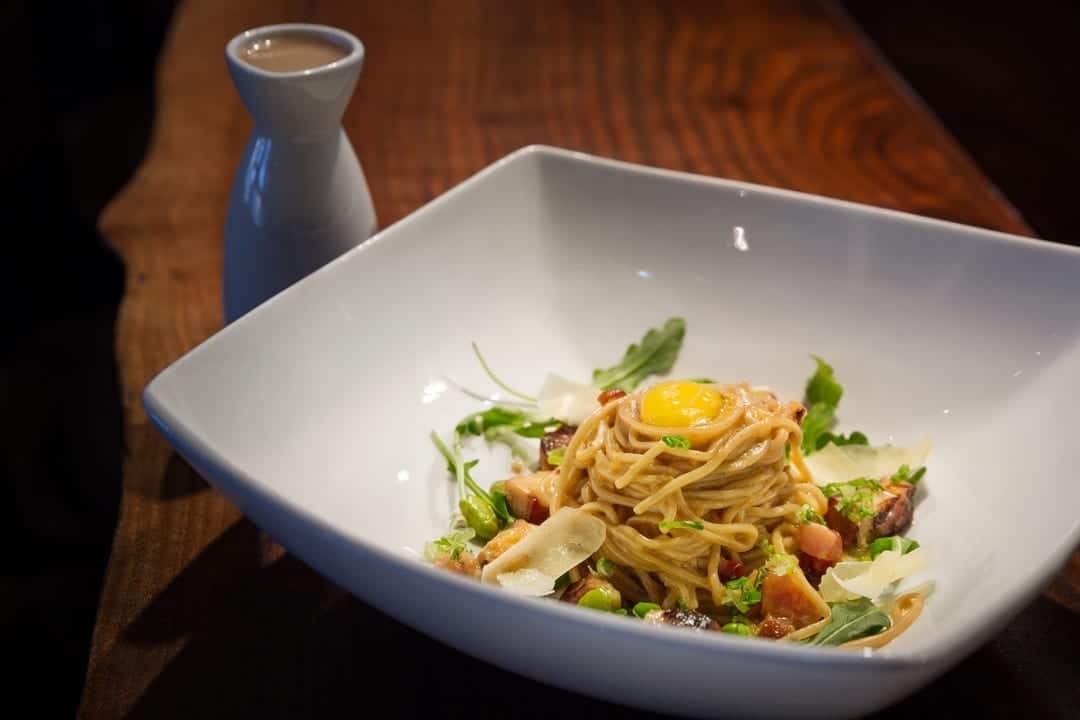
Win a copy of TheNew Camp Cookbook: Gourmet Grub for Campers, Road Trippers, and Adventurers by Linda Ly
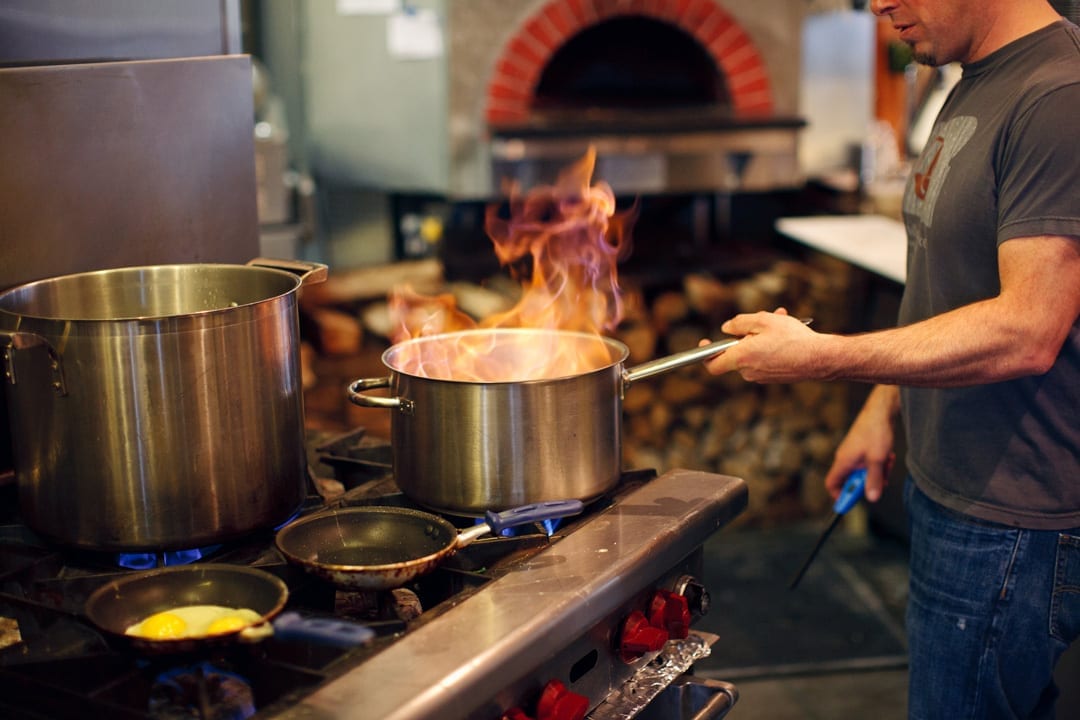
Linda Ly and her husband, along with their toddler, love to take overnight road trips with “no plans, no schedule,” Ly said. “If there’s a squiggly road we see on a map, we’ll tend to take that instead of an interstate or highway.” Ly is the chef and blogger behind Garden Betty, a website devoted to slow cooking and minimal living, and she recently moved to Bend with her family. Their summer adventures across the West were the inspiration for The New Camp Cookbook, a collection of more than 100 recipes to be cooked and enjoyed outside. Though the recipes, which range from savory breakfasts on a skillet to foil-baked dishes over a fire, may seem daunting for a weekend camping trip, Ly insists that they are all easy to prepare away from the convenience of a kitchen. She includes hacks and tips throughout the book to make the cooking process easier, and created the recipes using as few dishes as possible to keep cleanup fast so you can get back to enjoying your trip. Created for car camping—Ly’s family motto is, “If it fits, bring it”—these recipes will elevate any camp meal.
Win a copy of The New Camp Cookbook: Gourmet Grub for Campers, Road Trippers, and Adventurers by Linda Ly.
The contest begins on July 1 at 12:01 a.m. and ends on July 31 at 11:59 p.m. Three winners will be chosen. For the complete list of rules, visit our contest policy page.
Share this article with your friends on Facebook, Twitter or email and receive additional entries for each of your referrals.
In 2015, the American West reached an unprecedented environmental compromise to protect the greater sage grouse, a high desert bird with a drastically declining population. Two years later, the rug was pulled out from that plan, leaving an environmental community fuming and the small bird’s fate in question.
I looked out the back window of the truck and could see the last stars were still out. Below them, a faint outline of the mountains that surrounded us appeared in the distance. It was a little before 6 a.m. on an early spring day, and four of us were driving in a pickup truck along the winding frozen gravel roads of Hart Mountain National Antelope Refuge in Southeastern Oregon. Another passenger, Pam, was counting down the miles on our GPS so the driver, her husband Chris, would know when to slow down.
Through a series of miscommunications due to a lack of sleep, minimal coffee and sheer darkness, we were late getting through the U.S. Fish and Wildlife gate and still had a little more than five miles to drive to our stopping point, all before starting the mile-long hike through rugged sagebrush country to find our destination before first light. After reaching our stop, we bundled in layers of wool, puffy jackets and hats, quickly hopped out of the truck and started the trek.
Headlamps on and heads down, we navigated the frosted sagebrush, grass and rocks. I risked a few glances of the first hint of light creeping up over Beatys Butte in the distance, careful not to take my eyes off the ground for too long. Following our GPS, we hiked along a rock ridge, then scrambled up it and over, before the last quarter-mile over the lava rocks.
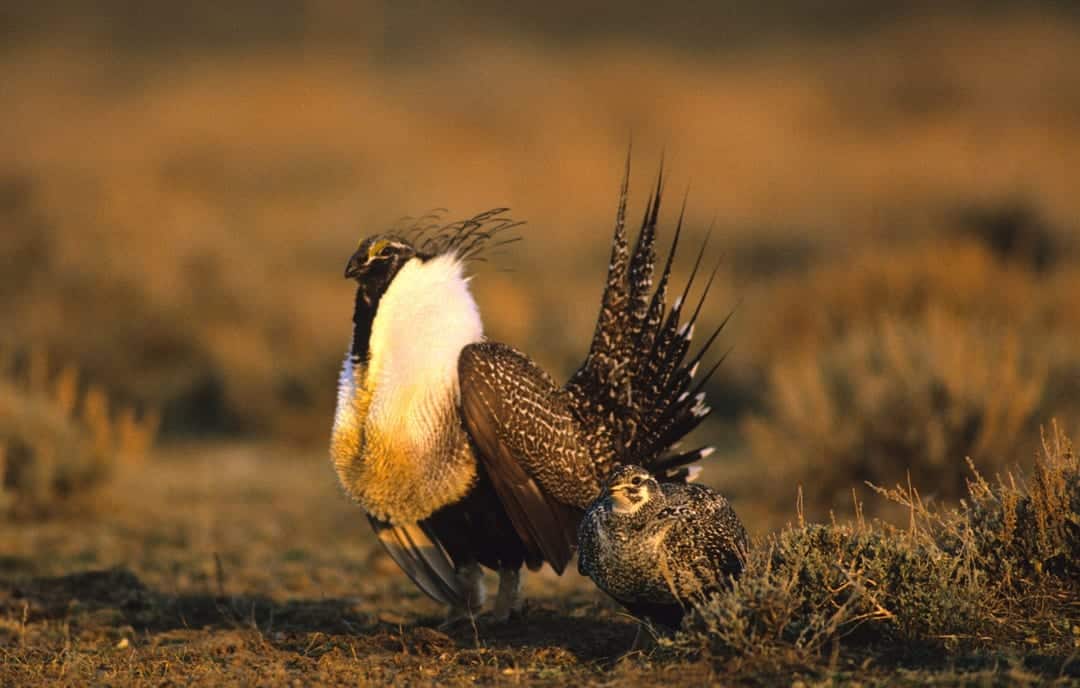
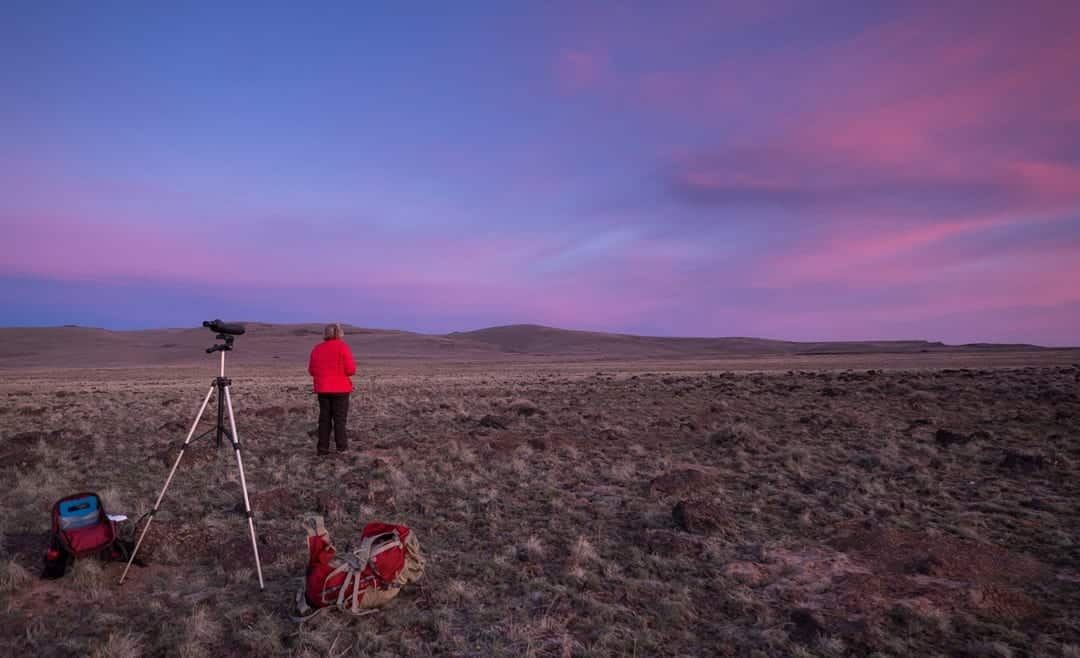
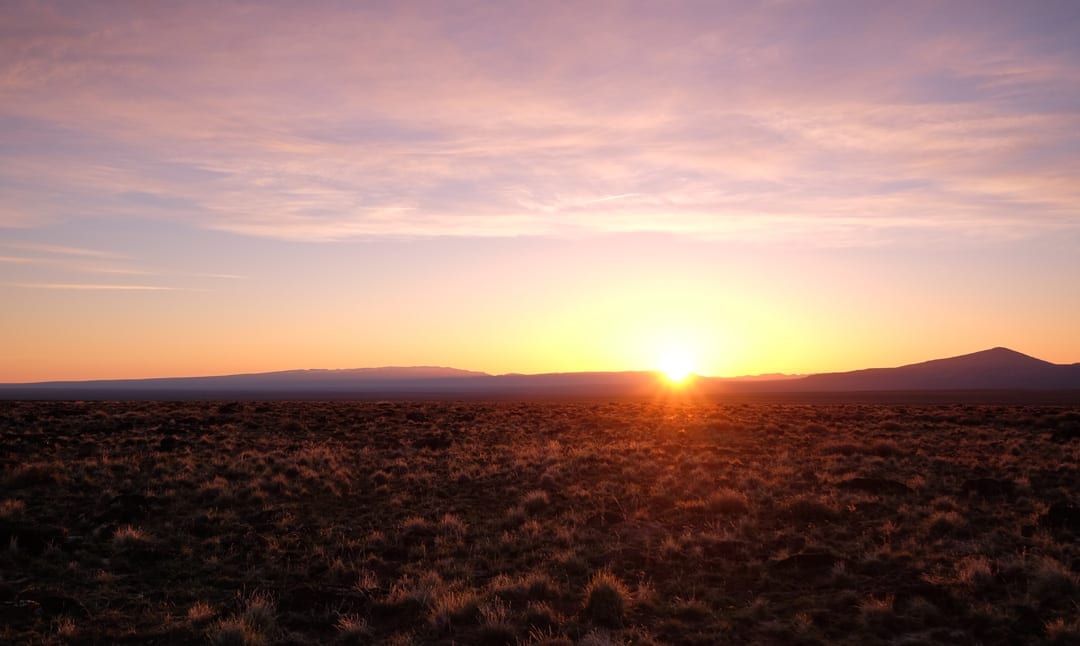
Finally, Chris stopped and set down his scope. We confirmed our location in hushed voices around the GPS, then took a moment to marvel at the sunrise and the 360-degree view of golden grass that tumbles over what is called the sagebrush sea. We brought our binoculars to our eyes and started scanning about 200 yards ahead. Sarah spotted the trademark white chest puffing up and down, then the unmistakable spiked and fanned feathers. A sage grouse. Then another bird is spotted. And another. We reached the lek. And I finally witnessed the thousands of years old mating ritual exclusive to the high desert.
We were far enough away for the sage grouse not to notice us watching. Unbeknownst to the sage grouse, much of the American West is also watching the small bird right now, as it is at the epicenter of a political controversy over public lands that spans across the high desert.
Rite of Spring
Chris and Pam Scranton are both retired teachers and have lived in Madras for twenty-two years. They saw the greater sage grouse for the first time in Millican, about twenty miles east of Bend, in 1995. They would stop there on their way to Eastern Oregon with their children to see the sage grouse at their leks each year. “Nobody was there, just us,” said Pam. “It felt like a rite of spring.”
From the Swedish verb meaning “to play,” a lek is sage grouse mating ground, usually found in a specific habitat in sagebrush country. Pam, Chris and their three children would watch the sage grouse, about the size of a large chicken, “display”, the scientific word for the puffed chests and fanned feathers strut that the male sage grouse do to impress females and, ideally, breed.
Chris said they saw about fifty males displaying the first time they went. Over the years, as word got out and more people arrived each spring to watch, the bird numbers dwindled as people got too close and the sage grouse stopped returning. “It’s not because [visitors] wanted to disturb them, I just don’t think they understood,” said Chris. Soon, due to the habitat disturbance, as well as other changes to the sagebrush steppe, the lek was gone. “It was rather sad to see it decline to the point of nothing.”
Chris and Pam were two of twelve volunteers on a three-day trip to count sage grouse in Hart Mountain with the Oregon Natural Desert Association (ONDA), a Bend-based nonprofit that works on public land and conservation issues east of the Cascades. The conservation of sage grouse is one of those issues, and one that, three years ago, had largely been resolved, or at least was on its way to be.
Fowl Politics
The Millican situation was unique because the leks were close to the highway and easily accessible to the public, but it is also a microcosm of what has happened to sage grouse across their historic range. It’s been a decades-long saga that has pushed them to the brink of extinction and to the forefront of a political battle over the intersection of private interest and public lands.
In 2015, a landmark environmental compromise was reached by almost every interest group, government agency and nonprofit that has a stake in public land throughout the eleven Western states. It was an unprecedented moment for wildlife conservation, said Paul Henson, the State Supervisor of U.S. Fish and Wildlife in Oregon. Henson has been involved with sage grouse almost the entirety his twenty-five years with the government agency in charge of habitat and wildlife monitoring.
The sage grouse saga began ten years earlier in 2005, when the sage grouse populations across the West were low enough for conservation groups to petition for the ground-nesting birds to be added to the Endangered Species List. The listing would have added broad protections for the species across the Western states where it is still found, but that was opposed by an alliance of farmers, ranchers and Western politicians. After a review, U.S. Fish and Wildlife determined a listing wasn’t warranted, but the agency “recognized that there was certain conservation concerns for sage grouse and sagebrush habitat that needed to be addressed,” said Henson.
Photo courtesy of Oregon Natural Desert Association
That decision was challenged by the environmental community, and between 2010 and 2015 a new management plan was created to address the threats to the species. “In Oregon and the other ten states, everyone rolled up their sleeves with sincere and good faith effort and developed plans at a federal level and the state level,” said Henson. Private landowners also played a key role in developing the plans, as a portion of sage grouse habitat is on ranches throughout the West.
At the end of it all in 2015, then Secretary of the Interior Sally Jewell recommended that the species did not merit an endangered species listing—if the plans were carried out. Though this sage grouse plan was not perfect, as I would be told countless times, it was considered a win for everyone involved, and for the sage grouse. Oregon Governor Kate Brown adopted Oregon’s version of the plan. After the celebrations faded, the work began and the sage grouse plan moved forward into implementation.
Then in the fall of 2017 things began to unravel. Ryan Zinke, a square-jawed former University of Oregon football player and Navy SEAL turned Montana congressman was appointed as Secretary of the Interior by the Trump administration. An avid outdoorsmen who had been endorsed by several environmental groups earlier in his political career, Zinke was charged with reviewing some of conservation plans rolled out during the Obama administration. Zinke wasted no time. He soon announced that the sage grouse plans, and a decade of work, would be reviewed and potentially amended. It came on the heels of Zinke’s plan to shrink several national monuments in the West such as Bears Ears in Utah and Cascade-Siskiyou in Southern Oregon, with the potential for increased mineral and resource extraction.
You could almost hear the collective sigh that reverberated across the West.
The Bird is the Word
About six months later, I arrived at Hart Mountain, a four-hour drive from Bend, in the afternoon on a clear day, though the smattering of snow on the roads reminded me that our late winter was far from over, despite the calendar inching forward. The wildlife refuge was established in 1936 to protect the American pronghorn, which gallop across the range in herds, but it shelters countless more species that have since declined in other spaces across the West. Part of its success is its sheer size. At 422 square miles, Hart offers critical habitat that spans from buttes to playa lakes to wide expanses of sagebrush and protects hundreds of plants and animals, including sage grouse.
I walked into the Oregon Department Fish and Wildlife bunkhouse to find the group of volunteers gathered. The sparse bunkhouse was a recent addition to the refuge, which has a handful of other offices and cottages from the 1930s, built to house seasonal wildlife biologists doing data collection and volunteer groups like ONDA. The tone of the trip was largely excited, perhaps a little uncertain. Some, like Pam and Chris, had experienced counting sage grouse before. Others in their twenties trying to break into a wilderness career were there to gain field experience. There were avid birders and outdoorsmen, and a couple retired science teachers. We were there to count sage grouse leks for a weekend as volunteers for U.S. Fish and Wildlife. It’s an easy enough task, save for the 4 a.m. alarms and frigid temperatures.
Sarah Imholt, 40, joined the trip. She’s a librarian at Oregon State University and described herself as a “bird person.” This trip was the first time she saw a sage grouse lek. “I got too excited and couldn’t do any counting for awhile,” she said after coming back from the first morning of data collection. “You can hear them making the glooping sounds. They’re just puffing their chests out and their tails are totally fanned out. They’re moving like little tanks, just struttin’ around.”
The greater sage grouse fits in well with sagebrush landscape. Their dark feathers stretch to their feet, and their white and brown speckled tails spike up in contrast to the yellow bunches of grass. The white chests, distinctly a feature of the males, puff up and make a sound like large drops of water when they fill up with air, and the grouse will sometimes bump their chests into each other while sparring at the leks to impress females.
“Sage grouse lekking behavior is one of the most magnificent natural phenomena we have in Southeastern Oregon,” said Lee Foster, the sage grouse conservation coordinator for Oregon Department of Fish and Wildlife (ODFW). Sage grouse leks are important because the birds return to them year after year for generations. “There’s a lek in Idaho that goes back eighty years. Some of those older leks have indications that Native Americans were hunting those leks,” said Foster.
One of the reasons sage grouse have become the poster child for sagebrush conservation is that their leks, set in wide open spaces on the ground among sagebrush, make them easy to spot and their populations easy to monitor. It also makes them susceptible to natural predators like ravens, golden eagles, bobcats and coyotes. “They really face every predator out there,” said Foster.
Sage grouse also need certain grasses native to sagebrush country as well as large swaths of uninterrupted habitat because they migrate between those areas, with a range in Oregon that has been documented at up to thirty miles. This is all to say that a variety of factors need to combine and work in harmony for sage grouse to thrive. If sage grouse are thriving, it’s a good indication that the 350 other species, animal or plant, that inhabit sagebrush country are thriving and the ecosystem is healthy. But as the high desert in the West has been infiltrated and exploited, new threats have arisen, and sage grouse are far from thriving.
Home on the Range
There are currently fewer than 500,000 sage grouse in the West, down from an estimated 16 million before the decline began in the mid-20th century. That’s a 97 percent decline in just a little over half a century. The primary reason is a dwindling habitat due to a trio of factors that all play into each other: invasive annual grasses, the encroaching juniper on lower elevation areas and wildfire.
Those three factors have contributed to the overall decline of the sagebrush ecosystem. Of the pre-settlement 153 million acres of sagebrush steppe, 106 million acres currently exist. Home to more than 350 species of flora and fauna, the high desert country is a vast landscape of varieties of sagebrush and sage grouse, but also wildflowers, American pronghorn, golden eagles, pygmy rabbits, coyotes, juniper and more. The ecosystem’s decline is pinpointed on overgrazing and introduced species of plants like cheatgrass that combined allow for more frequent and devastating wildfires. It’s considered one of the most imperiled ecosystems in North America, according to U.S. Fish and Wildlife.
The 2015 sage grouse management plan wouldn’t have reversed the decline of the sagebrush steppe, but it would have helped to preserve what remains. For some in the conservation community the plan didn’t go far enough.
“In the end, it was a marginally acceptable package of political compromises on what is effectively a scientific effort to do species conservation,” said Dan Morse, the conservation director of ONDA. Zinke’s announcement essentially put the conservation plans in limbo and was especially upsetting to groups like ONDA.
“The plan that came out in 2015 was far from perfect,” said Morse. “From our perspective there were things that could have been stronger for sage grouse conservation, but that if it were implemented rigorously and quickly, then it might be adequate for conserving a species. When these more recent plans to re-amend the sage grouse plan came out, we were very disappointed and frustrated that effectively the deal that had been reached was being re-negotiated by certain interests.”
In Oregon, much of the negotiations were with landowners and ranchers in Southeastern Oregon who rely on public lands to graze their cattle. Tom Sharp is the president-elect of the Oregon Cattlemen’s Association and has worked on the sage grouse issue for almost a decade providing conservation efforts on private lands, particularly in southeastern Oregon. For ranchers, the stakes in coming to a compromise about sage grouse and preventing a listing were high.
Photo courtesy of Oregon Natural Desert Association
“If we thought what happened to the timber industry in the 1980s was bad,” said Sharp, referring to the controversy over the Northern Spotted Owl Endangered Species listing, “well, it would be an order of magnitude greater with the sage grouse listing.” Sharp acknowledged that the ranchers were somewhat reluctant to forge an agreement with the federal government over the plans, but were largely on board to avoid a listing. The oft-cited mantra was, “What’s good for the bird is good for the herd.”
Andrew Shields, a wildlife biologist for Roaring Springs Ranch in southeastern Oregon, echoed Sharp’s statements. “Ranchers push back on some of these plans,” said Shields. “It’s not because they don’t like sage grouse or healthy rangeland, it’s because they’re so tied to the land and they care deeply about the land and wildlife, and a lot of the time, the things they’ve done work. That’s why there’s sage grouse there.”
In early May, the BLM released the draft environmental impact statement for sage grouse management and habitat. Overall, there were minimal changes to Oregon’s sage grouse conservation plan. In Oregon, a total of 22,000 acres, an area roughly the size of the city of Bend, previously designated as research natural areas, would be open for livestock grazing. From an environmentalist perspective, it fared better than other states such as Nevada, Wyoming and Idaho, which now may face more oil and gas drilling potential, development identified as a key threat to sage grouse. The BLM is accepting public comments until August 2 on the plan.
The proposed amendments are welcomed by Oregon’s cattle industry. “We believe that a reconsideration to amend these federal plans is necessary based on new science that came out that says properly managed livestock grazing is not a threat to sage grouse but can be compatible or beneficial to sage grouse species,” said Sharp. Not everyone agrees that grazing can be a benefit to sage grouse, but most scientists say that grazing, done properly, doesn’t have to interfere with sage grouse populations.
Given that the sage grouse is a rangewide species, meaning that its habitat crosses state lines, the federal consistency of the sage grouse management plan was integral to the success of the bird. These amendments coming state by state threaten that.
“[The federal plan] has a degree of consistency across the range,” said Morse. “If we decrease that consistency, we are doing what science tells us not to do.”
Conservationists are already pushing back. In late April, environmental groups sued the current administration for allegedly ignoring sage grouse protection policies and selling oil and gas leases in 475 square miles in Montana, Wyoming, Utah and Nevada. If the administration continues to prioritize energy development to the point that threatens more habitat on public land, it wouldn’t be surprising to see more lawsuits in the future.
At The Hart Of It
In Oregon, where there is less pressure to develop gas leases, the partnerships have more or less remained intact. Henson at U.S. Fish and Wildlife pointed out while the the political back and forth is common, the people on the ground keep moving forward. “The biggest message is even through an election and through some of the other challenges we’ve had like the Malheur occupation, where there was a lot of emotion and political acrimony, the partnership in Oregon for sage grouse conservation has remained really strong.”
Camped out in the pre-dawn hours on Hart Mountain, waiting patiently for an elusive bird to appear from the darkness, the politics of the sage grouse fight can feel a world away. “The fundamental reason [I joined this trip] is I spend a lot of time outdoors. It’s an important part of my life. The landscape, the things on this landscape—I value it. I want people to value it,” said Sam Miller, a retired science teacher from Eugene. “I don’t want to get too political here. I’m trying to find a way to say it without flames coming out of my mouth,” he continued while we were talking at Hart Mountain. “Our votes matter because ultimately that translates to the leadership we either have, or don’t have, and the direction that leadership takes. If we care about these kinds of places, then we need to make sure we support people who have that point of view.”
If sage grouse populations don’t return, it doesn’t mean that just another species of bird is lost. It means the sagebrush steppe—an entire ecosystem—has been lost. It means that millions of acres of high desert country have become vulnerable to the epic wildfires that have the potential to devastate the landscape, homes, economies and cities. It’s a lot of weight on the wings of one bird.
Witnessing sage grouse at the lek “feels really lucky,” said Imholt. “[Sage grouse] have been doing this for God knows how many thousands of years and they’re still doing it even though we’re screwing everything up around them.” At Hart Mountain at least, “this little sphere of existence is right, and these little birds are doing what they are supposed to do,” she said.
We woke up on the last morning to five inches of snow on the ground and a bluebird sky. By the time my group had reached the last lek, the birds there had already moved on, perhaps flushed out by the coyote we spotted in the distance. There was still evidence of their dance written on the snow—light touches of wings moving around in circles and patterns left behind in the last snowfall of the season where their feathers had dragged. The sage grouse would probably return to the lek to do their dance again the next morning, and hopefully their next generation would return the following spring. Our only job is to give them the space to continue and the chance to keep coming back.
Rock chucks, or yellow-bellied marmots, are a common sight among the boulders in Bend’s Old Mill District. Continue reading this post by a naturalist from the Sunriver Nature Center, PNW Naturalist.
Rock chucks are a beloved sign of spring in Central Oregon. To many, their emergence from winter hibernation signals the end of frigid weather and the arrival of warmer days and sunny skies that usher in the outdoor adventure season for Central Oregonians. But what exactly are these creatures?
You might be surprised to find out that the rock chuck, or the yellow-bellied marmot, is a ground squirrel. A large-bodied, plump and fuzzy ground squirrel.
Named for their typical choice of habitat, rock chucks prefer to make their burrows under rocky cropping near a consistent food source that can satisfy the hunger of even the roundest and most stoutly built individual. They inhabit much of the Western United States, often found in high elevation areas with open land such as sagebrush or meadows.
Rows of rock chucks can be seen along the roadsides in the Old Mill District, where perfectly groomed lawns, a primary food source for these marmots, allow for a keen view of any potential predator. Although the brunt of their diet consists of herbivorous eats, rock chucks are actually omnivorous opportunists who will take advantage of feeding upon insects and even bird eggs that may be precariously laid by killdeer or nighthawks on the ground. In the Old Mill District, however, you’ll probably just see them snacking on grass. On a sunny but cool early Sunday morning, this is where I would spend my time observing.
A naturalist is taught the art of observation, reading the landscape and natural behaviors of their subject in a broad sense and in an attempt to gather specific information. This can take hours of painstaking notes and illustration. This is not a method I would suggest for our friend the rock chuck. There is not much activity to speak of, as a matter of fact. Upon even the earliest moments of my observations, I can assure you that rock chucks do almost exclusively what you have likely viewed in your short moments of seeing them as you drive by. They eat. A lot. Moving from one square patch of grass to the next, seeming to pay little mind to us. But their face-down tendency towards constant caloric intake may be their most enduring quality.
For spending much of their time only feet from the hustle and bustle of Southwest Bond Street, rock chucks are surprisingly skittish. Within as little as ten yards’ distance from them, they each would quickly scurry up the hills and into their burrows, easily escaping my intrusion. This is a typical tactic used by the rock chuck to escape predation. Although it is nearly inaudible by human ears, rock chucks even sound the alarm to their fellow rock chuck family members when they come across any natural predators, which would most likely be dogs and eagles in the Old Mill District.
The rock chucks are famous in Central Oregon. Enduring and iconic, the rock chuck remains a delightful sight along the roadsides of the greater Central Oregon area. Not much to say, and even less to show. But perhaps that’s precisely what we find most charismatic about them.
Author Jason Chinchen aims to unify the Central Oregon bouldering community with his new guidebook and the High Desert Climbers Alliance. [Photo of Maitreya Sriram climbs “Bulletproof,” a V5 at Widgi Boulders. Courtesy of Central Oregon Bouldering.]
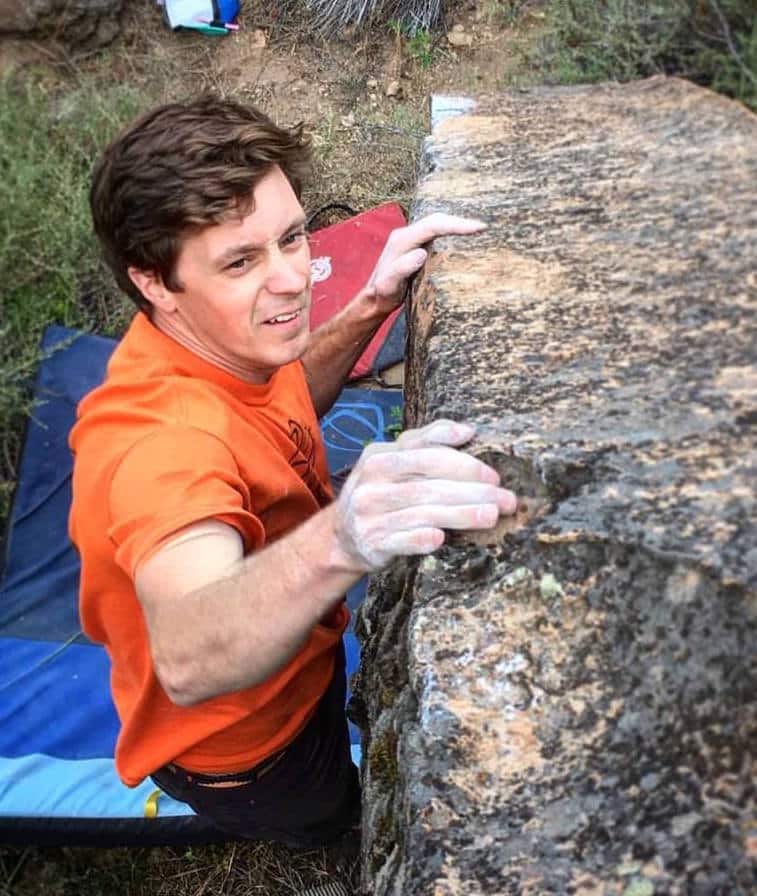
Bouldering is a style of climbing on smaller rock formations and uses “crash pads” as protection instead of ropes or harnesses. It started out as a means to warm-up and practice for rope climbing. Over time, however, with the spread of gyms, competitions and media coverage, it has evolved into its own subcategory of climbing. While climbers have been enjoying this sport in Central Oregon for decades, up until last year, information about Central Oregon’s many bouldering spots spread through word of mouth from climber to climber.
Last fall, Jason Chinchen, a man of many trades including woodworking and graphic design, authored and designed Central Oregon Bouldering, the first guidebook for Bend’s bouldering areas. The book has more than 1,200 climbing routes or “problems” at ten areas near the Deschutes River Trail and off Cascade Lakes Scenic Byway.
Chinchen has lived in Bend intermittently since the ’90s, originally moving to Central Oregon to climb at Smith Rock. Over the years, he has also lived in Bishop, California, the epicenter for bouldering in the United States. There, the climbing community rallies around the sport and has a developed guidebook with more than 2,300 routes. Upon returning to Bend, Chinchen found the outdoor climbing community here underdeveloped.
“When I came back here, the climbing community was really focused around the climbing gym and around Smith Rock, and there were very few people bouldering,” said Chinchen. “I tried to find people to go out and climb with me, but I had a really hard time.”
When word got out about the book being published, there was some pushback. Local climbers argued that the book would bring more traffic, increasing risk of misuse and expose spots that had formerly been well-kept secrets. Alan Watts, the developer of many Smith Rock routes and the author of the Smith Rock climbing guidebook, explained this dilemma in the foreword of Chinchen’s book.
“Bouldering in Central Oregon has long been shrouded in mystery, a closely held secret protected by tight-lipped locals,” said Watts. “Guidebooks are a paradox. On the one hand, there’s little question that they bring far more people into areas to climb once enjoyed by a privileged few. But on the other hand, the influx of people sparks development and brings fresh blood and energy to scenes that might otherwise grow stagnant.”
Mike Rougeux, the Climbing Program Director at Bend Endurance Academy (BEA), argued that the book continues the tradition of passing information down between climbing groups but in a different format.
“Either someone was going to write a guidebook for the bouldering in Bend and it would be someone that wasn’t from Bend or someone who was a part of the climbing community,” said Rougeux. “I think it was better that it was someone who was part of the community.”
Rougeux said that the book has solidified and legitimized this outdoor sport in Central Oregon and established boulderers as actual user groups. These areas have seen more traffic recently, not just because of the book but because of the growth of Bend. The book includes ten areas, so instead of climbers being concentrated at a few of the more well-known spots, it actually spreads them out.
After publishing his book, Chinchen helped establish the High Desert Climbers Alliance (HDCA), a nonprofit dedicated to working with land managers to protect these areas and mitigate any problems caused by increased traffic. Newly formed, HDCA has taken on the responsibility of protecting all rope climbing and bouldering in Central Oregon aside from Smith Rock, which has its own organization.
HDCA is now working with the Forest Service and has coordinated trail work plans at Meadow Camp, an area along the river with both rope climbing and bouldering. Rougeux is one of HDCA’s four officers, in addition to working with BEA. He is currently working with Central Oregon Trail Alliance (COTA) on the mountain bike trail being rerouted through the Widgi Boulders, near the Widgi Creek Golf Club.
“The biggest thing for us right now is putting the pieces in place for the continued growth of the sport and the growth of Bend,” said Rougeux. “We are trying to make sure climbers are represented in the community.”
Both the book and HDCA were created to bridge divides in the community.
“When you have a community that’s unified, we can get things done,” said Chinchen. “I think that my part has been done to give a central view and something for the community to gather around.”
Photo of Trevor Roosen climbing “Hieroglyphs,” a V4 near the Depot, courtesy of Central Oregon Bouldering
Grab your climbing shoes and chalk bag and head out to these locals’ favorite bouldering spots in Bend. Looking to skip the Smith Rock State Park summer heat and crowds or squeeze in an evening climbing session after work? There are boulders scattered across Central Oregon begging to be climbed and, with the recent publication of Central Oregon Bouldering, these spots are more accessible than ever. Check out these local climbers’ picks for the best areas to boulder around Bend.
Bouldering Term Cheat Sheet
Bouldering: A style of climbing utilizing “crash pads” rather than ropes or harnesses on relatively small rock formations. Approach: The hike or walk to get to a climbing area. Problems: Bouldering routes or projects Traverse: Climbing left or right instead of straight up, oftentimes lower to the ground V0-V13: The rating system used in the bouldering, with a V0 being the easiest and V13 being the hardest.
Trevor Roosen | Route Setter at Bend Rock Gym
“I’d say one of my favorite spots in town is ‘Mile Marker 5’ up Skyliners Road. I like that spot because it is always in the shade and perfect for hot summer days. There is a small concentration of problems, but they are all very high quality. There is a wide range of difficulties and most problems have nice, flat landings.
Tick Ranch has some cool boulders in a pretty rad setting next to Tumalo Creek. The boulders are big chunks that have fallen off of the big cliff band above. The cliff above is about thirty-feet- to forty-feet-tall and has some rad four- and five-bolt-long sport routes. It sits in the sun for most of the day, so it can be very warm in the summer.
The Depot is a cliff line right on the Deschutes in town. It gets shade almost all day and really cool air because of the close proximity to the river. Most of the boulders here are really tall, like fifteen feet. Fun fact, the Depot has one of Oregon’s hardest problems, a V11 called ‘The Goblin.’”
Mile Marker 5: Dirt parking lot on the left side of Skyliners Road at the 5 mile marker, 5-minute approach Tick Ranch: Off Skyliners Road along Tumalo Creek, open seasonally from March 1 to December 1, up to 15-minute approach The Depot: Off the Deschutes River Trail on river right, 15- to 25-minute approach from Farewell Bend Park
Mike Rougeux | Climbing Program Director at Bend Endurance Academy
“Mount Bachelor Village boulders are really good for newer climbers because there’s a super long traverse. There’s some stuff that’s a little bit lower, so you don’t have to feel like you’re committing to hard moves up high. It’s right on the river, so you can’t really beat the scenery.
Photo of Mike Rougeux courtesy of Central Oregon Bouldering.
The Widgi Boulders are great. There’s a lot of hard stuff there, but there are some easier climbs there that are getting more traffic now because of the Central Oregon Bouldering book. People used to go out there and be like ‘There are only these climbs with chalk on them and they are hard’ because that’s what all the people were climbing. Now there are people who are newer to climbing and they are going out there and revisiting some of the older V1s and V0s. There’s great boulders out there with decent landings.”
Mount Bachelor Village Boulders: Off the Deschutes River Trail on river left, 15- to 25-minute approach from Farewell Bend Park The Widgi Boulders: Turn at the dirt road across the Cascades Lakes Scenic Byway from Widgi Creek Golf Course, park at end of road next to boulders
Claire Christensen | Boulderer in Central Oregon
“I first started climbing last summer out at Meadow Camp on ropes but quickly bought a crash pad so I could go out solo. I was immediately hooked on bouldering at Meadow Camp because of how beautiful and serene it is. It’s so rad to be able to listen to the river while I’m climbing but also being far enough off trail that it feels like you have the whole forest to yourself.
The problems start at the parking lot and stretch all the way down the cliff line for a couple miles. The rock is volcanic, so it can be a little hard on the fingers sometimes, but offers cool finger pockets, crimps and cracks. There are lots of problems that are short and safe and also a lot of high ballers for those who are a little braver.”
Meadow Camp: Park at Meadow Camp Day Use Area, $5 Day Pass or NW Forest Pass required, 2- to 20-minute approach depending on what boulders you choose.
It’s a tough competition for the best fish tacos in Bend. In terms of culinary trends, the world has already reached peak taco. It happened sometime between the invention of the ChocoTaco and the first time someone put kimchi on a pulled pork taco. Today, it’s hard to go to a restaurant or food truck that hasn’t put their spin on the street-style taco. Perhaps not surprising given Bend’s burgeoning reputation as a foodie destination, we have some great options in town. Since nothing says summer quite like scarfing tacos down on a deck under the sun and washing it all down with a cold beer, here are some favorites to try.
Around for over two decades, Parilla is a staple for Tex-Mex-fusion. Parilla owner Jeff Dearing added the fried fish taco to the menu in 2002. Dearing said the breading has Hawaiian influences and the sauce drizzled over the top includes Japanese fish sauce, which gives it its flavor and spice. A lot of thought went into finding a sustainable fish to use and they settled on a catfish recommended by Seafood Watch, an organization of the Monterey Bay Aquarium. Parilla also cuts the fish by hand, a detailed touch that goes into this dish, and they worked with their food supplier to find the handmade flour tortillas they use. As for the corn salsa, Dearing said that using that salsa is part of what makes Parilla unique: incorporating its core ingredients into each culinary concoction. Bonus: You can get the fish tacos as a burrito or as a burrito bowl. Whichever way you choose, pair it with the $1 PBR to dine like a local.
Speaking of pairing tacos with beer, two of our craft breweries have produced a great alternative to the classic burger-and-fries order. Sunriver Brewing delivers a solid option with the grilled rockfish tacos that scream for the Fuzztail hefeweizen to wash them down. The trio comes with a red salsa on the side, but you really don’t need it. The fresh slaw and drizzled sauce—a chipotle aioli and a cilantro-lime sour cream—over the top takes care of any condiment cravings.
Worthy Brewing is a worthy opponent in this game (and will soon open a restaurant downtown entirely devoted to tacos and beer). The flagship location recently revamped its menu and now offers a steelhead taco, which is a game-changer in Bend’s taco scene. While steelhead, an anadromous trout in the Pacific Northwest, is known for its strong flavor, the flavors aren’t overwhelming in this dish. The price point is a bit higher, but the kitchen doesn’t skimp on servings. A guacamole base is topped with the steelhead, fresh cole slaw and a chipotle aioli drizzle. They recommend to pair it with a pale ale, but in the summer, opt for the lighter Kolsch or pilsner.
We’d be remiss if we didn’t include El Sancho, arguably the leader of the taco scene in Bend. Offering almost a dozen different styles of tacos to choose from, El Sancho has perfected what Bendites and visitors crave when it comes to the street-style taco. Next time you’re there, suppress your urge to order chicken, carnitas or barbacoa (for the umpteenth time) and try the grilled mahi mahi tacos. (A quick note: mahi mahi is not, as some people believe, shark. It’s a tropical dolphinfish also known as dorado that has tons of flavor.) Added to the menu when El Sancho opened their brick-and-mortar in 2015, the grilled mahi mahi tacos were an intentional choice to create a healthier fish taco option in Bend, said co-owner Jon Barvels. For this taco, it’s the slaw that separates it from the rest of the pack.
And while we’re on the subject of former food trucks, Spork also has a spicy and crispy fish taco unlike any other in town. The fusion-style cuisine is a must-try when in town. Its tacos are reasonably priced for their size and the flavors are on point. Similar to Parilla’s, Spork’s fish taco uses fried catfish. With just the right amount of spice from the chili mayo and jalapenos, it perfectly fits in with Spork’s eclectic and addicting menu.
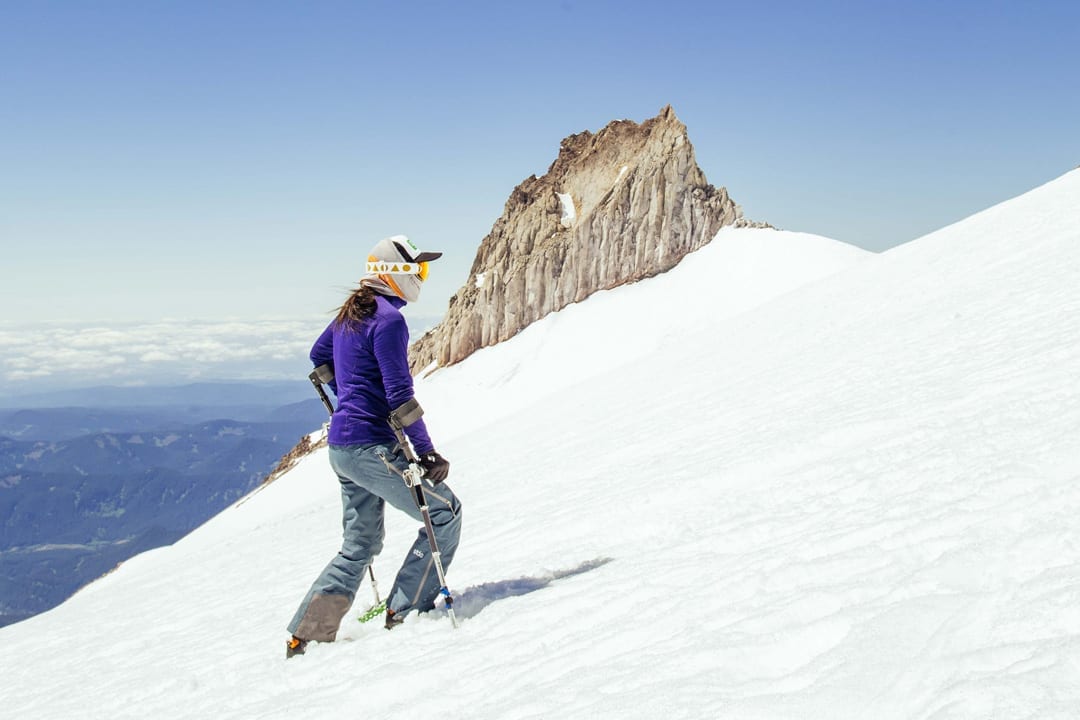
In 2015, Anna Soens, a 29-year-old wildlife biologist from Idaho, had been planning to climb Mount Hood with her dad when she free-fell thirty feet while climbing indoors and was left partially paralyzed from the waist down. This May, she and her dad set out fulfill their goal and summit the peak together.
There had been no guarantees when we set off for the summit of Mount Hood, which towers above the rest of Oregon at 11,250 feet. As my dad and I kicked exhausted steps into the ice just below the top, the rest of our team cheered from above. Glimpsing the true summit as we emerged from the narrow chute called the Pearly Gates was the first moment I was sure that we were going to make it. Two years earlier, doctors told me that I’d never walk again, let alone climb a mountain.
A week before Christmas in 2015, I accidentally failed to clip in while rock climbing solo at a gym in Portland and free-fell more than thirty feet to the ground. The impact pulverized my lowest thoracic vertebrae and left me with paralysis from the waist down. A few days after my fall, I slowly thumbed through a copy of Bill Mulee’s Mt. Hood Climber’s Guide. I jacketed the book in a festive sleeve and scribbled “Dad” across its surface. For a brief moment I allowed my daydreams to indulge visions of climbing Hood, something my dad and I had been planning to do together the following spring. When I opened my eyes, a stark hospital room brought me back to a suffocating reality. My world was much different now.
Amid surgeries to repair my back and a shattered wrist, Christmas Day arrived and my family squeezed into my hospital room in an effort to carry on our holiday traditions. Our stack of presents dwindled until just one remained. As I handed it to my dad, I tried to explain that I had bought the book a long time ago. That even though I fell, and even if it took an extra year or two, we would still reach the iconic peak together. That even though they could only really twitch right now, my legs would faithfully carry me down trails and up mountainsides again. But of all those things that I tried to say, the only thing I managed to utter was a tear-filled, “I’m sorry.”
I spent a year after my accident relearning how to do everything from putting on shoes to driving a car. I questioned my identity, which was linked to remote landscapes that I could no longer reach. I wondered about my future, given a past that was built on perpetual movement. I learned how to approach and accomplish old tasks differently and slowly built strength in muscles that were neurologically impaired and atrophied from the two months lying in hospitals. Restoring my independence, confidence and hunger for big things, which I rely on to chase lofty dreams like climbing Hood, required outsider perspective and experience.
Through friends, I found Oregon Adaptive Sports (OAS), a nonprofit based in Bend. They got me on an adaptive mountain bike for the first time, returned me to Smith Rock to climb and took me from the bunny hills to my first black diamond runs in a monoski (a molded seat mounted to a single ski that allows me to ski while seated). My closest friends can now be found within OAS’s community of adventure chasers, and through them, I’ve reclaimed the identity that was radically shaken when I fell.
While I spend the majority of my time in a wheelchair for practicality and efficiency, I can walk short distances with leg braces, crutches and a gait that resembles Frankenstein’s monster. But my knees that once hauled packs of ropes and climbing gear up gnarly talus fields can no longer bend against gravity. My leg braces disguise the fact that my calves and ankles are silent, ready for messages from my brain that my spinal cord can no longer relay. Still, climbing Mount Hood remained a dream that never quite died.
Our marathon effort to reach Oregon’s tallest peak began a full year ago—organizing, training, fundraising and developing specialized gear for an ascent with little precedent. It’s been two and a half years since my vow to climb Hood was renewed from a hospital bed, more in desperate longing than as a sincere promise. But that vow persisted through broken bones, damaged nerves and an uncertain future, and this spring that promise finally made it to the slopes of Mount Hood where it belongs.
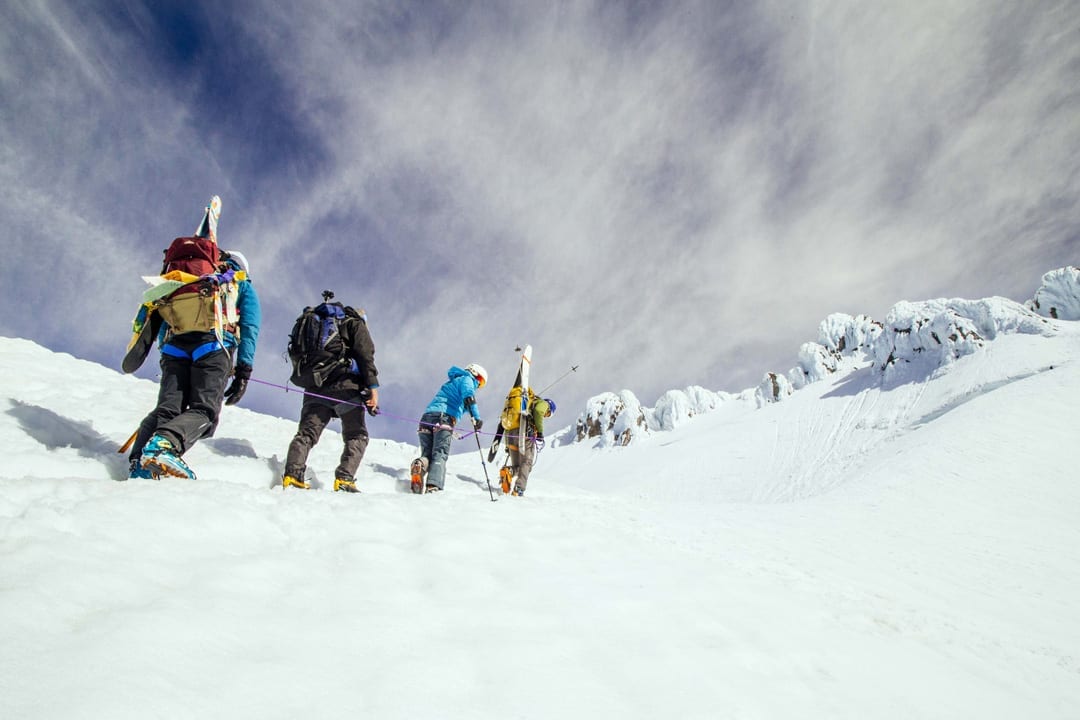
In late May, with thirteen enthusiastic friends recruited to haul my monoski and other gear, we set off from Timberline Lodge to attempt Hood’s popular South Side Route. Alternating between using specially-designed crutches and crawling on hands and feet, my progress was slow but steady. Nearing our basecamp at 9,600 feet, my 70-year-old father confessed surprise at how thin he found the air and how much effort he was exerting. As the sun set above the clouds and winds steadily gained strength, we pitched our village of tents, shared a pot of curry and hunkered in our nylon shelters for the night.
Summit day dawned. We rolled out of our tents and continued upward with thawing excitement in unyielding wind. Affected by the altitude and a heavy pack, my dad’s pace slowed and his breaks became more frequent and desperate. When we got to the crevasse just below 11,000 feet, he sat on a mound of snow and tearfully whispered in my ear that he wasn’t going to make it. He had worked out hours a day, six days a week for a year leading up to the climb. He had done everything he could. But he had been climbing at his max for hours and the steepest section was still ahead. I hugged him tight and told him that it didn’t matter. We had already accomplished what we both had doubted was possible. We were on Hood together despite everything.
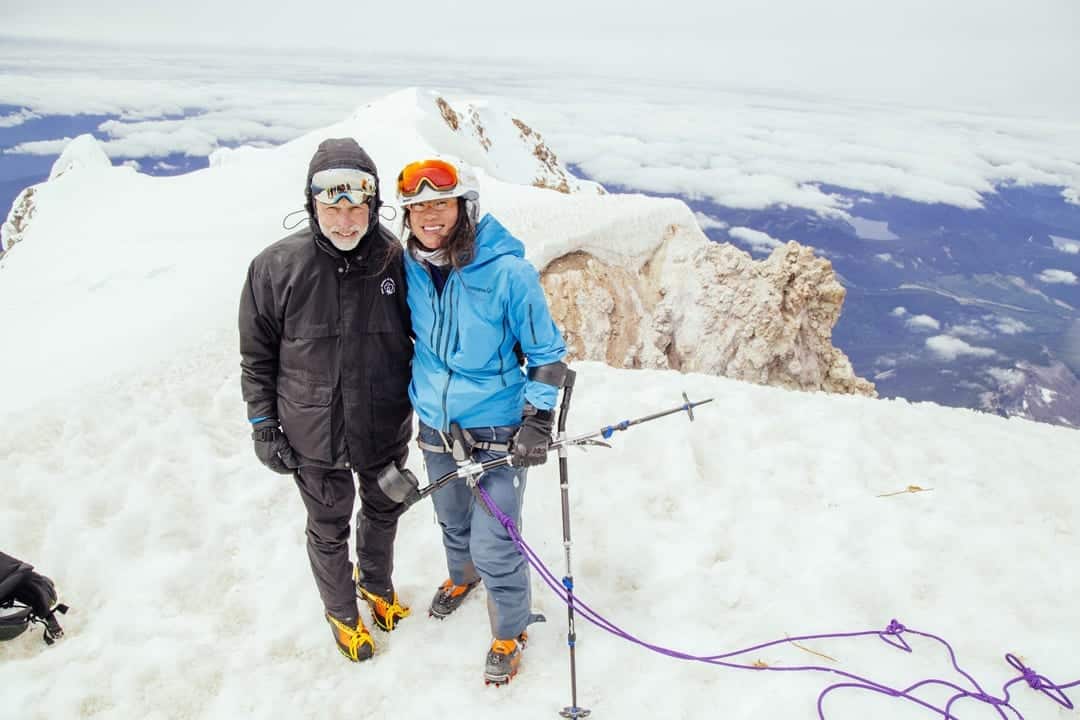
Anna and her father after summiting Mount Hood
He was silent for a moment, then his breathing abruptly calmed. He stood up and said he was going to keep climbing. I questioned him, but a stubbornness in him, that I recognize within myself, steeled him. We continued on, me haplessly bear-crawling and him with an exhausted but determined shuffle.
We could hear the cheers of our team as we emerged from the infamous Pearly Gates and trudged our way up the final slope to the summit. We made it. On May 29, my dad and I, surrounded by friends, stood on the top of Hood together, overlooking the far corners of Oregon from an unrivaled perch. From our high vista, mountain peaks beckoned across the horizon.
Lauren Hough was traveling around Bend with her classmates doing a singing Valentine program when the news came out about the mass shooting at Stoneman Douglas High School in Parkland, Florida. Though she wouldn’t describe herself as an activist, she had been involved in multiple social activism movements during her time as a student at Bend Senior High School. After the shooting, Hough, a senior, teamed up with students at her school and other student leaders in the region to organize the school walkouts protesting gun violence and the March For Our Lives. Hough talked to Bend Magazine about being a student in the age of mass shootings and what local students are asking of Bend’s and Central Oregon’s leaders.
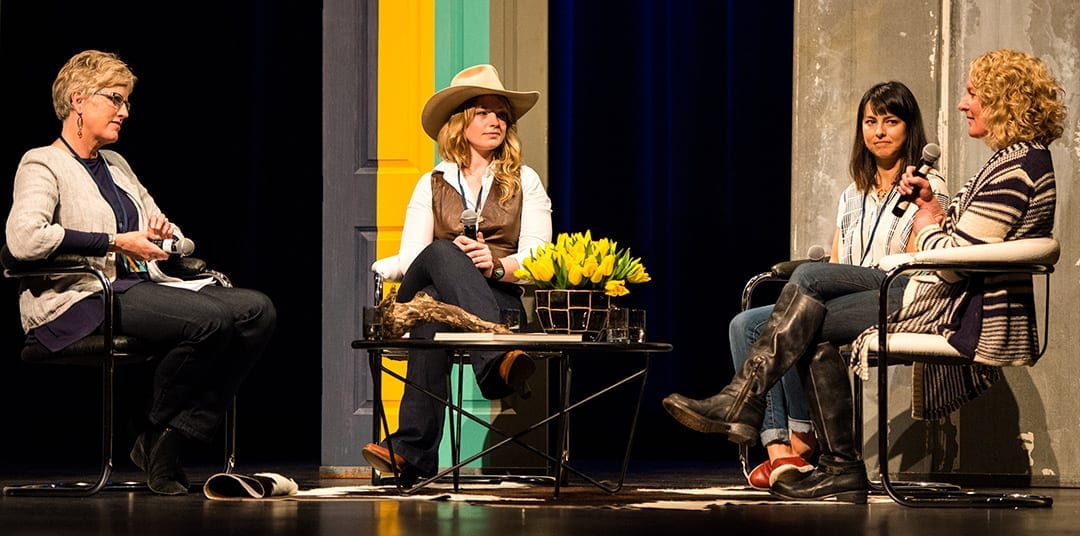
Left to right, Evelyn Diaz, Emma Smith, Heather Barclay and Lauren Hough. Photo by Matt Fox
Can you tell me about what the day of the Parkland school shooting was like for you?
I wasn’t actually at school that day. It was Valentine’s Day, and I’m in choir and was doing Val-O-Grams, which is where you go around town and sing to them. I wasn’t actually at school when I heard about it, but I remember we were in the car and someone got the notification on their news app.
When I was in school, we didn’t have those notifications on our phones and we often didn’t hear about the news until we got home. I’m wondering what it’s like to get this news while you’re in school, and unfortunately, in a time when these events are all too common.
It’s overwhelming. I turn off notifications constantly on the news app. I think we just grew up in a generation that’s inundated with constant messaging. It can be a big struggle to turn that off. What actually hit me with the Parkland shooting is that I was driving to school the next morning, and there was an NPR segment about it that had one of the parents of one of the victims talking. I don’t know if it was just NPR magic, but something about that hit me, and I just broke down. I thought, “This is not ok at all. This is heartbreaking.”
After the shooting, there were national and local efforts to talk to students get them engaged in political action. How were you involved in that?
I was involved in a lot of that, and I am still am. For me it started with planning the March For Our Lives. I’m involved in Rise Club, which is a social empowerment, feminist club. I’m close with my teacher who leads that. I reached out to her about what we should do as a club about the shootings. The next day, Vinna, who started the Facebook group, and I met and got a committee started to plan the march. Right now, we’re working on doing candidate endorsement for the primaries, just from the perspective of “What are you doing for school safety and gun legislation.” I’ve gotten to meet a lot of people who are running for office.
Had you been involved in planning anything of this scale or other activism?
I’ve done other activism work. I’ve been involved with the climate action committee in Bend. I used to go to Deschutes Democrats meetings and I’ve spoken in front of city council a few times, so I know a lot of our city councilors. But nothing of this scale of planning two walkouts and a march. It was all very new to me and also at a busy time in my life. For me one of the bigger planning efforts was the walkout on March 14, which I co-planned with Emma Smith.
What goes into planning a walkout, and how did you make it happen?
We joined forces with Summit through the 17 Days of Action and Muse. We collected a group of people to get up and read the victim’s bios. Two girls wrote speeches and performed. It was way bigger than we expected. People are saying half of Bend High walked out. It was raining the day of the walkout, so we met in Bend High’s common area. We had a whole stage set up with microphones. It was huge. It was really impactful because it was my peers. The respect that everyone gave at that moment surpassed anything I could have thought of. Also the support we had from our administration was really surprising to me. They turned out to be incredibly supportive. We were passing out orange pins for our teachers to wear in solidarity, and they had stickers for all of them. Our principal was there to support us and make sure everything got done.
Thinking about social activism in the age of social media, how did you deal with some of the criticism that the 17 Days of Action Instagram page received?
I was co-running that with two other girls from Summit. We all made the decisions for how to handle that. We ended up saying that we were going to be impartial and not respond to the comments. If they are hateful, we’re going to delete them, but if they are just criticism, we aren’t going to censor them. It doesn’t really bother me personally. I’ve had a lot of people fighting back to all of our messages. Especially when people criticise different actions you can take or are criticizing marches or walkouts, a lot of people say, “Well they don’t really do anything. You’re just marching or walking out. What does that actually do?” I believe it sends a message and makes people listen and it brings up the issue. As much as people want to criticize it, they’re not creating their own actions. No action is bad action. It would bother me more if those threats or criticism came from people in person, and they never do. They always come on social media.
What’s next for this movement locally?
Something we’ve been discussing is doing a community dinner. Having as diverse of a group as possible, having people with different viewpoints, sitting together at a table and having a directed conversation. I think for me a lot of takeaway has been that feelings, ideas and intentions are inflated on social media, and it makes the internet and social media not a good environment and not conducive to empathy. That it’s always better to talk to people in person. I want people to talk to me and have a different opinion than me because I want to understand their side as much as I can.
Are you looking for any specific changes in Bend-La Pine Schools?
I think that there are some safety measures that Bend-La Pine Schools needs to take. One that seems fairly simple to me is that the doors should lock from the inside. Most of the doors don’t. Where I draw my line on school safety is that I don’t want schools to feel like prisons. I don’t really believe in having all of the doors locked with one access point. Something I think we really need, and Oregon fails as a state in this, is mental health. It’s related to school shootings, but more about school environments in general. Bend High has one school psychologist and five counselors. It’s been pretty understaffed for awhile. That’s something I discussed as people who are running for office.
What do you want people to know about the work high school students are doing for this movement?
Not to underestimate the power of a high schoolers voice, or anyone’s voice for that matter. One message I’d like to share is how thankful I am for the community support in all this. Bend far surpassed the support that other teenagers have gotten. I feel like my opinions are always really valued when shared, and that’s something that people my age don’t generally get, is validated. A lot of really strong women in particular have been supportive in every way.
How do you keep people and students engaged in this activism while it’s not prevalent in the news cycle?
I think that’s a conversation that the people who are leading this movement still have a lot. One thing I think will always be making a difference is voting. It can be as simple as you show up and vote for people who are going to be there actively trying to change things. Getting younger people registered to vote and out to vote is going to be huge. One of the beauties of this movement is that is got younger students involved who will continue things.
Enjoy stunning views of cascading waterfalls with our picks of the best waterfall hikes in Central Oregon.
Chush Falls. Photo by Alex Jordan
A hike to a waterfall is one of the best ways to escape the Central Oregon heat in the summer. With a handful of hikes to pick from, enjoy astonishing views at the top of these falls or venture to their bases to get splashed and swim around in picturesque pools. Hike through dense forests or along rushing creeks to reach these essential summer destinations.
Sahalie Falls and Koosah Falls
Along the McKenzie River Highway, this moderately trafficked waterfall hike begins at Sahalie Falls, a 100-foot-tall waterfall that cascades over a natural lava dam. From here, the gravel trail descends down to seventy-foot-tall Koosah Falls, providing astonishing viewpoints in close proximity to the falls. For a shorter hike, you can head back to Sahalie Falls from here or do the full 2.6-mile loop that returns on the river’s far shore through a thick forest of Douglas firs. This short, yet rewarding, hike can be a great day-trip destination or a nice break from a long car ride.
Distance: 2.6 miles roundtrip Hiking level: Easy Parking: Both Sahalie and Koosah Falls have parking areas, but expect Sahalie to be more crowded, free at both parking areas Open: Year-round but best used March until October
Paulina Creek Falls
Paulina Creek Falls is located in the the Newberry National Volcanic Monument just west of Paulina Lake. These falls, which spill from several parts of the volcanic cliffs, drop approximately eighty feet onto the rocky creek below. If hiking is not in the day plan, park at Paulina Creek Falls day use area, where the viewpoint of the falls are mere steps away from the parking area. Here, you can view the falls from above or hike down to the bottom for exceptional views. If looking for a more challenging hike to these falls, start at the Peter Ogden trailhead, which is accessible even in the winter, for a 5.1-mile moderately trafficked out and back hike.
Distance: Up to 5.1 miles out and back Hiking level: Easy-Moderate Parking: Paulina Creek Falls day use area for short hike or Peter Ogden trailhead, $5 day pass or NW Forest Pass required, day passes are not available at parking areas but can be purchased from Forest Service offices or vendors Open: Peter Ogden trailhead open year-round, Paulina Creek Falls day use area open in summer months
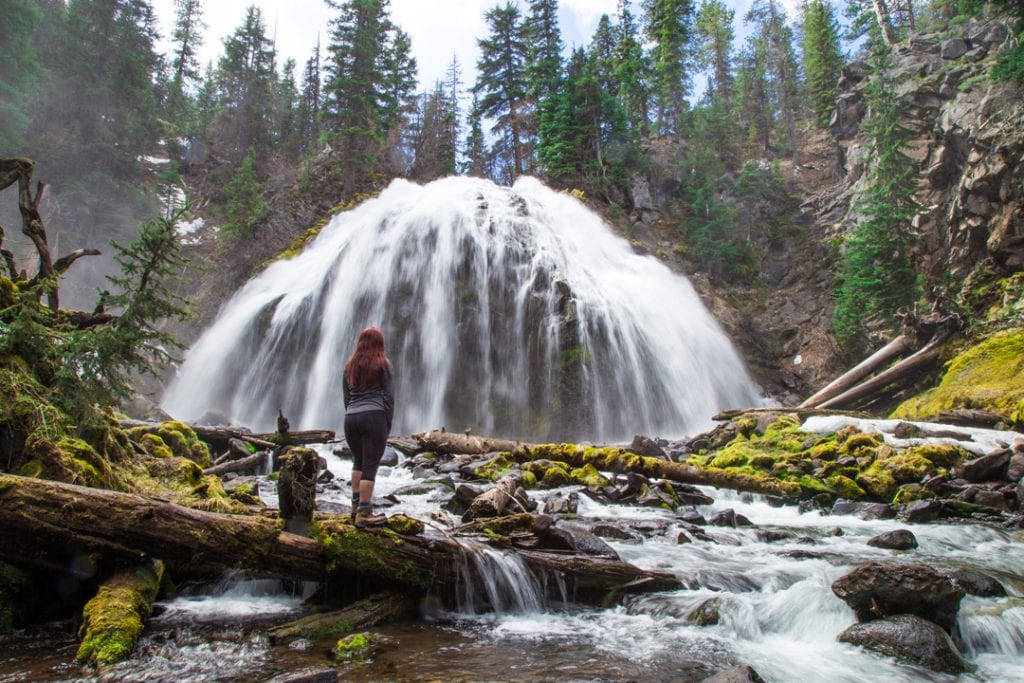
Chush Falls
Just outside of Sisters, Chush Falls is a seventy-foot-high, eighty-foot-wide waterfall on the Upper Whychus Creek. Fed by snowmelt and glaciers from Broken Top, Middle Sister and North Sister, this creek has high water levels all year long and breathtaking views of the mountains. Due to the Pole Creek Fire, which burned the area several years ago, the trail is rarely crowded. The fire drastically changed the landscape and changed what used to be a two-mile round trip hike to Chush Falls into a five-mile round trip hike, or six miles to access the upper falls. In order to access the trailhead, you’ll have to drive six miles on a gravel forest road, so make sure to take a car with high clearance. Once arriving at the falls, hike down to its base and enjoy an up close view of the rushing water from a lush meadow.
Distance: 5 miles out and back, 6 if you head to the upper falls Hiking level: Moderate Parking: Immediately before crossing Whychus Creek on a large concrete bridge, turn left and continue on a gravel road for one mile. Park once reaching a pile of rocks that block the road. Parking is free. Open: Year-round, but snowshoes are recommended in the winter
White River Falls and Celestial Falls
Whitewater rafting on the Deschutes River is not the only water-related activity popular near Maupin; White River Falls, a ninety-foot-tall waterfall tucked in a canyon, is located just out of this small Central Oregon town and can be reached by a 1.4-mile round trip hike. It is a two-tiered waterfall, the lower of which is called Celestial Falls, a forty-five-foot-tall falls frequently run by kayakers. Starting at the White River Falls Trailhead quickly brings you to a viewpoint of White River Falls, which roars in the spring but becomes a series of trickles as the summer goes on. A steep scramble trail leads down from here for a view of the lower Celestial Falls. Then, continue downstream to explore the fifteen-foot Lower White River Falls. The pool below is a great place to take a dip on a hot summer day. While short, this hike is said to be moderate for its uneven ground and steep slopes.
Distance: 1.4 miles out and back Hiking level: Moderate Parking: White River Falls Trailhead, free Open: Year-round
Salt Creek Falls and Diamond Creek Falls
Near Oakridge, approximately 1.5 hours outside of Bend, a 3.2 lightly trafficked loop trail weaves through the Salt Creek and Diamond Creek Canyons. Salt Creek Falls, Oregon’s second tallest waterfall (behind Multnomah Falls), is a short walk from the parking lot and cascades 286 feet. Most visitors stop here and enjoy the stunning views. If you’re looking for a more challenging hike, however, continue past these falls to Diamond Falls, a ninety-foot-tall falls with a series of tiers below that drop an additional 500 feet. A lower viewpoint provides an opportunity to sit at the base of the falls and get splashed. Either loop back to the trailhead from here or continue on a more strenuous hike for several miles to reach Vivian Lake.
Distance: 3.2 mile loop trail Hiking level: Easy Parking: Trailhead at Salt Creek Falls Observation Site, $5 day pass or NW Forest Pass required Open: Year-round but best used from June until October
Escape the summer heat and splash around in these lakes that are great for swimming in Central Oregon.
Summer would not be complete in Central Oregon without days spent swimming at a lake. With beautiful lakes in every direction, splashing around in one of these spots is the perfect activity for a hot summer day. Whether it be a day trip with friends or a camping trip with the family, these lakes have it all. No need to break out that fancy boat or canoe, these lakes are accessible for those looking to relax on a sandy beach and enjoy the beautiful Central Oregon views. Check out our picks for the best swimming lakes near Bend.
Crescent Lake
Crescent Lake, aptly named for its shape, lies on the eastern slope of the Cascade Mountains about sixty-five miles southwest of Bend. With more than twelve miles of wooded shoreline and sandy beaches and 4,008 acres of blue-green water, the lake offers ample opportunities for outdoor activities. Whether this be jumping off the docks and taking a swim or sailing across the glassy water, this lake has a little something for everybody. Motorized boats are permitted, making it a popular spot for waterskiing and fishing. The surrounding wooded area also features trails for hiking, horseback riding and mountain biking.
Distance from Bend: 1 hour 20 minutes Water activities permitted: motorized and non-motorized watercrafts Parking: $5 or NW Forest Pass at day use area Facilities: restrooms, picnic tables, boat ramp
Cultus Lake
Located approximately forty-eight miles southwest of Bend, Cultus Lake is a popular glacier-formed lake off of the Cascade Lakes Highway. Although it is one of the farthest Cascade lakes from Bend, it is well-worth the travel. Several scenic beach spots are accessible at the day use area without any kind of watercraft. The entire lake is surrounded by a dense, mixed conifer forest with views of Cultus Mountain. The lake is known for being one of the only Cascade Lakes that allows high speed motorized boats. There are opportunities for waterskiing, windsurfing, sailing and jet skiing as well as hiking and mountain biking trails that lead north into the Three Sisters Wilderness.
Distance from Bend: 1 hour Water activities permitted: motorized and non-motorized watercraft Parking: $5 or NW Forest Pass at day use area Facilities: restrooms, picnic tables, boat ramp
Devil’s Lake | Photo by Jared Mantzouranis
Devil’s Lake
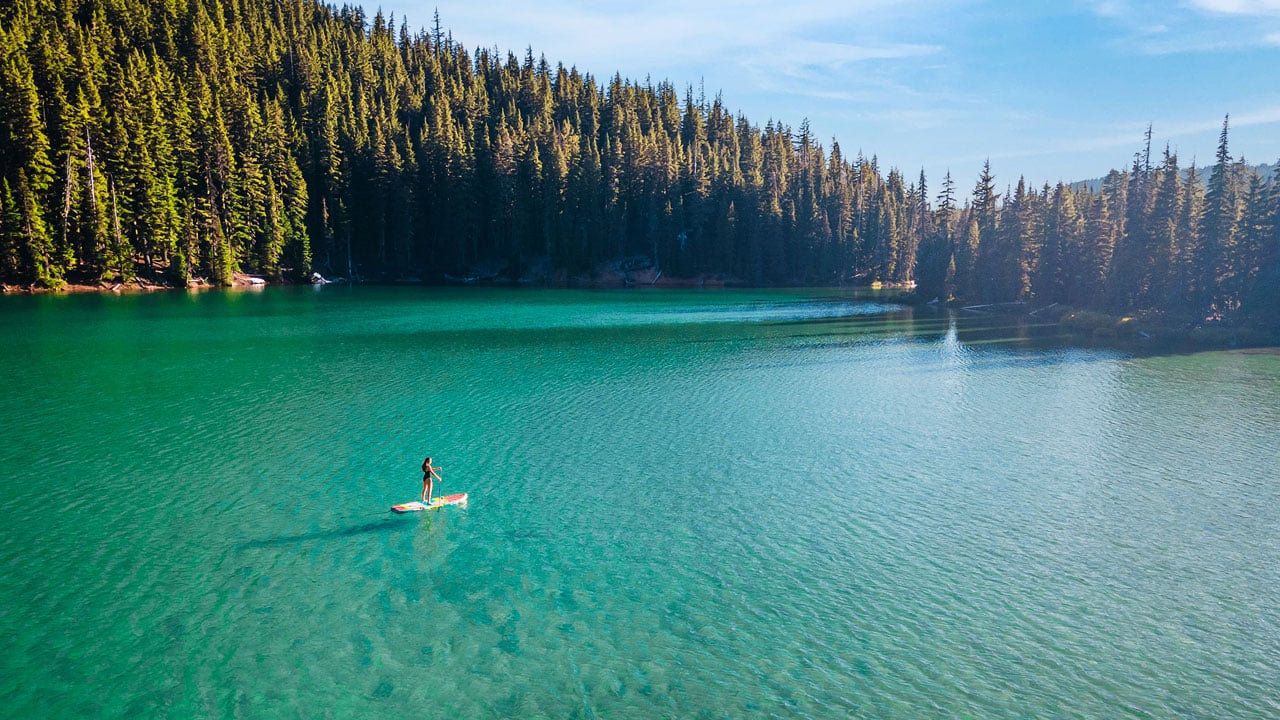
Looking for a truly stunning spot to cool off this summer? Just a short, scenic drive from Bend, you’ll discover Devil’s Lake, a breathtaking turquoise marvel that feels like stepping into a postcard. Tucked away along the Cascade Lakes Highway, this shallow (average depth: 3 feet!) and vibrant lake is a perfect escape for a refreshing dip on a hot day.
While the water is famously chilly (it’s fed by mountain snowmelt!), its crystal-clear, dazzling blue-green hues make it utterly irresistible for swimming, paddleboarding, and kayaking, no motorized boats here, so it’s extra peaceful! It’s also a fantastic spot for a picnic or embarking on nearby hikes that lead into the stunning Three Sisters Wilderness.
Remember to bring your recreation pass for parking, and be prepared for that invigorating mountain chill.
Distance from Bend: 35 minutes Water activities permitted: non-motorized watercrafts Parking: $5 or NW Forest Pass at day use area, limited parking available Facilities: restrooms
Lake Billy Chinook
Lake Billy Chinook lies just west of Madras at the crossroads of the Deschutes, Metolius and Crooked rivers. The lake spans 3,997 acres and reaches depths of 415 feet. It is surrounded by 400-foot cliffs reminiscent of those at Yosemite and, with arms that splinter off in every direction, the lake boasts seventy-two miles of shoreline. The lake features a day use area with picnic tables and a closed-off swimming area fit for the whole family. If wishing to access the more secluded shores or the picturesque Kettle Falls, hop on any kind of watercraft. Cove Palisades State Park is located just up the road on the cliffs towering above the lake and is a hub for all types of family camping.
Distance from Bend: 1 hour 20 minutes Water activities permitted: motorized and non-motorized watercraft Parking: $5 or NW Forest Pass at day use area Facilities: restrooms, picnic tables, boat ramp
Paulina Lake
About twenty-five miles south of Bend, Paulina Lake is situated at the basin of the Newberry Volcano caldera, featuring views of thousands of years of volcanic activity. You can find picnic areas and swimming beaches at the day use area. Since the water comes largely from snowmelt, it can be cold for swimming in early season. Luckily, a short hike on the Paulina Lake Loop Trail leads to geothermal hot springs along the north shore. If looking for more swimming opportunities, turn off Paulina Lake Road before reaching the lake for a short hike to Paulina Falls along Paulina Creek. Just past the falls, you can find swimming holes and natural waterslides great for a hot summer day.
Distance from Bend: 1 hour 20 minutes Water activities permitted: motorized and non-motorized watercraft Parking: $5 or NW Forest Pass at day use area Facilities: restrooms, picnic tables, boat ramp
Scout Lake
Resembling more of a pond than a lake, Scout Lake is the little sibling of Suttle Lake, a higher trafficked destination just a few miles up the road. Although Scout Lake is the local swimming hole for Sisters residents, it is rarely crowded. The warm water and sandy shores make the lake ideal for swimming. A small campground with nine sites is just adjacent to the day use area. Whether you are camping or using the day use area, remember to leave your furry friend at home. For sanitation and safety concerns, Scout Lake is one of the few recreation sites in the Deschutes National Forest where dogs are not allowed.
Distance from Bend: 50 minutes Water activities permitted: non-motorized watercrafts Parking: $5 or NW Forest Pass at day use area, limited parking available Facilities: restrooms, drinking water, picnic tables
South Twin Lake
Among the Cascade lakes, South Twin Lake is one of the smaller, less-frequented spots for swimming. The lake boasts sandy shores and water warm enough to swim in during the summer months. Motor boats are not allowed, enhancing the tranquility of the lake. With a surface area of ninety-nine acres and an average depth of thirty-three feet, it’s a good size to explore on kayak or canoe on for a little family fun. The lake is also known for its rainbow trout fishing, as well as the 1.6-mile-long loop trail along the shore and the offshoot trail leading to North Twin Lake. Both South and North Twin Lakes were formed around 20,000 years ago from volcanic activity that created the two craters that later filled with water.
Distance from Bend: 45 minutes Water activities permitted: non-motorized watercraft Parking: $5 or NW Forest Pass Facilities: restrooms
Smith Rock Scenic Bikeway | Photo by Russ Roca/Travel Oregon
Explore the region on two wheels by checking out these scenic bikeways and fun biking routes.
Oregon is a cycling mecca, especially in the summer, with more than a dozen designated scenic bikeways around the state. These routes take riders on journeys that combine scenery and history, winding through farmlands, over mountains and along rivers. The bikeways showcase some of Oregon’s small towns and are major contributors to the state’s rural tourism economy. Central Oregon has a number of designated bikeways that showcase some of the region’s diverse geography.. Here are the best routes to ride this summer.
Metolius River Loops
A family-friendly place for an extended bike ride, the Metolius River loops can be broken up into sections that fit, ranging from three miles to up to twenty-four miles. Bike along the crystal-clear water of the Metolius River and through the pine forest with small peeks of Cascade Mountain views. Fun stops for a quick break include the Wizard Falls Fish Hatchery, the headwaters of the Metolius River and the Camp Sherman general store.
Distance: Up to 24 miles Difficulty: Easy to challenging Don’t Miss: Stopping at the headwaters of the Metolius River.
Twin Bridges Scenic Bikeway
Twin Bridges Scenic Bikeway starts at the heart of downtown Bend in Drake Park. Over the thirty-six-mile loop ride, travel through Shevlin Park just outside of Bend and then end at Tumalo State Park before turning around. This ride has a few challenging hills, but it’s great for beginning road cyclists. A note of caution: This route was designed to ride only in the clockwise direction for safety.
Distance: 36-mile loop Difficulty: Moderate Don’t Miss: Stopping for fuel at the Tumalo food truck pod, where you’ll find a solid mix of food to eat as well as beer on tap to rehydrate.
Sisters to Smith Rock Scenic Bikeway
If you’re a beginner road cyclist, or if you’re looking for one of the easier scenic bikeways for a day, check out the Sisters to Smith Rock Scenic Bikeway. The thirty-seven-mile ride will take you on a Old West style tour of the region, starting in the small town of Sisters, then following scenic and low-traffic rural roads to Smith Rock in Terrebonne. The route distance is one-way, so you can turn this into a two-day trip by camping at Smith Rock, then heading back along the same route that offers a challenge with more uphill climbs.
Distance: 37 miles Difficulty: Moderate Don’t Miss: Lunch at Terrebonne Depot, with a stunning view of Smith Rock on the side.
Sherar’s Falls Scenic Bikeway
If you’re looking for solitude and stunning views, check out the Sherar’s Falls Scenic Bikeway. About two hours from Bend, this route takes you through some of the charming river towns in between the high desert and the Columbia River Gorge. Starting in Maupin, one of the most popular places for fishing and rafting in the state, the route starts with a tough but short climb out of town, then rewards you with unobstructed view of Mount Hood and the Deschutes River. Then you’ll loop around toward White River Falls State Park, the eponymous Sherar’s Falls and back into Maupin.
Distance: 33 miles Difficulty: Moderate Don’t Miss: Riverside in Maupin, where you’ll find a stellar menu of food and drinks.
Madras Mountain Views Scenic Bikeway
This loop begins and ends in Madras and winds through the rural farmland in Central Oregon. You’ll pass through the small towns of Culver and Metolius. This is a great route to bikepack and camp on the shores of Lake Billy Chinook. While the route is a few miles shorter than other scenic bikeways, it doesn’t skimp on hills to climb.
Distance: 29 miles Difficulty: Moderate Don’t Miss: Round Butte Overlook Park, where you can take a break and try to spot the wildlife like golden eagles that frequent the area.
Crooked River Canyon Scenic Bikeway
One of Oregon’s newest scenic bikeway designations, the Crooked River Canyon Scenic Bikeway starts at Rimrock Park in Prineville and winds along the rural roads and parallel geologic rock formations that will intrigue and inspire. Ride along the Wild & Scenic Crooked River, stopping for a break or lunch at any scenic spot on the water and ending at Prineville Reservoir before turning around.
Distance: 37 miles total Difficulty: Moderate Don’t Miss: Stopping at the Tastee Treet in Prineville, where you can treat yourself to a classic cheeseburger and milkshake after the ride.
New reads for spring suggested by COCC writing instructor Jennifer Forbess.
Freebird
by Jon Raymond
In his new novel Freebird, Portland-based author Jon Raymond explores the destructive influences society can have on an ordinary family. Sam, the grandfather of the Singer family, survived the Holocaust before seeking a new life in California. His son, Ben, a former Navy SEAL, deals with the repercussions of his violent military career. Sam’s daughter, Anne, trying to make a life for herself and her son, Aaron, struggles to maintain her morality in a cutthroat capitalistic environment. And Aaron, on the cusp of adulthood, seeks to find his place within a society that preys on the weak. This book is not wholly optimistic about our ability to overcome our modern social environment, but the members of the Singer family who make it through do come out stronger in the end
The Immortalists
by Chloe Benjamin
The Immortalists is infused with death, but not in the way of an action movie or a murder mystery. Four siblings visit a fortune teller, who predicts the dates of their deaths. The book traces the lives of the siblings as they approach and reach their prophesied date. The big question that runs through the novel is whether the dates are set in stone—independent of circumstances—or whether the dates become self-fulfilling prophesies. Do things happen to us, or do things happen because that’s what we think will happen? Is life about fate or self-determination? The book does not answer the question, and each reader might have a different take on the conclusion of this well-written and engrossing read.
Whirlaway
by Poe Ballantine
People can often seem on the surface to be relatively normal, but you just know there is a lot going on underneath, including, most likely, a little bit of crazy! At the beginning of the novel Whirlaway, protagonist Eddie Plum is an inmate of Napa State Psychiatric Hospital. Why? I’m not exactly sure. After he escapes with the help of his psychiatrist, he meets up with his friend Shelly, who sells old records to gullible Europeans for a living. After that, well, there is just no summarization that would do this story justice. Part literary novel, part mystery, part dream sequence, this is Eddie’s personal journey through the psychiatric hospitals, racetracks, garage sales and Tijuana landfills of life.
No Time to Spare
by Ursula K. Le Guin
I was in my office at COCC in the middle of reading No Time to Spare when I learned that LeGuin had died. She is so alive in the book, and the news was shocking. No Time to Spare is a collection of some of LeGuin’s blog posts from 2010 to early 2016. She covers a wide range of her interests in varying essays. Her rants are especially entertaining. “Would You Please Fucking Stop,” alone, is worth the price of the book. Other favorites include, “TGAN [The Great American Novel] Again,” and “A Modest Proposal: Vegempathy,” a satirical look at our cultural values around food. I grew up with LeGuin’s books, and it’s sad to see her go. But if you are what you read, then she’s still with me, and that’s comforting.
Traditional landscaping (think large, lush grass lawns) aren’t sustainable in the high desert’s arid climate. Here are a few easy ways to make your landscaping at home more friendly for the environment and use less water.
Sustainable landscaping in the high desert is essentially planning, planting and maintaining your outdoor space in a way that uses water judiciously. Its benefits go beyond being stewards of a limited resource. A sustainable landscape saves time, energy and money. As a general rule, you can save up to 40 percent on your water bill if you’re managing your irrigation wisely.
Whether designing a new landscape or retrofitting an existing one, selecting low- to moderate-water-use plants and adhering to efficient irrigation practices are key to creating a sustainable outdoor space in our low-moisture environment, said Amy Jo Detweiler, associate professor of horticulture for the OSU Extension in Central Oregon.
In addition to proper plant selection and irrigation practices, Detweiler said that modifying the soil of plant beds is a smart way to conserve water and maintain a thriving landscape.
“Our native soils are sandy, which drain water really quickly,” she explained. “Amending the planting area with a nice organic compost helps with root establishment and keeps more moisture in the soil, which will lead to less watering.” Aim to add approximately one-third soil amendment to two-thirds of your existing soil.
Before you banish turfgrass from your landscaping plan altogether, consider this: While the traditional ratio of 90 percent turf and 10 percent beds doesn’t make sense in Bend, turfgrass does have important benefits, including reducing erosion and runoff and providing a fire-resistance barrier around your home.
“In a water-efficient landscape,” noted Detweiler, “put grass only where you need it, such as high-use or play areas, and then fill in with perennials, trees and shrubs, which require less moisture.” Be sure to choose a turfgrass rated for cool weather and drought tolerance.
Tia Hatton is one of twenty-one students suing the federal government for failing to protect the nation’s youth from the effects of climate change.
Photo by Robin Loznak
Tia Hatton, 21, grew up in Bend, and like many locals, spent time with her family hiking and playing outside. In high school, she joined the cross country and Nordic ski teams. She’s currently a junior at University of Oregon studying environmental science and nonprofit management. She also happens to be one of a handful of climate change student activists suing the United States government for failing to act on climate change. Hatton is one of twenty-one students in Juliana v. United States, a potentially landmark lawsuit put forward in 2015 by Our Children’s Trust, a nonprofit based in Eugene. The case recently reached the Ninth Circuit Court of Appeals, where the three-judge panel ruled unanimously that the case can proceed in the U.S. District of Oregon, a major step forward for Hatton and other plaintiffs. Hatton talked with Bend Magazine about being involved in the lawsuit and what it takes to change the climate conversation.
Tell us about growing up in Bend and your connection to the environment.
My dad’s family moved to Bend in 1969, and my grandfather Raymond Hatton completed his Masters thesis on tourism in Bend at the time, then taught geography at COCC for many years. Weekends during my childhood were spent in the outdoors. Some of my earliest outdoor memories are of being outside east of Bend in the high desert dust, sagebrush and juniper, as well as of walking along the Metolius River. As I grew up, I got involved in Nordic skiing and cross country. My favorite times in the outdoors are runs during the fall along the upper Deschutes past Meadow Camp. I also have fond memories of taking a break during a tough ski at Meissner, only to hear silence and feel in awe of the crisp, wintry scene around me.
Did you ever notice changes to the region’s climate or landscape?
My senior year of high school, low snow caused Nordic practices to be cancelled or solely held at Mt. Bachelor, because of its higher elevation. The following summer, all of Oregon was in a severe drought, and the wildfire season was bad. Those were noticeable changes, and science confirms the climate is shifting to higher average global temperatures and more extreme weather events.
How did you get involved in Our Children’s Trust?
In the spring of 2015 I heard about a meeting for high schoolers interested in taking local action to curb the effects of climate change, my friend and I attended. That’s when I got connected to Our Children’s Trust YouCAN, Youth Climate Action Now. In the meeting we learned about the successful efforts of Eugene youth to ask their city council to pass a climate ordinance. That’s when the other high schoolers and I decided to pursue similar actions to urge action on the part of our city council. I never ended up participating in these activities, as I moved to Eugene a few months later. Kelsey Juliana, who is the lead plaintiff on our case, emailed me asking if I wanted to take meaningful action to stop human caused climate change by suing the U.S. Government. I said yes.
What has the experience of being involved in the lawsuit been like for you?
Being a plaintiff on this lawsuit is a tremendous experience. I’ve learned about the government’s long-standing knowledge of the harmful effects of increasing carbon dioxide pollution and other greenhouse gases. I’ve experienced the intricacies of our court system after attending multiple hearings. It’s extremely powerful to hear our stories being told in front of judges and the Department of Justice lawyers. The lawsuit has attracted media attention, and I’ve been interviewed by CNN, MSNBC, Global Citizen, the Youtube channel Soulpancake, have been on C-SPAN, and more. I’m passionate about the subject, and the route we are taking as young people. I wish the U.S. government, and global community had listened when they first realized the science, and rapidly started making changes and advancing renewable energy technology. It is unfortunately a topic tied to politics. Due partly to this, there is some negativity from people who either don’t believe in human caused climate change yet, or don’t care to understand the importance and necessity of the case.
What kinds of changes would you like to see in Bend to reduce our impact on the environment?
I’m impressed to see solar going up around the city, and I commend those who support it. The city council has adopted a climate resolution. However, it isn’t binding in any capacity, and there is a lot of work to be done. It’s important for business owners, especially those who rely on tourism, to understand that climate change can negatively affect their business. I think it’s a good step in the right direction, however, climate change is already happening, and every year without concrete action to curb emissions just means that much more carbon dioxide in the atmosphere, where it stays for a long time.
The Environmental Center of Bend shares five easy ways to make your home more sustainable.
Here it is—another list to help you reduce your carbon footprint. How many of these lists have you skipped past or skimmed through? Just ponder this for a moment though—the act of doing just one thing. And the impact that one thing will have when an entire community takes action. When you act to reduce your energy use, you are part of something bigger than yourself. To put this in perspective: if every home in Bend were to replace just six low-efficiency light bulbs, our community would save $2.6 million each year. How’s that for making an impact? And that’s just light bulbs. Here are a few things that you can do to do your part—and while you’re at it, see if you can get your friends to do just one thing, too.
1. Install efficient LED light bulbs.
Let’s get you started on something easy! LED bulbs use 80 percent less energy than standard light bulbs. Get up to sixteen installed for free from The Energy Challenge
2. Reduce your hot water usage.
This one doesn’t require you to buy anything. Hot water accounts for up to 20 percent of the average home’s energy use, so by using less hot water, your savings can add up quickly. Think twice about how long the water is running when you’re doing dishes. Consider washing your clothes in cold water. These days, most detergents are just as well-suited to be used in cold water. On top of this, you can get new high-pressure, water-saving showerheads for free when you get your free LEDs.
3. Turn down your water heater thermostat to 120 degrees.
This helps your water heater work a lot less hard. Sometimes this can be tricky. The best bet is to just Google it. If you have what looks like a heavy-duty extension cord going into the top or side of your water heater, it’s electric. If you see a flue or something that looks like a metal chimney, it’s a gas water heater. You’ll need to refine your search based on which type of water heater you have.
4. Take control of your thermostat.
Optimize your heating and cooling by making sure you’re taking advantage of times when you’re not home and setting your AC at a higher temperature. Remember, you only need your home to be comfortable when you’re there. (Note to skeptics: energy audits have proven that it’s more efficient to reheat and cool a home on demand than it is to maintain a consistent temperature.)
5. Consider an electric vehicle.
Yes, this one’s a much bigger move, but hear us out. Make sure you have all the information you need—you may find an EV fits into your life better than you may think. Stay tuned for details on workshops to learn more, Ride and Drive events to take one for a spin and special deals over the summer.
You can find out more on each of these topics and sign up for free LEDs at theenergychallenge.org
Editor’s note: This article was written by Lindsey Hardy, the Environmental Center’s Energy Challenge program director.
Sara Wiener on finding community in Bend and running a small business.
Sara Wiener does not sit still for long. An athlete and entrepreneur, Wiener thought Bend seemed the perfect place for her to settle with her partner Joanne and their daughter Bella. Often recognized for her variety of businesses, first Sara Bella, then Sara Bella Upcycled and now her new project Sara Wiener Consulting, she is not one to be kept down. Whether leading the charge to provide a safe and equal place for all community members, starting the Procession of Species parade (now the Earth Day parade) or becoming a CASA volunteer, Wiener has begun to find that perfect grass she had been looking for is the one she planted here when she started her journey in Bend more than twenty years ago.
On Finding Community
When I met Joanne in 1991, I didn’t know what Bend was, but Joanne had come to Bend as a child to ski. We were living in Olympia, Washington and would come here on vacations and long weekends. We were training for triathlons a lot and we were done with the rain. I got pregnant and then we decided to move here. I looked in the yellow pages under the words “gay” and “Jewish” to see what type of community I would find here for both of those pieces of my life. When we got here, there were a few gay people here who were willing to talk to us, but not interested in being outed. They made that very clear. Not that that was my plan, but we were coming here as an out couple—and pregnant! There is a Jewish community as well, but there was no temple and they met in the basement of a church. That has since changed and grown. I think we were a little bit threatening to people because we were out and not interested in anyway of going into a closet just because we moved to a Central Oregon town, which was about 25,000 people at the time. So, there have been some big, big changes since we moved here.
On A Changing Town
I like that there is a larger gay community in town that is more out now. We don’t have to be the pioneers anymore. I feel like we were in a lot of ways, from moving here pregnant, having a child and Joanne adopting Bella. It was the first birth by a known lesbian in town, and it was the first same-sex adoption in Deschutes County. Nobody seemed to know anyone else who had done it. But in any case we were very consciously wanting to make a path that would be easier for people who followed. As were raising Bella, there was a hate crime at The Grove, a restaurant and bar. It was a big, terrible shock. We were regulars there. We would take Bella all the time. We loved that there was a place that was overtly gay friendly in town. The hate crime led to a lot of changes. I was on the special committee to work on changing our Equal Rights Ordinance. That was a big deal and a bit of an eye opener. I gave testimony, and many other people gave testimony, pro and against. Someone gave testimony that the mountains were smoking because of us. I thought, “Well, thank you for that power.” But it changed things.
On Misconceptions
When people hear I live in Bend, they immediately think it must be a progressive place. I have to correct them, sadly, that on any vote, on any candidate, any issue, it’s often fifty-one percent to forty-nine percent. That tells you something. That is not what people understand about Bend. If they are coming in from Los Angeles or San Francisco or Portland, they are funneled into a particular part of Bend and they only know that part, whether it’s the west side or the beer culture or the ski culture.
On Bend’s Next Generations
One of the really cool things that has happened is with PRIDE, which is something that has grown wonderfully along with the growth of the town. It’s not the families who are moving here that are getting involved, but rather it’s our kids! It’s the kids who have grown up here. Whether they are gay or straight, they are getting it. These kids are getting it on all levels of gender diversity, fluidity, non-binary and trans, and I am loving seeing what is going on here.
On Why They Stayed
Moving from Olympia to Bend, it really felt like we were going backwards. I hated that feeling, but at the same time, what we decided was that we were going to stay and make something of it. We stayed because we loved it here, and we made some great friends. We are not necessarily looking for people that look like us. We’re just looking for good people. We are also athletes and outdoors people, major hikers, bikers (mountain and road). We skate ski, so we love the Nordic center and Meissner. We love taking our dog to Wanoga, where it’s off leash for skiing. We love hiking at Smith Rock and in the Three Sisters. We’re in love with the outdoors and the environment here.
On Starting A Small Business
I started Sara Bella in the early ’90s and named it after my grandmother because she was the most important and closest person in my life. She taught me how to sew. It’s funny, I spent many years in Bend as Sara Bella people did not know that I had a different last name. Being a small business owner for the last twenty years here in Bend, I loved being in the public eye. And being the extrovert and a manufacturer, artist, retail person, it was always important to me to be in a downtown core. I loved being part of the downtown core, before I got priced out. I started with the fleece and then I closed when I kept getting priced out of rent. I was burnt out. Then I was working on developing a cyber cafe in a small village in Kenya. Around that time, my friend told me you could iron plastic bags. I was so enthralled with it that I went into my studio and started ironing plastic bags like crazy and then Sara Bella Upcycled was born.
On Changing Careers
I’m excited to start my new business, Sara Wiener Consulting, coaching teens on executive functioning, time management and organizational skills. I have a masters in social work with a focus on school social work, and I have a teaching degree. So, I feel like this combines all of my education and skill set with what I can do today. I am excited and nervous and not very confident, but I feel like that is the exact right place to be in right now.
On The Grass Always Being Greener…
As much as I get frustrated with Bend for a variety of reasons, and I’ve said this for twenty-one years, where would we go? Where is the grass greener? I was always that person looking for the greener grass. I noticed within a year of being in Bend, as much as I questioned raising a kid here, I said to Joanne, “I don’t know where the grass is greener.” I can’t come up with a place that would be better that I would rather be, and today, I cannot do that either. At any point in the last twenty-one years, I have not thought of a better place to be. So, that really says something about this community.
A weekend in Willamette Valley wine tasting includes plenty of glasses of the region’s award-winning pinot noir as well as history, culture and farm-to-table meals.
Allison Inn & Spa
We launched our weekend of wining and dining on a grassy bank of the Willamette River. It was an overcast spring day, the air damp and smelling of black cottonwood. There was no wine in sight. No gleaming glasses of award-winning pinot noir, no hand-printed flight menus, no luxurious views of vineyard estates. Just a historic pavilion, fronted by an engraved stone pillar, marking this meadow as the site where Oregon’s first provisional government was formed in 1843. Without the rich soil, there wouldn’t have been a steady march of early settlers to the Willamette Valley. Without early settlers, there wouldn’t have been a provisional government. Without a provisional government, there wouldn’t have been an Oregon at all. Therefore, no fine Oregon pinot noir, born from the rich soil of the Willamette Valley. Turns out in Oregon’s wine country, everything comes full circle. You can’t pull the wine apart from the history, or the history apart from the people. Which was fine with us. My friend and I had come for relaxation and indulgence, but we were willing to interrupt decadence for culture and history. Each winery and restaurant, it would turn out, had a great backstory. Every Willamette Valley destination we visited wound into a tapestry of landscape, community, innovation and dreams.
Day 1
Alexana Winery. Photo by Andrea Johnson.
A significant aesthetic pleasure of touring Willamette Valley wine country is simply the road trip. It’s postcard-scenic here, each segment of the journey passing bucolic farms, fields readied for spring planting and stands of grand oak trees. We took in the sights with a sense of adventure as we set out on our two-day tour.
We ventured to ROCO Winery, outside of Newberg at the base of the Chehalem Mountains. Owner Rollin Soles came from Texas to make wine in Oregon in the 1980s. After crafting award-winning vintages for Argyle Winery for a few decades, he planted his own pinot noir grapes in a vineyard he christened Wits’ End. We sipped on ROCO Private Stash pinot noir from a bottle bearing the winery’s thunderbird logo, inspired by the petroglyphs of the Columbia Gorge.
Next on to Alexana Winery, where the view commanded our immediate attention. The vineyard descends over ridges and slopes into a misty wood, the coastal mountains poking through the cloud cover beyond. Dr. Madaiah Revana of Texas loved the great wines of Burgundy so much so that, in 2005, he sought out a place to grow grapes himself. The answer was this eighty-acre parcel outside of Newberg. The incredibly diverse and complex soils here are visually represented in the glass front of Alexana’s twenty-foot-long tasting bar, which is filled with layers of earth. We sipped chardonnay and contemplated colors from light sand to a rich brown to charcoal grey, in textures from gritty to dense. This was the stuff—the origin story of everything around here.
From the soil also rise wild mushrooms, one factor that drew the Czarnecki family to Oregon from Pennsylvania in the 1990s. Bringing four generations of restaurant experience, they took up shop in the historic Joel Palmer House, a grand two-story home built by the co-founder of Dayton in 1857. Since, the Joel Palmer House has become one of Oregon’s renowned fine dining restaurants and a purveyor of delectable dishes featuring mushrooms and other local foods. We settled into a four-course meal that included sturgeon, risotto, truffle oil, morels, lobster mushrooms and a divine white chocolate cheesecake, accompanied, of course, by Oregon wine. Chef Christopher Czarnecki paid us a tableside visit, explaining that his family and their friends still gather a majority of the mushrooms for the restaurant.
We arrived at the Allison Inn sated and sleepy. For years, wine country visitors had few overnight options. In 2009, Ken and Joan Austin built an incredible eighty-five-room luxury hotel in Newberg. The couple had grown up on farms in the area, ultimately founding a successful dental equipment company in their hometown. As the region captured international wine-tourism attention, they’d looked on, eventually creating lodging worthy of the most distinguished visitor. Our deluxe room offered a view of the vineyard from our own personal plush window seat.
Day 2
Carlton Winemakers Studio
We began the day in JORY Restaurant, the Allison’s nod to both the renowned soil underfoot and Pacific Northwest farm-to-table dining. Chef Sunny Jin has his own garden onsite, and my omelet came with a petit salad as well as locally sourced maple-sage sausage.
Was it too early to visit a winery? No, it was not. Winderlea Vineyard is perched outside Dundee, and its tasting room is in a glass-encased building that feels like a castle on the hill. We sampled Winderlea’s small-batch wines in a bright tasting room as Donna Morris told us how she and Bill Sweat left Boston and successful business careers behind to craft an Oregon pinot noir winery. Surrounded by vast garage door-windows boasting views across the vineyards into the valley beyond, I didn’t blame her one bit.
Lunch was at Red Hills Market, a marketplace and restaurant I fell in love with immediately. The tall square building embodies the best kind of neighborhood gathering place, warm and inviting, smelling of delicious foods and bustling with chatter. Wood-fired pizzas, soups, salads and more farm-to-table treats are served from a busy counter. The Oregon albacore tuna melt with local cheddar, capers and arugula hit the spot. It came as no surprise that, when we met the market’s owner Jody Kropf, we learned he’s an Oregon native who grew up helping his parents with their business, the Brownsville General Store, and that he was drawn right back home after culinary school in California.
Red Hills Market
The Carlton Winemakers Studio was born of collaboration and community. Twelve individual vintners produce coveted wines under one innovative roof in this modern and light space. When we were there, winemakers sat together over tasting glasses, decanters and clipboards, immersed in the tasks of the trade.
Scenic rural roads delivered us to McMinnville, where we began our tour at the McMenamins Hotel Oregon rooftop bar. Below us was the charming downtown and a bird’s-eye view of shops, restaurants and entertainment. The hotel was built in 1905 and brought back to life in 1999 by Oregon natives Mike and Brian McMenamin, famous for their restoration of old Pacific Northwest buildings.
Tucked away in a glass storefront on a side street, we found Thistle, a cozy, eclectic restaurant that quickly made a name for itself with a menu that changes constantly based on available provisions from nearby farmers and ranchers. Our experience began with a cocktail called the Millionaire—rum, gin, apricot brandy and lime—poured into an antique champagne cocktail glass. At a wooden-plank table, from mismatched vintage plates, we enjoyed innovative flavors by way of oysters from Netarts, “wild weeds,” anchovies, duckling and kale.
We found our walk-up flat over the Odd Fellows Lodge. The owners of Third Street Flats want guests to immerse themselves in McMinnville. We had a small apartment of our own, walking distance to shops and eats, with a tidy kitchen stocked with everything we might need (read: chocolate and wine). Our “8th Flat” was decorated contemporary post-modern, in colors of indigo and white.
Quiet, lovely and comfortable, the flat made us feel as if we were local insiders. Drifting to sleep, we could dream of living right here ourselves. Perhaps we would plant a vineyard or start a farm. Maybe open a restaurant. We would put down roots, connect with a new community and create something wonderful out of the rich soils of the Willamette Valley.
Water is one of the most talked about resources in the high desert.
1. Don’t set it and forget it
The most efficient irrigation method is the one that’s being monitored. A monitored system—whether by hand or timed/automatic—takes current weather and location (i.e., not the sidewalk) into consideration on a routine basis. In general, Detweiler recommends that irrigators should water less at the beginning of the summer, more as it progresses and then taper off again in the fall. One way to stay on top of irrigation management is to purchase a smart irrigation system, which responds to real-time weather conditions and forecasts, offers intelligent watering schedules and gives you control of your sprinklers from anywhere via an app.
2. Avoid runoff
When hardscaping an area, consider permeable pavers, which allows water to seep into the ground below. Similarly, dry river or rock beds can be positioned to collect rainwater and direct it somewhere useful, say, a plant or flower bed.
3. Just the right amount
Grouping plants together with similar water needs into distinct beds or zones prevents overwatering plants that don’t need the extra moisture. For example, group moderate water use plants in one bed and low-use plants in another. When it’s time to set up your irrigation schedule, you can easily provide more water to plants that need it and less to those that don’t.
4. Top it off
Adding a layer of mulching materials to your plant beds helps keep moisture in, versus bare soil, which dries out quicker. Aim for a two- to five-inch layer.
A retreat, a remodel and a modern infill project showcase creative approaches to sustainability.
Photo by Alan Brandt
Central Oregon is well-known for sweeping mountain vistas, towering stands of pine forests and clear, cold rivers, so it makes sense that our love for nature influences the way we design and build our homes. A modern retreat in the forest, a nearly 100-year-old bungalow and a Frank Lloyd Wright-inspired home all show that there’s more than one way to be green.
1. Old Bend Meets New Modern
Photo by Alan Brandt
Realtors often tout “location, location, location,” and when it comes to sustainability, living in a home where you can easily walk to amenities means you can drive less. Just half a block from the popular Jackson’s Corner eatery in the Old Bend neighborhood sits Doug and Kathryn Collins’s modern 2,000-square-foot home. The home was born from a desire to live in the heart of Bend so they could walk to downtown, the Deschutes River, Drake Park and the Old Mill District. “We decided to forgo the mountain views for the simplicity of walking to nearby things that we like to do,” said Doug.
The couple had several ideas that required a creative approach to the home. It had to be single-story and it had to be sited and designed so that it wouldn’t dominate the neighborhood or be visible from a block away. It also had to be environmentally friendly. Sustainable features include a 3.2-kilowatt grid-tied solar electric system on the roof and a heat recovery ventilator, which brings fresh air into the home through an energy efficient heat exchanger. All the lights have high efficiency LED bulbs, and the landscaping consists of entirely drought resistant native plants for a low maintenance and low water use yard.
The Collinses are architectural buffs with a love for Frank Lloyd Wright designs, so local architect Eric Meglasson wove together a modern look with touches of Wright. Clerestory windows filter in natural sunlight, while still providing privacy in this dense central neighborhood. The entire home has concrete flooring with radiant heating for warmth, and simple, low maintenance finishes are found throughout the home. The fir trim, along with the cedar ceilings and art from local artists, is an intentional nod to Pacific Northwest materials and culture.
2. A Passive Solar Home in the Pines
Photo by Might Creature Co
When Susan Worden and her husband Bill were planning to build a home in Central Oregon, Susan distinctly remembers saying to herself, “I want to feel like I’m living in the forest.” The couple also had specific goals for their home. It had to, in this order, be affordable, efficient, sustainable, have “aging in place” features and be architecturally beautiful. All those factors combined to produce a one-of-a-kind home on a forested property in the Three Rivers South area, south of Sunriver.
Designed and built by the Wordens, the house is passive solar, meaning it maximizes the sun to heat and illuminate the home. Orientated so that the south side of the home has most of the windows, the home is designed so that the warm sun filters into the home in the winter, but not in the summer. A large concrete fireplace heats the home, and the wood comes from trees cleared on the property. By sustainable, selective tree thinning around the house and on the fifteen-acre lot, the couple already has enough wood for at least the next nine years.
Tightly sealed and well-insulated walls, ceilings and foundation, triple and quadruple paned windows, LED lighting and ultra-efficient appliances are just a handful of the features that make the home energy efficient. The Wordens were also conscientious about the materials in the home and made an effort to find local, recycled or repurposed materials. All the fill and concrete was sourced from five miles away, and noticeable throughout the home are repurposed materials such as an “upcycled” stainless steel countertop and a dining table made from bowling alley flooring.
Designed with health and longevity in mind, the home has a yoga room, an infrared sauna, and has “aging in place” features such as no stairs or steps, wide hallways and curbless showers. “We intend to live here for a long time,” Worden said with a smile. It’s easy to see why, in this south county retreat.
3. A Net Zero Energy Historic Bungalow and ADU
Photo by Mighty Creature Co
Experts agree that when it comes to energy efficient and sustainable buildings, the holy grail is “net zero energy.” While it might sound like a lofty phrase, it’s actually a simple concept. A net zero energy home is one that creates onsite as much energy as it uses, leaving the occupants with no energy bills and a home that contributes no carbon dioxide into the atmosphere. This is usually done with a combination of renewable energy, usually from solar panels, and an extremely well-sealed, insulated and energy efficient home.
Designing and building a net zero energy home isn’t always simple to do, but Joe Emerson and Ann Brayfield have made it their mission to help people achieve net zero energy in their homes. The couple has built several net zero energy houses in Bend, and their latest project is a renovated 1926 west side Bend bungalow with a new accessory dwelling unit (ADU).
The 500-square-foot home evokes the yesteryears of Bend, when the lumber mills were churning out wood that was sent to build houses near and far, featuring a deep bungalow-style front porch, wide-trimmed windows and old fir floors.
“The house is amazingly well built, and we discovered right away that it has good bones, so we thought it would be an interesting home to transform into a zero energy home,” said Brayfield.
A closer look at the old home reveals features such as high-efficiency windows, blown-in insulation, new wiring, and high-efficiency LED lighting and heating.
The real powerhouse of the property is the new 600-square-foot ADU that sits behind the bungalow on the cozy lot. The small roof houses a 6.4-kilowatt solar panel system that provides clean, renewable energy for both units.
Since summer 2017, the two homes together have proven to be net zero energy—a green feat for this unique property.
Oregon’s newest resort near Burns, Silvies Valley Ranch combines Western ranch life with top-tier golfing for a unique and elevated ranch retreat.
Photo courtesy of Silvies Valley Ranch
Scott Campbell isn’t the kind of person who does anything halfway. Campbell is the veterinarian who did for animal care what Ray Kroc did for the hamburger, turning a sleepy Portland veterinary practice into a multimillion-dollar pet hospital empire. So when Campbell, now semi-retired, returned his attention to his native Eastern Oregon, folks who knew Campbell expected that he would come up with something big. He didn’t disappoint.
In late 2017, Campbell unveiled his latest venture—part luxury resort, part dude ranch and totally Oregon. Silvies Valley Ranch Retreat and Links is a 140,000-acre resort and golf destination located between Burns and John Day that ties the region’s colorful ranching history with what Campbell sees as its economic future.
Campbell grew up in nearby Burns, about forty-five minutes south of Silvies Valley, not far, at least by Eastern Oregon standards. It was in Burns that he developed his early interest in animal care, tending to horses and cattle on his family’s ranching operation. Campbell’s career took off in the late in 1980s when he grew his traditional veterinary practice into Banfield Pet Hospitals, a business franchise that pioneered concepts like health insurance for pets.
It’s no accident that Silvies Ranch sits far from the nearest city or international airport. Campbell wanted a project that showcased the diverse geography and natural beauty of Eastern Oregon, while also addressing the persistent lack of economic investment and job opportunity in places like Burns, where unemployment remains high and wages stubbornly low. Campbell looked to Bandon, another formerly depressed town on Oregon’s coast, and saw the economic transformation that followed the development of Bandon Dunes Golf Resort.
Worth the Wait
Photo Courtesy of Silvies Valley Ranch
Some seven years in the making, after a brief sneak preview last summer, the resort is now ready to debut for its first full year of operation. If you’re expecting Sunriver or Black Butte Ranch, think again. Unlike those sprawling resorts, there are no roads at Silvies. Guests check in at the welcome center and transfer their belongings into golf carts, the preferred mode of transportation around the property, where gravel paths connect the communal dining hall, cabins and golf courses.
While Silvies Ranch is plenty remote (the only traffic jam we witnessed involved a massive herd of resident elk), it’s also surprisingly accessible from Central Oregon. If you’re traveling from Bend, it’s hard to get lost. Head straight to Burns and hang a left. From there the two-lane Highway 395 climbs into the heart of the Malheur National Forest through a bulwark of massive lava rock and sandstone formations that at times pinch the road into narrow slot canyons, before climbing into a ponderosa forest that beckons exploration. Within half an hour or so, the highway drops into a broad valley where signs announce entry into the historic Silvies Valley Ranch, really a patchwork of pre-existing ranches and homestead properties that stretch into the surrounding hills to the east and west. Roadside signs direct guests along gravel roads into the ranch where they are greeted by a proverbial welcome wagon and concierge. The check-in process is eased by a causal refreshment station with a nice craft beer selection, wine by the glass and artisan cheese. (Cocktail hours are an enshrined part of daily life at Silvies.)
While 2018 brings the debut of a spa and fitness center, you won’t find a wave pool or waterslide. Instead, Campbell is betting that his unique approach to the destination golf resort will appeal to golfers who are willing to travel, sometimes across the globe, for one-of-a-kind experiences like Silvies. Designer Dan Hixson designed a “reversible golf course” that can be played as two different 18-hole layouts depending on the day. This year debuts an even wilder idea, a 7-hole, par-3 golf course dubbed McVeigh’s Gauntlet. The course, more an array of tee boxes and greens, requires players to make approach shots over narrow valleys to angular greens tucked onto hillsides. If it seems like cruel joke on average handicappers, consider this punchline: Silvies is employing trained goats to serve as caddies (the upside being that no tipping is required). There is also a short pitch-and-putt, par-3 course that offers players a taste of Silvies’ signature sloped greens and the links golf tactics they require. While the golf can be challenging, the views are beyond comparison with many holes featuring elevated tee boxes that offer broad vistas over seemingly endless rolling valleys that stretch to the foot of the Blue Mountains.
Off the Links
Photo Courtesy of Silvies Valley Ranch
Schedules typically revolve around tee times at Silvies, which leaves non-golfers plenty of time for exploration and relaxation, both of which are in abundance at the resort. In addition to golf, Silvies offers hiking, horseback riding and fishing in a man-made pond. Come July, the resort will also reveal its new spa, which includes a fitness room, lap pool, saunas, a climbing wall and spa treatments to soothe golf-weary shoulders and backs. In addition to golf and spa activities, the ranch offers off-road biking and a shooting range where guests can play Wyatt Earp under the watchful eye of an instructor who will offer the finer points of gun safety and marksmanship. Regular cattle drives mean guests can also witness and partake in the time-honored round-up tradition.
If you’d rather just relax and take in the scenery, Silvies has you covered there, too. The cabins feature a deck-side hot tub for guests staying in the main guest room. (A lockout feature allows the cabins to be set up in multiple configurations for booking flexibility.) The cabins themselves carry the resort’s Western themes and feature rustic luxury—think antler chandeliers and leather couches—with plenty of modern touches like climate-controlled wine storage and radiant heat.
If the days offer solitude, meals are an event that draw guests from around the ranch. During our stay, a single group seating offered a chance to mingle with others, making new friends while enjoying the ranch’s hospitality. Guests were offered steak or chicken dinner, but the choice was clear for me as well as most of my dining companions. We were asked to select a carving knife from a deliberately mismatched selection of hunting knives that was passed around the table like a church offering plate. Once properly armed, we dug into perfectly cooked ribeye steaks with sides like mashed potatoes and roasted broccolini shared around family style. Afterward, we migrated to the patio for a bonfire and a last round of cocktails, watching as crackling embers drifted over our heads toward the first evening stars peeking through a fading desert sky.
In time, Campbell hopes that Silvies Ranch will draw guests from as far away as Japan and China, not just for the golf, but for a chance to immerse themselves in the Old West, or at least the idea of it. Campbell acknowledges that it will likely take several years for international travel buzz to develop around Silvies, which has only now just begun to break ground on many of its planned overnight accommodations. Given the singular and signature Western experience, he believes that they will come. In the meantime, he’s got Oregon’s hardcore golfers looking east and seeing green.
Jamie Brown, a sprint paratriathlete, is climbing the ranks of the sport and aiming for the 2020 Olympics.
Jamie Brown. Photo by Pete Erickson
Run, cycle, swim—every day. That’s what it takes to stay faster than almost everyone in the world. Just ask Bend’s Jamie Brown, who has been doing it for the past eight years while climbing the ranks of the world’s best sprint triathletes.
Sprint triathletes race a truncated triathlon that includes a 20k bike leg and 5k run. A multisport event, the sprint triathlon is to the Ironman what the 100-yard dash is to the mile race in track and field. It takes a special kind of athlete and a certain mindset to succeed in a race that is part endurance race and part mad dash.
“I guess I have always just liked pushing myself and my limits,” said Brown. In March, he won the continental championships, and he’s currently training for the New York City Marathon. He’s done it all without the benefit of a right leg. Brown was born without a right fibula, but he’s never allowed it to slow him down. An early surgery set him up for a prosthetic lower leg. He started playing sports like everybody else, always competing against able-bodied athletes. Eventually, he was pitching in the Division III College World Series for Chapman University in California. “It never registered as ‘I’m the disabled kid,’” said Brown.
That kind of can-do mindset has served him well throughout his life. When he turned his focus to paratriathlon races roughly eight years ago, it didn’t take long for the results to follow. Since then he’s amassed an impressive list of achievements at the national and international level, including gold medals on the world championship level. Athletic ability and a fiercely competitive spirit have brought him success, but Brown credits his wife, also named Jamie, for her unwavering support. “I most likely would not be able to compete at this level without her motivating and pushing me to go swim every morning.”
With each season comes another set of obstacles and another set of opportunities. Later this year he’ll be in the Escape from Alcatraz triathlon, plus racing in Japan and on Australia’s Gold Coast. The ultimate goal is the Olympics. Brown narrowly missed qualifying for the last summer games in Rio de Janeiro in 2016. His recent successes have only added to his determination to qualify for the Tokyo 2020 Paralympics.
Talent and a loving spouse propel him far, but Brown’s essential strength originates in positive thought. “The further you go in sports, the more challenges and adversity you are going to have to encounter,” said Brown, who until a recent rule change, found himself racing alongside para-athletes who had both legs.
“It doesn’t matter how many parts you’re missing,” he said. “Mind state is critical.”
“I’m pretty big on practicing sports psych and visualization. With endurance sports, you’re consistently going, and, sure, when you’re hurting, negative things start to fill your head,” he added. So, as part of his training, Jamie imagines himself in those scenarios. “It allows me to create ways to resolve these feelings.”
Brown isn’t the type of competitor who hoards his knowledge as a competitive advantage. He coaches other para-athletes, like the nation’s best (and world number two) above-the-knee amputee, Mark Barr. Jamie also works with local youth triathlon camps and is creating a team of young triathletes alongside Ironman coach Jaime Dispenza. Meanwhile, Brown and his wife lead adult fitness classes in Bend, including family-specific group workouts.
Advice from one of Bend’s top athletes? “Eat right, get sleep and allow your body to recover.”
As the population of Bend and Central Oregon continues to grow, so does the amount of waste we collectively send to the landfill.
While recycling is an important step in trash management, preventing waste from occurring in the first place is the gold standard in sustainability.
“We say ‘reduce, reuse, recycle’ in that order because it’s the order of importance and impact,” said Denise Rowcroft, a sustainability educator and the manager of the ReThink Waste project spearheaded by the Environmental Center of Bend. Here, we share easy-to-adopt tips to help you begin a reduce-reuse-recycle habit. And for those who want to make an even bigger impact, we offer advice on how to take your home trash management and prevention routine to the next level.
About a quarter of the trash that enters the landfill is food waste. Once in the landfill, that food waste releases methane gas, which contributes to greenhouse gas emissions and ultimately global warming. Composting your food scraps not only reduces methane gas emissions, but also breaks down to create a nutrient-rich soil for your garden or flower beds.
While composting is highly recommended for disposing of unused veggies and fruits—just like recycling—it’s worth taking a look at your buying habits to prevent food from needing to be composted in the first place. It’s not just good home economics. Purchasing less means a reduction in your total carbon footprint.
“If you have a lot of fruits and veggies going bad in your fridge,” explained Rowcroft, “there is still a significant upstream environmental impact to ship that carrot grown in California on multiple trucks to Bend.”
1. Shop your cabinet and fridge first.
This has two benefits: You avoid buying duplicates and you may discover something to add to your weekly meal plan before it goes bad.
2. Make a plan before you buy.
Creating a meal plan and shopping list in advance of your trip to the grocery store helps you purchase only what you need.
3. Eat your leftovers.
Step 1 will help you remember to follow through with Step 3.
4. The freezer is your friend.
If you don’t have a plan for a specific food item before it will spoil, freeze it for later use. Just don’t forget to “shop your freezer” on a routine basis.
Tiny homes don’t skimp on design aesthetics and high-end features and contribute to the sustainable housing movement in Central Oregon.
A Wood Iron Tiny Home. Photo by Joshua Langlais
In 2014, mainstream America discovered the “tiny home movement” through shows like Tiny House Hunters, Tiny House Nation and Tiny House, Big Living. Four years later, tiny homes are still gaining popularity among builders and buyers. Part tree house, part camper trailer, so-called tiny homes come in many shapes, if not a lot of sizes. The mini cottages are typically built on camper trailer frames, offering a highly mobile residence with a bohemian feel for individuals and families who seek the comforts of home stripped down to the essentials.
Spud and MaryEsther Hooley of Bend’s Wood Iron Tiny Homes (WITH), like many in the movement, consider “tiny living” more a lifestyle than a floor plan. Before starting WITH, the Hooleys spent seventeen years on missions to impoverished countries. “For 75 percent of the world, living tiny is their only option,” explained Spud. After dwelling among those with so little, the Hooleys wanted their business to offer an alternative to American “McMansions”—something both elegant and economical. It seems many find the idea of pared down, sustainable living attractive, particularly in Oregon where interest in tiny home living and building is among the highest in the nation, according to Google’s search data.
Photo by Missy Mabel
The Hooleys migrated into the tiny home building market almost by accident. They tried RVs and remodeled a caboose, but discovered tiny homes had a winning combination of mobility and quality. They liked the idea of building something from scratch that was high on craftsmanship but low impact, environmentally speaking. For starters, tiny homes simply require less of everything, fewer raw materials, less space and energy. Mobility can also add to the dwelling’s efficiency.
“You can move a tiny home seasonally into shade or sun to conserve energy,” she added. Most tiny homes feature composting toilets, and WITH’s smaller model, dubbed McKenzie, sports portable solar panels and off-grid capabilities. The Hooleys keep transit costs down during building by shopping locally. Their debut model, North Sister, features hardwood floors, a cedar shake exterior, and granite countertops from Bend businesses and cabinets from wood milled in Sisters.
Photo by Missy Mabel
They see tiny homes conserving other things, too. “You shop less. With each purchase you consider, ‘Where would I put it? Do I love it more than what I have?’ So, your income goes farther,” said Mary Esther. Although WITH exists on the higher end of the tiny house price range, the Hooleys work to balance custom home quality with affordability. “You still have to come up with a six or seven-year payment, like a car, but it is better than a thirty-year mortgage,” said Spud.
Tiny Home resident Tamara Heauser bought the North Sister model last year, after touring it at an expo. “I wasn’t planning to buy a tiny house, I just wanted ideas for my own design,” explained Heauser. She had designed a custom home and remodeled a cabin previously. Although accustomed to beautiful aesthetics, she’s also lived in 400-square-foot spaces and even a tree house. She wanted mobility with custom-home quality, and her North Sister model fit the bill.
“I don’t feel it’s about not having things,” she said. “It’s more about choosing things that I use and value. It contributes to a simpler lifestyle.”
A thoroughbred racehorse destined for the racetrack suffers a twist of fate, but lands in Central Oregon, where a passionate equine community rallies to give him a second chance.
Kevin Thompson, Lisa Valenta and Norris
In the winter of 2012, a colt named American Pharoah was born in New Jersey. The thoroughbred spent his early life in some of the best barns in America, training to become an elite race horse. In 2015, he became the first horse to win the Triple Crown and the Breeders’ Cup Classic, considered the Grand Slam in horse racing. Acclaimed for his speed, good nature and athleticism, American Pharoah became a legend, revered by the horse community and popular with the media and public.
Around the same time American Pharoah was born, his half-brother was born in another barn. They called that colt Party on the Nile. He had the same smooth stride and impressive physique as his brother as well as the same kind demeanor and hardworking personality. His career, however, ended differently. Plagued by a damaged tendon and hoof problems, all chances of becoming a star racing horse like his half-brother were gone.
It would appear that Party on the Nile was the unlucky brother. But Party on the Nile caught a break when he caught the eye of Lisa Valenta, a Bend resident and horse enthusiast. Valenta spotted Party on the Nile at After The Races, a Pennsylvania-based nonprofit that rehabilitates thoroughbred racing horses and finds them new homes, and ideally, new careers. Valenta was searching for a thoroughbred to adopt and train as a hunter and jumper horse. She was drawn to Party on the Nile’s build, and she loved the look in his eye.
“So often you’re looking for one thing, and you find something else,” said Valenta.
Valenta took a leap of faith. Party on the Nile left Pennsylvania in a trailer bound for Oregon. He had cleared his first post-race hurdle, avoiding the slaughterhouse in Canada or Mexico, the fate of many young failed racehorses. Instead he was welcomed by a thriving equine community that was willing to make a different kind of bet on a thoroughbred racehorse.
A New Home
Lisa Valenta and Norris
Valenta wasn’t sure what to call him. For months Valenta and her husband, Kevin, called him New Horse. That became Norse, and eventually, Norris. The horse had a new name and a new start, but his health issues lingered. Despite expert care, Norris’s leg wasn’t getting better, it was getting worse.
Lisa and Kevin own four horses and are no strangers to horse problems. As high-performance animals, horses require a whole team of care, from farriers to the veterinary team to chiropractors to masseuses and trainers. “It’s not just you, and it’s not just the horse,” said Valenta.
That means plenty of room for opinions and plenty of opportunity for healthy debate. The equine community is tightly knit, but not always in lock step. In this insular culture everything from saddle fit to bits to feed is dissected and analyzed. About the only thing that the horse community can agree on is the duty to a sick animal.
“Norris wasn’t available for adoption to anyone except [someone] who had the resources, the community, to deal with these issues,” said Valenta. “Not all communities are are as lucky as Bend to have as many professionals, farriers and vets that specialize in these types of issues.”
It Takes A Village
Dr. Patrick Young
Dr. Patrick Young is a large animal veterinarian who moved to Central Oregon from the South in 2014, bringing along his Texas drawl, cowboy hat and boots and habit of chewing tobacco. The last of ten children, seven of which are medical doctors, Young bucked tradition when he “cowboy’d” for two years on a ranch before going to vet school.
Young was one of many who rose to the occasion to help Norris. He describes himself as a mobile “horse mechanic” who travels all over Central Oregon diagnosing and treating high performance horses like Norris. “I just fix their wheels,” he said modestly.
He’s humble, but in fact Young is a specialist in equine lameness, arguably one of the most challenging diagnostic puzzles a vet can face. He carefully takes in every muscle movement, the geometry of the horse’s gait, and the speed and force of each foot fall, following up with modern diagnostic tools like x-ray, MRI and ultrasound. Young also heads a biotech company and has successfully researched and licensed a new vaccine for pigeon fever in horses. His passion for creative problem solving is exactly what Norris needed.
There’s a saying about horses that dates back to the 18th century and persists to this day: No hoof, no horse. Horses with poor feet often end up in constant pain and suffer from severe lameness. When the Valentas first called Young to look at Norris, “It was definitely a lot worse than I envisioned,” he said. “It was definitely a bigger problem than what they thought it would be. But I thought it was fixable. I think everything is fixable. I think I have an ‘S’ on my chest.”
After watching Norris and taking x-rays, Young began treating his ailments with a series of progressive treatments like corrective shoeing to reshape his hooves and cocktails of antibiotics and anti- inflammatories, “voodoo” as Young calls it jokingly, to treat the infections and abscesses that were also growing.
For weeks at a time, Lisa and Kevin had to fill a bucket with water, epsom salts and betadine, unwrap Norris’s foot and place it in the bucket, make him stand there for twenty minutes, pack the hoof with epsom salts, rewrap it, then place it in a protective boot. Norris waited patiently in his stall, healing and resting for the next round of treatments.
A Second Chance
Jeff Cook
For most of the 20th century, thoroughbreds ruled jumping competitions. In the 1980s, though, European breeds began to take over, displacing domestic thoroughbreds. “It was hard to be competitive with those horses,” said Jeff Cook, a trainer who works with Norris. “You might go through twenty thoroughbreds to find one that truly is competitive. There’s a risk to it.”
Many thoroughbreds were left without a second career after racing, creating the risk of an excess supply of retired race horses. Recently, there have been efforts to get thoroughbreds back into the hunting and jumping competition. Cook has a soft spot for thoroughbreds like Norris, especially those in the competitive hunting and jumping world. “I love a thoroughbred, refined type, and that he is,” said Cook, who is renowned for his discipline and decades of experience training horses. He spends his entire day around horses. It’s hot and dirty work, yet Cook manages to stay as crisp and clean as when he walked in that morning.
Adding to the challenge, thoroughbred horses in particular are known for having sensitive feet due to their flat and thin soles. Foot problems can shorten a horse’s athletic career and contribute to inactivity and muscle atrophy. Those that don’t have access to quality veterinary care or resources are euthanized.
“We’re trying to encourage thoroughbreds back into our industry,” said Cook. “To this day of any of the horses I’ve seen, the best horse I’ve ever seen was a thoroughbred. A good thoroughbred cannot be beat. They look to go to the fences, they look to go to the jump.”
Jeremy Thompson is a local farrier, the guy called in to work with Norris’s hooves. “He’s had a lot of recovery,” said Thompson. “His feet are way better than when I met him. He had no heels. He had abscesses constantly. He had issues with soundness, being able to walk out without any signs of lameness. From what I saw when he showed up at our place in the beginning of winter is 100 percent better than it was.”
With corrective shoeing, Thompson is working on getting Norris’ hooves to grow more naturally upright, instead of flattening out like they are prone to do. It will give him more support, which is healthier for the hoof and better suited to jumping.
Norris’s tenacious personality showed through even in the initial treatments and encouraged Valenta. At one point while he was on stall rest for a month, he jumped up and over the top of his stalls without touching anything—from a standstill. An incredible feat for an almost 1,500-pound horse. It’s part of what draws people to Norris and what encourages the community to find solutions to his problems.
“I had some really frank discussions with Dr. Young about whether we should keep him as a sport horse or whether we should find a home for him that would be less demanding,” said Valenta. “I just keep getting encouraged to keep on with it, because he is such a nice horse, that we feel in maybe another six months to a year, he’ll be in a position to really see what he can do. It’s doable, it’s just going to take time.”
Young is also hopeful for Norris. “If we can keep that foot in alignment, that’s the key to him,” said Young. “If we can keep his wheels under him, he’ll be fine.”
Lisa and Kevin have taken on a huge risk with Norris. If he does respond to treatment, the question remains as to whether he will be competitive. “Hopefully he’s going to really love jumping,” said Lisa. “If he doesn’t love jumping…” she trailed off for a moment looking at Norris. “He’s such a cool horse.”
Back in the Saddle
Jeremey Thompson
At the end of January, after dozens of epsom salt soaks, antibiotics, new shoes and wedges, stall rest and numerous other therapies, Young made another barn call to assess Norris’s progress. Norris was feeling good, perhaps a little too good. His energy had been contained a little too long in a twelve-by-twelve-foot stall. Everyone has learned that when Norris decides to rear and stretch his legs, there isn’t a lot that can stop him, which is exactly what he does.
Norris slipped away from his handler and ran hell-bent for the leather, as they say, in the opposite direction. The onlookers watched attentively. Seeing a horse like Norris strut his stuff can fill you with exuberance. But with his physical limitations, it can also make you cringe, hoping he doesn’t re-injure his sensitive soles.
Young broke the silence. “He looks pretty fucking sound to me,” he said, before they all chased after Norris.
City partners with developers to revive historic Redmond Hotel.
The Redmond Hotel today. Photo by Heaven McArthur
For ninety years, the New Redmond Hotel stood through depression, war, boom and bust cycles of Central Oregon, changing economics and outright neglect. Now, Redmond’s grande dame is getting a makeover—from top to bottom, inside and out—with the hope that she can be restored to her original splendor and prominence.
“We want an eighteen- to twenty-four-hour environment that includes living, working and staying downtown. The hotel will play a key role,” said Chuck Arnold, Redmond’s economic development and urban renewal manager. He estimates that the hotel will bring in about $2.4 million to downtown businesses in just the first year of operation.
Listed on the National Register for Historic Places, the New Redmond Hotel was built on the corner of Southwest Sixth Street and Evergreen in 1928 for $150,000 by William and Fanny Wilson, replacing a wood hotel on the same site, which burned to the ground in 1927. The new structure was bigger, sturdier and built to last, framed in steel and fir, and cased in brick masonry.
Bend architect Hugh Thompson designed the New Redmond Hotel in the Georgian Revival-style with touches of Art Deco. The Georgian style was based on classical Roman and Greek values of symmetry and proportion. The three-story, 43,000-square-foot hotel featured a Romanesque arched entryway, an open lobby with high beam ceilings, painted Corinthian columns, a banquet space and one of the first elevators in Central Oregon.
As the Wilsons’ intended, the hotel became a gathering place for locals and travelers passing through on the adjacent Highway 97. Room rates averaged $1.75 per night, and ads billed the hotel as the finest lodging east of the mountains.
However, records and news stories reveal alternating cycles of deterioration and renovation over the decades. It’s been more than a decade since the last guest checked out of the hotel, which ceased lodging operations in 2004. City officials and other proponents of the hotel never stopped seeing it as an anchor for downtown redevelopment and a cornerstone of long-range revitalization plans. The trick was finding the right partner to jumpstart a makeover of the building, which needed both structural and cosmetic work.
Photo courtesy City of Redmond
“The incredible ‘bones’ of the hotel drew us into this project,” said Bill Tremper, chief operating officer of California-based Alpha Wave Investors, LLC, which bought the hotel in 2017. “Our overall intent is to restore the hotel as a social gathering spot for the whole community,” he said, adding that the group hopes its efforts will draw other businesses to downtown.
The renovations are being financed by a $670,000 loan from the city and Alpha Wave’s private capital. If Alpha Wave maintains the property as a hotel for ten years, the city will forgive the loan.
“We want to bring out the age and patina of the older rooms while making sure they’re super clean,” he said. The owners will work to maintain different sizes and shapes of the forty-six rooms on the upper two levels, with nightly prices ranging from $100 to $150. Street level will include a spacious new lobby with the original stone fireplace, antiques saved from the early days, a market cafe with ready-made food, a large room for hosting events and perhaps a social club.
With a commitment to sustainability, Alpha Wave plans to repurpose the original fir floors, repair lath and plaster walls, replace single-pane windows with double panes, add solar panels to the roof, install LED lighting and use tankless, on-demand water heating. “We employ efficient processes throughout our properties, from solar to water conservation to composting and minimal waste programs,” said Ken Cruse, founding partner and chief executive officer. “In doing our part in minimizing our footprint, we’re helping the communities that host us to flourish.”
A highlight of the renovations will be a greenhouse-themed rooftop bar with seating for about fifty people and 360-degree views that include Smith Rock and the Cascade Mountains. The owner will begin opening the hotel in phases, with the rooftop bar targeted for July, the street-level cafe for September and guest rooms in February 2019.
Since bringing beer production in-house in 2014, Sunriver Brewing Company has been turning out consistently solid, flavorful beers while winning awards locally and nationally. Head brewer Brett Thomas leads a team of talented brewers producing a wide range of styles, including a series on the cutting edge of trends, hazy IPAs.
Photo of Brett Thomas by Alex Jordan
At Sunriver you’ve really embraced the hazy New England-style IPA, a style that has exploded in popularity in recent years. Why do you think the style is so appealing?
I think it’s appealing for a number of reasons. We’re really getting to work with different mouthfeel components from the wheat and oats in the grist, lower levels of bitterness and higher levels of residual sweetness from the yeast selection and a brave new world of hop flavors and aromas from the varieties being used, the quantities being used and where we’re using them in the process.
You have a solid lineup of award-winning beers and a firm grasp of the classic styles, but what’s the most “out there” style you’ve tackled?
From recent memory, I’d say it was the ThaiPA we brewed last summer. The beer was a moderate gravity, low bitterness IPA with the addition of ginger, lime zest, kaffir lime leaves, purple basil and dragon chilis. It was certainly one of the most unique beers we’ve worked on and was actually really tasty.
Going into Memorial Day to kick off the official summer season here, what are your favorite styles of beer to drink during the summer?
Mexican Lager, Fuzztail Hefeweizen, Electric Avenue Session IPA, and a new beer that we’ll be debuting at the Oregon Brewers Festival called Hugs and Flip Flops. It’s a pale, hoppy wheat beer brewed with Oregon grown Amarillo hops.
A Sisters ranch is poised to culminate the decades Kathy Deggendorfer has devoted to fostering an arts economy for Central Oregon.
Inside one of Oregon’s last remaining round barns, hand-built nearly a century ago on a Sisters ranch dating back to 1850, Kathy Deggendorfer is looking up at the elegant slope of the conical roof, supported by a swirl of wooden beams. She marvels at the craftsmanship, speculating about the Old World design origins of the space where horses had been trained for decades. A square opening cut into the wall frames a snow-dusted Black Butte, one of a swath of surrounding peaks. Beyond that, a grove of cottonwoods, some of the oldest east of the Cascades, rustles in the breeze. Whychus Creek winds by, singing its liquid song.
Along the creek, about a dozen more 1930s structures stand as sentinels to that era and make up what is called Pine Meadow Ranch. There’s a bunkhouse, caretaker’s cottage, woodworking sheds, tack rooms and a home designed by one of Oregon’s preeminent architects, Ellis F. Lawrence, the mind behind a score of historic buildings around the state, such as the University of Oregon’s Jordan Schnitzer Museum of Art in Eugene.
Relatively few in Central Oregon may know of Pine Meadow Ranch—yet. The 260 acres was ranched, farmed and beloved for nearly a half-century by aviatrix and rodeo stalwart Dorro Sokol, who died last year at age 90. With riparian stretches close to town being scooped up for development, Deggendorfer swooped in and bought it in November to preserve the land, the views and historic buildings, and with the hope of creating a center for exploration of the arts and sciences through the lens of life on a working ranch.
This vision builds on her three decades of shaping the cultural life of the region, from grassroots work in the early days of the Sisters Folk Festival and the Sisters Quilt Show to supporting arts, education, environment and social services in surrounding counties and around the state. Hundreds of these efforts have been funded through The Roundhouse Foundation, which she began in 2002 with her mother, Gert Boyle, known as “one tough mother” from ad campaigns for her company, Columbia Sportswear. (The 94-year-old lives in Portland and has had a longtime affinity for Central Oregon.) Their goal has been to help celebrate creativity, particularly efforts in which artists serve as positive role models and mentors for children, and to create a new arts-driven economy for Central Oregon. With the addition of Pine Meadow Ranch, Deggendorfer is poised to take her vision to a new level.
“I thought, ‘What can we manage and what can we do here?’” she said, strolling the ranch in black boots, her hands in the pockets of a Columbia barn jacket. “I was not willing to see the loss of the view-scapes and the loss of agriculture. I don’t really need to take on this whole other project at 67. I could be a person who plays bridge and golf, but I just can’t. It’s just not right. I want to make a community that we want to live in, and if it’s done in the right way, the rest of the country might come along.”
For her, simply complaining about things is not an option.
A Creative Vision
Throughout her life, Deggendorfer, an accomplished painter, has found that the most inspiring discussions, and the most creative problem-solving, happen when artists and scientists of seemingly disparate disciplines come together to think and work. As she began formulating her vision for Pine Meadow Ranch, she wanted to look at potential models of the concept, but she also wanted others’ perspectives, too, so through The Roundhouse Foundation, she awarded scholarships to eighteen artists for residencies around the nation and abroad. “I chose working artists who are strong-willed, rather than someone who might try to say what they think I’d hoped,” said Deggendorfer.
The artists reported on their experiences, which helped Deggendorfer crystalize a vision for Pine Meadow Ranch. Her dream is to foster a place to connect the arts and sciences with the crafts and skills integral to ranching life: managing livestock, growing crops, preserving food, training horses and dogs, doing leatherwork, woodwork, glasswork, metalwork, ceramics and textiles, painting, photography, music, managing and enhancing Whychus Creek, riparian study, sustainable energy, recreation and social events.
“It’s about honoring that can-do, gotta do-it-yourself spirit,” said Deggendorfer.
For now, it remains a vision. In the short term, her focus is on inviting artists to do individual residencies on land zoned for agricultural and forest uses. “We don’t know what it can be, because we’re honoring the land-use laws and working diligently with the county to see what we are allowed to do, what we can do and how we can work with them to achieve the goal,” she said.
Preserving the working ranch would fit synergistically with a new creative space emulating the agricultural history of Sisters. It would be easily accessible to the community, a ten-minute walk for Sisters schoolchildren coming to the ranch for historical tours, and for artists to contribute to village life, too.
“A farm is a place where things happen—things are grown there beyond food,” she said. “There is a sense of community and thought, such that someday the next cure for whatever ails might come out of an author meeting with a scientist and a woodworker, and saying, ‘Did you ever think of this?’ And it sparks a whole new idea.”
For instance, she pointed to Finland’s Aalto University, which is gaining global awareness of a new environmentally friendly manufacturing process for making textiles. The multidisciplinary science and art community emphasizes that new opportunities and products require open collaboration across organizational and national boundaries.
Like the celebrated, visionary Fab Lab at the Massachusetts Institute of Technology, which lets anyone design and execute small-scale manufacturing digitally and cheaply, the ranch could offer myriad opportunities, from environmental study to learning songwriting or painting from a resident artist.
“Sisters is a perfect place for this because we have a terrific brain trust and philanthropic community that wants to stay engaged, share what they have and create a place for young minds to grow,” she said.
Back at the Ranch
Since buying the ranch, Deggendorfer and her husband, Frank, have focused on cleanup, salvaging whatever is useful or speaks to its past, from an old forge and branding equipment to a vintage sleigh and enamel cookstove. A monitor-style barn is made of lodgepole beams harvested from the property and has floors of Douglas fir from a nearby stand, now gone. The cat’s-eye pattern of the wallboards was designed by nature—the sweating of the hay stored in the loft. Those who’d gone to house concerts there years ago had described the acoustics of the space, above the adjacent cattle sorting-pens and squeeze shoots. “It was like being inside a guitar,” said Deggendorfer.
She hopes that in the next few years she will be inviting scientists, woodworkers, ceramic artists, painters, chefs and authors to the ranch for residencies and to join locals, exchanging ideas and creative thought. The concept is an extension of her 2014 exhibit, “Painting Oregon’s Harvest: The Art of Kathy Deggendorfer” at the High Desert Museum, which is now traveling to museums around the state. For that show, Deggendorfer visited working farms, fisheries, cherry, pear and apple orchards, vineyards, Bandon cranberry bogs, and ranches in Central and Eastern Oregon, depicting the beauty and bounty of Oregon-grown food.
“All that study I did is coming full circle,” she said. “It’s not just an art project anymore. The ranch is the opposite of the virtual world, it’s about whatever the body needs and sustains it. How do we honor this place where we are, and how do we not defile this place?”
One Tough Family
Transforming a ranch into a new-styled center for the arts and sciences would be daunting to most people, but Deggendorfer isn’t most people. Those close to her point to a personal history that has primed her for it.
In 1970, when she was 19 studying at the University of Oregon, her father, Joseph Cornelius “Neal” Boyle, died suddenly of a heart attack at age 47. Her mother, a 46-year-old housewife with no business experience, took his place at the helm of Columbia Sportswear, a small and financially struggling outerwear manufacturer that her father had founded in Portland.
Deggendorfer’s younger sister, Sarah “Sally” Bany, said this was a formative moment for all three children. “Mom jumped into the business, and we are all seeing mom doing that. One day you’re this, and the next day something like this happens, and you’ve just got to go for it,” she said. “It’s ingrained in all of us.”
Many expected Boyle to fail, but with her son, Tim Boyle, now the company’s president, CEO and director, they turned it into a leading global retailer of outdoor apparel, footwear and equipment with sales of nearly $2.5 billion last year. The ads featuring Gert as “one tough mother” made her an industry icon, but Deggendorfer said her childhood memories reveal her mother’s true self. “Employees would come to her strapped for cash, needing money for rent or to have their teeth fixed, and even though she didn’t have any money at all, she’d give them money or somehow take care of them, knowing they’d pay her back. She is a very generous person and has a lot of empathy for people.
“That persona of a tough mother, she’s the opposite of that,” she said. “She’ll definitely tell you what she thinks and is not going to take guff from anyone, but she’s protective, empathetic, caring … and taught us [children] all to be.”
Gert Boyle’s book, One Tough Mother: Taking Charge in Life, Business, and Apple Pies, chronicles her journey. She wrote it with Kerry Tymchuk, director of the Oregon Historical Society.
He said, “What Kathy has done for Sisters, turning it into a hub for artistic, creative minds is remarkable, and [Pine Meadow Ranch] is another step down the road of saving an architectural treasure and turning it into something to benefit the region. The fact that her mom is still going strong at 94 is just a little hint of where she gets it. Kathy’s just a force of nature, with a wonderful, self-deprecating sense of humor—she takes her vision of what she wants seriously, but doesn’t take herself seriously.”
In that vein, Deggendorfer quipped that Gert’s spirit may have “skipped a generation” to Deggendorfer’s daughter, Erin Borla. The 38-year-old of Sisters spearheads Columbia’s ReThreads program, which encourages customers to bring in their used clothing to be recycled into fibers for new products such as insulation, carpet padding, stuffing for toys and new fabric, diverting tons of waste from landfills. One of the barns at the Pine Meadow Ranch is also a temporary staging area for the company’s end-of-season coats, boots and other sportswear, which is sorted and delivered to nonprofits.
Columbia’s chairman of the board, who still works daily at her office in Portland, reflected on what shapes one’s work.
“As life goes on, you really think, ‘This is what I’d like to do,’ but I don’t think it should ever be written in stone,” said Boyle. “Things present themselves. I took over Columbia and that certainly was not in the plan, for my husband to die and I’d have to take over, but things present themselves, like the new ranch that Kathy and Frank bought. They were thinking about doing something like that, and the opportunity presented itself.”
At the ranch, the round barn mirrors a round house for which the Deggendorfers’ foundation is named. Kathy recalled that growing up, her family had a small house in Lincoln Beach, and Neal Boyle would tell his children they could wander no farther than the round house. “It was that thing that Dad would say to us kids: ‘Run to the round house! They’ll never corner you there!’”
All these years later, it seems she’s still listening.
Recognized by his peers as an industry leader, Paul Israel has helped pioneer Oregon’s green energy movement.
Paul Israel with his son.
A New Hampshire native and longtime Bend resident, Paul Israel opened Oregon’s first Sunlight Solar Energy storefront in Redmond in 1997, selling RV power accessories and off-grid products. Since then the business has added offices in Connecticut, Massachusetts and Portland, Oregon and has completed over 2,000 solar installations. Israel was recognized in 2012 as Oregon’s Solar Professional of the Year by the nonprofit industry advocate Solar Oregon. He spoke with Bend Magazine about the state of the solar industry and what the future holds for renewable energy.
How long have you been involved in renewable energy and how did you get started?
I started with a Ralph Nader fuel oil buying cooperative in the late 1980s in Washington, D.C. I got a taste of the power of energy to shape our environment and society.
Is Bend a good incubator for solar businesses?
I was running a solar business in Portland and Eugene, which was before the technology was so widely spread or accepted as it is today. So the first question I always got in the Willamette Valley was, “We don’t get much sun here—does solar work?” When I came over to Bend the question was, “We have so much sunshine, shouldn’t everyone be using solar?” So, for a solar business, Bend was a perfect incubator.
How has the company evolved over the past decade?
We have gone from the proverbial one employee to eighty-four employees in five offices in Bend, Portland, Colorado Springs, Boston and New Haven. We have full benefits and are exploring employee empowerment programs such as employee stock ownership plans and the cooperative model.
Where do you see the biggest opportunities in the solar industry over the next decade and how does Sunlight Solar plan to position itself?
We see growth happening in the larger, utility-scale projects, requiring us to have more sophisticated, financially educated employees. We also see opportunity in community solar (projects where a single solar array is owned by, or serves, multiple customers), which means understanding a law that is currently being enacted in Oregon to promote that initiative. Also, we will keep abreast of building trends, such as the use of integrated solar panels, namely solar-ready shingles that look like average shingles but generate electricity.
What are the biggest changes and challenges facing the solar and renewable energy industry right now?
Increasing prices. China was found to trading unfairly and all imports into the U.S. have been slapped with a 30 percent tariff. In addition, the aluminum industry just saw a 10 percent tariff. These are direct increases that have stopped cold a decade of continual price decreases.
Can the solar industry survive and thrive without strong state and federal incentives for business and consumers?
One could ask if the oil, gas and coal industries could survive without incentives that have been around for decades longer and exponentially higher than anything the renewable energy industry receives. For the coal industry the answer is obvious. If the playing field were level, solar would be even more competitive. Likewise, the cheap power that folks in the Oregon rural co-ops pay is a result of taxpayer investment in hydroelectric power. Is that the “free market” or is that a government incentive? Finally, if you believe like I do, that climate change and its consequences are the biggest threat to our children, then you need a widespread social and community response. It seems it will take continued catastrophes to motivate the people and politicians to do the right thing and invest in solar. Our nation could easily generate 100 percent of its power with wind, solar and other renewables.
Top 5 Energy Sources in Oregon
Hydroelectric – 40%
Coal – 32%
Natural Gas – 17%
Wind – 6%
Nuclear – 3%
Biomass, solar, geothermal, biogas, waste and others – <1%
The best dishes in some of the region’s most popular brunch restaurants. Who decided that only moms love brunch? Yes, Mother’s Day is synonymous with brunch, but the dual-purpose meal has become a whole new ballgame. There’s a brunch restaurant for every culinary trend, monster-sized drinks that could easily be a meal on their own and a new use for that charming Craftsman in your neighborhood. In Central Oregon, the brunch line is as ubiquitous as the lift line. With so many options, it’s impossible to narrow down the best or the favorite, but these are the dishes that make us want to skip the standard soggy cereal and indulge.
Christie’s Kitchen
Order: The quiche, made special every day
Christie Bryant of Christie’s Kitchen in Redmond wouldn’t call her restaurant a brunch destination, even if other people might. “We’re a breakfast and lunch restaurant, but we serve breakfast all day,” she said. “Especially on the weekend, our guests really enjoy the option of all-day breakfast.”
Christie and her husband Gary sold their previous restaurant, the Country Nook, over a decade ago to retire. “But I got bored,” said Bryant. Christie’s Kitchen was born in a red house in downtown Redmond six years ago to immediate popularity, given the frequent line out the front door. The menu is diner happiness, from biscuits and gravy to an eight-ounce sirloin to a malted waffle. Homemade cinnamon rolls or muffins are a delicious smaller treat, or go big with chicken fried steak, country gravy, eggs and potatoes.
Bryant’s “brunch” choice? The quiche. She makes it herself with handmade pie crust and different fillings every day. “I like them all, as long as they don’t have mushrooms,” said Bryant. Try the bacon spinach Swiss quiche or the club quiche, which mimics the namesake sandwich with smoked turkey, bacon, American cheese, Swiss cheese, ham and fresh grilled tomatoes. The quiche comes with fruit or hashbrowns, or upgrade to a soup or salad. When you’re finished, wave into the open kitchen to thank Bryant yourself for a great meal—just don’t call it brunch. — Kim Cooper Findling
Chow
Order: The Blackstone
In peak season, there’s going to be a line out the door of Chow no matter what day of the week. Not to worry, though, as there are bloody marys and mimosas to tide you over until you can nab a table at the popular west side Bend breakfast and lunch destination. Known for its commitment to locally sourced ingredients, including from the onsite garden, Chow offers a unique take on traditional and Southern-style flavors. Everything is made from scratch, from the sourdough toast to the innovative hot sauces like habanero carrot at each table.
There are classic breakfast options to choose from, but Chow is the kind of place to get out of your breakfast comfort zone. The Blackstone is a new take on eggs Benedict, with cornmeal-crusted tomatoes serving as the platter for smoked bacon, spinach and two perfectly poached eggs. A bernaise sauce, similar to a hollandaise but with more acidity from white wine vinegar and includes shallots and herbs, is poured over the top of it all. The result is a savory dish that feels fresh with each bite.
Opt for the bacon cheddar grits on the side instead of standard fried potatoes. The Southern delight could be a standalone meal, with bits of bacon and melted cheese inside a not too mushy, not too grainy corn grit. This is comfort food at its finest and what keeps people coming back. — Bronte Dod
Jackson’s Corner
Order: The Cristo
When Jackson’s Corner opened its doors on the corner of Delaware Avenue and Broadway Street more than a decade ago, it was on the leading edge of the local farm-to-table movement, with an emphasis on fresh and local ingredients and handmade breads and pastas. Today the cafe is an institution in Bend, having expanded to a second location near St. Charles Hospital.
The breakfast menu is straightforward, but the execution is pitch perfect on standards like huevos rancheros, prepared with Imperial Stock Ranch beef chorizo, and the playful Green Eggs (and ham), pesto scrambled eggs with shaved parmigiano-reggiano. But if we had to select just one dish that embodies Bend’s brunch ethos, it would be Jackson’s Cristo, a sweet and savory delight that is part lunch sandwich and part breakfast plate in one decadent package.
A variation of the traditional croque monsieur, a fried ham sandwich that appeared in French cafes in the early 20th century, the Cristo takes the concept to another level with egg-drenched French bread enveloping thinly sliced Hill’s ham and Tillamook Swiss cheese. The entire concoction is then pan fried to crispy perfection. Jackson’s finishes the sandwich with a fried egg perched atop. A dusting of powdered sugar and a side of maple syrup completes this brunch de resistance. — Eric Flowers
McKay Cottage
Order: Stuffed French Toast
The service at McKay Cottage is just about as charming as the 20th-century Craftsman that was converted into the brunch destination. Servers buzz around the tables, topping off coffee, chatting with regulars and balancing the plates that come stacked with food. The restaurant is off the beaten path for Bend standards, overlooking the Deschutes River on O.B. Riley Road, but that doesn’t stop the hordes of people who will wait in line for a table.
McKay Cottage has been open for more than a decade and is well known for its scratch-made dishes and freshly baked treats. If your meal doesn’t come with an incredibly light buttery scone, splurge and order one for the table, especially one that comes with a seasonal fruit baked inside. There are more than enough options to choose from for breakfast, including classic favorites such as eggs Benedict and biscuits and gravy, as well as modern takes such as breakfast burritos and even what can only be described as breakfast nachos.
The stuffed French toast is one of the best options. The typical hearty slice of toast is swapped for a flaky croissant, which is stuffed with an Italian mascarpone, a citrus and cheese filling. The entire concoction is dipped in batter, grilled and topped with a strawberry compote. It’s less adventure-fuel and more indulgence, but entirely worth the wait. — Bronte Dod
Bos Taurus Chef George Morris leverages modern techniques for classic steakhouse fare with a progressive American twist.
It’s the early ’90s in suburban Chicago. A 7-year-old boy, at home on the couch in his basement, is flipping through channels and comes across a cooking show. It’s with a lady who talks funny, so he stops, then watches as Julia Child prepares coq au vin. He’d never seen anything like it before.
That moment was what set George Morris on his life’s path. He asked his mother about the dish of chicken braised with wine. “That weekend, my parents took me downtown to a French bistro,” he said. “They were really good at recognizing how interested I was, and they’d take me to new, hip restaurants, ones with open kitchens where I could watch the cooks and chefs doing what I do now.”
Chef George Morris
Today, as the chef of Bos Taurus, an intimate downtown Bend restaurant serving some of the highest quality beef from around the globe, Morris feels that he has finally found his true home after nearly two decades in the industry. While at the Culinary Institute of America in Hyde Park, N.Y., he’d done stages at some of Manhattan’s best restaurants, from Le Bernardin and Daniel to Per Se and WD-50. He was sous chef at 5 Ninth in New York City (working with Chef Zak Pelaccio, James Beard Award winner of Best Chef Northeast) and at some of Chicago’s top restaurants. He rose to executive chef at Truffle Pig in Steamboat Springs, Colo. By 2015, he’d become executive chef at The Madeline Hotel and Residences in Telluride, Colo., overseeing the luxury resort’s three restaurants.
After he and his wife, Kellie, visited her father in Bend, George asked his father-in-law to let him know if he ever heard of any executive chef positions here. At the same time, the team behind 10 Barrel Brewing, founders Chris and Jeremy Cox, company president Kyle McKee and James Meskill, director of operations of The High End (the craft brands of Anheuser-Busch, which bought 10 Barrel in 2014), were looking to launch something new in Bend’s culinary scene. They got a lead that Barrio was looking to expand and leave its spot on Minnesota Avenue.
“It had been super successful, and some of our favorite restaurants had been there, such as Mars,” said Meskill. “And all of us remembered how much fun that place was, and we were excited to be the next in line.”
The space dictated the concept—a twist on a classic American steakhouse. “We wanted to keep it simple, classic, somewhat timeless, with clean lines, but with a Bend feel, not stuffy. We wanted to have fun with it.” Morris learned of it, came out to meet the team, and they hit it off. He said he wanted to grow with the endeavor, and they offered him a partnership.
Morris researched ranches, selected thirteen, and sourced seventy-five steaks. “Every cut we thought we wanted to use: porterhouse, ribeye, filet, New York, bavette and hanger.”
In one night, the five partners and general manager Jim Kiefer tasted all of them. “It was one of the greatest and worst days of my life,” said Meskill. They compared notes and voted unanimously on about a dozen steaks from five ranches. The ones that made the cut for the opening last year range from Japanese Hokkaido A5 Wagyu, with its off-the-chart marbling for tenderness and flavor, to the hanger steak from 7X Ranch in Hotchkiss, Colo., where the sustainably raised cattle graze on nine types of grasses.
Morris rubs the steaks with hickory-smoked salt and a blend of peppercorns and seasonings, sears them on a custom-made, two-inch thick, 200-pound, cast iron slab heated to 550°F, removes them, rubs them with local butter, lets them rest, and re-sears them to achieve the perfect crust and medium-rare doneness.
“I don’t think people realize how difficult it is to cook a perfect steak … every time,” said Morris. “It’s hard to find a staff that can do that daily. They’re amazing.” Morris and Meskill said the most important ingredient in any restaurant’s success is the quality of the staff, and they’ve got it.
Tumalo couple Rand and Holly Rodes Smithey are both self-taught artists who collaborate on contemporary art.
Randy and Holly Rodes Smithey
Lovers of contemporary art and natural desertscapes will find the perfect confluence of the two off Innes Market Road near Tumalo. That’s where Rand and Holly Rodes Smithey have built their home on ten acres with Cascade Mountain views and studios for making and showing art. The place is relatively easy to spot—just look for the contemporary metal sculptures rising from a former hay field in seemingly random displays of curves and geometry.
As they walk visitors through their two studios, the couple recounts meeting each other in 2002, marrying in 2006 and the collaboration that’s defined their lives. “It’s been about us coming together and having a similar eye,” said Holly, with Rand adding, “We tend to gravitate to the same pieces when viewing art.”
Rand Smithey
Their artistic expression is decidedly abstract and non-representational. In general, Rand creates steel sculptures, large and small, on wood and stone pedestals. He and Holly occasionally collaborate on large sculptures and metal paintings. Holly assembles patinaed metal and mixed media into paintings for wall display. Both spend time metalsmithing in the studio they built in 2004 and remodeled three times to accommodate their growing need for space. They recently finished a second studio with high, open spaces and a profusion of natural light for Rand’s big acrylic and oil paintings.
Self-taught, Holly enjoys the sense of discovery and physical aspects of making art. She moved to Bend in 1996 and worked for five years at the paddle company, Kialoa, where she hand-shaped outrigger canoe paddles. “I liked using my hands to create things,” she said, using that experience to segue into welding to express her art after meeting Rand.
“I draw inspiration from a sense of place and its connection with architecture and the natural world,” she said. “The work is guided by this combination of transitions, a fabric of rhythm and pattern between the visual and physical in a sculptural way.”
Also self-taught, Rand was influenced by “the wonderful sculpture collection” at Western Washington University in Bellingham where he studied science and literature. “I take pieces of vocabulary, transform and recombine them to create my own abstract visual language,” he said. “Sometimes I use explicit symbols. In my paintings, the ladder is metaphor for aspiration, our need to become more than we are, more than we think we can be, more than others expect of us. It’s about transcendence.” Rand often borrows from literature to title his paintings, including “Sea Starved Hungry Sea,” from a poem by W. B. Yeats or “Earth in Forgetful Snow,” from a poem by T.S. Eliot.
The Smithey’s gallery and workshop at home.
To share their love of art and artmaking, the Smitheys conduct workshops and are offering a new series of one-to-three-day classes from May through August. They’ll be teaching welding, mixed media techniques of acrylic paint on copper, abstract painting with the influence of poetry and abstract painting with the influence of sound. “We love the amazing energy participants bring,” said Holly, and Rand adds, “It’s a relaxed atmosphere with lots of room for people to explore.”
Both Rand and Holly have joined the Peterson/Roth Gallery in downtown Bend as gallery artists and will be the featured artists in May. Gallery Director Ken Roth said the pair has been active in the Central Oregon art scene for years and has a loyal following. “It’s unique to have a married couple who share ideas and a work space,” he said.
The Smitheys also do commissioned pieces, and their work, which sells for $500 up to $9,000, is collected coast to coast. Members of the public can make an appointment to visit their studios and meet the artists.
Five of the best mountain biking trails to ride in Central Oregon this spring. The snow has (mostly) melted off the lower elevations and some of the region’s best mountain biking trails are opening up for spring rides. Check out these easy to intermediate mountain biking trails across Central Oregon.
Cline Butte
Inside the Cline Buttes Recreation Area, the Cline Butte Trail is a perfect spring mountain biking trail. While the rest of the area is low in elevation, this trail climbs up Cline Butte. There are some steep grades that will get your heart pumping, as well as a fast downhill on the way back. The downhill is technical, with some steep rocks, but there are three routes down that all lead back to the trailhead, so you can pick the best option for you. The views at the top overlooking Redmond and the Cascades are well worth the ride.
Location: Redmond Type: Loop Level: Intermediate Length: 8 miles Open: Year-round; Best riding in late fall to late spring.
Lower 66
The Ochocos are well known for stellar trails, but most are ranked intermediate to advanced. Lower 66 trail system is close by in Prineville and offers some easier trails for beginners. There are five trails to choose from that all connect, but Rocky Racoon is the easiest loop in the trail 66-acre trail system. The trail has a few rocks to navigate as well as as a rock bridge over a creek.
Location: Prineville Type: Series of loops Level: Beginner to intermediate Length: 4.2 miles total, but can be broken up into shorter loops Open: Year-round
Black Rock Trail
This is one of the oldest mountain biking trails in Central Oregon. It begins at the Lava Lands Visitor Center near the Newberry National Volcanic Monument and ends at a connection on the Deschutes River Trail between Bend and Sunriver. The ride doesn’t have much elevation gain and isn’t considered technical, so it’s a good trail to try if you’re new to mountain biking. The name comes from the lava flow that the trail parallels. Take the turnoff about halfway down the trail. You’ll ride on a quarter-mile trail to an overlook that’s worth the detour.
Location: Between Bend and Sunriver Type: Out and back Level: Beginner Length: 8.2 miles total Open: May-October
Lake Creek
You won’t find many people on this trail, which is one of the newer hiking and mountain biking trails near Sisters. The 4.5-mile trail begins near Camp Sherman at the community hall. The double-track trail winds through the old-growth forest, a section of the Metolius Preserve before finally reaching Suttle Lake. While there are a few hills, the trail is considered easy and a great ride for beginners who want to work on their skills riding over roots and rocks without the crowds sharing trails.
Location: Camp Sherman Type: Out and back Level: Beginner Length: 9 miles total Open: Year-round, condition dependent
Catch and Release
Catch and Release is in the Wanoga Trail System, which doesn’t open until June. It’s a connector trail from the Forest Service Welcome Station on Cascade Lakes Highway to the more difficult trails in that area, but it’s a great trail for beginners to try. You also extend your ride and catch the loops of Lower Stormking or Tyler’s Traverse.
Location: Bend Type: Out and back Level: Beginner Length: 9 miles Open: Year-round
Mark your calendars for these concerts and music festivals in Central Oregon this summer.
Photo by Mitch Wiewel. Courtesy of Elk Lake Resort.
While Central Oregon regularly produces a solid lineup of shows and festivals throughout the year, summer is really where we hit our stride. From raucous shows on the lawn at the Les Schwab Amphitheater to folk festivals out on high desert ranches, these are the concerts and music festivals in Central Oregon and beyond that you don’t want to miss this summer.
Note: This list will be updated as more shows are announced and dates are confirmed, so check back throughout the summer for the latest shows.
Ray Lamontagne and Neko Case
May 30
Les Schwab Amphitheater
In a pairing that ensures the music gods were looking out for Bend this summer, singer-songwriter Ray Lamontagne and Neko Case (with her first solo album in five years) will be performing at the Les Schwab Amphitheater and opening a summer concert lineup of your dreams.
Jethro Tull
June 8
Les Schwab Amphitheater
Classic rock favorite Jethro Tull comes to the Les Schwab Amphitheater. Jethro Tull just released a new album and is on its 50th anniversary tour.
Slightly Stoopid
June 9
Les Schwab Amphitheater
Reggae band Slightly Stoopid will be in town again this summer. If last year’s performance is any indication, the reggae band will throw a party the whole town will be talking about.
Corner Gospel Explosion
June 16
Elk Lake Resort
One of the region’s best places to listen to live music in the summer is also one of the most scenic. Elk Lake Resort hosts a series of outdoor concerts for everyone. This season kicks off with Corner Gospel Explosion.
Michael Franti
June 19
Les Schwab Amphitheater
Is there any other town that loves Michael Franti more than Bend does? Back again this summer, Michael Franti will be taking over the lawn at the Les Schwab Amphitheater with his feel good summer jams.
Chris Isaak
June 21
Athletic Club of Bend
Singer-songwriter Chris Isaak kicks off the Clear Summer Nights concert series at the Athletic Club of Bend. The musician is known for the hit songs “Wicked Game,” “Baby Did A Bad Bad Thing” and “Somebody’s Crying.”
4 Peaks Music Festival
June 21-24
Stevenson Ranch
Each year, 4 Peaks Music Festival brings in some of the best acts in bluegrass, folk, Americana and more to a four-day festival in Bend. The event includes plenty of camping sites and activities for the whole family to enjoy.
Primus and Mastodon
June 23
Les Schwab Amphitheater
Rock bands Primus and Mastodon take the stage by the Deschutes River. These two acts bookend the “prog” rock genre but share a cult-like following. Pack your “moshing” shoes and your ear protection. It’s about to get loud.
Bill Keale
June 23
Elk Lake Resort
Spend one of the longest days of the year, at least in daylight terms, up at Elk Lake for an outdoor concert featuring Bill Keale. Pack some chairs for a picnic or eat at the lodge while you listen.
ZuhG
June 30
Elk Lake Resort
ZuhG is a jam group from Sacremento that will surely have the crowd on its feet at Elk Lake Resort.
Crawfest Music Festival
July 6-8
Powell Butte
The Crawfest Music Festival is a three-day music event that rocks Powell Butte in July. You’ll rock and roll, country, hip hop, EDM and more across two stages at an old ranch. There’s local food and drink vendors onsite as well as activities that the whole family can enjoy, including a nightly bonfire. It’s also one of the most affordable summer music festivals in Oregon.
Steve Martin, Martin Short and the Steep Canyon Rangers
July 6
Les Schwab Amphitheater
Steve Martin has completed one of the most successful pivots in show business and we are fully on board. Actors and comedians Steve Martin, also a successful folk musician, and Martin Short will be at the Les Schwab Amphitheater to perform their comedy/music act. The Steep Canyon Rangers and Jeff Babko will also be performing in the show dubbed “An Evening You Will Forget for the Rest of Your Life.”
Wheeler County Bluegrass Festival
July 6-8
Fossil
Bluegrass connoisseurs won’t want to miss the Wheeler County Bluegrass Festival held in Fossil. The annual show brings out bluegrass bands to entertain throughout the weekend and hosts other activities and events for families.
Broken Down Guitars
July 7
Elk Lake Resort
A Central Oregon favorite, Broken Down Guitars will be playing at Elk Lake Resort on July 7. Get to the resort early to find a spot because this concert will be busy.
Bookends
July 14
Elk Lake Resort
Bookends, a Simon and Garfunkel tribute band, will be playing at on the shores of Elk Lake.
G Bots and the Journeymen
July 21
Elk Lake Resort
Hometown band G Bots and Journeymen will be at Elk Lake. Take a break from your normal weekday routine and head up to the lodge to listen and a enjoy a hot summer evening.
Jackson Browne
July 24
Les Schwab Amphitheater
Seventies icon and erstwhile Eagles collaborator, Jackson Browne makes a stop in Bend on his West Coast tour. The “Running on Empty” singer-songwriter is a must-see for classic rock lovers.
Sheryl Crow
July 25
Les Schwab Amphitheater
Everyone’s favorite rock-country-pop crossover Sheryl Crow will be at the Les Schwab Amphitheater this summer. Her last studio album was released in 2017.
The Decemberists
July 26
Les Schwab Amphitheater
A Pacific Northwest favorite from Portland, The Decemberists arrive on the banks of the Deschutes River on July 26. The band always puts a great show and will be performing songs from their newest album, I’ll Be Your Girl.
Newberry Event Music & Arts Festival
July 27-29
Diamondstone Guest Lodges
Don’t miss this music festival in La Pine, a benefit for Defeat MS. The Newberry Event Music & Arts Festival in the woods at the Diamondstone Guest Lodges will have more than twenty bands throughout the weekend. It’s a family-friendly festival full of activities everyone will enjoy.
Kayleb James
July 28
Elk Lake Resort
From Redmond, Kayleb James and his guitar will be at Elk Lake Resort for a show.
Sisters Rhythm & Brews Festival
August 3-4
Village Green City Park
A new festival comes to Sisters this summer. The Sisters Rhythm & Brews Festival is a two-day music event with craft brews and live music from John Mayall, Nikki Hill, Curtis Selgado, Hillstomp and more.
Willie Nelson and Alison Kraus
August 4
Les Schwab Amphitheater
Tickets are already sold out for this show. Willie Nelson takes the stage in August along with Alison Krauss, creating a folk lineup that will surely be talked about for awhile.
Doc Ryan and the Whychus Creek Band
August 4
Elk Lake Resort
Doc Ryan and the Whychus Creek Band is an Americana and blues band taking the stage at Elk Lake Resort in August. It’s a popular band in the region that always puts on a great show.
Pixies
August 5
Les Schwab Amphitheater
The seminal alt-rock band of the 1990s is still going strong and will be in Bend at the Les Schwab Amphitheater playing songs from a catalog that reads like college radio playlist circa 1993 along with material from the more recent studio albums from 2015 and 2016.
Amos Lee
August 9
Les Schwab Amphitheater
The rock, folk and soul singer-songwriter Amos Lee (“Windows Are Rolled Down” ring a bell?) comes to Bend this summer on tour with his most recent self-produced album.
Cosmonautical
August 11
Elk Lake Resort
Bend indie-rock band Cosmonautical, who released their first album in 2016, will be at Elk Lake this summer.
Joe Russo’s Almost Dead
August 12
Athletic Club of Bend
Playing “mostly Grateful Dead songs,” Joe Russo’s Almost Dead will take the stage at the Athletic Club of Bend this summer. The rock band was formed in 2013 in Brooklyn.
Rebelution
August 15
Athletic Club of Bend
Summer plus concerts plus Bend equals reggae. Rebelution, a popular reggae band, will be in Bend at the Athletic Club of Bend to perform for a night.
Moon Mountain Ramblers
August 18
Elk Lake Resort
Around for more than a decade, the Moon Mountain Ramblers are a favorite local band in Central Oregon that takes bluegrass to a new level.
Steve Miller Band and Peter Frampton
August 21
Les Schwab Amphitheater
They bring down the house every year. Steve Miller Band and Peter Frampton will once again perform by the river and will produce a show that is one of the most popular tickets in town.
Brandi Carlisle
August 25
Les Schwab Amphitheater
With a new album under her belt, Brandi Carlisle will be in Bend at the Les Schwab Amphitheater on August 25. The singer-songwriter puts on sought-after shows that everyone will love.
Honey Don’t
August 25
Elk Lake Resort
Fans of American and folk music will want to head to Elk Lake for the Honey Don’t concert in late August.
Dave Matthews Band
August 28
Les Schwab Amphitheater
The rock band that you couldn’t get out of your head in the late-nineties and early-aughts will be at the Les Schwab Amphitheater in August. Dave Matthews Band recently released its ninth studio album. Update: Tickets have sold out.
Portugal. The Man
August 31
Les Schwab Amphitheater
Portland darlings Portugal. The Man, fresh off their recent Grammy win, will be at the Les Schwab Amphitheater. Tickets are already on sale and are likely to go fast, so get yours now if you want them.
Melanie Rose Dyer and Daniel Cooper
September 1
Elk Lake Resort
Soak up the last days of summer at Elk Lake with a performance from Melanie Rose Dyer and Daniel Cooper in style they call “American roots music with R&B influences.”
Sisters Folk Festival
September 7-9
Sisters
After last year’s wildfire season left the town of Sisters too smoky to host the Sisters Folk Festival, the festival returns this year with high hopes. The festival always brings some of the best acts in folk, Americana and bluegrass music to the Western-themed town for a weekend with music around every corner.
Mark Ransom
September 8
Elk Lake Resort
Mark Ransom, who also founded Bend Roots Revival will close out the summer concert series at Elk Lake Resort. Don’t miss this outdoor concert from the popular folk duo.
The Head and the Heart
September 19
Les Schwab Amphitheater
Indie-folk favorite The Head and the Heart will be at Les Schwab in one of last days of summer. Portland band Blind Pilot will also be on stage with them.
Where to hike in the spring in Central Oregon when the mountains are still snowed in.
Some of the best hiking in Central Oregon can be found in the spring. The wildflowers are popping up, the weather isn’t too warm yet and the summer crowds haven’t yet rolled in. Here are five hikes from around the region for all ages and abilities. They each lead to some stellar views of the region.
Hager Mountain
This is one of the least trafficked hikes close to Central Oregon in the Fremont-Winema National Forest, and there are a few options to make it a short two-mile hike, or extend it for a six- or eight-mile hike. At the peak, where it’s possible to see as far south as Mt. Shasta on a clear day, there’s an active forest service fire lookout that is staffed in the summer. This is a hidden gem to spot wildflowers in the spring. The hike has some steep elements to it as you trek through the Ponderosa forest until you reach the clearing at the summit.
Distance: 2 miles out and back Hiking level: Moderate Parking: Free at the Hagar Mountain Trailhead Open: June-November
Iron Mountain Trail
The wildflowers won’t pop up here until July, but that just means that there will be less people on the trail when it opens up in June. There are a few trails from the Iron Mountain Trailhead. The Iron Mountain Trail is a little over one mile to the peak, but it is a scramble up switchbacks to get there. There’s a viewpoint where you can spot Mount Adams, Mount Hood and Mount Jefferson. The trail is west of Sisters off Highway 20 and about ten minutes past the Highway 26 intersection.
Distance: 3 miles out and back Hiking level: Moderate Parking: $5 or NW Forest Pass at the trailhead Open: June
Marion Lake Trail
In the Mt. Jefferson Wilderness area, the Marion Lake Trail is a great option for a moderate-level hike in the spring, with less traffic than it normally gets in the summer. The hike is the access point for a few lesser-known waterfalls in the region. Marion and Gatch Falls are just off the trail, while Gooch Falls is just off the road on the drive there. You’ll also pass Lake Ann along the way.
Distance: 5.2 mile loop Hiking level: Moderate Parking: $5 at the trailhead, or NW Forest Pass, and fill out a permit to enter Open: Year-round, but there may be some snow still past Lake Ann in early spring.
Gray Butte Loop Trail
Popular with mountain bikers and horseback riders, the Gray Butte Trail in the Ochoco National Forest and Crooked River Grasslands leads to some stellar views of the region at a little more than 5,000 feet in elevation. The trail is maintained by the Ochoco National Forest and the Central Oregon Trail Alliance, and they both caution that hikers and mountain bikers can do a lot of damage to the trails if it is too muddy. If you run into a lot of mud on the trail, it’s best to turn around. There are few other loops and trails in the area that lead to Smith Rock State Park. It’s labeled as “difficult” because of the steep terrain and loose rocks.
In the Deschutes National Forest, the Sand Mountain Lookout Trail is an easy two-mile hike that leads to a view of the Cascade Range as well as some of the region’s large alpine lakes. There’s a forest service lookout at the top of the trail that is staffed by volunteers. The region is a “geologic special interest area” for the forest service, with a one-of-a-kind cinder cone formation that you can see from the summit. This is a family-friendly hike that would be better to try in the spring before the weather gets too hot.
Beer is big business—$110 billion every year in the United States. While the nation’s more than 5,300 breweries are all duking it out for market share, there are really two competitors here: Craft and Big Box. It’s a David and Goliath tale, and in recent years, David’s been getting the best of the behemoths.
The story is in the numbers. For instance, in 2016 the beer industry saw zero growth overall, with national total output stagnating at right around 200 million barrels, according to the Beer Institute, the national beer trade association.
But Americans threw back 6.2 percent more craft beer than the prior year. The year before that, the increase was 13 percent, and it was 18 percent growth in 2014. Craft sales are now 22 percent of the total market, according to the Brewers Association, which tracks trends in the microbrew industry.
The craft brew industry has been pouring on the incredible growth for eight consecutive years as the nation’s brew pubs, microbreweries and regional breweries chip away at the market share that mega-breweries such as Anheuser-Busch, Miller and Pabst have held for more than one hundred years.
Losing ground has forced these and other industry giants to retool their strategies, including snapping up micros for themselves.Now, more than 30 microbreweries that were once trailblazers in the craft field are owned by titans: Ballast Point Brewing, Goose Island, Elysian and Lagunitas, just to name a few.
Here in Oregon, the trend began in 1997 when Widmer Brewing sold about 30 percent of itself to Anheuser-Busch InBev. Since then several other breweries have followed suit—either selling a portion or all of their interest to big beer—including Bend-based 10 Barrel Brewing, Hop Valley Brewing and Portland Brewing Company.
These arrangements allow large breweries to throw their weight behind these micro labels using their near-guaranteed shelf space and deep marketing pockets to try to grab a foothold in the growing craft industry. Still, even with this leg-up, the data shows that it’s the true micros that appear to be making the greatest strides in the industry, proving that, when it comes to beer, it pays to think, and to drink, independently.
Is this winter a precursor to Central Oregon’s new normal?
When it comes to snow, Central Oregonians are something like Eskimos. We have an entire vocabulary dedicated to the frozen white crystals (the “pow was totally blower, bro”) and whole industries dedicated to leveraging it for recreation. While the novelty of shoveling snow by the foot off your roof wears thin quickly, even those who never click into a ski or snowboard find something to appreciate about the abundance of snow that falls around Central Oregon.
It’s the reason that our most recent drought is a cause for concern, not only among skiers, but also scientists, retailers, resort owners and anyone else that benefits from Central Oregon’s position as a winter tourism destination.
As of early February, snowpack in the Deschutes basin was less than half of the annual average, with little hope of recouping the shortfall before the onset of spring. The winter that wasn’t comes on the heels of an epic Central Oregon winter last year when snow loads collapsed roofs and shoveling seemed a daily occurrence.
Yet, the barren winter of 2017-2018 is only three years removed from one of the warmest and snow free winters on record in Oregon, 2014-2015. That winter, or lack thereof, is linked by scientists to an intense wildfire season that followed, severe stream flow reductions and drought conditions that affected everyone from fishermen to farmers across the state.
Though no one is predicting an end to winter altogether, projected changes in global climate are expected to result in significant temperature increases in Oregon. Under the most extreme cases, winter temperatures could increase by an average high of 4.5 degrees Fahrenheit by 2050, while summer temperatures could increase as much as 6.3 degrees. By 2080, winter high temperatures are expected to soar by as much as 7.4 degrees on average, with summer highs jumping by a sweltering ten-degree average.
Northwest climate scientists believe that the “worst-case” scenario model can be avoided, but even the most conservative estimates predict a sea change in Oregon’s climate over the next century, according to researchers at the Oregon Climate Change Research Institute (OCCRI). Under the “low emissions model,” which assumes that the world will find a way to cap and ultimately reduce its greenhouse gas pollution, Oregon’s average winter high temps would increase by more than three degrees by 2050. By 2080, that jumps to four degrees warmer than today’s average winter highs. Compare that to the last one hundred years, when Oregon’s average temperatures increased an average of roughly two degrees.
“When I started working on the subject twenty years ago, climate change was about what would happen in the future, and now we’re surrounded by evidence of climate change,” said Phillip Mote, OCCRI director and a climate research at Oregon State University.
Mote’s team at OCCRI is charged with quantifying and localizing climate change research specific to Oregon. A multitude of state and federal agencies, including the Bureau of Reclamation and the Portland Water Bureau to name just a few, rely on its research to inform their operations. The publicly funded institute releases a semi-annual report to the Oregon legislature, which spells out some of the observed impacts of climate change in Oregon. The most recent report was released in 2017 and contains some dire predictions. For snow lovers and farmers and others who rely on water, the report is particularly concerning.
According to Mote’s research team, Oregon’s snow levels are expected to rise, and most of the state’s high country is expected to move from a rain-snow mixture in winter to a predominantly rain dominated weather pattern in winter. By 2080, all of Oregon, save parts of the Blue Mountains, are projected to become rain dominant. That’s right, most of Oregon won’t see snow—at all—in another sixty years. In the meantime, the frequency of warm winters is expected to increase as part of a pattern of increased variability and propensity for more extreme weather, the report found.
While there is no guarantee that we will see another warm winter next year—or even the following year—the current drought offers a window onto some of the economic impacts and the reality of living with a winter that barely musters a whimper.
At Elk Lake Resort, owner Wendy Prieve said her business, which caters to snowmobilers and cross-country skiers, is down almost 35 percent from last year. The resort is booked full to its projected close on April 1, but Prieve is concerned that some of those guests will cancel their reservations if the warm weather trend continues. As of early February, there was only a five-to-six-inch base around the resort. The resort has largely idled its sno-cat transport that picks up guests at a locked gate near Mt. Bachelor, because there isn’t enough snow to make the journey. Snowmobile trails that access the resort are worn almost to dirt.
“Snowpack is so poor and non-existent that the local snowmobile clubs have stopped grooming,” Prieve said.
Prieve and her husband Dave, who purchased the resort in 2013, are weathering their second drought in four seasons. While closing for the winter is an option, it’s not their preference. The winter season allows them to keep key staff on payroll and provide a needed service to guests. Prieve isn’t holding out a ton of hope that Mother Nature will rescue them this year. She is already talking to the Forest Service about opening the locked gates on Century Drive early, which would allow guests to drive directly to the resort, something that hasn’t happened ever before. If the warm weather continues they might just start renting paddleboards, said a half-joking Prieve.
Nearby at Mt. Bachelor, the conversation rarely turns from weather—good, bad or otherwise. As Oregon’s highest ski resort and one that attracts frequents storms, Bachelor is somewhat insulated from the impacts of climate change and drought. This year, the resort opened prior to Thanksgiving and has only suspended operations due to winds and ice removal. Compare that situation to lower elevation resorts such as Willamette Pass, which had yet to transport a single skier on its lifts as of mid-February. In Southern Oregon, Mt. Ashland also didn’t open this year. It was the same situation at Warner Canyon, a one-lift ski community owned resort that services Lakeview and surrounding areas.
Though Mt. Bachelor is clearly in better shape than most, the year hasn’t been without its challenges, said Mt. Bachelor President and General Manager John McLeod. “We are down from last year and where we would have hoped to be this year, but we are not down as far as we could be,” McLeod said in January.
While weather will always be the biggest variable in its operations, Mt. Bachelor has already taken steps to hedge against warming winters. In 2016, Mt. Bachelor’s parent company, Salt Lake City-based Powdr Corp., acquired Sun Country guiding and rafting service in Bend. The resort has also added summer chairlift rides and high elevation dining at its mid-mountain lodge restaurant. It has also constructed a disc golf course and invested heavily in a downhill mountain bike course.
“We are in the business of adapting to what Mother Nature serves up, and that’s always been true. If there’s an increase in variability, we have to increase the rate at which we adapt our operations.” McLeod said.
For Central Oregon powderhounds, that may mean waiting longer for snow to arrive, traveling farther to get to it and coming up with more four-letter words for rain.
If anyone walks the walk, it’s Kim Brannock. She’s a freelance outdoor apparel designer in Bend that spends as much time outside as she does in her busy design studio. And she’s on mission to save the Deschutes River.
Photo by Sarah Grigg
Kim Brannock calls herself a designer of anything. “Give me something and I just problem-solve a solution,” said Brannock, 47, who spent ten years working for Portland-based Columbia Sportswear. For the past eleven years she has run her own outdoor apparel design studio, SY Design, which is sought-after by some of the biggest brands in the outdoor industry, including Filson, Simms, Nike, Columbia Sportswear and Patagonia (yes, she’s fly-fished with Yvon Chouinard and yes, you should read the account of that day on her website). She sat down with Bend Magazine to talk about designing for sustainability, Bend’s outdoor economy and more.
What are some of the challenges SY Design faces in Bend?
When I lived in Portland, there was a lot of up-and-coming young talent that I was working with all the time. That’s not as easy to find here. There are a lot of product brands, but not much in the soft goods arena. The bulk of what I do is technical, things that are seam-sealed or driven by function. There aren’t a ton of people who do that and do that well. It’s become a niche for me. Also, being a female who spends a ton of time outside, I’m a user, and I bring that to the design work I do, which is a rare combination.
Being a designer and user of this gear and apparel is interesting.
I work largely in outdoor, workwear, hunting, fishing, snowboarding and skiing. It’s interesting that a lot of these brands are located in major cities. They’re in an office in a place where it’s not that easy to get outside. When I lived in Portland, I thought I was a real user. That changed dramatically when I moved here. The accessibility is so good that I can get up in the morning and go on a backcountry tour, come back down and design all day and go back out in the afternoon and paddle or fish on the river—all while I’m working.
Has that lifestyle changed how you approach your designs?
Yeah, and I think that working with Patagonia has changed some of it, too, because I’m very environmentally conscious, and I’m fascinated now with designing things purposefully to make them not fail. I used to want to use every new technology in my designs. I didn’t even think about if it was durable. Now, I think about that a lot, from how you place seams in garments to what types of material you choose. As designers, we have this big impact at the product level to make these choices that can impact change. When companies are building, five, ten or twenty thousand pieces of something you designed, that’s a big environmental toll.
Do you think outdoor products and companies in Bend are being conscious of their environmental impacts?
Yes, I think it’s really exciting right now. Many smaller brands aren’t in business to become billion dollar brands. They have a reason that they started and usually have some meaning behind it. The biggest challenge is that some of that is superficial right now. It’s popular right now to be a brand and have this social or environmental story but not understand the depth of what that means. Everyone wants to say they’re doing something great, but the next step is for people to research their story and what that actually means to act on it. It’s one thing to say it, but it’s another to be authentic and transparent about it.
You have a river conservation project. How did the Coalition for the Deschutes begin?
I ended up rescuing fish on the upper Deschutes the first year I moved here. There were thousands of fish that died, and through that, I felt compelled to do something more. I discovered that there was a big problem that nobody wanted to tackle, but meanwhile the river is in a rapid decline. Most people don’t know that. It looks beautiful on the surface, but below, it’s extremely unhealthy. There’s a lot going on in the outdoor industry right now with creatives using their skills to do grassroots advocacy work. It’s rewarding to use my creative skills toward something meaningful, has a lot of depth to it and also supports the place where I live and the soil I’m connected to. But grassroots advocacy is hard, hard work.
Savoring six local breakfast desserts from Bend’s growing bakery scene.
There may be no sweeter wake-up ritual than that of indulging in a morning pastry. Still floating somewhere between the dream world and the to-do list, one’s senses awaken when entering a bakery. The rich aroma of sweet breads mingling with coffee comforts the soul. Catching sight of a case full of palm-sized treats brightens the eyes and kindles salivation. Bend’s bakery scene is growing along with the number of alarm clocks that keep its burgeoning population humming. Classics such as Sparrow, Nancy P’s and the Village Baker are still impeccable. Newcomers such as Too Sweet Cakes, Foxtail, La Magie and Thump Baking sweeten the pot. So, take a day off from your 6 a.m. run—or come afterward if you must—and revel in the delight of a pillowy morning treat. We think you’ve earned it.
Marionberry Turnover | La Magie
In Oregon, a blackberry is not just a blackberry. Our state grows up to 33 million pounds per year of marionberries, a type of the beloved dark fruit that was bred at Oregon State University. La Magie, which has locations in downtown Bend and Sisters, celebrates the marionberry by tucking it neatly into a triangle of laminated dough. An egg wash creates a crunchy casing—just the right vehicle for transporting the sweet and slightly tart compote of local antioxidants into your grateful pie hole.
Owner Di Long said that all of La Magie’s marionberry-infused goodies are popular with Oregonians. Visitors often don’t recognize the berry, she said, but end up leaving with a box to take home as edible souvenirs.
Lemon Tart | Foxtail Bakeshop
Lemon bars are well and good. A flawless lemon tart, though? That is the stuff of poetry. Sure, it may be known as a dessert more than a breakfast food, but we say, live on the wild side. At Foxtail Bakeshop, owner and pastry chef Nickol Hayden-Cady makes the curd for her lemon tart with fresh lemon juice and zest, egg yolks, vanilla beans and butter. A smooth texture lets the crisp, natural flavors speak. The pâte sucrée tart crust is “rolled quite thinly so you’re not having to struggle with the fork,” said Hayden-Cady, and the result is decidedly struggle free. A cloud of savory whipped vanilla bean mascarpone cream with thyme infusion sits atop the masterpiece.
The Box Factory in Bend got a lot sweeter this month when Foxtail moved to the business hub from its Columbia Street matchbox. The airy new location allowed Hayden-Cady to add a café and dessert bar. With space comes a broader selection of breakfast baked goods, locally roasted coffee, craft cocktails, tapas and desserts—all of which are appropriate to order in the morning hours.
Gluten-Free Lemon Blueberry Poppy Seed Muffin | Too Sweet Cakes
Bend native Shelbi Blok, 23, is the youngest bakery owner in Central Oregon, but her achievements belie her age. Already, her Too Sweet Cakes baked goods are carried in eleven shops around town (from Backporch Coffee Roasters to Spoken Moto), and she opened her first storefront, complete with dessert bar, in March. Blok started baking at age 7, then followed her dream of attending Portland’s Le Cordon Bleu College of Culinary Arts after high school. We’d sure like to get her secret recipe for passion, raw talent and success.
Wedding cakes are Blok’s specialty, but her gluten-free lemon blueberry poppy seed muffin is a dream whether you have celiac disease or just love a good treat. The muffin has a straightforward flavor profile with the nuttiness of the poppy seed and an ever-so-slightly-zippy lemon current running through each bite. Applesauce and tofu lend a moist lightness to the cohesive treat.
At Too Sweet Cakes’ first storefront on Cleveland Avenue in SE Bend, find dessert flights with wine from noon until close. “Flights and all the things I do are reminiscent of my growing up and of being in culinary school,” said Blok. “I like flavors that remind me of my journey, of being a kiddo.” We think nostalgia pairs nicely with sugar, too.
Ocean Roll | Sparrow Bakery
Whitney Keatman, who co-owns Sparrow Bakery with her wife and fellow pastry chef Jessica Keatman, knew that every successful French bakery needed a distinctive cornerstone pastry. Turning to her Finnish roots, Keatman landed on cardamom, a Scandinavian spice, to lend a special quality to the bakery’s croissant recipe. At that moment in 2006, the foodie movement was still germinating, and cardamom was not yet a word or a flavor on American’s tongues. But the real, laborious secret to the Ocean Roll is the hand folding of the dough. If you’re a pastry neophyte, all you need to know is that this method is virtually unheard of in commercial baking. The result is a bit more dense than flaky, and memorably delicious.
Keatman politely evaded a question about what’s next for Sparrow Bakery, only alluding to “stuff in the works” which she hopes to reveal within the next year. “My partner and I are young. We plan to do this for twenty-five, thirty more years, so we’ve always got stuff in the works,” said Keatman. “To stay relevant in business, you’ve got to keep it vibrant.” Acknowledging the growing competition for sweet tooth business in town, she added, “Our response to that is to really focus in on ourselves, on the basics, and to make sure that the product we are putting out is the best it can possibly be, if not the best it has ever been.”
Almond Croissant | Nancy P’s Café and Bakery
Known for its buttery, scratch-made scones and an entire case of gluten-free options, Nancy P’s Café & Bakery has been a neighborhood mainstay on the west side for seventeen years. High ceilings and walls of windows provide the ideal lighting for sitting down with the Sunday paper. Among Nancy P’s many savory and sweet goodies sits the unassuming almond croissant, and it’s worth branching out of your scone-ordering habit to savor its flavor. Chef Tommy Clabough starts with a buttery, flaky dough and fills it with small-batch almond paste. Baked to perfection, the pastry is lightly glazed and sprinkled with delicate almond slices and powdered sugar. Plus, almonds are said to boost brain power and memory.
Big Eddy | Village Baker
It started out as a Christmas dessert that served ten. Fortunately, the Village Baker owners long ago realized that we are all kids at heart who want the twinkle of Christmas morning available on a daily basis. The “personal”-sized version is best shared with a sweetie though, as its diameter is about the size of a hand. The beloved Eddy came to be when co-owners, bakers and spouses Lauren and Bill Kurzman—who opened the bakery in 1996—wanted to create a pastry take on a flourless chocolate cake. It sounds counterintuitive, but isn’t that how ingenuity sparks? Cream cheese and dark chocolate swirl together in harmony while the pastry dough forms a pie-like cradle for the rich decadence. “Always use cold ingredients,” mused Kurzman when prodded to reveal her pastry secrets. “And take our pie dough class.”
Fashion veteran Summer Robbins carved a niche in Central Oregon’s flourishing wedding and event market.
Summer Robbins’ florist studio is an oasis in the high desert, nestled at the end of a long, dirt road, surrounded by juniper and open space. Like most of Robbins’ Central Oregon life, that’s by design.
She was previously a menswear fashion designer in New York. “But I had a dream of getting out of fashion,” she said. Robbins and her husband also dreamt of living somewhere smaller and spending more time outside. She accomplished both in one fell swoop, moving to Bend in July 2015 and launching her floral business at the same time.
She’s since grown Summer Robbins Flowers into a flourishing business, recognized as a preferred vendor by many of the region’s top venues and deemed “Best Florist Outside of Portland” last year by Oregon Bride magazine.
Planting A New Career
Robbins attended Parsons School of Design and spent the next thirteen years as a menswear designer and personal stylist in New York City. She lived in New Jersey and was spending twelve hours a day out of the house and away from her family.
At the same time, she was losing her passion for fashion. Robbins found herself imagining other creative careers, from interior design to event planning. Then she took a flower designing class. “I’d always been inspired by flowers and their color palette,” she said. “I had this warm feeling when I’d work with flowers, and I knew it was the right thing.”
At 38, Robbins quit her job to go to flower design school for a year and apprenticed with some of New York’s best florists. “I was learning how to do this new thing, and everyone else was twenty years younger than me,” she said. “But it was really fun and inspiring to do something new.”
Growing A Business
As Robbins contemplated how to transform her new skills into a career, she and her husband also considered leaving the city. Robbins had grown up in many places, including Virginia, where she had loved the fresh air and playing outside. She and her husband were avid rock climbers, and her husband loves to mountain bike and ski.
“We always talked about moving somewhere where we could live off the land, live a little more sustainably, and have fresh air and water,” she said. “We really wanted to do that for our kids.”
They visited Bend for the first time in spring 2015 and fell in love with the town. She’d planned to open a florist shop, but quickly realized during her visit that it likely wouldn’t be a sustainable business.
Not for long, though. Robbins holed up in the AirBnB while her husband explored the local mountain bike trails, researching the Central Oregon wedding business. She discovered that there were some talented florists already here, a sign that the market was there for even more artistic floral design. And the idea of helping couples design their weddings filled her up. “I really love people and hearing their stories. I fall in love with them,” she said.
By the time her husband returned, she had a plan for a studio and a wedding flower business. She launched her website a few weeks later and booked her first-ever wedding for the weekend she and her family moved to town.
A Flourishing Future
Today, Robbins receives floral deliveries from Portland every Tuesday at her studio on Bend’s east side and forages on their twenty-acre property for additional materials. She employs four people and recently established a project minimum that allows her to spend more time with each client and her family. She also planted peonies this winter in hopes that they’ll thrive in the high desert—much like Robbins has.
Former fashion photographer Paula Bullwinkel now focuses her creative lens on paintings and prints that evoke magic, motion, surrealism and feminine figures—sometimes in disturbing ways.
Photo by Milly Dole
Paula Bullwinkel worked in the highest echelons of fashion photography. She shot for Vogue, British Elle, GQ and more and counted Andy Warhol among her clients. She lived in New York City and London photographing the famous such as Kevin Bacon, Morgan Freeman and Kate Moss. So how did she end up in Bend?
“I was in New York City on 9/11, had two small children. The competition was cutthroat. I was exhausted,” she explained. “My mother lived in Bend, and we wanted to be closer to her. I had stepped out of fashion photography and started painting about five years before leaving the city.” She moved with her husband and two girls to Bend in 2007. “The area transformed me with its exquisite physical beauty and a gentler pace of life,” she said.
Esme in the Lobby
“Paula moved from image making with a camera into painting, where she continues to create magical realism with surreal elements,” said mentor Bill Hoppe, professor of art and director of the 2D program at Central Oregon Community College. “Her study of the human figure through the lens of a camera is now translating itself into ideas on canvas.”
Women and girls, including her own daughters, figure heavily in her current body of work. “My painting expresses the complications of relationships, violence, sometimes the celebration and joy of life,” she said, adding that her pieces can appear both dreamlike and nightmarish. “My paintings often have something disturbing and unsettling, like life itself,” she said. “There’s no smooth sailing.” She takes inspiration from Marc Chagall, Henri Matisse and Vincent van Gogh.
She paints in oil on canvases that average thirty-by-forty inches, but recently she’s been working on five-foot canvases. The subjects invariably include the female figure (she rarely paints men) and often feature theatrical elements such as costumes and hybrid animal-human forms, although she said the latter have become so trendy that she’s moving away from hybrids.
Teaching others and passing along her techniques and passion are integral in Bullwinkel’s life. She’s a part-time instructor of photography and painting at COCC, a printmaker at Atelier 6 and teacher at Bend Art Center. She recently won two prestigious residencies, the monthlong Djerassi Resident Artists Program in Santa Cruz, California, and two weeks at the PLAYA Residency at Summer Lake, Oregon. “She’s reaching out and making connections with artists outside our community and bringing them back to our community,” Hoppe said. “She sets a high mark.”
She recently lost her biggest fan and mentor, her mother, Ann Bullwinkel, who died suddenly in December. She was a local landscape artist and ceramicist. “Mom pointed out colors to me as a child, took me to art galleries and museums and instilled in me the spirit that I could do anything,” she said.
The Portland Art Museum has several original Bullwinkel paintings in its rental gallery. To see more of Bullwinkel’s work, visit Franklin Crossing in downtown Bend in April where she’ll be the featured artist.
Tawna Fenske and Marie Harte are best-selling romance authors living in Bend.
Photo by Alex Jordan
You never forget your first romance novel. Mine was Outlander, the popular time-traveling, historical romance book. I tore through the tome, but dismissed the genre, thinking the rest are like the Nora Roberts novels I always saw my grandma reading.
That is until I did some, ahem, research. I read one of Bend author Tawna Fenske’s recent books This Time Around, a romantic comedy that was smart, with depth and humor that grabbed me from the first page. One week and five romance novels later, I was hooked. But it didn’t click for me just how huge the romance novel industry is until I tried to check out one by Marie Harte, another Bend author, at the library and had to join the (long) hold waitlist. When I did get my hands on A Sure Thing, I read the book, filled with quick-wit and endearing characters, in one sitting.
According to the Romance Writers of America, romance novels account for one third of the fiction market. It’s a $1 billion industry. There are thousands of romance novels published each day, and there is a growing market for niche-genre novels. Popular feels like an understatement; romance novels are a phenomenon.
Harte and Fenske fall under the contemporary romance category, and Fenske even more into romantic comedy. There’s also historical, LGBT, sci-fi, mystery—a romance novel on the shelf for every whim and fantasy. And there are a lot of shelves. “Romance readers are rabid readers,” said Harte, who has written more than one hundred books since she started writing in the early 2000s. Both Fenske and Harte consider themselves fast writers, cranking out thousands of words a day. It’s a common trait of romance authors, who today need to publish books as quickly as possible to meet the demands of readers and keep up with the ever-evolving trends of the industry that publishes almost as many ebooks as it does print.
“Now it’s all about discoverability,” said Harte. “There are so many authors publishing, and not just for publishers but for themselves.” Both Harte and Fenske, considered “midlisters” in the romance industry, have published books with traditional publishing houses and on their own. They’ve both reached bestseller lists with their novels and have a dedicated following of readers.
Both authors talked about how, despite the popularity of romance novels, many people still scoff at the genre because it’s not literary fiction.
“Everyone tries to say that they’re all bodice-rippers, you know the old historicals where she says no but she really means yes,” said Harte. “But they’re not all like that. It’s so different now—so much plot-driven, so much character-driven.”
Both Fenske and Harte also said that dialogue about consent and birth control have been industry-standard for years, far ahead of the social trends.
While there are formulas and contrivances to the romance novel, the best ones are turning those on their heads. One of Fenske’s most popular books, Marine for Hire, does exactly that, with an ex-Marine hired as a nanny by a single mom.
For all the changes in the romance publishing industry, though, there’s one thing that hasn’t changed: the ending. The hallmark of a romance novel is not the sex, but the HEA, industry-speak for the Happily Ever After.
“It’s the bargain we strike with our readers,” said Fenske. “You’ll be taken on a ride and there will be ups and downs, but in the end we promise you that you will get your happily ever after.”
It’s the casual conversations that remind Veronica Vega that, as brewmaster of Deschutes Brewery, she’s still an unusual figure in the industry.
“Typically if I say that I work for Deschutes, they assume that I’m a waitress at the pub,” said Vega, 39, who took over her top role in 2015. “When I explain what I do their eyes open up really wide in disbelief.”
Across town it’s a similar story for Tonya Cornett, innovation brewer with 10 Barrel Brewing since 2012.
“If I’m at a beer event or I’m around a bunch of brewers, there’s always that moment when I get introduced to someone, and then all of a sudden their perception of me changes,” said Cornett, 48.
These two women make up a small cadre of elite female brewers in the industry who are bucking the dominant trend—less than five percent of top brewmasters are women, according to a national study by Stanford University. But a renaissance is blooming as women take over lead roles in the boardroom and in the brewery. This Stanford study estimates about 20 percent of top leaders in the industry are female now. We talked to Vega and Cornett about how the industry is changing and what it means for beer.
It’s 2018 and female brewers are becoming so much more integrated into the industry. Is there even a “women in brewing” story anymore?
Veronica Vega | Photo by Jeff Kennedy
Vega: I have definitely wondered about that, but I keep coming back to these interviews because I get feedback from other female brewers that it inspires them. It makes me realize that it’s important to keep telling my own story.
Cornett: There was a time a few years ago when I was hooking up a jockey box (a mobile tap system commonly used at events) at a festival and someone asked where the brewer was. They didn’t believe my husband when he told them it was me. And I’ve heard of someone walking out of a pub when they learned the brewer was a woman. For a while, my joke was that you can’t even taste in the beer that I’m a woman. But honestly I don’t really get that much anymore.
What’s changed?
Vega: I think the story is moving away from male/female because there’s just an overall diversifying of brewers. More people from all backgrounds are going into brewing. And it’s the consumers who are benefitting from that. If everyone in the room is a guy in brewing, and you’re trying to create a brew for a wide variety of people—well, the diversity is key if you want a diverse consumer. I think that’s being valued more.
Cornett: I think one of the things influencing brewing right now is the popularity of all the cooking shows. In the grocery store there are, like, fifty kinds of ketchup now. That’s translating into all kinds of food, including beer. There are just a lot more diversity of flavors and approaches accepted in the industry now.
Are there approaches that still feel distinctly female?
Tonya Cornett | Photo by Alex Jordan
Vega: I remember this point of realization that I am really being trusted with this senior decision-making authority of the brewery, and it hit me hard. I think it’s possible that men would take that authority more for granted—like, of course, they belong there. For me, that realization was empowering and freeing, but I still feel so much pressure to get it right.
Cornett: I think there may be ways that women are more comfortable learning or managing before executing on a beer. Like for me, I want to make 100 percent sure I know what’s up before I tell someone what I think about it. I’ve noticed that men can feel more confident with less information but that women seem to really like to know what they are talking about beyond a shadow of a doubt before moving forward.
Across the country and right here in Central Oregon, nonprofits, social events, competitions and beer-drinking clubs are cropping up for women, by women.
At the national (and international!) level, the Pink Boots Society is the primary instigator of driving more women into the ranks of professional brewing and now boasts more than fifty chapters across the world.
In Oregon, the 2018 fourth annual SheBrew homebrew competition and pro-festival in early March featured more than 100 entries making up a vibrant female brewers-only event that’s grown dramatically year over year.
In Bend, the Central Oregon Homebrewers Organization, or COHO, has long fostered a strong showing from gals who are just as psyched as guys to spend an entire Saturday brewing up a batch of all-grain.
And the Central Oregon Beer Angels has turned beer drinking into a legitimate social club, attracting more than 850 women in five years with a current membership of 350.
Sam McCoy and her husband, Dan, have grown Atlas Cider from an idea hatched by two teachers to a business expected to produce 7,000 barrels of cider in 2018. Five years in, Sam sat down with us to reflect on the part Atlas has played in the growth of a nascent industry that is upsetting the apple cart in craft-made market share.
It all starts with the apple tree. What are some nuances of using Oregon-grown apples?
The juice has a small carbon footprint—there’s no shipping it across the country or shipping cheap concentrates here from overseas. Cider companies should thrive in apple-growing regions of the country. An interesting challenge with fruit is that each batch we receive from our supplier varies, a factor reminiscent of vintage differences in the wine industry. We can make minor changes to our blends to compensate, we want the fruit to do the talking and embrace the diversity of each batch we produce. This is a major differentiator from making beer or soda pop, where consistency is king. Also, we do not grow our own fruit so we are at the mercy of the often-exorbitant price of the specialty fruits that most of our ciders are made from.
Even though the number of cideries in the U.S. has more than doubled (now 800+) over the past four years, Oregon is one of the few states where cider sales are more than 3 percent the size of beer sales. What shift have you noticed in cider drinking clientele?
People are much more educated about cider in the Northwest now. When we first started sharing our ciders we had to explain what cider was and how it is different from wine and beer. Now we can focus on the things that set our brand apart from others and let people simply taste and form their own opinions.
Cider appears to be the great equalizer, with research showing that market share is fairly equally distributed among men and women (according to international food and beverage market research firm CGA Strategy). This is not the case in the beer and wine industries. Thoughts?
Cider, done right, is the perfect beverage. It all stems from the core of what it is: fruit. Not many would disagree that a fresh bowl of blackberries, apples, apricots, cherries is a wonderful thing. Our cider is at its best is when it is viewed in this way, with no preconceived notions of what it is or what it is supposed to taste like. When we first started I looked at us as the black sheep of Bend beer culture. We still are really proud of that. It can be a more sophisticated choice for the beer drinker, but at the same time it is a more casual choice for the wine drinker.
Cider naysayers tend to poo poo cider for its sweetness, yet some of yours are quite dry. How would you respond, sweetly of course, to these sugary claims?
Cider still has a bit of a problem with the less informed drinkers that have a black-and-white view of it as, “I do or don’t like cider.” Just as a light beer to a triple hopped IPA there is just as much variety, if not more so, in cider. We started the company because we were not impressed with the offerings in the marketplace and we were quite certain we could improve upon it with enough knowledge and the right fruit suppliers.
Atlas was one of the anchor tenants for the revival of the now-thriving Box Factory. You are the first cider partner of the Portland Trail Blazers. What other trends do you plan to set?
Summarized in a quote, “Fine fruit is the most beautiful and useful thing that the world knows.” Cider is about as Northwest as you can get and here in cider country, we are the biggest cider drinkers in the United States. Put simply: drink the fruit that grows here. Over the next few years we look forward to exploring the nature of how and why fruit thrives here. We also want to recognize the people who dedicate their lives to growing fruit and weathering the challenges of each season’s harvest.
Atlas is distributed in Oregon, Washington and Idaho. In Portland, you have a Washington Square taproom and plan to open another in the Pearl District. What percent of your sales comes from your brick and mortars?
Taproom sales make up less than 10 percent of what we sell through traditional channels (bars and supermarkets) but our Oregon taprooms are an important aspect of our brand. We want to give customers a place to experience our cider in an authentic way, to get a sense of who we are in addition to having a few pints. Dollar sales of craft cider were up 39 percent from 2015 to 2016 at off-premise retailers (grocery/convenience stores).
What has surprised you recently about the cider industry?
I see a packaging as a big factor. We started with twenty-two-ounce bottles but we have seen a shift toward customers choosing to buy ciders in cans. It makes perfect sense, especially for sessionable ciders, like ours, that beg to be sipped at any opportunity—not just for a special occasion or with friends. Customers also expect bars to serve it on draft, with many bars now offering multiple handles. Maybe there is something to be said for the phrase, “an apple a day keeps the doctor away.”
What are your top three sellers?
Blackberry has remained our number one selling cider since we released it. We took a risk on making a cider from nontraditional fruits and once we figured it out from a production standpoint we were really able to stand out in the marketplace with a cider that not only tastes delicious but looks the part. Our new dry organic apple and apricot ciders are the next most popular options.
Why are flavored ciders are growing in popularity, up 4 percent from last year off-premise and now representing 16 percent of overall cider sales in the country?
Variety is the spice of life! At our taprooms, our customers flock to our more creative fruit blends. Some of our locals have become cider sommeliers (or pommeliers), perfecting the art of mixing flavors.
How much do you think the newfound cultural awareness of gluten has played into the growth of the industry?
Anything that differentiates cider from beer in a positive way can only help grow the industry. It’s really cool when local breweries sell our cider. It supports what we are doing while giving their customers a gluten-free option so they can enjoy a pint along with their friends.
One of the most popular IPAs in Oregon, Boneyard RPM was first brewed by owner and brewmaster Tony Lawrence in 2010. Lawrence’s aim was to create a hoppy, but not necessarily bitter, beer. The early recipe for RPM had the beer coming in at 7.5 percent alcohol by volume. In 2013, inspired by Firestone Walker Brewing’s Union Jack IPA, he scaled the recipe back to about 6.7 percent alcohol. This didn’t hurt the beer’s popularity, as it still made up nearly 82 percent of Boneyard’s sales for 2017. For old-school RPM lovers looking for a throwback to its early years, rumor has it the brewey’s Hop A Wheelie IPA is based on the original recipe.
Black Butte Porter | Deschutes Brewery
When Deschutes Brewery opened its doors in June 1988, there were four beers on tap: Bachelor Bitter, Cascade Golden Ale, Wychick Weizen and Black Butte Porter. Today, Bachelor Bitter is still on tap at the pub, and Black Butte Porter is the company’s flagship. Frank Appleton, who opened the Horseshoe Bay Brewery in British Columbia in 1980, wrote the initial recipe, but brewer John Harris felt it was too light and tweaked it with more chocolate and dark malts. Harris went on to brew with Full Sail Brewing and open Ecliptic Brewing. Today, Black Butte Porter accounts for approximately 15 percent of all the beer Deschutes brews.
Blonde Bombshell | Cascade Lakes
First brewed in 1999 by Tom Kemp, the recipe for this crisp and popular blonde ale has changed little over the years. Originally brewed as a summer seasonal, the light ale was so popular that the brewery included it in its year-round lineup by 2003. Two-row malt and wheat round out the grain bill, and Liberty hops provide balance against the malt. (These days, the popular Citra hop variety backs it up as well.) In 2017, Blonde Bombshell comprised 26 percent of all beer sold at Cascade Lakes.
Tucked off the highway in quiet Tumalo, Kelly Roark is busy fermenting ciders that intrigue Central Oregon palates while impressing festival judges. From inspired years collecting and hand-pressing windfall apples in Bend, to building his own eco-friendly cidery and releasing the first kegs in 2016, to adding stainless steel fermenters and a bottling line last summer, Roark and business partner Jeff Bennett are carving out a dry cider niche in Oregon.
The growth of their Tumalo Cider Company over the last few years has developed as naturally and destined as a volunteer apple tree. Location proved crucial. Roark sources his custom pre-blended apple juice from orchards in Hood River and Yakima, and buys heirloom varieties from Salem—all an easy truck ride away. Distribution now reaches Portland, but Central Oregon remains Tumalo Cider Company’s priority.
“The people of Bend are the people who created us,” said Roark, surrounded by shiny fermentation tanks in the compact, clean cidery that family and friends helped construct. “In a way, they steered our flavor toward a drier cider. Bend’s support has been priceless.”
Tumalo Cider Company labels up to six different ciders at a time, including an unfiltered Farmhouse series and a few seasonals, like Alpenglow, which won the People’s Choice award at the 2016 Central Oregon Winter Beer Festival, beating out all the beers. Their latest seasonal, Winter Perry, took the same award in 2017.
For now, Roark crafts and bottles Tumalo Cider by hand, but a spacious tasting room and expanded production in Tumalo, plus cans for the outdoorsy Bend lifestyle, are in the plans. Part of Roark’s successful recipe stems from his appreciation of the apple’s myriad varieties and its seasonal differences and from his upbringing in the Willamette Valley’s wine country.
“Cider brings together that holistic kind of feeling. It comes from a tree, you can process it, and then you have this juice and cider, and the work was worth it.” A sip of vibrant, golden green, blossom-perfumed Tumalo Dry Cider deliciously proves Roark’s point.
Three beers made in Bend that have changed the brewing industry.
Sahalie | The Ale Apothecary
Owner and brewer Paul Arney has a knack for turning beer styles on their ear, melding modern techniques with Old World tradition. Though many of his beers can be considered groundbreaking, it was the flagship, Sahalie, that started it all. Brewed with a mix of wild yeast and bacteria and aged for a year in oak barrels, it presents layers of flavor and character and an ever-evolving sensory experience for the drinker.
Ching Ching | Bend Brewing
This Berliner Weisse-style sour wheat ale was at the forefront of the new American sour beer movement, with former brewermaster Tonya Cornett helping to pioneer the kettle souring technique that gives this beer its crisp, lactic-tart snap. Cornett was inspired to create something pink champagne-like, yet fruity and tart, and the addition of pomegranate and hibiscus give it its distinctive rosy color.
Farmhouse Saison | Crux Fermentation Project
Prior to Crux Fermentation Project entering the scene in 2012, if you wanted saison style ale on the regular, you had to prowl the bottleshops for imports or one-offs. Saison is a drinkable Belgian-style pale ale that’s fruity, spicy, dry and refreshing, yet for whatever reason it’s largely underserved. Crux not only brewed an excellent version in Farmhouse, but made it available year-round, opening the door to other Belgian-style brews such as Doublecross.
The life and times of the storyteller, naturalist and namesake of Hosmer Lake, Paul Hosmer.
Paul Hosmer was a master of words. More than anyone else, he took the pulse of Bend’s millworkers and painted their tough world in vivid details. He was their champion.
Hosmer was an enigma. He was the scribe of the community but left a few cookie crumbs behind to explain his upbringing and life before moving to Bend, according to his son Jim Hosmer. Born in 1887 in St. Paul, Minnesota, Hosmer shared a glimpse of his formative years in a 1924 article in the 4L Magazine (The Loyal Legions of Loggers and Lumbermen). Hosmer told readers, “Received my diploma in football, baseball, basketball and spelling. Took a postgraduate course in boxing and had intentions of becoming lightweight champ.”
The spelling diploma presumably led him to newspapers “in half a dozen cities” before Hosmer ended up in Bend in 1915 working for the Shevlin-Hixon Lumber Company.
World War I put a hold on Hosmer’s career. Together with his good friend, Frank Prince, he enlisted in the 20th Engineers (Forest) Regiment. The outfit was designed to set up sawmills in France to provide building materials for the Allied forces. The two friends arrived in Europe in August 1918. Hosmer became a war stenographer, stationed away from the front lines. “After the armistice, I traveled around France playing banjo in a dance orchestra and made enough money to get into the crap games every night,” Hosmer wrote.
Hosmer’s orchestra was one of the most sought-after attractions in the ’20s | Photo courtesy of The Deschutes Historical Museum
In the early ’20s after returning to Bend, Hosmer left the Shevlin-Hixon company and “moved across the river” to work for Brooks-Scanlon. One of his first jobs was to dream up the company newsletter that would define his life, Pine Echoes. Based on personal experiences, Hosmer told the stories of the workers at the mill and timber-fallers at the mill camps.
Hosmer’s articles also found their way into magazines such as the Saturday Evening Post and Oregon Motorist. In the 1930s, he shopped a story about Bend’s “Klondike Kate” Rockwell to the big Hollywood studios. Nothing came about, and the yarn eventually dreamed up by Tinseltown screenwriters for the 1943 film Klondike Kate had little to do with either “Aunt” Kate’s life or Hosmer’s script.
The lack of Hollywood success didn’t slow Hosmer, who remained a prolific writer and photographer throughout his years. It was Hosmer’s antics as much as his stories and images that imbued him with local celebrity status. Hosmer and his friend Prince were inseparable. Hosmer’s son Jim called them “the two roustabouts.”
A photograph Paul Hosmer took of a timber-feller in Bend | Photo courtesy of The Deschutes Historical Museum
“Frank had a lot of money, and dad had a lot of time and ideas, so they paired up and had all these escapades,” said Jim.
Like the time they lit a smoke bomb during a meeting at the Percy A. Stevens post of the American Legion and managed to keep the stunt a secret for several days. They were eventually hauled in front of the high court of the legion. The crowded hall was in full laughter throughout the proceedings. Although their defense strategy was built on an “insanity” plea of “temporary pyromania,” Hosmer and Prince were declared “guilty” of the crime and fined nominally for the prank.
Today, it’s hard to imagine just how isolated Bend was 100 years ago. Most of the culture was either homegrown or imported from family traditions. The mills attracted a large contingent of Scandinavian workers who had worked their way west in pursuit of timber jobs. Bend’s massive sawmills and the region’s extensive timber stock were a siren song for first and second-generation mill workers who came to Oregon from Minnesota and Wisconsin. (Both of Bend’s mills were owned by Minnesota-based companies.) Workers who came to Bend left behind extensive relations in the Midwest and abroad, but they brought along their passion for outdoor living—skiing during the winter and hiking and mountaineering all summer long. Eventually, they founded Bend’s ski club in 1927.
Hosmer came up with the name for the club, Skyliners. He also became the president of the club in 1929 and 1930. When Skyliners celebrated its ten-year anniversary in 1937, one of the founders, legendary cross-country skier Emil Nordeen, wrote that Hosmer was the “faithful pilot, without whose tireless effort the Skyliners’ dream could never have materialized.”
An amateur naturalist, Hosmer lived close to the outdoors throughout his life.
Janis and Paul Hosmer on Mud Lake, which was renamed Hosmer Lake in 1962 | Photo courtesy of The Deschutes Historical Museum
“His idea of having a good time was to walk into the woods with his canoe and paddles and go canoeing,” said Jim. In many ways, it is fitting he is the namesake of Hosmer Lake. Known previously as Mud Lake, it was renamed for him in 1962.
Hosmer retired from Brooks-Scanlon in 1961 after forty-one years as the editor of the Pine Echoes. He died a year later at the age of 74. One of the editorial writers for the Eugene Register-Guard, Bob Frazier, wrote, “the sage of the sagebrush country died last week.”
J Paige & Co crafts artisan leather handbags to hang on the arms of connoisseurs coast to coast.
Paige Bruguier in her studio | Photo by Alex Jordan
After Paige Bruguier graduated from Sisters High School, she left home to attend the Art Institute of Portland. Her goal was to become a jewelry artist—she’d always been creative and had taken jewelry-making classes at Sisters High School. “Metal had always been my medium,” she recalled.
But a trip to Portland leather supply outlet Oregon Leather Co. during her first year of college changed her trajectory forever. “I walked into this incredible shop, this room filled with hides,” she said. “It was so inspiring. I hadn’t realized what it meant to shop for leather.”
In a way, it was a return to her roots. Bruguier was born on a Native American reservation in Montana, and her father has long been a maker of tipis. As an infant, she’d played at his feet in his studio as he ran the industrial sewing machine. Sitting down at a machine to make a leather bag for the first time felt nostalgic. “I absolutely fell in love with bag making,” she said.
Just a few short years later, Bruguier, 25, is at the helm of her own business, J Paige & Co. (Her first name is actually Jessica.) The company creates leather handbags and other home goods sought after throughout the United States. Her artisan bags are simple and beautiful, each handmade by Bruguier in a clean, simple style. “I’ve always liked classic products. I started making what I wanted, and then other people wanted it, too.”
Photo by Alex Jordan
Bruguier left the Art Institute after a year and returned home to Central Oregon to launch her own endeavor. Both her parents are self-employed in artistic fields, and the teachers and peers she’d found here had been particularly supportive and nurturing. Being back home, she felt, would be a good incubator. “Bend is a very good place for artists,” she said. “They make you feel like being a maker is actually possible.”
It was two local shows—at Bend’s creative co-working space The Wilds and then at the athletic apparel store Lululemon—that kicked things off for Bruguier. Her work ended up on a Lululemon blog, she received a flood of orders, quit her job and was able to become a full-time artist. “I love having my own business,” she said. “I feel so free. I have the freedom to create what I want to.”
Bruguier’s process is self-admittedly unstructured. “I grab a hide and start cutting,” she said, demonstrating with a flourish of her hands and a smile. At the same time, she said, leather is famously unforgiving. “It requires me to focus. I have to be patient. It’s good for me.”
Late last year, Bruguier moved production from her living room into an industrial space. This allowed her to acquire a third industrial sewing machine and an industrial kick press. “I’ve become super geeky about machines,” she said. “You feel invincible. You can sew through anything.”
Bruguier’s bags range from $60 for a pouch to $480 for a Wild West bag and can be purchased online or in specialty shops. She hopes to keep J Paige & Co high quality with a modest volume. “I used to think I wanted this to be huge. But there are so many factors to being self-employed that take away from the creative process, and that aspect is very important to me,” she said. “I want every bag to be meaningful, even if that means I don’t sell as many.”
In any case, along the way, she’ll continue to benefit from support from the Central Oregon artist community, as well as from mentors a little closer to the heart. “My parents have been very helpful,” she said. “They are still who I go to for advice.”
Set into an outcropping above the Deschutes River as it tumbles through Tumalo, a modern home is built on the foundations of principles, patience and respect.
Photo by Rick Keating
Rare are the buildable sites in Central Oregon where one can see both the river and the Cascades. The challenge for principal architect Nathan Good and lead architect Lydia Peters of Nathan Good Architects was to design a home that not only took advantage of the views without disturbing nary a rock or tree, but also addressed the homeowners’ criteria in aesthetic design, self-sufficiency and environmental impact, as well as in human factors, including aging in place and universal design.
“Site dictated the design,” said Good of the slim band where the home sits with its mandated river and mountain views. “It was challenging to design a building that could be woven around ghost juniper trees, boulders and other features.”
Working with builder Dennis Szigeti of Leader Builders and a team of landscape experts and subcontractors, Good and Peters set about fulfilling the homeowners’ wishes in a four-year-long project.
Surrounded by stone patios and wrapped in natural stone, plaster and locally sourced wood, the low-slung home is visually tied to its surroundings. It also boasts an abundant use of glass to permit views from the house, through the house and, even from the front walk, over the house.
Photo by Rick Keating
Named Kalorama (from the Greek for beautiful vista) by the homeowners, the finished structure is formed in deliberate zones to delineate the home’s public spaces and private areas. To the left of the main entry sits the great room, the center of the 4,000-square-foot house. Anchored by a massive wood-burning fireplace set on a single raised hearthstone, the spacious area accommodates a welcoming seating arrangement, an expansive dining table, a music area with grand piano and a large open kitchen—all of which have views of the Cascades. (Only one room in the house is viewless, pointed out builder Szigeti, and that’s the wine cellar.)
Meeting the couple’s request that materials be sustainable and welcoming are a fir ceiling, fishtail oak floors made from repurposed shipping containers, a wood, live-edge dining table, frames of European larch wrapped around triple-pane windows and cherry wood kitchen cabinetry. The further use of wood in the floating shelves near the piano and in the bookshelves that form a pony wall by the staircase leading downstairs reinforce the space’s welcoming warmth.
Strategically positioned by the kitchen are a pantry, a mudroom (complete with a dog shower) with access to the garage and a solarium/greenhouse where the couple can grow small fruit trees, flowers and vegetables. (Cold frames are conveniently set just outside.)
Also by the kitchen is an elevator installed to accommodate guests who cannot use stairs and to ensure accessibility for the homeowners as they age in place.
Photo by Rick Keating
Downstairs is the mechanical room, a game room with a television and bar, a guest room with a private patio and a bathroom designed for universal use. Also downstairs is the wine cellar which, while viewless, has a speakeasy window in its door.
Upstairs and on the other side of the front entry is the homeowners’ sanctuary. Separated from the public space by a wood pocket door, a hall gallery of wood bookshelves and storage drawers face two offices that look toward the mountains. The offices’ shared wall is also a sound barrier to suit the working styles of the wife who wants perfect quiet and her husband who wants to play music. Past the offices and per the couple’s instructions, the bedroom was created as a simple sleeping space with a nearby laundry room, spacious closet and master bath.
Throughout the home, the use of common materials such as wood and stone, fittings such as bookcases, and design features such as live edges, chevrons and the home’s Kalorama logo provide visual unity.
Chief among the couple’s wishes was a sustainable and self-sufficient home that could be a harbor in all conditions. “There are eighty-four solar panels on the roof to provide power,” explained Peters. Other practical features such as LED lighting, exterior solar shades, an EV car charging station and connecting the solar panels to Tesla Powerwalls helped the all-electric LEED platinum home garner an energy performance score of zero. Elsewhere on the property, a HAM radio tower, potable water cistern and orchard ensure self-sufficiency.
With retirement in view, the homeowners made aging in place and universal design a priority. In addition to the elevator, doorways are thirty-six inches wide to accommodate wheelchairs. Intentional design decisions, such as zero threshold showers and grab bars in the bathrooms, ergonomic door and cabinet hardware and abundant lighting (even in the closet rods), were made throughout the house to ensure the couple will continue to successfully live in their home.
Photo by Rick Keating
The project was not without bumps. While the lot had been purchased in 2008, the homeowners decided to put construction on hold for two years during the recession. It was a break that became serendipitous because much of the technology used in the completed home, such as the Tesla Powerwalls, had yet to be invented when the project first started. And, pointed out Good and Peters, the interval was also a testament to the couple’s dedication to their original vision because there were few changes when the project started anew.
Builder Szigeti credits the relationship between the architects, the homeowners and all the other professionals and subcontractors to the project’s success. “Everyone listened, everyone was respectful of everyone else,” he explained. “All the subcontractors who started with the project finished with it, too. Everyone felt valued.”
Jenny Green believes that art is for the masses and has spent her career dedicated to making fine art accessible. She has a master’s in fine and decorative arts from the Sotheby’s Institute of Art in London and has worked in galleries, museums and auction houses in London and San Francisco. She moved to Bend twenty-two years ago and has been a cultivator of the arts community in Central Oregon, most recently as a founder of the At Liberty Arts Collaborative. Green sat down with Bend Magazine’s Teafly Peterson to talk about art, community and ensuring that Bend’s economic growth benefits everyone.
On Finding Home at First Sight
My husband, Tim, and I moved here in 1994. We’re pretty different people, so we were trying to figure out where our divergent interests would meet up. We were living in Wyoming, and he came home one day and said, “I think I found the place for us. It’s called Bend, Oregon.” I went to the University of Wyoming’s library and looked up Bend, Oregon in the card catalog. And, of course, all the things in the card catalog were, like, skiing, fishing—all the things Tim was interested in. It was a small town, but it had the Sunriver Music Festival, a few restaurants and an art gallery. We came to visit in 1993 during that last huge snowstorm. We fell in love with the town and moved here.
Discovering Art
My grandmother had art and jewelry and beautiful objects. I grew up in a family that wasn’t that interested in that kind of stuff. But for me, it was like finding treasures. These objects could have meaning beyond simply being an object—that someone could take the time to make it beautiful or to care enough to translate an idea. I remember going through her house, her holding my hand, and talking to me through paintings that were special in some way.
On the Democracy of Art
I wish that everyone understood that art is for the masses. I get really frustrated that people see it as elitist. We’ve had this professionalism take over the arts, where you will talk to someone and say “Oh, are you an artist?” or “Are you a musician?” and they will say no. And then you’ll ask “Do you ever paint or play the guitar?” and they say “Oh, yeah, every weekend.” But they will not call themselves an artist or a musician. If we start embracing that everyone has artistic means and capabilities and that all these things are available to all of us, then I think that would change.
Creating an Arts Collaborative
Kaari Vaughn, René Mitchell and I started At Liberty because we always dreamed of having a permanent contemporary art space that promoted the arts and lifted up other nonprofits by providing space for them. This kind of fell into our laps (while we had also been pursuing it for five years). There was already a history of BendFilm, Muse and other organizations using Liberty Theater as a hub, but we wanted to turn this into something that was more quotidian and that people would know as a space downtown where there is always something interesting going on.
Embracing Diversity
I would like to see us embrace that small town feeling where we are concerned about our neighbors, where there is affordable housing and room for everybody. I get worried that we might become too homogenous in our economic sector. I want to see more room for different ways of thinking, different ways of being. I want us to hold onto that core piece that was here when I moved here, which was community first. I think we have an awesome community, and I want us to continue wrapping our arms around everybody here.
On the Rising Tide in Bend
I feel like the nonprofits and the arts are starting to blossom in these little pockets and are getting stronger. People have the impression of Bend as only an outdoor town, but there have always been these side interests, and those are finally starting to come forward a little bit more. I think that right now we have this rising tide in our community and I am just hoping that it lifts all the ships—the artists, the organizations, the community. If we are having this good moment for our town, I hope we make sure everyone is on board.
“I saw on your Facebook page—you guys are having a baby!” said a customer as Schoolhouse Produce co-owner Jeromy Cockrell rang up her groceries.
“Yep, baby number one’s due anytime,” Cockrell replied with a grin as he went back to hand labeling that day’s beef delivery.
Cockrell pointed to the sign clipped to a Mason jar next to the register that read “New Baby Fund.” “We put that up because Sarah and I kept losing track of who we told,” he said of his wife and co-owner. More shoppers came in and out of Schoolhouse Produce over the next thirty minutes. Cockrell’s banter with each person was affable and often involved first names. Most people bought just an armful of items. The steaming pot of soup, scratch-made daily and also sold frozen, was a hot seller.
Schoolhouse Produce is located on a busy corner in Redmond just a few blocks from Fred Meyer, Jeromy and Sarah’s former employer. The market isn’t large. Let’s say a game of catch spontaneously erupted using one of the oranges stationed by the front door. You wouldn’t need much of an arm to lob a pitch into your co-conspirator’s mitt in the opposite corner of the store by a cooler emblazoned with author Michael Pollan’s admonition “Eat food. Not too much. Mostly greens.”
Schoolhouse Produce co-owner Jeromy Cockrell | Photo by Megan Oliver
“I think we fall more on the health-store side rather than purely the grocery side, so people seek us out when they have health issues or to supplement what they’re getting at the bigger stores in town,” said Cockrell. “We are a year-round produce stand. Most people assume that means it’s all local and organic, but that’s just not possible, as much as we’d like it to be.”
The grocer’s two main produce suppliers are in Portland, but Schoolhouse stocks beef from MC Cattle out of Terrebonne, Tumalo lamb and goat milk soap, honey from Deschutes County bees, Redmond salsa and jelly, Bend toffee, Prineville cheese, twenty-odd other locally sourced products, a number of regionally sourced items and a handful of other essentials such as, you guessed it, La Croix.
“We probably have a couple of things in here that are no bueno from a strictly healthful perspective, but we try not to carry any products with MSG, preservatives, artificial colors or sweeteners,” he said. “The less ingredients the better.”
Cockrell explained that he and Sarah see people turn their energy levels around by looking to real food and supplements that are 100 percent food based.
Jayne Simmons, from whom the Cockrells bought the business in 2014, was a former school teacher. “She said she wasn’t a very good one, but she found that when she started selling produce, she felt that she could teach people how to use, learn and interact with food,” said Cockrell. “We’ve carried on that spirit. Just eat real food. It’s pretty simple.”
When you need to escape the last dregs of winter, retreat to McKenzie Highway where mist rises from the forest and reliable cell phone service is spotty. Find scant snowfall, easy hiking trails, rustic hot springs, a cozy historic lodge and whispers of spring in this charming river community.
Terwilliger Hot Springs
You could drive back and forth along the McKenzie Highway dozens of times and never spot Loloma Lodge. The rustic retreat is nestled in the dense temperate forest, hidden behind layers of green. Driving under the modest wooden archway onto the property and spotting the log-cabin lodge feels like stumbling upon a hidden treasure.
About a year ago, Wallis Levin had that same feeling when she discovered Loloma Lodge. Self-described as obsessed with miscategorized or misspelled items on sites like eBay or Craigslist, Levin found Loloma incorrectly categorized as a single-family home on a real estate website. She and her husband, who both moved to Bend four years ago, jumped on it, and less than a month later found themselves the owners of this historic McKenzie River lodge and resort.
Historic Loloma Lodge
Built in 1932, Loloma is one of the last historic buildings in the area. It’s been through a handful of owners who have added their own touches to the property, but much of its past has yet to be uncovered. “I wish I knew more about the building,” said Levin. “We’ve been told that it’s related somehow to Timberline, but I don’t know if that was the architects or the actual builders. Loloma is a mystery, from what I can tell so far.” The mystery is part of its charm though, as if each person who finds Loloma gets to uncover the story for themselves, and add to it.
Levin and her husband didn’t know much about running a lodge when they became the owners. She has a background in wedding set design and runs an artisan pop-up shop in Bend. Her husband Tyrone works in product development. But they’re committed to holding on to the property and starting a new chapter for Loloma. They’ve had the lodge open to travelers since they purchased it, and they also inherited a full season of weddings booked on the property. Making updates slowly and deliberately, Levin wants to preserve Loloma’s function and character.
“This is definitely a life project, and I’m trying to build [the business] so it actually works,” she said. “I just want to do it right.”
A room in the main lodge at Loloma.
Levin did add her personal touch to the interior design. Her bohemian aesthetic mixed with mid-century modern furniture and color palette blends seamlessly into the property, making it feel modern and comfortable. With chickens running around the property’s eleven acres, a firepit tucked inside a grove of trees and the river as the backdrop, Loloma is an idyllic place to escape.
Roadside Americana
The handful of restaurants just off the highway are charming places for a quick meal. For breakfast, the place to be is Takoda’s. The classic diner’s breakfast options are generous and affordable. Close by, McKenzie Bridge Pub feels like a home kitchen. With a full bar as well, the restaurant is the place to swap fishing stories.
Farther down the road, Vida Cafe is a shoebox-size diner that happens to make some of the best homemade pies in Oregon. Expect classic comfort food dishes that satisfy after rainy outdoor adventures. Case in point: A woman at the table next to us noted that my eyes rolled into the back of my head when I took the first bite of my cheeseburger.
A trip along the highway isn’t complete without a stop in Christmas Treasures, where it’s Christmas all year long. The shop has hundreds of decorations and ornaments for sale. There’s holiday music playing year-round and usually a fire going. This year is the twenty-fifth anniversary of the shop, and the owners will relight the big Christmas tree that helped make the shop famous more than two decades ago.
Belknap Covered Bridge
Take a short detour to the Belknap Covered Bridge, which is just a few minutes off the highway. The wooden, white covered bridge provides a classic photo opportunity and is a reminder that some of Oregon’s best-preserved treasures are just off the road.
Hiking Trails and Hot Springs
Nature doesn’t always comply with the itinerary. Higher up in elevation along the McKenzie River highway, the trails to Sahalie and Koosah falls can have snow on the ground when the highway doesn’t. A fresh layer was melting on our hike along the trail that follows the ice blue, roaring McKenzie River. The Waterfalls Loop Trail is accessible to Sahalie Falls, then turns into a gravel path to Koosah Falls. The short hike is great for families as a destination for a day-trip or as a way to stretch your legs on a long car ride home.
About thirty minutes from the highway is Terwilliger Hot Springs, one of Oregon’s famed naturally warm pools that still feels rustic. You’ll meet a ranger at the trailhead, who gives you the rundown about the four natural pools, which are just a quarter-mile walk up the trail. Clothing is optional in the pools, and that credo is taken seriously, as in there are as many people in a birthday suit as there are in a bathing suit. Spend a few hours soaking in the warmth, protected from the rain by a canopy of trees.
Tamolitch Blue Pool
Pockets of blue sky finally peeked out behind the gray cloud cover on our last day as we hiked from the Blue Pool Trailhead on the McKenzie River Trail to Tamolitch Pool, the impossibly blue and clear natural wonder. Coming from the high desert, the McKenzie River Trail felt like walking into an enchanted forest. Green moss drips from the trees and cascades over the rocks along the trail. And seemingly out of nowhere, you reach Tamolitch Pool, looking down over it from the lava-rock trail. The dry weather and hints of sunshine were a welcome treat after two days of rain. Signs of the seasons to come.
Heart of Oregon Corps empowers marginalized youth to make powerful changes.
Photo by Abacus Photography
As Sarah Larocque-Fields continued the downward spiral of family drug addiction that included homelessness, crime and jail time, she considered herself broken beyond repair. But when the then-24-year-old became pregnant, she was determined to fix herself, raise her child drug-free and end the cycle of substance abuse that took the life of her brother and mother—and she turned to Heart of Oregon Corps to help.
Bend nonprofit Heart of Oregon Corps (HOC) is in the fixing business. They do so by giving at-risk young people the tools—quite literally—to turn their lives around, pursue educational goals and gain real-world work experience. Youth earn wages, stipends, and scholarships that increase economic self-sufficiency and financial literacy.
After meeting with HOC (her new baby girl in the stroller next to her during the interview) and being accepted into its AmeriCorps program, Larocque-Fields found herself in the Sisters wilderness working on wildfire prevention projects. It wasn’t long before she was leading the crews. She then moved on to building homes for needy families, all the while earning her GED through three months of college courses.
The key to HOC’s nearly twenty years of success is enrolling young people who truly want to make a change in their lives. “It gives you every single thing you need to be the person you want to be,” Larocque-Fields said. “It’s up to you to use the tools they give you.”
Because HOC is community-service based, it’s a society that benefits from the labor of volunteers like Larocque-Fields. “The projects our youth complete keep our community beautiful and healthy,” said HOC Executive Director Laura Handy.
Larocque-Fields’ success story comes full circle. Now 34, she spent nearly a decade working for BendBroadband and now works for a local real estate agent. And she serves as the secretary of Heart of Oregon’s board of directors. “I inspire myself when I think about all the things I’m doing,” she said. “I can’t wait to see what I’m doing ten years from now.”
Volunteer Spotlight: Mimi Ladine
Mimi Ladine began volunteering with Heart of Oregon Corps when she moved to Bend three years ago. Ladine is a mentor with the program and helps students with everything from schoolwork to getting signed up for healthcare. “A lot of negativity exists in the world today,” she said. “I think that’s why it’s more important than ever to instill optimism and hope in young people. People should work together to ensure that students have the opportunities and support to achieve their dreams.”
Federally protected salmon and steelhead returning to the Deschutes basin will have one less obstacle to survival thanks to a new fish passage project on the lower Crooked River. Work is set to begin in early summer on a 28-foot fish ladder on the lower Crooked River at Opal Springs Dam, allowing salmon and steelhead as well as resident trout to move freely between the Crooked River and Lake Billy Chinook.
For returning salmon and steelhead who begin arriving in early fall, the fish ladder will add 120-miles of spawning and rearing habitat in the Crooked River and its tributaries. Oregon Department of Fish and Wildlife biologist Brett Hodgson said that he and other fish managers have noticed many returning salmon and steelhead are swimming up the Crooked River only to have their journey cut short. Adding a fish ladder will allow these migrating salmon and steelhead to follow their natural instincts.
“We are confident that we will see natural reproduction and eventually a self-sustaining population once these fish establish themselves in the Crooked River,” said Hodgson.
The project, which is expected to be completed in fall 2019, is a long time coming for fish and fish advocates, due in part to the high price tag. The final project cost is expected to exceed $10 million, with a large portion of that coming from the Deschutes Valley Water District, which operates the dam at Opal Springs.
Christina McKeown is a professional paddler and watercolor artist in Bend.
Oregon’s river systems offer tremendous opportunities for the paddler: premier access, world-class rapids and breathtaking vistas. For professional paddler and watercolor artist Christina McKeown, it’s also a place to paint.
McKeown’s life and career have been about as predictable as a Class V rapid. She’s experienced different paces for different currents, large drops that lead to something new and exhibiting pure grace when being hammered with another oncoming wave. The one-time wound care nurse has not only displayed precise maneuvering when coping with these changes, but also has managed to earnestly pursue her first true love: art.
McKeown, 31, has been living in Bend since she was 13 years old—the same time she first hit the waters of the nearby McKenzie River. Since first appearing on the professional world circuit in 2006, the currents have swept her off to competitions both local and abroad, some as far away as New Zealand and Chile. Sometimes, she was the only woman who showed up to compete.
“There were several races where I was just thrown into the men’s category,” she said. “I even placed second and third in a few of them. But I never felt ostracized or alienated. It was just, ‘Sweet, you’re here, let’s race.’”
Photo by Josh McKeown
McKeown is retired from professional competition, but her fascination with water has evolved into a means of self-expression. As a plein air watercolor artist, she focuses on the Cascade’s imposing landscapes and grand tributaries. Her artwork doesn’t come at the expense of her passion for paddling. Quite the opposite. No matter the season, she’ll typically toss her art supplies inside a dry bag and take her tools of the trade along for the ride.
“I like the flexibility of the watercolors and ink,” she said about her work. “With water, you have control, but you don’t. Things dry differently and it’s kind of a guess sometimes. I just try and interpret the river through my own lens and make it into something that hopefully speaks to other people.”
McKeown has started selling her prints of highly saturated and vibrant colors that reveal a unique perspective of the sceneries as seen from the water. Her work has now evolved from basic prints into cards, holiday ornaments and solid wood canvases. She also works with companies such as Free Range Equipment, applying her art to its versatile adventure backpacks.
As for the future, McKeown hopes to partner with other companies to produce more wearable art and to further display her work at local showings.“I try to be open and present to everything that’s happening,” she said. “I accept it for what it is, just like when you’re paddling.”
Six day trips around Central Oregon to please all kinds of families in all kinds of weather. Consider this your spring break cheat sheet.
Photo by Adam McKibben
Spring break is tricky around here. The kids will be out of school for a week—that much we can count on. The rest is harder to pin down. Seize control of your time off by booking a trip to relax on a tropical island or soak up some culture in a big city. Stay around here, and, well, what is the weather going to do? It could snow sideways. It could rain buckets. Maybe the sun will come out. It’s likely to freeze. But it might hit 65 degrees. I’ve seen every one of those conditions arrive in this single late-March week. Here are a few ideas for you staycationers. No matter what your family is in to or what the weather is up to, at least one of these should fit the bill.
Wander to Waterfalls
Chush Falls | Photo by Adam McKibben
Upper and Lower Chush Falls on Whychus Creek are accessed by a relatively accessible, mellow hike with a great payoff. South of Sisters towards Three Creek Lake is Whychus Creek, which underwent a massive restoration process in the past decade.
These falls are along the upper creek, reached by a very moderate climb on a trail that follows a cliff high above the creek for about a mile and a half. The Pole Creek Fire burned through here several years ago, clearing out brush and trees with the silver lining of better waterfall views. Through the thinned forest, see the fan-shaped falls as it tumbles 200 feet
Eat: The Barn in Sisters is a food truck lot anchored by Boone Dog Wood Fired Pizza. This spot embodies the Western-themed and family friendly town of Sisters. There is space for children to play, food to satisfy a range of tastes and a regular line up of live music.
Savor the Snow
Between December and the end of March, the U.S. Forest Service leads free winter ecology tours on the flanks of Mount Bachelor. Strap on a loaner pair of snowshoes and follow a ranger naturalist around the rim of the mountain, working up a sweat while taking in incredible scenery and plenty of fresh alpine air.
On the way you’ll learn about ecology, geology, the watershed, and plants and animals from mountain hemlock to pine martens (the animal, not the ski lift). Beginners are welcome, though the USFS asks that each participant be at least 10 years old, and leave the doggies at home. Tours begin daily at 10 a.m. and 1:30 p.m.
Eat: On your way back into Bend, stop at The Row at Tetherow for lunch. Views of the Cascades, the rolling high desert and an award-winning golf course come with burgers, beer and an everything-is-$7 kids menu.
Seek the Sun
Oregon Badlands Wilderness | Photo by Christian Heeb
A good bet for tracking down sunshine is made by journeying into the desert. Head east on Highway 20 to the Oregon Badlands Wilderness, which exemplifies the untamed high desert landscape of old-growth juniper, rimrock and dusty volcanic soils. Fifty miles of trails wind through the wilderness, with some family-friendly hikes that pass by Native American pictographs and juniper trees approaching 400 years of age. In spring and summer, vibrant desert wildflowers appear like small colorful gumdrops on the side of the trail.
Speaking of Native American pictographs, more are to be found on the aptly-named Picture Rock Pass, the high point between the Silver Lake and Summer Lake valleys, about ninety minutes south of Bend. On the south side of the highway, right at the flat top of the summit, are petroglyphs carved into the rocks. Take a little walk and keep your eyes peeled—you’ll find the figures of animals and humans clearly visible in the rock. The kids will love the treasure hunt to find them.
Eat: The Lodge at Summer Lake is home to the Flyway Restaurant, one of my favorite stops when I’m in the Oregon Outback. A homey interior and friendly staff cook up big plates of great food. Try the club sandwich.
Catch a Wave
Bend Whitewater Park | Photo by Paul Clark
We may be nowhere near the ocean, but that doesn’t mean you can’t catch a wave in Central Oregon. Right in the middle of town is Bend’s Whitewater Park, where a state-of-the-art underwater system creates four wave features. Whitewater kayakers, surfers and paddleboarders on the higher-end of the skill set will enjoy this recreational option. The rest of us enjoy watching the action from the footbridge over the park.
For a mellower, indoor wave, visit Sunriver Fitness and Aquatics, formerly known as Maverick’s, which reopened last year. The recreation center’s main attraction is the FlowRider 1800 perpetual-wave machine. Billed as the ultimate surf machine, this beauty makes waves all day long. Ride to your heart’s content on a skimboard or boogie board.
Eat: You can’t go wrong with a visit to Monkless Belgian Ales Brasserie perched on a deck above the Deschutes River. You’ll find award-winning ales and Belgian specialties, like fresh moules (mussels) shipped in regularly from the coast. The menu ranges from pretzels and sausages to classic pub fare like burgers and a tower of fries, served with a trio of house-made sauces,
Immerse in Culture
High Desert Museum | Photo by George D. Lepp
Cruise the museum strip! Begin in downtown Bend at the old Reid School, Bend’s first school, built in 1914. Today, it’s home to the Deschutes Historical Museum. Visit Ms. Reid’s classroom, learn about pioneer life, shop for books about Bend’s history and more in this grand historic building.
South of Bend is the High Desert Museum, a treasure hunt of history, culture and wildlife. Some of the delights include living history; exhibits covering Native Americans, butterflies, quilts, watersheds and fur trappers; outdoor pathways on which you can see otters, teepees, a homestead and a sawmill; and birds of prey that just might fly right over your head.
Finally, head north to the Museum at Warm Springs, which interprets the cultural and historical journeys of the Warm Springs, Wasco and Pauite tribes. See Pacific Northwest Native American paintings, sculpture, masks, ceremonial clothing, ritual implements and beadwork, and experience firsthand the sounds of ancient songs and languages.
Eat: After a classic spring break road trip to Central Oregon cultural landmarks, stop by the first brewery in Madras. The Fortress from Initiative Brewing can accommodate larger groups either with indoor or outdoor seating. There is easy highway access, plenty of parking, and a menu with pub fare. Don’t miss the Nighthawk Nachos washed down with a craft brew or michelada.
Go Back In Time
Photo by Alex Jordan
Parts of Oregon used to be a lush tropical rainforest populated with prehistoric horses, elephants, camels and saber-toothed cats. Then it all got encapsulated in time. The John Day Fossil Beds National Monument east of Bend represents one of the most complete fossil records in the world. It’s also a really cool place to visit.
Drive east through Prineville and the Ochoco Mountains to the Painted Hills unit first. These gentle mounds of red, pink, bronze, tan and black ash and clay are layered in uneven stripes, surreal and lunar. They were created by deposits of sediment accumulating over thousands of years, like a river laid down a painting to last all time.
Continue east to the Thomas Condon Paleontology Center.Beautiful murals represent the environments that used to exist here, along with more than 500 fossils. Viewing windows allow the public to watch the scientists at work studying of fossils right before your eyes.
Eat: The refined watering hole of Tiger Town Brewing Co. is a spot for lunch or dinner, with unexpected surprises on the menu like refreshing gluten-free yuzu cheesecake. Just 9 miles from the Painted Hills, it’s a spot to settle in and share both food and spring break tales.
Central Oregon has an extensive roster of former Winter Olympians who blazed the trail for future athletes with a shot at the games.
Justin Wadsworth
With its mix of homegrown athletes, transplants and former Olympians, there’s no disputing the connections between the high desert and the Olympic winter games. It’s a relationship that dates back decades to the late 1960s when Lakeview grad and Skyliners ski club alum Jean Saubert claimed a bronze and silver medal in slalom and giant slalom at Innsbruck in 1964. Just a few years later an upstart teenage skier from Bend stormed onto the world stage as a late addition to the U.S. Ski Team at the 1968 Grenoble Games. Bend native Kiki Cutter posted the overall top result of any U.S. woman that year in France, skiing in the downhill, giant slalom and slalom events. She went on to become the first American woman to win a World Cup race. Cutter ultimately accumulated four World Cup titles before retiring early to attend college. She went on to become a ski ambassador and publisher. She now lives in Boston, but her influence is still felt in the Bend ski racing community and beyond.
Cutter was for years the only homegrown Olympian in Central Oregon, but others with winter Olympic pedigrees were circulating around Bend. Ski jumper Jim Brennan suited up for the 1960 Squaw Valley games as an alternate. Brennan later relocated to Bend where he worked as a ski coach and realtor. Now retired and still living in Central Oregon, Brennan was inducted into the U.S. Ski Jumping Hall of Fame in 2009.
Former Bend resident Jack Elder was another pioneer. Elder was an early member of the U.S. luge team, picking up the sport while stationed in Germany in the 1960s. He competed in the 1972 Sapporo Games and took part in several World Championships at a time when few Americans even knew the white-knuckle sport existed.
After Cutter, the next homegrown Olympian was Bend snowboarder Chris Klug, who competed at the Nagano Games in 1998 but broke through in the 2002 Salt Lake City Games, winning a Bronze medal in giant slalom. Klug qualified again for the 2010 games in Vancouver, B.C. with Bend ski and snowboard coach Rob Roy in his training camp.
Chris Klug
On the Nordic side, Bend is known less for its homegrown talent (though several have come close to breaking through) than for our propensity for attracting elite athletes, such three-time Winter Olympian and former Bendite, Mike Devecka, who competed in the Nordic Combined in ’72, ’76 and ’80. In fact, there was a time, not long ago, that if you wanted to know which former Olympians were living in Bend, you just needed to check the Pole Pedal Paddle results. The winners read like a roster of former U.S. Olympic Nordic skiers. There was two-time Olympic competitor Dan Simoneau, three-time Olympian Justin Wadsworth and two-time Olympians Suzanne King and Ben Husaby. Wadsworth, who competed in Lillehammer, Nagano and Salt Lake City, won eight consecutive Pole Pedal Paddle titles (a record). He now lives in Canmore, B.C. with his wife, gold medal winner Beckie Scott.
Medals are of course rare, but the memories are plentiful regardless of the event or the outcome. Husaby, who worked as the Nordic director at MBSEF and later founded the Bend Endurance Academy, recalls the excitement and being nearly overwhelmed by the scope of the games.
“The Olympics are a completely different animal. There is the added layer of guidelines and rules … the external stuff going on and a magnitude that’s more involved than the world championships. Nothing prepares you for it,” he said.
Husaby competed in 1992 at Albertville, France and then again in Lillehammer in 1994 after the Olympic committee decided to move the summer and winter games on an alternating two-year schedule. It was in his second games at Lillehammer that Husaby said the immensity of the games hit him. There, Nordic-obsessed fans packed the cross-country ski courses shoulder-to-shoulder in a crowd that Husaby estimated in the tens of thousands. “That was a once-in-a-lifetime experience,” Husaby said.
Note: Find the complete list of athletes from Central Oregon who have competed in the Winter Olympics in the January/February 2018 issue of Bend Magazine.
Oops. We may have given you some bad directions. If you arrived here from a link in our weekly newsletter, click here to read our story on Bend’s Roster of Olympic Hopefuls.
Ice skating in Bend has seen a renaissance since The Pavilion opened.
It’s 6 a.m. on a cold, dark Monday morning in November, and a group of young ponytailed figure skaters files into the bright light of Bend’s Pavilion ice rink. They are here to work on their edging and jumps with figure skating coach Rebecca King, carving arcing turns into the gleaming white sheet while the rest of Bend contemplates its first cup of coffee.
The history of ice skating in Central Oregon dates back more than a century, and longtime locals recall cold winters in the 1940s and 1950s when downtown Bend’s Troy Field was flooded with water to create an ice rink. Children would skate for free at night, stopping to warm their fingers by the bonfires glowing at the edges of the rink. As winters warmed, skating waned. Now with the recent opening of The Pavilion, King sees a skating renaissance.
Hailing from Fairbanks, Alaska, King started figure skating at age seven and competed throughout the Pacific Northwest in high school. After college, she worked for Disney On Ice as its tour coordinator, or as she puts it, “tour mom,” organizing all travel and logistics for the tours. In 2013, shortly after her parents moved to Washington, King made a quick weekend stop in Bend on her way to visit them. Like many Bend residents, she decided right then that she’d call Bend home. She started coaching at the Seventh Mountain Resort, then at The Pavilion when it opened.
Today, she is the vice president of Bend Ice Figure Skating Club and coaches anyone from young beginners to adults who skated in their youth and want to brush up on their skills. King can coach the tiniest of aspiring skaters and said that if they can walk, then they can get on the ice.
Thea Brown is one of King’s dedicated students who doesn’t seem to mind those early morning practices. At 13, she skates with King because she likes the challenge of improving, learning and making progress on the ice. “I like having Rebecca as a coach because she really pushes me and makes me face things head on. It takes my mind off of school and homework and gives me a different challenge in life.” With King’s guidance, Brown hopes to compete in regional and sectional U.S. Figure Skating competitions over the next few years.
Of course, the other key ingredient to figure skating is pageantry. For young girls, that means donning a sparkly dress that catches the breeze just so as the skater glides around the frozen sheet. When King was young, her mom made most of her competition dresses. Now, skaters anywhere can find reasonably priced dresses on eBay. “Through Bend Ice, we’re also hoping to provide a cost-effective way to let our students borrow or trade dresses for competitions,” said King.
What does she see for the future of figure skating in Bend? “I see nothing but growth in this sport. I’d love to see more boys and men interested in it. Even pairs or ice dancing would be a great addition.”
Careful preparations, choosing durable and easy to maintain materials and designing for safety will ensure the success of your master bathroom project.
Living rooms, like bedrooms, can be rearranged and reinvented. Couches can be swapped, colors added and subtracted. Lighting revamped. But bathrooms, like kitchens, remain stubbornly fixed in time. All the more reason to ensure that any bathroom remodel project is carefully planned and executed.
We talked with designers Martha Murray and Patricia Julber about two recent projects that combined contemporary style with functionality. In each instance the homeowner traded clunky or outright kitschy elements for clean, bright designs that emphasize simple elegance.
“When we looked at the house, you couldn’t help but notice the bright teal color of the bathtub even though the owners had tried to obscure it with a big potted plant,” explained Bend homeowner Shelley Ransom, who worked with Julber on the remodel. Other design features that had to go included small greenish tiles in the jetted tub’s surround and sinks that were carved into the counter to resemble shells.
Kathryn Miller had a different tale of bathroom woe. “I didn’t like the layout,” she said. “A huge shower was oddly placed in the middle of the room, and the dark cabinetry was maybe lodge, maybe Northwest, but not really anything, style.”
Both women echoed what designers say Central Oregonians now want in master bathrooms: light-filled spaces, freestanding tubs, easy to care for materials, white or light cabinetry and functional spaces.
Whatever the reasons for the project, or the accompanying wish list, the common denominators are budget and time. Managing expectations is key. “Watching HGTV has not done anyone any favors,” said Bend designer Julber. “The programs give a distorted view of the projects. Everyone thinks project timelines will be much shorter and budgets will buy a lot more.”
Due to the cost of plumbing and finish work, bathrooms are especially challenging. “It might be a small room,” added Murray, the designer who worked with Miller, “but people just don’t realize what goes into a bathroom—the technical details, money spent on fixtures, the number of workmen involved and the high labor costs in Central Oregon.” Whether the project is new construction or a remodel, upfront planning is essential and hiring a designer is an excellent idea. “I don’t know how someone could act as their own project manager,” said Ransom. “There is too much to do, and in Central Oregon where there is such a demand for good subcontractors, you need a designer who already has everyone in place.”
Many people start by choosing the counter material. Quartz, quartzite and granite are popular and durable choices that are easy to maintain. “I had originally wanted marble counters,” recounted Miller, who opted for low maintenance quartz, “but Martha talked me out of it because it stains easily.” Also out are tiled counters (though tile backsplashes are popular). “I can’t remember the last time I put in a tile counter,” said Julber, who used quartz in the Ransom home. “People want easy care.”
Like small tiles on countertops, big, jetted tubs are also out. “They took up too much room,” said Murray. “People are now asking for freestanding bathtubs.” Both Miller and Ransom replaced jetted-tubs with freestanding models. In the Miller bath, a freestanding tub took the place of the oddly placed shower, and in the Ransom home, it replaced the teal Jacuzzi.
While tubs and countertops may drive the design style, flooring, lighting, and hardware and plumbing fixtures are also important choices for style and safety. Miller and Ransom opted for porcelain non-slip tiles, which are budget friendly and help prevent accidents on wet floors. Additionally, both families had better lighting in their bathroom wish lists. “I like to layer lighting,” said Murray, who added a chandelier to Miller’s space, “with lighting overhead, at eye level and under cabinets.” Julber noted that while different metals have become popular for fixtures, it’s important to choose designs that are easy to manipulate, such as the lever-style faucets and bar-shaped drawer pulls in the Ransom project.
Choices made and work completed, Miller and Ransom are more than pleased with the finished rooms. At the Ransom household, the parents knew the project was a unanimous success when their two young daughters decided they could share the bathroom, as well. “I haven’t had the heart to send them back to their own bathroom,” said Ransom. “I understand why they want to be here.”
The owners of a steep lot in North Rim challenged the architect, builder, and subcontractors to execute their vision of a modern, industrial-style home that incorporated metal and steel in starring roles. The result? A stunning custom home.
The aesthetic unfolds from the front doorstep, where the doorbell is made with an engine bearing from a Porsche race car, embedded with a red button that says, “engine start.” A 1970s restored vintage motorcycle sits in the entry hall. An interior sliding barn door is actually a facsimile of a jailhouse door complete with a pass-through. These are among the fun and quirky features of the home in Bend’s North Rim neighborhood.
Custom built by Dennis Staines Construction between 2015 and 2017, the 4,080-square-foot residence incorporates wood, stone, concrete and other materials common in today’s contemporary styles. But it’s the metal work that sets it apart. And there’s plenty of it.
The owners, Marnye Summers and Kevin Reynolds, both create art from metal, so it’s not surprising they chose to incorporate it in structural components and as artistic flourishes around the home.
“Heating, smelting, forming, twisting, forging hot metal is bending nature’s raw materials to form structures that support and enhance our dwelling,” said Summers. “It is like magic to me. I love it!”
Reynolds restores vintage motorcycles and shares a downstairs studio with Summers. In her main floor studio, Summers creates dog-themed art by painting flat pieces of steel that she’s fabricated with a plasma cutter. These colorful pooches are frozen forever in dynamic poses affixed to walls throughout the home and sold to clients who commission her work. Flesh-and-blood rescue hound Ratty Rat, a pit-bull mix, is one of fourteen dogs the couple has rescued over the past thirty-four years. She keeps a guarded eye on her masters and spends time in her own custom-designed indoor and heated outdoor kennels.
An Urban Loft in Bend’s Foothills
The home’s main living space on the upper floor has high ceilings, oversized, industrial-style light fixtures and radiant heat beneath concrete floors. “There’s an urban loft atmosphere,” said Bend architect Scott Gilbride, who worked with the couple on designing the two-story home. “We got close to building an urban loft in the foothills of Central Oregon,” he joked, adding that “[Summers and Reynolds] don’t have the city, but they have the feel of it.”
The kitchen island and front door illustrate his point. The island’s Caesarstone quartz countertop is supported by a shipping container on steel castors (which don’t actually roll) and metal seats that swivel. The metal panels of the front door are constructed in what Gilbride describes as a “steampunk” design, which plays out in this house as scrap metal put together in a quilt-like pattern with exposed fasteners.
Doug Wagner of ModernFab in Bend built the metal panels for the front door, as well as the jailhouse barn door that separates Summers’ main-floor studio from the living, dining and kitchen area. “Marnye was persistent that the jail door have an opening where she could be fed,” he said, adding that she gave him a lot of freedom in creating the design. Working with the couple was fun because they were open to experimental approaches, he said. Another unique feature is a space high above Summers’ studio where salvaged, dilapidated windows of varying sizes and colors hang from metal railings constructed by Wagner.
A key design concept was to locate Summers’ and Reynolds’ studio and office spaces close together and adjacent to the great room. “We’ve been married thirty years and like to be close,” Reynolds explained. His office, like his wife’s studio, has a standing-height workstation on wheels.
Industrial Meets Contemporary
Despite the inclusion of one-of-a-kind metal touches (for example, all the wood baseboards and door trims are edged with steel, painstakingly incorporated by Elevado Metalwork), the industrial aspects are tempered by curved, knotty cedar ceilings, farmhouse sinks in the kitchen, rustic cherry wood doors and cabinets, bold colors and a wood-burning fireplace in the living room.
The master suite sports less metal, more wood and is a tribute to African art collected during the couple’s travels. The large, open bathroom with windows to the backyard features towel-warming racks, an open shower with no door to squeegee and a head-to-toe body dryer.
But the standout architectural feature is the huge closet. Three walls of floor-to-ceiling cherry cabinets hide clutter and every thread of clothing. (A meticulous streak apparently competes with Summers’ anything goes, artistic impulses.) A peek inside one of the cabinets confirms that shoes and sweaters do, indeed, reside there. The closet also includes an island and mirror to reflect its purpose.
City Style Outdoors
From the rusted metal panels that form the roof to the landscaping, the Reynolds-Summers industrial style found expression on the home’s exterior as well. Two local metal workers, Hunter Dahlberg of Orion Forge and John Herbert of Iron West, shaped steel into metal walls in the landscaping and forged exterior staircase railings and gates. Troy Stone and others of Bend Heating & Sheetmetal created rusted panels for siding. “They showed us different ‘recipes’ for rusting metal,” said Reynolds. The home is also sided with stone and a wood product that replicates the look of barn wood.
In the end, this couple moved directly into the house from Southern California and got exactly what they wanted: an industrial modern home that reflects their love of metal and space to pursue their creative visions.
FAN, or the Family Access Network, connected more than 9,000 children and family members to basic need services during the 2016-2017 school year.
Lena Loukojarvi moved to Central Oregon in 2011, with her two kids, looking for a change of scenery. But with no connections here and no local references, Loukojarvi couldn’t find a job. She struggled to make ends meet.
“I just remember being so completely overwhelmed with my circumstances,” recalled Loukojarvi. “I just needed some direction. I didn’t even know what to ask for. I just knew I needed help.”
A neighbor told her about FAN, or the Family Access Network. Founded in 1993, FAN is a nonprofit organization that works in public schools in Deschutes and Crook County to connect families with basic needs services. FAN’s mission is to ensure that children do not miss school because of a lack of basic needs, such as food insecurity, lack of clothing or school supplies or because of inadequate housing.
A FAN advocate is placed in each school and helps families navigate the government systems of aid, for everything from grants to pay utility bills to scholarships for school. It also connects families with job opportunities and affordable housing, the lack of which, say experts, is contributing the cycle of poverty in Central Oregon.
Loukojarvi met with the Three Rivers school FAN advocate, who helped her with school supplies and clothing for her kids. Then she helped her get into culinary school and pay for it with scholarships.
Loukojarvi described FAN as a safety net without judgment. “There’s no shame with them. Especially with government help, there’s a certain amount of shame you feel by having to reach out. That doesn’t exist with FAN,” said Loukojarvi.
Julie Lyche has been the executive director since 2005, when the FAN Foundation was formed to fundraise for the program. In the 2016-2017 school year, FAN helped more than 9,000 children and family members.
Lyche said that 50 percent of people who use FAN’s services only need it once to get back on their feet. FAN steps in to ensure that families can find stability so that kids “can walk in ready to learn.”
Sunny Maxwell started volunteering with FAN five years ago when her children entered kindergarten. She joined the board of directors shortly after to help fundraise for FAN. “The longer I’ve been on the board, the more I’m aware of the impact we make,” she said. “It continually amazes me that there’s so much need in Central Oregon, even though it’s so often hidden.”
The annual event for women and girls will also launch a month-long program that celebrates women in the Central Oregon community.
The Muse Conference has never felt more relevant or important. After a tumultuous year that saw the rise of action against sexual assaulters and harassers, a local space to elevate the power and voices of women and girls brings a needed message of hope and positivity to the dark social and political landscape.
Created by writer and activist Amanda Stuermer, who is also Bend Magazine’s editor-at-large, the Muse Conference brings people together from around the country for a four-day event each March. Featuring a range of feminist activists from entrepreneurs and artists to authors and athletes, Muse is not only a celebration of women and girls, but also a call to action for social change.
Stuermer said that this year’s conference and speakers will cover a variety of issues facing women today, including the #MeToo movement and sexual harassment, social media, immigration, teen suicide, systemic racism, women’s incarceration and more.
The sixth annual Muse Conference will also feature talks from internationally recognized speakers, as well as art shows, yoga classes, films and workshops.
About more than just awareness, Muse’s mission is to change the narrative about these issues and provide tools for social change at a community level.
“We’re not just talking about all the issues, but really looking at them through the solutions lens,” said Stuermer.
The annual conference is just one aspect of World Muse, the nonprofit organization that Stuermer founded along with a team of other activists and entrepreneurs in Central Oregon. Muse also hosts a camp each summer for girls, as well as programs in local schools for girls.
New this year is the Bend Women’s March, a month-long series of programs and events that will continue after the Muse Conference. Muse will partner with local businesses and organizations to celebrate “all the ways women are contributing to our community through arts and culture and the outdoors,” said Stuermer.
The Muse Conference will take place in downtown Bend from March 1 through 4. Learn more about the conference and how to get involved with World Muse at theworldmuse.org
Pity February and its never-ending nights and frigid days. The second month of the year is so unpopular that we actually shortened its stay to twenty-eight days. But February possesses a powerful irony; the month so unloved is all about…love. Yes, this is the time of year when we celebrate romance and relationships. February isn’t for haters—it’s for lovers! So inspired are we by this notion that we’ve come up with easy weekend retreats that will either rekindle the most dormant romance or throw another log onto an inferno of passion. Whatever your status, we’ve got ideas for a cozy itinerary just for two.
Wintry Escape Into Newberry Crater
A (semi)adventurous overnighter in the heart of a volcano.
Photo by Kat Dierickx
Not much has changed at Paulina Lodge over the past half century, and that’s by design. If you’re looking for a luxury experience, you’ve come to the wrong place. The accommodations are rustic but cozy, especially against a long winter night. The resort offers nearly a dozen cabins ranging from one-bedroom abodes that are perfect for couples and small families to “Grand Cabins” that sleep up to a dozen and are suited for larger groups and extended families. While the resort offers restaurant and bar service for guests and day visitors, all cabins include full kitchens, and many opt to prepare their own meals.
The lodge operates on a special use permit from the Deschutes National Forest, one of two resorts and a handful of private residences that were grandfathered when the Newberry National Monument was designated in the 1980s to preserve the area from further development. Those who have visited during the summer months know that the area is often abuzz with activity. The twin waterbodies of East Lake and Paulina Lake are a draw for anglers who begin arriving in June in search of trophy brown and rainbow trout. In winter, it’s a different scene altogether. The resort’s primary clientele consists of snowmobilers and skiers who come for the hundreds of miles of snow-packed trails that are accessible from the resort.
From the winter basecamp, visitors can explore the surrounding area, making skinny tracks across the frozen lake. On nearby Paulina Peak, backcountry skiers mine some of the region’s steepest and deepest powder stashes, dropping narrow chutes above tree line into broad glades below. Paulina’s primary draw, though, is for snowmobilers who use the resort as wintry basecamp from which to zip around the 150 miles of groomed trails and the more than 300,000 acres of designated off-trail riding.
For the Romance Win: If deep snow doesn’t prevent you, locate the hot springs on East Lake and dig out a romantic soak for two. Don’t forget the champagne.
Storm Chasing On The Oregon Coast
Wildly stormy beach days pack an unforgettable punch.
Winter storms are fantastic entertainment. Waves pummel the shore, trees lash in the wind and flocks of birds arc through the sky in thrilling, pure theater. But an epic storm can be introspective, too. Tucked away at a safe vantage from which to witness the earth’s atmosphere unleash on a coastline, we are able to truly contemplate the power of nature. Even better if you are hunkered down observing the drama with your sweetie by your side.
Just about anywhere on the Oregon Coast will do when it comes to reveling in winter weather gone wild. The Central Oregon Coast offers Lincoln City, where storm watching comes with a fun challenge. Each winter, “Float Fairies” place hundreds of hand-blown glass floats on the seven-mile stretch of beachfront. The city-sponsored program “Finders Keepers” happens daily, rain or shine, giving visitors a solid reason to go forth into a storm. Find a float; take it home. Didn’t find a float? Buy one at Jennifer Sears Glass Art Studio, where you can also see glass artists at work creating the round beauties from scratch. Have dinner at Kyllo’s Seafood Grill, suspended on a platform over the beach and the D River. Stay the night at Inn at Spanish Head, where guest rooms tower ten stories over the ocean and boast floor to ceiling windows perfect for taking in the tumultuous scene outside.
For the Romance Win: A winding forest road and a short hike take you to the tippy-tip of Cascade Head. From a high meadow perch, views of the Salmon River Estuary and Lincoln City beaches to the south are breathtaking enough for a proposal.
Serenity at Sisters’ FivePine Lodge
Find luxury and romance at the base of the Cascade Mountains.
Photo by Benjamin Edwards
Sometimes the best getaways are the ones that don’t take much effort to achieve. A close-to-home destination just right for winter escape and romance is FivePine Lodge and Conference Center in Sisters, where a collection of brand new cabins opened last year. Drive thirty minutes from Bend and check into a luxurious cabin for two in the lush forest at the base of the Cascade Mountains.
The new Serenity Cabins sit at the western edge of the FivePine campus and were designed specifically for romance. Each is appointed with all the necessities for a cozy weekend, including a pedestal bathtub, a shower with three kinds of showerheads, a fireplace, plush robes, gorgeous Craftsman-style furniture and a back patio with two Adirondack chairs facing the ponderosa pine forest. What isn’t in your cabin is nearby: The FivePine campus includes restaurants, entertainment, swimming pools and more. If you’re in the mood for a film, wander over to the Sisters Movie House. Three Creeks Brewing, fashioned after an Old West livery stable where they pour their own terrific craft beers, is also on the FivePine campus, as is Rio, a Mexican dining destination.
FivePine also boasts an incredible spa, Shibui, a serene and beautiful Asian-inspired escape. Enter into an open space, low-lit with an expansive water feature marked by a large Buddha statue. The sound of water permeates into surrounding, luxurious treatment rooms. Before and after treatments, enjoy the Swedish dry sauna and hot thermal soaking tub. Rest in the common area before you leave, basking in a tranquil environment of healing and relaxation.
For the Romance Win: At Shibui, book the couple package, Rendezvous for Two, which includes a hot stone massage and a glass of champagne for each person.
The perennially anemic winter flows in the upper Deschutes basin will get a boost this winter thanks to a decision by Central Oregon’s irrigators to release more water between November and March 2018, a period when river levels are typically at their lowest.
Photo by Alex Jordan
The Deschutes Basin Board of Control, which comprises all the local irrigation districts, voted in mid-November to ramp up releases below Wickiup Reservoir to at least 175 cubic feet per second (cfs), which is the equivalent of 78,000 gallons per minute, or enough to fill roughly seven Olympic-sized swimming pools in an hour. That’s a significant increase from the 100 cfs that the districts had previously agreed to release during the winter to benefit fish and wildlife.
“We could have sat on the 100 cfs all winter and come spring have a big gush of water in the river,” said board chair Mike Britton. “That’s not really what we are after. We are trying to balance the flows in the river over a long period of time versus the historic ups and downs.”
The decision is part of a larger effort by irrigators and interest groups to address the impacts of irrigation withdrawals on the upper Deschutes River, primarily the stretch between Wickiup Reservoir and the Fall River confluence where river flows are most depleted in winter.
The ramping back of releases to below historic averages, and the subsequent ramping up in the summer months to above normal flows, contributes to erosion and negatively impacts wildlife, including native redband trout and the Oregon spotted frog. Britton said those concerns are not lost on irrigators or their patrons, who share the public’s concern about the health of the river.
“They completely understand the dynamics and politics,” said Britton, “and if we can release a little more water to improve conditions, not just for the river, but also our public perception, they are all for it.”
Youthful energy abounds at Hope Springs Dairy in Tumalo. One fall day, the lively chatter of owners Jeff and Lysa Seversons’ six children, all under the age of nine and on their best behavior, echoed pleasantly, complementing a quintessential farm soundtrack. Six piglets rolled in flakes of hay as two cows contentedly munched on their brunch. Two dogs wrestled emphatically, weaving past grazing chickens who clucked disapproval. Mud squelched under hooves, boots and paws as the whole menagerie gathered in the pasture, where each cow-calf pair gets an about an acre of land, so the adults could talk about the raw milk business.
“I wanted to do something where I could be around my kids,” said Jeff, who was working in the building industry until he and his wife started the farm in 2013. “My buddy at the Bend Soap Company pointed out that we’d been milking goats for years so our kids could drink quality milk. We believe in the nutritional benefits, so it was a values-driven business that my wife and I could get behind.”
As the Seversons transitioned from hobbyists to business owners, they also made the move from goats to Jersey and Guernsey cattle breeds. “We met the Jersey cow and it was all over,” said Jeff. “They have great milk—with the best cream—and high production volume. They also have such nice personalities. I needed cows I could trust with my kids.”
The Seversons’ timing couldn’t have been better. Within a year of starting Hope Springs Dairy, the family had enough income to support Jeff diving into the business full-time.
Around the same time, the Oregon Department of Agriculture settled a lawsuit that cited first amendment infringement and stopped enforcing the state law that banned raw milk advertising. In 2015, Gov. Kate Brown signed a bill allowing dairies to advertise in Oregon. While laws regarding the way in which raw milk can be sold vary by state, the number of states that allow the sale of unpasteurized milk has increased more than 20 percent since Gov. Brown’s decision.
“When it came through that they were going to uphold free speech and the constitution, I went gangbusters—advertising and building the business,” said Jeff. “We now have more than 200 herdshare members and produce more than 200 gallons per week. We’ll be growing the business from our own herd and will hopefully have ten milkers soon, producing about 300 gallons of milk per week.”
A herdshare is a partial ownership stake in a cow, which is the only legal avenue for off-farm raw milk sales in Oregon. In Hope Springs’ herdshare program, customers buy a portion of the cow and receive weekly milk deliveries that break down to $8 per gallon, then pick up their deliveries at one of two drop sites, Central Oregon Locavore in Bend or Schoolhouse Produce in Redmond. The Seversons are essentially the cattle’s caretakers, farming, milking and running delivery logistics. They have built the business organically, not having sought any financing for the dairy.
So why all the legal battles and tricky ownership structure for a natural product? Many public health experts warn that pasteurization, the process of heating milk to kill potentially harmful bacteria, parasites and viruses, is necessary for public health.
The Seversons, and other raw milk proponents, argue that cows are milked using a closed milking system (in which a hose is placed over the teats), reducing risky exposure during the milking process.
“I hang my hat on studies that show that the enzymes and probiotics in raw milk attack pathogens,” said Jeff. “We combine that know-ledge with sanitary practices and healthy cows.”
Supporters also cite studies showing the added nutritional benefits of drinking unpasteurized versus pasteurized milk and the large percentages of people who are lactose intolerant who can purportedly drink raw milk with no reaction. While the scientific community is divided on the issue, legislative changes are tipping toward camp “raw,” and the market share of people with raw, unpasteurized milk mustaches continues to grow.
“We couldn’t be more thankful for people who want to eat locally and care where it comes from,” said Jeff, whose cows only eat non-GMO grass, hay and locally-milled barley. “We feel so blessed.”
In 2018, St. Charles celebrates its 100th anniversary. Sister Catherine Hellmann, president of St. Charles for twenty-five years, had the vision for what the medical center is today.
When Sister Catherine Hellmann arrived in 1948, Bend was an emerging mill town of 10,000 people. A nurse by training, Hellman was sent by the Sisters of St. Joseph of Indiana to work as the nursing supervisor at St. Charles hospital in downtown Bend. Hellmann, then just 27 years old, had dedicated her life to service. Though her initial stay spanned just three years, it had a lasting impression on Hellman that changed the course of health care in Central Oregon.
Years before, a chance meeting on a ship returning from Ireland in 1908 between Father Luke Sheehan, a Catholic priest from Bend and founder of St. Francis Church and school, and Mother Gertrude Moffitt, a nun from Indiana, would mark the beginning of St. Charles Health System. At the time, Bend had around 500 people. Sheehan spoke to Moffitt about the need for a hospital in the small, poor mill town. Eight years later, Sheehan visited Moffitt in Indiana, urging her to send nuns to Bend to start a hospital. On Christmas Day in 1917, five Sisters of St. Joseph traveled from Indiana to Bend by train, arriving three days later to start a small hospital on the banks of Mirror Pond.
In 1921, the hospital was rebuilt in downtown Bend and named St. Charles. By 1951, it had been remodeled at the same downtown site into a modern facility with sixty-five beds.
Hellmann returned to Bend in 1969 with a master’s degree in health care administration and a mission to further modernize Bend’s health care system. She was named the president of the hospital that year. It was her foresight and grit that led her to spend the next three decades transforming the hospital into the regional medical center it is today. It was a labor of love, but also of sacrifice.
“It was hard to give up that hands-on nursing,” recalled Hellmann in an interview with the Bulletin in 1987. “But at the top I could have more influence on how patients were treated … I also felt that I could contribute something to the health field by demonstrating that good business and the spiritual aspect of the healing ministry can be in harmony.” In 1972, the Sisters of St. Joseph transferred ownership of the hospital to the new nonprofit St. Charles Medical Center, Inc., which maintained an affiliation with the Catholic church until 2010.
Hellmann’s primary goal was to find a new location for the hospital. She had her eyes set on a sight east of Bend near Pilot Butte, and though “[h]er dream was met with jokes and protests that the new hospital was going to be halfway to Burns,” according to a 1999 Bulletin story, she persisted, and convinced the county to approve a $12 million bond to build the hospital. In 1970, St. Charles purchased the land off Neff Road, and the new hospital was built in 1975.
In her twenty-five years as president of St. Charles, Hellmann oversaw its transition from a Catholic institution to a nonprofit organization. Her “singular vision and determination” took “St. Charles from a $1-million-a-year city facility into a $40-million-a-year regional medical center offering cancer treatment, open-heart surgery and a host of other services not generally associated with rural medicine,” according to the 1987 Bulletin article.
Hellmann stepped down in 1995 when she was close to 70 years old. She was the last of the Sisters of St. Joseph in Bend. She returned to Indiana in 2001 and died in 2009. Today, St. Charles is the region’s largest private employer, employing more than 4,400 people in 2017. It might not be what it is today—a regional health care system with hospitals in Bend, Redmond, Madras and Prineville and still the only Level II trauma center in Oregon east of the Cascades—if not for the vision of Hellmann.
Oops. We may have given you some bad directions. If you arrived here from a link in our weekly newsletter, click here to read our story on Local Olympic Hall of Famers.
In Bend, Weld Design Studio crafts aesthetically detailed, highly original sculpture and furniture in a north Bend metal shop.
For the past eleven years, Andrew Wachs has run a metal shop called Weld Design Studio out of a modest industrial space on Bend’s north end. The 1,350-square-foot studio is wedged into a nondescript building surrounded by rabbit brush and juniper near the Deschutes River. Inside is a feeling of order. Steel plates and bars lean efficiently against one wall. Slabs of reclaimed wood are stacked neatly on a table. An enormous CNC plasma-cutter sits unobtrusively in one corner. Simple design elements decorate a wall. Everything, it seems, is precisely in place.
“It works for me this way,” said Wachs, who has lived and worked in Bend for the better part of twenty-three years. “It’s a tight space for a reason. I can work more efficiently. Whenever I feel cramped, I think, ‘If this studio was in Brooklyn, you’d be a king.’”
An amazing diversity of fine art, sculpture and metal fabrication emerge from Weld, as if rabbits from hats. Wachs, who grew up in Portland and studied sculpture at Western Washington University, has completed projects in scope from 10 Barrel Brewing logo cutouts smaller than your hand to a kingfisher perch installed near the Bend Whitewater Park last spring that’s as tall as a tree snag.
Dylan Woock and Andrew Wachs | Photo by Alex Jordan
Lately, Wachs’ passion has turned to furniture. A few years ago, he began collaborating with Portland-resident Dylan Woock, a family friend, Bend native and University of Oregon architecture graduate. The two dreamed up a collection of tables, each individually designed from the top down, that they call the Sketch Series.
That’s where the reclaimed wood comes in. “Each table is handmade and driven by shape,”said Wachs. The table design begins with a wooden slab, suspended mid-air. “We begin with a concept of dimension.”
Legs of rolled steel are essentially ad libbed underneath, fitted to complement the table top, creating a product guaranteed to be different than the one that came before it and the one that will come after. “We use four uniform legs—they are all the same,” explained Woock.
“But by the nature of how we compose them, they look random,” said Wachs. “That’s why I call these tables sketches. They come together like a drawing.”
The collaboration that Wachs, 50, and Woock, 27, share benefits from a “fluid information transfer,” said Wachs. Woock is a skilled computer draftsman and technician, while Wachs is more free-form, accustomed to creating sculptures in real space.
On the other hand, Woock said, “My approach is looser. Andy’s work is beautifully detailed and highly crafted, but my design sensibility is to show roughness here, a blemish there.”
This blend is demonstrated in another recent project, a rocking chair known as Rocker XL that Woock sketched on a whim one day. “That’s been our baby for the last year,” he said. The simple, contemporary sling rocker is fabricated from tube steel treated with a patina, oiled leather for the sling and black and white oak for the arm rests. “The rocker is the classic American piece of furniture,” said Woock. “Ours is clean, contemporary and oversized. It feels like sitting in a hammock.”
For now, the Rocker XL is available only as a commissioned piece, though Wachs and Woock dream of taking it to market on a larger scale. The Sketch Series tables are also mainly commissioned, produced one at a time from Weld’s compact, tidy studio. In each case, they are a demonstration of art meeting purpose, springing from order. “My approach is straightforward,” said Wachs. “Design, fabrication, execution. We’re creating something to function—it shouldn’t be just pretty.”
As Oregon’s top athletes gear up for the Winter Olympics in PyeongChang this year, we look back at the history of Oregon’s bid to host the games.
Chris Klug
Come February all sporting eyes will be on South Korea—assuming Kim Jong Un doesn’t nuke it first. These Games give the South Koreans a chance to show the world they do more than just kimchee and K-pop and that they have a winter sports culture, too. But let’s get real, if seaside Sochi was a stretch, then South Korea doesn’t seem much better.
Let’s do some comparing. PyeongChang, like Bend, has an outdoorsy vibe with a river and trails and cars crowned with roof racks, but unlike Bend, PyeongChang is not a single town but a collection of them. Taken together, they have about the same population as we did circa June 1999, or about 44,000 people. Their mountains, the Taebaeks, are no Cascades at about 5,000 feet. And though PyeongChang does have more ski areas than we do, you could fit every one of theirs into our one, all at once. Snow? We got you there, chingu. In Korea, powder usually refers to what you put on your face. So if South Korea can pull it off, why not Oregon? The U.S. Olympic Committee is lobbying to bring the Winter Games back to home soil. So how about it, why not Bend 2038?
“Well, we did host the National Beard and Moustache Championships here,” joked Kevney Dugan, president of Visit Bend. “The Olympics would be fascinating but, I mean, just some of the basic requirements for something like that, where would we even start?”
The question, it turns out, isn’t “where” so much as “when,” and the answer is a hoot: 1984. That’s the last time someone got serious about trying to bring the Winter Olympics to Oregon, while noting the events that could come to Bend.
The story of the time the Olympics nearly came to Bend but didn’t starts with one Sam Lackaff, a Portlander and general manager of Blue Bell, a potato chip company that Lays would later crush. The Winter Olympics that year were headed to Sarajevo, Yugoslavia, where the Bosnians had to build the starting gate for the men’s downhill on the roof of a mountain-top lodge just to meet the event’s requisite vertical drop. Lackaff thought if Sarajevo could do it, Oregon could do it. So he took the idea public and mentioned aloud how some of the ice skating events could unfold on Sparks Lake.
Jack Elder laughed when he heard that. Elder had been an Olympic luge athlete at the 1972 Games in Sapporo, where he got fifteenth. After the Games, he moved to Bend to work at KBND, so he knew both Sparks Lake and the Olympics well. “I phoned Sam up and said they don’t do Olympic ice skating on lakes any more,” recalled Elder, now 76 and living in a suburb south of Portland. “Sam said to me, well, if you know so much why don’t you come work with me. So I did.”
Elder rallied Oregon grocery store executives, business leaders and a couple of IRS agents to form a nonprofit called Winter Organization Oregon, or WOO, and together they set their sights on the 1998 Games. The timing was good. Anchorage had just been passed over for the 1992 Games, which ended up in Albertville, France and the United States Olympic Committee opened the bidding up to other destinations. Salt Lake City, Reno and “Oregon” all expressed interest.
By 1988, things were cooking. “No better Oregon project than a bid for Olympics,” boomed an editorial in the Oregonian. “Let’s get aggressive and try to land this gem,” read another a few months later. A survey of 300 mostly-Portland residents found 80 percent of respondents would favor hosting the Games. Lawmakers in Salem freed up $300,000 in matching funds to go toward the estimated $1 million it’d cost to just prepare a bid. All in all, estimates put the total price tag of hosting the Olympics at around $700 million. Could this really happen?
“There were a lot of dreamers back then,” recalled Bob “Woody” Woodward, a former Bend mayor who covered six Olympics as a journalist starting in 1980. “I think everyone was a little starry eyed.”
Even so, Bend roared into the discussion on January 22, 1988, when UMA Engineering out of Portland released a technical assessment looking at where exactly the events could be held. Portland’s Civic Stadium, with some upgrades, could hold the opening and closing ceremonies and an expanded coliseum could house the hockey. It mentions housing athletes on cruise ships moored along the riverfront. Mount Hood would likely get the Nordic events on new trails that’d have to be built along with some of the alpine runs. The Bachelor portions might make you gasp.
Today if you head skier’s right off of Bachelor’s Cloudchaser chair, cruise past Wanoga and drop into what the maps call The Low East, you’ll find the kind of terrain the study pinpointed as ideal for a bobsled course. If you come back around and gaze high upon the West Ridge and all the way down Thunderbird, that would be the Olympic downhill course, though today that route is not quite long enough. And ski jumping? “Mt. Bachelor has potential on a small butte near the main day lodge,” the report noted. That’s right; it’d be on the cone.
In the end, the effort fizzled. Salt Lake City, which would eventually land the 2002 Games, had thrown down more money and mustered more political will. An executive at U.S. Bank in Portland nailed the coffin closed after he pulled Elder into a room and told him that none of the big banks were willing to risk the hundreds of millions of dollars it’d take to make it all happen. They tossed him a bone. If he didn’t blame the banks for the failed bid they’d pay off WOO’s $100,000 debt. No hard feelings, Elder said. “To quote The Godfather, it was just business.”
The idea of Oregon hosting the Olympics still lingers, though. Most recently, Damian Smith, founder of Pepper Foster in Portland, launched Oregon 2028 to explore the idea of bringing the summer games to our state. That effort lost its edge when Los Angeles won, but Smith said the idea isn’t dead but postponed. As for Bend, Dugan and others think the town should try to hold a smaller event like such as an Ironman or a Nordic championship. We have the hotels. We have the terrain. We have the will. Until then, we’ll always have PyeongChang.
Luminaria has been a popular cross-country skiing community event since it began more than a decade ago.
Photo by Tim Neville
Twelve months ago, when Bend was still in the thick of the snowiest winter since the invention of the Subaru, dozens of bundled up skiers and snowshoers milled around the parking lot at the Virginia Meissner Sno-Park, ready for one of the coolest events of the season. They futzed with headlamps and bindings and primed their cores with cups of free hot chocolate. Lights dangling from the shelter’s eaves lent the snow a festive flare. Coolest of all, hundreds of tea candles tucked into paper bags lined a trail leading off into the forest. Gemültich didn’t begin to cut it.
Every year for the past fifteen years the Meissner Nordic club—the group that brings you free cross-country skiing and snowshoeing on forty kilometers of groomed trails—has organized the annual Luminaria event. Though the night has fallen under various names and has been held for varying reasons, the purpose has largely remained the same: a community event to get people out into the wilderness at night.
This year was no different, except it was. Whether it was the epic snowfall or the word was simply just “out,” the event drew the most people ever. By the time my daughter, Evie, and I showed up with a couple of friends around 7 p.m., volunteers had already handed out more than 700 glow-sticks to help people see each other in the dark. All told about one thousand people would slip under the faint stain of a moon for the mile or so it takes to reach the Meissner Hut, where bonfires burned in fire pans and volunteer Josh Cook and friends had built a massive snow dragon sculpture complete with an internal luge. We poked our heads inside just in time to see a marriage proposal. (She said yes.)
The event is also a fundraiser for the club, which managed to pull in about $3,000 in donations. That’s but a flake in the blizzard of expenses it costs the crew to groom so many miles of trails each season. (Think in the $30,000 range.) While the fundraising helps, that was never really the point of the event. In fact the first edition, held just weeks after we invaded Iraq in 2003, was called the Luminaria Ski for Peace. “In a small way it was a resistance event,” said Sue Vordenberg, now 74, who started the tradition along with a couple of friends. “It was all pretty spontaneous.”
Every year has been different, of course. It’s been icy or windy or warm and wet. In 2013 the event was dedicated to Vordenberg’s late-husband, Lloyd, who’d spent a couple of seasons grooming the trails with an ATV retrofitted with tank-like treads instead of wheels. A high school jazz club sang around the bonfires. Now the club lords over a $40,000 Pisten Bully groomer, and the event has grown so large that last year’s organizers teamed up with the Bend Endurance Academy to offer shuttles between Wanoga and Meissner sno-parks to help ease the parking crunch.
This year, organizers would love to have a shuttle run directly from town. It’d be nice if the jazz singers came back or if the weather would hold for real. Even if they don’t and even if it doesn’t, you should still grab some sticks and give it a go. Standing in the forest at night with so many candles warming the way, you can’t help but feel that, even in the midst of such an unforgiving season, there’s still no place you’d rather be.
Ruffwear’s president Will Blount on growing an international company in Bend and nurturing a collaborative creative community of outdoor entrepreneurs.
Photo by Will Blount
Colorado native Will Blount has been at the helm of Ruffwear since 2001. The performance dog gear company was founded by Patrick Kruse, who presented a collapsible, fabric water bowl for dogs to an immediately enthusiastic public in the early 1990s. Today, Kruse leads the product development team and Blount is president of Ruffwear, which generates $20 million a year in sales from its headquarters on Bend’s west side. Bend Magazine caught up with Blount to discuss the company’s trajectory, the local outdoor entrepreneurial scene and the cool renovations coming to Ruffwear’s commercial space.
Tell us about your background and how you first came to Bend.
I grew up amid the mountains and rivers of the Rocky Mountains. I earned a business administration degree in college, and knew early on that outdoor pursuits, following curiosity for the unknown and learning by doing were my path to a fulfilling life. When I was 10, my father took me steelhead fishing on the Deschutes River. I remember the beautiful sunrise and sunset and the adrenaline rush of catching my first anadromous trout on its journey back to its birthplace to spawn. This experience ultimately drew me to call Bend home in 2001.
What have been the most significant challenges and benefits of growing an international business in a small Oregon mountain town?
Our backyard is full of mountains, forests and a vast high desert that are the inspiration and testing ground for all our gear. Recreational attractions, combined with a great culture, help us attract amazing talent. As for challenges, one we’ve set for ourselves is to make purposeful visits to our customers and distributors, whether that means down the street or across the ocean, to understand their needs.
Ruffwear is renovating its headquarters to include a new co-working space. What sort of members do you wish to attract, and what sort of environment do you hope will result?
We consider the co-working space to be an incubator targeted toward outdoor-oriented professionals. We envision it as a home to like-minded businesses, independents, startups and freelancers, from creatives to conservation nonprofit organizations. We want this to be a community, with up to 125 new users to the space and nearly 25 percent of the space developed as common areas.
Ruffwear is projecting at least 100 percent revenue growth over the next four years. What are your goals moving forward as a company and as a part of Bend’s outdoor products scene?
From the start, we’ve been a company driven by purpose over profit. We’re focused on building relationships with our dealers and customers, as well as our team and our community. While Ruffwear is an international company now, we started as one fellow working in his garage. We believe in a culture of innovation, and we hope the co-working space will nurture this. Through educational talks, noon-hour mountain bike rides or beers with friends at day’s end, we believe networking, sharing resources and conveying experiences make for engaging days—this makes us better at what we do best. We also believe the time is right. Bend is home to the first outdoor industry-focused accelerator in the country, Bend Outdoor Worx, and a funding conference, Venture Out, for outdoor companies, as well as the Oregon Outdoor Alliance and an outdoor product design program at OSU-Cascades. It’s an exciting time.
What do the dogs have to say about more company at the company?
We’re secretly working on a dog translator! But I think it’s safe to say the dogs are excited about having more four-legged and two-legged friends.
While there’s never a good time to suffer a snowsports injury, twisting an ankle, tearing a knee or nursing a sore back can make for a long winter of sitting on the couch watching ski videos instead of living them.
Avoiding ski injuries starts with prevention, and any good program should include elements of sport-specific strength, flexibility and balance, said Ellie Meyrowitz, a physical therapist at Rebound Excellence Project (REP) Biomechanics Lab, a performance center for recreational as well as professional athletes. Rebound, an official physical therapy provider for the U.S. Ski, Snowboarding and Freeskiing teams, treats scores of cross-country and downhill skiers suffering from snowsports-related injuries, many of which are preventable, she said.
Nordic Skiing
Typical Nordic skiing-related injuries are caused by overuse or repetitive movements, the most common of which are knee pain, back pain and shoulder pain. Less common, but not infrequent, are traumatic injuries to ankles, wrists, thumbs and knees, which occur from falls. To avoid this, stay upright. Here’s how.
Build a strong foundation
“You can shoot a cannon off a deck or a canoe,” said Meyrowitz. Be the deck. A strong core sets the foundation for stability throughout your body, and decreases the likelihood of both falls and repetitive use injuries. Simple, dynamic plank exercises are a good place to start.
Get your balance on
Balance on snow is huge in Nordic skiing—not only for preventing injuries, but also in the ever-constant pursuit of being more efficient. Set aside time when you hit the trails to practice skiing without your poles. Once you’ve mastered this drill, advance to gliding on one ski for as long as you can, maintaining a quiet posture. You’ll get an idea of which leg is stronger, after which you can work toward gliding on each leg for the same amount of time, until your right and left leg glide the same distance with equal effort.
Pace yourself
Possibly the hardest advice to follow is the easiest one. Don’t do too much too soon. Try to resist picking up where you left off last spring by following the 10 percent rule, just as you would with running. Give your body time to adjust by increasing your ski volume by no more than 10 percent each week. This simple step will go a long way toward keeping you on snow and out of a PT clinic.
Alpine Riders
As you might expect, alpine injuries are most often the results of a trauma caused by a fall. And ACL (anterior cruciate ligament) tears take the prize for most frequent injury “by leaps and bounds,” said Meyrowitz, followed by MCL (medial collateral ligament) tears. Keep your knees in good shape with these steps.
Mind your equipment
Good working and well-fitted equipment is critical to avoiding knee and leg injuries. Be sure your bindings release properly and that your ski length is appropriate for your height and your skill level. “The shorter the ski, the easier it is to control,” said Meyrowitz. “We have many local ski shops that are all great in helping the local skiers out for this type of prevention.”
Check your ego
Just because your buddy is shredding the black diamond run doesn’t mean you should. Mind your ability and stick with the terrain you’re comfortable with. Meyrowitz notes that aggressive snow plowing—sometimes referred to as pizza pie—is taxing on the MCL. “Keep the season fun and light, and enjoy runs where you are comfortable,” she said. “If you do find yourself in a big pizza pie, make sure each leg has equal balance.”
Bending is winning
When skiing over bumps, jumps and uneven terrain, be sure to absorb these features with a bent, rather than a straight, knee. And, be sure not to stand erect to avoid a fall. The best way to avoid the rigid-knee response is to practice landing safely doing plyometric ski lunge drills. This teaches skiers to load the leg, spring off, and then absorb the force and land safely again.
When Shanan Kelley first came to Bend in 2009, she told her friends she’d be back to Seattle in a few short weeks. Eight years later, she’s still here teaching yoga, emceeing events and fundraisers and bringing laughter through The Night Light Show, a regular variety show featuring local artists and community members. Adjusting to life in a smaller city has allowed Kelley to tap into her creative side. Kelley sat down with Bend Magazine’s Teafly Peterson to talk about finding her muse and what it’s like to live on “island time.”
Photo and Illustration by Teafly
On Starting Over
I was in denial about moving here. I was living in Seattle, which I loved. I thought if I left it would be a big deal, because it is so beautiful there. So, if I was leaving then surely it was because I was going to New York or London or beyond. But then I got here and it was so beautiful, and the idea of moving at a slightly slower pace sounded really appealing. There were so many wonderful people here who were talking about how much they loved their community, and that really captured me right away.
On Bend’s Growing Pains
I don’t miss making $10,000 a year. I don’t miss being recessed. I think our poverty consciousness has slightly improved. This is why I love the growth. I want more unique people to come here. I want people who have a bigger thought process and broader view of what it means to live in society to come here and help us make good policy and manage how we grow and make the most of what we have here. I want that for myself, and I want that for my larger community as well.
On Possibilities
Bend is a really safe place to do a lot of things. When I first moved here, I felt really strongly that I could build something for myself here. The possibility of what I could build felt like it was worth pursuing, without a doubt.
Leaving the Rat Race
We’re on island time here. When I first came here, I was really shocked by how long it would take for someone to email you back in business. I had to embrace it. And then I loved it, because it gave me some grace. And then you get a bonus of, like, ten hours a week, because you’re not in your car as much. You could use it for anything—exercise, time with your family, creativity! That is really significant. And if you use that bonus of ten hours a week to sit on your ass, it will literally change your life.
On Family
I get my sense of humor from my family. Growing up, we had a lot of stress, but we laughed all the way through it. They made me super sensitive. I had experiences as a young person that were so intense, you don’t un-experience them. Those experiences gave me a level of empathy.
Finding Her Voice
When I got to the University of Washington, I took Drama 101 and I just was like, “Oh my God!” All of a sudden these doors just flew open. I’ve always known I was funny, but as a young person it would veer toward sarcasm. So, I was learning how to manage that. And then I was in this drama class and it was so open and free. I had found my place! Prior to this I thought I wanted to be a lawyer or an engineer. As it turned out, I just wanted to play one on TV!
On Being Ourselves
Sometimes in Bend, we have this “big fish in a small pond” mentality. It is very high-schooly in a way. Do you do this because you love it or because you feel the need to fit in? I would love to see people give themselves permission to break out of that and explore more deeply who they are and why this place called to them. Because that is truly beautiful, people being themselves. There are so many healers here and so many people facilitating opportunities for that kind of work—for true connection and self-discovery, so take it. What are you using your bonus “island time” for?
This winter, skip the lift lines (and traffic) and head to Mount Bailey for an epic backcountry skiing experience. Not into extreme skiing? Close by, Diamond Lake Resort offers adventures for everyone.
Photo Sebastian Folz
What if I told you that we could reduce snowriding to its essence? No resort crowds, no lift lines. How about no lifts at all—and no boundaries. You’re thinking Valdez. But I’m talking about Southern Oregon’s Mount Bailey, where the primary marketing initiative is word of mouth, and the terrain, well, it speaks for itself.
Bailey was once intended to be Oregon’s next-big-thing destination ski resort, but plans to transform the 8,000-foot volcano into a traditional lift-accessed ski area never came to fruition. Instead, Mount Bailey remains a remote outpost of powder skiing. With more than 5,000 acres of terrain and 600 inches of annual snowfall, Bailey’s bounty is reserved for those who hop aboard Diamond Lake Resort’s snowcat for a ride that starts at the resort and ends somewhere in backcountry nirvana above Bailey’s seemingly endless chutes and glades.
Photo Sebastian Folz
One of the oldest ski-touring companies in the west, Cat Ski Mt. Bailey is just two hours south of Bend near Crater Lake in the Umpqua National Forest. Roughly 100 miles from the nearest population center, Mount Bailey is no secret, but its location and lack of amenities has kept it off the radar of most casual skiers.
Assuming you can ski powder on expert terrain at your home mountain, then you’re at least a candidate for Bailey. There are no prerequisite skill tests, but Mount Bailey’s crew isn’t in the babysitting business. It pitches its services to advanced and expert skiers and boarders in plain language. The resort’s website advises would-be visitors to “leave intermediate skiers at home.”
For those who seek the steep and deep, Cat Ski Mt. Bailey’s expert guides and varied terrain offer an experience unlike anything available at traditional resorts. Mount Bailey can provide a once-in-a-lifetime type of day that is savored among each small group of skiers and boarders. (The operation limits its groups to twelve skiers or riders per day.) Powderhounds fortunate enough to load the snowcat after a winter storm lays down a fresh layer of snow can expect a day full of powder “whoops” and snow-eating grins.
“Every day is different, every run is different,” said guide Ryan Oswald, son of the legendary late guide Rick (Oz) Oswald.
Guests can typically expect around six or seven runs in a day, totaling roughly 15,000 to 18,000 feet of vertical drop, according to lead guide Ross Duncan. And while storms are frequent, the durable snowcats and varied terrain mean there are always turns to be had.
Even on storm days when the lifts close at Bachelor, Mount Bailey offers protected tree runs. “Stormy days are great—we love skiing them,” said Duncan.
Cat skiing is typically offered daily from December to early April—conditions dependent—for $385 per person per day. Group rates and ski-and-stay packages are available, with accommodations at Diamond Lake Resort.
Photo Sebastian Folz
Stay and Play
If extreme backcountry adventure isn’t your thing, Diamond Lake Resort also has a variety of family-friendly activities.
“The beauty of being in the mountains in the snow—there’s not many places in Oregon that can offer everything we have,” said Diamond Lake Resort operations manager John Jonesburg.
He’s called the resort, established in 1922, home for twenty-eight years. “I just love it. I can’t imagine living anywhere else,” he said.
The lakeside resort added a new 470-foot “wonder carpet” conveyor lift to its tubing hill last year and offers an extensive network of groomed cross-country and snowmobile trails. It’s even possible to snowmobile to Crater Lake.
Lodging options range from motel-room-style to a full seven-bedroom cabin, added just three years ago. Prices vary from $105 to $1,099 per night. The resort also offers lodging, snowmobile and cat ski package rates.
A mountain molded into the bottom of a pint glass took off like wildfire—and Mount Bachelor is the next peak in line to be pressed forever into glass from North Drinkware.
Photo North Drinkware
On February 1, 2015—Superbowl Sunday—Leigh and Matt Capozzi and their family kicked back to watch TV in their Portland home. On the screen wasn’t the game, however, but a live feed of the Kickstarter campaign they’d launched that morning. The goal was to raise $15,000 to begin production on a pet project they’d dreamed up with their friend Nic Ramirez: a hand-blown pint glass with the shape of Mount Hood molded into the base.
“Our hope was to be able to produce maybe 200 glasses to fulfill Kickstarter orders and gift the rest to friends and family,” recalled Matt. Fate had another plan for the founders of North Drinkware. Instead of the projected thirty-two days, $15,000 was raised in five hours and fifteen minutes. Within forty-eight hours, North Drinkware was 600 percent funded. The campaign ended with $531,000 in pre-orders of The Oregon Pint from more than 5,500 backers.
“We achieved our five-year business plan day one,” recalled Matt. “It was blistering,” agreed Leigh. “We thought, wow, this is a much bigger idea than we thought it was.”
What the North team loved about the handcrafted vessel—the way it celebrated both Oregon craft beer and the state’s beloved and tallest mountain—turned out to be only part of what attracted others. “We fielded hundreds of emails in those early days,” said Leigh. Some interested buyers were Oregon ex-patriots, missing home. Some were one-time visitors seeking a souvenir. Some loved the idea of supporting the art community. Others appreciated the 100 percent locally sourced business model. Overall, the glass hit a serious chord of connection to Oregon and the mountains.
Photo North Drinkware
“What’s great about Kickstarter is that it’s a platform for authentic connection with consumers,” said Leigh. “You can put your idea out to the mass community and see what people really think.”
The team was blown away by the feedback they received, both aesthetic and financial. But challenges were still to come. Taking USGS data of a mountain from 3-D imagery to tangible, detailed design was its own trial. Next was the search for a mold medium that could withstand the 600-degree temperatures of the hand blown glass process. Several very expensive graphite molds (as well as a lot of pint glasses) were destroyed before they arrived at the stainless steel mold currently in use. It took eight months to fulfill the original 12,000 Kickstarter orders and another to launch an online store, which promptly sold out.
These were all good problems to have, and anyway, the trio had come to North Drinkware with a combined powerful skillset. Leigh and Matt met in the late 1990s while working for Burton Snowboards, Matt in product management and Leigh in public relations. Matt and Nic both presently work for Cinco Design in Portland, a product and brand design agency with huge clients such as Nike, Smith Optics and Microsoft.
“All three of us have had the opportunity to work for world-class brands and agencies through our careers,” said Leigh. “Launching a brand and having to manage everything from logistics to development and production to marketing to finance has been an amazing growth opportunity.”
Like so many entrepreneurs, the team has found that what makes this experience stand out in the arc of their careers is that it’s personal. “Doing great work is fulfilling, but doing great work and seeing results for your own brand is super rewarding,” said Leigh.
Matt and Leigh moved to Bend in 2016, fulfilling another dream to raise their two daughters closer to their long-term “personal playground,” Mount Bachelor. Nic and Matt now put in a day or two each a week for North, while Leigh concentrates full-time on the company. Glass blowers create custom pints and tumblers five days a week at Elements Glass in Northwest Portland; warehousing and shipping is all out of Portland, too.
Photo North Drinkware
North Drinkware currently produces glasses featuring mountains from Washington, Colorado, California and Vermont, in addition to Oregon. Custom wood coasters featuring USGS topographic data complement each glass. This February, North will launch a new collection featuring a second mountain from a state for the first time. Not surprisingly, the peak they chose for this distinction is their own most cherished, Mount Bachelor. “We’re excited to honor our local mountain and offer a glass to our hometown,” said Leigh. The Mount Bachelor pint and tumbler will be available at Ginger’s Kitchenware and Lark Mountain Modern in Bend, as well as online.
More mountains should appear in the bottom of your glass in coming years, though maybe not as quickly as that Kickstarter campaign that got everything started. “We have a team mantra of wanting the company to be ‘just big enough,’” said Leigh. “We want to grow responsibly and authentically.”
Check out new page-turners recommended by Sara Q. Thompson and Paige Bentley Flannery of the Deschutes Public Library.
The Moth Presents All These Wonders: True stories about facing the unknown edited by Catherine Burns; foreword by Neil Gaiman
Forty-five memories from forty-five different voices curated by the creators of The Moth storytelling series (and podcast). We meet the English hairdresser who gave David Bowie his first dye job. We stand in the rubble of a catastrophic earthquake with an engineer and his team. We hold our breath with refugees as they board a plane with their children, hoping against hope that this flight will save their lives. We share an awkward family dinner with relatives who have just met for the first time. Reading these moments of honesty and reflection called to mind the old saying, “Be kind, for everyone you meet is fighting a hard battle.” —Sara Q. Thompson, adult services manager
New People by Danzy Senna
Maria, a young graduate, is living in New York with her fiancé and college sweetheart, Khalil. Everything seems normal as we follow Maria through libraries while she works on her dissertation and Khalil works though his dot-com adventures. But is she ready for marriage? The biracial twenty-somethings are being filmed for a documentary about “new people” like them who are at the forefront of a new generation. But it’s a young poet who upends Maria’s world, as her interest in him veers into obsession. Danzy Senna, the bestselling author of Caucasia, weaves a story of cultural issues with dark humor. It’s a captivating novel with discussions of race, marriage and family that readers will continue to ponder. — Paige Bentley Flannery, community librarian
Colors of the West: An artist’s guide to nature’s palette by Molly Hashimoto
For the outdoor and art enthusiast in your life, this book can serve as travel book, nature guide, artist manual and coffee table display. Hashimoto weaves beautiful pen and watercolor sketches from national parks, monuments, vistas with flora
and fauna notes, artist profiles, location-specific palettes and painting technique tips. There were many pages that I savored with pleasure. The color palette for the Yellowstone thermal pools took my breath away. Central Oregonians will recognize favorite regional haunts Smith Rock, the Badlands and Crater Lake. The chapters are arranged by color, and the book is so luscious you will likely find yourself flipping through the pages just for the joy of it. —SQT
Manhattan Beach by Jennifer Egan
Anna’s family is living in New York City during the 1930s when her father disappears, leaving them without an explanation. Anna begins her journey searching for answers. Her strength is beautifully shown as she takes care of her sister and mother and works in the Navy Yard. There, her independence shines as she becomes the first female diver and works a dangerous job repairing ships to support the war. Readers will appreciate the rich atmosphere in this historical fiction as the heroine rides her bike through alleys, visits Brooklyn waterfront saloons an
d mixes with the gritty characters who earn their living on the water. Pulitzer Prize-winning author Jennifer Egan captures the essence of New York City in this magnificent novel filled with survival, war, mystery and romance. —PBF
Five chefs show us how to stave off the winter chill with the stories and recipes behind favorite comfort food dishes on their restaurants’ menus.
In the dead of winter during long, cold nights, our minds dig deep for the familiar dishes that leave us feeling warm, satisfied, nostalgic. Central Oregon has a healthy relationship with comfort cuisine, from traditional recipes to the avant-garde. Several of our chefs have elevated the concept to create flavors that bring us back to grandma’s cooking—that is if your grandma was Julia Child—and conjure up memories of childhood around the table.
Seafood Pot Pie
The Porch | Chef Jon Hosler
“This dish is such a hit because of how it makes you feel when you eat it—like a warm hug to your soul on any day.” — Chef Jon Hosler
The entire menu at The Porch in Sisters fits the definition of comfort food. Meatloaf, chicken and waffles, three cheese mac. The seafood pot pie, a take on the classic chicken pot pie with a Pacific Northwest twist, also easily fulfills the “haute” side of haute comfort. A light cream and vegetable base coats shrimp, scallops and smoked salmon. Puff pastry on top adds texture as well as a mechanism to soak up the delicious sauce.
Cooking tips: Cook down a base of roughly chopped onion, celery and carrots in olive oil and add a splash of white wine. Add seafood and just enough heavy cream to cover the ingredients. Season and let simmer until reduced by one-quarter or veggies are tender. Top with puff pastry (even store-bought will do).
Mac & Cheese Flight
The Blacksmith | Chef Bryan Chang
“To me, comfort food should bring back memories of our younger days and hearty, homecooked meals. I like to combine both modern and classic techniques and ingredients to bring dishes to life for our guests, and I feel our food accentuates our cozy and comfortable atmosphere.”
— Chef Bryan Chang
What’s better than rich macaroni and cheese made with the best ingredients and cooked to perfection? Three kinds! Blacksmith’s flight of three mac and cheese recipes—smoked, bacon and truffle smoked—are arguably the best in town. It’s hard to pick a favorite, but, at Blacksmith, you fortunately don’t have to.
Cooking tips: Tillamook smoked cheddar plus heavy cream equals flavor. Never use skim or low-fat dairy products in mac and cheese.
Ramen Carbonara
5 Fusion | Chef Joe Kim
“On a cold day, there is not much more that I want than tomato soup with oyster crackers or a grilled cheese sandwich, because that is what my mother would cook for me as a child on a cold day. When I was in Japan, ramen was always my comfort food. I think everyone’s comfort food is probably different. It is something that takes you to a place you loved, a person you loved or time you loved.” — Chef Joe Kim
A stunner of a dish, 5 Fusion’s ramen carbonara combines the satisfaction of a hearty soup with the perfect dashes of refinement and balance that place it high among the impressive creations from James Beard-nominated Chef Joe Kim. This dish, topped with a quail egg and bathed in a broth that has an unexpected richness, will get you through a long winter night.
Cooking tips: 5 Fusion’s ramen broth is made in-house with pork bones, shallots, garlic, miso and tamari. The process takes about two days of boiling the pork bones to extract flavor, a method that might be overwhelming for a home cook. Any soup base can be used; instant miso soup is a great substitute.
Trophy Elk Chili
Joolz | Chef Ramsey Hamdan
“People crave comforting dishes and keep returning to them when they offer a more exotic flair that they don’t usually make at home.” — Chef Ramsey Hamdan
Joolz’s trophy elk chili embodies the restaurant’s theme “where the Middle East meets the Wild West.” Garbanzo beans, rose harissa, crumbled feta and Middle Eastern spices are combined with traditional chili beans and ground elk, representing the West. An instant hit when it was added to the menu, this dish provides all the heartiness of a stick-to-your-ribs chili, but is lighter and has a surprising flavor profile that may outshine the original.
Cooking tips: Top it off with Fritos like they do at Joolz to add crunch and offer a taste of childhood.
Fried Chicken Dinner
900 Wall | Chef Clifford Eslinger
“This dish provides a good perspective of the balance we strike at 900 Wall. We have an extensive wine list, yet pour Rainier on tap. We have a seasonal menu that highlights local ranches and farms. While our burger is one of our best sellers, we sell out of fried chicken every Sunday. I think the fact that we are able to offer so many aspects and styles of dining at a consistently high level speaks to our commitment to not doing anything halfway.” — Chef Clifford Eslinger
When it comes to comfort food, it doesn’t get more straightforward than fried chicken with mashed potatoes and gravy. But look a little closer at 900 Wall’s fried chicken dinner, served Sundays only, and you’ll find a perfectly crispy crust, not too greasy; the highest quality locally sourced chicken; a heap of creamy potatoes and gravy without a hint of a lump in either; and sautéed greens with onions and pancetta. It’s the ultimate rendition of the classic.
Cooking tips: Marinate chicken in a buttermilk base, dredge in seasoned flour and refrigerate for eight to twenty-four hours—a key step in drying it out to make for an extra crispy final product. To ensure a crispy crust, fry chicken in small batches to keep the oil temperature from dropping below 300°F.
The up-and-coming skiers and snowboarders from Bend who have a shot at gold and history in the PyeongChang Winter Olympics.
Gabe Ferguson, Olympic Halfpipe Hopeful
When the Winter Olympics commence this February half a world away in PyeongChang, South Korea, some fans here in Bend will be watching the games with a little more at stake than national pride. They will be rooting for homegrown and hometown athletes that they’ve known as students, classmates, friends and neighbors. They are the latest local hopefuls who have run the gauntlet of amateur and professional competition for a shot at Olympic gold and a place in history.
It’s rarified air, to be sure. Only a handful of athletes make it to the top. But this year’s games hold promise for a select few, including downhillers Laurenne Ross and Tommy Ford and snowboarder Ben Ferguson. Look a little deeper and you’ll see a number of local skiers and riders in the Team USA pipeline who have their sights set on 2022. Take another step back and you will see a community that is chock full of former Olympians such as speed skater Dick Hunt (’60, ’64) and cross-country skiing great Suzanne King (’94, ’98). Yes, the Games are an international spectacle, but the fingerprints of Bend athletes are all over them. And for those about to compete, We Salute You!
The Current Cast of Olympians
Kent Callister
Age 22
Sport: Snowboard Park and Pipe
A hometown kid with an international pedigree, Callister rode to a surprise ninth place overall finish in the men’s halfpipe at the 2014 Games in Sochi. A Bachelor product, Callister took a side door into the Olympics by joining the Australian team thanks to dual citizenship. His father is Australian, and Callister spent his younger years living in Australia, where he took up skateboarding. The family relocated to Central Oregon when Callister was just nine. He transitioned quickly to snowboarding and showed an aptitude for big air theatrics. Callister followed up his ninth place finish with a third place podium at the World Cup in 2015 at Park City and a sixth place spot at the World Championships in Austria that same year. In 2016 Callister qualified for the X Games halfpipe finals in Aspen, but withdrew after sustaining a concussion during a first-run fall. Several strong subsequent finishes have Callister well positioned for 2018. He remains a member of the Australian Park and Pipe team and is positioned to qualify and compete again in PyeongChang, bringing a dash of Central Oregon freestyle to South Korea.
Laurenne Ross
Age 29
Sport: Alpine Skiing
The Olympics run in the blood of alpine ski racer Laurenne Ross. Her father was a professional ski racer in Canada, and her grandfather was on the 1952 Canadian Olympic hockey team. But Ross has made a name for herself in women’s downhill and super-G on the U.S. Ski Team. Born in Canada and on skis by two years old, Ross has dual citizenship and moved to Bend when she was 7. She earned her stripes racing at MBSEF and made the U.S. Ski Team when she was 17. Now 29 and based in Bend, she’s ranked the sixth best downhill skier in the world and is aiming to make her second Olympic appearance. She made it to Sochi in 2014 and placed eleventh in the women’s downhill, but she’s only gained speed and skill since then. A traumatic knee injury during the last race of the 2016-2017 ski season prevented her from skiing for six months, but the multitalented athlete (she’s also an art student at University of Oregon) is determined to make it to the Olympics again this year. For Ross, it all comes down to the mental game, and if the last few seasons are any indicator, she’s got that part down.
Tommy Ford
Age 28
Sport: Alpine Skiing
Tommy Ford recently landed in the top ten at a World Cup giant slalom race in Colorado—a career best—putting him on the path for a career high in the 2017-2018 ski season. It’s been a long road back for Ford who suffered a serious injury while skiing in France in 2013, but one that Ford hopes leads to the slopes of PyeongChang and another shot at Olympic glory. A graduate of Summit High School and Bend resident since the age of 2, Ford, 28, skied with MBSEF at Mt. Bachelor and made the U.S. Ski Team in 2008. After a storied amateur career that included a second place finish at the World Junior Champioships in 2008, Ford defied critics and punched a ticket to Vancouver in 2010 in giant slalom, one of his specialties along with super-G. A freeskiing injury scuttled his hopes for an Olympic encore at the 2014 Olympics in Sochi, but a major comeback in 2015 catapulted him to a second-place finish in giant slalom at the U.S. Alpine Championships at Sugarloaf in Maine last year.
Bend’s Olympic Dreamers
Ben Ferguson
Age 22
2nd place SuperPipe, 2016 X Games Aspen
Ben’s ascent into snowboarding’s elite began at age six on the curvy slopes of Bachelor. A knack for big, stylish airs gradually appeared, and Ben stacked up wins as a junior. By 2013, he had made the U.S. Snowboard Halfpipe Team and became a respected name in the world of professional snowboarding. Soft-spoken and mellow, Ben nonetheless works hard on every angle of his career, and is self-competitive as an athlete. This explains his new-found fascination with freeriding in Alaska, where his truest instincts as a snowboarder come into play. Catch a glimpse of Ben’s chops in his latest film, Hail Mary.
Gabe Ferguson
Age 19
5th place Halfpipe, 2016 X Games Aspen
Little brother of Ben Ferguson, Gabe belongs to the up-and-coming younger generation of mind-blowing snowboarders. Bachelor’s terrain, like a mountain of natural halfpipes, raised Gabe from age 4. Now a U.S. Snowboard Halfpipe Team member, Gabe is rewriting the way tricks are done, like frontside 540 nose grabs. On and off the hill, Gabe is too relaxed to worry much. He keeps his stress level low. Gabe’s riding style looks slow-motion, while brother Ben’s is explosive. No wonder the two took first place for their doubles run at the 2015 Red Bull Double Pipe event in Aspen. Gabe’s career has just taken off.
Hunter Hess
Age 19
2nd place in Halfpipe, 2016 Calgary NorAm
As a U.S. Ski Team Freeski Rookie Team member, Hunter starts the season in 2017 ranked fourteenth in the world for halfpipe. Bachelor’s natural transitions and an MBSEF upbringing helped shape him into a freeskier on the verge of Olympic fame. His confidence draws on a deep love for skiing, and a devotion to the halfpipe, where he’s busy perfecting right-side double corks and learning new grabs. A competitive nature, methodical training and a keen sense of comic relief have Hunter on track to take podiums and Olympic medals in the near future. Beyond that, Hunter plans to debut soon in major ski films, and to spend more time street and powder skiing.
Anna Gorham
Age 17
5th place in Halfpipe, 2016 Alpine Snowmass Freeskiing Open
The youngest of Bend’s U.S. Freeskiing Rookie Halfpipe team, Anna is a soft spoken high school student who has quietly risen the U.S. freeskiing ranks. She has plenty of opportunity ahead to impress judges. Before she was old enough to drive, Anna snagged a halfpipe bronze medal at the 2015 FIS Junior World Championships in Italy. Now she’s looking to enter the top twenty as a women’s halfpipe skier. Anna trained independently on Bachelor to become a professional skier, a testament to her work ethic and inherent talent. A happy-go-lucky attitude and polished manners make Anna a great ambassador, while her freeskiing speaks fiercely for itself.
Jake Mageau
Age 20
4th place in Halfpipe, 2017 Aspen Snowmass Freeskiing Open
Jake brings a free-spirited style to the U.S. Ski Team. An early childhood spent in Hawaii explains his flair. Unique grabs and a whole lot of flow put the spotlight on Jake’s skiing, although his humble nature shies away from hype. Heading into his third year as a Rookie Halfpipe Team skier, Jake looks set to represent his Bachelor roots with plenty of podium finishes. MBSEF coaching focused Jake’s incredible athletic ability and talent, while his originality as a freeskier bodes well for a future of filming and pushing the evolution of his sport.
Jacob Beebe
Age 18
Overall Halfpipe Champion, 2014 U.S. Revolution Tour
Jacob’s halfpipe skills and confidence are high enough to win titles. He proved this as overall champion on the Revolution Tour in 2014 and by making the U.S. Ski Team Rookie Halfpipe squad last season. Although Beebe trained in Sun Valley, he also attended Bend’s Summit High School where he was an honor student. Bachelor’s natural features taught Jacob how to blast airs, and a twelfth place finish at the 2016 X Games in Oslo proved he could compete at freestyle skiing’s premiere events. When he’s not traveling the world to ski pipes and powder, Jacob studies business at the University of Utah.
Artist Dawn Emerson used her past life in the circus as inspiration for her latest art.
When Ringling Bros. and Barnum & Baily Circus closed in 2017, it revived memories of Terrebonne artist Dawn Emerson’s summer of 1975. “I loved elephants and wanted to run away with the circus,” she recalled. “I joined a third-rate, no maybe fourth-rate circus with crusty clowns as a synchronized swimmer between my sophomore and junior years of college.”
The pools were dirty, and she nearly drowned in four feet of water. “We were never really synchronized,” she said with a laugh. She left the circus and returned to school as planned but never forgot the mood and vibrancy of life under the big top.
Four decades later, Emerson recreated images of this bygone era in “Cirque d’Art,” a body of work exhibited last fall at the Bend Art Center. The program guide stated that by “using simple cutouts, textured materials, layers of color and different printmaking processes, Emerson captures a time, place and feeling that lives on in our imagination.”
Emerson sees the circus as a metaphor for life. “It’s serious, magical and humorous,” she said. “We all have to learn to juggle, take leaps of faith and figure out what’s in our own tents.”
Photo by Alex Jordan
Emerson’s own tent turned out to be art and the creation of mixed media pieces, printmaking, book writing, illustration and pastel paintings inspired by French Impressionist Edgar Degas. She also discovered a love for teaching children and adults how to express themselves through art. She spent five years as an artist in residence in the local public schools in the early 1990s, designing an art curriculum for kindergartners through twelfth graders. “Kindergartners are the hardest to teach,” she said, “but they taught me how to make art come alive.”
In 1992, she started painting with pastels and enrolled in workshops to learn from the best pastel artists in the country. She won awards for her pastels and exhibited in galleries across the country, including at Bend’s Mockingbird Gallery where she still shows her work.
Photo by Alex Jordan
In 2008, she met mentor and printmaker Pat Clark, founder of Atelier 6000 studio (the education component of the Bend Art Center). Clark introduced Emerson to monoprinting, a process that results in a single print made with ink and a roller, often called a “painterly print.” After years of working in pastel, Emerson said the new medium caused her to “throw everything out and start anew.”
“The studio inspired a different voice in her work,” said Clark. “She conquered everything that was thrown at her in methods and media.”
Instead of working in small format, the two women created huge plates and then “ran over them” with steam rollers like those used in road building. Clark said Emerson became so skilled with ink that she created her own mixed-media techniques, combining monoprints with pastels. “She’s in the top two percent of American artists who work in pastels. She’s sought after as a workshop instructor and an art show juror,” said Clark.
Today, Emerson continues to challenge and reinvent herself as an artist. Her husband, Bruce, built her a large studio adjacent to their home in Terrebonne. She wrote and illustrated the book Pastel Innovations. And with a growing national reputation, she teaches about ten workshops a year across the country. But unlike her summer with the circus, the spotlight is on her and helping others find their own tents.
Our most popular stories of the year, from top-of lists to historical features.
1. 5 Classic Drive-Ins You Have to Eat at This Summer
Nothing says, “summer is here!” like a burger hot off a sizzling grill with a side of piping hot fries, preferably served with a milkshake. No Central Oregon summer vacation or staycation is complete without a stop at one of several nostalgia-rich, drive-in burger joints sprinkled around Central Oregon.
2. Mr. and Mrs. Smith: Visionary Duo Transformed a Town
It’s approaching midnight on the Deschutes River and the scene is unusually quiet at the Brooks-Scanlon lumber mill in 1973. A workers’ strike has silenced the churning economic backbone of Bend, which, in 1973, supports many of the nearly 15,000 residents, directly or indirectly. The night watchman patrolling the riverbank has no clue his contributions would one day make an “undeniable impact on changing the face of Bend and what it means to visit here.”
In Central Oregon, hiking season is year-round. When there’s snow in the mountains, head to these lower elevation trails throughout the region. Closer to town or in canyon country, these trails usually stay clear of snow throughout the winter months. Read the full story.
4. The Coldest Cold Case
A brazen bombing remains at the heart of a ninety-year-old mystery that rocked the small mill town at the height of Prohibition.
5. Flyte Camp Builds Retro Camping Trailer With Modern Luxuries
Photo by Carol Sternkopf
Flyte Camp, a vintage trailer restoration company in Bend, breaks the mold in the camp trailer industry with its new line of trailers that look vintage, but have modern luxuries. Read the full story.
6. Bend She Shed Doesn’t Sacrifice Style for Space
Named in the same vein as the “man cave,” she sheds are often built by and for women. The outbuildings offer a dedicated space to pursue hobbies and crafts.
7. NW Green Panels Makes Instagram-Worthy Greenhouses
Dutch doors, French windows and wainscoting are not terms you would expect to use when describing a backyard greenhouse. Then again, these are not run-of-the-mill greenhouses. Custom designed, made with Incense Cedar, and handcrafted with wood and stone details, the greenhouses made by NW Green Panels are immensely Instagram-worthy.
What better way to start a workday than with a mountain summit? Mt. Bachelor may seem a little intimidating, but the trail to the summit is beautiful and totally doable. With 2,600 feet of climbing in about 3 miles, it’s only about twice the distance of hiking Tumalo. Usually you’ll have the mountain to yourself, though occasionally you’ll see a lone skier hiking to a high snow-patch for a morning turn.
Central Oregon is known for its almost unnaturally cool summer evenings, but the days are another story. Come July and August, the High Desert begins to live up to its name. If you don’t have air conditioning, it can be tough to beat the heat. (And who wants to sit inside, anyhow?) Thankfully, our wealth of rivers, streams, reservoirs and high alpine lakes offer boundless opportunities to soak, splash and even surf. Read the full story.
10. Whitewater Kayaking in Central Oregon
With irrigation-moderated flows, scores of rapids and a variety of runs, rivers in the Bend area make for great year-round kayaking. Whether you’re front surfing at the whitewater park or running rapids on the Deschutes River, share the water and paddle safely with these practical tips while enjoying the best regional places to point your kayak downstream.
Central Oregon is known as a downhill skiing destination, but you don’t need a set of expensive skis or a snowboard to feel the pull of gravity. The region also has ample opportunities for sledding or inner tubing when you just want to play in the snow. From lift-powered tubing hills at area ski resorts to the DIY experience of sno-parks, here’s our list of the best places to sled and tube in Central Oregon.
Autobahn Tubing
Where: Hoodoo Ski Area, Sisters
For the adventurous, Autobahn Tubing at Hoodoo Ski Area features an 800-foot tubing hill for an exhilarating inner tubing experience. Choose to walk back up the hill or let the rope pull you and your tube after each run. For a smaller hill, Snow Bunny Sled Hill near the Easy Rider lift is also available. Bring your own sled or tube, or opt for rental tubes offered by Hoodoo.
Diamond Lake
Where: Diamond Lake Resort, Diamond Lake
This is a bit of a trek from Bend, but Diamond Lake Resort boasts a 470-foot conveyor belt that effortlessly transports eager tubers uphill. There are multiple lanes to ride down. Tubes are provided, and tickets must be purchased online.
Santiam Sno-Park
Where: Santiam Sno-Park
Santiam Sno-Park offers a sledding hill, generally free of trees or obstacles. While the snow conditions can vary, providing a slick surface for faster tubing with less control, this park is the sole tubing or sledding hill recommended by the National Forest Service in the Santiam National Forest. Restrooms are available on-site, though there are no warming huts.
Wanoga Sno-Park
Where: Wanoga Sno-Park, Bend
If you have an inner tube or sled, Wanoga Sno-Park is the place to be. The park includes a warming hut for breaks between runs. Situated in a dog-friendly area of the National Forest, it offers fun for the whole family, including furry friends. Additionally, the park provides opportunities for cross-country skiing, snowshoeing, and snowmobiling.
Whether you’re in Sunriver, Bend or Redmond, Central Oregon offers ample opportunity for ice skating. Dust off your skates (or rent a pair if you don’t have your own) and get to these ice skating rinks before the snow melts.
Downtown Redmond’s Outdoor Ice Skating Rink
The ice skating rink in Redmond is located downtown on 7th Street between Deschutes and Evergreen. It’s one of the only ice skating rinks that is completely outdoors, and the rink is open most afternoons and nights for skating. It’s also one of the cheapest places to skate in Central Oregon, especially if you have your own skates.
When: Open every day
The Pavilion, Bend
Photo by Greg Kleinert
The newest ice-skating rink in Central Oregon, The Pavilion opened two years ago to large crowds with no signs of slowing down today. Through Bend Parks & Recreation, you can join pick-up hockey games, join a curling league, or ice skate at one of the open sessions. The Pavilion is mostly open air, so you’ll want to be extra bundled on colder days. When you’re ready to warm up, there’s a café on the site where you can find hot chocolate and other warm drinks.
Ice skating at 7th Mountain Resort | Photo by Sebastian Foltz
Located on Century Drive on the way up to Mt. Bachelor, the ice skating rink is completely outside and open air. The rink is part of Seventh Mountain Resort, but open to the public. With the all-day rate, you can come and go as you please. One of the best times to skate is at night, when there is a laser light display while you skate under the stars.
When: Open every day
Sunriver Village
Part of the growing Village in Sunriver, the ice skating rink was recently updated with an expanded and remodeled warming area. The rink is located in the middle of the village allowing skaters to enjoy the village ambiance as they lap the ice sheet. When you’re done skating, there are lots of places in the village to grab or a treat or a warm drink, including the adjacent Sunriver Brewery and Goody’s confection shop.
When: Open every day but sessions vary. Check online for updated skate times.
Reynolds Pond, Mayfield Pond, and Beyond
You don’t need anything more than a spell of cold weather and some ingenuity to make your own ice rink. Central Oregonians have been skating on frozen lakes and ponds since long before the Bend Pavilion opened in 2016. While the freezing and thawing cycle can make for unpredictable conditions, there are a few reliable locations for DIY skating when the weather is right. Reynold Pond in Alfalfa is good bet, as is Mayfield Pond just east of Bend. Closer to home, there are areas around the Seventh Mountain Resort where conditions can allow for skating on the natural sloughs adjacent to the Deschutes River.
When: After a good week of consistently below freezing temperatures.*
*Note: Venturing out on ice can be dangerous and should not be done alone. Adults familiar with ice conditions should be present with children. If you are unsure, avoid it.
Local running experts Lauren Fleshman and Lucas Alberg share the best routes and trails for running around Bend this winter.
Lucas Alberg running in the winter at Horse Butte near Bend.
Bend is known for its abundance of running trails that are popular in the spring, summer and fall. But in the winter with snow on the ground, there are fewer trails from which to choose. We turned to local running experts Lauren Fleshman and Lucas Alberg to share some of their winter running routes around Bend. The takeaways: If you plan on running this winter, you’ll want a pair of Yaktrax. Or go east.
Lauren Fleshman: former competitive athlete, co-owner of Picky Bars
Columbia Park-Skyliner Loop
From Columbia Park in Bend, head through the neighborhoods toward 17th Street. Most of the streets are quiet and groomed. Then cut over to Galveston Ave., where you pick up the groomed path that follows Galveston Ave./Skyliner west. Turn left on Skyline Ranch Road, left on Metolius and then left again on Mount Washington to take you back to Skyliner. She said the paths are usually groomed enough to run with Yaktrax on. “Basically, if you can find low traffic roads that are plowed, and run during low traffic times, it is very pleasant,” said Fleshman. The whole route is about eight miles and gets you off of some of the busier roads in town.
Old Mill District
Fleshman said that she also likes to run loops in the Old Mill District. From Farewell Bend Park, this stretch of the Deschutes River Trail is mostly paved. Three bridges that cross the river mean you can make the loops as short as a mile or as long at three miles. Fleshman recommends bringing Yaktrax, clamps that attach to the bottom of your shoes, to use if the trail has some snow on it.
Lucas Alberg: avid trail runner, author and PR & Communications Manager at Hydro Flask
Oregon Badlands Wilderness
“I really like the Badlands because of the solitude and the beauty,” said Alberg. The region is relatively flat, with wide and sandy paths. The Flatiron Trailhead is sixteen miles east of Bend, and the whole trail is around six miles, but there are lots of connecting loops for you to choose how long you want to run. “It’s somewhere that you’d never want to run during summer with the heat and sand, but come winter the sand packs hard, there’s not a soul in site, and there’s a perfect stillness and beauty that can’t be matched,” said Alberg.
Horse Butte
Also east of Bend, the Horse Butte area is popular with mountain bikers and runners. “I also enjoy Horse Butte, especially in early winter as you still get some of the color from the sagebrush turning,” said Alberg. The whole loop is ten miles long with one steep section of switchbacks. “Combined with the red lava rock of Horse Butte, it makes for a spectacular combo,” said Alberg.
At Trattoria Sbandati, an almost decade old restaurant on Bend’s west side, Chef Juri Sbandati serves polpette, a traditional Tuscan meatball dish inspired by his grandmother.
Photo by Alex Jordan
Chef Juri Sbandati traces his earliest culinary memory to his grandmother’s kitchen in Florence, Italy. A small stove emanating wonderful smells, cluttered with an array of little pans. A white refrigerator, the kind from the 1950s that you had to open with a floor pedal. A classic red Gaggia espresso machine that chu gged along for decades. “Her house was perfect,” said Sbandati. “Her food full of love.”
For Sbandati, food is comfort. Food is family. Nowhere is that more palpable than in one of his signature dishes, Polpette. Three ground beef meatballs with a texture that cooks dream of achieving are topped with beautifully balanced tomato sauce and melted mozzarella, served with a side of sautéed spinach. Hearty, unfussy and impeccably executed, it’s honest food and is clearly made with love. For Sbandati, cooking this dish, as well as so many others on his menu, is “poetically personal” and you can taste it.
Trattoria Sbandati, an intimate restaurant located at the bottom of NW College Way in Bend, has been serving carefully handcrafted pastas and other authentic Tuscan dishes since 2009. The Polpette has never gone off the menu.
When asked about his meatball secrets, he offered four morsels. Number one: Share them with people you love; number two: Put some bread in the mix; number three: Add Parmigiano-Reggiano, not parmesan; and number four (the cardinal rule): Never mix them with spaghetti! (Go ahead and ask for spaghetti and meatballs if you dare, and incur Juri’s wrath.)
Before she died a few years ago, Sbandati’s grandmother would speak with him on the phone. During those conversations, she would ask him what he was cooking and how he was making it. Inevitably, he was doing something wrong and would get an earful. “I wish I could get yelled at again,” he said. “I miss her every day.”
Instead, he cooks in honor of his most cherished memories of her and for the chance to make his family and others feel those moments through his food.
Wild Oregon Foods brings a modern take on classic deli food from a seasoned Bend chef in southeast Bend.
When James Fink was growing up in the Bay Area, his family would drive forty-five minutes to get sandwiches at a small, hole-in-the-wall deli tucked between a tanning salon and a bank. His nostalgia for that place, and the sandwiches, kept him coming back years later when he was starting his career as a chef.
When he and his wife, Sarah, decided to open their own restaurant here, a location in the Bend Factory Stores, tucked on a corner next to Rocky Mountain Chocolate Factory, brought back James’ memories of that deli from his childhood. Walking into the space for the first time, “I just had that weird, tingly feeling of it being just the right spot,” said James, who before opening his own spot helped craft dishes at Jackson’s Corner, Brasada Ranch and most recently Deschutes Brewery. Within six months, he and Sarah opened Wild Oregon Foods, a modern diner serving a fresh take on casual, deli-style food. A variety of soups, salads and sandwiches are all made using ingredients sourced as locally as possible.
Khrisma Carter, the property manager at the Bend Factory Stores, said she thinks Wild Oregon Foods will thrive in this neighborhood. “I’m really excited about this one, because it’s locally sourced,” said Carter. “I think in this community it’s really going to take off.”
Located on Third Street in southeast Bend, the Bend Factory Stores is the home of Oregon outdoor brands such as Nike, Columbia Sportswear and Pendleton as well as national brands such as Coach and Eddie Bauer. There are more than twenty shops and retailers in the walkable location, and Wild Oregon Foods is the only full-service restaurant there. Carter said that Wild Oregon Foods fits in with the hometown feel of the Bend Factory Stores.
“Wild Oregon Foods being so locally sourced is a good fit for where we’re trying to go,” said Carter. Plus, “their food is delicious.”
Making local and organic food accessible and affordable is something that James and Sarah value.
“We really want to make sure that organic food isn’t a privilege, but something that all of us are invested in,” said Sarah. “Because it’s too expensive, or you can only go to certain places to buy it, large swaths of our community get excluded. That was one of the reasons we chose southeast Bend. There really is nothing down here like it.”
Wild Oregon Foods serves lunch and dinner, and has a marketplace with local snacks and drinks. The restaurant also has a generous happy hour menu, with housemade cocktails inspired by local ingredients. Soon, Wild Oregon Foods will start serving breakfast, too. Sarah and James hope that it becomes a destination for families seeking quality and healthy comfort food, much like the deli from James’ childhood.
“We are trying to pave the path for new, healthy living for a lot of people that wouldn’t have the opportunity two minutes from their house,” said James.
With Wild Oregon Foods, James is on a mission to expose people to better ingredients, and in turn, better food.
“There’s not much to it,” said James of the menu. “It’s very simple, comfort, pure love in the food.”
Wild Oregon Foods
Open Tuesday – Friday, 11 a.m. – 8 p.m., Saturday 8 a.m. – 8 p.m., Sunday 8 a.m. – 4 p.m. 61334 S Hwy 97 Suite 360 Bend, OR 97701 541-668-6344 wildoregonfoods.com
Bend Factory Stores
Open Monday – Saturday, 9:30 a.m. – 8 p.m., Sunday 11 a.m. – 6 p.m. 61300 S Hwy 97 Bend, OR 97702 541-382-4512 bendfactorystores.com
Believe it or not, the holiday season has arrived. This weekend find traditional holiday events throughout Central Oregon. For those who aren’t quite ready to get into the holiday spirit, there’s also jazz performances and a chance to stock your pantry with local food for the winter. And for the snow lovers, Mt. Bachelor will officially open for the season on Saturday.
Photo courtesy of Mt. Bachelor
Holiday Food & Gift Festival
November 17-19 | Deschutes Fair & Expo Center, Redmond
Each year, Redmond’s Holiday Food & Gift Festival draws thousands of attendees. While you shop booths from more than 120 local vendors selling their handmade and artisan goods, fuel up with gourmet food samples. Now in its seventeenth year, the festival is one of the largest of its kind in the Pacific Northwest.
Jazz at the Oxford
November 17-18 | 10 Below at the Oxford Hotel, Bend
In the second installment of the Jazz at the Oxford series, the Peter Erskine Trio will be performing two shows on November 17 and 18. Jazz at the Oxford brings world renowned jazz musicians to Bend for a weekend of performances throughout the year. On Saturday, the Oxford will also host a free music education workshop, where members of the Peter Erskine Trio will share their musical skills and knowledge.
Mt. Bachelor Riverhouse Jazz
November 17-18 | Riverhouse on the Deschutes, Bend
Legendary New Orleans saxophonist Donald Harrison performs with the Terell Stafford Quintet in a rare joint appearance for these two contemporary jazz giants in the Riverhouse Jazz Series. Together these modern jazz masters have amassed a stunning resume that includes collaborations with Miles Davis, pianist McCoy Tyner and be bop pioneer Art Blakey.
Mt. Bachelor Opening Day
November 18 | Mt. Bachelor, Bend
Powderhounds, rejoice. With almost 100 inches of snowfall already this season, Mt. Bachelor will officially open to the public on Saturday, November 18. Find your balaclavas and get your skis and boards tuned up so you’re ready for the big day. Pine Marten, Skyliner and Sunshine Accelerator lifts will all open at 9 a.m., as well as the Nordic Center.
Santa’s Workshop
November 18 | Carey Foster Hall, Prineville
Kids ages 3 to 9 are invited to spend an afternoon making crafts and holiday gifts at Santa’s Workshop at the County Fairgrounds in Prineville. With unlimited access to arts and crafts, kids can make projects for gifts to give throughout the holidays. The event costs $5 per child, and they’ll have unlimited access to create as well as time to get a picture with Santa.
Fill Your Pantry
November 18 | Pleasant Ridge Community Hall, Redmond
Fill Your Pantry is a bulk-buying farmers market from Central Oregon Locavore. Stock up your pantry and freezer for the winter with local grains, meat, produce and more. This is the second year for the event, which benefits local farmers and is a chance to get to know more about Central Oregon’s local food system.
Grand Illumination
November 18 | Great Lodge, Sunriver
Families will enjoy the Grand Illumination tree lighting party and ceremony at Sunriver Lodge, which will have children’s activities, visits from Santa, train rides, sleigh rides and more. Live music will entertain throughout the evening. There will also be pony rides and a petting zoo from DD Ranch. Local food vendors will be on site at this free event.
High Desert Chamber Music Annual Benefit Gala
November 18 | Bend Golf and Country Club, Bend
Support the High Desert Chamber Music and its community education programs by attending the Annual Benefit Gala, which has become a holiday season tradition in Bend. The gala includes a performance from the Spotlight Chamber Players, dinner and a silent auction with items from local businesses.
Warm Springs’ Elizabeth Woody on life, loss and becoming Oregon’s poet laureate.
Elizabeth Woody. Photo by Amy Castano
Driving along the winding highway between Portland and Warm Springs on a cloudy day in early April, Elizabeth Woody saw her cell phone light up on the passenger seat. Recognizing the number, she pulled her dusty silver SUV off to the side of the road and picked up, wondering why they would be calling her—she hadn’t worked with them in years.
The unfamiliar voice on the other end introduced himself as Adam Davis, executive director of Oregon Humanities; he told her he had good news. After reviewing her nomination and submitted writing samples, the statewide selection committee was ready to nominate Oregon’s next poet laureate. Appointed by the governor, the poet laureate position is presented to a single author who has made a significant contribution to the state’s literary canon. The recipient spends two years promoting poetry across the state through the written word, as well as their presence at literary events. The committee thought Liz was the right person for the role.
“She has some national presence; when she was selected I heard from people around the country congratulating us on her appointment,” said Davis. For Woody the nomination came at a time when personal events were overshadowing her professional life.
“I was surprised, delighted, honored—and very hesitant to accept,” she remembers, her face filling with emotion. “My first thought was of my mother.”
Beginnings
Photo by Amy Castano
Sitting on a small gray sofa in her mother’s house in Warm Springs, Woody tilts her head to slip on a pair of earrings, pale discs that dangle playfully against strands of her long black hair. While her face shows fatigue from months in mourning and a recent bout of bronchitis, her eyes still light up when she laughs.
Tribal masks with hollow eyes watch over a bookshelf filled with picture frames, hints of Woody’s heritage that color her work and inspire her actions. Amid statuettes of Jesus and a Buddha, the visage of her great grandma Charlotte Edwards Pitt stares off into the distance wearing two long braids, her neck adorned in beads of the Wasco tribe. Portraits of Woody’s grandparents, Elizabeth and Lewis Pitt, sit alongside a snapshot of a smiling Woody with her sister Jolene and aunt Lillian Pitt that was taken at the American Book Awards when she was a finalist. In all these photos, one person is missing. Observing tribal traditions for mourning, Woody has removed all photos that include her mother and, for a year, she won’t even speak her mother’s name.
Surrounded by her heritage, Oregon’s newest poet laureate pays tribute to the lives and landscape that have shaped her literature by sharing her words and connecting with communities, one small town at a time.
Born in Ganado, Arizona in 1959, Woody moved to Central Oregon when she was four years old to her mother’s childhood home in Warm Springs, fifteen miles north of Madras. Created by treaty in 1855, the Warm Springs Reservation is home to the descendants of the Wasco, Walla Walla and Paiute tribes that unified as the Confederated Tribes of Warm Springs in 1938. As a child, Woody lived with her grandparents in a house near Madras where she and her sister grew up with a strong sense of connection to the Central Oregon landscape.
“Some things have changed, but mostly what I loved about growing up here was going outside,” she recalled. “My grandparents would take us on these long drives to the lava beds and the start of the Metolius River, which now is all a big park but back then it wasn’t anything. We were involved with people who were hunters, fishers and who gathered food, people who knew this land well. It’s the land that became ‘home’ to me.”
After hearing family stories on these long drives, five-year-old Elizabeth started telling stories of her own, written and illustrated on paper with her grandfather’s fountain pen and organized in a three-ring binder.
As a teenager, Woody’s interest gravitated toward images instead of words; she clocked countless hours in the darkroom at Madras High School trying to build up a portfolio for photography school and actually failed an English class. To her, classic literature lacked relevance. That was until a troupe of Shakespearean actors from Ashland performed at Madras High. The scenes were improv, not Shakespeare, but one Hispanic actor caught her attention by making an effort to involve Native students.
“I think that opened a door in Liz’s mind,” said Kim Stafford, a Portland writer and longtime family friend, relating the experience. “It made her think that ‘someone like me could do art’ and now she can open doors for other people because she has a bigger sense of what it’s about.”
In 1978, at end of her senior year, Woody’s English teacher asked her to enter a contest to attend the first Oregon High School Writers Workshop held at Lewis & Clark College. Never having written a poem before, she went home that night and wrote two because, as she explained it, she wanted to meet a living author. That summer, Woody got her wish and was chosen as one of four students to study creative writing with Sandra McPherson and James Welch at the weeklong workshop where she learned to play with words and lyrical rhythms, and discovered her own—previously unconsidered—path.
“When I was in high school, I wanted to be a photographer. My mom wanted me to go to law school, my uncle wanted me to go into natural resources and my aunt wanted me to be an artist,” she said with a laugh. “I could have chosen a lot of different ways to go, but writing seemed to be the thing that happened—the positive in my life came from writing.”
Inspirations
Unsnapping the latches on the worn black case, Woody uncovered the old Royal typewriter. Carefully placing it on the kitchen table, she tapped a key with one finger as a smile spread across her face. Pretty soon she was clicking away until—DING! She laughed as the carriage reached the end of a row, clearly tickled to bring out the tool she used to type her first manuscript. It’s a relic that she hadn’t touched in years. Splotches of whiteout still speckled the machine’s front, leftover evidence of past revisions. Tucked in back is a memo made in her mother’s handwriting to an attorney, a reminder of her mother’s activism and the politics that percolate into Woody’s poetry.
“My grandfather was a translator, secretary treasurer and one of the co-authors of the first tribal council. So Indian rights and tribal treaties—that’s what we grew up talking about at our kitchen table,” Woody said. “This is what we learned in the home, in my home. Not everybody has that, but my family lived in that climate.”
A destitute alcoholic during her and her sister’s childhood years, Woody’s mother turned her life around through social activism. She became a counselor for the Native American Rehabilitation Association in the 1970s and pushed for American Indian freedoms across the state, writing grants to build sweathouse treatment centers in Corvallis and supporting fishing rights struggles on the Columbia River, including the imprisonment of David Sohappy during the 1980s.
Trips to the library to research court cases from microfiche and typing up notes for her mom taught Woody to research her questions and write about them. After studying at the Institute of American Indian Arts in Santa Fe, New Mexico from 1980 to 1983, Woody returned to her mother’s typewriter in Portland and started reworking her school assignments into a manuscript, written over coffee and conversations.
“I would type draft after draft, then we would go to a little café around the corner and get a cup of coffee for 25 cents,” Woody remembered. “We’d sit for hours and hours; I would read her the poems and she got it. She understood this whole universe of poetry because it came from my roots, which were her roots, too.”
Many of the poems in Woody’s first book, 1988’s Hand into Stone, centered around the Columbia River and American Indian culture, including the loss of tribal fishing areas at Celilo Falls, near The Dalles. (Celilo was one of several historically and spiritually significant spots lost when the lower Columbia dams altered the landscape.) This debut book, which went on to win the American Book Award in 1990, almost almost never was. In 1987 as she was finishing writing, the briefcase containing her first manuscript was stolen in northeast Portland.
“Maybe a week later the police called me, I went in to the police station and there was my briefcase stuffed with these papers, covered with great big cop boot prints and gravel holes—I wish I had saved it,” Woody said with a laugh. “I had said when I lost it: ‘If this ever comes back I will submit it; I will quit holding onto it.’”
And she did just that. Hand Into Stone gained Woody national attention and was reprinted as Seven Hands Seven Hearts, along with another writing collection called Luminaries of the Humble, originally released in 1994. In addition to writing three books in six years, she also earned a bachelor’s degree in humanities from Evergreen State College in Olympia, Washington in 1991 and continued to write numerous poems, as well as short stories and essays.
Although personal and rooted in her tribal upbringing, Woody’s words also speak to a larger audience.
“One thing I find in her writing is that I need to surrender some of my habits of the rational and get ready for the mythical,” said acclaimed writer Kim Stafford, describing Woody’s works.
“It’s ‘look close and you will see’ rather than ‘let me tell you what it’s all about.’ She makes you work for the mysterious, it’s not all spelled out in neon and requires patience. It’s more challenging than some writing, but she’s not showing off, not even showing–she’s singing,” said Stafford.
Speaking with an honesty that is sometimes considered harsh, Woody recalled audience members walking-out at early readings and claims her writing was “not in its time.” If some found her words abrasive, there is a reason: her works tell the realities of American Indian life, including poverty, homelessness and domestic violence.
“It’s not a manifesto, not a call to arms—what I’m writing about is life,” Woody said of her style and subject matter. “I love complexity; I think that’s what I want to communicate about my experience as I get older. I don’t care if people like it; I do it for people who need my work.” One of those people is her.
Once, Woody called her aunt, artist Lillian Pitt, on the phone to read a draft.
“She would call me and read her new poems,” remembered Pitt. “One time I was exhausted and I said ‘Oh honey why can’t you write happy puppy poems?’ And she never forgot that. But Liz is intellectual, very intelligent and she feels things very intensely.”
Pitt went on to explain that while Woody’s writing has known success, she has known great tragedy: her mother’s alcoholism; a house fire when she was thirteen; layoffs when she was a professor in Santa Fe and most recently, her mother’s death.
In some ways the tragedies and tumult fed her creativity.
“She went through that, kept it all to herself,” Pitt said. “A person does need help to get through traumatic experiences like that. I think her writing has been part of that process.”
Homecoming
Photo by Amy Castano
The news came last September, after Woody had received a call from her mother complaining about pain. Studying X-rays of her mother’s lungs that day at the doctor’s office, Woody said the tumors looked like dark little berries on her lungs. “You don’t have pneumonia,” the doctor told them. The diagnosis had arrived suddenly, but Woody didn’t hesitate to put her life on hold to come to her mother’s side.
With an M.A. in Public Administration from Portland State University, Woody has lived the last eighteen years in Portland, where she directed the Indigenous Leadership Program at Ecotrust, a nonprofit environmental organization, and developed programs at Oregon Health & Science University as well as the Meyer Memorial Trust. As soon as she learned about the cancer, she moved back to Warm Springs to care for her mother, who was gone just weeks later on October 1.
The loss left Woody, her sister and all of Warms Springs to mourn for a mother and counselor who could’ve gone to Harvard (Woody’s mom applied and was accepted to the school in 1973) but instead returned and devoted the last years of her life to helping the people of the reservation. For Woody, the traditional yearlong process of mourning means she won’t gather first fruits or attend celebrations and powwows. But even in sadness, she said the memory of her mother helped her answer the call to accept the poet laureate position, which she illuminated with a story.
“When I was a girl, we would go with my mother all over Oregon and Washington—she wanted us to see everything and everybody,” said Woody. “We supported Grande Ronde when they had their first powwow and all they had was a cassette deck.
“Our uncle Leslie Thomas was the emcee and they only had four dancers, these little kids. But mom said ‘It’s really important. These people need our support. They need to be recognized as who they are.’ We told her ‘But mom there’s nobody here!’ and she said ‘So? You get out there and dance!’”
The message of outreach and solidarity stuck with Woody and in some ways inspired her most recent undertaking.
As Oregon’s poet laureate, Woody is tasked with making more than twenty appearances and presentations at literary events across the state. Her goal is to reach beyond the writing centers in Portland and Eugene to rural communities like the one she came from.
“I felt like I had to pay homage to that spirit of going and supporting people and looking—just looking,” said Woody. “How many people go to these places and spend any time, or have the ability and capacity to try and build some bridges for them?”
In her proposal for the position, Woody outlined a plan to cultivate relationships with border towns, reservations and rural communities. She aims to support the humanities in smalltown schools and libraries by sharing the support that she has experienced. Despite the high school career counselor who discouraged her from going to college, Woody cites many more mentors who have encouraged her to write, including teachers, writers, tribe members and one Madras shopkeeper who was happy to hear she had become a poet.
“The community has always been supportive,” said Lillian Pitt about the impact of the arts on places such as Warm Springs. “The elders have said to us, ‘Keep doing it. By letting people know our culture, it lets them know we’re still here.’”
Walking onto the porch of her mother’s yellow house, Woody listened to the world in Warms Springs—crickets and bees, dogs barking, and the faint sounds of Shitike, her favorite creek in the world. Off in the distance stands Mt. Jefferson, its summit capped in clouds.
Tomorrow, she will return to Portland but will travel back each week to connect with people in places that are important to her. In a few months, when the fires have died down and the wooden fence posts around the cemetery have been replaced, Woody will wait for her mother’s spirit to return in the form of an animal, to assure her and her sister that she’s okay. But that evening, she crossed the highway into the Museum at Warm Springs to attend an opening for her Aunt Lillian’s art exhibit.
Passing under the inscription TWANAT (meaning “to follow the ancestors”), she walked through the doors and watched friends and family sing and dance until it was her turn. The gathering went quiet as she stepped up to the microphone and began to read in a clear and calm voice. Evidenced by the hush, the group seemed intent on hearing what she had to say.
The holidays are upon us—cue the annual family drama and overindulgence. I’ve been known to book a post-holiday cleanse as soon as I feel the first signs of autumn. I sat down with my favorite mindfulness teacher, Cynthia LaRoche, to discuss ways we can avoid the old pattern of holiday stress, carb-loading and the subsequent guilt-induced cleanse.
So, Cynthia, are there ways we can build up our emotional immunity to holiday stress? I’m asking for a friend.
Alignment is the theme of all my work lately. We get pulled by drama, external stimulus and other people’s emotions when we aren’t grounded in our own alignment or haven’t defined what it is we want to feel. Crazy Uncle Larry probably won’t ever change his politics and you may not be able to say no to a third helping of mom’s homemade mac and cheese, but you can change your relationship with these things. This begins by being clear on how you want to feel, then beginning practices that align with this.
You offer a Step Into Stillness retreat down in Mexico every October. Why is this an ideal time?
It’s the ultimate pre-holiday reset. It allows us to step away from our every day, to separate from our current condition, examine it, set new intentions for how we want to be, and then go back into the holidays and our lives with more clarity.
Are there other ways people can find stillness a little closer to home? Again, asking for a friend.
A regular yoga/meditation practice is an amazing way to keep your sanity. Groove Yoga offers a holiday special on class packages each year. I will also be offering two yoga nidra classes over the holidays. November will be a special intention-setting, healing session. December will be a “Holiday Relief” class with comedian Shanan Kelley. If the busyness of the season has you stretched thin, book a private yoga session to learn how to practice on your own.
When that annoying, overly opinionated uncle is sitting across the table, how do we not sling mashed potatoes in his face or tell him to shut his pie hole?
This is exactly what I meant by our alignment work. We have the ability to change our relationship with situations we don’t like. Here’s a practice I learned that really helps me in times like this: Before the family arrives, take a sheet of paper and write “If this situation were different I would feel…” and write how you would feel if the situation were more to your liking. Keep writing the words that come to mind until you begin to feel that way. It’s about taking your power back and not being so swayed by what is going on around you.
Even with all these tips, some of us will still fall off the mindfulness wagon and overindulge this holiday season. So how do we repent?
Falling off the wagon is always worse when it’s filled with guilt and regret. We’re human; ease up about this. Just get back on. Make a choice that moves you closer to alignment next time. Remember, you are in control of you.
EDCO’s Tech Industry Coordinator Teri Hockett on workforce challenges in Bend and the importance of diversity in tech.
Teri Hockett
Teri Hockett spent much of her career recruiting for tech, helping companies find talent and helping talented people find job opportunities. Now she’s using her experience and expertise to strengthen Bend’s tech community. Hockett moved to Bend after winding down her own recruiting firm, What’s for Work, which aimed to specifically help women transitioning back into tech careers after raising families.
After taking a year off, she rolled up her sleeves and got to work as the tech industry coordinator for Economic Development of Central Oregon (EDCO). She’s since repositioned to be the Central Oregon director for the Technology Association of Oregon (TAO), a statewide nonprofit supporting the technology companies. We caught up with Hockett to learn more about her work, her passion for supporting women in tech and her hopes for our business community.
First, what brought you Bend?
After thirty years in the Bay Area, raising our two daughters and launching our respective companies, we were ready for the beauty and serenity of Bend. We love the mountains and we wanted a small town. Boulder had always been on our short list, but it’s not the same Boulder it was thirty years ago. Also, our youngest daughter is at the University of Oregon, so we were coming up to Oregon to visit. You’ve been involved in the tech industry for a long time.
What challenges do you see here?
Primarily the workforce pipeline. Bend employers have long been able to rely on the fact that they live in this great place—that was enough to recruit people. They haven’t had to offer nationally competitive wages or benefits. Now that’s changed. With remote workforces, you’re competing for talent with employers all over the world. Our companies have definitely recognized that and have made some really great hires. But recruiting is still tough.
Speaking of workforce development, can you discuss your STEAM initiative?
TAO STEAM is an effort to help grow the pipeline of women in science, technology, engineering, art and math careers. Most of the tech company executives here want to see more women applying for jobs. That work starts long before you ever see a job posting. We need to see ourselves in those positions and then see the path. Our STEAM events in Bend are giving young girls and women the opportunity to do that.
You’ve helped expand TAO’s presence in Central Oregon. Why is it important for TAO to have someone here?
The first day I started, Skip Newberry, the TAO executive director, took me over to meet the current TAO advisory board members in Bend. They said right away, “We don’t want to do everything that TAO in Portland is doing.” Central Oregon has its own unique community and needs. They were really focused on workforce development, which was a natural fit for my experience with career development. Tech has become an integral part of all business, so we’re helping companies here figure out how to grow the pipeline of potential talent.
What resources does Central Oregon need to help encourage more women in STEAM?
We’d love to have a diversity inclusion program at OSU-Cascades—that’s something that is already underway. TAO STEAM launched a formalized mentorship program specifically for women interested in STEAM careers in October. And then it’s about working with the youth, such as getting more girls into coding and encouraging the state of Oregon to offer high school credits for computer science courses and coding education.
What do you hope that Bend’s tech community looks like in five years?
I’d like diversity and inclusion to no longer be hot topics—because we’ve made them a non-issue. I’d like equal pay to not be a tough conversation that we have to have. For the tech community in general, I think that OSU’s Innovation Center for Entrepreneurship has the chance to help entrepreneurs and companies know that they can come here and start their businesses with all these resources available to them. If you look at the broader business landscape, I think we can be a destination place, known for being an open-arms, inclusive community with opportunities in outdoor, biosciences, technology and more.
Based in Oregon, SMART is a nonprofit that encourages early childhood literacy and fosters a love of reading in children.
In a perfect world, every child would have a parent to sit down with them at night and read Green Eggs and Ham. The reality is that many children don’t get the support or resources they need to fall in love with reading.
In Oregon, a literary program is tackling the problem by leaning on volunteers, many of them retirees, to step in as surrogate teachers for a few hours per month. These volunteers dedicate their time as reading buddies and mentors, allowing students to explore the world of reading at their own pace with a captive audience.
Founded in 1992, SMART (Start Making A Reader Today) is an Oregon-based nonprofit organization that encourages early childhood literacy and fosters a love of reading that kids carry with them throughout their lives. SMART works to improve literacy and cultivate an early love of reading that builds stronger readers by the time kids are in third grade, which is the critical point of education for kids, said Sue Stephens, the senior program manager for SMART.
The program pairs students with volunteers to read one-on-one for the school year. Each student takes home two free books each month that they can keep to start building a personal library. Teachers benefit from reduced reading class sizes since SMART program kids leave the classroom, resulting in more individualized attention for all students.
In Central Oregon, SMART has twenty-two programs in preschools and elementary schools throughout Crook, Deschutes, Jefferson and Grant counties. Jeri Coffin, the site coordinator for SMART at Roslund Elementary School in La Pine, said that giving out the free books is one of the best ways to keep kids reading at home.
“There are families who don’t have the funds to buy books or may not be able to go to a library to get books,” said Coffin. “Kids get to pick the books they take home. If they fall in love with the book, they are more apt to read it with their parents.”
One of the problems that SMART can run into, which happened with two Central Oregon elementary schools in 2014, is overcrowding in schools, which can mean a lack of space to run the reading the program. With new elementary schools recently added to the Bend-La Pine School District, Stephens doesn’t anticipate having a problem with overcrowding in the future.
Most of the volunteer readers are retired. Stephens said the bond that the pairs form is a crucial to the program’s success. “There’s that magic that happens between the older generation and the kids,” said Stephens.
The short, storied life and demise of Pilot Butte Inn, Bend’s iconic chalet.
Maybe today, the Pilot Butte Inn, an iconic building, might have stood today as a living piece of history. It might have followed in the arc of the Tower Theatre, as a restored landmark. Instead, the Swiss chalet-style hotel on the banks of the Deschutes River lives on in memories and photographs.
In half a century, the building went from being the community hub and pride of Bend to a neglected shell of its grandeur. Even a designation on the National Register of Historic Places in 1972 couldn’t save it. Less than a year later, Pilot Butte Inn was demolished. A headline from a Bulletin article on the day it was torn down in 1973 read, “Bend era ends with inn’s destruction.” Today, a bank, burrito joint and bakery stand in its place at the corner of Newport Avenue and Wall Street.
Using three-foot thick pine from the nearby forests and the river rock from the Deschutes River that ran just steps away, skilled carpenters and masons built the Pilot Butte Inn in 1917. The inn followed the opening of the two sawmills in 1916, solidifying Bend’s place as more than a homestead community. (Philip R. Brooks, a relative of the Brooks family of Brooks-Scanlon, Inc. financed the construction of the inn.) Designed as an alpine-style lodge by John E. Tourtellotte, Pilot Butte Inn was a destination for travelers, living out its best years in the heyday of motor tourism.
A Legacy of Grandeur and Hidden Pleasures
The inn was built with sixty guest rooms, additional construction over its lifetime added about one hundred more. The first floor had a large fireplace, private dining rooms for men and women, billiard and card rooms and a secret wine cellar. A picture window in the main dining room framed a panorama of the Cascade Mountain Range. Oregon was technically a dry state at the time of its construction, but the grand opening party had “no shortage of spirits” and brought people from all over the state, according to contemporary accounts. Famous guests at the inn included Oregon governors such as Oswald West. In 1934, Eleanor Roosevelt stayed at the inn and reportedly ate a planked trout in the dining room.
Photo courtesy of Deschutes County Historical Society
Bend historian Ila Grant Hopper described Pilot Butte Inn as the center of the town’s social life, with balls, banquets, conventions and weddings held there throughout the years. “But more than any other service, it provided community identity: it was Bend to outsiders, whose surprise and pleasure at encountering a hostelry of such excellence amid reaches of the interior were translated into grateful and lasting memory,” she wrote. “Should its familiar outline vanish from downtown Bend, something vital to the community spirit will be irrevocably lost.”
Beginning in the 1960s, the hotel went through a series of owners and fell into disarray. Local architecture student Jean Anderson was one of the strongest advocates for saving the hotel, but efforts to preserve the building were ultimately unsuccessful.
A piece of the inn does still remain in Bend, though. When the inn was demolished, the iconic stone fireplace was dismantled first, each stone carefully preserved so that one day the fireplace could be reconstructed. The fireplace now stands in the foyer of the Athletic Club of Bend, surrounded by historic photos and available for visitors who want to take in a genuine piece of some building blocks of Bend’s history.
Bend Beer Yoga is a new event that brings together two of Bend’s favorite pastimes: drinking beer and doing yoga.
Bend Beer Yoga at 10 Barrel in Bend, Oregon. Photo by Alex Jordan.
“They tell you to ‘be present, be here.’ For me, when I take a yoga class my mind tends to drift,” said Bend Beer Yoga creator Cady Lindsey. “When you’re holding a beer, and trying to balance at the same time, you can’t help but be present because otherwise you’re going to spill your drink.”
Lindsey said she’s no yogi, but yoga was the most helpful thing she tried while recovering from a car accident. After reading about beer yoga in Germany, Lindsey eagerly looked for a class in Bend.
“When I realized it wasn’t being done here, I thought that it should be,” she said. “It was an ‘If you build it they will come’ sort of situation. Bend people are active. They want to do more than just sit at a bar.”
A successful kick-off class of twenty people at Worthy Brewing in September turned into a full autumn schedule booked at watering holes around town, including 10 Barrel’s new location, GoodLife and Bendistillery. Bend Beer Yoga classes are taught by one of four local yoga instructors. Each instructor brings their own music and style, so classes can range from restorative to flow.
“It’s meant to be pretty beginner and accessible to anyone [who is over 21 years of age],” said Lindsey. “It’s interactive. There’s a lot of ‘cheersing’ and laughing going on.”
So far, class demographics have matched Lindsey’s vision: all levels of yogis, a variety of ages and a ratio of at least one male to every three females. Attendees can even borrow a cup holder to avoid party fouls.
How Mecca Grade is pumping the flavor back into malt.
Photo courtesy of Mecca Grade
Up on the High Desert plateau, just outside Madras, a century farm connects the region’s agricultural past and its present. Owners Seth Klann and his father, Brad, know their history. Their family has been here making a living off the land for generations. Now they are betting they can also see the future. If they’re right, this family farm could be the key to the next step in the evolution of craft brewing: high-end estate malt.
Malt is the backbone of beer. The germination of barley in a controlled environment, followed by the roasting of the grain at its starchiest and most saccharine point, creates beer’s complexion, alcohol content and sweetness. It also, like with hops, contributes flavor and mouthfeel. Yet only a few strains of barley supply most of North America’s maltsters, a ripple effect of bland flavor profiles that dates to Prohibition. Mecca Grade Estate Malt is trying to bring back the nuanced flavors of old European malts with its estate-grown, estate-malted barley varieties bred in partnership with barley scientists at Oregon State University.
“It takes a lot of malt to make the world go ’round,” said Seth Klann, whose family has owned the farmland since 1905. “We’re always looking for a way to keep the farm in the family for another generation. Wheat price goes up and down. Artisanal malted barley is an untapped market with huge potential.”
Photo courtesy of Mecca Grade
Seth, an OSU graphic design graduate who also studied ag business, was sourcing malts from Germany for his homebrews when he had a lightbulb moment. Already growing wheat on his family’s 1,000 acres, he experimented with malting that grain before turning to barley. He convinced Brad to get on board and they headed to malting school in Canada, where 80 percent of barley comes from the same parent strain, much like in the United States.
To the Klanns’ surprise, no one else was trying to turn specialty barley into premium malt and they recognized the novelty in what they wanted to achieve.
“Trying to make a luxury product out of something that’s been a base commodity for so long means that every step of the process, from the field to the finished product, has to be unique,” said Seth. “OSU bred Full Pint, a flavorful barley varietal that grows well in Central Oregon. Through our partnership with them we are continuing to crossbreed Full Pint with old European barleys to create heirloom varietals. Because of this, we are a decade ahead of anyone else in the malt business.”
The father-son duo set to work in 2014, creating a rotational crop schedule where they can gradually add spring and rye barley to a rotation of wheat and Kentucky bluegrass, plus other cold-season crops such as winter peas. Brad and his father were early adopters of water-saving irrigation techniques decades before most farmers, foresight which is helping Mecca Grade during the salmon-safe certification process.
Foresight is a family forte. An Oregon manufacturer accepted the Klanns’ pitch to have a custom malting machine built that now churns out 24,000 pounds of malt per month in the farm’s estate warehouse. They built the zero-waste facility with scaling in mind, leaving room to install three more machines down the road. Last winter, Seth completed an industrial barn-style tasting room that offers client’s beers and Seth’s homebrews on tap.
Three-quarters of the company’s product is a pilsner malt, the lightest form. “It’s a true rustic farmhouse malt: sweet and nutty with a little bit of grassiness to it,” said Seth. “Our malts that we roast longer bring out more of a graham cracker flavor.”
Photo courtesy of Mecca Grade
Using Mecca Grade’s artisan malt costs brewers about twenty cents more per pint than the standard malt, so customer acquisition requires a selling point to brewers and distillers that reaches beyond the “buy local” angle. Thus far, feedback from clients is positive. One of the company’s California brewery clients reports improved flavor character using just 20 percent Mecca Grade malt.
Being in the artisanal libation business also necessitates patience, as the products are typically barrel aged. Oregon Spirit Distillers in Bend and House Spirit Distillers in Portland currently have whiskeys in barrel malted with Mecca Grade. At The Ale Apothecary, Bend’s “vintage batch oak barrel” brewery where bottles go for upwards of $30 each, they like the malt so much they now use Mecca Grade exclusively.
“By developing obscure varieties and malting in-house, our process produces the only flavors like this in the world, all estate-grown on our family farmland,” said Seth. “Our goal is to show people how better quality malt is the next step in the evolution of the craft beer industry.”
A brazen bombing remains at the heart of a ninety-year-old mystery that rocked Bend at the height of Prohibition.
Prineville Sheriff Stephen Yancey (holding a rifle) rests of the bumper of his automobile with his deputies at his side. Yancey served the county between 1925 and 1929 at the height of prohibition. The sheriff was on the front lines of the effort to stamp out the moonshine business in Crook County.
It is three o’clock in the morning and the burgeoning mill town of Bend is asleep. The first blow of the mill whistle won’t sound for another four hours. A dog barks, breaking the silence that envelops the tightly knit neighborhood around Hood Place and Congress Street, just blocks from Bend’s commercial center.
Suddenly, an explosion rips through the Congress Apartments. The ground shakes as bricks fly like cannonballs from the back of the one-story building where a massive hole has opened. Inside the small apartment, two state prohibition agents scramble, alive but shaken. The explosion was no accident, rather a hit ordered by outlaw moonshiners on the agents who worked as enforcers of unpopular prohibition laws.
Welcome to Bend circa 1926, where lawlessness and old school retribution put even lawmen in the line of fire. The brazen bombing is believed to have been payback for the killing of a local moonshiner just a few weeks earlier east of Bend. Despite much publicity at the time, the crime remains unsolved to this day.
Ninety-one years later, Bend Police cold case detectives Sgt. Devin Lewis and Lt. Jason Maniscalco are looking at crime scene photos from the dynamiting of Congress Apartments in downtown Bend.
“Look, the whole back wall is gone,” said Lewis. “I’ve never heard about this case before.”
Although there were never Al Capone-Elliot Ness styled shootouts between the police and moonshiners, Bend was a rough and tumble town in its early days. Loggers and blue-collar millworkers supplied a ready and thirsty market for moonshiners eager to skirt the state and federal laws banning the production and sale of alcohol. State and federal agents were never far behind, and for several years a game of cat and mouse played out across the High Desert.
Confiscated booze was flushed into the gutter during pouring parties. This “party” took place outside the courthouse in Prineville.
According to contemporary accounts in the local newspaper, the attempted hit on the two state prohibition agents was believed to be retribution for the killing of a suspected bootlegger during a raid on a clandestine distillery between Brothers and Burns. Since no one was killed in the explosion, the statute of limitations has long expired. The century-old case is too old for law enforcement to prosecute or even pursue. It is the coldest of cold cases.
Like many local policing agencies around the country, the Bend Police Department does not have a dedicated cold case unit. With limited resources and new cases popping up daily, most detective resources are dedicated to solving the latest crimes since evidence and memories are fresh.
That’s not to say that cold cases are ignored. They might appear to be dead, but they’re just dormant, waiting for the right clue to emerge or witness to come forward. Sgt. Lewis is supervising detective. He assigns the caseload to one of the eight detectives in the unit.
“Everyone has read up on their cases. It’s just easier if we get a great tip or new evidence comes to light,” said Lewis.
A case may never be solved unless a tip comes in or crucial evidence is unearthed.
“It all comes down to the solvability factor,” said Lewis. “You could spend hundreds of hours working on a cold case and not get any further.”
Time is the enemy and the ally in cold cases. It may be years or decades before a citizen decides to provide a clue to police.
“A witness may come forward. It may not be an eyewitness, but maybe a family member who remembers something from the past,” said Lewis. “They tell us, I remember when I was ten years old, my brother was talking about his involvement in the case. I really didn’t think about it until yesterday.”
Lewis stressed it may not be the best information, but it gives the detectives a point of reference to other leads, which could crack the case.
Modern forensic technology has changed the amount of evidence collected. A murder case may contain binders of written evidence, interviews and transcripts. It is not uncommon for a case file to contain 600 pages.
“A fifty-year-old murder case may be captured in a two-inch-thick folder,” said Maniscalco.
In the case of the Congress Apartment bombing, time has erased all but a few historical records. Today, the case is a piece of local lore. Still, the brash act fascinates, offering a window into the Wild West mentality that endured in rural outposts such as Bend well into the 20th century.
A view of the Congress Avenue apartment building on the corner of Hood Place and Congress Street in Bend circa 1926.
To understand the Congress Apartments’ attack, one requires a bit of historical context. In 1916, the temperance movement managed to squeak through a referendum that made Oregon an alcohol-free state—four years before the rest of the country. The dry years were a boon for moonshiners and bootleggers in Central Oregon, but the law and practice didn’t always square, according to Prineville historian Steve Lent with the Bowman Museum.
“Enforcement was pretty lax, particularly up until the Prohibition,” said Lent.
The Volstead Act, which kicked off federal prohibition, made everything containing alcohol illegal and marked the start of a more deliberate enforcement approach. Yet, the laws of supply and demand dictated that moonshiners would fill the void left by shuttered commercial distilleries. These alcohol outlaws made their living by circumventing the liquor ban while avoiding the much-feared state and federal prohibition agents. Stills popped up all over the High Desert, with production facilities hidden in lava caves and backyard sheds.
“There were not enough law enforcement officers to cover all of Central Oregon,” said Lent.
Janelle Alameda remembers hearing stories about her grandfather, “Buck” Mariott, who served as a sergeant in the Marine Corps in World War I. In the early 1920s, Mariott became a state prohibition officer. Stationed in Eugene, Mariott patrolled the Central Oregon high desert together with his partner, “Mac” McBride.
“My grandfather would go out in the wilderness and look for stills,” said Alameda. “It was a dangerous occupation, and he always carried a gun.”
Back in 1926, McBride and Mariott worked for the Oregon Bureau of Prohibition, a sort of local version of the federal ATF. They worked in cooperation with the police and sheriff’s departments in Bend, Redmond, Prineville and Madras.
It was a risky proposition to go after moonshiners who were often armed and eager to avoid losing their investment. But that was exactly what Mariott and McBride decided to do on February 17, 1926. Based on a tip from an informant, the agents travelled to an alleged moonshine operation outside of Hampton, Oregon.
Crime scene photos show the damage from the explosion that ripped through the back of the Congress Apartments where two prohibition agents were living.
The agents reached the area in the afternoon and found a stilling operation stashed in a primitive shelter constructed of juniper logs and dirt. Peering through a window, they found ten barrels of mash brewing over a simmering fire, two fifty-gallon stills and another twenty-four barrels of mash. McBride and Mariott pried open a window, crawled inside and waited.
The following morning, Vayle Taylor, a homesteader from nearby Alfalfa, arrived on horseback. What happened next is a matter of historic record and based on the agents’ recollection.
According the agents, it was Taylor who got the drop on them after spotting their tracks outside his hideout. He turned the tables on the waiting agents by jamming the door, locking them inside. According to the two agents, Taylor then struck a match and brandished a rag. Clearly the bust was not going as planned, with Taylor seemingly ready to burn down his operation with the agents inside. According to Mariott, the desperate agents broke down the door from the inside. In the process, McBride’s gun accidentally discharged, instantly killing Taylor.
Both McBride and Mariott were cleared at the coroner’s inquest in Prineville the following day. Taylor’s associates, a group known as the Bear Creek and High Desert Gang, weren’t ready for a truce. They were looking to settle the score. They didn’t wait long. Just eighteen days later, the violent blast shook the Congress Apartments where Marriot and McBridge were living.
Local blasting experts speculated the criminals had used either fifty sticks of dynamite or twenty five to thirty pounds of TNT. The police eventually linked the explosion to members of the Bear Creek and High Desert Gang based on information from an informant.
Although the crime was investigated by the Bend Police and the Deschutes County Sheriff’s departments, it was never solved. The county court even offered a $1,500 reward to anyone who could identify the criminals who blew up the building. In this case, the mystery is more a matter of historic curiosity than justice.
Everybody connected to the case is long gone. Vayle Taylor is buried at the Pilot Butte Cemetery in Bend beside his mother, Mildred, who died in 1920. There is no gravestone marking the site. Alvie “Buck” Mariott and his wife Myrtle are laid to rest at the Willamette National Cemetery. “Mac” McBride disappeared from the gaze of history in 1932, the last time his name was mentioned in the Bulletin. And the criminals who dynamited Congress Apartments never stood before a judge.
Within five years after the bombing the eighth amendment had been repealed, formally ending prohibition. With the stroke of a pen, President Roosevelt undid seventeen years of prohibition in Oregon. The Bureau of Prohibition and its agents were relegated to history. The first truckload of legal beer rolled into Bend on April 24, 1933.
Still, it would be years before the moonshine business dried up in Central Oregon. It seemed that some locals preferred the cheap backyard brand of booze to the highly taxed bottles in the store. But the heyday of moonshiners had come and gone—with a boom.
How Travis Yamada, aka “the most humble dude ever,” became the unofficial ambassador of surfing and skating in Bend.
The Travis Yamada story picks up in the present tense, as he hovers over a surfboard-shaped piece of foam in the middle of a small, blue-walled room that serves as his workshop and corporate headquarters. Working deliberately, he saws out the rails, planes in the rocker and regularly pauses to pick up the blank, examining his work with the critical eye of a confident perfectionist.
Not far away, wetsuit-clad river rats are surfing Yamada’s boards at Bend’s Whitewater Park, stoked on the smooth green wave and on the laid-back scene. Just a few miles east, a new generation of skateboarders are ripping around the polished concrete bowls and ramps in the Ponderosa 2 skateboard park off Wilson Avenue. The riders may or may not know Travis Yamada, but his fingerprints are all over their urban playgrounds.
To understand that you must go back to where Yamada’s story begins—way back to the early 1980s in California’s Central Valley. It was there that Yamada, whose mother traces her roots back multiple generations, developed his cowboy work ethic, code of responsibility and his love of mountains. Those traits carried him through a stint as a professional snowboarder, fueled his drive to start his own businesses and saw him evolve from a skate punk to a skateboard ambassador, giving voice to a population that was often overlooked by the mainstream.
Photo by Jon Tapper
Jump back to Yamada’s latest enterprise, a freshwater and saltwater surfboard shaping company, dubbed Cubicle. Like Gerry Lopez, another Bend icon, Yamada has taken his talent for carving lines into cornices and curling waves and turned it into a passion for creating unique products that allow others to do the same. On the blue walls hang a master craftsman’s quiver of templates, saws, planers, calipers and sandpaper, all testifying to the complexity of building surfboards. “I’m not trying to reinvent the wheel,” said Yamada. “Surfers figured this out a long time ago.” He’s too modest to admit it, but Travis has also helped pioneer the evolution of river surfboards and river surfing, especially in Bend.
Innovation has followed Yamada ever since he first stood on a skateboard as a kid in the early 80s. His charisma and business acumen, combined with his skilled hands and his experience as a former pro snowboarder, have led Yamada to pursue a lifestyle rooted in surf, skate and snow. The Bend community has supported Yamada for more than twenty-five years, and in return Yamada has made this place more fun, in a sideways-riding fashion.
Photo by Joey Hamilton
Yamada grew up on a cattle ranch in Sonora, California, a rural town in the gold rush foothills of the western Sierra Nevada, where skateboarding was culturally a crime. The son of a Japanese-American father and a mother whose family homesteaded Sonora, Yamada followed his own line early in life. Around sixth grade, Yamada discovered snowboarding in the back pages of Thrasher skateboard magazine. So his dad rented him a board and drove him up to Boreal, where Yamada wrapped his Air Jordan skate shoes in plastic grocery bags, stuffed them into his moon boots and slid down the hill. “I was hooked from there.”
Yamada’s commitment only gained momentum, and he let his life follow it. His evolution from rider to ambassador was, in some ways, as natural as a backside carve. In the early 2000s, Bend skaters had eyed up a plot of dirt under an overpass at Division Street, where the construction of the Bend Parkway had created an urban vacuum of sorts in the neighborhood just north of downtown. Inspired by places like Portland’s Burnside skatepark, Bend skaters envisioned a true grassroots skatepark. Eventually, to make it happen, a handful of skaters organized under the name PUSH, Promoting Urban Skate Habitats. Yamada served as PUSH’s de facto leader. “He’s a great ambassador,” said Christopher “Topher” Laws, a Bend skater and snowboarder who joined PUSH early on. “Travis knows how to read people, and he knows how to get his point across in a very professional way.”
By 2009, PUSH held its first of four fundraisers—actually huge parties downtown, with food, beer, live music and an auction of 100 skateboards painted by local artist friends, all proceeds going to the cause. In total, they raised close to $40,000. Though the Division Street project stalled, the seed had been planted. Led by Yamada and other veteran skaters, PUSH approached Bend Park and Recreation District about a collaboration.
Yamada’s diplomacy paid off, and his argument convinced people like Matt Mercer, the district’s Director of Recreation Services. “The most important thing Travis did was to challenge everybody, including the Park and Recreation District, to consider skate parks as essentially just another amenity in the development of a park, like playgrounds, tennis or basketball courts. And that’s just what we’re doing now,” explained Mercer. Ponderosa 2 finally opened in 2014, and Bend’s newest skate park, part of Rockridge Park, which opened this fall, included skateboarding from the start.
Meanwhile, work had begun on Bend’s Whitewater Park, which included a wave for river surfing. Yamada and friends had been riding standing waves in Central Oregon irrigation canals for more than a decade, a common, though illegal, practice. Hopes were high for the new whitewater park when it debuted in September 2015. Despite much fanfare, the wave, like other elements of the $8 million dollar whitewater park, was not performing as advertised. While some grumbled and kvetched, Yamada and others pushed back, urging the park district to rework the primary features for a better experience.
Ryan Richard, the Bend Park and Recreation District’s wave shaper, has worked with Yamada and the Bend Surf Alliance for more than two years now. “Travis’ best role in talking with Park & Rec is his levelheadedness. He’s always even-keeled, he doesn’t get amped up like a lot of other guys do,” Richard said.
Yamada doesn’t take credit for developing the river wave. But he did help organize the surf community, “to convey our message,” he said, “and not come off as a bunch of whiners.” Just as he did with PUSH, Yamada proposed collaborative solutions.
Scott Huggin, a surfer who worked with Yamada on the whitewater wave, likewise gives Yamada props. “Without Travis, I don’t know where the wave would be right now in terms of a surf wave. I don’t know if anyone would be surfing. Travis wanted a successful wave for the community, but also for himself!”
Yamada is proud of the role he’s played in the projects and he’s excited about the prospects for his company. Still, he keeps things in perspective. “There are people in life doing important stuff. This isn’t important; this is fun. Doctors are saving lives, and I’m making toys, basically.”
Photo by Joey Hamilton
For all he has done, Bend is paying Yamada back in an indirect, double-edged way—by ordering so many boards that Yamada said he hardly has time to do product testing. Ryan Richard, who rides one of Yamada’s Cubicle boards, laughed at this: “I look over my shoulder and always see him creeping from the Colorado Avenue bridge! Still, when he surfs, he rips, man. He reminds me of a bee flying across the face, super agile, super fast.”
Yamada has focused himself on building his brand, which has him working such long days into the night. He has a problem with trying to do everything himself. It’s a weakness he’s aware of, a lesson he said he’s learned, but still hasn’t implemented. As Josh Dirksen put it, “He’s definitely not working at factory speed. He’s doing every board perfectly, how it should be done.”
Rewind back to Yamada’s pro snowboarding days. He’d been working construction during the summers to make ends meet so he could ride all winter. Then his knees got in the way. After two ACL reconstuctions, Yamada knew it was time to let the dream go. “It kinda fizzled out. But I was okay with that. I never thought being pro was sustainable anyhow.”
So he adapted to the new reality, shifted his focus to business and applied his skills in equally successful ways. First, Yamada started Deck Tech, a deck restoration outfit with a loyal following. Next came Paint Tech, a partnership with childhood friend Brent Rankin, who noticed Yamada’s “insane attention to detail.”
“I think Travis adopted his grandfather’s old cowboy ways of doing right by people,” said Rankin. “And that transfers into all aspects of business. Travis respects the people he works with and the clients he works for. It’s partly his boyish charm, his country gentleman style mixed with hip skateboard and snowboard kid.”
Photo by Jon Tapper
Around Bend, you’d be hard-pressed to find someone with a bad thing to say about Yamada. To his friends’ kids, he’s Uncle Travis. But Yamada himself readily admits that it’s not all parties and powder days. “I can be stubborn as hell. I like challenges, to a fault. And I’m really good at making things more complicated or difficult. I think I’m a bit of a masochist in that way.”
Yamada considers himself overly meticulous, “OCD-style,” yet he finds the positive in this like he does with whatever else he’s involved in. “I think that’s what has allowed me, in a short amount of time, to make these boards to surf shop quality. But I haven’t mastered it, and I’m not even close.”
Obsessive perfectionism may slow Yamada down, but the final product honors the countless hours spent designing, shaping, glassing and sanding a board. “Travis loves making things he can put his name on and be proud about,” said longtime friend Rankin. “He does things the way he wants, the way he’d want them done for himself.” Which is why fellow rippers like Josh Dirksen and Curtis Ciszek, who has a Cubicle pro model, ride Yamada’s boards.
“I think Travis’ genuine, legitimate drive for doing what he does is sharing what he loves. Being an ambassador of the sport, making amazing surfboards—he does it because he wants to share that experience with other people. He’s the most humble dude ever,” said wave shaper Richard.
Starting his own surfboard brand has provided Yamada with a welcome challenge, despite the requisite sacrifices. “Figuring out what somebody needs to surf better, being able to execute it, and then delivering something that will improve their surfing is more rewarding than going down to the wave and getting better myself,” Yamada said. “The best part is changing someone’s surfing—they couldn’t be happier. I’ve seen it a bunch. I love that, and I want to continue doing that.”
A modern home in Shevlin Commons is designed to embrace the natural elements that surround it, with function, style and comfort in the details.
Two years ago, when Allen and Traci Clautice-Engle set out to design and build a custom home, they came to the process with some very specific ideas. The couple had lived in Central Oregon since 1998. They’d been married for more than thirty years and raised two children together. This would be their third Bend home. Allen and Traci knew themselves, the community and how they wished to live in it.
But their desires weren’t identical. Allen explained succinctly: “I’m an engineer, and she’s a doctor.” Allen, who is retired, was looking for energy efficiency, low-maintenance landscaping and a location closer to Mt. Bachelor, where he is a ski patroller. “I wanted all LED lights, built-in solar and to spend less time landscaping.”
His wife, Traci, who works full-time as a radiologist at Central Oregon Radiology Associates, nurtured more interior desires—in terms of design, that is. “Not many people have the opportunity to create a custom home to perfectly fit your life,” she explained. “I wanted to spend plenty of time on details and design.”
Both were avid outdoors lovers and travelers who wanted their empty-nester home to be incredibly comfortable and beautiful. Both wanted a special place to display the large collection of art and photography they had gathered from travels around the world. Each wanted a location “in town, but out of town—close enough to downtown to bike in if we wanted,” said Allen. A place near nature trails would be a bonus.
Shevlin Commons was the answer. The community, four miles west of downtown, sits adjacent to Bend’s signature open space, Shevlin Park. The Clautice-Engles purchased a lot with a view of the park and of the Cascade Range. Then they hired builder Doug Young and longtime Bend architect Karen Smuland to craft their home from scratch.
“The first thing to attend to was layout and orientation,” explained Smuland, who has been designing homes in Bend for fourteen years. The lot wasn’t overly large, but offered a few key opportunities. “We oriented the house to best use photovoltaic solar, create one-level living with plenty of natural light, take advantage of the predominant views and create unique outdoor living spaces,” she said.
The Clautice-Engle home is a stunning, contemporary 3,400-square-foot structure with exterior materials of cedar, stone and stucco, and views of Mt. Bachelor and Mt. Jefferson. A U-shaped footprint shelters a south-facing courtyard, which is private, absorbs sun and avoids wind. A combination of shed and flat rooflines is not only visually attractive but also allows more natural light into the home.
The visitor’s eye is drawn to the front door by a cantilevered roof. The entry hall is tile, lined with art niches for the Clautice-Engles’ collection. At the hall’s end is the great room, which boasts three walls of windows with storefront glazing to maximize view and motorized windows to allow in fresh air.
The kitchen, adjacent to the great room, was Traci’s domain. Working with Bend interior designer Kirsti Wolfe, Traci created a room well planned for the traffic patterns of an avid home chef and her guests. “We fine tuned everything on her wish list,” said Wolfe, who has been an interior designer for twenty-eight years. “We wanted the kitchen to flow with Traci’s personality and how she functions.”
The kitchen includes ‘work stations,’ one of which is a beverage bar. A wide counter space is home to tea, coffee, wine and the like, flanked by two roll-up storage spaces housing kitchen gadgets. “It’s a gathering space away from the main cooking area, so that not everyone ends up in the same space,” explained Wolfe. Island seating at two levels—a round eating area at a lower level and bar-height stools—create additional gathering spaces. The counters are black granite, and all woodwork is Sapele, sometimes referred to as African mahogany.
“The flow of the house is outstanding for entertaining,” said Traci.
Allen got his wishes in terms of energy efficiency. The home is Earth Advantage Certified, and a combination of photovoltaic solar, double stud walls, excellent insulation and a heat pump add to the sustainable footprint. Active management of workable windows means that the house is extremely efficient. “I expect we’ll be net zero or positive this year,” said Allen, meaning the home will create as much energy as it consumes.
Perhaps the home’s best features—and the owners’ favorites—are its patios. An enclosed sunroom of wood and glass faces south, absorbing sun and heat in colder seasons and cooler times of day. “Our indoor patio faces the park and is a great place to have a glass of wine or relax,” said Allen.
The outdoor patio is accented with a waterfall, visible from the kitchen window, which becomes a stream that crosses the expanse. “You step over the stream to access the patio,” explained Smuland. “The patio is really the masterpiece of the home.”
Wolfe feels that the patio, like the house, achieves beauty by “using all of the elements—wood, glass, metal and water. All are combined to achieve a more peaceful environment. It’s an extremely serene, comfortable home.”
Within a few years, Blackstrap went from another Bend outdoor startup to being one of the essential—and most popular—pieces of equipment on the mountain.
Photo by Alex Jordan
It seems you can’t get on a chairlift these days without seeing at least one of the colorful Blackstrap balaclavas cinched under a helmet. Indeed, the facemask/headcover is to the mountain what the Hydro Flask water bottle is to the hiking trail—essential equipment.
Coming off an epic winter that saw more than 600 inches of snowfall locally, Blackstrap is hitting its stride. The company is now taking its winning winter formula beyond the ski hill with a line of river-oriented gear, though Jim Sanco, Blackstrap’s brand manager, admits that the company’s employees are still glued to the snow reports throughout the winter season.
Blackstrap manager Jim Sanco. Photo by Alex Jordan.
Blackstrap released its spring and summer line in 2015 with a line of lighter-weight facemasks aimed at anglers but suitable for anyone who spends time on the water or is exposed to sun for prolonged periods. Sanco said it’s more of an insurance policy than a change in business philosophy.
“You have those unforeseens, whether it’s a bad winter or a really good winter—it could go either way,” said Sanco. “If it snows and it’s cold, we’re all geniuses, everyone rejoice. But then you have a bad winter … You get that fluctuation when you’re in an industry that’s bound by the weather.”
Recently, the company released a line of gloves for steelhead anglers to protect their hands when they are stripping fishing line, bringing consistent year-round business into the company.
One thing that hasn’t changed is Blackstrap’s commitment to an entirely domestic production process—from milling fabrics and printing custom facemasks to quality control and shipping. It’s a point of pride for the company that has managed to grow at a steady rate without losing sight of its original mission.
“Our end product is still really where we started,” said Sanco. “We’ve never had this massive influx of capital to do whatever we want. We’ve had to be very strategic about all these things.”
Like others in the industry, Sanco, 32, came to Bend for the mountains. He met Blackstrap founder, Abe Shehadeh, also 32, through mutual friends, and decided to join him, building the business from Shehadeh’s Sunriver home. (Though Shehadeh is the founder, he prefers to stay behind the scenes.)
Blackstrap has remained a small business, with only ten full-time employees (nine men and one woman) who work in the office and warehouse. Sanco describes Blackstrap’s marketing efforts as “guerilla” and credits the widespread success of Blackstrap to its attention to detail in the product, in addition to personal relationships built with resorts and retailers throughout the country.
Blackstrap is currently sold in more than 500 retail locations nationwide. In the 2016-2017 winter season, Blackstrap became the fifth-bestselling facemask in the United States, according to Snowsports Industries of America. “It might be cheaper [to outsource], but we would be going batshit crazy not knowing what’s going on everyday with all that stuff,” said Sanco.
At Powder House Ski & Snowboard in Bend, owner Shanda McGee said that Blackstrap has developed a cult following, with everyone from construction workers to athletes buying the product.
“It’s a great technical product without being out of reach,” she said. She estimates that the ski shop easily sells about one thousand Blackstrap products each winter.
McGee said that working with the team is easy, too. “They’re just a great group of guys,” she said. “Their passion is what makes it fun, too. They’re out on the mountain; they’re talking to people; they support the community.”
Unconventional collaboration defines the work of artists and twins Lisa and Lori Lubbesmeyer.
Photo by Alex Jordan
To spend an hour with Lisa and Lori Lubbesmeyer is to glimpse into the world of identical twins. It is a window into challenges of being separate within the undeniable pull of inseparableness. Four paintings that hang in their Old Mill District studio tell their remarkable story: two acrylic paintings that reaffirmed their collaboration and two darker expressions of today’s political and social climate.
Known nationally for their serene and colorful fiber art “paintings,” the Lubbesmeyers were once so professionally competitive that they didn’t speak. But on their thirtieth birthday, they agreed that they needed to be together and that art was the path.
The creative partnership was not necessarily intuitive; Lori was a painter and Lisa a printmaker. Compromise was in order. They decided to give up their own disciplines and agreed on fiber as their new medium. The sisters learned to sew, and over the years found their way to an unconventional collaboration. Their process involves taking turns working on the same piece without discussing it, without looking over the other’s shoulder, and without critiquing or redoing the work. Each piece takes about a month to complete and contains a dozen to as many as thirty layers of fabric.
Dave Webster and his wife, Liz Fancher, have spent many hours with the sisters and collected several pieces. “They have the twin vibe, a shared consciousness that brings the rest of us into their world,” Webster said. “A lot of their pieces take me to a place, and I’m really there, even though it may not be a real place.”
In 2011, Lori was diagnosed with a disease that damages the nervous system, compromising her ability to work in fiber and altering the collaboration with her sister. Lisa worried about creating without her and wondered whether they should try another medium or just work alone. “I was acutely aware that we may have limited time,” Lisa said.
Photo by Alex Jordan
Lori suggested they consider painting and asked Lisa to try an experiment. They set up two easels, back to back, and painted for an hour without looking at the other’s work. No rules, just paint whatever came to mind. The moment they turned around and saw the other’s canvas—almost identical pictures—it was an ah-ha moment that affirmed their creative connection. “It was thrilling and made us both cry,” Lisa recalled. Not long after that, the sisters added painting to their professional repertoire, employing the same collaborative, back-and-forth technique that worked so well in fiber. As with fiber, each piece takes about a month to complete, with the pair finishing about seventeen projects each year.
Today, the Lubbesmeyer studio showcases fiber art and acrylic paintings that portray their sought after whimsical, layered renditions of nature and hardscapes. Their work is often acquired before it’s finished and has been collected around the globe.
Now 48 years old, the sisters continue their collaboration in fiber and acrylic and hope to begin printmaking together. “We’ve realized there’s a lot of meaning in showing up, slowing down, paying attention to the natural environment,” said Lisa. And after nearly two decades of shared creations, they say they’re on the same track—it just happens to lead in more directions.
Summer Lake Hot Springs is a year-round rejuvenating retreat south of Central Oregon. Flow is the primary theme at Summer Lake Hot Springs. Whether it’s hot mineral water flowing into the bathhouse and pools or the geothermal heat flowing into rustic cabins, the soothing natural energy seems to permeate all things at this back-to-basics retreat tucked in the rugged Oregon Outback southeast of Bend.
While Summer Lake is no longer the secret that it once was, the pace remains easy and visitor pressure remains relatively light. On a recent weekend, a gathering of Central Oregon families made camp around an RV and a row of tents. In the bathhouse, their teenagers shifted nervously in the corner of the bathhouse pool, trying to keep their voices hushed as etiquette decrees, while the parents luxuriated in the healing waters. In an outdoor pool, a California couple soaked. They landed their small plane at nearby Paisley airport and rode their bikes over for one of their regular weekend getaways. Yveline Wilnau drove six hours to stay here during her days off.
“For ten-plus years, I’ve made Summer Lake Hot Springs my annual post-Burn pilgrimage for open sky, majestic nature and healing, sacred waters. I always depart feeling more at home within myself and centered in gratitude,” said Wilnau, who lives in Eugene, but spends two months each summer working for the Burning Man organization at the Nevada event site.
“People will go to the edges of the earth for boutique experiences,” said owner Duane Graham, who saw potential when he bought the rundown chicken and cattle ranch that charged passersby a quarter to soak in the bathhouse. Graham fell for Summer Lake on a road trip to the Steens, long before Highway 31 was named Oregon’s Outback Scenic Byway.
“I’d always been into topographical maps. We came this way because there was a clear point of interest on the map with the vertical drop of Winter Ridge,” he said.
When Graham, a Portland contractor and home renovator by trade, discovered that the hot springs property was for sale for the first time since the 1950s, he made a down payment. For his first nine years of ownership, Graham kept a hands-off approach, leaving the management to a couple he hired to live onsite.
Once he was finally able to move to Summer Lake full-time in 2006, he began cultivating his vision, heeding the advice of a friend: “Just set the table and don’t worry about it. If you have the right setting combination, people will come.”
This was sage advice for creating a culture of healing on 145 acres of playa and sagebrush in south-central Oregon’s Lake County, where the sun casts a pastel filter on every moment of daylight. Walking through the scrubland you’ll experience nature’s Easter palate in eggshell white brushed with muted blues, greens, pinks, purples and yellows, complete with the occasional jackrabbit. After the sun sets behind Winter Ridge, the coyotes announce the arrival of the stars that salt the night sky, a scene pleasantly devoid of light pollution. Lounge sans swimwear (after 9 p.m.) in the comfort of the 106- to 118-degree mineral water pools and allow all your senses to embrace a long winter’s night.
Graham knows that the natural world is the draw here and he lets the landscape speak for itself with simple, well-designed infrastructure. Since the Great Recession, business has steadily risen, giving Graham enough capital to build new cabins and two delightful, Southwest-style duplexes made of Pumice-Crete. A road realignment and a relocation of the tent and RV sites will be complete by next summer—more evidence of Graham’s continued quest to “set the table” for an idyllic retreat that is accessible for anyone who seeks its healing waters.
“I never want to regulate my customers through the price,” said Graham, who charges less than $150 per night for each cabin (a large ranch home is available for groups), $20 for camping and $50 for RVs. “I’m not really going for more numbers, really more for quality experience. With me, I always see the potential in things, what it could be. Who knows what causes me to do that, but I like that diamond in the rough.”
Take a Scenic Drive
Experience the high country in Fremont National Forest on paved NF-290, which offers views from Winter Rim.
Eat & Drink
Grab a bar stool at the Pioneer Saloon in Paisley and ask about Oregon’s oldest bar.
Ancient Art
See some of the finest examples of Neolithic petroglyphs in North America at Picture Rock Pass along the Oregon Outback Scenic Byway.
In March, U.S. Ski Team member and Bendite Laurenne Ross sustained a traumatic knee injury on the last day of the racing season. Just a few months later, she’s aiming to get back on the snow in time to qualify for the 2018 Olympics in PyeongChang.
Photo courtesy US Ski and Snowboard
Laurenne Ross was at the starting gate for her first run in a giant slalom at the U.S. Alpine Championships at Sugarloaf in Maine. It was late March, and the last race of the 2016-2017 season. Though the season had started shakily, a string of top five and top ten finishes had given her momentum. Just two days earlier, she won the super-G course title, cementing her place as one of the top speed skiers in the world and America’s number two downhill and super G racer behind Lindsey Vonn.
Ross felt confident at the gate, but a combination of sleet and snow the night before this race had created a slick surface on the course, and a strong wind was blowing downhill. “It was a really awful weather day,” she recalled. “I remember being at the start thinking this is crazy.”
On the sixth gate, she slipped out on a right-footed turn. As she started to transfer the weight from her hip back to her feet, her uphill ski caught an outside edge, twisting and pulling her knee into a barrage of devastating injuries.
Photo courtesy US Ski and Snowboard
Six months later, Ross walked into Dudley’s Bookstore & Coffee in downtown Bend. She had biked there from her house just a few blocks away. She walked with only a slight limp, the only evidence of her injury. “I’ve actually been trying to bike everywhere in town recently,” she said as she sat down. “Just trying not to use my car and save gas and save on the fumes.”
Ross, 29, is a renaissance woman. In addition to being a member of the U.S. Ski Team, a member of the 2014 Olympic team at Sochi and a 2018 Olympic hopeful, Ross is working toward her bachelor’s degree in fine arts at University of Oregon. She is an avid film photographer and plays three instruments.
“I don’t think that I will ever be somebody who is focused on one thing. I don’t think even when I’m done with skiing I will only do art or only do school,” she said. “Sometimes it turns into a negative thing when I start spreading myself too thin. But I can’t do it any other way. When I’m not doing something, I don’t feel fulfilled.”
The constant need to be doing and creating has been a part of Ross since she was young. Born in Canada, Ross learned to ski when she was two years old. Her family moved to Klamath Falls when she was seven, and she spent weekends skiing and racing at Mt. Bachelor with Mt. Bachelor Ski Education Foundation. At seventeen, she got the call that she had made the U.S. Ski Team while she was on her way to the state solo soprano singing competition.
Kent Towlerton, an alpine racing coach for forty years, was Ross’ coach while she was in high school. He described her as motivated and smart, pointing to natural athletic ability (her dad was a ski racer in Canada and her grandfather was on the 1952 Canadian Olympic hockey team) as well as her drive to succeed.
Artwork by Laurenne Ross
“When you’re doing what she does, it’s very risky, because the failure is real, and the failure is traumatic,” said Towlerton. When you get to the top level of the sport, Towlerton said that it comes down to focus and determination, which is what Ross has. “You knew that when she was younger,” he said.
Ross climbed the ranks on the ski team, going to her first World Cup in 2010 and then on to Sochi in 2014. The next season saw Ross gathering momentum, consistently posting top twenty finishes. Ross started the 2016-2017 season slowly, but found her groove in February, earning top ten finishes, including the super-G title, days before her fall. It was the last day of her racing season and she was ranked as the sixth best downhill skier in the world, the best ranking she’s ever had.
Ross remembers that day vividly, and she’s honest and candid about her experience, from the initial fall to the surgery and recovery process. “I’ve been through a few injuries, and this was just so much worse,” she said. A knee surgeon in Vail performed the surgery and she spent five days in the hospital there before coming back to Bend, her home base for the last six years where she lives with her boyfriend Tommy Ford who is also on the U.S. Ski Team, for the majority of her recovery. She spent six weeks in a straight-leg brace. For someone who is used to constantly moving, she described that time as hell. A breakthrough came in July, when she was finally allowed on a bike outside.
Ross figures that if she can ski again this year, she’ll have about five years left as a ski racer. She knows she needs to get back on snow by the end of the year if she wants to have a shot at the 2018 Winter Olympics in PyeongChang in February.
“It’s been a very slow progression,” she said of her recovery. “It takes weeks for me to relearn all the skills I’ve learned before.” She’s aware that some people will question how quickly she’s coming back to racing, maybe not as strong as she could be if she holds out another season to recover. But for her, that’s not what skiing is about.
“It’s not the person who can squat the most or has the most symmetrical strength. They’re not winning. The people who have an internal drive and the people who have the mental game are the ones that are getting gold medals and winning World Cups,” she said. “I can’t take my time,” said Ross of her recovery timeline. “I feel like if I were to take it really slow and do everything perfectly, I feel like I would have regrets. I couldn’t live with that.”
When we talked in September, the first snow had just fallen on Mt. Bachelor. “It’s amazing when it happens this early. Everybody always kind of freaks out and gets really excited,” she said. “But there’s always ups and downs. It never really lasts. It’s probably going to melt, and then it’ll come back, and then it’ll melt and then it will come back.”
“But,” she added, “it does make me really excited to go skiing.”
The Dark Net, the most recent novel from the award-winning author, blends thriller, horror and fantasy genres into a fast-moving plot that is filled with the quick-witted prose for which Percy is known. The novel is especially prescient in today’s political climate, with villains that lurk in the dark corners of the internet, wreaking havoc through binary code.
“There are so many things we fear right now, but cybercrime is chief among them. I wanted to take a knife to the nerve of the moment,” said Percy. “We can’t build walls that can keep those people out.”
Percy hones in on today’s political and social anxiety, but brings in an element of fantasy that engages, rather than making you feel like flipping the channel to escape the news cycle. Percy described The Dark Net as a “fairy tale for the digital era.” It’s a book that can be devoured in a weekend, but it will stick in your head much longer than that and make you question yourself each time you pick up your phone to mindlessly scroll and click. Those who’ve spent any time in Portland will appreciate the references tucked into each page, from slices of Hot Lips pizza to a heart-racing scene that captures the specific anxiety of driving through the Terwilliger curves in the rain.
Though he lives in Minnesota now with his family, Percy, 38, grew up in Oregon. Born in Eugene, his family moved to Hawaii for brief stint then to Central Oregon when he was in fourth grade. He graduated from (the now-closed) Sunriver Preparatory School in 1997. He describes the town at that time as “in the process of being Californicated.”
Photo by Arnab Chakladar
Percy went to Brown University with the idea of becoming Indiana Jones, majoring in anthropology. He described his parents as “obsessive rockhounds,” and the family spent weekends exploring Central and Eastern Oregon for fossils, geodes and petrified wood, where he caught the bug for archeology. They were all voracious readers, too. Percy describes a typical evening scene at his house, the entire family sprawled out reading: his dad, science fiction; mom, westerns; sister, astrophysics; and him, horror. “That appetite for books carried on through adulthood,” Percy said. (His sister, Jennifer Percy, is an award-winning journalist for the New York Times Magazine.)
Percy finally “hung up his fedora and Indiana Jones fantasy in my mind” when he worked for a summer at Glacier National Park. He was writing love letters to his girlfriend, and now wife, who told him he should become a writer. He replied, “OK.”
The Dark Net is Percy’s fourth novel. He writes short stories as well as essays and nonfiction. Most recently, he writes the Green Arrow and Teen Titan comic book series for DC Comics and the James Bond comics for Dynamite Entertainment as well as screenplays. Percy will be at Roundabout Books on November 12.