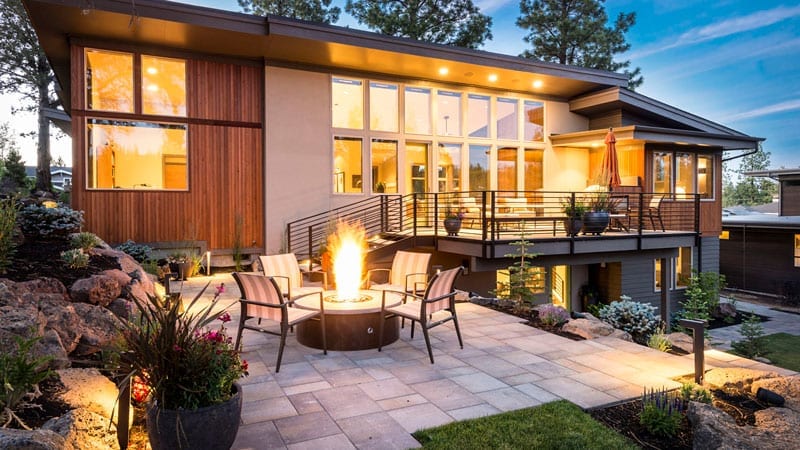
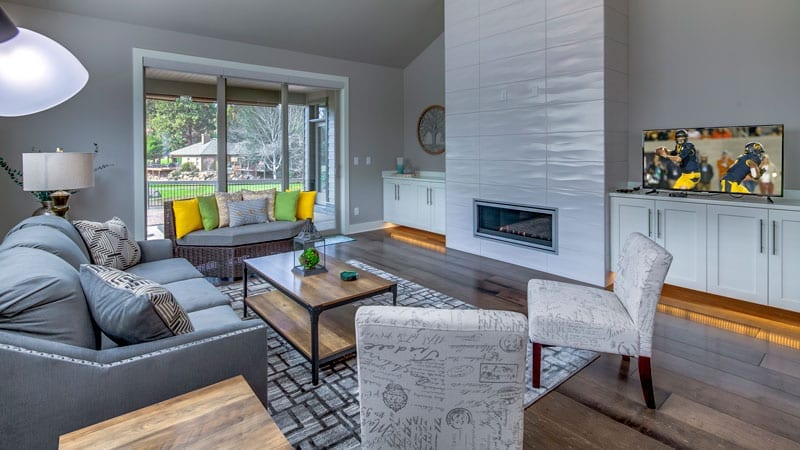
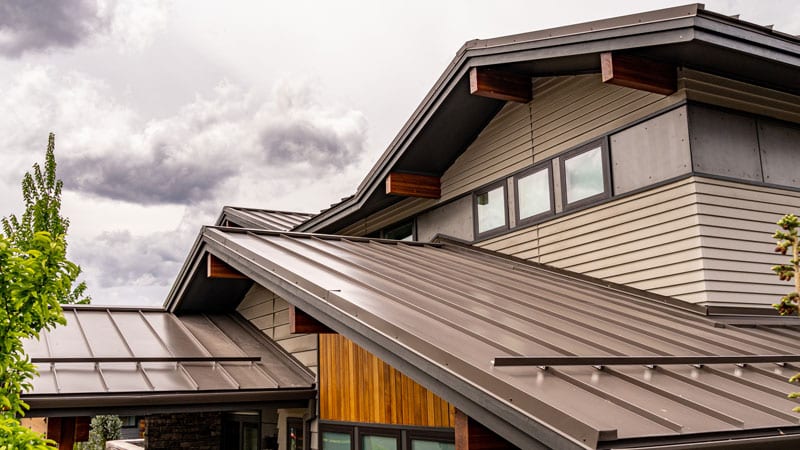
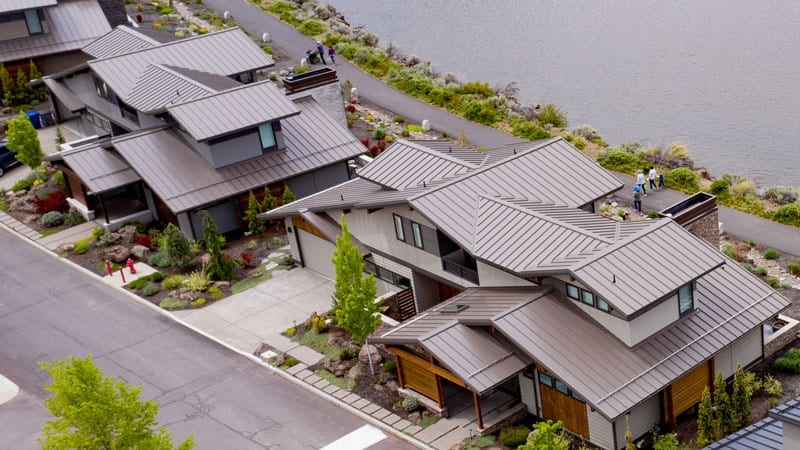
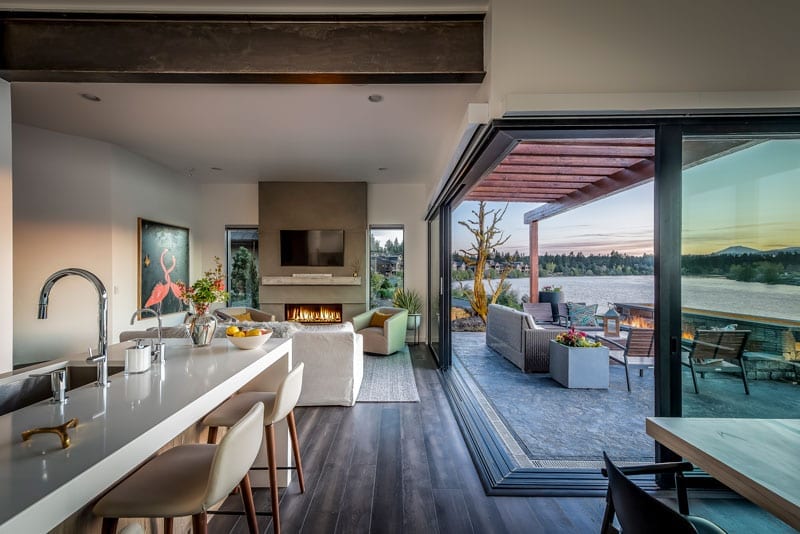
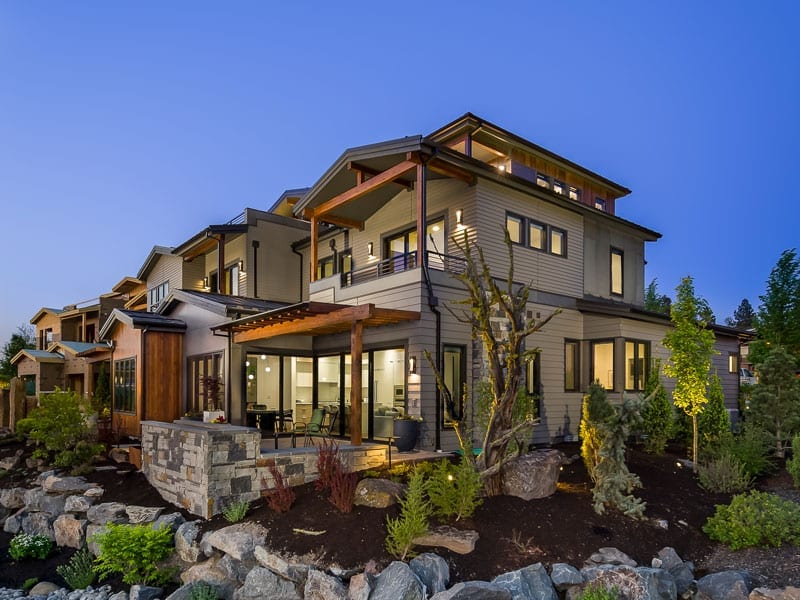
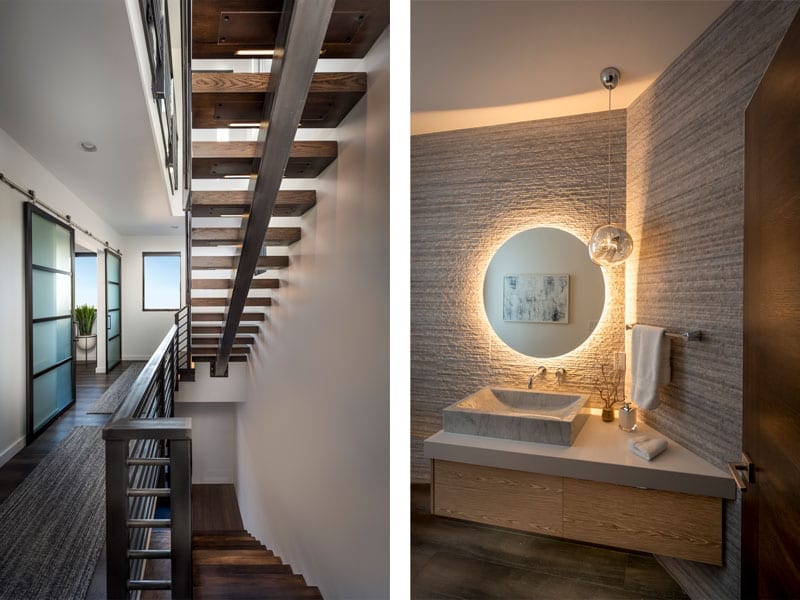
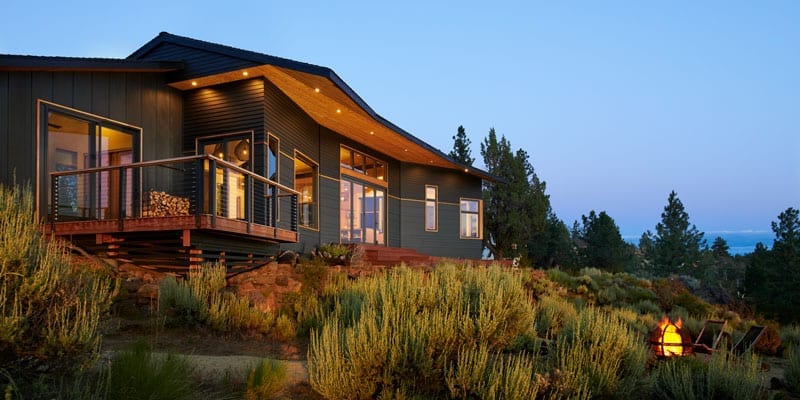
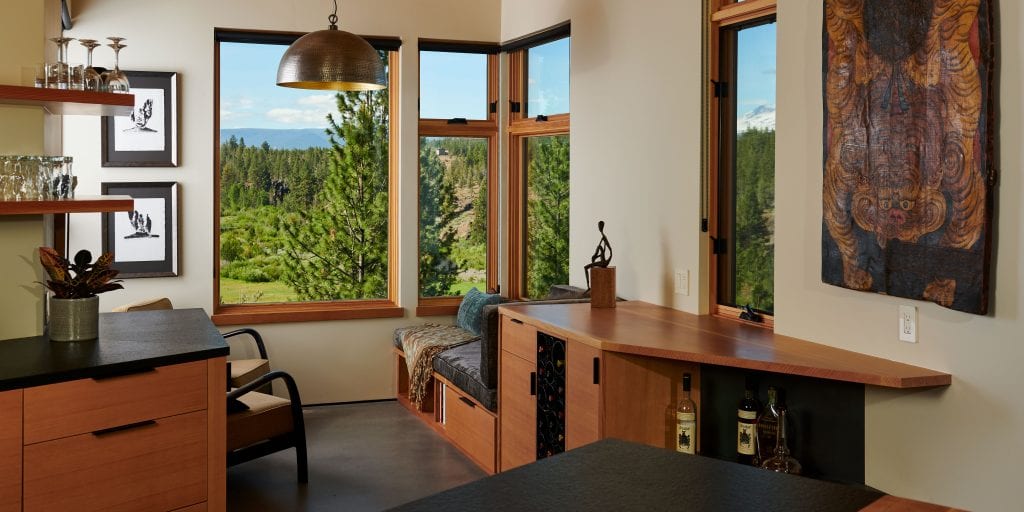
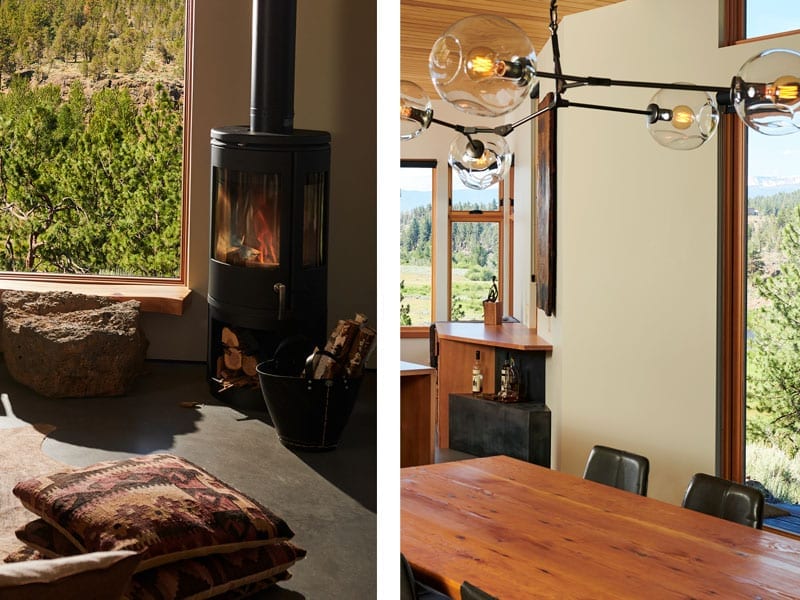
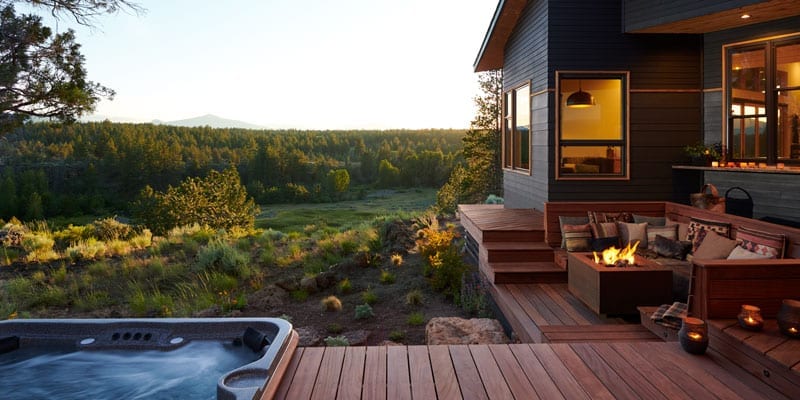
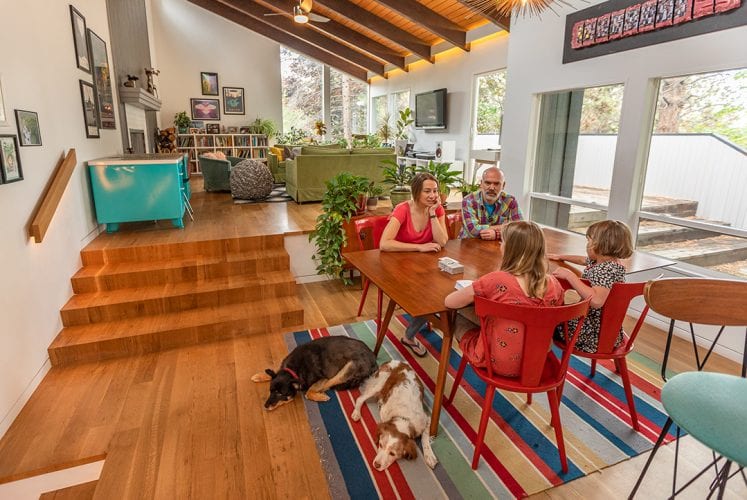
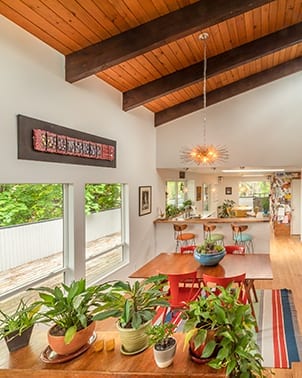
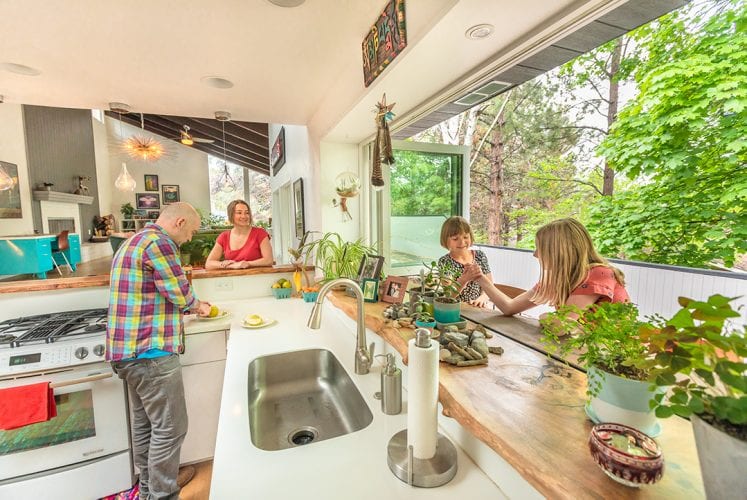
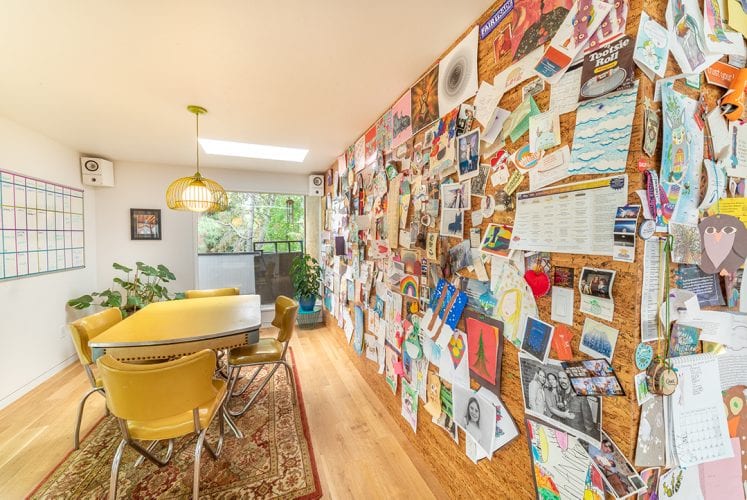
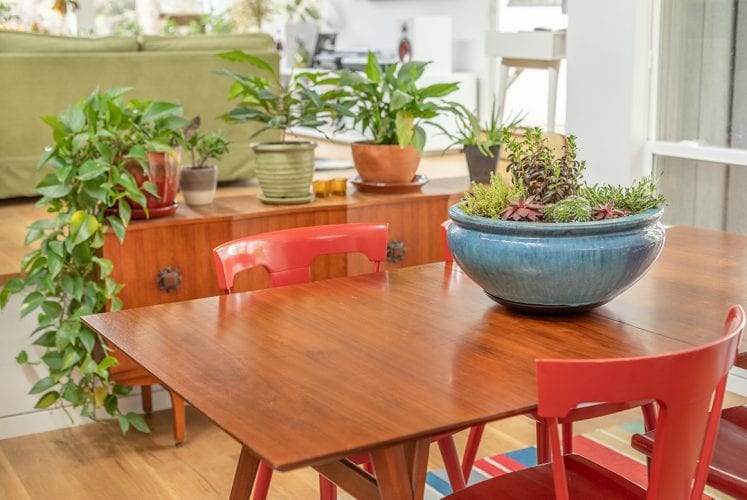
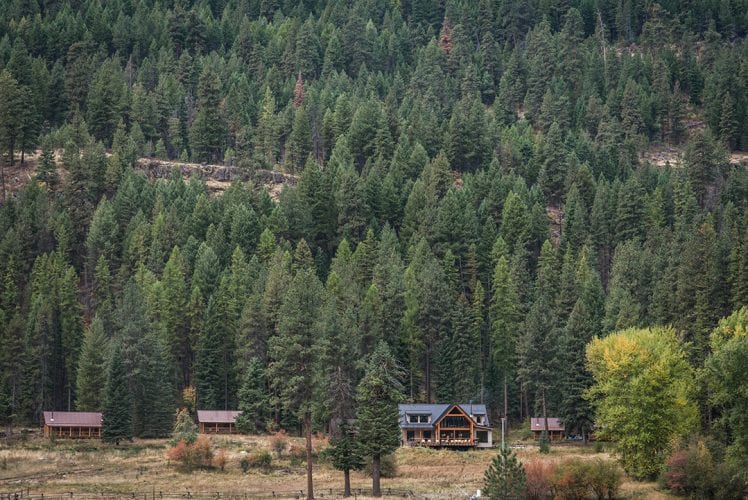
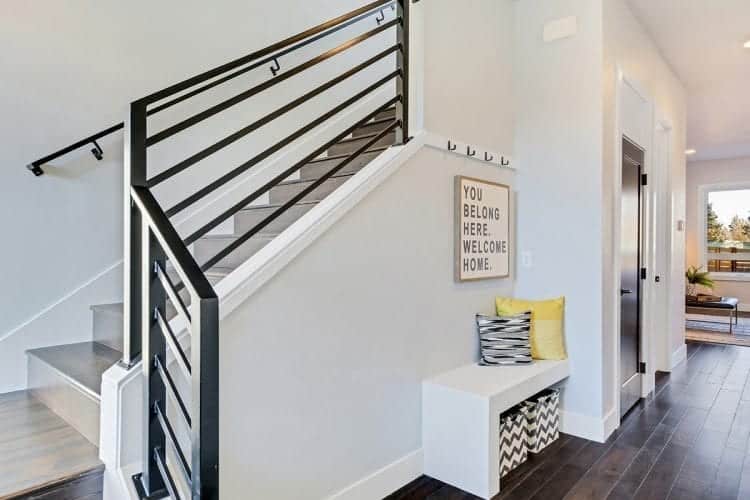
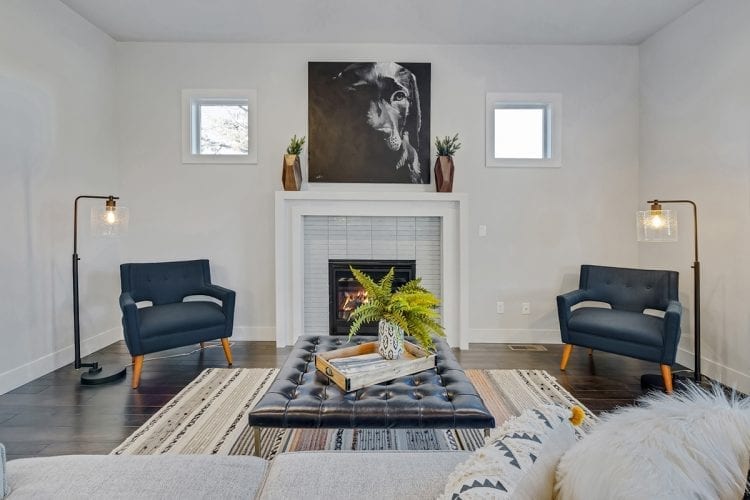
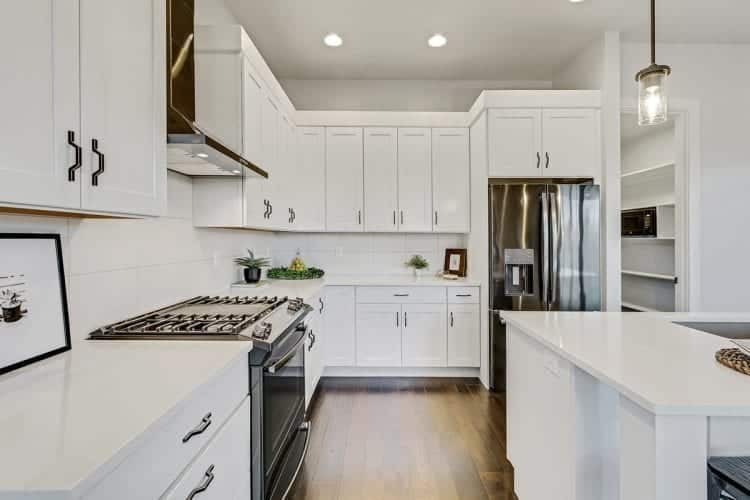
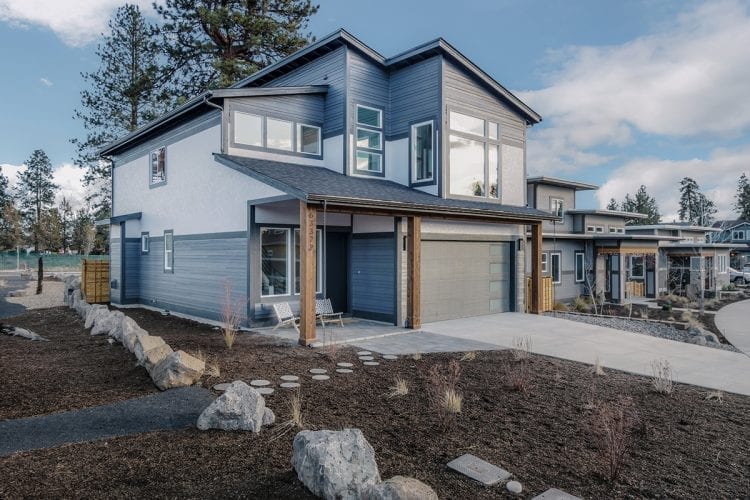
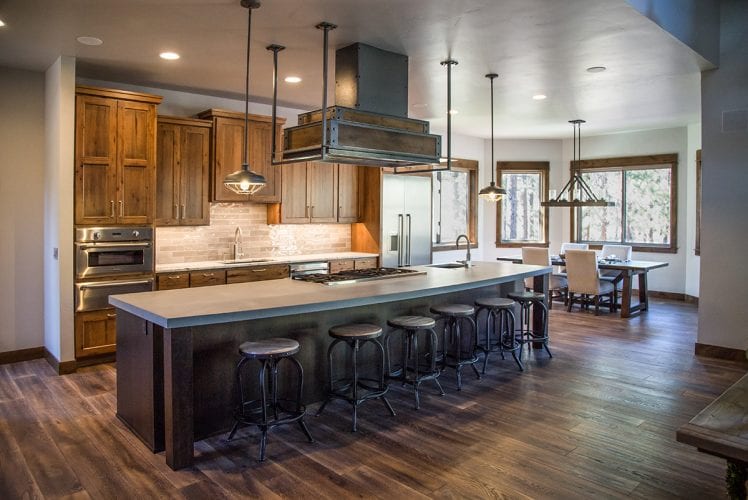
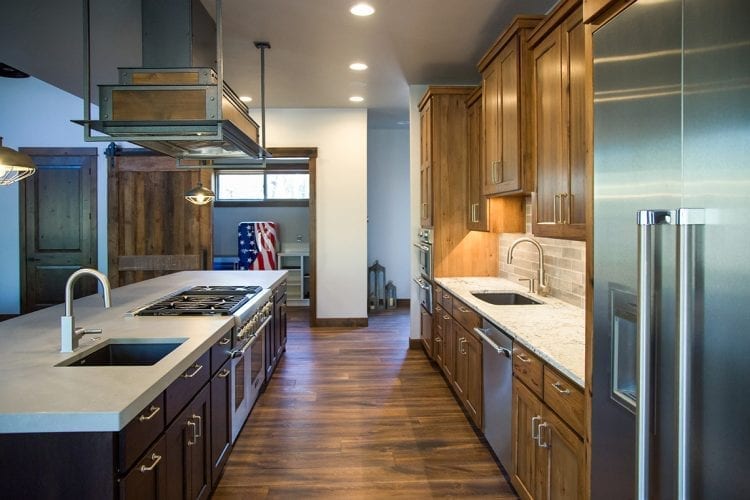
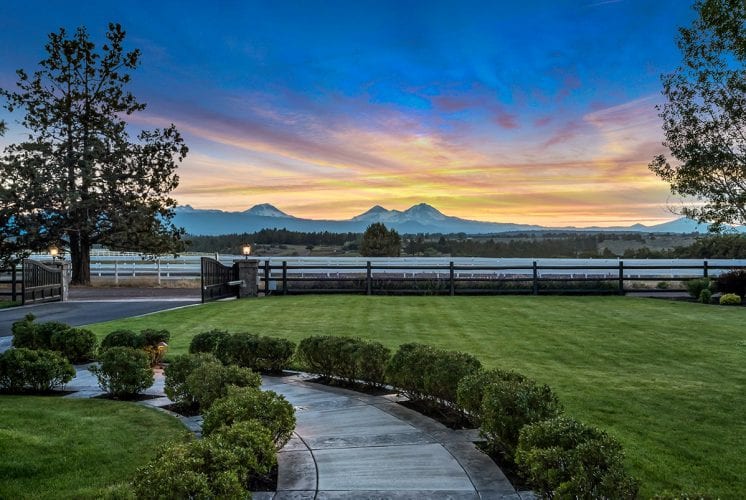
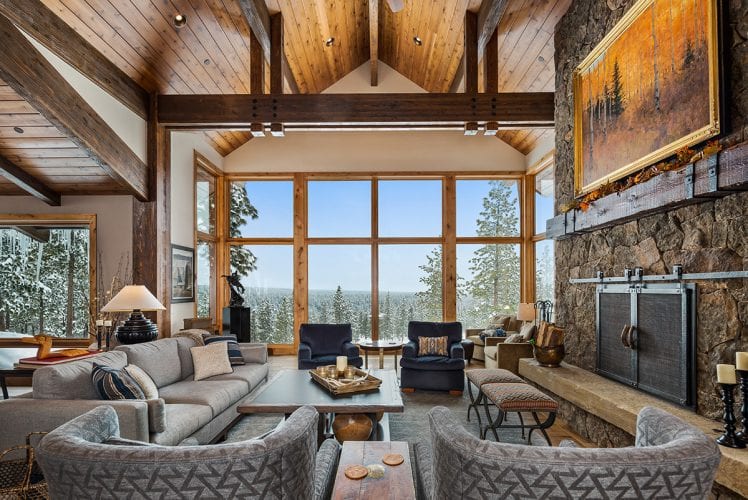
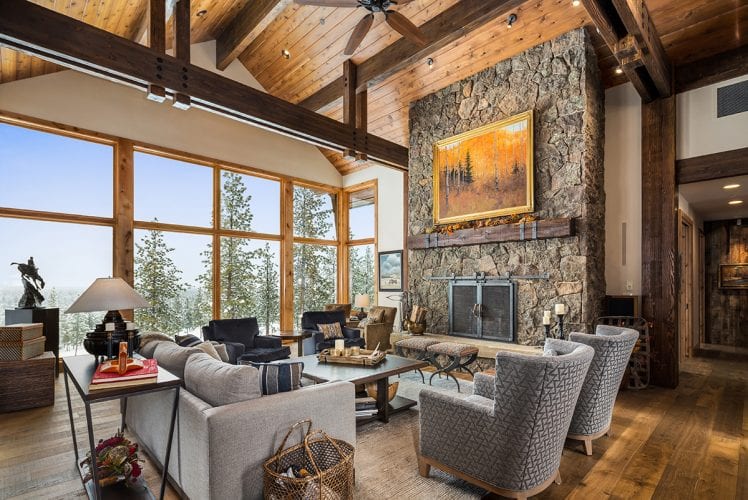
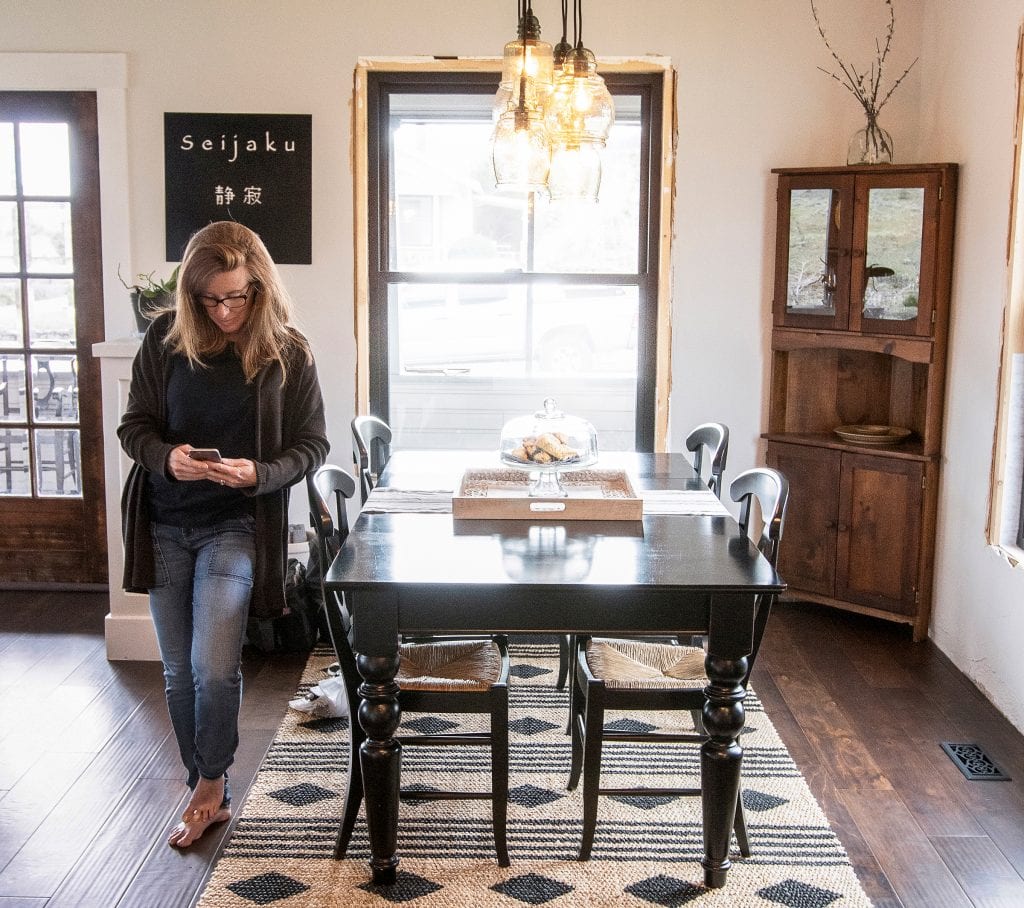
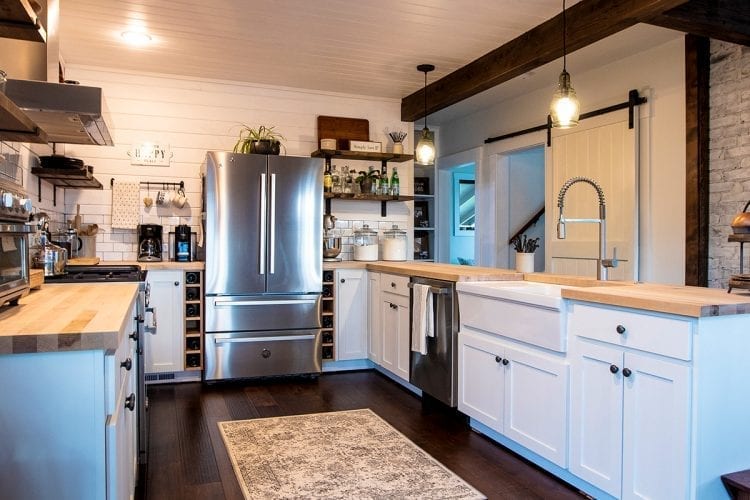
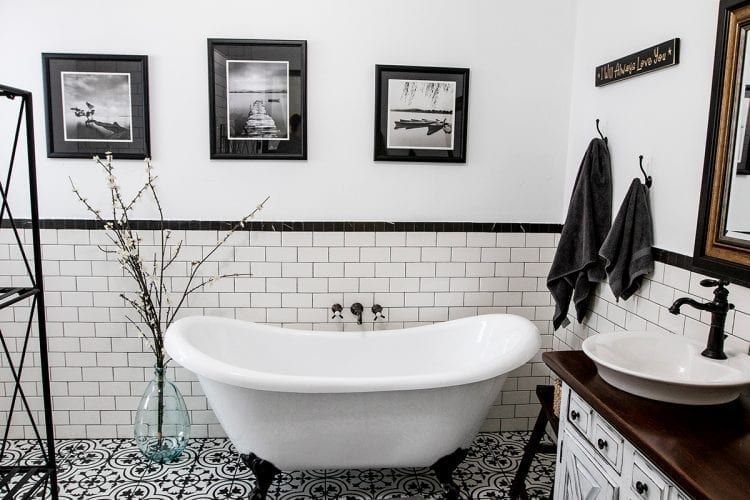
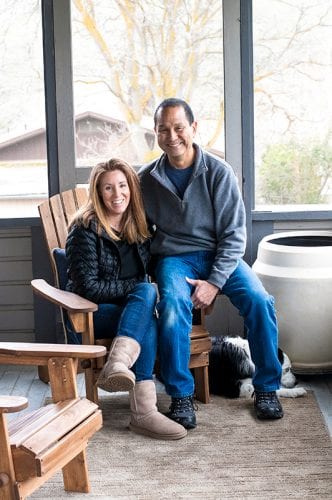
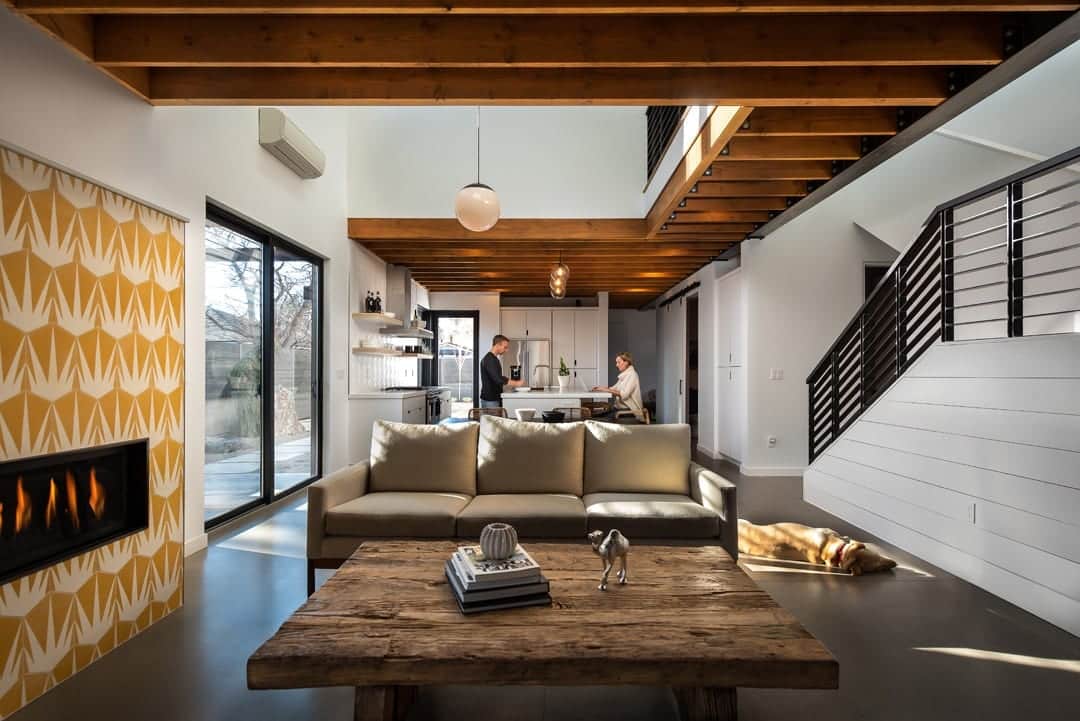
Take a tour inside this modern ranch retreat, a custom home built by Norman Building & Design in the new Bend neighborhood The Tree Farm.
When Mac and Patti Douglas moved from Seattle to Bend four years ago, they bought a house in Broken Top. While they loved the large, refined-style home in the high-end development, and especially its very livable layout, the location wasn’t quite right. “We wanted more privacy, and a view,” recalled Patti.
They searched for some time for a new home, but the right place didn’t materialize. What they found was either too dated, too large, or on too much land. Explained Patti, “We wanted more elbow room, but not too much property.” Patti was interested in custom building a home, but Mac was hesitant. “We’d been through that process before,” he said, referring to two homes the couple had designed and built in the past. “I wasn’t ready for that level of involvement and intensity again.”
Despite Mac’s hesitation, the Douglases reached out to Bend company Norman Building & Design—the team that had built the Broken Top house that they liked so much. The match was instantly positive. The company’s long history in Central Oregon made them knowledgeable and reliable, and the team was easy to work with. “It was convenient and stress-free to work with Norman,” said Mac. “Everything was done in-house—they really hold your hand through the process.” Patti added, “The relationship was so much fun.”
Central Oregon Ties
Patti was born in Bend, and the couple and their family had been vacationing during summers at Black Butte since the 1970s. The Douglases were familiar with the region. Once their thoughts shifted to building a home, the task turned to finding land.
After a thorough search, Mac and Patti bought a lot in The Tree Farm, one of Bend’s newest neighborhoods. Located west of town off of Skyliner Road, on what was for many decades actually a tree farm owned by the Miller Lumber family, the development consists of 50 two-acre home sites on a ridge and in the forest. The Douglases secured a spacious lot with views of the Cascade Range, and began plans for their new home.
While contemporary design is trending now, the Douglases wanted a warmer style. “We knew we wanted many of the same elements as our previous home, but with a more rustic lodge-style.” said Patti. The completed nearly-4000-square-foot house is in the style of a modern ranch home, or rustic lodge, with plenty of wood and stone accents. Their Tree Farm residence is a grand home that is also extremely comfortable, welcoming and warm.
A Home By Design
As one approaches the home, a circular drive parallels a fence and gate which protect a spacious front courtyard. The home’s exterior is cement shingles accented with rusted metal, for a rustic appearance that blends nicely with the forested landscape. The exterior of the home is entirely fire-safe, per the Tree Farm’s strict requirements, as a Firewise community from the ground up.
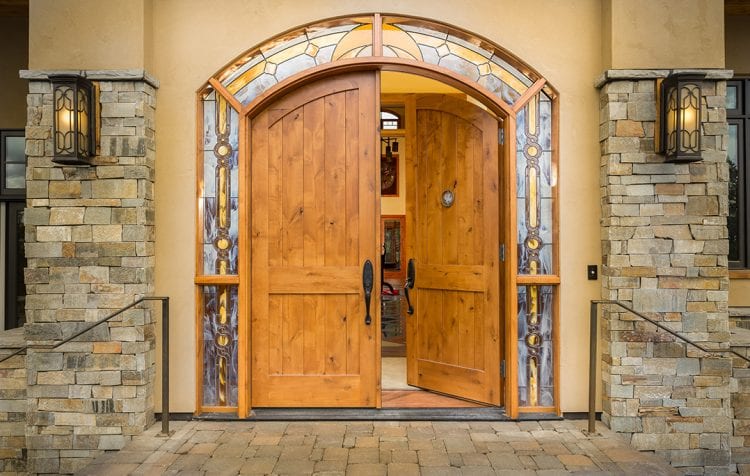
The timber-framed front entry shelters a large alder door surrounded by two massive rock walls. Guests enter into the great room, facing huge windows framing a northwest view, taking in sights of a sloping hill, a Ponderosa forest, and Mount Bachelor, Mount Jefferson and Black Butte in the distance.
The great room, purposely, has no electronics or screens installed. “There are no distractions,” said Mac. “We can just read here, or watch the views.” The couple owns a large collection of Western art, from sculpture to paintings, which is subtly placed throughout the home, including a piece prominently displayed over the great room’s massive rock fireplace.
To the southwest of the great room, the master bedroom opens into a den, enlarging that space when desired. “We wanted the home to be designed smart, with no wasted space,”said Patti. “Each room works for us.” Patti’s spacious, coveted sewing room is on that end of the home as well.
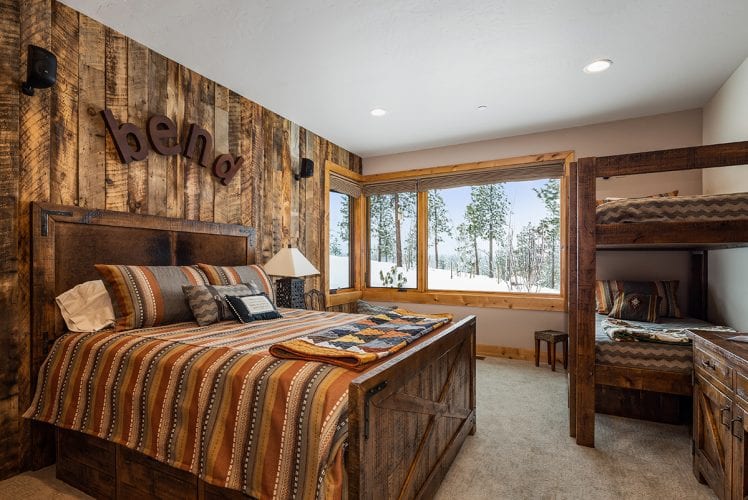
On the other end of the home is a family and media room, with two guest rooms, one with a bunk as well as a queen bed. “Every room has a reason for being,” said Patti.
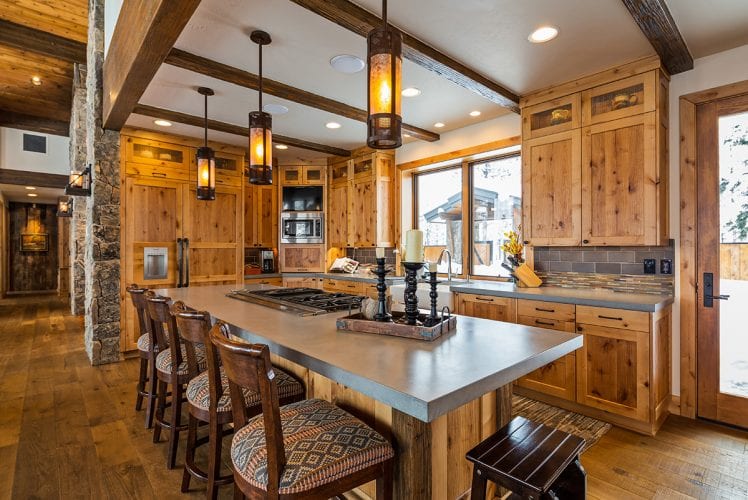
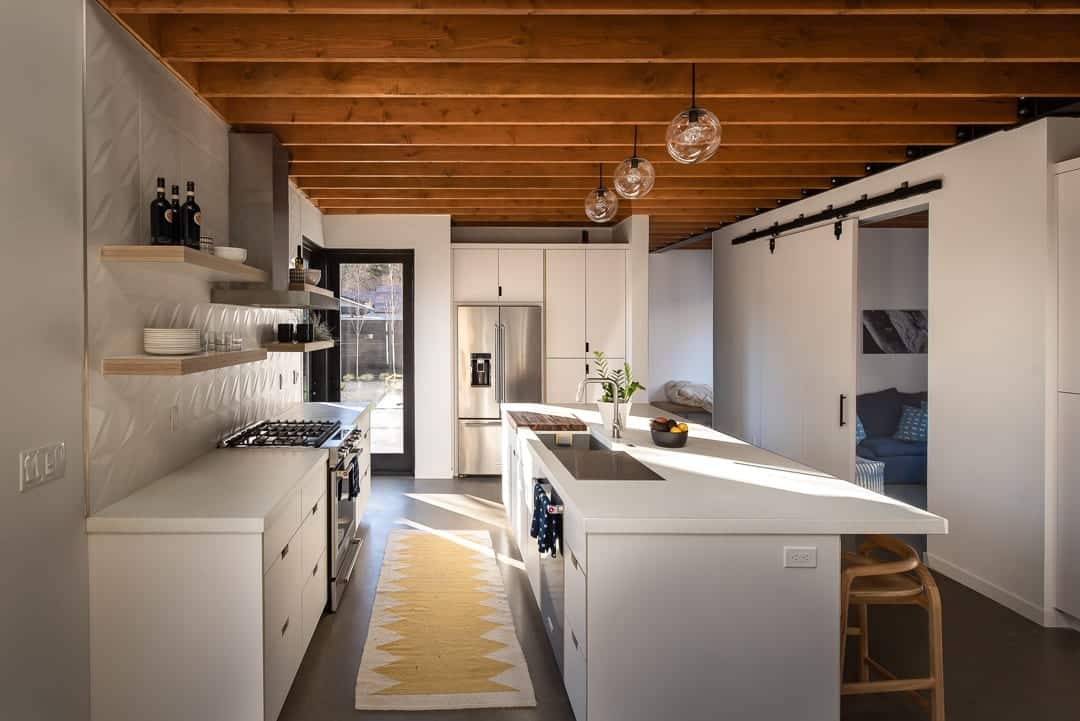
In the kitchen, a huge dish pantry contains everything cleanly, with easy access. “I have so much storage in this house,” said Patti. Polished concrete countertops cover a large center island in the open kitchen space.
The theme of wood—purposefully compatible with a tree farm—appears throughout the home. One hallway wall is rugged reclaimed barn wood. Even some of the tiles in the bathrooms are designed to look like wood, in different grain appearance. The woods contribute to a rich and warm texture. Patti is a quilter, and several quilts and other fabric panels are hung around the home, also adding texture.
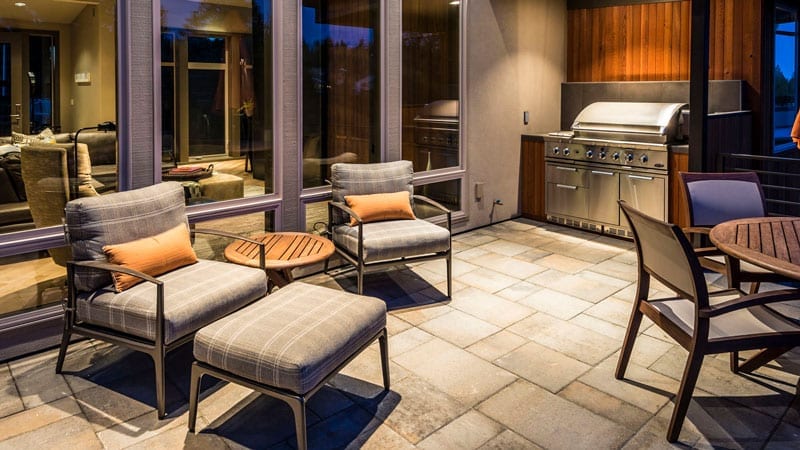
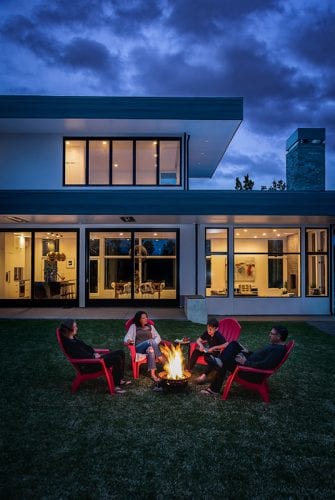
An outdoor patio off of the back is tucked into the shape of the house, designed for shelter from the elements, with an overhang inset with heat lamps. A full-size outdoor fireplace sits near several seating options. Off the patio is a round fire pit, perfect for roasting marshmallows on a summer night. “The fire draws people in and brings conversation,” said Patti. “The patio brings us together.”
At Home in Comfort
Patti and Mac have three grown children as well as many grandchildren, and one desire for their home was that it would be welcoming for their family to visit. “We had fifteen people here at Christmas, and it worked out very well,” said Patti. The guest wing closes off entirely, giving both guests and homeowners privacy.
The Douglases moved into their new home in April 2018. “We just love our home,” said Patti. “It lives so well.” Mac added, “And we have good memories of the process. The Norman team did a great job of listening to us.”
Small-town commitment and a champion hell-bent on a comeback meet at the Sisters Rodeo on the eve of its eightieth year.
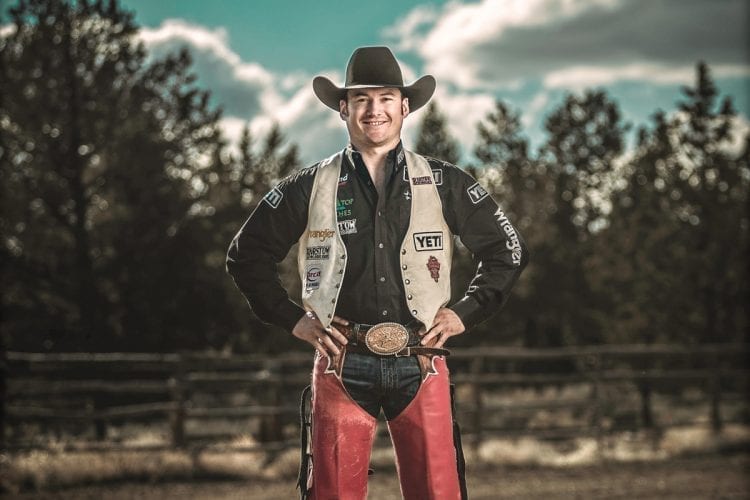
Redmond’s Steven Peebles hopes the Sisters Rodeo will be a springboard back to the upper echelon of pro rodeo. Photo Jeff Kennedy
Steven Peebles is in the bucking chute, on the bare back of a bronc. He runs his gloved right hand into a leather rigging on a cinch around the horse’s powerful chest.
It’s a crucial moment, technically and psychologically, Peebles says. “You know it’s gonna hurt, and in a sick, twisted way, you’ve gotta crave it, love it.” That’s the only way to summon the final shred of strength to hang on with that one hand for at least eight seconds—or walk out a loser. To score well, though, he’ll have to stay on longer.
He leans back and nods—that’s the signal. The gate swings open and the 1,400-pound animal does what it was bred to do: buck like hell.
Three rolls of athletic tape strain to keep Peebles’ wrist, elbow, every bone, muscle, tendon and joint from tearing, breaking or hyperextending. The world champion rider from Redmond who, at age 30 has broken his back three times, is about to look like a rag doll on a roiling, insane roller coaster — fringes flying, left hand flailing, cowboy hat flipping furiously into the dirt. He’ll hang on for dear life, with points awarded for technical style.
Peebles fell in love with this in seventh grade, after moving from Salinas, California to Redmond. His uncle, a rodeo veteran, like a second father to him, introduced him to a friend, Bobby Mote, of Culver, who was halfway to becoming a four-time world champion in the event.
Peebles and his family would go to the Sisters Rodeo every year. As soon as he turned 18, he was eligible to compete in the professional event, practically in his backyard, using it as springboard to a career that has spanned two decades and the continent. On the pro circuit, traveling to scores of rodeos across the country, his goal became winning a world championship, which he did in 2005. He’d qualified for the national finals seven times, until 2016, when he broke his back twice and had elbow and shoulder surgery.
Even for someone who has reached the pinnacle of the sport, the Sisters Rodeo, among the oldest and best attended in the Pacific Northwest, bears a distinct significance.
“It stands out from the rest,” says Peebles. “Riding is a little different when your family, friends, your hometown are in the crowd. You don’t want to mess up. If you’re in Kansas City or somewhere—every time you want to win—but if you don’t do good, you go somewhere else and don’t dwell on it. It puts a little twist on it.”
A Seventy-Nine Year Ride
For the rodeo to have endured for seventy-nine years, though, has demanded that many people think well beyond the excitement in the arena. Like a tenacious bronc rider, it has held on tight, maneuvering through hard times and evolving from an amateur event to a professional one with a permanent home because of locals who’ve loved it and worked hard for it.
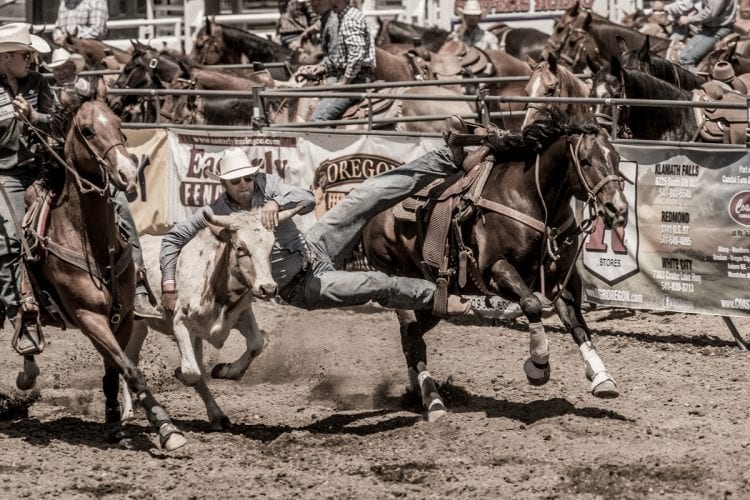
Several of the rodeo’s eleven board members have been with it about a half-century. That includes Arena Director John Leavitt, who began competing in the rodeo at age 17 in tie-down calf roping, steer wrestling and doing pickup riding (scooping up competitors on horseback after bull riding, saddle bronc and bareback riding). He reminisced about those early days, when his sister barrel raced and the rodeo was right downtown, on North Pine Street, where Hoyt’s Hardware & Building Supply is today.
He ran his Western wear store, Leavitt’s, in downtown Sisters for four decades, outfitting real cowboys and cowgirls as well as those enamored with Western style. The rodeo queen’s outfit would come from the store, a tradition that continues since Leavitt sold it in 2015 and it became Dixie’s.
Leavitt takes pride in the work that the board and two hundred volunteers do to make the event run as smoothly as the state’s largest professional rodeos, the Pendleton Roundup and the St. Paul Rodeo. He credits Sisters Rodeo Board President Glenn Miller, who has volunteered for about four decades and oversees sponsorships that support awarding $10,000 to each winner in seven categories from bull riding to team bronc riding.
Traditions And New Blood, Too
Board Secretary Bonnie Malone has put her University of Oregon journalism degree to work for the rodeo, leading media and communications for the event she’s served since moving here nearly forty years ago. Malone, a chiropractor, savors the stories she finds at the rodeo.
For example, there’s Peggy Clerf Tehan, the 2019 Grand Marshal of the Sisters Rodeo Parade. Tehan sang “The Star Spangled Banner” at every rodeo for twenty-nine years, almost always a capella on horseback. That first time, Tehan left her three-month-old daughter in the stands with Jean Wells, founder of the Stitchin’ Post sewing shop and the Sisters Outdoor Quilt Show. As the young soprano sang, she could hear her infant howling. Four years later, Tehan sang, albeit not on horseback, a week before giving birth to the howler’s sibling.
Last year, Tehan retired from lending her voice to the event. Rodeo organizers asked her to chair a committee to bring on new singers for each performance. Audrey Tehan, the howling infant at her mother’s debut, sang in her mother’s place at the rodeo opener last year.
As essential to the rodeo as the national anthem is the rodeo clown. When Sisters hired neophyte performer J.J. Harrison thirteen years ago, it launched his second career. This clown holds a master’s degree and was teaching middle school in Walla Walla, Washington when he heard about the opportunity. Last year, the Professional Rodeo Cowboys Association nominated him for Clown of the Year.
Malone recalled one of her favorite rodeo moments, in 2010. Harrison jumped up on a barrel, taunting a bull, and as the massive, horned bovine started toward him, the clown dropped inside the barrel. “That bull took on an attitude and started whacking him down the field, rolling it like a soccer ball, right through the center exit gate,” she said. The crowd went wild. “Everyone was like, ‘Goal!’ It was hysterical. You just couldn’t plan this thing.”
Harrison appears at Sisters Elementary School on the Friday of every rodeo. “As a former middle school teacher, he just takes over, and his whole message is about not bullying, standing up for people who are bullied, and befriending those who look like they’re alone,” said Malone. “The kids absolutely love him.”
Board member Cathy Williams, 86, volunteered at the rodeo since the early 1980s, and just retired as board member and ticket office manager. After teaching in Portland schools for thirty-two years, she moved to a log cabin, a family vacation home, just north of Sisters.
From the ticket booth, she educated spectators coming to the rodeo for the first time. She let them know about the event’s emphasis on animal care.
The animals, Malone points out, are athletes, bred and groomed for their careers in rodeo. They’re valuable—six-figures for the best performers—so it makes sense that their owners would take good care of them, she said.
Heading Home and Chasing Glory
Like a successful rodeo, a rider’s career is sustained through passion and almost slavish devotion to excellence. It’s a journey that has taken Peebles to the sport’s highest highs and its back-breaking lows. This year, the Sister’s Rodeo and dozens like it will be key to Peebles’ chance of another shot at that vaunted high. His goal is to once again qualify for the Wrangler National Finals Rodeo in Las Vegas, rodeo’s premier event, in December. If he makes it, it will add an exclamation point to a dramatic comeback.
Last year, he’d finished a rodeo in Austin and was driving home to Redmond after a string of less than satisfying results. Near Llano, he stopped at a store and ran into his old friend Bobby Mote. Peebles didn’t know Mote had moved to that part of Texas. He went home with his mentor and friend, who took him back to the basics, refining the essentials of where they’d started nearly two decades ago.
“It took sitting down with Bobby,” says Peebles. “He grounded me. I had some time off in spring to slowly heal, and in summer, I started climbing back up. I was barely short of making finals, but it was a game-changer. I’ve been winning.”
Whether he can ride that momentum to Vegas hinges on how he does at the sixty-five rodeos he’ll have driven to across the country, between February and September this year. The Sisters Rodeo, June 5 to 9, is one of them, as it has been nearly every year for the past decade.
It’s a mental and physical grind. On the road, Peebles will get to a rodeo, ride, and sometimes will drive all night to the next. After the Sisters Rodeo, though, he’ll change out of his gear, get to see the second half of the saddle bronc riding, and meet his friends and family in the beer garden. But he won’t linger.
With two rodeo buddies, they’ll share the driving, to a new state practically every day. “There’s Reno, then July 4th weekend. It’s called cowboy Christmas. We’ll go to twelve rodeos in five days. Arizona, St. Paul and Molalla (Oregon) … Arkansas, Colorado, Alberta…” Enough high scores would mean a return to the finals.
Like the Sisters Rodeo, Peebles has stood up to challenges, which, for other folks, would’ve done them in long ago. Now they both stand to reap the rewards of hanging on, no matter how rough the ride.
In May 2019, Steven Peebles broke his leg and will not be competing in the Sisters Rodeo.
A Bend mother-daughter duo author a teen mystery about family secrets, brave girls and spectacularly bad weather.
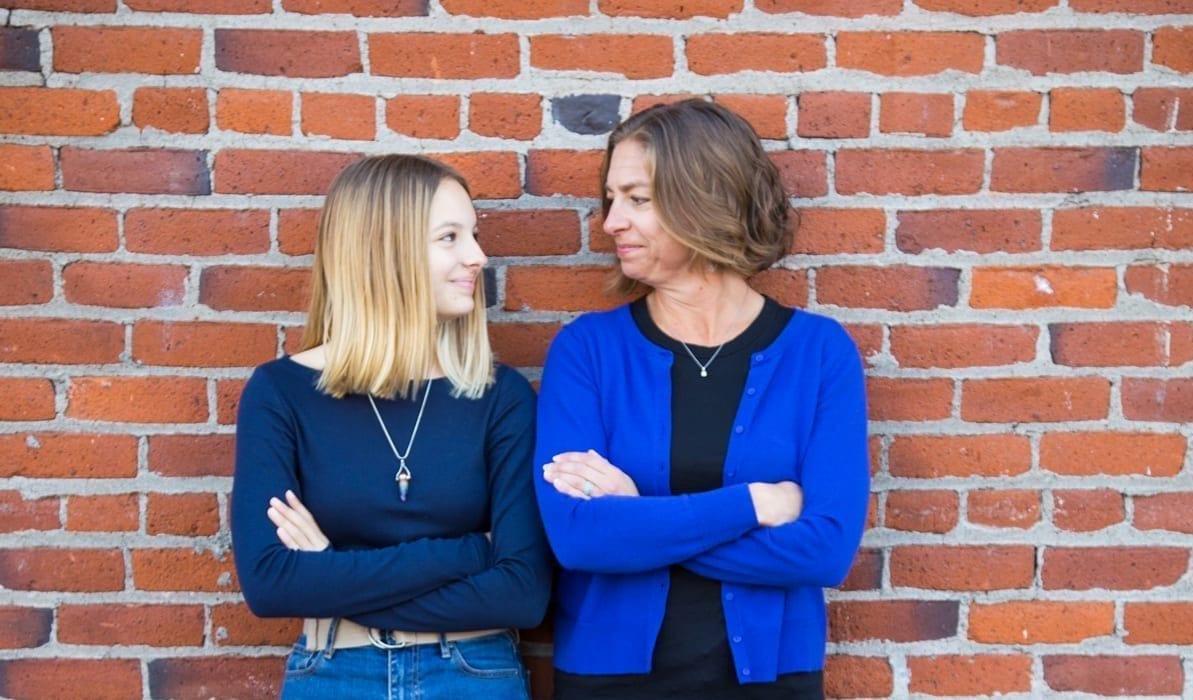
Kim Cooper Findling and daughter Libby Findling
Oregon Media’s own Kim Cooper Findling has written three nonfiction books, including Bend, Oregon Daycations: Day Trips for Curious Families. In addition to serving as the editor of our newly launched Bend Home + Design magazine, Kim recently completed her first fiction effort—a teen mystery set on the Oregon Coast, co-written with her 14-year-old daughter Libby, titled The Sixth Storm. Bend Magazine sat down with the two to discuss collaborative writing, dark humor and the long road to publication.
What was the inspiration to write a book together?
Libby: On a stormy night four years ago, I said to my mom, “What if weather patterns represented people changing?” Kim: I scribbled what she’d said on a piece of paper. I knew at that moment we had to write a book together.
What was the writing process like for you?
Kim: We began weekly brainstorming sessions at a sandwich shop in Bend while Libby’s little sister had dance class next door. Libby: We did all the concepting and character development together, stealing names from family members and out of books on the sub shop book shelf. I loved creating people straight from scratch. Kim: Then I began writing chapters and bringing them to Libby… Libby: …and I would fix them!
What were the biggest challenges you faced?
Libby: Time. I had school, mom had work. We fit it in where we could, around activities and on the weekends. Kim: Writing fiction was a blast but from the start, but really whipping a whole novel into shape was much harder than I expected. I had no idea what I was getting into. A third of our first draft ended up on the cutting room floor.
Tell us about your book’s setting.
Kim: The story takes place in a small rural town on the Oregon Coast, similar to where I grew up. Libby: People who know Oregon will recognize a lot of familiar places, from the beach to Mount Hood.
What was it like to kill characters off on the page?
Kim: Delicate. I needed to kill five or six people without upsetting a young reader. Libby: I said, ‘Mom, just kill ‘em’. I think we should have done more to upset the reader!
What impact did writing a book together have on your relationship?
Libby: We have the same type of mind and love dark humor, so it was easy to work together. Kim: We are a lot alike and made a natural team. Writing is typically a solo sport, and it was wonderful to not be in it alone for the first time.
This project took four years. How did your perspectives change over that time period?
Kim: I started writing a book with a ten-year-old and finished writing it with a 14-year-old. That’s a period of life full of a lot of change. The story elements that mattered the most to Libby shifted over time. Libby: Like romance. Kim: There is debate about our protagonist. I think she has an innocent crush on the weather man. Libby: She definitely does not!
Who is your favorite character?
Libby: I love Ashley (the protagonist’s best friend) because she’s so quirky and shows up when you least expect her to. Kim: Andrew (the protagonist’s brother) is the big brother I always wanted.
What’s one thing that each of you learned about the other through the book writing process that you might not otherwise have known?
Kim: I knew Libby had a rich imagination and loved storytelling, but I didn’t realize the depth of plotting and character that she could bring to a project. Libby: When my mom starts writing something she will not stop until she’s happy with it.
What are readers most enjoying about The Sixth Storm?
Libby: Fast pace, fun mystery, a brave female lead, and my friends say they can really relate to the characters. Kim: The second half is a page turner, and there is a delicious plot twist at the end.
Will there be another book from you two?
Kim: This has been so much fun, but I am tempted to turn the reins of fiction over to Libby for the long haul. Libby: I guess we’ll just have to wait and see!
The tent leaks, the sleeping bags are MIA and the campstove is temperamental. If you can check any or all of these boxes, it may be time to reconsider your approach to camping this summer (yes, camping is still mandatory—this is Oregon). Thankfully, you have options that allow you to forego the traditional ritual of gathering and inventorying gear, during which you will no doubt omit some essential item, thereby sending the entire ill-conceived excursion into a tailspin. Consider instead booking a turnkey operation that removes the stress from planning and turns the prospect of disappointment into delight. Here are a few options from rustic to resplendent.
Panacea at the Canyon
This forty-acre luxury tent resort and spa Panacea at the Canyon offers a solar-powered oasis prompting guests to truly unplug and reconnect with nature to nurture their mind, body and spirit. Yoga and labyrinth meditation are among the offerings here, as is a rimrock clifftop soaking pool.
Elk Lake Resort
The popular Elk Lake Resort offers cabin rentals and rustic camping, but added glamping into the mix recently with the addition of more than a half-dozen luxury tents that include two futons with full bedding, a dining room table and access to the resort’s showers.
Lake Billy Chinook Cabins
The Cove Palisades State Park at Lake Billy Chinook has more than 200 campsites, many with RV hook-ups. But if you want to travel light, book one of the three deluxe, lakeside cabins. The cozy log homes sleep up to eight people and offer easy access to the popular boating and fishing destination, with separation from the campground to offer some privacy. Boat rentals are available through the nearby marina.
Austin Anderson, a former Bay Area software engineer, finds a home in Bend for Rupie, his cutting-edge game development platform.
Austin Anderson left a downtown San Francisco job at LinkedIn and came to Bend with little more than an idea of what was next. Friends talked him out of starting a boutique video game development studio here. But the idea of creating a niche in the game development space stuck. Just one year later, Anderson’s new company, Rupie, is rolling out a game development and team management platform that could change the way that games are built. The company has seen strong seed funding and is poised for rapid growth. Earlier this year, BendTECH tapped Anderson and Rupie as the first company to occupy its Startup Founders Office incubator space, a move aimed at helping the company connect with more local talent and dollars. We talked with Anderson about the company’s plans.
What problem is Rupie addressing for game builders and studios?
It’s really a challenge for game talent to find consistent work, and one of the reasons why is because about 80 percent of game studios leverage outsourced talent. It’s huge. And there are some, I’d say, less than healthy practices in terms of releasing talent after contracts expire. A lot of times [agreements] are very informal; there is not a lot of tooling built around how these transactions operate. It’s not like enterprise software where the processes have been established and really baked in for decades. In the games industry, it’s still very much the Wild West. That idea of starting a gaming studio didn’t come to fruition.
How did that idea evolve into Rupie?
I figured out after a lot of investigation that finding talent in the games industry is really hard. There are some unique reasons for that, but it’s a big pain point. I thought, well there is this interesting Venn diagram-like conversion of my LinkedIn experience combined with my gaming experience. I wondered what it would be like to create a managed marketplace for game developers to help them connect with opportunity consistently and also to help studios find talent. It seems what you are doing at Rupie could be applied to many industries.
What is it about the gaming industry that speaks to you?
I really just love what games represent. To me it is this openended creation process. You’re not confined to a specific medium or physical reality when you’re creating. To me it’s about the convergence of what games can do. We see games being able to leverage virtual reality (VR) for therapeutic purposes and all sorts of things. Right now, the gaming industry is bigger than the film and music industries combined. The futurist in me says that augmented reality (AR) and VR are going to enable more opportunity and expansion.
Can Central Oregon become part of that story?
My longtail vision [that] I’m very excited about is that I think Bend could easily become a hub for game developers and game events. There are some pretty large spaces here, it’s a little cheaper, there is good airport access and there are also quite a few companies here [already]. So, we’re excited about bringing the events that we are already doing and pulling them into Bend. It’s one of my personal goals with Rupie.
The Haven is a new co-working space that will allow for 100 members and space for collaborative and independent work.
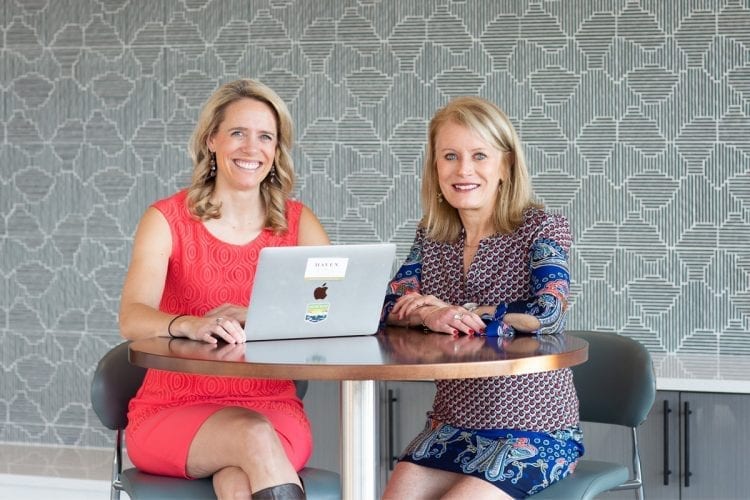
Carrie Douglass and Chelsea Callicott. Photo by Jill Rosell
In 2011, Bend native Carrie Douglass worked from home and felt stir-crazy. As the founder and CEO of the national nonprofit School Board Partners, a co-owner of Cascade Relays, a Bend-La Pine School Board member and a wife and mother, Douglass, 38, wanted to mix with the world while still clocking some serious productivity.
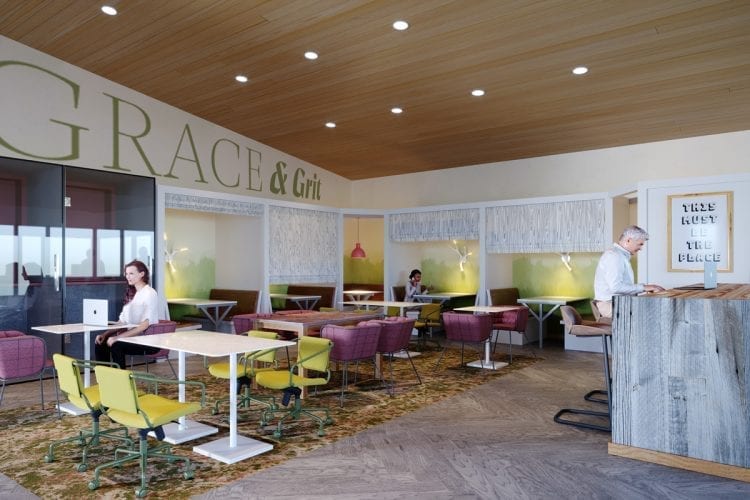
Douglass checked out Bend’s co-working spaces, of which there are now about half a dozen and largely cater to tech startups, but they didn’t meet this sweet spot of cozy inspiration and functional utility, Douglass said. So, she took it upon herself to start her own co-working space, The Haven, with the help of an all-women team and a small local “tribe” of ten investors. The Haven blends the best attributes of the coffee shop, living room and conference hall into an intuitive floor plan.
Douglass said that most co-working spaces start with a certain number of square feet and ask themselves how many desks or offices can fit into it. “We started with questions like: Where are you most creative? What amenities would help you be at your best? What spaces inspire you?” said Douglass.
The Haven’s executive director Chelsea Callicott also knows the value of a tailored space. Her husband Preston Callicott is the CEO of Five Talent software, which is BendTech’s anchor tenant. Chelsea Callicott tried to work at the space but the silent focus of the tech incubator didn’t help her productivity.
“I just couldn’t do it. It was so quiet you could hear a pin drop,” Callicott said. “That’s a different kind of intensity than the way I work. I need a little bit of conversation.”
According to a recent US Census estimate, the Bend-Redmond metropolitan area leads the country with 12.1 percent of workers who do so remotely. The national average hovers around 3 percent, according to a report by Flexjobs. That local number will only grow, said Adam Krynicki, the executive director of OSU-Cascades Innovation Co-Lab, which opened in spring 2018 and incubates as many as fifteen one-to-two-person startups at a time. Bend’s easy access to the outdoors and the burgeoning tech scene has become increasingly attractive to entrepreneurs and aspiring remote workers, he said.
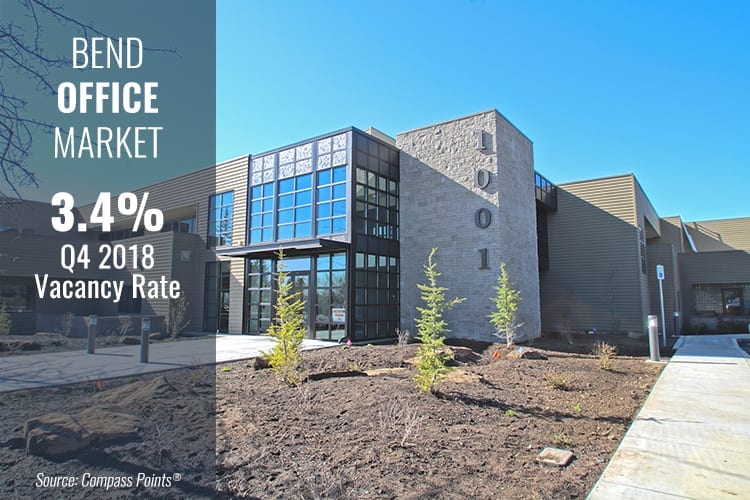
Opening in June, The Haven will occupy 11,000 square feet across two floors of the Deschutes Ridge Office (1001 SW Disk Dr.) in southwest Bend. While The Haven is dedicated to the needs of professional women, about 25 percent of the approximately 100 members who have already signed up are men, organizers said. Membership will be capped at 200.
“Women are still such a small percentage of entrepreneurs, CEOs and politicians that we want to focus specifically on helping women succeed in those leadership roles,” Douglass said. “But lots of men are also finding that they are excited about our programming, amenities and design.”
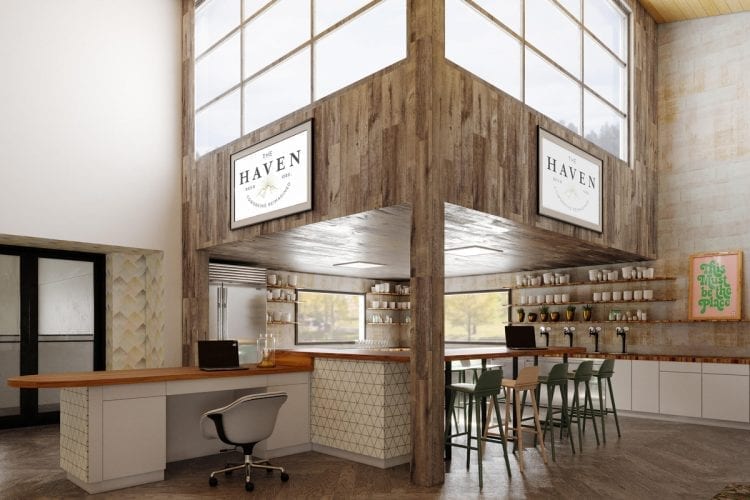
Drenched by sunlight that pours in from eight 180-degree views of the Deschutes River, The Haven is anchored by a striking communal work table salvaged from the trunk of a 380-year-old ponderosa pine that grew in what is now Drake Park until it toppled from natural causes. Conferences and brainstorming sessions will be aided by complimentary coffee, kombucha, craft beer and wine. Beneath a ceiling of cheery no-knot pine panels, mornings may begin with a sketch pad in the cushy yet cell phone- and conversation-free living room area called The Refuge. Afternoons might happen in The Pods, which features six semi-private booths for conversation with drawable curtains for heightened privacy. There are also five soundproof phone booths. Other members may wrap up their workday at one of fourteen dedicated desks or one of seven private meeting rooms which can hold four to fourteen people.
The Haven’s diverse spaces are owed to the vision of creative director and interior designer Susan Manrao, who has previously worked with luxe hotels such as W Hotels Worldwide, St. Regis and Waldorf Astoria. The Haven team also conducted focus groups to hone in on what remote workers wanted.
A variety of work spaces allow members to transition throughout their workday depending on their needs.
“The Haven’s space is the antithesis of the typical office environment,” Manrao said.
Progressive amenities abound. Mothers will have access to a nursing/pumping space. Those who are invigorated by mid-day runs and hikes can freshen up afterward in the locker room area replete with four showers and beauty stations. There will also be programs dedicated to public speaking and personal marketing.
“We learned what people needed from a co-working space to function and also what they needed to thrive, to bring them to their best every day,” Manrao said.
Douglass hopes The Haven will foster a work-life balance and help mitigate against an all-or-nothing attitude toward one’s career.
“I feel like we’re in this grand experiment at the forefront of the country,” Douglass said of Central Oregon being the nation’s leader for remote working. “So how do we really maintain the special, close-knit relationship-based community that I think makes Bend really special? We’re trying to be that place-based community for this huge section of our population that no longer has that.”
A four-day itinerary to experience Central Oregon and the Painted Hills as a family.
RVs and campers are a great way to experience Central Oregon and beyond. They are are also extremely costly to maintain. Enjoy the benefits without the hassles by renting an RV and taking your show on the road. In Bend, Happy Camper RV Rentals has a fleet of late model campers and RVs available for about the same cost as a cabin rental at many of the local resorts.
Day 1
Head to historic Prineville and hang a right, following the Wild and Scenic Crooked River deep into the canyon. Pick a riverside spot as your temporary home. Wet a line on the blue-ribbon trout fishery or just kick back with a good book.
Crook County Chamber in Prineville
Day 2
Return to Prineville and from there it’s on to the John Day Fossil Beds National Monument. Head east through Mitchell and onto the Sheep Rock Unit where you’ll find the Thomas Condon Paleontology Center. Visitors learn about the fossil beds that date back millions of years, some of the oldest records of animal life in North America.
Day 3
Get your hands dirty by heading to the Clarno Unit, near the small town of Fossil on the John Day River. Head into town and explore the open dig site behind Wheeler High School, where the public is welcome to comb for fossils in a prehistoric lakebed that dates back 33 million years.
Day 4
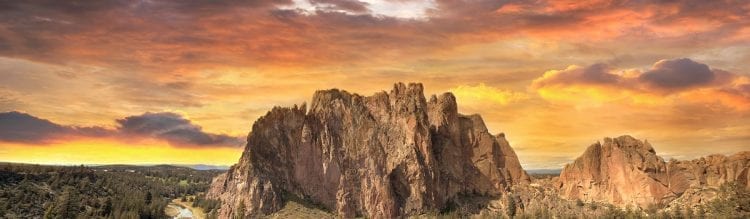
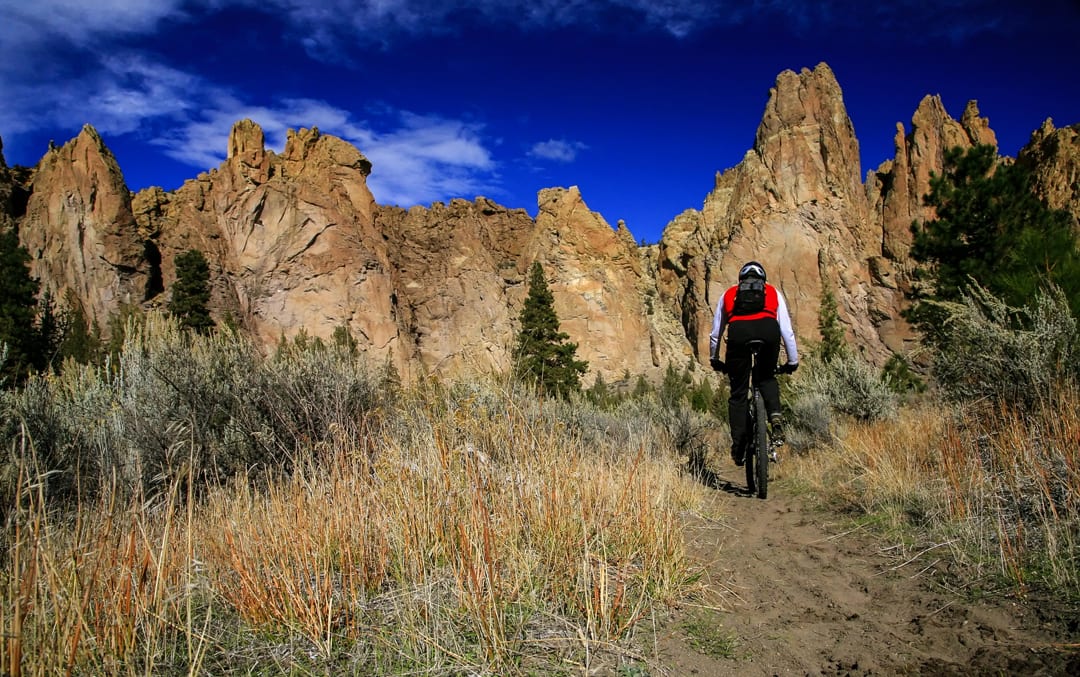
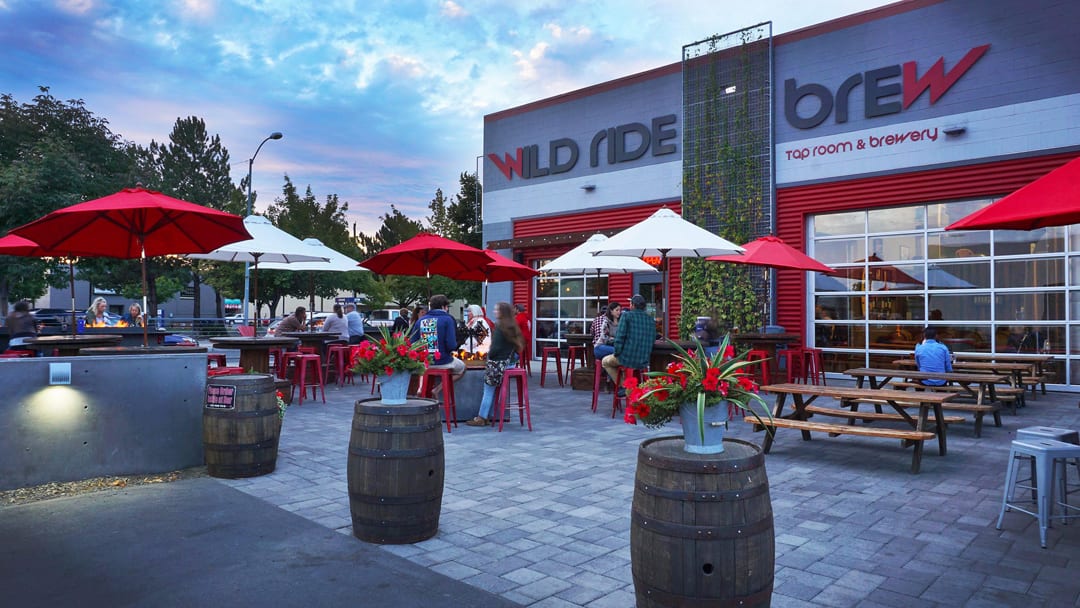
Head back to Bend, but stop first at Smith Rock State Park, where the Crooked River winds around the base of one of America’s premier rock-climbing destinations. Watch as climbers dangle impossibly from the volcanic tuff spires. Finish your day with a beer and a snack at Redmond’s Wild Ride brewery.
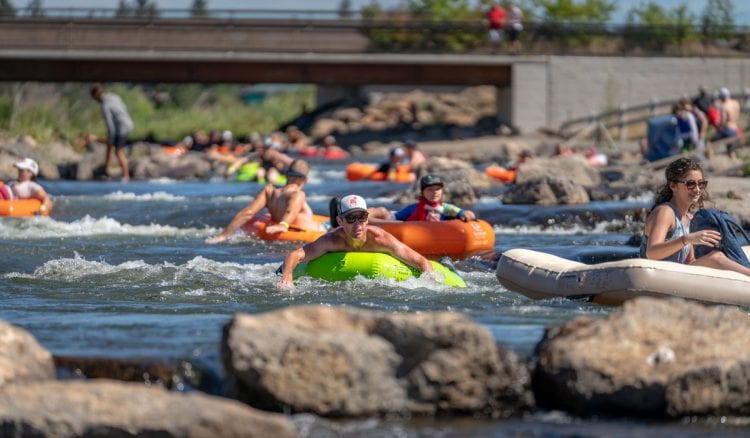
Whether you live in Bend or are just visiting for the weekend, consider this your cheat sheet for floating the Deschutes River.
The popularity of floating the river has surpassed what anyone envisioned when Bend’s Park and Recreation District formally opened the river for business. Unfortunately, the amount of trash, from lost clothing to littered cans, has also ballooned. Rather than curtail floating, the park district and its partners, including the Old Mill District and Tumalo Creek Kayak & Canoe, are asking locals and visitors to consider their impact when they set sail from Farewell Bend Park. Points of emphasis include eliminating trash and litter on the river and reducing stress on native and restored riparian areas, by helping users identify and use established access and exit points on the river.
Do
Bring your own tube and inflation device OR rent onsite at Riverbend Park, or at Tumalo Creek and Kayak ($20 for 2 hours).
Bring cash for a river shuttle ($3) or run your own shuttle using a bike or Zagster bike sharing service.
Put life jackets on children.
Pick up trash. (Is seeing it and leaving it any better than littering?)
Don’t
Bring food or other packaged items that produce garbage.
Bring single use water bottles. (You’re in the birthplace of the HydroFlask!)
Consume drugs and alcohol. (They are both illegal and dangerous on the river.)
Float through the safe passageway channel unless you’re willing to risk a bump or scratch. (It’s a river, not an amusement park.)
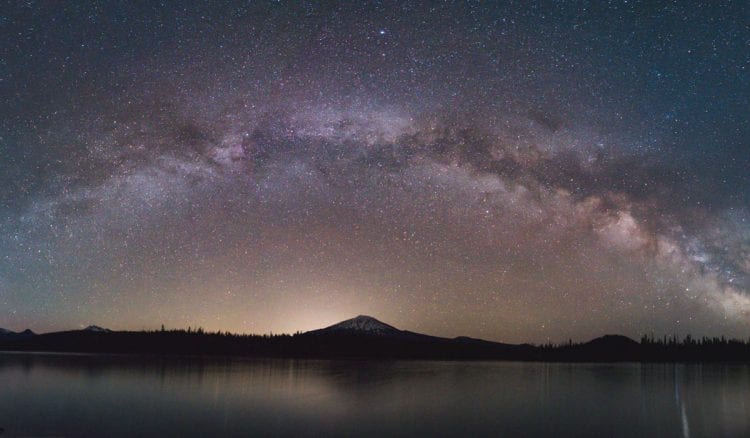
Check out these places with limited light pollution for some of the best stargazing in Central Oregon.
The beauty of living in the high elevation and relatively low population region of Central Oregon is that our night skies are some of the best places in the U.S. to see stars. You don’t have to travel far from home to get a taste of what the galaxy has to offer. Early summer is a great time to stay out late and immerse yourself in the natural world. Whether you view by telescope, binoculars, or nothing but your own set of eyes, here are three locations we recommend to get a view of our galaxy.
Cascades Lakes
Within just a few dozen miles of Bend, you can find yourself at any one of your favorite Cascade Lakes trailheads. Really anywhere will do, but we recommend hitting Todd Lake. Open meadows nestled in majestic pines with a serene setting of chorus frogs serenading your visit makes this the perfect location to go looking for constellations and the occasional shooting star. Remember: these are breeding grounds for many local amphibians, so please respect their space and avoid trampling the shoreline.
Old McKenzie Highway
You’ve yet to really experience the Milky Way if you haven’t observed it from the heart of one of North America’s largest lava fields. As you surround yourself with jagged rocks that feel almost extra-terrestrial, you get the feeling that you are watching the stars from the surface of another planet. Head west from Sisters on Highway 242 towards the Dee Wright Observatory (telescopes not included) and accompanying lava flows. Find yourself a place with a good view of the southern sky. Note: The Old McKenzie Highway, aka Highway 242, is closed during winter and spring and typically opens in mid-June to motor vehicle traffic.
The Badlands
For arguably the darkest skies and best star viewing in the western United States, head east on Highway 20 towards the Badlands Wilderness, an ancient juniper forest perched on the edge of a shield volcano. With few visual obstructions, this expansive and open natural wonder gives you the sense of being surrounded by the cosmos. While looking south will no doubt give the best view of the Milky Way, turn your eyes in any direction and find the majority of constellations viewable in the Northern Hemisphere, as well as planets like Jupiter and Saturn.
Park the car and take a walking tour of downtown Bend to find historical tidbits, architectural legacies and even a ghost.
NP Smith Hardware Building (now Lone Crow Bungalow)
937 NW Wall St.
Built in 1909, this is the only remaining original wood frame building from downtown. The Smith family moved into the apartment upstairs, and Marjorie, their daughter, lived there until her 90s. During the devastating fires of the early 1900s, their building survived because Cora Smith hung wet sheets out the windows. All the other wood frame buildings either burned down or were replaced by brick buildings. [Learn more about how Bend was built brick by brick] The first gas tank in Bend was here, and today there is a little square piece of cement in the sidewalk out front that is both unmarked and out of place—that is where the first gas tank was.
O’Kane Building
115 NW Oregon Ave.
The original Bend Hotel on the site was one of many that burned to the ground, so Hugh O’Kane went for all brand-new fire-proof construction in building its replacement in 1917. The other special piece is that he built the Bend Emblem Club logo into the transom windows. The building was home to the original offices for the brand-new county government when it opened, as well as many other important businesses and offices over the years, including the Grand Theater and Cashman’s clothing store.
Goodwillie-Allen-Rademacher House
869 NW Wall St.
Built in 1904, this is the oldest standing structure within the city limits. Arthur Goodwillie came to Bend in his early 20s to work for Alexander Drake and at 23 was elected the first mayor of Bend, right after the construction of his home. A makeshift band marched to his house celebrating his election. The town was only about 530 people then, and his was a substantial home with leaded glass windows. The other reason to love the house is that it was almost torn down in the 1990s and the community rallied around it to save it from being torn down to put up a parking lot—literally like the Joni Mitchell song.
Drake Park
The Frank T. Johns Memorial Marker
This spot is a testament to humanity. Frank was stumping for his presidential candidacy with a speech at Drake Park in 1928. During the speech, he heard a young boy cry for help in the river. He took off his jacket and jumped in, a healthy and strong man in his thirties. This story also shows what we have done to the river—back then it was fast, dangerous and cold. Johns was unable to save the boy and succumbed to the cold water himself and they both drowned. The citizens of Bend pooled their money to get his body back to Portland, as well as to give a small fund to his widow and their two daughters. A couple of years later, citizens of Bend wrote and nominated him for the Carnegie medal for his heroism, which came with a lifetime stipend for his wife. They were successful and he was awarded the medal posthumously.
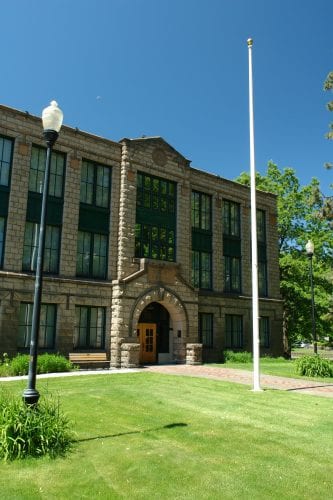
The Reid School
The Reid School
129 NW Idaho Ave.
Named for Ruth Reid who came to teach in Bend in 1904, the building was the first modern school built in Bend. Opened in 1914, it had indoor plumbing, heating and electricity. Many of the children that first attended the school did not have indoor plumbing yet. Ruth founded the first high school classes and became first principal of all schools. She had to quit after marrying a local entrepreneur and politician H.J. Overturf, for whom Overturf Butte is named. Reid took her husband’s name, but when Reid School was built, they named it for her by her maiden name. To this day, the building (now home to the Deschutes Historical Museum) is reportedly haunted by the ghost of George Brosterhous, who died of a fall during the building’s construction
The fresh prepared food service Boxwood Kitchen opened a brick-and-mortar in Bend’s Old Mill District.
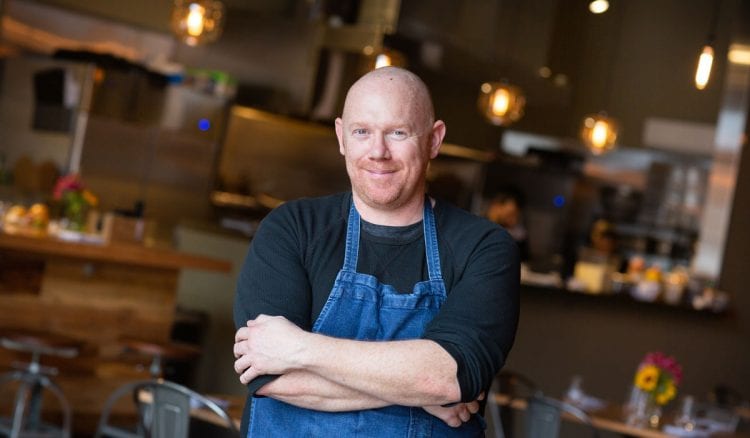
Chef Eric Rud
When Chef Eric Rud describes Boxwood Kitchen, which he opened in the Old Mill District at the start of the year, it’s devoid of trendy terms.
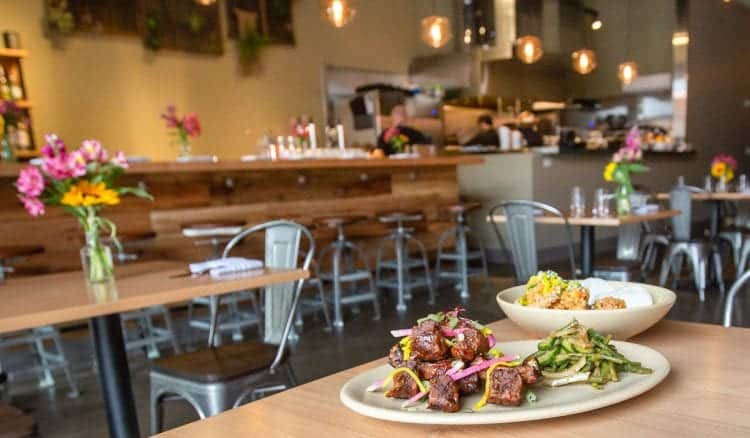
“My vision is comfort food and all the little details, the efforts behind the scenes that no one would know about,” he said. “I want a plate to be recognizable and delicious, beautiful without being pretentious, and I want to give value.”
That’s just part of the story, though. The phrase “efforts behind the scenes” is essential. For starters, Rud and his staff of ten make all the pasta, from pappardelle and gnocchi to spaetzle. House-made dinner rolls emerge warm from the oven nightly, served with lava salt and herb butter.
A savory dimension to the vegetarian gnocchi comes from umami powder, which the kitchen makes by dehydrating mushrooms, a process that requires two days and valuable kitchen space. Smoked shallots further boost the dish. All meats, including a hanger steak, are cooked sous vide, vacuum sealed in a pouch immersed in precisely heated water to achieve optimum flavor and texture. The pork chop is brined and marinated first.
“In our dry storage, in winter we have canned tomatoes, oil, vinegar and salt—no other cans,” said Rud. “We make all of our red curry, sauces and vinaigrettes from scratch. Personally, for me, there’s no other way to do it. It’s tricky, it causes a little stress, but we all take pride in it.”
Boxwood stands on the shoulders of the personal and career experiences of Rud, 42. He was born in San Francisco, but doesn’t have many formative food memories before age 6, when his family moved to Germany on a military assignment.
“While we lived on a military base, my parents insisted we would get out every weekend,” said Rud. He and his sister discovered the food cultures throughout Germany and in Italy and France. Being a picky eater wasn’t an option. “It pushed me in the right direction,” he said.
He started working in restaurants in Germany when he was 18, and about five years later, returned to the United States to attend Le Cordon Bleu College of Culinary Arts in Minneapolis. He returned to San Francisco and co-owned Aliment, an inventive, American eatery. Eventually, he and his girlfriend, Riane Welch, wanted to move on from the area, with its high cost of living. They saved for a year, and he sold his share in the restaurant.
They moved to Welch’s parents’ vacation home in Sunriver and launched Boxwood Kitchen, offering thoughtfully prepared salads, sandwiches and noodle bowl dishes, for online order, delivery and in local boutique grocers. The concept wasn’t taking off, but one of their delivery customers, the Old Mill District management office, approached them about opening in the fifty-two-seat space, behind Jimmy Johns.
While Boxwood still sells vegetarian and vegan salads at Market of Choice and Newport Market, the focus is on their popular eatery. This summer, they plan to add planters (of Oregon boxwood, an evergreen shrub) outside to create a patio.
Welch works full-time in marketing for Les Schwab Tire Centers, and as a restaurant partner, lends those talents to Boxwood, too. “I am, and will always be Eric’s biggest fan,” she said. “He takes so much care in crafting dishes and combining flavors and elements. He is always pushing himself to find that one thing that will really take our menu items over the top.”
In the heart of Powell Butte, an organic farm is a model of efficiency. Every element of the farm is utilized, including the minutes in the day.
Onda and Michael Hueners
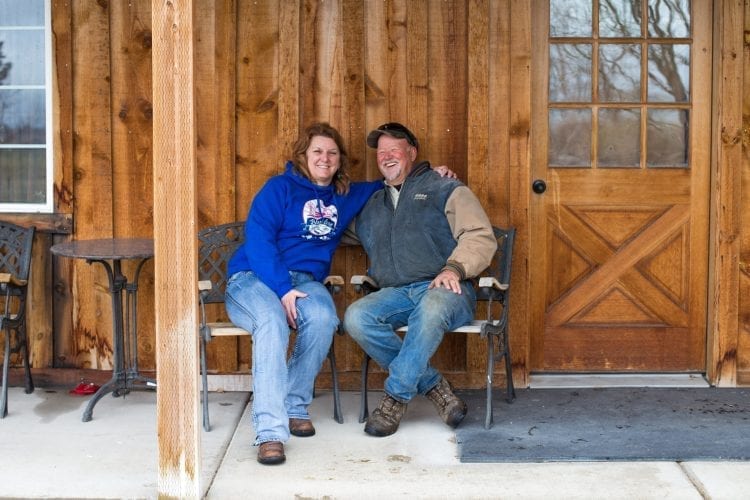
Michael and Onda Hueners must have more hours in the day than the average person. The Hueners run Bluestone Natural Farms, a thirty-five-acre organic farm in the heart of Powell Butte, producing beef, pork, eggs, vegetables, goat milk products, textiles and more for their farm stand as well as local farmers markets. They host educational farm tours on their property and are leaders of a handful of local agriculture organizations. And they do it all while holding full-time jobs—Michael owns Bluestone Gardens and Landscapes and Onda is an RN at St. Charles in Bend.
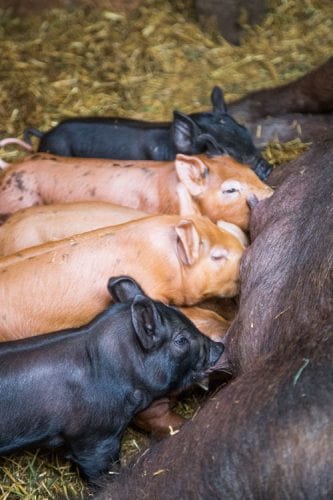
“It started out as a hobby, with the idea that we would work it into our retirement,” said Onda. “We started with a couple cows, and it’s just gone crazy from there.” Today they have about twenty head of cattle, fortyish pigs, about the same number of goats and another couple dozen chickens. A greenhouse and garden beds around the property produce a variety of vegetables.
Michael and Onda bought the property in 2004. Onda grew up in Wallowa County on a small farm and Michael grew up in Minnesota and moved to California, where they met in 1999. They have seven children between them from previous marriages and eighteen grandchildren who occasionally lend a hand, but most of the time it’s just the two of them.
Their main goal is to have the farm be as self-sufficient as possible, and they work with local businesses to collect food waste to feed the animals or create their compost. They collect spent grains from Kobold Brewing in Redmond to feed the cows and pigs and pre-consumer food waste from Worthy Brewing and Dairy Queen. (One look at the bucket of melted soft-serve next to the pig pen will put you off Blizzards forever. “The pigs just go crazy for it,” said Onda.) Facebook, and soon Apple, give them their pre-consumer food waste as well, which is part of a new initiative for the companies.
Unlike the narrow vertical approach of Big Ag, every component in the Bluestone operation has a dual purpose. Waste from the animals, along with hay grown on the farm and their own food waste, makes the compost that nurtures the vegetables.
While it may lack the economies of scale that are the hallmark of modern farming, there is an elegant efficiency here unrivaled in commodity driven farming. “Why have the farm that raises pigs, if you don’t have this, that and the other,” said Michael, referring to all the other components of the farm that aid in the process of raising pigs, like hay from the fields and whey from making goat’s milk. Otherwise, “It’s not a complete circle,” he said.
Education is another priority for the Hueners. They work with local schools to bring kids out to the farm to learn where food comes from. The adults are just as intrigued as the kids, they said. “It’s important to us because people have lost track of where their food comes from, or the work that it takes to produce that food,” said Onda.
A less diversified farm might be more profitable for them, but that isn’t the point. They do it all to be stewards of the environment, an example for a new generation of small farms and to be able to say that an average meal for them was produced entirely on their thirty-five acres.
“We haven’t made our own lasagna noodles yet, but everything else, even the tomato sauce, is from here,” said Michael.
A Bend couple decides to retreat to the little town on the Deschutes River and renovate a century-old home.
Kyle Suenaga in her Maupin home.
The first thing Kyle Suenaga noticed when she walked in the house was that it smelled 100 years old. Not that it was a bad thing. Just that it smelled like this house, on the corner of a Maupin neighborhood that overlooks the Deschutes River, had 100 years of life in its floors and walls, which it did, and just needed some TLC.
Kyle discovered Maupin a decade ago when she took her two sons on a rafting trip for the weekend. After that, they started visiting year-round to retreat from the Bend area. “We’d just come up here to unplug. No cell phone reception, no TV. It was awesome,” said Kyle.
That’s changed in the past decade. Today, Maupin not only has cell phone reception but also high-speed internet, which makes living there full-time a much easier transition for people like Kyle and her husband, Stan, who spent the majority of their lives in cities. By way of contrast there are about 430 full-time residents in Maupin, though the population booms to a couple thousand in the summer, with seasonal residents and tourists drawn to the world-class rafting and fishing.
The kitchen was the first room to get a full makeover in the century-old home.
Last year, the Suenagas were living in Bend but wanted a change of pace; Maupin fit the bill. When the century-old grey house on the corner came up for sale, they took the leap and decided to take on the fixer upper themselves.
“We moved in on a Friday and Saturday and started ripping up carpets on Sunday,” said Kyle. The asbestos abatement and roofer came on Monday. Kyle kept her job as an English teacher at Mountain View High School until the end of the school year, and Stan retired from his work for the government. By the summer, every day was devoted to renovating the house.
“Every single day was a project—that usually took three days longer than I thought,” said Kyle. “They make it look so easy on DIY shows.” (The modern farmhouse style popularized by HGTV’s Joanna Gaines is prominent throughout the remodel, replete with white shiplap on the walls.) “We tried to do it systematically, and then it ended up that everything was torn apart. And we’re still married,” said Kyle with a laugh.
While they were sledgehammering the lath and plaster walls and replacing the white shag carpet with hardwood floors and tile, they slept on cots on the screened-in front porch and cooked on the back patio throughout the summer. They didn’t have electricity for months; extension cords ran the coffeepot and fans—the latter of which is a necessity during Maupin summers that consistently hit three digits.
A classic claw-foot tub fits the neo-farmhouse theme.
A Unique Challenge
They tackled the kitchen first. The couple took down two walls, which opened up the front of the house. Butcher-block counters and white cabinets replaced the dated laminate and plywood and provide a modern farmhouse look. The trendy open shelving was also practical for Kyle, who said that she’s too short to reach upper cabinets. The backsplash is a white subway tile with black grout, which Kyle learned probably should have been done after the house’s siding was replaced. (The pounding damaged the fresh grout, which had to be redone.)
Each home renovation comes with a unique set of challenges, particularly when it’s being done in a rural area.
Kyle described the process of getting subcontractors to Maupin as “hell.” It took months to get a plumber and an electrician to the house, and the couple decided to forgo gutters when they still couldn’t find someone to install them. Most of the wait is because of booming construction in The Gorge and Central Oregon has delayed subcontractors. So they learned to do a lot themselves and relied on the help of some family and friendly neighbors. One night while eating at The Riverside restaurant in Maupin, they were talking about needing to patch some cement in their walkway. A construction worker who was in town to work on Maupin’s new civic center offered to lend supplies and a hand.
Kyle and Stan on the porch where they temporarily resided during the peak of the remodel process.
Make it Your Own
Charming quirks appear around every corner. In the living room, Kyle found a patch of brick on a wall and decided to expose it. Turns out, it was just leftover from an old fireplace. But that corner of brick remains, and she whitewashed it as an accent.
“Our mantra is, ‘It’s a 100-year-old house.’ We’re going for rustic,” said Kyle. “Not perfect,” added Stan. “Doing the work yourself, we just stumbled through it. You spend a lot of time on it, you call it good.”
There are two bathrooms on the main floor, one that had been remodeled by the previous owners, and the other was without a toilet. They kept it as a bathroom anyway, adding a clawfoot tub, standalone shower and embracing the idiosyncrasy of a bathroom without a toilet.
A sliding barn door now opens to the stairwell. Upstairs, a landing area has a powder room tucked in an alcove. That was a remnant of the house’s previous life as Maupin City Hall. Kyle learned that at some point, the original city hall burned to the ground, and the city officials turned this house into city headquarters. The three bedrooms upstairs had been used for offices.
They’re still waiting for new trim for the windows and need to install doors upstairs. They haven’t done much to the exterior yet, which will be tackled next. They’re eager to get started, but then again this is Maupin. And they didn’t come here to rush.
An ethic of sustainable manufacturing drives Damien Teitelbaum’s durable designs.
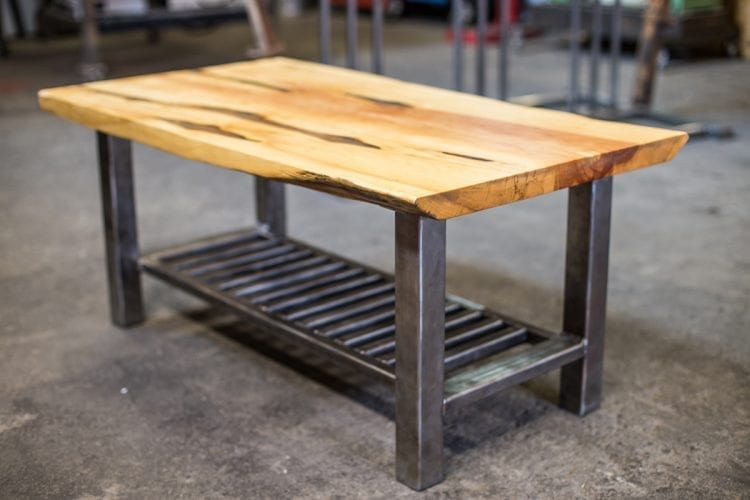
Steel-legged coffee table topped with juniper.
As the adage goes, “One man’s trash is another man’s treasure.” For local metal artist Damien Teitelbaum, it only takes a trip to the local scrap yard to find his latest inspiration.
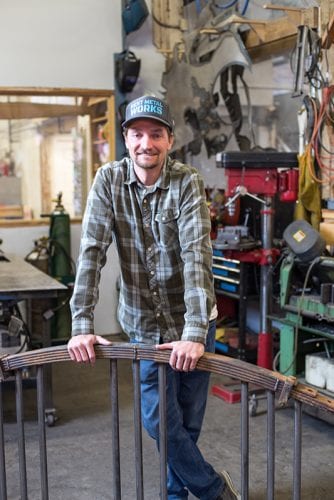
Teitelbaum is the mind and hands behind Bent Metal Works, a one-man studio that uses metal as the basis for functional yet sustainable pieces that range from robots (R2-D2 makes a great a wedding gift!) to wine racks. Teitelbaum often merges wood and glass for finished pieces that have a rugged industrial elegance.
If you venture around downtown long enough, you’ll discover multiple examples of his projects consisting of upcycled bike racks that Teitelbaum fused out of old car parts. Walk into a local furniture store and you’re just as likely to see a steel-legged coffee table topped with an ancient juniper slab.
Damien Teitelbaum
“I enjoy welding and how it’s somewhat forgiving,” Teitelbaum said. “It’s gratifying to take metal and build things that are both functional and fashionable.”
Bent Metal Works found its niche in the process of “upcycling” metals into functional everyday items. Rather than purchase new materials to turn into amazing artwork, Teitelbaum follows the four “R’s” of sustainability: reduce, reuse, repair and recycle. For Bent Metal Works that means having the least amount of impact on the planet while still creating something exceptional.
Bent Metal Works does most of its manufacturing at the local DIY Cave, a co-workshop studio on Bend’s eastside in the old Pakit Liquidators space off 9th Street. Here, professional and amateur crafts people, mechanics, designers and artists come together under one roof to turn ideas into reality in an atmosphere that fosters collaboration.
Teitelbaum frequently bounces back and forth from the metalwork to woodworking spaces while sharing concepts and strategies with other artisans. He said that DIY Cave’s access to such a wide variety of resources is essential when working across multiple mediums.
“Everyone at the DIY Cave is reading the same book,” Teitelbaum said. “But everyone here is just reading a different chapter.”
In the end, it’s all about community, said Teitelbaum. Whether it be at the DIY Cave or at the homes of his clients and friends, Bent Metal Works is all about creating something that lasts and doing it together.
“I’ve found that the people of Bend can really appreciate finding someone local to design their tables or furniture,” he said. “It makes me happy when, months down the road, people send me photos of the habitats where my furniture ends up.”
Take a tour inside a mid-century modern masterpiece in the high desert that is built around indoor-outdoor living.
If you’ve stayed in an open-air home in the tropics with birds and breezes flowing through, then you’ll have a sense of what Maya Moon and her husband Brian have accomplished in the high desert outside Bend. The mid-century modern home with Frank Lloyd Wright influences sits on twenty-nine acres of junipers, scrub brush and rock and invokes indoor-outdoor living.
“The homeowners will be able to open sliding-glass walls and large windows in their great room and be outside at the same time,” said Al Tozer, an architectural designer with Tozer Design. The home is built around the concept of “biophilia,” the human tendency to seek connection with nature and other living things, he explained.
Tozer and his design colleague, Cecile Cuddihy, spent many hours at the site evaluating elevations that would capture views of the Cascades, from Mount Hood to Mount Bachelor, and create multi-levels embedded into the natural landscape. “Walking through the home is like walking where the landscape originally rose and fell,” Tozer said.
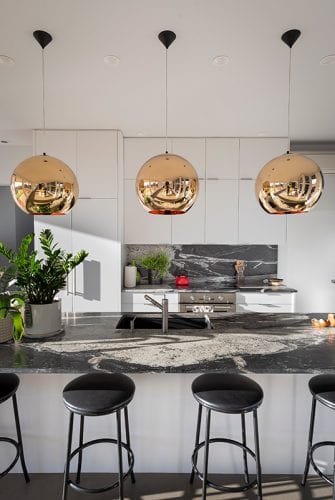
The Dixon copper ball lights provide a warm contrast to the kitchen’s black and white quartzite island and wall backsplash.
To maximize the mountain views and have the connectivity with the outside through sliding doors and large windows, the home has more glass than solid walls, meeting one of Maya’s dreams to live in a glass house. The desertscape and the absence of nearby neighbors matched Brian’s desire for privacy.
With the high desert’s changing seasons and temperatures, capturing sunlight in the winter and shading it in the summer was important, especially with so much glass. The design team used strategic placement of overhangs, orientation of the home and operable windows to allow cross ventilation. The upstairs bonus room has five-foot high, fifteen-foot-long stacking windows on two sides that, when open, give the sense of being outside with unobstructed, clear mountain views, the scent of juniper and perhaps the possibility of a butterfly fluttering through.
Maya Makes Magic Inside
To fashion a home for themselves and their two boys, the couple sold the house where Maya grew up, a converted 1915 schoolhouse in Olema (Marin County), California, which she inherited from her mother. Both parents were artists, her mother a puzzle maker and her father a wood carver of artisanal furniture and other pieces (and the road manager for the Youngbloods rock band). The proceeds of the sale helped fund the desert dwelling the family moved into in September 2018, a legacy to her mother’s memory.
A well-known local designer of high-end, handmade leather goods, Maya brought her distinct sense and quirky aesthetics to the project. During construction, Brian says that some of his wife’s choices “pushed my boundaries.” He said they had an agreement upfront about each having veto power. “I only used my veto card once,” he said laughing. “I couldn’t do a pink slab on the island.”
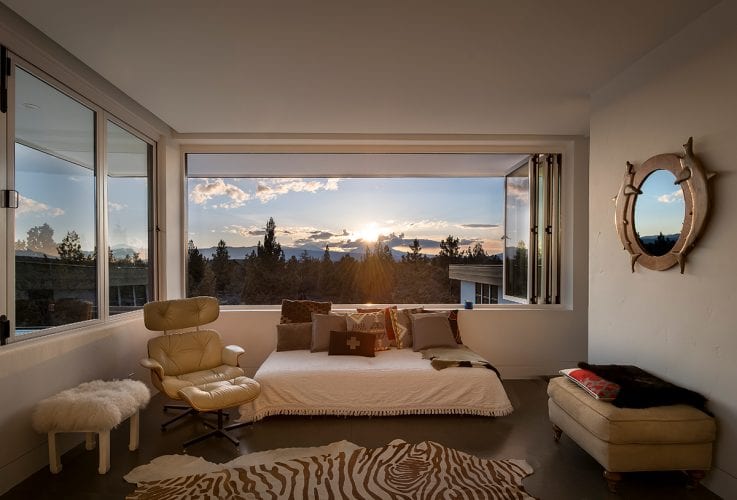
With so much emphasis on bringing the outside in, she chose clean, uncluttered lines that wouldn’t compete with nature. The walls are white, windows black, and the floors are concrete slabs.
“It’s a spacious home but still feels intimate,” said Jeannie Legum of Legum Design who helped select materials for hard surfaces, such as counter slabs, tiles and hardwood. “Maya’s modern design aesthetic worked well with her eclectic artistic flair,” Legum said.
Unobstructed view of the mountains at sunset from the upstairs bonus room.
The white walls feel like gallery space where the couple can display original artwork from Maya’s childhood and items they’ve collected more recently. Some of the pieces serve as the “wow” statement that Maya wanted for each room, such as the recently acquired Valerie Winterholler painting in the living room, the red front door and orange Vola faucets in the powder rooms.
The kitchen island and backsplash above the stove are black and white leather quartzite with the pattern “Skyfall” that feels like water swirling across the surface. Her eye for the unusual landed her a rare and expensive olivewood burl Milo Baughman dining table that she found on Craigslist. The mid-century wire Bertoia dining chairs are covered with sheep skin.
Her father, John Bauer, hand carved a hardwood “tree” chair and the wood-framed, animal mirrors for the home’s décor.
Cow hides and animal furs bring warmth and texture to the concrete floors throughout. Lighting fixtures include numerous large, ball-shaped hanging pendants that add pop to the dining room, island and entryway, and soften the square lines and corners in the house.
The Moon family enjoys warmth around the firepit with the inside of the home fully visible through the large doors and windows.
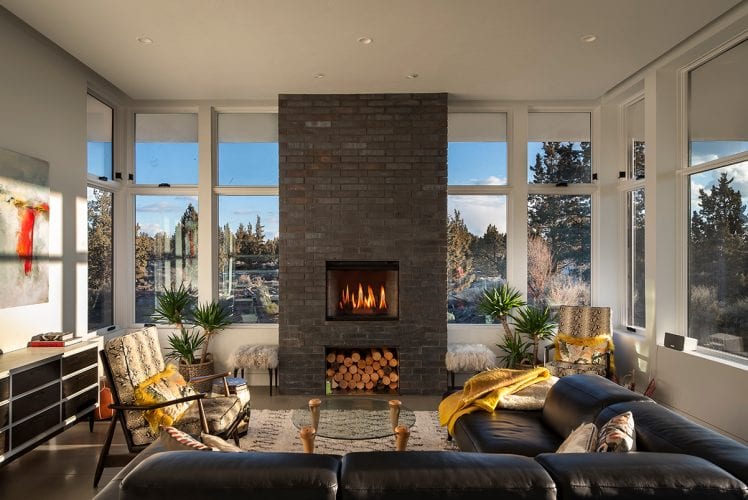
The focal point of the living room is the wood-burning fireplace constructed of black brick. “We’re all attracted to the romance of wood-burning fireplaces,” Tozer said, adding that fires elicit feelings of hominess, comfort and security. Underscoring that point, Brian said he loves sitting in the living room because it’s peaceful and zen-like.
The perfect union of the home’s design and aesthetics is found in the master suite that reaches west and is a quiet place for retreating. A hallway leads past the couple’s closets and bathroom to a cozy bedroom where they can lie in bed to see the occasional shooting star or step out to an alcove with comfy chairs for a nightcap.
Dave Wachs is a wandering landscape painter who draws inspiration from communion with remote places.
Photo by Caitlin Eddolls
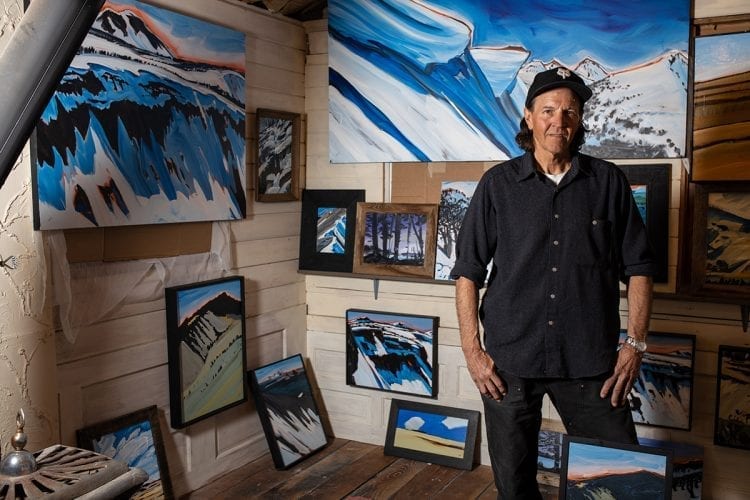
Dave Wachs is a hard man to catch up with. When you do, he conveys a sense of life in constant motion, whether he’s ping-ponging between his homes in Peshastin, Washington and Bend, traveling internationally or putting paint on canvas in hurried brush strokes. The frantic pace is a contrast to Wachs’ art that captures seemingly eternal landscapes in quiet repose.
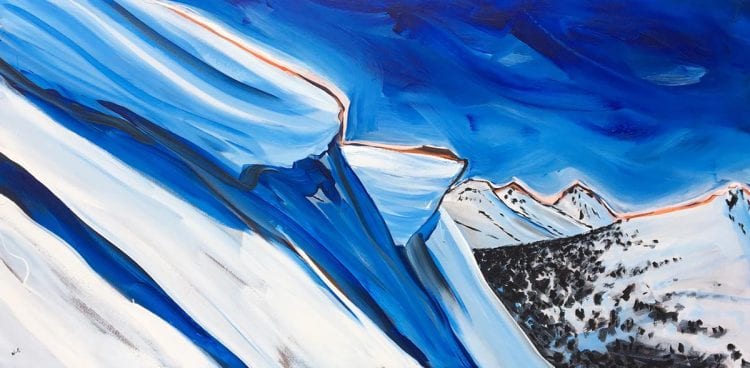
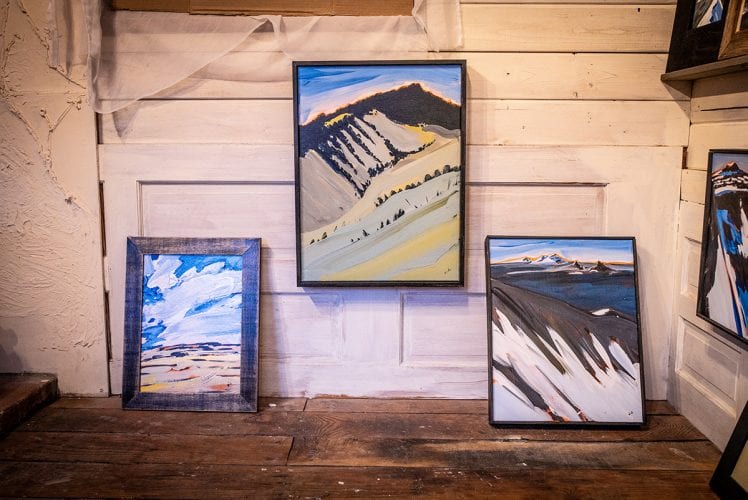
The landscape artist’s wandering impulse derives from his love of the outdoors and his love of painting the outdoors. As an artist, he says the deepest inspiration he gets is from nature and the environment. “I don’t go to cities, and I don’t have to add barns or roads to my work,” he said. His landscapes convey an impression of mountainsides, pear orchards and the countryside in vivid colors, often blues, white and splashes of orange.
Those parallel themes of art and being in nature have driven his life since college. While he was earning a degree in graphic design and fine arts painting from Montana State University in Bozeman, he was hitting the ski slopes at every opportunity. “He was part of a group of guys who would focus their binoculars on distant mountain peaks in the summer, looking for one chute that still had snow,” recalled Julie Berry, friend and fellow MSU art student. “Dave was a skiing maniac. He and his friends spent days in the backcountry, climbing up and skiing down.”
She said Wachs committed the same devotion to his art. “We’d show up at the school’s painting studio at ten at night, paint till morning and then go out to breakfast,” Berry said. After graduating in 1983, Wachs moved to Portland from Montana, which he says “was a gnarly transition for me as I didn’t want to leave Montana, but you couldn’t make a living there.” He eventually worked in advertising with Nike and then snagged a project with North Face called Steep Tech to design a collection of hard-working clothing for legendary extreme skier Scot Schmidt, with whom he collaborated.
In 1992, he moved to Bend from Taos, New Mexico, and bought a farm in Tumalo where he worked for twenty-two years. In the three years since he’s left the farm, he’s worked out of studios in Colorado, New Mexico, Montana, Washington and Oregon. “I don’t need a fancy place to work, but it can’t be freezing,” he said with a laugh. His primary residence is a pear orchard outside Peshastin, near Leavenworth, Washington, although he returns to Central Oregon for several months a year.
Dave Wachs Painting
Wachs travels to remote and inspiring places in his Chevy pick-up and on dirt bikes, gathering imagery with a camera and sketch book. “I have a rule that I have to have been there to paint a landscape,” he said. “I’m trying to capture the image out of the corner of your eye,” he said.
The resulting landscape pieces could be mistaken for photographs from afar but reveal brush strokes upon closer examination.
“Dave’s paintings take me to those peaceful spots where it’s just air, wind and what’s beneath my feet,” said Berry, who worked in custom picture framing for years in Bozeman and framed dozens of her friend’s pieces for an exhibit in Bend. Before receiving the paintings for framing, she saw photos of them. “They were so expansive in feeling that I thought he was doing six-by-eight-foot paintings. When they arrived, they were small, and I was amazed at how he captured such an expansive feeling on such a tiny surface.”
The landscapes feel eternal, but Wachs’ painting process is fast. He starts a painting with a sketch and then works quickly to cover the canvas in acrylic paint that he mixes himself. “I don’t have patience for oil or the smell of oil paints,” he said. He paints with big brushes and finishes most canvases in two to three days, mostly at night when he says “the creative stuff comes out.” He adds that, “If it looks good at night, it will look good in the day.”
He strives for spontaneity, which ironically takes a lot of discipline. He compares his process to the art of Japanese Haiku poetry. “I have to think or meditate about a piece of work before starting,” he said. He draws inspiration from the 1920s-era Canadian “Group of Seven” artists who explored the countryside and documented their impressions through painting. But he’s clear that he doesn’t emulate them or anyone else. “I think my work looks like my work, and I’m proud of where I am now.”
Photo by Caitlin Eddolls
Wachs has done commissioned work for individuals and businesses across the country. He is currently represented in Central Oregon by art consultant Billye Turner who will be hanging about twenty-five recent landscapes at Franklin Crossing in downtown Bend during June. His pieces sell for $500 to $10,000, with the larger canvases at the higher end.
“The quality of Dave’s work is worthy of collecting…because his genuineness and talent add up to paintings that you’ll love for decades and still be transported to another place,” said Berry.
Musician and instructor Dale Largent talks to Teafly about on the role of musicians in Central Oregon, how that has changed over the years and the importance of music in our lives and on our brains.
Artwork by Teafly
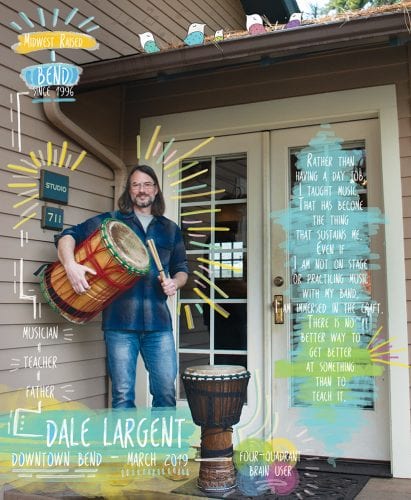
Dale Largent gave up music twenty-three years ago and moved to Bend. But he did not give it up for long, and within the first year of living in Bend, he began playing again, luckily for us. A classically trained percussionist, Largent has been an active member of the music scene in Bend, teaching in various schools and showing up on the stage with Tarrka, Brent Alan and his Funky Friends and perhaps most notably The Moon Mountain Ramblers, with whom he has played regularly for more than twelve years.
On Moving to Bend
Having grown up and lived entirely in the Midwest, I knew I wanted to get out to someplace with mountains. I got here on August 1, 1996. I got the truck all unloaded and the boxes were stacked up. Then it was August 2, and it was a gorgeous day and I thought, “I cannot unpack these boxes, I must go out!” So, I go up into the mountains and explore. And August 3 was a gorgeous day! So I went out and explored and this went on for two weeks. And then it occurred to me, “Wait, every day is going to be gorgeous, I must unpack these boxes even if it’s gorgeous.”
On Finding Music Again
I started playing music at age 5. One of the most disappointing things that I ever grabbed out of adults in my community when I was growing up and/or in popular culture was the message that musicians need a day job. I wasted so much money and time trying to have a day job when I could have just been making money as a musician. Very early on when I was first living here and exploring, a new music store was opening. The owners were there and invited me to come in. They were super friendly. They asked me about my music and I told them, “I quit music for the third and final time.” And the owner looks at me and said, “Then why are you in a music store?” I told him, “I don’t have an answer for you. That is a profound question. Why am I here?” A couple days later, I called up the store and said I’d like to teach, which I had done before. Ever since then I have been a professional musician. But trying to pull it all together is fascinating.
On Learning Through Teaching
Rather than having a day job, I taught music. That has become the thing that sustains me. Even if I am not on stage or practicing music with my band, I am immersed in the craft. There is no better way to get better at something than to teach it. The basics I put my students through, I go through 100 times in a week. If I was on my own practicing, I may only go through them ten times in a week. I think I am significantly better as an artist because of all the teaching I have done.
On Live Music
In Bend I feel like the number of stages that musicians can play on has dramatically changed in twenty-three years. The downside is that the pay has gotten worse. We do not create musical venues, we create brew pubs that decide to have free music so they can compete against the other pubs that have free music. I hear talk in this town so frequently about how we support live music. And on the one hand that is completely genuine. People show up for local artists, and I am very proud of our community. On the other hand, they almost never pay a single dime for that music. That is my experience. This town really supports its local artists with their attendance and appreciation but not with their dollars. And I don’t think it’s their fault, because they aren’t asked to pay.
On the Ups and Downs of Change
I still appreciate that with Bend having all this growth, I still feel community here. It feels very like a community kind of place, but it is the feeling of community as opposed to the actual community. [It used to be that] I had to leave an extra twenty minutes early for anything because we were going to know somebody and we were going to visit. That human connection that I really cherished in Bend—only through growth, not in attitude—I think has been lost. On the upside we have really good restaurants! I used to crave going to Eugene or Portland to get good food. Now I can walk out my door and be very happy about any of the places I have to chose from. The Grove closed, but we got Spork! So, hey that’s a fair trade.
On Finding Your Place
If you are truly driven and passionate to spend your time and energy playing music, then you should definitely do it. Your challenge, as anyone entering a career, is to find the way, the place and the path to do that. I think what is different about what I understand now at age 51 is that there are many places to fit yourself in and there are many ways to fit in. It might take a few of those places pieced together in various ways, but you can fit. You do fit.
What If We Could is a website and social marketing platform that partners with nonprofits on a series of rotating initiatives that alternate between marshalling volunteers, fundraising and gathering in-kind donations.
Greg’s Grill Manager Andreas Greoriou (left) and Rys Fairbrother
In Bend, it’s estimated that there are more than 500 nonprofits working in everything from childcare to mountain bike trail maintenance. Nationally, nonprofits are doing big business. According to the Urban Institute’s most recent report, there were more than 1.5 million nonprofit’s operating in 2015 with $3.5 trillion in revenue.
That picture obscures the reality faced by most nonprofits: they face a perpetual scramble to maintain funding through grants and private donations. The truth is that there aren’t enough charity golf tournaments and galas to fund all the organizations.
It’s a problem that Rys Fairbrother has been thinking about for years. A former account manager at Zolo Media, Fairbrother has a passion for public service that is rooted in his Christian faith. But he is also an enterprising thinker who has worked in marketing and social media. A few years ago, he began to envision a business dedicated to helping nonprofits better serve their constituents while helping inspire ordinary people to acts of altruism.
An extended road trip with his oldest son last summer served as the inspiration to take that dream and turn it into reality. He quit his day job last fall and dedicated himself to the idea, which he launched in January as What If We Could, a website and social marketing platform that partners with nonprofits on a series of rotating initiatives that alternate between marshalling volunteers, fundraising and gathering in-kind donations. It’s all driven by a series of social media campaigns developed by Fairbrother with his nonprofit clients.
“I’ve always loved taking new technologies and old ways of doing things and bringing them together,” Fairbrother said.
In the case of What If We Could, Fairbrother saw an opportunity in the intersection of crowdsourcing platforms like Go Fund Me and the ongoing funding and operational requirements of nonprofits. As with crowdsourcing campaigns, the ability of nonprofits to fundraise is tied to their story. Successful nonprofits understand that and have sophisticated marketing arms to support their work. But most nonprofits don’t have the time and resources necessary to support strong outreach campaigns. What If We Could helps nonprofits articulate that story, while allowing supporters to become vested in specific initiatives through donations and volunteering.
There is also a matter of transparency. Fairbrother said donors are taking a greater interest in where and how their money is being spent.
“I believe that giving is changing. Our parents gave $500 to the United Way and away it went. And now, people want to see where their money goes and how it is being used in the community,” he said.
Fairbrother wanted his platform to address both sides of the equation. Better narratives for nonprofits that resonated with donors and volunteers and a transparent connection between donations and outcomes gives supporters a clear sense of how their giving impacted the community.
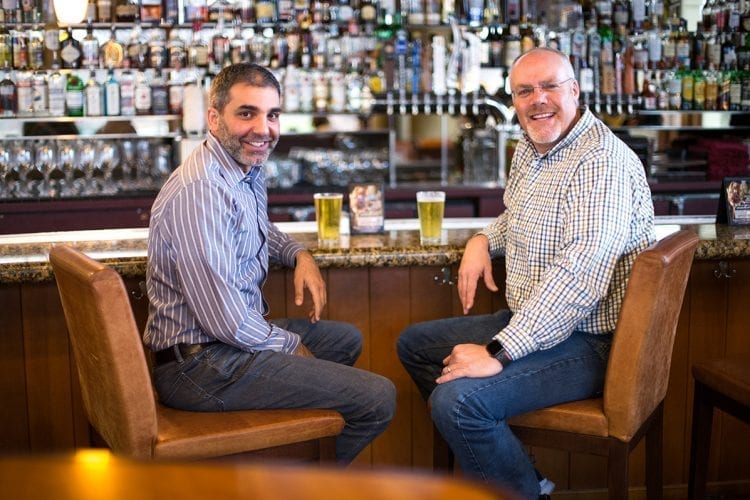
A third leg of the stool brings in business sponsors to underwrite the social campaigns. One of the first to get on board is Greg’s Grill, which was already using its wine of the month program to help raise money for non-profits such as Central Oregon Veteran’s Outreach. (COVO) Manager Andreas Gregoriou believes that partnering with Fairbrother will allow him to more than double Greg’s fundraising.
“What we have done with Rys is pretty much that [program] on steroids, so we can maximize revenue for COVO and awareness for COVO, as well,” Gregoriou said. If the program is successful, Fairbrother said the model can be taken to other markets in Oregon and beyond.
“I think there is just such a heart in the community to want to give back and help these nonprofits. They just need the platform,” Fairbrother said.
Bend’s pioneering brickmaker left an enduring imprint on Bend’s main street. When Hugh O’Kane’s saloon on the corner of Oregon and Bond streets burned down in Bend’s first fire on April 27, 1905, he told the Bend Bulletin, “This is quite a blow to me just at this time […] but I will put up another building and try again.” Ten years later, his other business, the Bend Hotel, also went up in smoke. In 1916, he finally got it right. The fire-proofed O’Kane building still sits at the corner of Oregon and Bond streets.
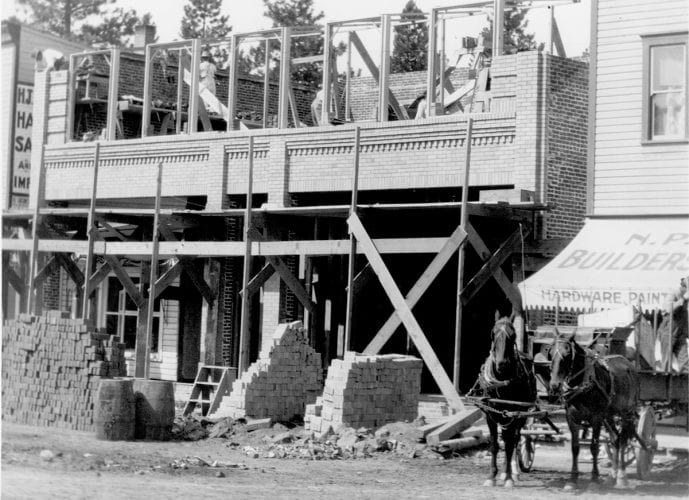
O’Kane’s losses were hardly outliers in an era long before the advent of fire alarms, sprinkler systems and modern fire-fighting equipment. Blazes could spread quickly with deadly consequences, especially in timber towns like Bend where wood from the local mill was the de facto building material. In those early years, Bend’s business district was cobbled together from an assortment of frame-built buildings. Fire-prone restaurants and saloons stood next-door to grocery or clothing stores. A fire could make short work of an entire business district, severely crippling the local economy.
Although national and state building codes changed after Mrs. O’Leary’s cow famously started the Great Chicago Fire in 1871, it was not until March 1912 when the Bend City Council bolstered the local building codes and demanded fireproof buildings in the business district.
“The switch from wood frame construction to brick, stone and concrete is reflective of fires ripping through downtown areas,” said Michael Houser, former Deschutes County Historic Preservation Planner. “There are many examples of entire downtowns being obliterated by a single fire.”
PHOTO COURTESY OF DESCHUTES HISTORICAL MUSEUM
More than half of Prineville’s business section was leveled in a catastrophic fire in June 1922 and Sisters was hit with a big blaze in September 1925 that destroyed half of the town.
As Bend matured, builders and investors started looking for a material that would stand the test of time and the elements. They turned to Bend’s premiere brickmaker, Arthur “Art” Horn. An enterprising newcomer, Horn took the long way to Bend. Born in Auburn, Michigan, Horn moved to Bellingham, Washington in 1903 and to Bend in 1910.
After the first train rolled into Bend on October 5, 1911, the city went through a building boom. Perhaps seeing the opportunity to supply bricks to the commercial district, Horn bought the languishing Bend Brick and Lumber Company located between west Bend and Shevlin Park.
The first brick building in Bend’s business district housed the Bend Bulletin. Built in 1912, the one-story building comprised 27,000 bricks and cost $1,600. The building sits across from the old post office building on Wall Street.
PHOTO COURTESY OF DESCHUTES HISTORICAL MUSEUM
Horn started out making common bricks, which had round corners and required larger and irregular mortar joints. As design trends changed, Bend customers wanted a more uniform look and started requesting so-called repressed bricks.
Horn initially did not have the machines needed to produce bricks with sharper edges. In March 1916, Horn invested in a new $3,000 soft mud brick machine, modernizing his operation.
“The new re-pressed brick, which the company is making this year on a large scale is proving popular among local builders,” Horn told the Bend Bulletin.
Building with bricks soon became a status symbol in Bend; it also demanded skilled labor.
“It’s what [business men] from the East Coast were accustomed to,” said Heidi Slaybaugh, principal at COLE architects and former chair of the Bend Landmarks Commission. “The more details [the building featured] the more money you had.”
Horn sold the company in the early 1920s and moved to Eugene to start another brickyard. The Bend Brick and Lumber Company produced bricks until the late 1920s before new owners shuttered the operation. In 1932, the former brickyard was turned into a racetrack and rodeo grounds. By then better transportation and evolving markets meant that bricks could be imported into Bend more cheaply than they could be produced here.
The local brick-making era was over, but Horn and his upstart brick business had already left an enduring imprint on downtown Bend, forming the literal cornerstone of the urban center.
Camp Sherman offers adventures and activities for everyone in the family.
Camp Sherman was established in the early 1890s by wheat farmers from Sherman County looking to escape the summer heat by lounging by the cool waters of the Metolius River. Since they first tacked up a shoebox sign declaring this area their own summer camp, not much has changed.
The small community off Highway 20, only forty-five minutes by car from Bend, is home to a few lodgings, a tiny school, a fire station, a couple of restaurants, one store and loads of charm. This area is one of the few remaining places where one still cannot get reliable cell reception, which is what soothes and relaxes the tech-addled visitor, once they give into the situation.
Sometimes my family and I overnight in a campground or cabin to the yips of a pack of excitable coyotes howling at the moon. Come dawn, we awake to cool mountain-air mornings, the sweet smells of Ponderosa pine and snowbrush and pink sunrises promising sunny days. But Camp Sherman is an equally terrific day trip.
Begin your exploration at the Camp Sherman store, which is stocked with a huge variety of goods from sun-proof clothing to fine wine to canned soup. Pick up a picnic lunch and eat outside with a view of the Metolius. Stroll down the river trail after lunch and get a glimpse of some of the area’s campgrounds and the pristine river, known for its wild rainbow and elusive bull trout, a two-fer that draws fly-fishing anglers year-round to the fabled waters.
If you’ve never picked up a fly rod in your life, you can still marvel at the Metolius River, which springs literally from underground, or as it appears, from a rocky hillside. Drive to its headwaters a few miles from Camp Sherman to see the river’s perpetual rebirth. The site is accessed by a short quarter-mile trail with a killer view of Mount Jefferson. Expect to encounter a mighty band of yellow pine chipmunks accustomed to dining on visitors’ treats.
Also accustomed to bite-sized morsels delivered by human hands are the fish at the Wizard Falls Fish Hatchery, the birthplace of six varieties of fish. Fish food from a vending machine can be tossed in a long cement pool to trout and kokanee, which ambitiously leap and swipe at the scattered bits.
End your day with dinner under the pines on the deck at Lake Creek Lodge, which feels as peaceful and quaint as it likely did years ago when the first visitors relaxed here. You can just see a glimpse of the sunset on the Three Sisters.
Sophia Rodriguez, a Bend youngster who took the bike world by storm, heads to Belgium for the BMX world championships.
PHOTO BY ALEX JORDAN
After winning a qualifying race in New Mexico earlier this spring, Sophia Rodriguez is headed back to BMX racing’s most prestigious event, the World Championships, set for July in Belgium. A month later, she’ll enter middle school back here in Bend.
This summer will mark the 10-year-old’s second world championship appearance. Her first came in 2017, when she stunned the BMX world with a sixth-place finish in her age group, despite having taken up BMX less than nine months earlier.
“We went there so unprepared,” recalls Albert Rodriguez, Sophia’s father, of the 2017 world championship held in South Carolina. “She was wearing football gloves and a heavy helmet. I had no clue what BMX was about—or how it worked. But after going to worlds, getting sixth out of fifty-five girls from all over the world, that was the game changer. From there, we were hooked.”
SOPHIA RODRIGUEZ
The Rodriguez family, which in addition to Sophia and Albert includes mom, Jinky, and younger siblings Stella, 6, and Nikolai, 1, moved to Bend from Anaheim in 2016 for a lifestyle change. Albert, an avid cyclist who raced as a semi-pro for many years in SoCal, continued to race mountain bikes once they arrived in Oregon, and Sophia often tagged along, entering kids races anytime she could.
Now a fifth-grader at Buckingham Elementary, Sophia says she stills rides and trains on her mountain and road bike, but her primary focus has turned to the high-intensity, don’t-blink-or-you’ll-miss-it discipline of BMX—a close combat sport akin to ski or snowboard cross.
In late 2016, young Sophia accepted an invitation from a friend to try BMX for the first time at the High Desert track. Since then, Sophia’s BMX star has risen meteorically. Hours of sprint practice and careful study watching videos of other racers has led to big improvements and a new nickname, “So Fast” Rodriguez, coined by a national announcer.
No longer flying under the radar, Sophia is currently ranked first in Oregon and fourth nationally in her age group. She also recently picked up her first major sponsor, Yess, a Canadian BMX frame manufacturer.
Fast and unpredictable, BMX racing involves sprinting out of a start gate on a short, off-road course over bumps and berms in a series of qualifying heats that may last only thirty seconds.
“I’m really good at the pumping because I have a strong upper body,” explains Sophia. “If there’s a long pump section, my gap gets bigger and bigger. I’m good at snapping the gate, which means getting out in first. Because if you don’t get out in first, it’s really hard to come back since there’s no more room to get in the front.”
SOPHIA RODRIGUEZ
Despite the emphasis on a fast start, Sophia says she doesn’t get too anxious before her races.
“I take a few breaths before I go up,” she says, “and that calms my nerves to be relaxed.”
While Bend’s climate doesn’t lend itself to riding BMX year-round and can pose a disadvantage at times when Sophia competes against riders from more temperate regions, Albert believes it makes for a more well-rounded athlete less susceptible to burnout. He credits Sophia’s success not only to her focus and willingness to train, but also to the many hours the father and daughter spend road or mountain biking together “just for fun.”
At this summer’s world championship in Europe, Sophia says her goal is to win a world title. It may be her first, but likely won’t be her last.
This spring, spend a weekend exploring Hood River, where you’ll find a mix of outdoor recreation, local bounty and unique history in the backdrop of the Columbia River Gorge and Mount Hood.
Hood River
It’s a beautiful day for a bike ride. To our left, the great Columbia River glows deep blue under the May sunshine. To our right, a lush hardwood forest of alder and rhododendron provides shade. The road beneath our tires is 100 years old, and was the nation’s first planned scenic roadway, built to take in Columbia River Gorge views just as stunning today as they were then.
I am new to road cycling, and my husband spent years as a competitive cyclist, so finding compatible routes for us can be a challenge. The Historic Columbia River Highway State Trail out of Hood River strikes the perfect balance. The historic highway is mostly famous as a scenic car route, but several sections are designated non-motorized use only, including seven miles between Hood River and Mosier. No traffic, outstanding scenery, two tunnels to navigate, history, terrain just hilly enough to be interesting—there is enough to like for both of us, though one of us is still slower (me).
An hour and a half later, ride completed, we drive into Hood River for lunch. Full Sail Brewery is one of the oldest breweries in Oregon. Murals grace the walls, depicting the history and beauty of the Gorge, and huge windows frame magnificent river views. Salmon fish and chips and a fire burger hit the spot, and then it’s time to explore the town.
PHOTO BY CHRISTIAN HEEB
Set on a steep slope that descends to the Columbia River, with Mount Hood looming in the distance, Hood River has an unbeatable setting. From just about anywhere in the downtown area, the river is in view. The energy of that waterway, and the famous wind created by the Columbia River Gorge, define the town. We wander from store to store, perusing sportswear at Melika and the Ruddy Duck, jewelry at Twiggs and Chemistry, art at Made in the Gorge Artists Co-op.
Our room for the night is at The Hood River Hotel. Dating back to 1888 and on the National Register of Historic Places, the hotel has restored original features including lofty ceilings, expansive windows, a brass elevator gate and a marble-faced lobby fireplace. Rooms are recently renovated and are comfortable with the warm hint of history, and large windows overlooking the street front.
For dinner we visit Three Rivers Grill, where it is just warm enough to dine on the second-floor outdoor patio with sweeping views of the town and the river. The French-inspired menu satisfies with Northwest steelhead and halibut almandine. We round out our evening with a nightcap at Oak Street Pub, complete with a round of shuffleboard (similar to the cycling, I did not emerge from this contest as the winner).
PHOTO BY ALEX JORDAN
Bette’s Place Restaurant has a legendary reputation, and sure enough, when we get there in the morning there is already a line out the door. Located in a classic old-style mall and family-owned for four decades, the diner offers a huge menu of deliciousness including a Dungeness crab benedict and a Mexi scramble. After the generous meal, it was tempting to go back to the hotel and take a nap, but the sun was out and the waterfront was calling, so we stroll down to the Hood River Waterfront Park.
Windsports were practically founded in Hood River. On any given day, the bright colors of kiteboards and windsurfing rigs dot the water. The wind that makes all of these windsports possible is blowing, but the air temperature is balmy and the park full of weekend revelers.
Bend was calling for our return, but we take our time leaving the Hood River Valley. The “Fruit Loop,” as it’s called, consists of thirty destinations in the fertile valley offering wine, cider, fruit, veggies and more. We stop at Packer Orchards and Bakery for a jar of slow simmered apple butter, Wy’East Winery for a bottle of pinot noir and Fox Tail Cider for a tiny sip of triple hopped cider before we head for home.
Restaurants
Full Sail Brewing was founded in 1987 in an old fruit cannery and still anchors the waterfront with great brews and food. Double Mountain Brewing in the heart of the city has seating inside and out and specializes in brick-oven pizza. Bette’s Place Restaurant has been going strong under one family’s leadership for four decades, with a huge breakfast menu and frequent wait times. Three Rivers Grill is the place to be in the summer, when the second-story patio offers outdoor dining with an incredible view of the Columbia River. Frement Brewing is Hood River’s newest brewery, located in an ultra-modern building near Waterfront Park. Solstice Wood Fire Pizza is also on the waterfront, and a local’s favorite for hyperlocal ingredients and riverfront views.
Lodging
Hood River Hotel has anchored downtown since 1888 and is still a great central location from which to base your stay, within walking distance of most everything great. Oak Street Hotel is another downtown gem, a boutique hotel with nine rooms and a farm-fresh breakfast based on seasonally-available foods. Columbia Gorge Hotel is the region’s grand old beauty—a gorgeous Mission-style hotel right on the river, built in 1920 by one of the developers of the historic Columbia River Highway.
Nearby Attractions
Hood River Mountain Trail takes hikers atop a 2,000-plus-foot rise south of Hood River, from which wildflowers and orchards stretch to Mount Hood, popping impressively in the distance. Hood River Fruit Loop is a thirty-five-mile scenic drive that begins and ends in Hood River, passing through the valley’s orchards, forests, and farmlands, visiting orchards, wineries, farms and more.
The 750-mile Oregon Desert Trail can be experienced as an epic backpacking excursion. It can also be explored on day hikes that still show off the stunning landscape. Find maps, waypoints and directions on from the Oregon Natural Desert Association’s Trail Resources.
CRACK IN THE GROUND
Just east of Christmas Valley, the aptly named Crack in the Ground trail drops onto the floor of a two-mile volcanic fissure. A favorite of local geology buffs; some rock scrambling is required. Make it an overnight adventure at the rustic Green Mountain campground. (BYO drinking water!)
Moss Pass to Morgan Butte offers panoramic vistas from the Steens to Mount Shasta. This Fremont National Forest trail, about an hour’s drive south of Paisley, is open to horses and mountain bikers, too.
Branching off the main route through the Steens, the Little Blitzen Gorge trail follows the river through a glacier-carved gorge. Try an out-and-back hike to 4-Mile Campground or backpack in to reach the waterfall.
Near the Owyhee River at the end of the ODT, Leslie Gulch offers dramatic spires and unusual honeycomb rock formations. Bighorn sheep and elk roam the area, and birdwatchers can spot chukar, songbirds and raptors.
At five years old, the 750-mile Oregon Desert Trail can be enjoyed as a feast or series of bite-sized outback adventures.
PHOTO BY NATE WYETH
When Robin Sullivan talks about her hike on the Oregon Desert Trail last summer, the enthusiasm on her face belies the words. “I had a painful blister on my foot, I’d spilled my water, and I had to backtrack up a ridge after going the wrong way,” she said and laughs, jumping up to demonstrate climbing over the boulders.
She’d covered more than fifty miles, backpacking with a friend, but cut the trip short, because “stuff happens.” Despite the mishaps, she’s already planning routes for this year. What is it about the Oregon Desert Trail that draws her back?
“Maybe it’s the solitude, or the incredible stars, or the physical challenge…the desert is full of surprises.”
PHOTO BY KAT DIERICKX
From the Badlands to the Canyons
The Oregon Desert Trail is a relative newcomer to the list of North American through-hiking trails, which includes iconic routes such as the Appalachian Trail and the Pacific Crest Trail. It’s the first long-distance hike created by a conservation organization, designed to introduce the beauty of Oregon’s desert to a broader audience and to nurture appreciation for public lands.
The Oregon Natural Desert Association, or ONDA, began mapping the route in 2011. They pieced together existing trails, old wagon roads and routes across public lands. By 2014, they’d connected 750 miles, beginning in the Badlands outside of Bend. The route wanders south along the Fremont National Forest, then arcs east through Hart Mountain and into Steens Mountain. Looping around to the Owyhee Canyonlands, it terminates at the Owyhee State Campground.
This year marks the fifth anniversary of the Oregon Desert Trail. To date, only twenty-six hikers have through-hiked the entire 750 miles, a feat that requires intense planning and support. Many more hikers are like Robin Sullivan, targeting different regions on shorter hikes. There’s so much to experience, after all: sagebrush plateaus and ancient gorge rims, hidden petroglyphs and hot springs and the darkest starry nights in North America.
“Immersion in the desert landscape is addicting,” said Renee Patrick, ONDA’s desert trail coordinator and a through-hiker herself. Patrick wants to make hiking the ODT possible for every hiker. Since the ODT has launched, she’s been developing a trail guide complete with digital tools to help more people access the desert and prepare for the challenges of the trail.
“The trail guide is meant to remove barriers to hiking,” said Patrick. “We want everyone to have the opportunity to fall in love with the desert.” (The trail guide, maps and interactive spreadsheets are all free to download from onda.org)
PHOTO BY WHITNEY WHITEHOUSE
Digital Tools for an Unplugged Experience
Even a day hike in the desert requires preparation. Packing ample drinking water is critical, as water sources vary greatly throughout the hiking season. ONDA’s water guidelines provide low-tech advice, like how to cache water along your route, and there are high-tech tools too: an interactive spreadsheet lists GPS waypoints for water sources. Hikers update water levels in real time and check the status of what lies ahead.
Water is the first concern, but navigation skills run a close second, especially because most of the trail is unmarked.
“The ODT is not a distinct line on the map, like the PCT,” explained Patrick. “The trail often goes cross-country, where you can’t just follow the path. You have to engage with the landscape.” The lack of signage makes for a more natural experience, but it requires old-school paper maps and compass navigation, as well as digital maps with GPS waypoints.
Patrick encourages hikers to download and study the map PDFs. The terrain is rated like a ski run, from easy greens to black diamonds. Each trail is detailed with fence and gate locations, trailheads, road access points and topographic lines. Mountain bikers and horsepackers will find helpful information to avoid conflict between users along the trail.
Finding Solitude and Community in the Desert
Many hikers, like Sullivan, enjoy the solitude of the open desert. But the small communities dotted along the trail are worth exploring before or after a day on the trail. Save some time for towns like Summer Lake, where the hot springs revive trail-weary muscles, or Paisley, where the Mercantile and Pioneer Saloon welcome hikers. Many towns keep registries for hikers to share information, and local trail angels often support hikers along the way.
For the solitary days along the trail, Sullivan offers some advice: “First, pack extra socks! They’re critical to avoid blisters. Second, keep an open mind, like an artist looking for a new palette, and you’ll find beauty everywhere.”
Rebrand in hand, Worthy Brewing looks to solidify its reputation as an industry leader with a renewed focus on sustainability.
Bend’s Worthy Brewing recently unveiled new, redesigned cans as part of a full-scale rebranding effort that showcases the work of a local artist and portrays the brewery’s mantra, “Earth First. Beer Second.”
The move allows each of Worthy’s unique beers to tell their own story, but still fall under a new, bold and consistent brand.
“Each can represents a piece of Worthy’s identity,” said Director of Marketing Meghan Hoey. “And together they help tell Worthy’s story.”
That story revolves around making great beer with an organizational dedication to environmental stewardship.
Worthy, founded in 2012 by Roger Worthington, is a local industry leader in green practices including local sourcing of hops and restaurant ingredients, the use of alternative energy—thanks to more than 160 solar panels, waste repurposing and environmentally-friendly packaging.
Additionally, Worthy partners with several local nonprofits including Oregon Natural Desert Association, The Environmental Center, Tour des Chutes, Deschutes Public Library Foundation, Commute Options, The High Desert Museum and the High Desert Food and Farm Alliance.
The Worthy Garden Club is an on-site nonprofit that features a greenhouse and hop yard in addition to the Hopservatory, which raises science literacy through tours, lectures, night sky and solar viewings.
“We’re not just a craft brewery in Bend that has great food and good times in the summer,” Hoey said. “We’re those things and we’re a company that donates hundreds of thousands of dollars to nonprofits every year, a company that gives back to the community here in Bend and across Oregon through various events and programs.”
The new branding calls attention to all of those efforts and features the work of Bend artist Paul Leighton, whose signature style is synonymous with Central Oregon’s outdoor lifestyle. The Sol Power Pilsner features a design highlighting Worthy’s commitment to solar energy while the Lights Out Stout showcases the Hopservatory and raises awareness to keeping Bend’s night skies dark.
Leighton’s hand-drawn work can be found on Worthy’s other flagship beer labels and throughout the restaurant and marketing efforts.
Worthy plans to continue expanding its can offerings, but also will continue to bottle select single-serve beers through a new reusable bottling program in September “to get as close to zero waste as we can,” Hoey said.
Hoey says the brewery also plans to take steps to become even more sustainable than it already is and, ultimately, serve as a catalyst to broader efforts. “Hopefully other businesses follow suit and maybe policies even adapt,” she said. “And we have delicious beer as a great vehicle to push that message.”
The unique brews, on-site observatory and garden and creative restaurant space are just part of what help Worthy stand out in an area chock-full of amazing breweries. It’s exactly the culture Worthington envisioned when he opened the brewery.
“At Worthy, we want to enhance the guest experience,” Worthington said, “and also do the right thing by Mother Earth.”
The Open Hub Singing Club is a group formed by Ian Carrick that explores the mental and physical benefits of singing in a group.
Open Hub Singing Club
When we think about getting healthier, diet may come to mind first—what we put into our mouths. Now, think about what may come out—in the form of song. Increasingly, research shows that singing can improve physical and mental health, boosting the immune system, reducing stress hormone levels, aiding asthma, helping stave off dementia, and elevating general health, mood and well-being.
Although singing is as old as humanity, new local vocal opportunities are piping up. Consider chanting, a capella, folk, gospel, spiritual, rock choir, and singing for newborns in intensive care and for the dying. At the same time, longtime groups in the area, including a youth choir nearly three decades old, are thriving.
Ian Carrick has been convinced of the transformational and healing power of singing by his experiences, from harmonizing under a full moon with rural workers in northern Sumatra, Indonesia, to leading songs in a drug-and-alcohol treatment center in Newberg, to traveling to Decorah, Iowa, to meet with a community song leader, Liz Rog. She introduced him to Open Hub Singing in 2016. It was that style of group singing, in which people harmonize in uplifting songs passed on through oral tradition, that caught the imagination of Carrick, a 26-year-old who has lived in Bend since age 1.
Rog’s music-driven work in the Midwest was moving to Carrick, as was what he’d seen in Sumatra a couple of years earlier, during two trips to study global poverty, language and culture through Seattle University. “I was blown away. Singing was what people did before work, on the farm, after dinner…it’s a big component of the culture,” Carrick said.
Rog urged him to start an Open Hub Singing Club in Bend, and he did. More than fifty members have joined the welcoming, audition-free group, which is focused on joy. Carrick’s vision is for singing together to become an essential part of a more honest, less fearful, kinder culture.
The group has done a singing flash mob at the Old Mill and sings to welcome friends home, say goodbye, honor new endeavors, let tired dreams die and support people of all ages in the midst of life transitions. Another fledgling group seeks to offer ease and compassion to people at the thresholds of life, be it birth or death.
Yolanda Sanchez-Peterson brings to Bend more than a decade of experience in the California Bay Area singing for newborns in intensive care and for the dying. For the past three years, she has been singing at bedsides for St. Charles Hospice Volunteers and has formed the Bend Threshold Singers. The members strive to sing virtually any kind of music upon request for people at the end of their lives throughout Central Oregon.
“This singing isn’t about having a fantastic voice. It’s more about knowing how to be quiet and present in the midst of what I consider to be any person going through a sacred space,” Sanchez-Peterson said.
Central Oregon’s most diverse commercial real estate company analyzes the successes of 2018, indicators for this year’s market.
As national media continues hailing Bend as one of the top places to live and work, Compass Commercial Real Estate Services wrapped up 2018 as its best year in the company’s twenty-year history. Factoring the current state of the economy, along with all indicators pointing to a strong commercial real estate market, they anticipate another great finish in 2019.
Market data from the national level and locally in Central Oregon tells a compelling story. Fourth-quarter economic reports from the U.S. Commerce Department revealed a 2017 growth rate of 2.6 percent, continuing one of the longest periods of economic expansion in U.S. history.
The Q4 2018 Compass Points® market report forecast was correct. “We’d predicted this trajectory would energize our ability to deliver the results you can expect from a team that has many professional accreditations, decades of experience and industry knowledge, and is dedicated to serving the needs of each client,” said Howard Friedman, partner and the managing principal broker for Compass Commercial.
A favorable market wasn’t the only factor driving remarkable results for Compass in 2018. Their expertise as the only commercial real estate firm in the region offering in-house asset and property management and construction services led to an exceptional year as well.
“Whether you want to buy, sell or lease commercial real estate, schedule tenant improvements, or consult with an asset and property manager to protect and grow your investment, we provide this for everything from office, retail and industrial to land and multifamily property investments,” Friedman said.
Cascade Village Shopping Center
Why the 2018 Market Mattered
From Bend’s office and retail market to industrial and multifamily trends, the successes of 2018 were due to factors that will support another prosperous year. Bend’s office market vacancy rate dropped from 3.6 percent in Q4 2017 to 3.4 percent in Q4 2018. Lease rates held steady, too.
Last year, the office vacancy rate dropped for the eighth year in a row. In 2010, vacancies were 22 percent of the total market. Today it’s a fraction of that, with just over 87,000 square feet available.
Bend’s retail vacancies dropped at the end of last year, landing at less than 3 percent in Q4 2018, while rental rates held strong. “Restaurants and new retail projects are commanding high rates, despite the construction of many new projects,” Friedman said.
In the industrial sector, Bend’s vacancy rate dropped for the fifth consecutive year, from 3.3 percent in 2017 to an amazing 1.7 percent last year. In Redmond, those vacancy rates dropped for the seventh consecutive year, from 3.5 percent to just 1.9 percent in Q4 2018.
Office rental rates will remain strong as the supply in Bend remains tight. “This mirrors national trends as the economy continues its steady growth,” Friedman said.
Meanwhile, strong construction and labor costs continue locally. Some companies cite tariffs contributing to price increases in steel and appliances. This will continue to squeeze the office market’s supply. “Projects like Crane Shed Commons and Deschutes Ridge Business Park saw successful leasing during 2018, and there are few new office projects on the books for 2019,” Friedman said.
Deschutes Ridge Business Park
Robust Sectors and the Rent Question
Central Oregon’s retail market continues its robust growth and low vacancies. Last year, Compass Commercial cited a few projects that are still in the beginning stages, including the former Ray’s Food Place, to become Westside Village Marketplace, a mixed-use retail and multifamily complex, currently under construction. “Many redeveloped retail properties also saw strong absorption in 2018,” Friedman said.
In the industrial sector, rents are strong as the supply remains limited in Bend and Redmond. However, a decade-long collaborative effort was approved for industrial development on 949-acres south of the Deschutes County Fair & Expo Center in Redmond.
Multifamily building in Central Oregon continues. This has eased the housing crunch, but affordability is still an issue. Local community leaders are attempting to ease this, but it is challenging.
Oregon enacted residential rent control this year. “Something must be done to help our neighbors live and work without fearing homelessness or displacement from our growing region,” said Friedman, who is also CEO and board president of the Bethlehem Inn homeless shelter in Bend.
Direct Business Center
What’s Ahead
Howard Friedman, CCIM
Some predict a national economic slowdown, but Central Oregon’s commercial real estate is not expected to be affected. “We predict it will continue to be strong, with rent increases slowing, but values staying robust in 2019,” said Friedman. “Capitalization rates (the rate of return on an investment property based on the income it’s expected to generate) should rise a bit considering increases in interest rates. All in all, we see a bullish market ahead.”
Do you have questions about Central Oregon commercial property market trends? Would you like expert consultation on leasing or selling commercial property, property management or tenant improvements? If so, the experts at Compass Commercial are ready to help. Give them a call at 541-383-2444.
*Statistics and quotes are from the Q4 2018 Compass Points®. To subscribe to the quarterly market report, go to compasscommercial.com/market-research.
Find a range of surprising flavors and heady libations at 900 Wall in Bend.
Tempura green beans. photo by alex jordan
At 900 Wall, with 180 seats, including a bar that stretches the length of the first of two levels, the experience can be as bubbly as a vintage champagne or low-key and intimate, depending on where you request to be and when you land there. Every spot, though, offers a place to share a range of surprising flavors and heady libations.
Try the tempura green beans with a classic aioli of egg yolk, garlic, olive oil, salt, pepper, Dijon mustard and a dash of lemon. Sip a bright, sparkling Domaine Patrice Colin Pineau d’Aunis, with a spicy, crisp, light, fruity character.
Return from France to the Pacific Northwest, with six oysters along with six large, wild shrimp from the Gulf of Mexico. They arrive on a two-tier stand of beds of crushed ice with lemon, mignonette and cocktail sauce.
Depending on the varieties of oysters that are freshest at the time, the taste may range from a sweet salinity to notes of clam, which Chef Cliff Eslinger recalls from growing up on the East Coast.
“The flavor profiles are broad,” he said. “The Olympias are almost like sucking on a penny, there’s such a potent mineral note.”
The white shrimp offer a sweetness and texture that are better than the many that Eslinger’s team has tried. “Side by side, there’s a stark difference,” he said, adding that in addition to taste, he supports sustainable agriculture whenever possible.
Sip a glass of Chateau de Breze brut rosé with it. Like your date or group of girlfriends, it may be pretty, pink and sparkling, but it also has a quiet strength. It’s dry, not sweet, with full, structured fruit and tannins—a perfect companion to the dish, particularly the shrimp, said Eric Adams, lead server.
The 2017 Arregi 2017 Txakolina (pronounced cha-co-leena) from Spain offers great acidity and minerality that ties into the oysters’ flavor profile.
“It is my favorite white wine, period,” said Adams. “I take it to sushi all the time. It’s lighter in alcohol, slightly sparkling, with an understated elegance that goes with oysters and delicate dishes such as ahi tuna or carpaccio. I can’t think of anything better.”
Most well known for climbing, Smith Rock State Park also has miles of singletrack for mountain bikers to enjoy in spring before the summer crowds arrive.
This Pacific Northwest rock climbing mecca isn’t just a place to bag peaks. It’s also a lesser traveled mountain biking destination that welcomes pedalers with miles of singletrack. Ambitious adventurers can easily turn a day at Smith Rock State Park into a classic multi-sport day.
We started our ride at Skull Hollow Campground, riding along the singletrack switchbacks of Gray Butte, the tallest peak in the greater Smith Rock area. This pronounced butte hosts myriad epic climbs as well as grand scenery. We circumnavigated the entire feature. After reaching the base of the summit, we dismounted and scrambled up the final steep section of scree. Our ride culminated with a descent that provided plenty of burly thrills and fast shoots.
There are plenty of riding options at one of Oregon’s most photographed state parks. Take the classic Summit Loop, or link up with the Cole Trail that circumnavigates Gray Butte.
After Party: Wild Ride Brewing
This family-friendly taproom in the heart of downtown has been a welcome addition to the Redmond scene. With the beautiful mountain peaks huddled in the distance, a 3 Sisters American Red Ale seemed the logical choice. I added a Yakisoba bowl from Shred Town, just one of the many food trucks Wild Ride has on site.
Three weeks in the Grand Canyon on the Colorado River among a company of adventurous Central Oregon women.
“You don’t see many trips go out with more girls than boys.” That’s the on-the-spot assessment offered by Ranger Peggy upon surveying our female-centric crew that has arrived at Lee’s Ferry, the iconic starting point for Grand Canyon adventures.
Our rag tag crew of river rats, organic farmers and adventurers has a three-to-one ratio of girls to guys. We aren’t out to make a statement, but we are the exception. Forget what you might see in the latest Patagonia catalog, the gender participation gap is a persistent failure of the outdoor industry, especially when it comes to leadership and guiding. America’s greatest river is no exception. But it’s also changing.
Rising slowly and steadily like a spring flood measured not in days but decades, the number of women voyaging through the Grand Canyon has steadily increased since Major Wesley Powell made his pioneering voyage down the then unchartered river in 1869.
Central Oregon’s Sarahlee Lawrence is one of the women who has helped smash the river guide stereotype. She’s also the chief organizer and fearless leader of our ramshackle voyage, cobbled together on a cancelled permit (an alternative to entering the long-odds lottery that determines who gets to launch a boat for the three-week, 225-mile journey through the Grand Canyon). Without a lot of lead time, we departed in the low, cold light of November.
I’ve known Lawrence for years as a friend and colleague, which was enough to merit an invitation on her trip. I jumped at the chance to join the journey in part because of Lawrence, whose reputation as a top-notch boater was earned on rivers across multiple continents over a multi-decade guiding career. Lately, she’s largely traded her oars for the tools of organic farming that she employs at Rainshadow Organics, her family farm near Terrebonne. But even when Lawrence’s feet are firmly on the ground, her mind is never far from the river. Especially this river.
A Woman’s Place
Photo by K.M. Collins
Once the sole province of men, the Grand Canyon has been inching toward integration for more than half a century, when the last serious dam building initiatives were thwarted by conservationists. It was then the river as we now know it was enshrined as a permanent national resource and a premier destination for boaters and rafters.
In some ways the Colorado River has been out in front of the rest of the country when it comes to women’s equality. The infamous and beloved Georgie White was the first documented woman to row a boat through the Grand Canyon’s gauntlet of massive rapids. That was way back in 1952, before most American’s owned a television. By 1955 White had pioneered a new motorboat design for navigating the Canyon, which she did as commercial outfit owner until her death in 1992. By that time, she had become a Grand Canyon icon, enshrined in the lore of the river.
Photo by K.M. Collins
My own passion for whitewater was ignited by a love for river ecology and a desire to fit in at my day job at a local paddling shop. A relative late bloomer, I jumped into my river obsession just a few years ago. I was a devout practitioner and in return, rivers emerged as my greatest gurus, especially the ones flowing through Oregon.
The Metolius River had taught me to kayak in brutally cold water that felt like liquid ice. The John Day River enticed me to embark on a seventy-mile solo trip on a paddleboard. The Rogue, Owyhee and Grand Ronde rivers taught me how to tough out winter as a raft passenger on a multiday trip. And as a rookie, I learned plenty from our own desert river, the Deschutes, which like the Colorado has been tamed by dams, yet manages to retain a piece of its wild soul.
The Mighty Colorado
Like other river devotees, I knew the ultimate goal lay beyond my home waters deep in a canyon that has captured America’s imagination like no other place in the world. For devout paddlers it isn’t a line item on the Bucket List. It is the Bucket.
Still nothing can quite prepare you for the immensity and the sheer grandeur of the Grand Canyon. And yet the Colorado River’s true wonders were in the mud cracks and dry washes. It was the scent of the mesquite and tamarisk; it was the swaying of the cottonwood, sedge and willow. The magic was in the freshly caught trout that Bridget shared around the campfire.
Inside the canyon, the familiar great blue heron, belted kingfisher, chukar and canyon wren offered us warm song on the coldest days. Here enveloped in the pink granite walls of the Inner George, the notion of time shrinks in the presence of place. Inside sentinels’ schist, conglomerate and limestone shepherd our route as precious day slips and fades into night, where we curl under a blanket of stars.
It’s a simple life, but it’s not an easy one. Running the Grand Canyon is an accomplishment, but it’s also a journey. After three weeks and countless rapids our voyage through time concluded with a few quiet oar strokes. I wondered what young women would follow in our wake. Will they still be an exception? Will they have to earn their spot on the river, or will they be welcomed as equals? Only time will tell.
Be sure to visit this diverse trail system for mountain biking at Horse Ridge and Horse Butte in the spring before the summer dust descends.
On the east side of Bend, a mixture of rocky volcanic lava sediment and delicate sagebrush lines frame intermediate singletrack on both the Horse Butte and Horse Ridge trail systems, which share a name but not a trailhead. (Horse Butte sits on the east side of Bend, north of China Hat Road. Horse Ridge is located near the Badlands Wilderness Area south of Highway 20.) These spring riding havens have much in common and offered a midwinter reprieve for a few hearty cyclists emerging from hibernation.
Horse Butte offers various beginning trails and intermediate loop options consisting of ten to thirty miles of high desert panoramas. While we were investigating the trails, we also took some time to explore the expansive lava cave systems by headlamp just to change things up a bit.
From there it was on to Horse Ridge where we steered our bikes over slightly more technical lava rock terrain on our way to Crazy Horse loop. We linked up with the Parkway trail and took a fast and winding descent through the Horse Ridge Research Natural Area where the trail began to open, and the rolling desert hills welcomed us with stunning wildland vistas.
In 2017, Jenny Green, René Mitchell and Kaari Vaughn opened At Liberty Arts Collaborative in downtown Bend in the 102-year-old historic Liberty Theater.
Jenny Green, René Mitchell and Kaari Vaughn. Photo by Marisa Chappell Hossick
The At Liberty Arts Collaborative was created through pooled resources and the expertise of three working moms for the betterment of their community. You might call it a 21st century DIY art patronage.
In 2017, Jenny Green, René Mitchell and Kaari Vaughn opened At Liberty Arts Collaborative in downtown Bend in the 102-year-old historic Liberty Theater. Their mission is to showcase contemporary art and also make a home for creative nonprofit organizations and a community gathering place. They call themselves the Ladies of Liberty, and each brings impressive credentials to the task. It’s their first project together, but it’s just the latest in a long list of contributions that each have made to bolster Central Oregon’s growing creative economy.
Mitchell was a Bend Design Conference founder and sits on the boards of Caldera, Art in Public Places and ScaleHouse. Green was appointed by Gov. Kate Brown to the Oregon Arts Commission, is a board member of World Muse and a member of Bend Cultural Tourism Fund. Vaughn is a longtime volunteer and former board member of BendFilm and the former manager of the Liberty Theater.
The business LLC they formed to run the renovated space was born of friendship, a passion for art and mutual admiration for one another. It followed years of talk about the possibility of opening an art gallery.
“There was a lot of art in Central Oregon, but we were all wishing there was more,” Green recalled. “We had the same dream, but we’re three mothers who are very involved in the community. The thought of doing it individually wasn’t possible. The only way to do it was to come together.”
Mitchell had collaborated closely with Vaughn on Bend Design and BendFilm events that were held at the Liberty. She also envisioned a space for ScaleHouse and other organizations that sought a physical presence in downtown Bend.
The partners have four revenue streams to support the mission: venue rental, sales from artwork, collaboration from nonprofit groups that sublease space and a small gift shop.
“I feel like it’s a more modern concept to have a space that is flexible in terms of its mission,” Green said. “We are a serious contemporary art venue as well as a collaborative working space and an events venue. We aim to be a gathering space where people can come together to enjoy themselves and their community, to experience and see new ideas, and to work together to continue to lift the arts in Bend.”
The partners curate six art exhibitions a year with each show running for about two months. At Liberty is open to the public, 11 a.m. to 6 p.m., Wednesday through Saturday.
Liliana Cabrera is Central Oregon’s advocate for women’s access to reproductive healthcare.
photo by marisa chappell hossick
Liliana Cabrera began working for Planned Parenthood more than ten years ago and brought a wealth of knowledge and experience with her when she took the position of Community Education and Outreach Coordinator for Planned Parenthood of Central Oregon. In the four years Cabrera has lived here, she has become an integral voice and advocate for access to women’s reproductive healthcare in our community.
As a Latina and openly gay woman, Cabrera is a natural conversation starter in a community sorely lacking diversity. She brings her unique perspective to everything she does, including serving as board chair of Let’s Talk Diversity Coalition in Madras, president of Latino Community Association and as a board member at-large of OUT Central Oregon.
Arriving in Bend
I moved from Salinas, California to Central Oregon in 2015 to work at Planned Parenthood. My partner’s family lives in Portland, and I was looking for work in Oregon. The main [Planned Parenthood] office is in Portland, but the job was in Bend. I had never heard of Bend. When I came for my interview, I looked around at what the town looked like and it looked very similar to what Salinas looked like when I was growing up. So I enjoy the small rural aspect of it, but I didn’t realize the cultural difference and lack of diversity.
Getting Started
My work in the past has looked very different than it does now. I was in classrooms talking to kids. We had a teen pregnancy program and so that was a space where I was working with pregnant and parenting teen moms. I held conversations with middle school girls and went into the juvenile halls. There are no [teen support] programs here. There haven’t been any programs. My approach has been going out listening, learning what people want to know. Really seeing what people are saying we need to have and then responding to that within my capacity.
Roadblocks and Resistance
I see through my own lens the issues here, and I hear what other people tell me. I am also very aware of who is telling what story. I am hearing things like, “Well, there are other people already doing that work, so we don’t need Planned Parenthood in the schools.” So, okay. They are getting some education, but there is limited access to resources for high school students. We have to be invited in, so we don’t always hear about what is going on unless someone says something about it and reports it.
On Access to Information
If parents say they want to talk to their kids about sex, but they’re not doing it, how can I help them to be more confident to have that conversation? They need to hear us. I think all young people should have access to the information [about sex and sexuality] and hear it from different voices, in particular the people that look like them. If there are students of color in those classrooms, I want to be in front of them talking very openly about this topic. A healthy community is one where people can access the things they need, and it is not a struggle. A healthy community is where people have the information and it’s not being withheld because of someone else’s own personal beliefs. Everybody should have what they need when they need it.
On Being Yourself
Being a queer woman of color who wants to see this world, this community, flourish and grow in a healthy way and having some part of it is me seeking my community. All of these different places where I work is because they are all part of who I am. We are all human beings and we are all in the struggle together, and we are all facing different [challenges]. At the end of the day, we have to live in the community together. We have to look at each other as people who are all going through different things.
Amy Tykeson has a long legacy in Central Oregon, where she was the former CEO of BendBroadband. In 2018, she was named Bend’s “Person of the Year.”
photo by marisa chappell hossick
Amy Tykeson is the former CEO of BendBroadband, where she guided the company into a new era of digital technology and community partnerships. Tykeson is currently the managing trustee of the Tykeson Family Foundation, supporting education and healthcare in Oregon. She has served on numerous boards for nonprofits, startups and higher education initiatives in Central Oregon. Among other recognitions, Tykeson was inducted into the Cable Hall of Fame in 2013 and was awarded “Person of the Year” by the Bend Chamber of Commerce in 2018.
Your career spanned many facets of the telecommunications industry. Can you identify one thread that kept you inspired?
I like solving complex problems, and I get a lot of energy from being around smart people. When I started in the 1980s, the industry was exploding, and we had a ball making it happen. At HBO, I couldn’t imagine another environment as fun or interesting. But working in operations at Bend Cable was fascinating. Working with innovative people who transform problems into positive change—that inspires me. Like many of my peers, I got involved in the Women In Cable organization, which allowed me to experience leadership and expand my skills. Similar groups can be found in most industries, with valuable opportunities for young professionals to flex their business muscles.
Learning to flex business muscles is great advice. What other suggestions would you offer young women launching their careers?
Most importantly, gain as many experiences as possible. Flex your muscles through volunteering, and build your portfolio of skills both within your organization and in the community. Second, develop the habit of thinking ahead. Plan how to navigate the waters before you present new ideas, and prepare answers to objections you might encounter. A pre-mortem, in effect! Then do a post-mortem to develop a game plan for your next goal. Finally, support other women. For example, in meetings when one person’s ideas are ignored or restated by another, be sure to give credit where it’s due. Also, feedback is critical. Ask for it, and ask permission to give it. That’s not always easy.
Do you feel that young women have a different toolbox of skills today?
I see more independence and self-reliance today, maybe because they’ve seen more role models. There’s a greater ability to speak up and share one’s opinion. Young men, too, now grow up seeing women as vital to the economy and the community.
Your father left a legacy of philanthropy, and you’ve continued that tradition. How does supporting community fit into your definition of a good life?
My dad always said it’s incumbent upon us to be good stewards, and I subscribe to that. Every one of us can give back with talents, time or financial resources. It’s part of being a whole person to reach beyond our own little bubble, nurture good works that help people thrive and improve the environment for future generations. I feel fortunate to work on projects that strengthen our community. In particular, I appreciate organizations that bring together different voices—many nature conservation groups follow that model. I also admire the Bend Science Station’s approach to getting more science in front of kids and teachers. And I’m very excited about developments at OPB as we approach the 100th anniversary!
What else are you thinking about now?
I’m still asking myself how to best use my time and gifts. Our young people need adaptability and resiliency, in order to flourish in the future. How do we instill the tools to cope through tough waters? I don’t have the answers, but I want to sharpen the saw and augment the impact I can have on our many needs. On a personal side, I’m thinking about establishing new family traditions. I relished the shared experiences my parents created these past decades. As our family’s elders pass on, it’s now our privilege and our priority to build on the delight that comes from spending time with those who matter most.
Sylvana Yelda is a data scientist for Kollective in Bend, volunteers with ChickTech and gets to run the telescope at Worthy’s Hopservatory.
In 1979, Sylvana Yelda’s parents moved from Iraq to Michigan. Sylvana, their fourth child, arrived a year later, the first of their family born in the United States. Her father had only graduated high school; her mother had left school at an early age to care for family.
From an early age, Yelda showed a strong aptitude for school—especially for science. A high school astronomy course set her off and running on what would be an epic academic journey. “I loved astronomy,” she said, her eyes lighting up. “It was so fun and challenging.”
After astronomy, Yelda fell in love with psychology and the study of the brain and perception, and earned a BA in psychology from the University of Michigan. She began a master’s degree program in that field before returning to astronomy, earning a MS in astrophysics and a PhD in astrophysics from UCLA. “I went to college for fourteen years,” Yelda said, quickly adding, “but I loved it.”
She considered a career in academia, but professorial positions are highly competitive—and besides, she explained, collegiate teaching means delegating data research to graduate students. “I like doing it myself. I like digging in the data,” she explained.
Digging in the data is what she does every day in her current position as a senior data scientist at Kollective, a technology company located on Bend’s westside. Data scientists must possess a variety of skills, she explained, from hard science to storytelling.
“You must understand statistics, computer programming and machine learning,” Yelda said. “You must be able to visualize the data, get it into a form that will answer your questions, and then interpret it and relay it to your audience.”
Yelda said she loves her job, but still, she misses teaching, and finds ways to incorporate public outreach into her life. “I volunteer with ChickTech, a national organization with a mission to get girls interested in STEM,” she said.
Last fall, she led female high school students through a two-day workshop on how to code and program a machine learning model, using the data set from the sinking of the Titanic.
“They predicted with eighty percent accuracy who was more likely to die based on their location on the ship, gender and class,” she said. “It’s a little bit dark, but they really got into it.”
Working as a data scientist also means Sylvana has taken a sidestep from astronomy, but a serendipitous event occurred not long after her move to Bend three years ago—Worthy Brewing opened its Hopservatory.
“I run the telescope there on a volunteer basis,” said Yelda. “That means I still get to look at the stars.”
The vibe at Bos Taurus—classic steakhouse, updated and seared with Bend style—means quality without stuffiness, and a beefy dose of fun. Go decadent with the foie gras terrine and move on to the wagyu.
Hudson Valley Foie gras terrine. Photo by ALex Jordan
Chef George Morris’ take on a foie gras terrine is a perfect example. He sous vide cooks Hudson Valley foie gras, vacuum sealing it in a pouch, immersing it in precisely heated water. The duck delicacy never touches a heated metal pan, flames, steam, water or smoke, thereby achieving optimum flavor and texture. Combined with cream, gelatin, salt and a bit of sugar, it’s set in a French terrine mold overnight.
The sublimely smooth, rich result is dusted with crumbled pistachios and watercress powder. The counterpoint is Oregon Coast cranberries three ways: a cranberry gastrique, sous vide cranberry and cranberry maple pudding. It’s framed by watercress petals, and grilled sourdough is the crunchy vehicle for it all. Morris sets the dish beneath a glass dome filled with maplewood smoke—the foie gras smokes en route from the kitchen to you.
“When you get it to the table, you can’t actually see the dish,” said Morris. Lifting the dome, a veil of smoke wafts away, revealing it. The aroma is the first part of the experience, building anticipation of the first savory, sweet, crunchy bite.
Morris pairs it with the Tonic 2 Old Fashioned, with Bulleit Rye, Tonic 2 (Tahitian vanilla, chamomile, maple syrup) and Angostura orange bitters. The orange complements the dish’s cranberry. The rye and foie gras share flavor profiles. Both have as an ingredient Noble barrel aged maple syrup.
“The high-octane alcohol and whiskey background cuts through the richness of the foie gras, cleaning up and lightening the palate, and the foie gras’ richness mellows out and softens the drink,” he said.
Another big experience on a small plate is the Japanese Miyazaki A5 wagyu beef raised in the Japan’s Miyazaki prefecture. It’s renowned worldwide for its fat marbling, tenderness and flavor. Morris seasons it with hickory-smoked sea salt and black, white, pink and green peppercorns, searing it on a 550°F cast iron flattop custom stove to medium-rare. It’s sliced kimono-silk thin, so delicate that it is plated and served with elegantly shaped seven-and-a-half-inch culinary tweezers. “It literally melts in your mouth,” said Morris.
A big cabernet with bold fruit and strong tannins stands up to the luxurious fat of the beef, and General Manager David Oliver recommends the 2015 Paul Hobbs CrossBarn from Napa Valley.
Bend’s star triathlete Heather Jackson on bouncing back from disappointment and cranking up the speed.
photo by wattie ink
After finishing third, fourth and fifth among pro women between 2015 and 2017 at the Ironman World Championships, Heather Jackson was considered a favorite this past fall to do what no American woman has done at the Kona race in more than twenty years—win.
The Bend pro would finish a disappointing fourteenth, the result she said of overtraining and insufficient rest in the lead-up to the October championship.
Frustrated, she returned home to Bend to re-group.
“I didn’t want to end 2018 like that,” recalled the 34-year-old Jackson. “I needed to redeem myself.”
So five weeks later, Jackson lined up at Ironman Arizona. She went on to win with a blistering time of eight hours, thirty-nine minutes, setting a new best Ironman time for American women, and shattering her own personal record by more than twenty minutes.
With the victory, Jackson punched her ticket to the 2019 Kona championship, and, now in her tenth season, is more determined than ever to leave her mark there.
The Road to Bend
A standout youth hockey player from New England, Jackson was star and captain of the Princeton women’s hockey team when she was invited to try out for, but narrowly missed, landing a spot on the 2006 Olympic squad. After graduation, she moved to Southern California and took up cycling, where her strong skating legs were an asset. Swimming, however, proved more difficult.
“I was a rock in the pool,” she said.
Despite this, less than two years after entering her first event, Jackson quit her teaching job to take up triathlon full-time. She and her husband Sean “Wattie” Watkins moved to Bend three years later.
On paper, Bend may not seem like ideal training ground for pro triathletes, given that winters here aren’t ideal for cycling and running. But Jackson disagrees, citing an ideal altitude for training, extensive running trails and a devoted community of Masters swimmers.
Although Bend’s triathlon scene may be relatively small, three of the country’s top pros, Jackson, Linsey Corbin and Jesse Thomas, all live and train here.
‘Crazy Hilly Hard’
photo by wattie ink
A doppelganger of the rockstar Pink—complete with the cropped platinum hair, extensive body ink, and tight, compact frame—Jackson is drawn to the sport’s toughest courses.
She’s amassed five Ironman wins, including Coeur d’Alene and Lake Placid, where she holds the course record among women, and will be gunning for her fifth Wildflower victory this spring, a race known for its gut-checking hilly terrain.
“Crazy hilly hard” is the phrase Jackson uses to describe her favorite events, those that allow her compact powerful frame and gritty determination to shine.
Focusing Inward
An extreme competitor all her life, Jackson said her attitude has matured over the past decade. Early in her career, she’d be in tears if she missed a training goal, and felt fiercely competitive toward her fellow racers.
“I’d line up and think ‘I’m going to beat all these girls,’” she recalled. “It’s weird how it shifts. I still want to beat everyone, but not in an aggressive, angry competitor sort of way.”
Over the years, Jackson’s learned to bring her focus inward and give herself some grace if a training session or race doesn’t go exactly as planned.
“If I’m in the middle of a session, and I’m not close to the splits, I’ll just jog home,” she explained. “I don’t bash my head against the wall anymore. In time you learn what makes you able to go the hardest. And it might not be on the day your coach put it on your training schedule.
“I used to think I had to do more than everyone else,” she continued. “But it’s not like that anymore. It’s more about how I can get the best out of myself.”
Looking Ahead
photo by wattie ink
Along with the Ironman World Championships in October, look for Jackson to try to four-peat at Ironman Chattanooga in May and attempt her fifth win at Wildflower—both of which are half-ironman distances.
By racing only shorter distances and shifting her training schedule up in this year, Jackson hopes to enter Kona fresh and ready to compete for a spot on the podium.
A public snub turns into marketing gold for Lora DiCarlo, a sex-tech startup in Bend.
Lora Haddock
Lora Haddock, founder of Bend-based robotic sex toy startup Lora DiCarlo, has an uncanny knack for making what seem like taboo topics—orgasms, anatomy, sex devices—a comfortable part of regular conversation. That skill came in especially handy earlier this year, when Haddock’s startup went viral.
Lora DiCarlo got the world’s attention in January when the company revealed they’d received a prestigious robotics innovation award from the Consumer Electronics Show, only to have it taken away a month later after the conference organizers deemed the product obscene. At issue: The startup’s handsfree, vagina-focused device for blended orgasms.
Haddock penned an open letter that took off on social media and prompted national news coverage, saying that rescinding the award illustrated a gender double standard for the long-standing tech event. Everyone from the New York Times to TechCrunch to Glamour Magazine picked up the story.
While losing the award was disappointing to Haddock and her team, she notes that the viral moment provided a silver lining—an outpouring of support for her product and company from around the world.
“That was gratifying,” she said. “It’s not just about the product, but about a shift in society and promoting change toward sex positivity for women and non-gender conforming people.”
An Engineering Problem
Dr. Ada-Rhodes Short working on Osé in CAD.
Haddock was 28 when she had what she calls the holy grail of orgasms—a blended orgasm. “It kind of landed me on the ground, and I was like, ‘How can I do that again?’ ” The question stuck with her, and she eventually left her job in healthcare with the intention of creating a device that could replicate the perfect orgasm.
“There’s no product on the market that speaks to female physiology and vaginal physiology,” Haddock said.
Coming from a long line of engineers, she began by getting better anatomical data—asking people to measure different aspects of their vaginas—so she could develop a device that could fit a multitude of bodies.
Then in 2017, Haddock reached out to John Parmigiani, head of Oregon State University’s Prototype Development Laboratory. Haddock arrived for the meeting with not just a host of market measurements, but also a list of fifty-two functional engineering requirements.
“It was a very well-posed mechanical engineering problem,” Parmigiani told the Bend Bulletin.
The Business of Pleasure
Recognition and rebuff at CES
Haddock created a team of student and professional engineers at the OSU Corvallis campus, and they built the first device, called Osé, within a year. The feedback from young women engineering students who worked with the company stuck with Haddock.
“They said that they’d never had female role models before and now they have many,” she said. “That’s the kind of company I want to build.”
And she’s well en route. The startup’s staff is mostly women, and includes a doctoral student in mechanical engineering and another engineer with a Ph.D in AI and robotics. Their flagship product, Osé, is already subject to several robotics-related patent applications.
With $1.1 million in funding, Lora DiCarlo is readying to manufacture and have the device for sale by year’s end. In the meantime, Haddock will continue to speak out about the taboo around female sexuality.
“This is about human needs, being sex positive, and having an honest conversation about our bodies and something that is part of our everyday lives.”
An interview with Tammy Baney, who is deeply involved in Central Oregon’s community through public service, including serving as a Deschutes County Commissioner for over a decade and currently as the director of the Central Oregon Intergovernmental Council.
photo by marisa chappell hossick
Tammy Baney was raised in rural Bend in a tightly knit family of do-ers, known for lending a hand to friends and neighbors. With an instinct for leaning in and a heart for community involvement/support, she ran and was elected as a Deschutes County Commissioner in 2006, at age 34. She served as commissioner from 2007-2018, with a focus on transportation, housing and health. Baney currently serves as director of the Central Oregon Intergovernmental Council, where she heads cooperative projects in Deschutes, Crook and Jefferson counties. She continues as chairperson of the Oregon Transportation Commission and as board chair for the Central Oregon Health Council.
As a young woman starting a career in the ’90s, what were some of the challenges you faced?
I began at a local golf course and started moving into management, learning as I moved forward. Sexual harassment was rampant in those days. After one incident I was offered a payout, which meant leaving my job, keeping my salary and health insurance, but not fighting the harassment. At that time, I made a practical choice. It gave me the financial ability to move forward and get my realtor’s license. Today, we have more choices and we know more about our responsibility to address harassment. Yet I still relate to women who have not felt safe speaking up, and I know how fear makes us pick our battles carefully.
As you moved into public service as a county commissioner, did your voice differ from those of your colleagues?
I was a single mom, managing childcare and homework help, while working with male colleagues of my father’s generation. My voice was definitely different. Not better or more powerful, but often more inclusive. I believe how we do things matters as much as what we do. My colleagues joked about “the niceties” of recognizing and listening to others, but they also acknowledged the importance of being approachable.
At first, I’d often be called out mid-discussion with questions intended to check my understanding of issues and policies. In a backhanded way, it made me a better commissioner because I learned to clearly support my positions, especially on controversial votes. I had to gain the confidence to say, “I’ll get back to you on that,” knowing I could find the answers. I still experience occasional “mansplaining,” but gone are the days when I question myself about whether I communicated my thoughts clearly. I find humor to be the best tool to deal with that.
Over the course of your career, how have you seen gender equality evolve—for both women and men?
My daughter doesn’t see the barriers that I saw. We’ve made great strides, but we still have women who fear being seen—[women] who believe they are not enough. At the same time, I don’t believe the generation of men before me wants to minimize women. Inclusiveness is not yet in their wheelhouse, but it can be learned. We have the opportunity to redefine boundaries and roles and expand what each person can bring to society.
What advice would you give to young women interested in public service?
When I first ran for office, I did not know my value. I questioned most aspects of my life, but I wanted to serve. No one said, “Tammy, you should run for office!” I didn’t wait to be invited. If you feel in your heart that you want to serve in this capacity, do it. First, check your core—is it just one issue you want to work on? Public service is about many issues, and about the people.
What are you most looking forward to in your new role at the COIC?
As a council of governments, we have a unique ability to tackle regional issues such as affordable home ownership. Our communities have crossover, yet projects compete for funds. I want to convene our collective voices to identify the gaps, communicate our needs to the state, and elevate the region as a whole.
Foley Waters Trail is a moderate hike that is great for families in the spring who want to find great sightings of wildlife.
Photo by Alex Jordan
If you’re looking for a true high desert experience, take the short drive to Crooked River Ranch, a sprawling rural residential community perched on an elevated peninsula between the Deschutes and Crooked rivers. There’s plenty to see here, but you have to know where to look. For those willing to search, no less than half a dozen spectacular hikes await.
A hike less traveled is the Foley Waters Trailhead, one of several hikes that leads trekkers deep into the belly of a river gorge carved out of rock that tells the dramatic geologic history of our region. Located just south of the ever-popular Steelhead Falls Trailhead, this popular fly fishing destination also makes a fantastic scenic tour.
If you stick to the Foley Waters Trailhead, you will travel about one-and-a-half miles. But if you are looking to explore further, there are miles and miles of additional pathways leading to rocky crevices and breathtaking views.
Although these hikes are familiar for even the novice hiker amongst us, I encourage you to revisit them annually, if not seasonally. Try see if you can see new things with fresh eyes. Consider this hike through the eyes of a naturalist. Read the landscape, study the wildlife and look for change. And always, enjoy your time in nature.
Spring Wildlife Scavenger Hunt
During your river canyon exploration, see if you can find these four common sights:
Horsetail: Named for its obvious likeness to a certain mammal’s tail, this plant can be found in riparian areas among the river shoreline.
Bald Eagle: The trick to this commonly found raptor is in the fact that it doesn’t get it’s full-white plumed head until maturity of near five years of age.
Golden Stonefly: The spring stonefly hatch is a legendary event on the lower Deschutes River when these oversized insects take clumsily to the air, setting off a trout feeding frenzy.
Big Sagebrush: Widespread in the high desert region, and highly fragrant in spring bloom.
The six-mile hike from on the upper Deschutes River has a wealth of wildlife on display in early spring.
If you’re used to driving into Benham Falls from Century Drive or the Lava Lands Visitor Center, try walking into it from the south at Sunriver.
This out-and-back hike of about six miles is surprisingly variable. It starts out on the forest road in Sunriver and ends at the dramatic chute falls on the upper Deschutes River. The route is well traveled and clearly marked with virtually no chance of getting lost in the wilderness.
But with the variation of wildlife to be found, matched with breadth of changing landscape, this low-level hike ends up making the perfect trip for even the experienced trekker. It’s also one of the first areas outside Bend to really show signs of the emerging spring. With the wealth of habitat in the surrounding forest and adjacent river, nature is on full display.
Spring Wildlife Scavenger Hunt
If you head out at the right time, you can make a sort of game out of the trek, a scavenger hunt of sorts. See if you and your fellow hikers can find the following:
Redwinged Blackbirds: These birds will spend most of their time on cattails and tall grass in riparian zones along the river. They have a distinct whistle that is a sure sign of spring in Central Oregon.
Belding’s Ground Squirrel: Often mistaken for “prairie dogs,” these small brown rodents can be found poking their heads out from small burrows in the ground.
Oregon Grape: Part of the holly family and Oregon’s official state flower, the Oregon grape has spiny, waxy leaves and bright-yellow flowers. This plant makes a great indicator for spring, as it tends to bloom earlier than most plants in Central Oregon.
Greenleaf Manzanita: Identified by their red-brown and twisted branches, these fire-dependent shrubs are often found near areas of recent burns.
Renaissance man David Sowards-Emmerd is a physicist, blacksmith and a recovering reality TV competitor.
On a cold winter day in his barn, David Sowards-Emmerd pulls on leather gloves and grabs iron tongs to extract orange-hot metal from his backyard blacksmithing forge. A pair of yellow labs pay scant attention to this bit of daily alchemy that goes on around here as ordinary hunks of metal become extraordinary objects of beauty and usefulness.
That transformation of steel into Damascus knives worthy of a king and an Instagram post in 2017 earned Sowards-Emmerd a spot on the History Channel’s “Forged in Fire” series. He traveled to Stamford, Connecticut, to appear twice on the show, the first time competing as one of four bladesmiths tasked with making a slasher blade suitable for a horror movie. Each contestant selected a hunk of steel from a smoking cauldron and had three hours in which to complete the project.
Sowards-Emmerd turned his steel into a campfire chopper blade but when he put the it in a vice and cranked down, the blade unexpectedly broke into three pieces. The failed stress test essentially eliminated him from the winner’s circle. He returned to the show a second time but came up short in the show’s “Project Runway”-style round of judging.
“Forging on the show was a great experience,” he said. “I work well under pressure, and I think it showed that I love what I do and was able to stay relaxed in that chaotic environment.” He adds that on his second appearance that aired in February, he was able to show that his Damascus would hold up to J. Neilson, a renowned knife maker and one of the show’s most demanding judges, “beating the hell out of it.”
He notes that the other contestants were like family. “We’re all just focused on making the best blade we can and helping each other out along the way. I still keep in touch with folks from both episodes. The [show] tends to throw a wrench in it, and that’s where the drama comes from.”
Sowards-Emmerd is happy to explain the ins and outs of this ancient art that dates to the Iron Age. He rattles off terms such as forging temperatures (thousands of degrees), quenching (rapid cooling), thermal cycling (heating and cooling), buffing (shining and sharpening), grinding, punching (hole creation) and many other factors to produce knives, bottle openers and other objects from steel. His blacksmithing barn on ten acres east of Bend is replete with hammers, tongs, anvils, propane and coke-fueled forges, a hydraulic metal press, scrap metals and propane tanks.
The tools may be straight out of the Middle Ages, but Sowards-Emmerd brings a 21st century approach to the trade. He earned a PhD in physics from Stanford University and thought he’d live the life of an academic. He taught astronomy at City College of San Francisco starting in 2005 but after two years, accepted a position at Phillips Medical Systems North America in the Bay Area.
“I worked in CT and nuclear medicine, and instead of studying signals from distant galaxies, I designed medical devices that help diagnose and treat cancer and heart disease,” he said. When the company closed its California office in 2012, Sowards-Emmerd worked remotely for several years rather than move to Cleveland. But working remotely took him away from his lab and the hands on aspect of his work. He began forging in 2012, which he said, “kept me sane after sitting in front of a computer all day.”
He and his wife, Rebecca, moved to Bend in 2016 where they bought a farm that provided space to expand his forging business. He continued to work remotely until 2018 when the company completed its final round of layoffs. Untethered from the corporate world, Sowards-Emmerd could turn his love of blacksmithing into a full-time job.
“David has an enormous capacity to learn and absorb things,” wife Rebecca said. “He puts a lot of time into experimenting with different patterns and exploring the artistic parts of Damascus. You can see the quality when you can pick up an item and hold it in person.”
Sowards-Emmerds coaxes unique and beautiful patterns from his steel through techniques, such as stacking and layering, twisting, hammering and etching. He sells his blades and bottle openers online on Etsy and in knife-related forums, by word of mouth or on his website, drunkenmarmotforge.com. Buyers include campers, hikers and bushcrafters, and they pay between from $50 to $1,500 for bottle openers and knives.
“People are afraid to use high-end knives, but my goal is to convince folks that well-made Damascus tools will hold up to many lifetimes of regular use,” he said. “[Bladesmithing] isn’t my retirement job, it’s my forever job. It’s fun and challenging and it gives you the satisfaction of making something.”
The historic home of Lilly Dairy owners Lillian and Nels Anderson is at the intersection of future developments in Bend.
photo courtesy deschutes historical museum
There is a constant din at the office of Instant Landscaping on Nels Anderson Road. Cars and trucks buzz by on the Bend Parkway just a hundred yards from the building. In the background, the Cascade Village Mall fills the view.
The area has been referred to as Bend’s “Golden Triangle” for its development potential at the intersection of the area’s two major highways, 20 and 97. Standing in the way of progress is the remains of what was once the largest dairy farm in Bend, Lilly Dairy, a 350-acre operation run by Lillian and Nels Anderson during Bend’s first boom in the early 20th century.
Their home still stands, as a historic landmark, but it’s an endangered one, according to owner Tim Larocco who operates his landscaping business out of the property. Larocco personally renovated the property after he acquired it in 1999. He said, however, that the home has been slated for demolition by the Oregon Department of Transportation as part of a highway realignment project. The agency has offered $30,000 to help with relocation, a fraction of what Larocco says is the actual cost. While the home’s future is still unclear, its history is deeply entwined with the story of Bend.
The Lilly Dairy era was a time when shopping local wasn’t just a slogan. And the Lilly Dairy farm was one of many small dairy farms in Central Oregon supplying milk and butter to Bend’s growing population.
Like many immigrants of that era, Anderson traveled a long and winding road to Bend. Anderson was born in 1879 in the community of Sall in the Danish Jutland region. The area is known for dairying and progressive farmers who instituted the dairy cooperative.
Processing cheese at the old bend dairy. photo courtesy deschutes historical museum
At 25 years old, Anderson joined the many thousands of Scandinavians who emigrated to the United States. He stepped off the boat at Ellis Island in 1904. His first job also entailed working around animals, but not in the way he expected.
“Nels shoveled manure in the streets of New York,” said Carol Willard, who knew the Andersons in the 1950s, long after they sold the farm in Bend.
Eventually Anderson moved to Bend in the early 1910s and married Kansas-born Lillian Daniels on August 25, 1914. During the following years, the entrepreneurial couple created a 350-acre dairy operation at the north end of Bend. Lilly Dairy was one of ten dairies that produced milk and butter for the local market, which relied on regional producers to provide products with short shelf lives.
“It was hard work,” said Sharon Rosengarth. Her parents, Jim and Virginia Matson, sharecropped the Dean Hollinshead farm during the same time Lilly Dairy was operating. “You didn’t go anywhere,” said Rosengarth. “You had to milk the cows in the morning and in the evening.”
In many ways the Lilly Farm more closely resembled it’s 19th century predecessors than its 21st century successors. Without electricity, the cows had to be milked by hand. Employees were served a communal meal at the Anderson’s home during their lunch break, said Larocco.
In 1929, the Andersons built a new home. An English Tudor-styled building, the home was as much theirs as the employees who worked at the farm. Rosengarth remembers the Lilly Dairy and the large barns on the property.
the andersons celebrating the holidays at home in bend.
“With that much acreage, the Anderson’s could easily have accommodated 100 to 150 heads of cows,” he said.
The Andersons looked out for more than just their extended family of workers. They were the go-to couple if a young person was homeless.
“The Andersons lost a baby during the 1930s,” said Willard. The couple never reproduced the pregnancy. But the home was not without love. They would make a family.
“One day there was a knock on the door. A young gal had heard about the couple and was wondering if she could stay with them. They adopted the gal and raised her,” said Larocco, who has spent time researching the Anderson’s lives while renovating and restoring the Anderson’s historic residence.
He credits Michael Houser, former Deschutes County Historic Preservation Planner, for inspiring him to take on the renovation of the Anderson House. “We weren’t sure the house could be saved, but after hearing about the rich history, it was a no-brainer,” Larocco said.
The yearlong project saw Larocco and his crew stripping everything to the studs inside and renovating the outside stucco.
“The one thing solid about the house was the timber, which came from the local Brooks-Scanlon mill.”
In Central Oregon, KOR Community Land Trust found a new way to offer affordable housing to working families.
Two decades in Oregon as a service industry worker and a contractor taught Amy Warren that the housing market in Central Oregon is nothing if not volatile. But after watching another run-up in housing prices over the past decade, she knew one thing was guaranteed: many potential buyers will continue to be priced out of home ownership.
It’s the reason why Warren, after finishing a degree in Energy Systems Engineering at OSU-Cascades, decided to get back into the construction business as a different kind of developer. Warren and longtime friend Jason Offutt formed KOR Community Land Trust in 2015, with the goal of building low-energy homes using a model that emphasized shared resources, beginning with the land under the homes.
Warren said she and Offutt, who owns Shelter Studio, a local residential design firm, developed the idea after she studied net-zero homes in a class at OSU-Cascades. Warren said she was struck by the idea that we could meet our growing needs as a society by reducing our ecological footprint as individuals.
“That really spoke to me. That as opposed to learning how to make more, we should learn how to consume less,” Warren said.
She and Offutt discussed the idea over a pint. He also liked the net-zero concept, but was adamant that any project they undertook would have to place a premium on affordability. But with land prices rising quickly in Bend, the pair faced an immediate hurdle: how to avoid passing on that cost to buyers.
Amy Warren on KOR’s first piece of land
A little research turned up models in Portland and Orcas Island in Puget Sound that had tackled the same problem in those communities with a community land trust. While many are familiar with the land trust concept when it comes to conservation, land trusts are a relatively new idea in housing. The underlying principle is similar, with the big caveat that one model usually prevents all forms of development while the other facilitates it.
Like a traditional land trust, where the property is held in perpetuity by a nonprofit board, the job of a community land trust is to find and acquire land. The trust works with a developer or other partners to build housing that is sold below market rate. Unlike other affordable housing models, the buyer acquires only the home. The land remains with the trust, essentially creating a permanent subsidy.
After three years spent developing its mission and securing its nonprofit status, KOR secured its first major funding in 2018 by partnering with Redmond-based Housing Works on a grant request from the city of Bend. The city awarded KOR enough money to close a deal on its first piece of land, a roughly half-acre parcel on 27th Street and Hurita Place on Bend’s east side.
While anyone is welcome to apply, KOR is positioning itself to serve working people who might not qualify for other forms of affordable housing by taking applicants who make up to 125 percent of area median income. That’s a niche where other housing providers aren’t able to operate consistently, said Lynne McConnell, Bend’s affordable housing manager.
“We know home ownership is still a part of the American dream and support the type of approach that Amy and Jason have taken,” McConnell said. “It’s a great opportunity for middle class folks to have a chance to buy a house in Bend at lower price than they would get at a market rate.”
KOR plans to break ground on its development—dubbed Corazon, Spanish for heart—this spring. The development will include five homes, developed on a 1,100-square foot floor plan with shared community and open space.
Local writer and OSU-Cascades faculty member Beth Alvarado talks about family, anxiety and more in her latest collection of essays, Anxious Attachments.
Beth Alvarado comes from a family of storytellers, so it’s no surprise that she found writing as her creative outlet and ultimately her career. In 2013, after her husband died, she started spending summers in Bend and moved here in 2016 to be closer to her daughter and grandchildren. She is core faculty at OSU-Cascades Low Residency MFA Program, where she teaches prose, both fiction and creative nonfiction. Her third book, Anxious Attachments, is a book of essays that will be published in March from Autumn House Press.
Tell us about your new book.
This is my third book; these essays span events that took place over forty years of my life. Many of them are about personal struggles—quitting heroin, caring for preemies, tending to the dying—but none are purely personal. Instead, each takes up issues that have affected my family and cause me a lot of anxiety, especially when I think of my children and grandchildren. Although the theme of anxiety runs through the book, I have also woven my story with my husband, Fernando, through it. Even though he died, he is still the glue that holds everything together for me. I think being married to him gave me a way of seeing our individual lives as being part of a larger web of lives—how everyone is connected and how we are, therefore, responsible to one another.
What topics do you cover in your essays?
One essay is about Fernando’s cancer in the context of the water pollution in Tucson that contributed to his death and to the deaths of approximately 20,000 other people, primarily Mexican and Native Americans; one is about caring for my infant grandchildren in Bend last summer, while surrounded by wildfires; another essay explores the ramifications of school shootings and video games in my life as a teacher and in the lives of my older grandchildren who attend public schools; another is about a journey I took to Mexico to see the place where my father-in-law was orphaned during the Mexican Revolution.
When did you first realize you were a writer?
I was a kid who went to the library every weekend and checked out a stack of books. I always wanted to write. My mother wanted to encourage me, so she refurbished an old Underwood typewriter and gave it to me along with a copy of Writers’ Digest Magazine. I had always wanted to draw but had no talent for it, but I could describe things in words. Later, in high school, I loved black and white photography, but it was too costly to pursue. When I got married, I started writing again. It was as if I needed some kind of creative outlet, and I always had paper and pens. In some ways, because I got married and had children so young, I think writing became this place in my life that was just for me, where I could be myself and remember who I was as an individual.
How did you carve out time for your writing while you were a busy mom with young children?
It wasn’t easy. I think the hardest thing is having any solitude for thinking. Like William Stafford said once, writing is like fishing. You have to cast the line out every morning and see what happens, but with young children, of course, you don’t have that luxury. Back when my kids were little, I had to stay up really late at night to write or study. And if you’re writing, teaching, and caring for others—each of those activities requires focus and attention. They are not things you can put on automatic pilot. And so you need to tell yourself to give over specific time to your writing, even if it’s only two mornings a week, and then you need to protect that time.
What do you recommend to people who are interested in writing themselves?
Initially, I wanted to be a poet, and the advice that I was given was, “If you want to write good poetry, read contemporary fiction.” So I did. I read everything in this anthology my husband had from his English class at the community college. Katherine Anne Porter and James Baldwin were two of the writers I liked and so I went to the library and got all of their other books. By the time I did go back to school as an undergraduate, I had already educated myself—but I had given myself an alternative education because when I was in school in the ’80s, you could go for whole semesters without reading one woman writer or one writer of color and those were the writers who spoke to me and whose work affirmed my own attempts at writing, my own subject matter. That’s kind of a long way of saying: be a reader if you want to be a writer. I have heard so many writers say that their best teachers were books.
Why was finding a creative community in Bend vital to you?
I told myself I would never be one of those people who retire and then follow their children. I never wanted my daughter’s life to become my life, and she didn’t want me to do that either. But living near her, and closer to my son and his family in Boise, is every bit as important as my writing life in Tucson. It goes back to that central conflict, the pull between family and the writing, and it’s partly why I made the move gradually and why I wanted to be involved in OSU – Cascades. I had to meet other writers. I had to find my creative home. Now that I’ve been here for a few years and met other writers and now that my most recent writing is set here in the Oregon high desert, I am starting to feel as if I’ve found a new home.
Kerani Mitchell is on a mission to create an inclusive Central Oregon for all.
photo by marisa chappell hossick
If you got to know Kerani Mitchell through her recent Bend City Council bid, you might know she’s a woman of color, a renter and a telecommuter. But if you’re involved in local social justice work, you know her conversation-starting candidacy is just the tip of the iceberg.
Adopted from India as an infant, 33-year-old Mitchell has lived in Central Oregon since middle school. And though she spent her youth in Sisters listening to country music and caring for farm animals, she is often perceived as an outsider because of her first name and skin color. It’s a perception she has battled all her life, but it’s also a challenge that has prompted her to take an active role creating conversations that dispels harmful myths and prejudices in our midst.
“This is my home. This is where I grew up. This is where my family still lives. If there’s any place in the world I can claim as home and have some part in social change, it’s here,” she explained. “And if I want to stay and live here, it’s imperative that my community and I move forward on issues of equity, inclusion, education and social transformation.”
I’ve had insight into Mitchell’s often behind- the-scenes work over the past year and a half as Mitchell and I have gone from acquaintances to business partners. But Mitchell isn’t looking for recognition (case in point: she was reluctant to be interviewed). For her, community involvement is both a spiritual responsibility and a survival tactic.
Mitchell grew up Catholic and is inspired by the Jesuits’ “Ignatian spirituality,” which author Ronald Mordas describes as “a humanism that defends human rights, prizes learning from other cultures, seeks common ground between science and religion,” and social justice.
Mitchell developed strong community connections in her youth, volunteering with her dad’s Kiwanis club, serving as a camp counselor, and facilitating art groups for grieving kids. While these connections were protective, as one of the few persons of color in Sisters, she still experienced inequities her peers didn’t face. And it got worse after 9/11.
“It was a very lonely experience to walk around with fear of racial profiling or just silly comments. People calling me the ‘n-word,’ or refusing to shake my hand,” Mitchell recalls.
When she returned home from Seattle University, Mitchell says these interactions and attitudes persisted. Strangers would ask “Where are you from?” and get angry when she said, “Sisters.” Or say things like, “Aren’t you glad you’re here? You could have ended up like Slumdog Millionaire.”
So Mitchell channeled those experiences into the Oregon Humanities conversation project “Where Are You From?” The project has taken her across the state to facilitate conversations about identity and belonging and given her an opportunity to reclaim her narrative.
Mitchell said she has always had a strong sense of empathy and a passion for solving problems. Raised to be independent, she’s never been shy about taking action.
We founded Allyship in Action together in 2018, bringing together local equity facilitators to support one another and the community. But she says it’s also an opportunity to demonstrate the power of diverse folks coming together as allies to one another.
“I’ve had crisis and pain in my life, and I viscerally remember what it is like to feel alone,” Mitchell explained. “If I can do something that someone else might not be able to do, I feel it’s my responsibility in that moment to honor my community by speaking up.”
Contemporary artist Kelly Thiel’s feminine mystique takes center stage in a new colalboration with Athleta featuring female athletes.
photo by alex jordan
In her studio space on Bend’s west side, artist Kelly Thiel puts on headphones, cranks up her music and begins layering paint on canvas. Because she’s always short on time, she paints fast and intuitively. The resulting canvases are colorful, contemporary and express the mystery and mood of her subjects, often women.
“I’m obsessed with people’s personal stories and experience,” she said. “I want to know what they have to say and convey that through my art.”
Thiel begins her paintings by “journaling,” which involves writing words on canvas with translucent Copic ink. It’s a way for her to organize her thoughts. Sometimes she covers the words entirely as she builds layers of acrylic ink onto the canvas. Other times, she allows the words to peek through. “Words infuse energy onto the piece,” she said.
J.M. Brodrick, an internationally recognized Bend painter, said that her friend and colleague is “fearless and doesn’t hold back. She’ll attack any subject and dive in. She may struggle when she’s first learning a new technique, but then she triumphs.”
In a collaboration with Athleta, the sportswear company for women and girls, Thiel will create a series of paintings from photos her husband, Charlie, took of model-athletes striking various athletic poses. “I want to show the grace and elegance and strength of these women,” she said. The seven to ten females featured in the series will complement Athleta’s color line for 2019 and will hang in the store’s retail space in the Old Mill District during June. Charlie will also exhibit his photos. A portion of any painting that Thiel sells will go to Saving Grace, a nonprofit that supports individuals experiencing violence and sexual assault.
An interior designer by education, Thiel began her art career as a sculptor 1999 when she and her mother enrolled in a pottery course in Charleston, South Carolina, where Thiel was living at the time. She spent eight years making mugs, plates and cups from clay. When her mother died in 2008, Thiel shifted her attention to figurative work in clay and also began painting. Sculpture and painting inform one another, she said.
Today she splits her time equally between the two mediums. A common theme in her early work was birds, which her mother loved. She incorporated them into both mediums, often as human-bird hybrids. Horns, rabbit ears and even a small flock of birds adorn the heads of women. “It was art therapy, and started out as a way for me to ‘fly away.’ As I healed, I moved away from birds,” she said.
In 2014, Thiel and her family moved to Central Oregon, and in 2015, she joined with two other women to open The Wilds— Coworking for Creatives. It functions as studio space for her and other artists and office space for people working in creative fields. On evenings and weekends, it’s gathering spot and a place for art classes. It’s also where she can exhibit her work; a series of abstract paintings currently hangs along one wall, perhaps signaling a new direction in her art.
photo by alex jordan
Brodrick likes her friend’s abstract work and notes that she is likely to continue to pursue both figurative and abstract impulses. “I admire Kelly’s boldness in colors, and it’s one of the things that stands her apart from other artists. She’s got a lot of potential and pushes the edges. What she’s doing now is not what she’ll be doing ten years from now.”
The 46-year-old artist exhibits paintings and sculptures across the country, and sculpture internationally at the Kunsthuis Gallery in Yorkshire, northern England. Her work has been on the cover of Handmade Business Magazine and in the 500 Figures in Clay, Volume 2, published in 2014 by in Lark Books, a publisher that showcases the best in the craft world. The public can sometimes see Thiel’s artwork around town in such places as the Oxford Hotel, Franklin Crossing, Substance Coffee and Stellar Realty Northwest. She also does commissioned work, with prices for a painting or sculpture ranging between $1,000 and $3,000.
Windflower Farm, an artisan farm on the edge of the high desert, swims against the current.
Spring at Windflower Farm in Alfalfa may appear much as it has for the past fourteen years, with a couple of thoroughbreds loping on twenty acres shared with hens, goats, honeybees, and planted with flowers. Here, at the edge of the Badlands about fifteen miles east of Bend, Gigi Meyer is considering her next move.
Since 2005, Meyer has poured her commitment to biodiversity into her land, creating a small-scale sustainable farm that has supplied stellar produce and eggs to some of the area’s best chefs and discerning consumers. It has also been a working classroom for area college students and aspiring farmers.
The animals provide fertilizer composted on-site, crops are rotated, and flowers are planted to attract insects that support a vibrant ecosystem before the blooms are sold to restaurants and boutique markets. The farm isn’t certified organic, but Meyer uses no pesticides, even those approved for certified organic farms. Meyer found that by continually caring for the soil, strategic seed selection and time-sensitive planting, she didn’t need any chemicals.
Gigi Meyer and Rosie the goat
“It’s my own baroque artist thing—I bring it all in and distill it into a system that works,” said Meyer. “That’s my M.O., a microcosm of the natural process.” Meyer grew up on a ranch in Eastern Oregon, studied art at the New York Studio School in Manhattan, lived in Italy and trained racehorses in Southern California before returning to her home state.
Now, the farm is symbolic of concerns about Oregon’s agricultural future. The average age of Oregon farmers is 60, up from 55 in 2002. As farmers retire, more than 10 million acres—64 percent of Oregon’s agricultural land—will be sold. The potential change in use could massively affect Oregon’s economy, environment and food sources, which calls for thoughtful succession planning.
At age 60, after decades of intensely physical work and riding crazy, young thoroughbreds, Meyer is looking for a young farmer to take the reins. She wants to stay on the farm, but return to her earlier artistic pursuits, writing and painting. “I’ve built something that’s productive to society, the community, and the landscape. There are farmers like me all across the country, and I’m proud of what I’ve created.”
Others are, too. Owen Murphy, assistant professor of Health and Human Performance at Central Oregon Community College, said, “Windflower is such a valuable learning experience for my students because of how diverse it is—vegetables, flowers, herbs, milk and meat. It’s a wonderful example of smallscale, polyculture-based agriculture.”
Last year, Murphy brought his Sustainable Food Production Systems class there. “It was the dead of winter, but we helped weed, mulch and prep the beds for spring,” he said. “Then we gathered around for dinner with ingredients sourced from the farm. It was cold and dark outside, but full of warmth and conversation inside. Gigi helped the students understand some of the hard work and joy associated with small-scale farming.”
Bend couple’s infill home adds a modern twist to an established westside neighborhood.
By the time Andy and Jenny Boyd had sold a successful business, traveled the world and returned home to Boulder, they were ready for a change. “Bend felt like a better place [than Boulder] to raise our kid,” Andy recalled. “We get outside here more often, and exploring the area is way easier, plus we love being within striking distance of West Coast cities and the ocean.”
During a visit to Bend in the “snowpocalypse” winter of 2017, they found an empty lot (buried under a mound of snow) that met their requirements. It was a block off Galveston Avenue, steps away from the food trucks at The Lot and easy strolling distance from the Deschutes River and Drake Park. They’d lived in San Francisco “where we shared a car, walked everywhere and got hooked on a pedestrian lifestyle,” Jenny said. Also, Westside Village Magnet School was nearby and their son, Emmett, could walk to school until the eighth grade. “That was huge for us and helped us pick the neighborhood,” she added.
The couple hired Brandon Olin of Olin Architecture to design a contemporary home. A top priority for the Boyds was to maximize natural and direct sunlight. To achieve this, Olin placed the house toward the north side of the property, thereby opening up the south side by putting windows, doors and outdoor space there. Natural light floods the great room through an open ceiling and a span of skylights in the two-story home. “Brandon just crushed it,” Andy said. He recalled a moment last December shortly after moving into the house. “I came downstairs in the morning and the room was lit up. I didn’t have to turn on any lights.”
Besides a lot of light, Andy and Jenny sought clean, unfussy lines. The floor and kitchen counter tops are concrete, the walls industrial white, there’s a steel guardrail at the stairs and no trim around windows or doors. In short, everything about the home from finishes to furniture speaks minimalism.
The Boyds hired interior designer Kate Darden to help them realize their minimalist aesthetic and select furnishings. “Jenny and Andy steered away from soft finishes, such as carpeting, wall coverings or drapery,” she said. “Instead, they opted for pops of bold color, nothing moody or dramatic.”
Exposed wood ceiling beams in the living room, hardwood floors upstairs and splashes of colored tile and area rugs soften and complement the hard surfaces. Darden selected Moroccan and handmade tile in primary colors for several places, including a showpiece gas fireplace in the living room. The artichoke-patterned yellow tile is “beautifully fired and feels really warm,” she said. Olin added that the fireplace with its yellow tile “is cool because it is substantial enough that you see it from the front of the house.”
For consistency, Darden stuck with primary colored tile throughout the home. She chose hexagon blue tile with stars for 9-year-old Emmett’s upstairs bathroom and a green tile in random shapes in the downstairs powder room. For the couple’s master bath, she went with white tiles etched in black lines on the back wall to match the square cabinetry and retro Schoolhouse pendant lights. Cabinetry throughout the house is by Harvest Moon Woodworks and features exposed plywood-edges with cutouts for pulls, rather than hardware.
The 2,300-square-foot home has one great room that flows from living room to dining room and kitchen. Behind the kitchen is a narrow hallway with a cozy TV and reading room that can be closed off by a sliding barn door, and a mud room at the back. Olin added a second side-yard-facing garage door at the back which gives the homeowners another opportunity to blend indoor and outdoor living. “We located three bedrooms upstairs for privacy and to take advantage of elevated views of the neighborhood with an additional covered outdoor patio off the master bedroom,” Olin said.
An interesting feature of the home is its view of the Texaco station on Galveston, especially from the master bedroom. “Jenny and Andy embraced the fact that their neighborhood is about as urban as it gets in Bend, and they enjoy having The Lot and Galveston literally right out their door,” Olin said. “I think their background of having lived throughout the U.S. and in urban environments…contributed to the feeling of being comfortable right in the city.”
Land Effects installed the landscaping, which includes large concrete blocks with gravel and turf strips between them, small trees and giant rocks. The front yard is bordered by a low, concrete wall, with seats arrayed around a firepit, a place where the couple hopes to entertain friends and neighbors who stop by.
The exterior continues the interior’s sleek, contemporary lines. The siding is vertical board and batten painted white, broken up by horizontal cedar boards and a black front door with opaque glass panels. “The house turned out taller and stands out more than we expected, but we love it,” Andy said. “This was a fun project. It turned out to be a super home.”
Epic Aircraft’s new plane has the Bend company posed for a second chapter.
Photo by Jean Marie Urlacher
Every Thursday afternoon, Epic Aircraft employees gather in a showroom hangar for some food and drink. In late January, the crew was also asked to do something a little different during the event: sign their name to an airplane cowling, its hood, and typically one of the last pieces of a plane put in place.
The signatures were at the request of the aircraft’s owner as Epic neared completion of its fifty-fourth and final experimental kit. That plane will mark the end of an era for Epic, which has been designing and manufacturing carbon fiber, high-performance turboprop “kit” planes since 2004.
Today, a new $3.25 million plane currently being assembled at Epic’s Bend headquarters is poised to help the company truly take off. After seven years of design, manufacturing and rigorous testing, the Epic E1000 is set to become the company’s first FAA-certified, fully factory-built aircraft, fulfilling a goal the company had from the beginning.
“It also signals the arrival of a truly game-changing aircraft,” said Epic CEO Doug King. “One that is going to disrupt the aviation industry, setting a new standard for innovation, performance and price. Now that is very exciting.”
Epic’s first five factory-built E1000 aircraft are in production, in various stages of fabrication, bonding and final assembly. They are expected to be delivered to customers later this year.
“We have a large order book of more than eighty airplanes, we just need to start delivering planes, and we intend to do that this summer,” King said. “This is a big year for us.”
From Kit to Complete
Photo by Jill Rosell
The coveted FAA certification is “a done deal,” said Gale Evans, Epic’s marketing manager. “The only question is exactly when it will be a done deal.”
The experimental kit plane process Epic gained national recognition for involved the company designing and manufacturing the aircraft, but the FAA required customers to build 51 percent of the plane. The process often took several years to complete with customers spending weeks at a time at Epic putting together the planes under close supervision.
The new FAA certificate, expected this summer, allows Epic to design and build the plane from start to finish and ramp up production considerably. Since 2004, just fifty-two planes were sold and built. Epic now expects to build more than fifty planes a year and already has orders from customers in the U.S., Australia, Europe and Russia.
“We’re expanding our market from 10 percent [of the general aviation market] to all of it,” King said. “And instead of requiring a deep personal commitment to the kit-plane process, now all a potential customer has to determine is whether it’s capable enough for them and whether they can afford it.”
King said his customers are folks who run small to mid-sized businesses—construction contractors, developers, doctors or entertainers. They are people who have money and who need to move around quickly. Because of its smaller size, the E1000 is able to land and take off from some of the hundreds of smaller airports situated around the country, an intriguing benefit for many potential customers.
Epic touts the E1000 as cheaper and faster than its competitors. The six-seater can fly from San Francisco to the Mississippi River on a single tank of gas, cruising at 375 miles per hour fully loaded.
“It expands their ability to get around at near airliner speeds at relatively low costs,” King said.
Pia Bergqvist, executive editor at Flying Magazine, has been monitoring Epic and the certification process for years. She flew in one of the test E1000s a few years ago and said, “The performance truly is spectacular” and seconds Epic’s claims that the new plane is much more capable than its rivals.
“Airplanes not only have to perform really well, but they have to be sexy for people to want to buy them,” she said. “It’s a cool looking plane and it has terrific performance. I think it’s going to be a winner once it’s out.”
New Plane, New Culture
Photo by Jill Rosell
It’s definitely been a long trip for Epic and King. Just ten years ago, King was an Epic customer and in the middle of building his own kit plane when the company went bankrupt, mothballing his project for a while.
A year later, he formed an investment group of kit-plane owners who bought and rescued the company. In 2012 King sold to a private Russian investor, solidifying the company’s financial future and ensuring funding would be in place for FAA certication. King stayed on board as the CEO.
“That was an interesting time and the decision I had to make was, do I walk away from it or do I go all in,” King said. “A lot of people thought I was nuts investing in an airplane company in 2010 [in the midst of the recession]…but the airplane is really a star. I had a chance to do it and it turned one dream into a different dream.”
Epic has reason to be optimistic about the future market for its new plane. There were close to 400 turboprop deliveries through the third quarter of 2018—up nearly six percent from 2017 according to the General Aviation Manufacturers Association. Officials there are bullish about the $12.7 billion industry’s future performance, in part, due to new products set to be introduced.
“The industry is very excited,” Evans said. “The FAA has been supportive of us too. Aviation needs more innovation and we’re offering the market something new, something that will redefine expectations in the industry.”
The projected increase in production means they’ll also need to increase the current workforce at Epic, which already hovers around 250 people. King said Epic could hire as many as 100 new employees in the coming year, to do everything from fabrication to final inspection.
Photo by Jill Rosell
“We’re always hiring here,” King said. “And it’s a good job that someone with or even without a degree can begin a good career in Bend. That’s the biggest reason for our outreach in the area. We’re not trying to find customers here, but we are trying to find employees.”
Epic discontinued its kit plane program in 2013, preparing for the FAA certification. When the final experimental plane is ready, they’ll bring it to the showroom hangar— complete with a giant bow. Evans said they will probably involve the entire Epic staff and give the plane a special send-off, effectively turning the page for the company.
“It’s closing one chapter,” Evans said, “and starting a very exciting next chapter that everyone has their eyes focused on.”
For Darla Naugher, the decision to have hip replacement surgery became clear while on a beach vacation in Mexico. Instead of running on the beach with her sisters, as she usually would, she simply could not keep up with them. In fact, she could hardly walk at all, because of the pain in her hip.
Like many Central Oregonians, Naugher has a passion for fitness and outdoor recreation; exercise and running were part of her routine and part of her identity, as well. At age 50, she had no intention of slowing down, until she learned more about what was happening to her hip joint.
“I’d been dealing with some foot problems, especially with the joint in my toe, and I assumed that my uneven gait was making my hip hurt,” Naugher explained. She found help from a chiropractor and physical therapist, but eventually she was sent to Dr. James Hall, an orthopedic surgeon at The Center in Bend. Her x-rays clearly showed how the cartilage in her hip socket had degraded, leaving the ball of the femur bone-on-bone in the socket.
Naugher understood that a total hip replacement was the best treatment to relieve her pain, but she wasn’t ready yet. “Dr. Hall said I’d know when it was the right time for surgery,” she said. “But I thought I was way too young—hip replacements were for old people!” said Naugher. Missing out on the fun on her beach vacation was the turning point. She worried that life would soon start passing her by, and she decided to learn more about joint replacement.
About Hip Replacement Surgery
When wear-and-tear arthritis breaks down the smooth cartilage that cushions bone movement within a joint, often the only treatment is a total joint replacement. The surgeon removes the damaged parts of the hip joint, and replaces them with implants made of metal and ceramic or a durable plastic. These implants fit into the bone and recreate the ball and socket of a healthy joint.
New advancements have changed the way this surgery is done, with less disruption to surrounding muscles and tissues.
“Our techniques are so much better now. The incisions are minimal, and the new components have better longevity,” explained Dr. Hall.
Traditionally, hip replacements were only done in a hospital setting, where patients stayed for one or more nights. With the recent advancements, hip replacements can now be done at outpatient surgery clinics. Patients leave the surgery center within hours after the procedure, and begin their recovery in the comfort of their own home.
Choosing Outpatient Care
Dr. Hall found Naugher to be a good candidate for outpatient surgery. “It’s important that patients are in good health overall, and are very motivated to work with the physical therapists,” said Hall. Outpatient surgery candidates also need a key person to stay with them for several days, who communicates with the surgery center staff and supports the patient’s recovery. Naugher fit all of those conditions.
Not every patient finds outpatient surgery to be the appropriate choice. For patients over age 65, Medicare restrictions only cover traditional hospital settings for joint replacement. Some health conditions, including chronic pain problems and sleep apnea, make in-patient surgery a better option. But fit, active patients like Naugher often prefer to avoid hospital settings.
Cascade Surgicenter was the first surgery center in Central Oregon to offer outpatient joint replacement in October of 2015. The surgical group based their protocols on well-established best practices from outpatient centers around the country, and built a support team of nurses, nurse practitioners, and physical therapists with expertise in joint replacement recovery. The trend towards outpatient surgery is growing, according to Dr. Hall, especially among Bend’s population of outdoor enthusiasts.
Naugher felt confident about choosing outpatient surgery for her hip replacement after talking through her concerns with nursing staff at Cascade Surgicenter. “They answered all my questions so thoroughly. I can’t say enough about how good they are,” she said.
Recovery At Home
For the first few days after surgery, Naugher needed help from her sisters. The discomfort was manageable and the need for pain medication was short-lived. The greatest challenge for an active person, like Naugher, may be to follow the doctor’s orders to take it easy.
“The healing happened quickly. I had to promise to do no exercise the first six weeks, and that was the hardest part,” said Naugher. “I felt good, but I just had to stay out of the gym and let it heal.” After a few days of using a walker for balance, she began walking without support. Two weeks later, she returned to work. Once she was cleared to begin physical therapy, Naugher made it a mission to get back to her previous level of fitness.
One year later, Naugher is on the move again, and barely notices any limitations. “It’s a new lease on life, really. I can do anything—I can hike, go to spin class and yoga. I can wear cute shoes again too!” she laughed.
Because her other hip also shows signs of cartilage damage, Naugher has chosen to replace running with hiking, to minimize the impact on that joint. Fortunately, the hiking opportunities in Central Oregon are plentiful, and she heads out to the trails regularly with her dog at her side.
Smith Rock is a favorite destination, and climbing up to take in the views are all the sweeter these days, with no pain to hold her back.
Her advice to anyone considering hip joint replacement surgery? “Once you learn that your pain won’t get better without surgery, don’t wait. Don’t give up all that time, and miss out on a good quality of life while you wait for your hip to get better.”
The Center Orthopedic and Neurosurgical Care offers free seminars on outpatient total joint replacement at OSU-Cascades Tykeson Hall. To learn more or to register for a seminar, contact The Center at 541-322-2211
Spider City Brewing is not only Bend’s newest brewery, but it is also the only brewery in the region run entirely by women.
Melanie Betti
Bend’s newest brewery, Spider City Brewing, opened late last year on Bend’s east side and gained attention not only for its unusual name (a reference to the residential garage that housed Spider City’s pre-launch homebrewing system) but also because it is Bend’s only brewery owned entirely by women.
Twin sisters Melanie and Michele Betti and Tammy Treat spent the last several years planning the brewery and developing recipes, homebrewing in the garage while homing in on their brewery and taproom concept. Longtime friends, the brewery idea was a pipedream long before it was a plan.
“We met each other at California State University, Chico. We all have a passion for beer and dreamed of one day opening our own brewery. Perhaps it was all that Sierra Nevada we drank at Chico,” joked Betti.
What’s it like going from homebrew-sized batches to fifteen-barrel batches?
We invested in a SABCO BrewMagic Pilot brewhouse and four glycol-chilled stainless-steel fermenters in order to be able to brew on a system that would mirror to some extent our fifteen-barrel brew house. This system has allowed us to brew at a professional level and work on our recipe development.
How has being a sommelier (and owner of The Wine Shop) helped you with beer and brewing?
As a sommelier I know what is in balance and what is out of balance in wine and beer. I have traveled all over the world for wine, and in every country that I visit I always make sure I check out the beer scene. I have always loved beer just as much as I love wine. It is that passion that drove me to open a brewery and to make good, quality, clean beer.
You’ve already got quite a variety of beers on tap. Are there any styles that you look forward to brewing?
We will always keep things fresh at Spider City Brewing. Michele, Tammy and I use our travels to inspire us. We are going to be coming up with some very cool hopped recipes that I think the public will enjoy and some kettle sours that will be super drinkable.
When you were homebrewing and developing recipes, were there any notable successes that made it to the commercial level?
Yes. We have a few recipes that are some of our most popular in which rye and rye flakes are used in the malt bill. The key to a good malt bill is keeping it simple, but then trying to see if there is a malt that can add complexity to the overall profile of the beer. I’m talking two to three percent to the overall recipe.
Were there any notable failures? What did you learn from those?
Of course, yes! Our fruit beers gave us some of the most trouble. Using fresh fruit is always the preferable method. It may cost a bit more and take a little longer, but the results are worth it. And like I said before, the key to a good recipe is keeping the malt bill simple. And the hop additions minimal too. There are several tricks you can use to get the most out of a hop. If you get too complex, then everything gets muddled.
I know the brewery has just launched, but are there any plans to package the beer in cans or bottles?
Yes. We plan on canning our beer in sixteen-ounce cans. While the public is waiting on those you can always stop by the southeast side brewery and pick up a Crowler or two to go. Those are always fun!
An interview with Bend’s Sierra Klapproth, a member of the all-female flat-track roller derby team, the Lava City Roller Dolls.
Founded in 2006, the Lava City Roller Dolls is Bend’s all-female flat-track roller derby team. We talked with Bend’s Sierra Klapproth, who’s been skating with the club since she was 10. Now 19, Klapproth, the team’s point-scoring jammer, shares what drew her to roller derby and how she skates like a Star Wars character.
How did 10-year-old Sierra come to join roller derby?
In fourth grade I read a book called Derby Girl (the YA novel behind the film Whip It!). I fell in love with the idea of it. I talked to my parents and said, ‘I want to do this, I need this.’ They took me to the roller skating rink, and there happened to be a flier about a junior roller derby camp. I signed up for the camp and loved it. I’ve been doing it ever since.
How was roller derby different than other sports you had participated in?
I always wanted to play football, but girls don’t play football. There wasn’t really an aggressive sport option for girls. Once I got into derby, this aggressive sport with girls of all shapes and sizes and backgrounds, it made me feel so strong, even as a young kid. I felt a real sense of belonging for the tomboyish kid that I was.
What’s the story behind your skater name Darth Maully?
I picked my name the night before I went to my first derby camp, because I was worried that my real name wasn’t tough enough. My brother had one of his Star War collectibles on the railing of the stairs. It was a Darth Maul doll. He is really mysterious and on the dark side. I always liked that he was super agile and strong. Now, it reflects the way I skate. I like to be sneaky, agile and play mental mind games. It’s a perfect match.
Do you feel or act differently when you’re in the rink versus your “normal” life?
Absolutely. As a junior, I definitely was more outspoken and more aggressive [on skates]. In my day-to-day life, I was a shy, nerdy kid. For the older women, derby is their loud, crazy outlet because they sit behind a desk during the day.
Why is roller derby important to you and the other women on your team?
For me personally, it keeps me strong, mentally and physically, which is something that I’ve always really valued. It’s also taught me to be more comfortable with myself. That it doesn’t matter what I look like, or what I am into. It puts such a strength into people. I see grown women who are shy and really quiet, and all of the sudden they are strong and fast and really outspoken. They just come out of their shell.
What are you future derby dreams?
I’ve always had the goal to skate in Portland for the Rose City Roller Dolls. They’re the number one team in the world. In the last several years as derby has grown, there are World Cups with Team USA, which I would love to be a part of.
This spring, make a trip to Ashland, a cultural and outdoors hub in the heart of Southern Oregon.
Lithia Park. Photo by Sean Bagshaw
My daughters run through the sycamore grove in Lithia Park, our first stop during our three-day Ashland getaway. The grove is one of my favorite places in Ashland, Southern Oregon’s cultural hub. Home to the world-famous Oregon Shakespeare Festival, we visit Ashland each year to see live theater and music, eat amazing meals, take a backstage tour, do a little shopping and wander in urban nature.
Ashland in the summer means packed streets, hot weather and the Oregon Shakespeare Festival at full tilt. But OSF actually fires up in March, and this year, we decided to make Southern Oregon our spring break trip. The scene is quieter, temperatures are high 60s instead of high 80s, and while we won’t be hitting the hotel pool, it’s still at least ten degrees warmer than back home in Bend. It feels great to get out of town, soak up some culture, and of course, walk in Lithia Park—ninety-three acres of landscaped paradise on Ashland Creek, featuring a Japanese garden, two duck ponds, a formal rose garden and a children’s playground.
After the park, we wander along the creek downtown and explore the Lithia Artisans Market, a little outdoor shopping experience featuring art, clothing and trinkets. Then it’s dinner at Standing Stone Brewery, which uses as many local products as possible, even in their beer (try the I Heart Oregon Ale, which is 100 percent Oregon-sourced).
Oregon Shakespeare Festival. Photo by T Charles Erickson
It’s busy before play time, and after our meal we walk with others up the hill to the Angus Bowmer Theatre to see a contemporary drama. While the festival was founded eighty years ago as a Shakespeare-only troupe, today OSF presents plays of all eras and genres. This early in the season, the outdoor theater isn’t open yet, and the nightly free entertainment known as the Green Show hasn’t begun either, but the tradeoff is that we got great seats, second row, and the girls are riveted throughout the romantic, Elizabethan, sometimes-bawdy story of Shakespeare in Love.
On the agenda the next morning is the backstage tour, led by an OSF company member and a great way to learn more about festival history, the amazing effort that goes into productions and get a glimpse behind the curtain, from the dressing rooms to the set to stories of when things went wrong on stage (unscripted vomiting, anyone?).
A long weekend in Ashland is these experiences on repeat: another play, another meal, some shopping, another walk in the park. Our three days in Ashland pass quickly, and we return home with a lingering taste of the culture and flavor of Southern Oregon.
Restaurants
Larks
Larks, in the Ashland Springs Hotel, serves fresh fine dining focusing on local products and produce. The light and lovely space is the perfect place for a nice meal accompanied by great cocktails and an extensive Oregon-based wine list. Brother’s Restaurant serves delicious breakfast and lunch and is a great option for brunch before a matinee. The food here is plentiful and extremely tasty, and best accompanied by one of their incredible bloody marys.
Lodging
Ashland Springs Hotel
Ashland Springs Hotel is the crown jewel. This luxurious landmark hotel first opened in 1925 and underwent a restoration and reopening in 2000. Rooms are modest in size but beautiful and comfortable. The lobby is a little natural history museum, with bird taxidermy, eggs and seashells on display. Bard’s Inn is another great lodging option, located within easy walking distance of theaters. With many rooms including suites, and a swimming pool, this is a great destination for families. Jacksonville Inn, built in 1861 during the gold rush, is a good choice for extremely charming lodging and dining in nearby Jacksonville.
Nearby Attractions
Crater Lake National Park
Crater Lake is between Bend and Ashland. The road from the south doesn’t open until summer season, but a stop is well worth the effort in season. Applegate Valley offers wine tasting and scenery galore in this valley with over a dozen wineries. Jacksonville began as a gold rush town in the 1850s and is home to the Britt Festival, a summer-long lineup of concerts in a very pretty and unique outdoor venue in the hills just to the west of downtown. The Rogue River is one of America’s original Wild and Scenic Rivers, and a terric destination for whitewater rafting, fishing and hiking.
An evening at Ariana is like being at a convivial party at the home of friends—ones who serve eclectic, seasonal dishes inspired by their Italian and Colombian roots, that is.
Sicilian-style calamari. Photo by Alex Jordan
Start with an appetizer that Ariana Restaurant co-owners and chefs Ariana and Andres Fernandez discovered in New York City in 2014, when they were invited to cook a dinner at the prestigious James Beard House.
During the trip at The Spotted Pig restaurant, they ordered gnudi, a ricotta ravioli of sorts, but one that’s practically “nude,” with a fine, delicate layer veiling the cheese rather than encasing it in a pasta shell. The husband-and-wife team adapted the recipe, creating a gluten-free version using rice and tapioca flour.
“We did that purposefully, because many of our clients are gluten-free,” said Ariana.
They strain luscious, whole-milk ricotta overnight, form it into small, meatball-size balls, roll it in the non-wheat flour mixture, and allow a thin exterior layer to form overnight. They cook them like ravioli and serve them with brown butter and fried sage. Pair it with a glass of 2017 Bethel Heights pinot gris, from Eola-Amity Hills in the Willamette Valley. Not your typical pinot gris, it’s made in an Alsatian style.
“In other words, the wine is bone-dry,” said sommelier Brett Larson. “Most Oregon pinot gris maintain a noticeable amount of residual sugar.”
With notes of green apple, pear, and wet stone, this light-to-medium bodied wine’s racy acidity balances the richness of the dish.
Next, try the Sicilian-style calamari, a menu mainstay in honor of Ariana’s family heritage. Andres created the salty-sweet recipe, simmering the tender squid with tomato, chiles, capers, currants, and serving it with fregola, tiny, toasted balls of semolina pasta. Savor it with a 2016 Bodega Bernabeleva garnacha, Camino de Navaherreros, from a vineyard on the eastern edge of mountains west of Madrid.
The cool nights at higher elevation prompt good acidity, and notes of raspberry and rhubarb plays against the tomato sauce. Light-to-medium bodied, with very little tannin structure, it allows the salty-sweet flavor of the calamari to reveal itself.
Because sometimes you’re just a little beer’d out, here are the best places to find good wine and good times in Bend and beyond. For all its attention to beer, Central Oregon also has many fantastic places to enjoy a great glass of wine—some of which are even made locally. Whether you’re in the mood for a pinot or a port, or just craving a good chardonnay, one of our local wineries or wine bars will have something to fill your glass.
Elixir Wine Group
Where: 11 NW Lava Rd., Bend
Open: Monday to Friday 9 a.m.-6 p.m.
The newest wine tasting room opened on NW Lava Road in Bend earlier this year. Elixir Wine Group, which has been importing and producing wine for more than two decades. Browse the collection at the new location and try a flight of rotating wines.
The Good Drop Wine Shoppe
Where: 141 NW Minnesota Ave., Bend
Open: Monday to Thursday 11:30 a.m. to 7 p.m., Friday and Saturday noon to 8 p.m. and Sunday noon to 4 p.m.
For one of the best selection of domestic and international bottles, look no further than The Good Drop Wine Shoppe in downtown Bend. The shoebox-sized shop is filled with a fantastic selection of bottles that you are meticulously sourced. Owner Sarah has spent time building relationships with winemakers around the world and introducing wonderful bottles to her loyal customers. Stop in to try some wine, and discover something new.
Faith, Hope and Charity Vineyards
Where: 70450 NW Lower Valley Dr., Terrebonne
Open: Daily noon to 5 p.m.
Price: $10 tasting
Named for Central Oregon’s Three Sisters peaks, Faith, Hope and Charity Vineyards is an estate vineyard and tasting room on 312 acres in Terrebonne. Take a tour, sip on a flight of wines, and learn about the process of growing wine grapes in the arid and unpredictable climate of Central Oregon. Along with a variety of wines, there is also a menu of small bites as well as pizza to snack on while you relax and enjoy the views from the vineyard. If you’re looking for a little more action, there is live music at the tasting room and vineyard every Saturday night from 6 to 9 p.m. Grab a friend, and make this Terrebonne gem a destination wine date. (Shown in photo above.)
Maragas Winery
Where: 15523 US-97, Culver
Open: Hours change depending on the season, so check their website for the most up to date information
Price: $15 tasting
Set off Highway 97 in between Culver and Terrebonne with stunning views of Smith Rock, Maragas Winery has been open and producing old world style, barrel aged wine for more than a decade. After some starts and stops growing its own wine grapes, the winery has come into its own and produces European varietals as well as French American hybrids. Stop in for a tour and a taste of its current releases. The wine world is taking notice of Maragas’ accomplishments—the winery received silver medals for four of its bottles in the 2018 San Francisco Chronicle wine competition. And keep an eye out for its annual grape stomping event during crush in September, one of the best times of year to visit the winery.
Naked Winery
Where: 330 SW Powerhouse Dr. #10, Bend
Open: Monday to Saturday 12 p.m.-8 p.m. and Sunday 12 p.m.-6 p.m.
Price: $15 for a full tasting, $2 a splash
Find a fun atmosphere as well as glasses of great wine at Naked Winery in the Old Mill District. The wine shop and tasting room is family friendly and also has a small selection of snacks for wine-tasters. With wine made from grapes that are sourced from Oregon, Washington and California, you’ll find a variety of flavor profiles in its wines.
Portello Winecafe
Where: 2754 NW Crossing Dr., Bend
Open: Sunday to Tuesday 4-9 p.m., Wednesday and Thursday 11:30 a.m.-9 p.m., Friday and Saturday 11:30 a.m.-10 p.m.
If you’re looking for more than just a tasting of wine, your best bet in Bend is Portello Winecafe in NorthWest Crossing. The upscale, intimate setting is perfect for a date or getting together with friends. Let the experts guide you in finding a glass to complement your meal from the menu that features light and flavorful European-inspired fare. (The happy hour menu has some of the best deals in town as well.) Flights of wine are available every Saturday and Sunday night.
Va Piano Vineyards
Where: 425 SW Powerhouse Dr. #301, Bend
Open: Monday to Saturday noon to 8:00 p.m. and Sunday noon to 6:00 p.m.
Price: $15 wine tasting
Sip on wine while enjoying a front-row view of the Deschutes River. Va Piano Vineyards is a new addition the Old Mill District that hails wine from Washington state. The family vineyard and winery in Walla Walla primarily uses estate-grown grapes in its small-lot batches. You can also pair your wine tasting flight with cheese plates ($18) that can be enjoyed inside the modern tasting room or outside on the patio.
The Wine Shop and Tasting Bar
Where: 55 NW Minnesota Ave.
Open: Tuesday to Thursday 1-9 p.m., Friday and Saturday 1-11 p.m., Sunday noon to 7 p.m.
Find a selection to suit the whims of just about any wine and or beer lover at The Wine Shop and Tasting Bar in downtown Bend. Open late into the evening throughout the week and weekend, the cozy space is a great place to discover a new bottle or brew from regional makers and beyond. There’s also a menu of food, so you can stick around for a snack or a meal while you taste. A recent addition is a series of taps featuring ales from owner Melanie Betti’s side project, Spider City Brewing.
No longer do you have to sacrifice healthy, real food for speed and convenience. At Life & Time, you can have it both ways. We are excited to see this healthy new alternative to conventional fast food, that’s why we’ve partnered with our friends to bring you the opportunity to win a gift card to their brand new restaurant. One winner will randomly be chosen.
“Our food is real and packed with nutrients to fuel all of life’s adventures. We are honored to lead the Real Food Revolution, and change the face of fast food forever.”
The contest begins on February 1 at 12:01 a.m. and ends on February 17 at 11:59 p.m. For the complete list of rules, visit our contest policy page.
Share this giveaway with your friends on Facebook, Twitter or email and receive additional entries for each of your referrals.
Welcome to the inaugural Bend Magazine Readers’ choice Awards. In the fall, our readers weighed in on the best in dining, drinks, entertainment and more in Central Oregon. And the winners are…
If participation is any measure of your interest, it was off the charts. In total almost 25,000 votes were cast across all categories. The process took several months for us to complete, beginning with a round of preliminary nominations back in October. Those initial votes determined our finalists, though we kept all categories open for write-in nominations. A final round of voting was held in November. Despite the volume of participation, some of the votes were achingly close—a testament to the wealth of great options available around the region when it comes to entertainment. Thanks to all of you who participated in the balloting. We had a great time watching the results pour in. We know you’ll recognize many of these names, but hopefully you’ll find a few new ideas as well. Congratulations to all our winners, you are the toast of the town. Might we suggest you raise a glass of champagne to the good work you do and to our readers who recognized the effort.
Best Happy Hour
Pine Tavern
The Pine Tavern isn’t so much a restaurant as an institution in Bend. Complete with signature ponderosa pines that jut through the center of the dining room, the Pine Tavern has been part of the fabric of Bend’s dining and downtown for nearly a century. It has welcomed loggers, mill owners, debutants and dignitaries. It also happens to be a great watering hole. The restaurant’s cozy lounge offers, a welcoming spot to belly up the oak bar. It’s the reason that Bend Magazine readers selected Pine Tavern as their top happy hour spot in Central Oregon—well that and the incredible value on food and drinks. Small bites and shareable snacks start at $4.25 and go up to $5.95. There are also specials on well drinks and drafts, including the popular Pine Tavern Sangria. Happy hours are weekdays 3 to 6 p.m., opening to 4:30 p.m. on Saturday and Sunday.
Best Pizza
Pizza Mondo
When it comes to Readers’ Choice Awards and pizza, it seems there is only one choice, Pizza Mondo. The downtown Bend pizza nook has become a veritable institution by serving up amazingly consistent and creative pies, delivered in a hip atmosphere that bustles with urban energy. It’s been this way since founders John Picarazzi and Steve Koch opened Pizza Mondo in 1996. Other pizza joints have come and mostly gone, but Mondo remains an essential part of Bend’s dining scene—no matter how you slice it.
Best Coffee
Backporch Coffee Roasters
Dave Beach is quick to acknowledge the number of choices that consumers in Central Oregon, and particularly Bend, have when it comes to choosing a cup of coffee. It’s the reason why as the owner of Backporch Coffee Roasters, Beach has put so much thought into what goes into your cup. From the biology of the coffee plants, to the soil where it is grown, to the farmers and laborers in El Salvador and Columbia who pick and process the raw coffee beans, Beach leaves little to chance. But at the end of the day, Beach says the key ingredient that has allowed Backporch to flourish (the company now as four locations and 26 employees) isn’t a proprietary bean or roasting technique, it’s relationships. “It can’t just be product, because there are a lot of good cups of coffee out there. It’s about relationships that are made over the counter,” said Beach.
Best Sushi
5 Fusion & Sushi Bar
Over the last decade, 5 Fusion & Sushi Bar has provided a menu of consistent delights, but chef Joe Kim, a James Beard nominated chef, said variety and experimentation are key to 5 Fusion’s success. Kim prepares ten to twelve specials a day to keep things fresh. It’s not all about the food, however. He credits meticulous service at the front of house for 5 Fusion’s popularity, something that has lasted in the ten years of 5 Fusion.
Best Spa
Anjou Spa
About a year ago, Anjou Spa reopened in a new location on Bend’s west side after a fire destroyed its previous building downtown. The move turned into a rejuvenation of sorts for the spa, said owner Jenna Walden. They focused more on the local customers, promoting a generous spa membership for regulars. They also adjust the spa menu with feedback from customers and employees as well as seasonally to be up to date on the needs to the community. “We try to be inclusive and make it comfortable for both women and men; that was translated in our interior design choices and our men’s spa menu,” said Walden. “We really want to make ‘spa’ more approachable for men so they are addressing relaxation, skincare and other options and incorporating it into their lives.”
Best Staycation
Brasada Ranch
Tucked into the southern facing hip of Powell Butte, Brasada Ranch escapes the gaze of many locals. But if you haven’t been there, you don’t know what you’re missing. The resort has become the premiere destination for Northwest families looking for something different than Disneyland, while becoming a staycation staple for locals in the know. In addition to a spa, world class golf and dining, the resort offers equine activities at its on-property stable and perhaps the best pool in all of Oregon, complete with lazy river and waterslide—and that’s just the beginning. Hot tubs, steam rooms, sauna, workout facilities, on site concierge and mini-taxis have VIP written all over them. Add in a world class sunset that arrives like clockwork over the distant desert peaks and you can see why readers were quick to name Brasada their top staycation spot in Central Oregon.
Best Yoga Studio
Yoga Lab
“When people walk through the doors of Yoga Lab, they feel like they’ve traveled somewhere different—to a place that makes you feel like you really are in a sanctuary,” said Rebecca Bell, one of the owners of The Yoga Lab in Bend. That feeling is just one of the ways that The Yoga Lab is set apart from other studios in Bend. Founded by Bell, Aleta Adams and Ulla Lundgren, The Yoga Lab offers more than two dozen yoga classes a week in a variety of styles. “Because we’re a non-dogmatic school, we can offer classes the community to meet people where they’re at,” said Bell. That community focus, along with teachers who have been leading classes for years, has kept yogis coming back to their mats at The Yoga Lab time and time again.
Best Bike Shop
Hutch’s Bicycles
Hutch’s Bicycles was founded in Eugene in the 1920s, and expanded in Bend in 1981 with Eugene transplant and longtime Hutch’s employee Jim Lewis at the helm. The rest, as they say, is history. Said Hutch’s Petie Thom of the store’s enduring popularity, “We are cyclists first and we know how happy riding a bike can make someone. We want to help share that passion with our customers.” Hutch’s offers bicycle sales, rentals, service and car rack systems from three Central Oregon locations—two in Bend and one in Redmond.
Best Art Gallery
Red Chair Gallery
Located in the historic O’Kane building in downtown Bend, Red Chair Gallery features a large variety of art and contemporary craft from local artists. Potters, painters, glass artists, fiber artists and more are represented. “Nine years ago, a number of local artists and artisans were in need of a place to be together,” said Managing Partner Rita Neely Dunlavy. “We are a gallery for everyone, owned and operated by Central Oregon artists. We’re dedicated to keeping up the good work.”
Best Tour Company
Wanderlust Tours
Since its founding in 1993, Wanderlust has been on the forefront of local ecotourism. The company pioneered canoe paddle tours on the Cascade Lakes in summer and moonlight snowshoe tours in winter using a model that emphasizes sustainability, accessibility and inclusion. It’s an approach that is less about conquering the outdoors and more about harmonizing with it. “We try to be as sustainable as possible. It’s a huge part of what we do on our tours—how we plan them out, where we send people and what we discuss when we’re there,” said Brooke Perkins, marketing manager. “Rather than just having fun and playing in the snow—and we do have a lot of fun— that education aspect is a really important part of what we do.”
Best Burger
Dandy’s Drive-In
The best burger in Central Oregon is a hotly contested debate. Everyone has an opinion about where to find the best one. But there’s something about Dandy’s that keeps it on the top of most people’s lists. It could be that Dandy’s doesn’t mess with the classic drive-in burger recipe, just cooks it to no-frills perfection. It could also be the nostalgia-inducing service, with employees who bring you your burger on roller skates. Whatever it is, Dandy’s took the top prize for our inaugural awards.
Best Tacos
El Sancho
El Sancho’s beginnings were as one of Bend’s first food trucks, but their brick-and-mortar location off of 3rd Street has only served to make them more popular. The restaurant’s menu of Mexican street food (think all kinds of tacos), tasty fresh margaritas and cervezas leave guests coming back for more. The big patio, colorful space and the shop’s commitment to affordability and sustainability don’t hurt either. “We try to have as much fun working at El Sancho as customers do eating and drinking at El Sancho,” said owner Jon Barvels. “It’s just one big party, we’re just the ones making sure it all come together.”
Best Breakfast
McKay Cottage
There’s little doubt that Bend pioneers Clyde and Olive McKay would approve of the delicious breakfasts and lunches served today in the 1916-era Craftsman bungalow that was their home. For years, McKay Cottage has been pleasing lovers of fresh-made comfort food, while winning best breakfast contests in the process. Owner Pam Morgan, who has been in the restaurant business for thirty years, said, “When I opened McKay almost thirteen years ago I had no idea we would be so successful.” She credits her serving and kitchen staff for their welcoming nature and talent. “We create new and interesting comfort food to keep our menu exciting and I love being a part of this creative process. And, we were lucky enough to locate McKay in such a great rustic 100-year-old Craftsman full of such character. It really is a part of Bend’s history.”
Best Local Brewery
Crux Fermentation Project
When Crux Fermentation Project opened its converted garage doors 2012, it immediately became a hit in Bend’s booming craft brewery scene. Known for its trendsetting experimental and one-off brews, Crux draws a steady mix of visitors and locals to its somewhat difficult to reach location between the Box Factory area and the Bend Parkway. A recent expansion will add more room to the indoor/outdoor seating, leaving more room for the ever-expanding crowds that are drawn to the brewery’s atmosphere and large grassy area where families can hang on a sunny afternoon.
Best Food Cart
Brown Owl
Of the Brown Owl, one could write an ode to its fried chicken sandwich, a novel dedicated to the pigs in a blanket, wax poetic about the breakfast burrito and build-your-own bloody mary bar. The food cart set up its permanent home in the Box Factory but still cooks its delicious meals from the truck. Drinks are inside and the assortment of regional beers are great pairs to the diverse menu. It’s a popular place for bites and drinks any day of the week.
Best Bakery
The Sparrow Bakery
Just saying the words “ocean roll” will elicit drooling in locals. The staple pasty of The Sparrow Bakery may be its most popular treat, but the bakery is also known for its quality bread and creative breakfast options. The two locations in Bend mean that you won’t have to wait too long in line to treat yourself to the bakery. Beyond the baked good, the bakery is also a trailblazer in treating their employees well and providing a great working atmosphere.
Best Wine List & Best Restaurant
Zydeco Kitchen & Cocktails
Voted Best Wine List and Best Restaurant in Bend, Zydeco Kitchen & Cocktails took the top prize for two categories in our Readers’ Choice Awards, which puts it in the company of just a handful of other businesses in town. Perhaps it’s the unique menu (at least by Bend’s standards) of Northwest cuisine meets Southern and Creole fare. The regional wine list and knowledgeable staff adds a level of sophistication that’s hard to find elsewhere in Central Oregon. And the atmosphere draws crowds each night in search of a great date spot, place to bring visitors and family.
Best Bloody Mary
Victorian Cafe
Drive past Victorian Cafe on any weekend morning (or weekday morning, for that matter) and there will surely be a line out of people outside the door awaiting their turn for a coveted seat at the Victorian Cafe. The brunch restaurant is well known for its colossal bloody Mary, which won our Readers’ Choice award for the best bloody mary in town, as well as its plates of eggs Benedict cooked to perfection. And in the competitive breakfast cocktail scene in Central Oregon, coming out on top is quite the accomplishment.
Best Jewelry Store
Silverado Jewelry Gallery
Of all the jewelry stores in Central Oregon, Silverado Jewelry Gallery came out on top. The store on the corner of downtown has options for every style and budget. It’s easy to spot the style on locals and visitors around town.
Best Women’s Clothing
Vanilla Urban Threads
One more than one occasion, usually a local festival, I’ve spotted a woman who stands out from the crowd in the perfect outfit. When I ask where she found it, the answer is consistently Vanilla Urban Threads. Located in the Old Mill District, the locally owned clothing store is the place to find trendy and quality men’s and women’s clothes in Bend. In a variety of prices and styles, Vanilla has a selection that speaks perfectly to Bend’s casual chic ethos.
Best Outdoor Gear Shop
REI
There was a time when locals bristled at the notion of a national outdoor retailer setting up shop in the heart of Bend. Sticker campaigns were launched. In the ensuing years, it’s become clear that there is enough room for REI and everyone else in this outdoor loving town. The employee-owned company remains a beacon of corporate responsibility and social leader with campaigns like #optoutside. With two floors of outdoor clothing, gear and accessories, ensconced in the historic, brick power house building, the store is browsing paradise for outdoors lovers of all stripes.
Best Trivia
Silver Moon’s Trivia on the Moon
It seems as if it’s almost hard to find bar or pub that doesn’t offer some sort of live trivia night. Silver Moon distinguishes itself by being on of the few that writes its own questions, allowing an injection of local color and knowledge into the proceedings. Wash it all down with one of Silver Moon’s award winning beers in the Greenwood Avenue pub and rest assured that you’re living like a local.
Best Ladies’ Night & Best Late Night
The Dogwood Cocktail Cabin
The Dogwood Cocktail Cabin, opened in 2014, feels unlike any other bar in town. Dark wood accents, plus the unique array of refurbished decor, creates a mid-century-meet-cabin vibe that is a great place to drink for any occasion. The one-of-a-kind cocktails and the small plates menu provide drinks and bites that you can’t find anywhere else in town. It’s a formula that owners Doug and Phoebe Pedersen has stuck to since they opened, and has been successful. On any weekend night, you’ll find Dogwood packed with people. “We’re really appreciative that Bend loves us as much as we love Bend,” said Doug Pedersen.
Best Date Night
Ariana Restaurant
Ariana Restaurant opened more than a decade ago, and husband-wife team chefs Ariana and Andres Fernandez continue to delight its loyal following. The fine dining restaurant won the peoples’ choice for best date night in Bend. The intimate setting inside in a cozy westside craftsman on Bend’s west side provides a romantic setting for two. And don’t skip on the desserts.
Best Live Music Venue
Les Schwab Amphitheater
Summer officially kicks off in town with the first outdoor concert at Les Schwab Amphitheater, so it’s no surprise that the outdoor concert venue was chosen as the top live music venue. Bringing in national touring acts as well as featuring local up-and-coming performers, the amphitheater draws thousands of locals and visitors alike to performances from big name artists throughout the season. Concert goers are treated to views of the Deschutes River as well as clear starry skies, making it a sought-after destination that added to Central Oregon’s booming growth.
Best Hiking Trail
Deschutes River Trail
The Deschutes River Trail epitomizes what Bendites love about their town: the river, hiking trails (that also allow dogs) and friendly faces all in one place. When tasked with naming the best hike in Central Oregon, there were a lot of great options to choose from. But what took the cake was probably the obvious choice in the end. In town, accessible and open to bikers, runners and walkers and the perfect location to soak your feet in the river or kick back on a patio at the Old Mill, the Deschutes River Trail really is the hiking trail that has it all.
Best Public Play Course
Widgi Creek Golf Club
For more than twenty years Widgi Creek Golf Club, or simply Widgi, has served as Bend’s de facto municipal golf course—a go to track for locals and visitors alike. Visionary owner Barry Helm was among the first of Central Oregon golf course owners to actively cultivate local play with deep discounts on “twilight” rounds and locals’ discount passes. Central Oregon locals have rewarded Helm and course managers with a loyal following that speaks not just to the discounts, but also Widgi’s stellar customer service and tireless focus on a great golf experience for all.
Best Swimming Spot
Elk Lake
Central Oregon is not quite the land of 10,000 lakes, but locals and visitors do have their fair share of alpine lakes to choose from when it comes to cooling off on a hot day in the summer. Of all the options, Elk Lake was chosen as our readers’ choice for the best lake for swimming. It’s a half-hour drive from Bend and easily accessible, with beach access to spread out with your family and hang out by the lake all day.
Best Place for a Workout
Juniper Swim and Fitness Center
The Juniper Swim & Fitness Center is operated by Bend Park & Recreations District with a variety of fitness and aquatic exercise and play opportunities. It boasts hundreds of classes each week, three pools, yoga, exercise, and cycling studios, hot tub sauna and steam room. With everything it has to offer year-round, including the open-air pool, the center was undoubtedly chosen for the best place to workout in Bend.
Best Salon
Lemon Drop
When it comes to hair, the results were abundantly clear—Lemon Drop Salon was the choice for Best Salon in Bend. Focusing on just cut, color and extensions, the salon has honed its skills and techniques that allows Bendites to trust it with their tresses.
Best Indoor Entertainment
Tower Theatre
When the Tower Theatre reopened in 2004 after an extensive renovation, it created a headquarters for Bend’s thriving cultural scene and brightened downtown Bend’s main street with its marquee. Almost every night of the week you’ll find a concert, play, talk or event taking place, and it’s the hub of activity for conferences throughout the year. Bringing in national touring acts as well as showcasing local arts, the Tower Theatre is without a doubt the best place for indoor entertainment year-round.
Best Place to Hang Out With Friends
Floating the River
No surprises here. When the community was tasked with nominating and voting for the best place to hang out with friends, Bendites chose being outside. Specifically, floating the river. On a summer day, the Deschutes River is packed with people on rafts, floaties, paddleboards and kayaks who are taking advantage of the water to cool down and relax with friends.

The Office Group is a nonprofit in Bend that counsels at-risk students and prepares them for life after high school and college.
Three years ago, Dustin Follett was a 17-year-old junior and two-sport athlete at Summit High School—everything was seemingly going according to plan. There was just one problem: there was no plan. Follet, like many of his peers, hadn’t thought beyond his high school years. None of his family had graduated college, so the path forward was particularly unclear.
It was right around the time that Follett discovered The Office Group, an off-campus counseling service aimed at helping students facing social, economic and other obstacles navigate the transition between high school and adult life by ensuring they graduate high school and are prepared for the next phase, whatever that might be.
Fast forward three years and Follett is a computer science major at Eastern Oregon University and excited about what the future holds for him. He says before The Office Group, he never thought college was an option for him.
“I can honestly say, with 100 percent certainty, I wouldn’t be here without The Office Group’s help,” explained Follett over the phone, as he finished his classes for the day. “They helped me prep for the SAT exams—my family could never have afforded a private SAT prep course—and they coached me with my college application essays. Also, they drove me to visit different college campuses, even one out of state.”
Success stories like this are not uncommon for the four-year-old counseling nonprofit that locals Brad and Melissa Kent started with Summit head football coach Corben Hyatt and his wife Kristal.
Brad and Melissa approached the Hyatts about helping them start The Office Group in March of 2014, and by July of that year, they had recruited ten students. Since then The Office Group has grown every year. To manage numbers, they now require prospective students to receive a nomination from a teacher, counselor or coach before they can apply. Currently, thirty students from five different local high schools in Central Oregon are represented at The Office Group.
Hyatt says working at The Office Group was a natural fit, since as a coach he had to make sure his football players were academically eligible to play. Even now, it’s Hyatt who holds The Office Group students accountable. He makes sure they’re going to classes, and he checks in with them about their exams and grades.
Follett also credits Hyatt and the Kents for finding extra college funds to help pay his tuition at EOU, and it was The Office Group that helped his family wade through the myriad of complex federal tuition aid requirements.
Both the Hyatts and the Kents say the Office Group couldn’t do it without their faithful cadre of forty volunteers, who help with everything from homework to college and career counseling. So far, sixty-nine students have gone through The Office Group program and they’re represented at thirteen different colleges and universities on the West Coast, with one earning admission into the Air Force Academy and two others who opted to enlist in the Marines and Navy.
“What we’re trying to do is level the playing field and give them the resources, so they can be successful. That may be college, it may be the trades or military. We want them to have options and put them on a successful path post-high school,” Hyatt said.
Eberhard’s Dairy in Redmond is run by four generations of the family.
Bob Eberhard. Illustration by Mona Daly.
It was the late 1940s when a twentysomething immigrant who spoke no English got off the train in Redmond to find a job. He’d seen the Swift & Company cream buying station from the train and knew how to make butter, so he thought he’d try his luck.
By 1951, that Swiss immigrant, John Eberhard, had bought the company, which purchased cream from local dairy farmers and sold it to the community. By 1964, Nelda and John Eberhard’s three sons, John, Bob and Richard Eberhard, were running the company, Eberhard’s Dairy Products, expanding it to produce milk, chocolate milk, whipping cream, cottage cheese, ice cream and more. Jack and Richard had retired by 2005, and Bob Eberhard carried on nearly until he died at age 82, in 2017.
Today, the founder’s grandson, Mark Eberhard, 55, is at the helm as company president. In many ways, he’s been training for the job nearly all his life. Starting at age 10, he and his five brothers and sisters were involved in the business. They started out bagging ice.
“When I was 14, my grandfather taught me how to make butter,” he said. “That was his passion and got him where he was, and today we do it the same way—with a different churn, but with the same style.”
Every summer they’d be at the Redmond dairy, helping. “At Redmond High School, I played sports, basketball, but I still worked, it was just ingrained in you—that’s what you do.” He values the life lessons and business sense he learned from his grandfather and father (both John or “Jack”) and “how to hold people accountable and hold yourself accountable.”
Twelve years ago, Mark Eberhard became general manager and his Uncle Bob mentored him in sales, helping him develop relationships with customers. When the economic crisis of 2008 hit though, he looked for partners in other markets and began creating ice cream for Seattle-based Haggen foods.
Through the generations, three core family-business values endure. No matter who has been at the helm, the Eberhard’s brand is associated with supporting local businesses whenever possible, treating their fifty-seven employees well, and donating to local nonprofits, from schools and veterans’ services to musical events, Eberhard said. A fourth generation is involved, too. His daughters, Emily Holston, 26, runs Eberhard’s quality control department and Maddie Kirby, 27, runs the company’s social media from the East Coast.
The Miller Lumber Company in Bend was founded in 1911 and is currently run by its third generation. [Illustration by Mona Daly]
It’s 1929, along the Deschutes River in Bend, and 10-year-old William E. Miller is feeding draft horses. They’ll be hooked up to go to the Shevlin-Hixon mill on the opposite bank and distribute lumber throughout Central Oregon. It’s a daily chore that the boy does for his father, Harry A. (Ham) Miller, who’d come to Bend from Wisconsin and founded the Miller Lumber Company in 1911. Later, William will ride his horse to the Kenwood School, five blocks from his home.
By 1944, a day such as this would seem like paradise to him. A U.S. Navy fighter pilot, he was shot down over the Pacific, stranded at sea for three days, then on a deserted island for eighteen more days before fishermen would find him and hide him from the enemy until he was rescued three months later, just after Christmas.
When he got home, he returned to Stanford University and earned a bachelor’s degree and M.B.A., before joining his father back at the family business. Today, Charley Miller, the decorated war hero’s son, runs the company. He and his seven siblings also worked at the company while growing up. Like his father, he left Bend to go to college and was called up for service, albeit of a different sort.
“I went off to Oregon State University [in Corvallis] in 1980, and things were pretty bad in 1980 in Central Oregon,” said Miller, 56. “Most of us left, not expecting to come back.”
The great recession had hit the nation, and at the same time, the local timber industry was collapsing. “I came back in ’85, mainly because the business was in trouble—not that I was going to save it, but I was sure going to help,” he said.
Hard work, lean operations and creativity got them through it. His father had given him advice that he still follows, and that Miller believes was shaped by his father’s war experience. “He was always forward thinking,” said Miller, who became company president in 2001, the year his father died. “You learn from the past, but don’t dwell on it.”
Miller learned about civic and philanthropic work from his father and grandfather, too. Harry Miller was a founding member of the Bend Chamber of Commerce in 1926, and helped found Central Oregon Community College in 1949. The two elder Millers each served as Bend mayor, and on many nonprofit boards as well as contributing to hundreds of causes, he said.
“Being active in the community is important,” said the chief of the thirty-employee company, which includes his sister, Constance Marshall, chief financial officer, and his brother, Harry C. Miller, vice president. “There’s lots of pleasure and satisfaction in guiding the community in the right direction.”
The family has fifteen in its fourth generation and one may choose the family business as a career path, Charley Miller said, “but we don’t want to force it … otherwise, we have great staff here.”
Thom Marchionna handcrafts “insanely great” furniture, under the name Able Fine Woodworking, from childhood experience and high-tech design.
An irresistible impulse to examine, admire and even run one’s hands over the wood is all part of experiencing Thom Marchionna’s furniture for the first time. An African mahogany coffee table is slit down the middle in wavy, book-matched grain, joined across the gap by contrasting square accents. If set on its end, the table could qualify as wall art. The seat of a chair gives the illusion of being made of woven leather but is, in fact, sturdy cherry.
All his pieces—from tables, chairs, dining room sets, doors and boxes—blend soft, beveled edges and organic contours with hard geometric lines in unique, modern designs. “I spend a lot of time refining, playing with proportion, simplifying lines, matching grain and getting it to harmonize throughout the piece,” he said. “Paying close attention to using the wood in the best possible way is my way of honoring a tree and giving it a new life for generations.”
Marchionna spent his early childhood in western Pennsylvania, the son of a cabinet and woodmaker. “Dad picked me up after school, took me to his shop, gave me scrap wood, a hammer and nails, and let me do what I wanted.” The family later moved to the San Francisco area in the 1960s where his father built apartments and custom homes.
photo by alex jordan
The younger Marchionna framed houses during college summers, installed cabinets, expanded houses, built fences, decks and took an interest in furniture. “[Woodworking] became a necessary pastime,” he said.
His design aesthetic that elevates simplicity as the ultimate sophistication came from an entirely different direction. In 1986, Marchionna was working at an ad agency in Los Gatos when he got a call from Apple Computer offering him a job.
“I wasn’t sure. I had a five-year-old son and a mortgage. I was drawn by the salary and Apple’s insistence on great design,” he said. “It turned out to be an eight-year PhD course in design. It was an environment for powerful simplicity where less was more and an insistence on making things insanely great.” He became a senior creative director who managed dozens of people and designed print and marketing communications for Apple.
“Apple changed people’s lives for the better, especially in adaptive technology, and allowed the ordinary to become the extraordinary,” he said. But competitive market forces in the 1990s altered Apple’s focus, causing it to pull back from the founding spirit. “Over time, much of the joy [of the work] receded as well,” he said.
He left Apple in 1993, working as a creative on his own and in ad agencies in Silicon Valley and Portland. For the next two decades, his work paralleled the ups and downs of the high-tech industry.
By 2016, he was ready to pivot out of the agency world to working with his hands. He chose a familiar medium: wood. He moved his family to Central Oregon for the same reason that many others come here. “I saw that Bend had 290 days of sunshine, it was a small town, had good food and the people were nice,” he said.
Today, Marchionna spends his “second act,” as he calls it, in a soaring warehouse on Bend’s northeast side handcrafting furniture under the name Able Fine Woodworking and using traditional joinery methods. The space is filled with wood he collects from Hardwood Industries in Bend, and Crosscut Hardwoods and Goby Walnut, both in Portland, along with clamps, design sketches, prototypes of furniture under construction, saws, sanders and all the necessary tools to make commissioned pieces costing from hundreds to thousands of dollars for a growing list of clients.
“It’s design and execution for people who want something they’ll cherish and pass on,” he said. Some might even say Apple’s original mission of “insanely great” can be appreciated in the handiwork of one former employee.
Saxon’s Fine Jewelers was founded in 1983 by Ron Henderson, and his daughter Natasha plans to continue the family legacy of making jewelry and giving back to the community.
Illustration by Mona Daly
In 1983, Bend’s timber industry was dying, and downtown was dusty, desolate and depressed. Most people wouldn’t have thought it a good time to move here to start a jewelry store. But Ron Henderson had a truck, jewelers’ tools and his fiancé, Annette, when he came here to open Saxon’s Fine Jewelers.
Henderson, discovered jewelry making in high school in Klamath Falls, shortly after moving there. His father had a lung illness caused by years of working in a nuclear plant in Livermore, California, and needed clean air. A high school jewelry-making teacher recognized Henderson’s talent and encouraged him to pursue it.
Without the money to send him to college, Henderson’s father bought him professional jewelry-making tools and paid for an apprenticeship with a jewelry manufacturer.
“It was in high school when he set his sights on Bend,” said Henderson’s daughter, Natasha Henderson, who manages Saxon’s. “He always knew Bend would be something, and he was willing to gamble on it.”
Natasha recalled that during the 1980s, to build his business, he’d spend weeks at a time at his shop, sleeping there and eating food from cans. Saxon’s grew, with farmers and ranchers from around the region coming to Henderson when they were ready to propose marriage or celebrate family milestones. Henderson devoted time to Rotary, served on the board of Central Oregon Community College, and supported the High Desert Museum and other local nonprofits.
The family had just returned from a business trip to Thailand in 2004 when a catastrophic tsunami killed thousands there. It was Christmas, and Henderson had just finished his annual rounds portraying Santa. He began calling vendors and friends, raising $1 million to support relief efforts.
“It plain and simple feels good to give to someone who is in need and might not have had the opportunities that we have had,” Ron Henderson said. “It helps to introduce you to people that you might not have had contact with otherwise, and opens doors to continued friendships.”
Along the way, the Hendersons and Saxon’s co-owner Bruce Plummer have developed longstanding relationships with customers, knowing their wedding anniversaries and children’s birthdays. It was Plummer who reminded Natasha how much she loved that. It’s what lured her back, after she had graduated from Linfield College in McMinnville and was trying out a career in banking.
“I hope to continue the legacy, of being a good steward of where you live,” she said.
Taylor NW is a family-run business in Bend that has focused on serving the Central Oregon community.
Todd Taylor. Illustration by Mona Daly
Hap Taylor and Sons was a big name in construction in Central Oregon in the 1980s and ’90s, with one of those sons, Todd Taylor, continuing to dominate in that sector here today. He and his wife, Lorri, have run Taylor Northwest, a heavy construction contractor and commercial development company in Bend since 2008.
Although the Taylor company name is well known locally, Todd Taylor believes the behind-the-scenes influences of his mother and grandmother were crucial in the family businesses’ longevity and success. It began in the ’60s, with Hap Taylor, now 81, working in construction here through the ’70s, on projects such as Black Butte Ranch and Sunriver resorts. He formed his own company, and by 1987, had added “and Sons” onto the name.
The family sold that enterprise to Knife River in 1998, and Todd Taylor was its regional president overseeing Oregon, Washington and Idaho for the decade before he and Lorri launched Taylor Northwest.
“One thing that’s really important to me and Lorri, and she is truly my equal in life, is that growing up, you can’t underestimate how important my mom was in process. My dad had the name, and my mom was a huge influence on doing the right thing,” he said. For decades, his mom, Sandy Taylor, 79, worked with many nonprofits, including one providing meals for people in need, which she still does today, or donating her time as an interior decorator.
Sandy would get the family company to donate labor and equipment for community projects. In the 1960s, Bend Parks’ legendary leader Vince Genna would routinely recruit local businesses including Hap Taylor’s to help get local parks and ball fields built.
“Early on, we recognized we could use those tools philanthropically as well,” said Todd Taylor. The company’s 170 employees get satisfaction from it, too, whether it’s making an exhibit trail accessible to wheelchairs at the High Desert Museum or doing structural work for J Bar J Youth Services.
“It’s just part of being in business in Bend and being a community member in Bend,” he said. “A lot of people give in a lot of ways, and our way may just be more visible because we have big equipment … tools that most people don’t have.”
The Taylors expect their children to carry on the company’s tradition of community service—should they continue to prove their passion for the work, he said. Their son, Joe Hap Taylor, 25, and daughter, Abigail, 22, are interested in the commercial development side of the business and are meeting their parents’ criteria of pursuing a master’s degree in a related field. Both are in the real estate finance program at Portland State University.
“They must present passion and desire to be a part of it and put in the energy, as Lorri and I as owners, and the rest of the employees have,” Taylor said.
Read more about legacy businesses in Central Oregon including Eberhard’s Dairy Products, Saxon’s Fine Jewelers, Newport Avenue Market and Miller Lumber Company.
Thanks to the long lens and quick shutter of photographer Trevor Lyden, we had more pictures than pages for our feature story on Bend’s adult ice hockey D-League. Lyden snapped dozens of images that capture the spirit of a growing group of adult players participating in a beginners-only league. On-ice shots and behind the scene images show the small triumphs and tribulations of these players.
Bend might not yet be a real hockey town, but don’t tell that to the growing ranks of D-league players.
As the scoreboard clock hits high noon on a warm Tuesday in November, several hockey players weave between each other and flip wrist shots toward an empty net at the Pavilion in Bend.
A few focus on agility as they skate between orange cones near the bench. And some pair up to practice passing, pushing the puck back and forth and concentrating on hitting their partner’s stick on the tape. This dedicated group works on their fundamentals while most people their age work on their lunch.
Could the extra ice time help one of them become the next great American hockey player?
Not likely.
Well, for starters, most of this ragged bunch is probably in their early to mid-40s and have to be back at work after an hour of breathing heavily and sweating heavily under all their gear.
A few are retired and the mid-day hockey is just helping them pass the time until there’s enough snow to ski on. And some, like me, maybe just tried ice skating for the first time a week ago and are still trying to figure it out.
Author, Ted Taylor, making his ice debut
While Bend is not yet a hockey town, there is a small group of adult hockey players here who grew up with the sport. Excellent skaters and pinpoint snipers from the wing who maybe, just maybe, could have been something more than amateurs. This story isn’t about them.
Instead, this is about the marginally-skilled, constantly sore who have more enthusiasm than experience. They are grown-up hockey players new to the sport and eager to strap on the skates and pads for competition, camaraderie and cold beers. Many of them find themselves in the Deschutes League, aka the Development League, aka the “D” league.
The men and women of the D-League are a minority among Bend’s hockey players, but their ranks are growing as fast as any other segment of the hockey population. Last year the D-League had two teams. This year it has six.
Ryan Buccola, a Bend real estate agent and second-year D-Leaguer is one of the league’s biggest ambassadors. A place he never expected to be. Two years ago, Buccola’s on-ice experience consisted of family outings to the rinks at Sunriver and Seventh Mountain Resort. But once his 11-year-old son proclaimed that hockey would be his sport and that he planned to join the local traveling team, the Bend Rapids, dad wasn’t far behind.
“I’m 42 and played soccer all my life and love the competition,” he said. “I wanted to learn something new, so I just signed up.”
This year, Buccola is one of the team captains for the Flames, one of the six, sixteen-player D-League teams that play on Monday nights. In all, the adult hockey program has twenty-two teams playing in the A-D divisions. That’s up from sixteen teams in 2015 when the Pavilion first opened. The growth here has mirrored what’s happening across the country.
Nationally, adult hockey participation has soared to nearly 180,000 players—a 53 percent jump over the last decade according to USA Hockey. “We were hopeful to get eight teams total that first year,” said Pavilion Manager Kevin Collier. “We knew there was interest in the ice rink, but it exceeded our expectations from the get-go.”
Bend isn’t yet a hockey town, but there’s a movement to make it so. And it’s not just adult hockey fueling the interest in ice sports. A year after the rink opened, nearly 150 youth hockey players fielded fourteen teams. This year the program has nearly 250 players and twenty teams. Show up at 5:30 a.m. and you’ll find one of the Bend Rapids club teams, the cream of the local crop of young hockey talent getting in some practice before school. (It’s one of the few times that the team can book ice due to the popularity of the rink and the challenge of scheduling around school start and release times.)
Show up mid-morning and you’ll be able to see some talented figure skaters dancing and spinning in the middle of the rink.
Swing by after 7:30 p.m. on Monday night and it’s a different story. Monday is D-League night in Bend. Three back-to-back games of moderately paced and modestly skilled hockey. The D-League is the Bad News Bears of adult hockey. A league full of Washington Generals and no Harlem Globetrotters. A senior version of the Mighty Ducks before Gordon Bombay showed up. More spunk than skill. In fact, for several players in the league, the first game of the current season, which began in November, was the first time they’d ever played organized hockey.
The inexperience is evident, sometimes with comical implications.
At one point during the league’s first game of the year, there were three players down on the ice at the same time while two others appeared to be hugging (but more likely trying to keep each other from falling) in front of the goal.
But just a couple of minutes later, one of the more skilled players broke free with the puck and made an actual hockey move—a nifty toe-drag to his forehand, putting the puck into the back of the net.
It’s true many of the players are new to the sport, but the D-League teams this year also feature several who could probably be playing up in the C-League. That’s not necessarily a bad thing. Having some experienced and skilled players on the ice tends to elevate the play in general—the old adage that a rising tide floats all boats apparently applies even when the water is frozen.
It also helps that the league provides coaches—two per team, in fact. And while there aren’t any organized practices for the teams, the coaches take a lot of time during the game to impart some wisdom to players on the bench.
Rory Howatt’s been volunteer coaching kids and adults since the Pavilion opened. A native of Eastern Canada, the 66-year-old said since many of the adults are new to the sport, they’re more willing to listen and learn. But they often get frustrated because their athletic abilities don’t always immediately translate to success on the ice.
“We have to encourage them and remind them that hockey is a tough sport,” he said. “You’re required to have athletic ability, reflexes and speed and you’re doing it on a blade of steel that’s 3/8th of an inch wide. You have to take your time and you have to practice.”
“Practice” happens during lunch hour stick time offerings and the formalized skills and drills sessions that happen late on Friday nights. It’s a hockey boot camp of sorts for die-hard beginners willing trade date night, family night or whatever for a few more hours on the ice.
A handful of coaches run the players through skating, shooting, passing and game situation drills, taking time to correct mistakes and shout words of encouragement for a job well done. There’s a lot of falling and sprawling and more fumbled passes than completed connections.
It’s not just late nights, it’s also early mornings for players like Buccola who will return to the rink for their kids’ practice before sunrise the next morning. On a recent night D-league goalie Travis White brought his travel camper to a Monday night game so he could overnight near the rink. White lives in Madras and his son is a goaltender for the Bend Rapids 12 and under team. It was easier to camp in Bend than to finish his game and drive back to Madras only to return a few hours later for his son’s 5:30 a.m. practice.
These are the kinds of sacrifices that lead even season players to give up the game. So the question is why? Why stay up late when others are ensconced in warm covers? Why struggle? Ask a few in the D-league the question and the answer usually comes down to “why not?”
First-year player Andy Conde’s skated a lot as a kid thirty years ago and was confident the skills would return when he hit the ice. His family wasn’t so sure.“My wife and my kids think I’m crazy and they think I’m definitely going to get hurt,” the 54-year-old said. “My kids have seen me skate at [Seventh Mountain Resort] and say, ‘Dad, you can’t do that’.”
That’s just the kind of motivation old guys like Conde and Buccola need to give the sport a try. Katie Willis has IPAs to thank for her introduction to hockey.
She showed up at the rink to watch some friends play one night a few years ago. She was greeted by a beer cart in the Pavilion lobby, but it was what was happening on the ice that intrigued her more. After the game they suggested she come out and play in the Pavilion’s pick-up games.
“I had had a few beers and said, ‘Yeah, sure, I’ll be there’,” the 37-year-old remembered with a laugh. She showed up. And it didn’t take long for her get hooked, thanks to the vibe she felt immediately after taking the ice for the first time.
“If you show up and demonstrate an interest, everyone will support you,” she said. “I didn’t have a single negative interaction that first time out. Nobody treated me like I didn’t belong on the ice.”
Last year the D-League had just a handful of women, but this season there are nearly twenty. “The D-league is going to stand for Dames pretty soon,” Willis said. “The ice is genderless. You show up and you are supported.”
That sense of community is what helps hockey in Bend thrive.
“There’s a really great camaraderie when you surround yourself with people who are also learning something new,” Buccola said. “We’re competitive, but we’re also celebrating everyone. Everyone’s dripping wet and fired up. We got some really great exercise, everyone gets out of the house. There’s just a pretty awesome social aspect to it.”
Players from the other leagues can often be found at the D-League games cheering on friends and having a beer. The D-Leaguers usually come to hang out before their game and long after their games have ended. The Silver Moon beer cart inside the Pavilion was still pouring IPAs after 11 p.m. when the last game of the night finished up on a recent Monday night.
“The Bend hockey community is relatively small when compared to other areas in the country,” said Rick Marshall, one of the D-League coaches. “We only have one rink so people really get to know one another and it has created an atmosphere of camaraderie that you don’t find in places that have larger leagues or multiple rinks.”
Marshall retired from the Army in 2017 and watched with interest from Afghanistan as Bend mulled the idea of a hockey rink. The Connecticut native had chosen to retire here and thought his days of playing hockey were over.
Once the Pavilion was built, Marshall was all in, joining the adult league, working with the youth teams and coaching the adults.
During the first period of his first game of the year behind the bench, Marshall wasn’t shy about providing some good-natured ribbing.
“This is lazy hockey!” he shouted toward the ice. “You play harder during pick-up games.”
But as soon as the offending line was back on the bench, he was smiling and offering encouragement.
“I enjoy it because I love the game of hockey and I like being around players who are excited to learn and get better,” he said. “The best part of it all is seeing the players get better and being there to high five them when they make a good play.”
Buccola might be new to the sport, but like with any athletic endeavor there’s a desire to improve.
“I’m terrible,” he said. “I started at nothing and I’ve learned to skate backward, pivot and several different shots. I’m at the stage of my hockey career that every time I go out I get better and that’s really fun.”
After his first year in the league last year, Buccola and some buddies went to a hockey camp in Las Vegas to hone their skills.
“It’s a good thing to move up and get challenged and get beat a little bit,” he said. “I hope I end up in the C League so I can continue to improve.”
There’s also an interesting social experiment component to it all, bringing adults together in an uncomfortable environment and asking them to succeed together as a group.
“We put kids in team sports for a reason, to learn all those skills you want them to develop in a team sport,” Willis said. “As an adult are you in any less of a need for that cache of skills? Be uncomfortable, be engaged, show up, deal with a challenge. It’s just amazing.”
A Tetherow home is designed for a clean aesthetic and maximum functionality.
Mary and Greg Noble were some of the first buyers in the Bend luxury development Tetherow. In 2007, they purchased a lot on the 17th hole of the golf course, which sat on the rolling landscape between the west side of Bend and the national forest, boasted views of the Cascade mountains and offered plenty of room for the modern home the couple envisioned. Mary and Greg were both nearing the end of thirty-plus-year careers with Boeing and were eager to leave the Seattle area for Bend, which they’d visited on ski vacations for many years.
But as it turned out, they would have to wait. The economy stumbled and the Great Recession settled in, postponing their retirement. Still, though they knew a move to Bend was likely years away, they reached out to Bend architect Eric Meglasson and started a conversation about the home they desired. That conversation went on for many years, until the Nobles were finally able to break ground in 2013.
Meglasson said that the home, completed in 2015, would not be what it is if it weren’t for that lengthy delay. “During that time frame, I really got to know Mary and Greg,” he said. Meglasson even visited their Seattle home, seeing the ways in which they lived and posing questions about how that might be improved. Meanwhile, numerous site analyses were completed on the Tetherow lot to determine the best placement and orientation of the home. When go-time arrived, “we designed the house on the first pass,” said Meglasson. “I learned that the longer you stew on a project, the quicker the design process goes.”
The 3,300-square-foot two-level home that resulted is contemporary minimalist in style and yet long on livability and functionality. A primary feature is an interior courtyard completely surrounded by the house, which provides privacy as well as an aesthetic focal point that changes all year. “It’s outside, but feels as if it’s inside the house,” said Mary. “In the winter, it’s very interesting as snow falls and drifts into the courtyard.” Planters and boulders sit on a surface comprised of pavers and nearly black stones, and a single fir tree provides a Zen-like touch.
The courtyard also contributes light to the interior of the home, as do the many exterior floor-to-ceiling windows. “Coming from Seattle, we really wanted the light,” said Mary. Large white tiles comprise the flooring, which incorporates a radiant heat system. Quartz countertops are also in light colors. The natural stone of the living room’s expansive fireplace mimics almost exactly the color of the pumice pit, the signature feature of Tetherow’s 17th hole, visible just outdoors. Throughout the home, materials are metal, concrete and ceramic—“all highly durable and low maintenance, yet still with a sense of warmth,” said Meglasson.
A particularly dramatic feature is the interior stairwell. Because Mary wanted the home to be “transparent,” with few visual barriers, a unique approach was necessary for the stairwell. Cables were strung ceiling to floor, with enough tension to support the stairs. The eye passes through the cables to reveal views of the courtyard. “It was quite a challenge to string, but the result is dramatic,” said Meglasson. “It has a veil effect depending on how light falls on it.”
Throughout the home, simple but highly functional features dominate. Mary credits her husband Greg—who has a graphic design degree and worked in design for Boeing—with the vision for many of these design concepts. The flat screen television rises from a built in cabinet and can swivel to be kitchen-facing or living room-facing. Closets along the main hallway are nearly invisible, behind a seamless line of wood paneling opened by the touch of a hand. Along that stretch is a powder room, also all but hidden behind continuous paneling. In a bedroom closet, a full-length mirror is installed on a mechanism which allows it to be unfolded from within. A table is similarly unfolded from a wall panel. “I’m much more traditional, but I came to appreciate his aesthetic,” said Mary.
The home has two master bedrooms, one upstairs and one down. Currently, Greg’s mother resides downstairs. But the couple envisions a time when they will move to the main floor themselves. Two other rooms are flexible—one mainly an office, but easily converted to a temporary bedroom. The other an art/yoga studio which functions as a guest room as well.
The exterior landscape was important to Mary. Each side of the house offers a slightly different view. “I like a continuous hardscape, so that you can walk all the way around the house without your feet getting yucky.” Natural landscaping includes manzanita and bunchgrass. A few old snags invite visits from great horned owls and hummingbirds. A water feature and various seating arrangements expand the livability of the home.
In the twelve years since the Nobles purchased their lot, much has changed in the Tetherow landscape. The economy is strong again, and many homes have been built around the Noble house. But that’s okay with Mary and Greg. Aside from proximity to Mt. Bachelor and views of the Cascade Range, one priority for them when they were deciding where to live was that that be around other people. “Coming from Seattle, we knew no one in Bend,” said Greg. “We wanted to live in a community. This is just perfect for us.”
Dan Simoneau, a former Olympian and local Nordic coach, is on the mend from heart surgery and back on the snow in Central Oregon.
Photo by Bob Woodward
Dan Simoneau has spent most of his life with two skis attached to his feet. Whether he was slicing snow in the granite hills of New England or competing on the cross-country skiing world stage in the Swiss Alps, his resumé tells the story of a life dedicated skiing.
Simoneau, who serves as the Mt. Bachelor Sports Education Foundation (MBSEF) Nordic ski director, underwent triple-bypass heart surgery in September. For a man whose life was predicated on fitness, it was a shock. After cycling around Crater Lake in September 2018 with his MBSEF team roller-skiing in tow, something didn’t quite feel right.
“I’d stand up, take a deep breath, and my wife would be worried,” said Simoneau. “I just felt like crap, and we discovered I had a significantly high calcium score that was building up plaque in my arteries.”
He was soon diagnosed with Type-2 diabetes. Upon the diagnosis, it was discovered that he possessed a genetic heart condition. Within days he was in the operating room undergoing surgery. Now on the mend, Simoneau is looking forward with the same determination that led him to three Traffic jam in the highlands of Peru Olympic games in 1980s.
A native of Livermore Falls, Maine, Simoneau first visited Oregon in the 1970s to train for the cross-country World Championships. He fell in love with the ease of access and alpine glaciers and enrolled at the University of Oregon. His skiing career led him to compete in multiple world championships and represent the United States in three separate Olympics in 1980, 1984 and 1988. Although, he didn’t technically compete in the 1980 games, arriving at Lake Placid as an alternate, he was on-hand for one of the biggest upsets in sports history when the United States hockey team beat the Soviet Union in the game that came to be known as the “Miracle On Ice.”
After developing muscle compartment syndrome in his legs and requiring surgery, he retired from professional racing following the ’88 Olympic games in Calgary. He moved on from the competitive side of the sport and began a career on the business side, joining the team at Fischer Sports and relocating to Massachusetts. But the mountains called him back to his adopted home, and Simoneau returned to Central Oregon in 2003 where he began coaching with MBSEF while exercising a little of his own competitive juices by claiming three Pole Pedal Paddle individual titles.
He became the MBSEF Nordic program director in 2008. For the last decade he has watched his athletes grow from beginners into collegiate, national and international competitors. Fast forward to 2018 and Simoneau can lay claim to numerous athletes that have received college scholarships. This year fourteen MBSEF skiers are heading to the prestigious U.S. Nationals, a proving ground for future Olympians.
“When you [see] someone succeed because of hard work, perseverance, and because they showed up, it’s really, really cool,” said Simoneau.
Thanks to a full recovery from triple-bypass heart surgery, Simoneau is back doing what he loves—skiing in his free time and coaching and mentoring in the rest of it. He might be hoping for the next winter Olympics miracle, maybe one with a storyline that leads back to his adopted hometown. But at this point it’s about more than gold or silver. It’s about helping young men and women achieve their dreams, whatever they might be, he said.
“I’ve gotten more aspirational with what I see us doing,” said Simoneau. “There’s a sign on my door that says, ‘We are the sum of the decisions we make.’ It’s things like that help me remember that it’s not just about skiing. It’s about what you teach beyond skiing.”
Classic and timeless books about Oregon, by Oregon authors, to read this year.
Oregon lays claim to many world famous authors from Jean M. Auel of Clan of the Cave Bear fame to Chuck Palahniuk, author of Fight Club. I could name a host of bestselling novelists who reside in Oregon, but few books features this incredible and varied land better than the following.
The Jump-off Creek by Molly Gloss
Gloss created a masterpiece in this gritty, slim and sparse novel of the trials and hardships of early pioneers. In The Jump-off Creek, Lydia Sanderson leave her home in Pennsylvania to homestead in the rugged eastern Oregon of the 1890s. With little food in the bitter winters and brackish water in the boiling summers, Lydia stubbornly claws a life for herself in a raw and unforgiving land.
Martin Marten: A Novel by Brian Doyle
One of my all time favorites and a great feel-good/comfort read. Martin Marten is about the intertwining lives of the humans and animals that call Wy’east (Mount Hood) their home.
The Sky Fisherman by Craig Lesley
Central Oregon doesn’t get as much play in novels about our state as does our iconically rainy side. But Lesley’s coming of age story, The Sky Fisherman, feels firmly rooted in our part of the country, complete with beautiful descriptions of fly-fishing and the ravaging wildfires that we are all too familiar with.
Trask by Don Berry
Based on the real-life mountain man Elbridge Trask who settled in the Tillamook area in the 1840s and his relationships with many tribal people in the area. Trask is a wonderful example of historical fiction at it’s finest.
Sometimes a Great Notion by Ken Kesey
Sometimes a Great Notion makes my list of just all around “Great American Novels” along with Grapes of Wrath and To Kill a Mockingbird. Faulknerian in language and Shakespearean in it’s execution, this epic story of the Stamper family and a logging strike in a coastal town is truly a must-read for Oregonians. It’s not easy, but it’s worth it.
Ryan Houston was recently named the executive director of the Oregon Natural Desert Association (ONDA).
Artwork by Teafly
Ryan Houston, the recently named executive director of the Oregon Natural Desert Association (ONDA), spent his free time in the desert of Southern California when he was growing up. “I’m a westerner,” said Houston, 44. “I like the wide open spaces and the big sky of the West.” He spent almost two decades leading the Upper Deschutes Watershed Council, finding common ground between public and private interest to protect and restore the Deschutes River. Houston said he feels fortunate to join ONDA, a nonprofit dedicated to the preservation of Oregon’s desert, in this moment. “It has a tremendously talented professional staff in place, and it has a lot of accomplishments under its belt,” he said. “We know who we are, we know what we want to do, and we stay focused on that.” Here, Houston talks about his desert education, finding common ground for environmental conservation and why public lands matter in Oregon.
On a Desert Education
Unlike most folks who grew up in San Diego who went to the ocean any chance they got, when I had free time, I turned toward the desert. When you head out of San Diego and head over the mountains, it’s a lot like Oregon, where suddenly the wide open desert appears. My earliest exploration was with my older brother. And I had some science teachers in middle school who were interested in introducing people to the natural world. They opened the door. I’ve always been interested in ecology and biology and the desert. When you apply all that to conservation values and a love of environmental protection, it all sort of fits together.
On Science and Conservation
I’ve always loved the natural world. I’ve always had an interest in conservation. To me, my career has been this combination of a love of science and a desire to engage and make the world a better place for the things I care about. What I learned very quickly is that science is one thing, but when it comes to actually achieving conservation objectives or making a difference in environmental issues, it’s a lot more than science. It’s people, politics, economics, collaboration. It’s relationships and coalition-building. Fundamentally that diversity of elements is what’s interesting about it. I don’t just want to sit in a room and do science. I don’t just want to sit in a room and do the legal work. But trying to pull it all together is fascinating.
On Finding Common Ground
Especially in today’s political environment, it would be easy to interpret that there’s just no common ground between different political interests. What I found working on these issues is that a rancher outside of Sisters loves the river, in different ways, but just as deeply, as a conservationist from Portland who has a very different relationship with it. One may vote Republican and one may vote Democrat, but it’s really neat to see people find that place where their interests overlap and they actually start working together. That’s not always possible, but it’s inspiring because it reminds me that we have a lot more in common than what divides us.
On Finding Hope in Small Wins
Part of the challenge of the environmental or conservation field is that it’s littered with all sorts of depressing stories. The pieces that inspire me are the small wins where you actually see measures of progress. Out in Whychus Creek, salmon and steelhead are coming back for the first time in fifty years because of the reintroduction effort that was started in the 2000s. There was a fifty-year period where salmon and steelhead were completely blocked from coming up the Deschutes River and going into places like Whychus Creek and the community of Sisters. There’s probably a day in 2019, where you and I could go out there and see one. We’re at small numbers—five, three, eight. But they’re actually there. Those are big deals. To think that in this time period, we can actually make those kinds of changes, that’s actually inspiring.
On Public Lands
Oregon has a lot of public land. It’s important for Oregonians to remember. Wherever we come from—whether you’re a fifth-generation Oregonian or you’re a recent transplant from another part of the country—this is something really special and it’s something you need to pay attention to. The occupation out on the Malheur reminded people that public lands can’t be taken for granted. In fact, all 350 million in the United States are public land owners. That kind of a shift is really important for the work we do. It’s easy for people to go to look at deserts and see them as things like wastelands. As people get a little closer to look at the desert ecosystem, and understanding that it’s all of ours, you can see people stepping into a stewardship role.
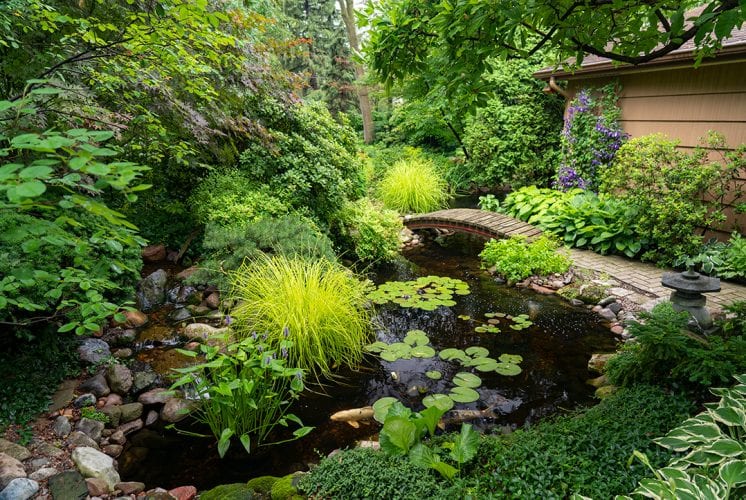
On The Next Generation
The most rewarding thing for me as a parent is being out in the open spaces and watching those guys really explore their world. In early July I took my 10-year-old girl and my 13-year-old boy out in the desert east of Steens Mountain for eight days of just bumming around. We fished in the rivers and we hiked. One day, we drove in this dirt road, to an area with a unique geothermal hot springs. As we got out of the car, the kids were looking around and there was this beautiful veneer of small pebbles across the landscape. Both of them got down on their hands and knees, and I think we spent two hours crawling around and checking out the rocks. Just that freedom is the kind of experience that I like to create for them. That’s why I love public lands, because it creates opportunities for people to connect and explore. And you can’t script that.
The Santiam Pass Ski Lodge, a historic but neglected ski lodge off the highway, gets a new lease on life thanks to the dedication of one Oregon couple.
Dwight Sheets’ first memory of the Santiam Pass Ski Lodge is of being a child, standing inside the lodge and looking around at the seventy-five windows, feeling like he was outside. It’s a memory that has stuck with him for decades even as the iconic lodge slipped into disrepair.
After seeing the building sit vacant for three decades, Dwight and his wife, Susan, made the restoration of the lodge a personal mission. Today, the massive task of revitalizing the long-neglected lodge is looking less like a pipedream. In November of 2018, the lodge was added to the National Register of Historic Places. It’s a designation that has taken decades of work, and, along with recognizing the significance of the lodge, will help with the costs of the renovation in tax credits.
The lodge was built as a Civilian Conservation Corps project in 1940, just a year after Hoodoo Ski Area began operating. It had a rope tow, overnight lodging and was popular with skiers, but Hoodoo took off because it was more easily accessible from the road.
By the 1950s, it had been turned over to the Presbyterian church and used as a retreat center for the next three decades. In 1986, the church opted not to renew its permit, and the lodge was boarded up. No one came forward to claim the lodge, so it sat empty. But it wasn’t forgotten.
In 1989, Catherine Lindberg, an archeologist for the Willamette National Forest, began the work of getting the lodge on the National Register of Historic Places, cementing its place in Oregon history. It was also key to securing its future thanks to the protection and benefits afforded such places. She wrote an evaluation of the lodge, detailing much of its history and recounting stories from the skiers and travelers who had experienced it in the 1940s and 1950s.
In 2000, some internal support structure was added to keep the aging lodge from collapsing, but still no one showed interest in taking on the lodge. In 2003, the lodge was almost lost. The B&B Complex Fires burned more than 90,000 acres of the Cascade Range and threatened the lodge, but a team of community members and wildland firefighters wrapped the Santiam Pass Ski Lodge in Kevlar, cut a fireline around the perimeter and were able to save it even as the forest around it burned.
While clearly many cared about the lodge, no one was ready to take up its revitalization as a cause. That is until Dwight and Susan Sheets toured the lodge with a ranger in 2016. Dwight, a former college professor, and Susan, a former music teacher, decided they wanted to take on the restoration project and revive the lodge for the public. They’ll be operating the lodge under a special use permit that was given to them in January of 2018. They formed a nonprofit, Friends of Santiam Pass Ski Lodge, to raise funds for the project, which they estimate will cost up to $3 million.
Darren Cross is the McKenzie National Forest district ranger and is aiding the Sheets during the restoration project. “I give them a lot of credit for taking this on in the public interest,” said Cross. “It’s a unique and important site for [the Forest Service].”
Cross said the Santiam Pass Ski Lodge is at a location that will draw people year-round who are visiting Hoodoo Ski Area, Ray Benson Sno-Park, Big Lake and the Santiam Off Highway Vehicle Area.
With the permit in hand and some funding secured, Dwight and Susan can start the renovation, beginning with restoring the iconic windows that captured Dwight’s imagination as a young man. They will also remove some of the outer additions that were added after it was built, restoring the original architecture of the lodge.
Dwight and Susan envision the lodge as a rest stop along Santiam Pass as well as a destination for cultural events. They plan to add new ADA restrooms (“Something that’s really needed as you travel along the pass,” said Susan) along with a cafe with snacks, desserts, drinks and maybe a gift shop. In the winter, the area is used by snowshoers and cross-country skiers, and the Sheetses expect that the lodge will still be used as a warming hut. The main level upstairs will be an event space, and they are hoping to draw music and arts events.
“The thing that stood out for both of us, is we wanted it to be enjoyed by as many people as possible,” said Dwight.
Aerial yoga can decrease risk factors for heart disease, improve your flexibility and is just plain fun.
I’d wager that your New Year’s resolution has to do with health, something like running three miles every day, cutting out gluten or drinking less beer. That’s pretty standard, but a growing population of Central Oregonians will be starting their new year by turning the traditional workout on its head, or at least its horizontal axis with “aerial” yoga, a mashup between traditional floor-based yoga and silk aerials.
While aerial yoga has been trending in the health and fitness world for a few years, the benefits aren’t a passing fad. A 2016 study from the American Council on Exercise found that “a single session of aerial yoga offered participants many of the benefits associated with low- to moderate-intensity aerobic exercise like brisk walking or leisurely cycling” and “[a]fter the six week program, participants displayed measurable reductions in some common risk factors for cardiovascular heart disease.”
The term aerial might conjure visions of Olympic snowboarders or Chinese acrobats, the reality is that you don’t need to have Olympic strength or circus coordination to assimilate. Even me, a goes-on-walks and sometimes-makes-it-to-yoga person, could handle aerial yoga. (My one pro-tip would be to not eat dinner beforehand.) The silk hammock, an admittedly intimidating piece of workout equipment, can withstand up to 3,000 pounds. Yogis can sit, stand, twirl and hang in and on the fabric without fear of falling, but it’s a mental battle as much as it is physical.
Timea Eckerdt is a certified yoga instructor with Tula Movement Arts, a yoga and massage studio in NorthWest Crossing that opened in 2017. An instructor since 2013, Eckerdt tried aerial yoga and “instantly fell in love with the silks,” she said. “It felt really supportive.”
Aerial yoga is an extension of Vinyasa and Hatha yoga, where the silks add leverage to stretch muscles and then support inversions. Eckerdt said that it can be a much more accessible form of yoga. “With the silks, anyone can go upside down,” said Ekerdt. “There’s a woman who’s in her seventies, and she finds it more supportive, easier and accessible.”
The postures, aided by the silks, can increase strength and flexibility and are a good reset after a day at the office. “It’s a great counterbalance of our daily lives and all the things we do that mess up our bodies, like sitting all day,” said Eckerdt.
Take a road trip to the Oregon Coast this winter and bring along this perfect itinerary for the gastronomically inclined.
Buttercup Ice Cream and Chowder Restaurant in Nehalem, OR. Photo by Justin Bailie
Winter in Central Oregon is gorgeous, but sometimes the ocean calls you away from the mountains for a weekend getaway. Four hours west and you’re in the land of sand, sea and salty air. At the beach, the flavors of the ocean, forest and farm come together under the skilled hands of local chefs to create delicious foods and crafted beverages. At the beach, don’t practice restraint. Taste everything. Here’s our suggested coastal foodie tour weekend itinerary.
Begin with a Friday night pint of pale ale at Astoria’s Buoy Beer Company, housed in a 100-year-old warehouse on piers overlooking the Columbia River. Dinner is at the Astoria Coffeehouse and Bistro, where the halibut tacos are fresh and the ambiance vintage Americana. Grab an ice cream cone for dessert at Frite and Scoop, to the sounds of the sea lions barking on the waterfront.
Buoy Brewing in Astoria, OR. Photo by Justin Bailie
Saturday brunch is in Manzanita at Yolk, where you might linger over eggs benedict or fresh tuna salad long enough to make it to happy hour, offered with class at MacGregor’s Whiskey Bar down the street. Craft cocktails and a menu of more than 200 brown liquors are offered in this locals’-favorite gathering place with a fire pit out front.
Grab some chowder for the road at Buttercup Ice Creams and Chowders in Nehalem, where freshly made seafood soups range from Thai to Indian to good old-fashioned clam chowder. Your dinner destination is Local Ocean Seafood on Newport’s bayfront. Grab a crab po’ boy sandwich with crunchy French fries and a Willamette Valley pinot gris, or perhaps the supremely fresh grilled albacore tuna kabobs are more your style.
Local Ocean Seafood in Newport, OR. Photo by Justin Bailie
Grab Sunday breakfast at the Drift Inn, on the highway in Yachats. Live music and divine seafood dishes light up this place at night, but breakfast brings crepes, eggs benedict, or clam and eggs to your plate. Blown glass light fixtures and umbrellas (open and hung from the ceiling) mark the Drift Inn, which has a long and salty history as a dive bar that you can read about on the back of the menu.
Sunday lunch is in downtown Coos Bay at Shark Bites, which features locally sourced seafood including Coos Bay oysters and Dungeness crab cakes, surrounded by traditional coastal décor of driftwood and surfboards on the wall.
Redfish in Port Orford, OR
Your gastronomical tour concludes in Port Orford with dinner at the renowned Redfish restaurant, perched on a cliff with a panoramic view of the beach. The black cod primavera comes with local vegetables. The sun setting over the ocean is 100 percent local, too, and just as satisfying as the amazing meals you’ve enjoyed all weekend.
Make Union Creek Resort your basecamp for cross-country skiing at Crater Lake this winter.
A lush, wintry landscape surrounds you. Douglas fir, spruce and cedar hang overhead in a sheltering canopy over Highway 62, west of Crater Lake, on one of the prettiest scenic drives in the state of Oregon. Blink and you’ll miss Union Creek Resort, but those in the know never miss a chance to take a break here, at least for a slice of Beckie’s famous pie. This winter, make a longer stop by booking a rustic cabin and making a weekend of it.
Union Creek Resort was built in the 1920s, and the cozy getaway retains a sense of going back in time. The collection of cabins sheltered in the forest near the narrow channel of the upper Rogue River are a peaceful retreat. Beckie’s serves homestyle breakfast, lunch and dinner in a log cabin that’s listed on the National Historic Register—and don’t forget about that pie, which comes in a dozen flavors.
Even better, from Union Creek Resort you’ll find easy access to some of Oregon’s most epic—and outrageously scenic cross-country skiing. It’s only twenty-four miles to the rim of Crater Lake via the south entrance, which is the only route kept clear of snow for vehicles in the wintertime. Reach the rim and put on your skis. Glide the trail a short ways or a long ways, depending on your stamina and how many times you stop to gape at that incredible bowl of blue water contrasted by white snow. Return to the resort for hot chocolate and some time in front of the fire. Perfection achieved.
A Bend mother-son duo could be HGTV’s next makeover hit with a new Bend-based show,“Mom & Me,” set to debut in 2019.
photo by alex jordan
With a sparkling personality and a natural ease on camera, Karrie Trowbridge of Bend is parlaying a home remodeling and design business into something that could become an ongoing series on HGTV.
A pilot show that aired in August 2017 rated well enough for HGTV to enlist Trowbridge and her son, Tristan, the oldest of three sons, to produce six additional episodes titled “Mom & Me.” The network is planning to air them in early 2019. If they gain traction, the Trowbridges could be signed up for thirteen more episodes. Owned by Discovery, Inc., HGTV broadcasts home improvement programming to millions of viewers through cable and satellite channels.
They’re definitely riding the crest of HGTV’s second wave of programming aimed at a younger demographic, the Gen X and Y viewers who are starting to buy their first homes. Petite and blond, Karrie is a youthful 42. Tristan, at just 22, believes he may be one of the youngest remodelers on HGTV. “They ended up liking me,” he said. “With us in its lineup, the network can reach out to a younger demographic. It’s a new niche.”
Like many success stories, the Trowbridges’ foray into television started with an unlikely event. Karrie had been fixing up and selling homes for more than a decade when a local investor hired her in 2015 to renovate and prepare six foreclosed Central Oregon homes for resale. She posted a before and after shot of one of the remodeled kitchens on Instagram. It caught the eye of a production company, which began informal auditions on Skype to see whether she and Tristan might be the next undiscovered talent for HGTV. The company, Essential Quail Television, liked what it saw and shot a “sizzle reel,” a four-minute video, to pitch the Trowbridges to HGTV.
“I feel like I’ve won the lottery, and I didn’t even purchase a ticket,” Karrie said. “We weren’t looking to do this. I’ve since learned that tons of people are always pitching their ideas to the network with hopes of landing a show. The thought never occurred to me that this could happen to us.”
Behind the scenes on the first season of “Mom & Me”.
“There’s a magic that happens with them on screen, and that’s why they’ve made it this far,” said Patrick Trowbridge, Karrie’s husband and Tristan’s father. “After shooting the pilot, they got better and better.”
The Trowbridge’s Bend home makeover narrative is more than just a made for TV plot. They have been living this story for almost two decades. The family moved to Bend in 2000 with hopes of buying their first home. They slept in a tent for two months while searching for the perfect starter home. Although that didn’t pan out right away, they eventually bought a 1923 Craftsman near Newport Market. “It was in terrible shape,” Karrie recalled. “We did the work ourselves and when the remodel was finished, I thought, ‘Ooh, I want to do more of this work’.”
Thus began a cycle of buying, fixing up and selling, with Patrick serving as real estate guru and Karrie as general contractor. “I love what I do,” Karrie said. “It’s almost like a sickness. The worse the house, the more I love it.” After the pilot aired, HGTV began casting for homeowners in Central Oregon willing to turn over their homes to Karrie and Tristan. Those chosen had to commit at least $60,000 to pay for their home remodel and move out for six weeks while the Trowbridges worked their magic. “People trusted me with their home, even though it was for a reality TV show,” said Karrie. “My number one goal was to ensure that the client was happy with the results.”
photo by alex jordan
Because of the high cost of filming, the six homes had to be completed within ten weeks. “It was extremely stressful,” Karrie said, adding that she designed each renovation, enlisted client input, coordinated contractors and was on camera with Tristan.
Under normal circumstances, each of the homes would have taken six months to finish. But Karrie was able to hire local subcontractors and had a project manager, Peter Carmichael, to facilitate the fast pace. “The tight deadlines, high pressure and the stress, especially for my mom, brought us together,” Tristan said. “When it got really hard, we were there for each other.”
A film producer was on set to direct interviews between mother and son. Their banter is good natured, with Karrie respecting Tristan’s input. “He’s so supportive, plus he’s got a great design eye,” she said. “We like to bounce around ideas that we think the client is going to love.” The Trowbridges hope they can continue making shows for HGTV, but if that doesn’t happen, they’ll still be out pounding nails and transforming client homes. “Making a beautiful space to live in is never going to go out of style,” said husband Patrick.
Newport Avenue Market CEO Lauren Johnson is the second generation in her family to run the specialty, employee-owned grocery store on Bend’s west side.
Debbie and Rudy Dory. Illustration by Mona Daly
When she’d turned 16, Lauren G.R. Johnson applied at Newport Avenue Market to be a courtesy clerk, bagging groceries, a job that in the late 1990s was called “box boy.” She moved up to donut fryer, then checker.
“Everybody has a first job that’s really about getting the foundation of showing up on time, with a clean uniform, doing what you’re told and when,” said Johnson, 44. “I had great people mentoring me in good customer service.” There was an added wrinkle—those department managers knew that one day she might be their boss.
Johnson’s parents, Rudy and Debbie Dory, store owners since 1991, were slowly transforming the conventional market into a specialty store, with both of their children working there as teenagers, but Debbie didn’t think either of her children would step into their shoes.
Lauren left Bend for two decades to be a flight attendant, work the front desk at a public relations firm in Portland, and to be at home raising her daughter there as well as in Texas and Vancouver, Washington. About eight years ago, she came back to the family business. A top priority was its nearly 100 employees, which still included some who’d trained her as a teenager.
“With the difficulty of the business and the continuing increase of expenses, I wanted to look after employees, and one of the best ways was to be employee-owned, which allows them to retire at some point and be a viable, important part of the community,” said Johnson, the market’s CEO. She and her parents had talked about it for years, but the market had to generate enough sales to justify the expense.
“We wanted to continue our legacy in the community and reward employees who make us who we are,” she said. They made the store employee-owned in 2014.
“Lauren was away for twenty years, and I didn’t think she’d be coming back, but she did,” said Debbie Dory. “She’d always been here for annual meetings, so she always had her finger in the pie, so to speak, and remembered a whole lot more than I’d thought she would, not being in Bend, and it has been an excellent thing. It’s always nice when you have fresh ideas. For one, our store is a very fun place, it’s not a typical grocery store.”
Rick Bartow, a late Native artist who lived most of his life in Newport, Oregon, is featured in a traveling retrospective exhibit of his work that will be at the High Desert Museum beginning January 26.
A rare treat awaits visitors to the High Desert Museum when an exhibit by Rick Bartow, an internationally recognized American artist with deep roots in Oregon, opens January 26. Organized by the Jordan Schnitzer Museum of Art, University of Oregon, the retrospective, “Rick Bartow: Things You Know But Cannot Explain,” brings four decades of Bartow’s powerful, gripping, and sometimes humorous drawings, paintings, prints and sculptures to his home state after traveling to nine other American museums.
Bartow was a lifelong resident of Newport where he was born in 1946 and died in 2016. His mother was white, and his father a Wiyot Indian of the Mad River Tribe of northern California. This dual heritage greatly influenced his art.
“Rick worked from an intercultural position, embracing both,” said Charles Froelick, a friend and owner of the Froelick Gallery in Portland. “He was at the forefront of intersectional identity, and yet his work was simply about being human.”
Another lasting influence came from his experience in Vietnam. The Army drafted him in 1969 after he graduated from Western Oregon University. While in Vietnam he worked as a teletype operator and played music for dying and wounded soldiers, earning a Bronze Star for his service. But he came home broken from what he’d seen.
“I had buried a lot of monsters with alcoholism and drug abuse and when they started getting out of the box, I lost the lid and couldn’t put it back,” Bartow told Cultural Survival magazine in 2007. That struggle is reflected in Bartow’s gripping work. In fact, the exhibit takes its name from a graphic-on-paper drawing of a tortured figure, mouth open in horror, with a hand seeming to reach outside its paper prison. He completed this painting in 1979, the same year he sought help from an elder of the Siletz Reservation and got sober.
“There’s a lot of intense emotion in his artwork,” said Froelick. “I was asked many times whether the artist was a sad or angry person. People were afraid to meet him,” he recalled. “I’d have to laugh because Rick was a most delightful person, mild mannered and very gentle.”
Bartow’s work took off after 1985 when William Jamison of Jamison/Thomas Gallery in Portland offered him a solo exhibit. Following Jamison’s death in 1995, he joined the Froelick Gallery and by 1997, he was among twelve Native artists who contributed sculptures for display in the Jacqueline Kennedy Garden at the White House.
In 2012, he carved a pair of twenty-foot poles from a 400-year-old red cedar. He topped one pole with a bear, the other with a raven. The two, titled “We Were Always Here,” stand at the entrance to the Smithsonian’s National Museum of the American Indian and overlooking the National Mall.
He had a lifelong fascination with animals and the stories told in all cultures about them that manifested in his artwork. His paintings and drawings often contain a human head on an animal or animal features on humans in the seamlessness of life. “He was equal parts observant, irreverent, scholarly and goofy, and constantly intrigued by the connectivity between humans, other animal and the spirit realm,” according to his longtime friend and companion, Erin Tormey. “The nexus was endlessly inspiring to him.”
He was a guitarist and singer, and performed around the Northwest. In Newport he was known as a generous man who donated his work to charity events, played music at benefits and at local venues with his band, the Backseat Drivers. The group also appeared at the Sisters Folk Festival.
“He was excited by life and inspired by its complexities—the poetic, the dark and the joyful mysteries,” recalled Froelick. “His work didn’t have a political agenda, and that’s why I believe it’s so powerful and impactful. He simply expressed his art from his own genuine sense of self, and that’s why he’s so respected and why people keep writing about him. His worldview was highly elevated but had plain spoken directness that made it so searing.”
Amy and Courtney Wright embrace healthful cuisine and yoga without sacrificing flavor at Sunny Yoga Kitchen in NorthWest Crossing.
Courtney and Amy Wright
It’s about 4 p.m. in NorthWest Crossing, and Sunny Yoga Kitchen is closed after lunch, but the aroma of pork, sesame oil and chilis, just beginning to braise in a hot pan, has wafted onto the sidewalk of this tidy, planned neighborhood. The fragrance is headily distracting. If this were a cartoon, passersby would be levitating, their noses gliding along the entrancing, vapor tendrils.
There’s a knock on the door. A woman asks if the eatery-yoga-studio offers gluten- and dairy-free dishes. Chef Amy Wright explains that the menu is entirely gluten-free, and she favors using avocado, nut cheeses, cashews and nutritional yeast as a cheese alternative. She shuts the door and returns her attention to the pork, which she has marinated for two days in an amino-acid packed protein concentrate from soybeans.
Beyond the kitchen, barely bigger than a Eurovan, the rest of the 1,000 square feet seats twenty. Hours before, Vinyasa yoga students were exploring rhythmic, moving meditation on the smooth wooden floor. Given the establishment’s big-picture goal—to build a thriving community by helping people strengthen their minds and bodies through yoga and fresh, nourishing food—one might expect this endeavor to be heavy on the passion, light on the palate. Think again.
“I appreciate it when people are excited that this is not typical, yoga-inspired food,” said Wright. “People try it and are surprised. They expect it to be a little more on the ‘crunchy side’ or ‘ski bum’ side. We want to be different, but not afraid of being ourselves.”
Wright’s partner in the business and in marriage is Courtney Wright, who performs a work trifecta: yoga teacher, prep cook and server. They met in 2008, the day Amy reported for her first day as a server at Restaurant Muramoto in Madison, Wisconsin, and Courtney was tasked with training her. Within two weeks, Amy was managing the enduringly popular sushi and Asian-fusion spot in the food-focused city. Chef Shinji Muramoto’s influence on Amy is evident in Sunny Yoga’s Shinji salad of cabbage, peppers, arugula, cilantro, sesame seeds and vinaigrette.
Burmese Pork and Golden Juice
Her fluency in Asian flavors was built atop the culinary foundation she’d developed from 2000 to 2007 at the acclaimed Zuni Café in San Francisco, famous for chef Judy Rodgers’ evolving hybrid of Eurocentric cuisine. During that time, the café and Rodgers won several James Beard awards, including outstanding restaurant in the country in 2003, and outstanding chef in 2004.
Amy, a liaison between floor staff, management and Rodgers, took it all in. “When you work somewhere for so long, you tend to learn everything,” she said. “It’s where I got my chops.”
In 2012, Amy moved with Courtney to Portland, where Amy helped chef Vitaly Paley and his team open Imperial Restaurant and Portland Penny Diner in the Hotel Lucia, downtown. Courtney was teaching yoga and serving at nationally recognized chef Jenn Louis’ restaurant, Lincoln. The Wrights frequented Yoga Pearl, which sparked the idea to open a restaurant-yoga studio.
Both snowboarders, they fell in love with Bend, moved here in 2013, and opened their business in 2014. They were grateful that it was popular, but Amy found herself working 100-hour weeks. The stress contributed to an inner ear infection and a crippling, five-day bout of vertigo.
“It was the first time in twenty-seven years of working that I’d called in sick, and it was to my own restaurant,” said Amy, who learned that she was allergic to dairy, a contributor to ear and throat problems.
The following year, Courtney had surgery to remove her thyroid after a cancer diagnosis. “It was another huge sign to not drown ourselves in work,” Amy said. “Instead of expanding and hiring more people, we decided to [stop] doing dinner, and focus on lunch and having more energy to nourish and rest ourselves.”
Sunny Yoga Studio Class. Photo by Adam McKibben
They cut sugar from everything on the menu (“except for the Burmese pork, because it’s so amazing,” Amy said). For everything else, Amy raves about monk fruit sweetener.
Like other healthy alternatives that also pack great flavor, such as liquid aminos as a substitute for tamari, monk fruit sweetener is significantly more expensive, but Amy believes it’s worth it. She hopes it gains popularity, which also will help bring the price down.
The Wrights are also proponents of using locally made Ablis CBD oils in their juices. Derived from hemp, the oil has no THC, and thus no psychotropic effects. Amy endorses it as a healthful way to manage the pain of being on her feet all day in the kitchen.
They discovered the oil after Max Bendis, national sales director of Ablis, became a fan of the Wrights’ food, especially the Burmese pork and the golden juice: carrot, orange, local turmeric and ginger over ice.
Bendis said, “They are two of my favorite people in Bend, they are so awesome, so nice and have really good food.”
Thanks to our skiing ancestors in the European Alps for coining the phrase “après ski” and instituting one of the best parts of winter recreation: the after party. A warm plate of comfort food and a tall pint are the ultimate reward after a day of adventure, but the après ski scene is as much about the atmosphere as appetizers. In Central Oregon, with the mountains just a short drive away from town, you’re never too far from a warm fire to thaw your frozen toes after a day in the snow. For your next post-powder gathering, shortlist some of these pubs and patios around the region to relax and refuel for the next day’s adventures.
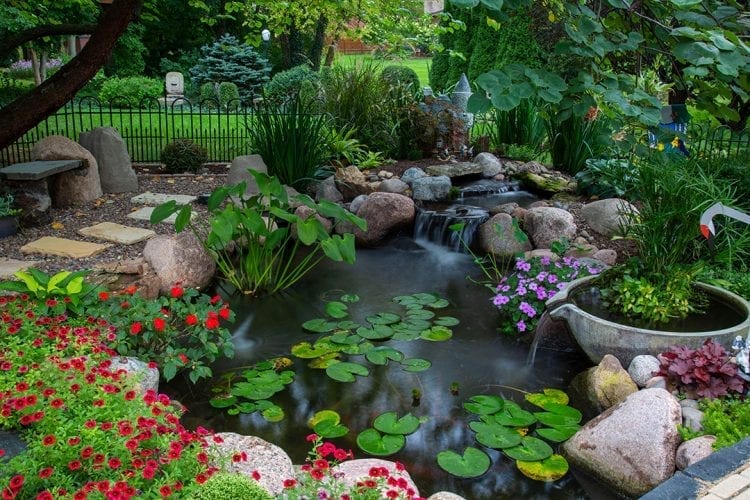
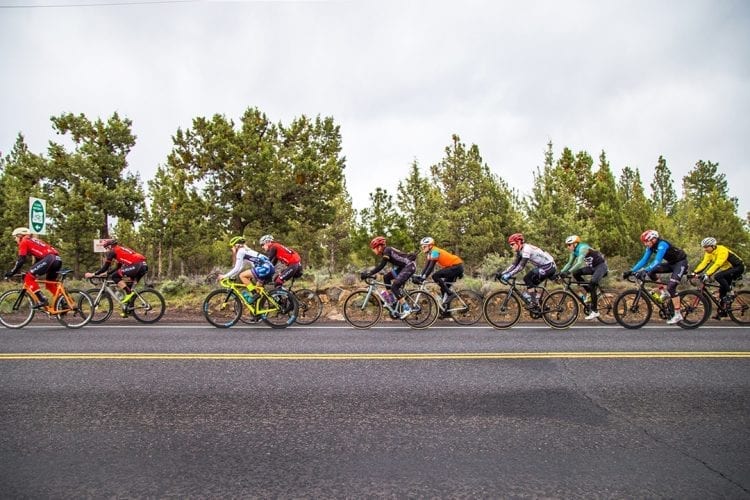
When you’re looking for a spot to knock the snow off your boots after a long day of mountain play, don’t overlook one of the newcomers to the scene, River Pig Saloon. This upstart watering hole with a Portland pedigree feels right at home in Bend where owner Ramzy Hattar has settled into the Box Factory in style. A throwback Western-themed bar wraps around the center of the room affording visitors a view of the multiple televisions where you’re likely to find a Ducks, Blazers or Timbers game playing. Behind the bar a life-sized stuffed Bison watches over the proceedings. Upstairs a loft allows for a semi-private gathering space and serves as an elevated stage for live music.
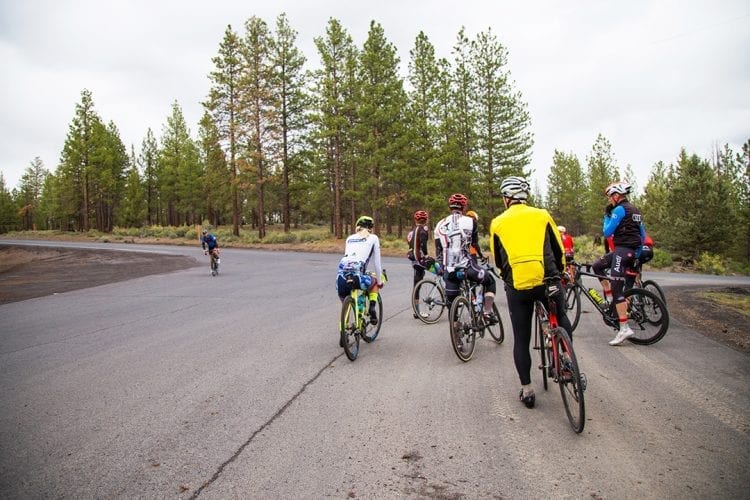
The piece de resistance though isn’t inside the thoughtfully designed saloon, it’s outside where Hattar commissioned Orion Forge’s Hunter Dahlberg to build one-of-a-kind galvanized steel hearth complete with wrought iron doors and a smoke alleviating chimney. It’s a perfect venue for gathering on a winter afternoon around the handful of tables on the sidewalk facing Arizona Ave.
Once you get yourself comfortable, order a round of the friend pickle chips, sliced dill pickles, rolled in cornmeal batter and deep fried to delightful perfection. If you’re appetite is as big as a buffalo, order the bison burger, a lean cut of ground American bison on a duck fat infused bun from Jackson’s corner. Wash it all down with River Pig Pilsner from Backwoods Brewery and pass the pickle chips. — Eric Flowers
Some of us old timers might be tempted to call it the Owl’s Nest, but by whatever moniker, Twisted River Tavern in the Sunriver Lodge is a classic destination to gather with friends at the end of a winter’s day. A remodel a few years back updated the interior to a modern sheen, as well as justified a name change, but the moody ambiance and chance to tuck up next to the fireplace with your friends and a bevvy remain intact.
Order a Millionaire’s Coffee or a Chocolate Martini alongside some duck nuggets or fried pickles and kick back to watch the sun slip behind South Sister. A terrific happy hour is offered seven days a week, covering extended hours on Saturday and Sunday, beginning at 11:30 a.m. A full menu draws on some of the flavors of the finer-dining next door at Carson’s American Kitchen. Your children and underage friends are welcome here, too. Make a night of it—Twisted River is open late. — Kim Cooper Findling
When the then-upstart 10 Barrel Brewing opened its flagship pub in 2010 nobody could have predicted the company’s meteoric rise, opening pubs in Boise and Portland and its ultimate sale to the international brewing mega corporation, InBev. While there have been many changes, including the opening of a second larger pub on Bend’s east side at 10 Barrel’s corporate headquarters, a few things have remained constants.
One of them is the neighborhood vibe that presides over the flagship pub on Galveston, where locals and visitors alike gather year-round on the open-air patio, huddling around a crackling wood fire that is stoked with regularity. It’s one of the best places in town to strike up a conversation with a stranger or kick back with old friends.
The prime location makes 10 Barrel a coveted location for an après ski layover. Assuming that you can find parking on the bustling Galveston corridor, you’ll be rewarded with a huge selection of taps, including small-batch and pub-only beers. Pair those with some of 10 Barrel’s pub grub and you’ve got the makings of a great post mountain pit stop. 10 Barrel’s pizza and burgers are the staple of this menu, but a great après ski dish is one that can be shared. For that, you can’t go wrong with the guilt-inducing flavorfest that is the steak and gorgonzola nachos. A staple of the menu over the past eight years, the dish is an inspired variation on traditional nachos, offering guests the option of either house-made Cajun chips or fries as the foundation. From there add a liberal dose of gorgonzola, ground steak and chopped applewood bacon, topped with four cheese sauce. If you’re looking to make up some lost calories on the mountain, look no further. — Eric Flowers
Comfort food, revolving taps and family-friendly atmosphere. Fresh off Cascade Lakes Highway, it’s hard to beat Brother Jon’s Public House for an après ski gathering that everyone in the group will enjoy. Grab a corner table, order a pint from the ever-changing menu of brews and dig into the comfort food. The spicy buffalo mac and cheese includes jalapenos, peas and buffalo meat in a spicy Sriracha cheese that will warm you from the inside out. It’s best paired with an easy, light beer that can wash down the heat. The dish could easily feed two, or at least would make a stellar leftover lunch. But if you’re ravenous after a day on the slopes, it’s definitely going to be enough to fill you up. — Bronte Dod
In Sisters, the place to après ski is the Sisters Saloon & Ranch Grill. Housed in the refurbished Hotel Sisters that was originally built in 1912, the restaurant opened in 2016 with decor that is on theme in true Sisters fashion and a menu that is a modern take on Western fare. Get started with the loaded potato skins and chicken wings. But make sure to save room for the coup de gras, a pulled pork sando served Memphis style with house-made slaw under a freshly baked brioche bun. Still got an appetite? The Saloon Cracklin’s are a local favorite: flash-fried pork rinds in a chili lime seasoning. Order it all to share, a cocktail from the full bar or a beer on tap and kick up your feet in the family-friendly atmosphere that channels just enough Billy the Kid attitude to keep things interesting. — Bronte Dod
The AdvenChair, created by Geoff Babb and Dale Neubaurer, is an all-terrain wheelchair designed to go off-road.
Geoff Babb. Photo by Michelle Simmons
In September 2016, almost eleven years after suffering a near-fatal brain-stem stroke, Geoff Babb sat in his modified wheelchair at the Bright Angel trailhead with his family and a group of friends. Given the path that he had traveled to reach that point, a wheelchair journey into the belly of the Grand Canyon didn’t seem far-fetched.
An avid backpacker, climber and mountain biker before his lifechanging stroke, Babb wasn’t content to surrender his outdoor lifestyle because of his limited mobility. Determined to get back into the wild places that inspired him, he soon realized that his enjoyment of the outdoors with friends was limited not so much by his legs, but the frailties of his wheelchair.
“Normal wheelchairs just can’t cut it in the wilderness,” said Babb. “To get off the beaten path, I needed something that was much more durable and versatile than anything out there. That’s how the AdvenChair was born.”
Babb, a fire ecologist for the BLM, began developing the all-terrain AdvenChair several years ago with the help of Dale Neubauer, a friend and helicopter mechanic. Together they created a human-powered vehicle with mountain bike tires, a detachable front wheel, a rear handle bar with dual disc brakes, and a harness that would allow a team of up to four people to push, pull and guide Babb up and down rugged trails, as well as over sand and snow.
“What drove me to work with Geoff was his incredible perseverance, optimism and positive drive,” said Neubauer. “When you spend time around someone like that, the last thing you’d want to do is hold him back.”
Initially, Babb’s stroke therapy included sit-skiing with Oregon Adaptive Sports and visits to Healing Reins Therapeutic Riding Center, which gave him the idea to trek with friends into the Grand Canyon via pack mule. But when the wait for a permit and other logistics got in the way of a trip in September of 2016, he decided to put his AdvenChair to the test instead.
Despite surviving rugged trails at Mount Bachelor and Smith Rock State Park, as well as at Mount Rainier, Crater Lake and Glacier national parks, the AdvenChair ultimately succumbed to a broken axle sheath two miles down the Bright Angel Trail. “The pounding of the wheels over dozens of water bars was just too much,” explained Babb.
The break sent Babb and his team back to the drawing board to strengthen the AdvenChair.
Photo by Michelle Simmons
“The structural failure of the axle assembly allowed us to start with a clean slate,” said Neubauer. “Geoff came up with the idea of blending the attributes of a sit-ski with high-grade aluminum mountain bike components, including beefier twenty-seven-and-a-half inch wheels, that led us to an entirely new hybrid design.”
After receiving encouragement at Bend’s Venture Out Conference in October of 2017, Babb was preparing an IndieGoGo campaign to help produce prototypes of Version 2.0, when he encountered a significant bump in the road. On November 10, 2017, he had a second stroke—twelve years to the day after his first one.
“The chances of surviving a brain-stem stroke are about 10 percent,” said Geoff’s wife Yvonne. “I knew getting him back from another one at age 60 would be pretty miraculous. But he looked at me from his hospital bed the next day and confidently murmured, ‘Not our first rodeo’.”
Despite doctor’s predictions, Babb relearned how to swallow and eat solid food all over again, and emerged more determined than ever to bring the AdvenChair 2.0 to reality, not just for himself, but for the nearly 15 million people nationwide suffering from limited mobility, and highly limiting wheelchairs.
Oregon Adaptive Sports Executive Director, Pat Addabbo, sees tremendous potential on a global scale. “As a program provider, the things I look for are adjustability for different sizes and abilities of people, ease of assistance by staff/volunteers and durability,” he says. “The AdvenChair fits all of these. It will surely fill a need in the adaptive recreation industry.”
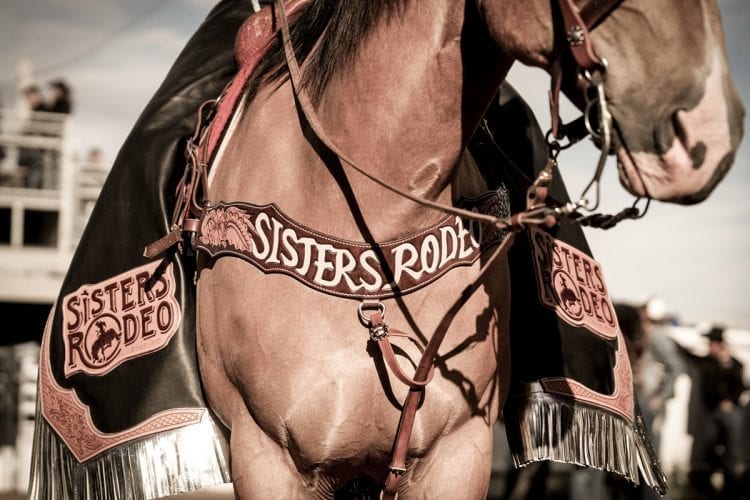
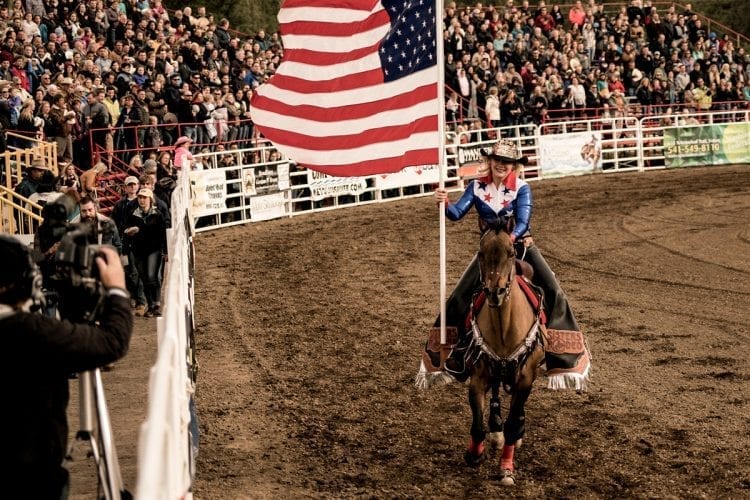
Babb’s fellow Oregon Adaptive Sports skier Kirk Petersen, who is paralyzed from the waist down, is anxious to test the new chair.
“The chair is going to do wonders for getting people like myself to remote places,” said Petersen. “We don’t want to be stuck in the house watching TV. We want to be doing the same things everyone else wants to be doing outside. We just need a little help.”
Perhaps not surprisingly, Babb chose November 10, 2018 as the day to launch his fundraising campaign to help build and test several prototypes. With funding through his website, his goal is to begin selling chairs in 2019, and ultimately, to see them in use throughout the country, so people can share their stories online.
“Having access to nature and solitude does wonders for the mind and body,” said Babb. “Whether venturing to the bottom of the Grand Canyon or not, we hope to provide some very rewarding journeys.”
Cross-country or Nordic skiing is a popular sport in Central Oregon. But not every trail or sno-park allows dogs. If you’re looking for a new trail to try this winter with your furry friend, here are some great options.
Nordic skiing has a long history in Central Oregon, with the first ski club formed in the early 20th century. There are miles of cross-country trails to explore across the region, but not all of them allow dogs. Since this is Central Oregon, and dogs are even allowed at some breweries, here are some options for where to take your dog cross-country skiing with you. Keep in mind that the Forest Service asks that dogs stay within voice control at all times and that they be leashed when in the sno-park.
Kapka Sno-Park
Near Sunriver off Forest Service Road 45, Kapka Sno-Park is one of the few places where dogs are allowed on the ungroomed cross-country skiing trails. The low-elevation sno-park has limited views, but its also one of the least-trafficked sno-parks in the region, so you and your pooch will have plenty of room to explore. Dogs are allowed at the park, along with snowshoers and snowmobilers, so keep an eye out and share the trails.
Wanoga Sno-Park
One of the first parks off Cascade Lakes Highway in Bend, Wanoga Sno-Park is also one of the most popular. There are designated trails for snowshoeing, Nordic skiing and snowmobiling, and the park is also busy with families who take advantage of the legendary sledding hill. A two-mile cross-country skiing trail, maintained by DogPac, allows dogs and is a popular winter Nordic skiing destination for those that don’t want to leave the dogs behind.
Edison Butte Sno-Park
Edison Butte Sno-Park, also off Cascade Lakes Highway, is open to skiers, snowshoers and snowmobilers. There are miles of trails to explore from here, and most will lead to one of two warming huts in the park. Dogs are allowed on the looped network of trails that can keep skiers and dogs busy for hours. Edison Butte is farther up the highway than other popular parks, and you’ll probably be sharing the trails with other skiers and their dogs as well.
What started as a small backyard concert and modest fundraiser for Oregon Adaptive Sports has grown into the region’s premier private concert event. A one-day, all-inclusive concert and charity auction that celebrates Central Oregon’s commitment to a level playing field athletes of all abilities, Bigstock Bend is the primary fundraising event for Oregon Adaptive Sports.
This year the event returns to Coyote Ridge Ranch in Tumalo on August 10, 2019 when Big Head Todd and the Monsters and special guest Freddy Jones Band will take the stage for an unforgettable evening of music under the stars.
Presented by Bend Magazine, Bigstock Bend welcomes headliner Big Head Todd and the Monsters for its only Central Oregon appearance this year. The Boulder, Colorado-based band is known for its powerful live performances that cover a twenty-plus-year career. With hits like “Broken Hearted Savior” and “Bittersweet“ from the band’s platinum-selling breakout album, Sister Sweetly, Big Head Todd’s career has spanned the arc of modern radio music. The band’s most recent album New World Arisin’ was released in 2017 and continues the group’s commitment to hook-driven rock and heartfelt lyricism.
Supporting act Freddy Jones Band ensures the day will not be short on funky groves and extended jams. The Chicago-based band cut its teeth during the mid-90s and has been touring hard ever since while scoring hits like, “One World“ and “In a Daydream.“
Bigstock Bend is a celebration of music, friendship and philanthropy that makes a positive impact on the lives of differently abled athletes by ensuring the outdoors is open to all.
In addition to live music, Bigstock attendees can participate in a silent auction with proceeds going directly to Oregon Adaptive Sports, an organization committed to providing equal access and opportunities for athletes of all ages and abilities.
A hosted bar includes local beer, wine and craft spirits with each ticket, as well as a cocktail mug. A diverse sampling of the region’s culinary offerings will also be featured in a pop-up food court featuring some of the area’s most popular food trucks.
All the best New Year’s Eve parties, celebrations and events around Bend. Central Oregon knows how to throw a good party.
Photo by Brad Bailey courtesy of Wanderlust Tours
If you’re looking to join in on some of the festivities for New Year’s Eve in Central Oregon, here are all the best places to ring in 2019. From resorts to the mountain, these are the parties and concerts that you don’t want to miss.
Bonfire on the Snow
Where: Wanderlust Tours and Deschutes National Forest When: Depart from the Wanderlust Tours office in Bend at 9 p.m. Who: All ages are allowed on the tour Details: For a unique way to celebrate New Year’s Eve, join the Bonfire on the Snow event from Wanderlust Tours. You’ll follow a naturalist guide on a showshow tour through the old-growth forest to a bonfire carved out in the snow. Sip on tasty warm beverages (including cocktails for adults) and local desserts while a guide talks about the history of the forest and the starry night sky.
River Pig Saloon
Where: River Pig Saloon When: Beginning at 8 p.m. Who: 21 and over Details: The River Pig will be hosting one of the biggest celebrations of the night. A Bend New Year’s Eve starts at 8 p.m. and will take over the Box Factory. There will be live music, a silent disco and a ball drop at midnight with a complimentary beer or champagne toast. A portion of the ticket sales will go toward the Bend Fire Community Assistance Program and there will be a 20 percent discount on all Lyft rides to and from the event.
Brasada’s New Year’s Eve at the Ranch
Where: Brasada Ranch When: Dinner from 6-10 p.m., Kids’ Cosmic Pool Party from 6:45 p.m.-12:45 a.m., NYE Barn Party 8 p.m.-12:30 a.m. Who: All ages are allowed at the dinner. Kids of all ages are allowed at the pool party. NYE Barn Party is 21 and over. Details: Head to Brasada Ranch for New Year’s Eve events that the whole family can enjoy. Start with a prix fixe dinner that will include ribeye and seafood paella. Kids can hang out at the cosmic pool party all night while the adults enjoy dancing at the barn and a champagne toast at midnight.
Hoodoo’s New Year’s Eve Party
Where: Hoodoo Ski Area When: 9 a.m.-12 a.m. Who: All ages Details: Spend New Year’s Eve at Hoodoo Ski Area. It’ll be an all-day party on the mountain, followed by a special dinner at the lodge, live music and a professional fireworks show at 9 p.m.
McMenamins Old St. Francis School
Where: McMenamins Old St. Francis School When: 9 p.m.-12:30 a.m. Who: 21 and over Details: If you’re looking for live music and a party, head to McMenamins in downtown Bend. There will be live music at Father Luke’s Room and in the Theater. There are also some special lodging packages available if you’re visiting from out of town or are looking for a staycation in Bend.
Sunriver Resort
Where: Sunriver Resort When: Dinner 5-9 p.m., Family night from 7:30-9:30 p.m., Party from 9 p.m.-1 a.m. Who: Dinner and family night are open to all ages. Party is 21 and over. Details: The whole family can celebrate New Year’s Eve at Sunriver Resort. There is five-course plated dinner that is open to the whole family with a sparkling cider or champagne toast. Families can then head to the Homestead building for games and snacks. Adults can join the party that will have live music from Precious Byrd and a champagne toast at midnight.
Larry and His Flask at Midtown Ballroom
Where: Midtown Ballroom When: 7 p.m.-2 a.m. Who: 21 and over Details: Local favorite Larry and His Flask will take over Midtown Ballroom New Year’s Eve for a raucous party. Their sound and genre are all their own, but never fails to get the crowd dancing. If you’re looking for a great concert in downtown Bend, this is the place to be.
Tetherow New Year’s Eve Party
Where: Tetherow Resort Pavilion When: 9 p.m.-12 a.m. Who: 21 and over Details: Tetherow Resort is hosting its annual New Year’s Party. There will be hosted time zone cocktails at 9, 10, 11 p.m. and midnight to ring in the new year. If you dine at Solomon’s beforehand, your ticket price to the party will be reduced. There will also be a DJ and a photobooth to round out the festivities.
The Cutmen with Tang at Volcanic Theatre Pub
Where: Volcanic Theatre Pub When: 9 p.m. Who: 21 and over Details: If you’re looking for a concert, The Cutmen, joined by Tang, will be taking over Volcanic Theatre Pub for the night. It’s always a party there, and even more so on New Year’s Eve. Plus, with tickets at just $5, it’s one of the least expensive options for the evening.
Local book expert Kaisha Khalifeh Gaede recommends her favorite books to give this holiday season, because books make the best holiday gifts.
Everyone can appreciate getting lost in good book. One of our local book experts Kaisha Khalifeh Gaede recommends the best books to give this holiday season that everyone on your list will enjoy.
How to Raise a Plant: And Make It Love You Back by Morgan Doane and Erin Harding
It’s impossible not to notice the explosive rise in the popularity of houseplants. How to Raise a Plant and Make It Love You Back is beautiful guide written by the creative minds behind the Instagram account @houseplantclub and is a great gift for anyone young or old who is trying to get more green into their life and into their living space.
There’s No Such Thing as Bad Weather: A Scandinavian Mom’s Secrets for Raising Healthy, Resilient, and Confident Kids by Linda Åkeson McGurk
If you are looking for a good gift for new parents, this is a great option. Less a parenting advice book and more an exploration into the science and benefits of a life lived in the great outdoors, There’s No Such Thing as Bad Weather will inspire the whole family to bundle-up and get outside.
Shinrin Yoku by Yoshifumi Miyazaki
For the person in your life who loved The Life Changing Magic of Tiding Up. While Shinrin Yoku: The Japanese Art of Forest Bathing has nothing to do with cleaning, this book on the practice of Japanese forest bathing is a beautiful and fascinating book to give to those people in your life who love hiking, yoga and meditation, which, if they live in Central Oregon, they probably do.
Cræft: An Inquiry Into the Origins and True Meaning of Traditional Crafts by Alexander Langlands
Written by an archaeologist and historian, Cræft is the perfect gift for that person who loves handmade furniture, artisan breads, craft beers and really appreciates and is fascinated by an authentically crafted life.
Brave New Weed: Adventures into the Uncharted World of Cannabis by Joe Dolce
Brave New Weed is a fantastically researched and entertaining look at the new world of legal cannabis, the history of cannabis prohibition and the emerging research on this fascinating plant. It’s a great gift for those who partake or those who are just curious.
The Royal Wulff Murders by Keith McCafferty
This is a great Dad-gift, especially if your dad is a huge C.J. Box fan or a dedicated watcher/reader of the Longmire series. In The Royal Wulff Murders, a fly-fishing guide in Montana turns his hand to solving crime in this first volume of the Sean Stranahan mysteries.
Ka: Dar Oakley in the Ruin of Ymr by John Crowley
For that friend who reads mostly fantasy but every once in a while dives in to hard-hitting literary fiction, the one who loves George R.R. Martin and Haruki Murakami. Narrated by a crow, Ka is a deep, slow river of a book that creeps into your soul and leaves you with new eyes to see the world.
The Heart’s Invisible Furies by John Boyne
The Heart’s Invisible Furies is one of the best books I have read in ages—every lover of a good, heart-stirring novel that I know is getting a copy this Christmas. The novel follows the life of Cyril Avery, given up for adoption in the early 1950s in Ireland. His loves, his triumphs and his sorrows are fully animated and full of life in this novel that is both hysterical and heartbreaking.
2018 has been a good year for Bend’s restaurant scene. Here are some great new restaurants that popped up in Bend this year.
Poke Row
Bend tends to attract bold, creative entrepreneurs as well as people working up appetites on the river, mountain, and forest trails at every turn. So, it follows that new culinary offerings are a given. Lately, this has meant an infusion of global flavors, from a lifted embargo on Cuban cuisine to Mediterranean bistro fare, savory pub grub and Bend’s stylized take on a world-class steakhouse experience.
Cuban Kitchen
133 SW Century Dr. Suite 204, Bend
Open: Tuesday-Friday 11 a.m.-8 p.m., Saturday 11 a.m.-8 p.m. Closed Sunday and Monday
The flavors of the Little Havana section of Miami come together at Cuban Kitchen in Bend, which offers classic dishes based on family recipes, bringing a dash of the Caribbean to the Cascades. Try the Cubanos, pressed, grilled sandwiches with savory fillings such as roasted pork, ham and Swiss cheese, or slow roasted pork or chicken, or thinly sliced and pounded sirloin. They’re also stuffed with sautéed onions, or sweet plantains with lettuce, tomatoes, mustard, mayonnaise and crunchy fried potato sticks, which all meld lusciously. The cheese melts, the bread toasts and the result is as satisfying as a lifted embargo. Top entrees include puerco asada, slowly cooked with a mojo marinade of garlic, cumin, and oregano and orange juice, and Cuban-style chicken fricassee and rice.
With a name that harkens back to the Pacific Northwest’s logging past, River Pig Saloon landed in a trending district on NW Arizona Avenue in Bend. The neighborhood is complete with a marijuana dispensary and board-game emporium, but this modern-day saloon delivers cocktails evocative of Bend’s burlier days, such as the River Pig old-fashioned, in which whiskey has its way with bitters and fig and maple flavors, or the PickleBack, whiskey neat, with a chaser of house pickle juice. Meanwhile, the red-headed stranger concoction tempts, with vodka, grapefruit, ginger and pear cider. Appetizers and rustic pub fare range from fried pickles in buttermilk batter with ranch on the side, to fried cheese-stuffed yucca with spicy ranch. Bratwurst with pickle relish and caramelized onion, mac and cheese, tacos and steak salad are suppers that will make you feel as fortified as a tree-feller.
Poke Row
2735 NW Crossing Dr. #105, Bend
Open: Monday-Thursday 11 a.m.-8 p.m., Friday-Saturday 11 a.m.-8:30 p.m., Sunday 11 a.m.-4 p.m.
At Poke Row in Northwest Crossing, the focus is on fresh, casual Hawaiian cuisine, drawing on poke (pronounced poh-kay) which historically referred to how fishermen would season small slices of their daily catch as a snack with some seaweed. It has evolved to a menu in which patrons select yellowfin or spicy tuna, shrimp, salmon, chicken or tofu, as well as sauces such as spicy mayo, spicy yuzu, sweet ginger soy, wasabi aioli and toppings, from cucumber or mango to pineapple, jalapeno and edamame, all served with rice and mixed greens. The signature bowl is tuna, shrimp, salmon, mango, sesame soy, spicy yuzu, avocado, green onions, sesame seeds, crispy noodles and toasted seaweed. The endeavor was founded by the team at Bend’s award-winning 5 Fusion and Sushi Bar.
The Lemon Tree
718 NW Franklin Ave., Bend
Open: Tuesday-Sunday 8 a.m.-3 p.m.
At The Lemon Tree, a quaint eatery in the heart of downtown Bend, two chefs who cooked on cruise ships, using fresh ingredients from the daily port of call, have landed their style here. The breakfast and lunch service features international fare such as: shakshuka, a Tunisian dish with poached eggs in a sauce of tomatoes, chile peppers and onions, cumin, garlic, paprika and coriander; feta and spinach frittata garnished with toasted pine nuts; crab cake Benedict; nasi goreng, Indonesian-style fried rice with prawns, chicken and vegetables topped with an over-easy egg and amaretto french toast with slivered almonds and raspberries. With friendly service and a charming, European-influenced atmosphere, this bistro sprung up to fill a niche in the abundant downtown restaurant offerings.
Boneyard Beer
1955 NE Division St., Bend
Open: Every day 11 a.m.-10 p.m.
Since its scrappy beginnings in an old auto shop off the beaten path in 2010, Boneyard Beer has had a growing fan base, prompting the opening of an expanded brewhouse and pub on NE Division Street. With about a score of brews to its name, the eclectic menu offerings pair well with a range of what’s on tap, typically ranging from a wheat “witbier” and a German Pilsner to their Diablo Rojo Red Ale and Incredible Pulp Pale Ale. Palate-stimulating food pairings include bold, umami-packed Asian and Latin American flavors, such as marinated, roasted wings ranging from Japanese barbecue, spicy green chili verde and carrot habanero to honey-mustard-Boneyard beer. Starters include a roasted vegetable platter with a celery root puree and local Sparrow Bakery pretzel. Japanese-style bahn mi hot dog with local Primal Cuts sriracha pork sausage and a crunchy-coated Japanese pork belly sandwich with Asian slaw, pickles and ginger aioli exemplify the emphasis on innovative flavors.
Bos Taurus
163 NW Minnesota Ave., Bend
Open: Every day 5-10 p.m.
Bos Taurus Chef George Morris leverages modern techniques for classic steakhouse fare with a progressive American (and Bend) twist. Try the Japanese Hokkaido A5 Wagyu, with its off-the-chart marbling for tenderness and flavor, or the hanger steak from 7X Ranch in Hotchkiss, Colorado, where the sustainably raised cattle graze on nine types of grasses. Morris rubs the steaks with hickory-smoked salt and a blend of peppercorns and seasonings, sears them on a custom-made, two-inch thick, 200-pound, cast iron slab heated to 550° F, removes them, rubs them with local butter, lets them rest, and re-sears them to achieve the perfect crust and medium-rare doneness. All that, plus top-shelf service and craft cocktails, make it a must.
The Old Mill District is much more than a shopping mall. It mixes your love of shopping, dining and the outdoors into one spectacular place. Riverside restaurants, trails, shops and shows—Bend is here! That’s why we have partnered with our friends at the Old Mill District to bring you an exclusive Holiday Giveaway. One winner will be randomly chosen.
Dana Robles has been a brewer at Boneyard Beer in Bend since 2015. Here’s what a typical workday looks like for her.
Dana Robles thought she might become a teacher after college. But she started working at Oakshire, a brewery in Eugene, and decided that she could turn her homebrewing hobby into a career. “I met a lot of brewers, and it just really made sense,” she said. “The lifestyle and everything about brewing seemed to fit me more.” Robles, 34, ended up going to brewing school, then landed a job at Ninkasi, where she met her now-fiancee, Mark Henion. In 2015, she got her brewing position at Boneyard Beer and moved to Bend with Henion (who’s also a brewer at Boneyard).
She said the thing she enjoys most about brewing is how hands-on it is. “It’s a lot of physical work, and can be challenging when things go wrong,” she said. “It challenges you to troubleshoot, think and act on your toes and dig into the well of knowledge gained throughout the years to keep things running smoothly.”
Robles added, “Work hard, play hard seems to be the M.O. Plus, we make beer, which is inherently fun and interesting.” Here’s how she spends a typical workday. — Bronte Dod
4:30 a.m. Not all of our shifts start this early. This is the opening shift, and we all rotate through it. That being said, 4:30 a.m. is really too early to be getting up. This morning, like every morning that I work at 5 a.m., I groggily get out of bed and turn on the coffee maker, which gives me 15 minutes to throw on my Carhartts, T-shirt, socks, sweatshirt and boots, brush my hair, my teeth and pack my lunch. Then I am out the door at 4:45 a.m.
5 a.m. Arriving at the brewery, I unlock the doors and immediately begin mash-in. On a day like this, we will brew three batches of beer, it takes about fourteen hours. Mashing-in, at our facility, consists of loading a super sack of milled malt above a bucket elevator that dumps the grain into the mash mixer scoop by scoop, while hydrating it with water. This morning is cold, and so is the grain. I am mashing-in at a strike temperature of 166 degrees. The strike temperature is the temperature that the water from the hydrater meets the grain. The goal is to finish mash-in with the entire mash at 150 degrees, the perfect temperature for the enzymes to convert starches to sugar in the malted barley. This process takes one hour, from start of mash to transfer to lauter tun, the vessel in the brew house used to wash the sugar from the mash and send it to the kettle.
6 a.m. Cellar-persons and racking crew have began to arrive. I am transferring the mash to the lauter tun via a three-inch pipe and a pump. This process takes ten minutes. After “first wort” (the most sugar-concentrated liquid) is through, the sparge water will rinse the grain for the remainder of the run to kettle. The liquid created in this process is called wort. This is usually un-hopped until boil.
7 a.m. Yeast harvest. There are many ways to harvest yeast for the days brew. It is an essential part of the process because the yeast is what converts the sugar to precious alcohol. At our brewery we harvest into fifty liter kegs depending on the batch size, then pitch the yeast in line to the fermenter, mixing it with wort and oxygen. The oxygen is another essential ingredient in the process. Yeast needs oxygen to thrive. Without the addition of oxygen, fermentation would be sluggish and the yeast would struggle to grow and survive in that environment. 8 a.m. Second mash-in. We are mashing three beers today, and mash-ins occur every three hours, unless there is a problem.Today, everything is going smoothly. Another brewer has joined me at this point and is helping with mash-in. The other brewer has weighed out the hops we will use for today’s three brews.
8:30 a.m. Kettle full and grain-out. This is the boogie. The “boogie” is a term coined by a brewer named Anders Johansen who I worked with at Ninkasi. He’s a veteran brewer with thirty-plus years experience, and has a one-of-a-kind vernacular. The boogie is the part of the brew day that ultimately has the most going on, requires multitasking and usually involves attention to multiple vessels at once.
While still mashing in, we get to kettle full, which is at sixty-seven barrels of wort. The kettle is boiling, hops get thrown and the lauter tun is ready for grain-out. After securing the kettle lid and recording boil time, I hop on the forklift to assist my fellow brewer in graining-out. An “iris” below the lauter tun is manually opened and out pours hot spent grain into plastic totes. Most people visiting the brewery at this moment remark on the terrific smell of the spent grain. After each bin is filled, I fork lift the totes outside behind the brewery. Later, an employee of Barley Beef will come by and we will load the totes onto his truck. That grain will later be taken to feed their cattle.
We have many “Groundhog Day moments” at the brewery. Mashing-in and graining-out are two of those moments. Brewing is monotonous and is designed to be so. Consistency is key in making quality beer that people can trust will taste like the last one they had. So everything we do throughout the day is part of a very regimented minute by minute brew schedule. Only when equipment fails, or people, does chaos happen.
9 a.m. Grain-out is over, and the new mash has been transferred to the lauter tun and is resting before vorlauf. Vorlauf, a german word, is the process of recirculating wort. We do this for about twenty minutes, until it is bright enough to send to our secondary holding tank called the wort receiver. The kettle is still full and boiling so we cannot send wort here just yet.
This is a good time to check in on the rest of the brewery’s happenings. I head over to the keg line, and help load empty dirty kegs onto the keg line. I bring new stacks of dirty kegs to the line via forklift, and remove the tags and shrink wrap. I haul away freshly packaged beer and help out wherever possible before returning to the brew deck. At this point in the day we are all hands on deck. If I leave the brew deck to help with cellars or packaging, there will surely be another brewer or two keeping an eye on the brews.
10 a.m. We are just about done transferring the boiled wort to the whirlpool. This process is called knockout. It is essential in separating heavy solids out of the beer to help with clarity downstream and in not clogging the heat exchanger when we send the wort to the fermenter. This process takes twenty minutes. Once the brew kettle is empty we send what we have collected in the wort receiver to the empty kettle and repeat the process we just completed with the first brew of the day.
10:30 a.m. Time to send the wort from the whirlpool to the fermenter. This is called “pump over.” This consists of running hot 200 degree wort through a plate and frame chiller, that has cold groundwater running the opposite direction of the wort. By the time the wort exits the heat exchanger it should be at our fermentation temp of 67 degrees. This is where I add the yeast I have harvested earlier. Pump over takes one hour.
11 a.m. Third and final mash-in. Now it is nice to have three brewers on shift. One monitors pump over, another filling the kettle and grain out and the third mashing in. We have an incredibly manual large brewery, so it is a very hands on process for the size.
Noon Lunch break. I take a half hour to sit quietly in the office and chow down on some food I got from the taco cart down the street.
12:30 p.m. Back to work, for the next hour and a half I will be loading kegs, cleaning drains and tank feet and monitoring run to kettle.
2:20 p.m. Final kettle full, final grain-out. I assist in graining-out, while my co-worker forklifts the totes away. My other coworker is finishing the second brew as it goes into the fermenter. Once I get the lauter tun empty, I do some final tidying around the brew house while the late shift brewer pulls plates up and rinses the lauter tun, tucking it away for the night.
2:40 p.m. Today is special because we have sensory. A nice surprise and a good way to end the day. I sample five different beers, rate them in order of preference, describe the aroma, flavor and appearance and offer criticism or praise for each.
3 p.m. My shift is over. I take a stroll to the back office to indulge in my favorite after work pastime: pinball and beer. I pour a PABO pils off the kegerator and fire up Playboy Pinball. “Welcome to my party,” Hef exclaims as I hit player one. Ball is life.
After that I either go home and head to Cycle Bar for spin, dig into a sewing project I dreamt about at work or snuggle with my old pup who isn’t doing so well right now. Or all three! Either way I am happy to be home and happy to kick off my stinky boots. Ready to make some more delicious beer tomorrow.
Elena Pressprich (you may know her as @findmeoutside on Instagram) is the staff photographer for Ruffwear and gets to take photos of dogs all day. Here’s what a typical workday looks like for her.
Elena Pressprich
Talking to Elena Pressprich over the phone, you could hear her dogs playing together in the background. She recently added a third to her pack, Millie, a golden retriever. On Instagram, you may know her as @findmeoutside. Pressprich has built a following around her outdoor adventures, always with her dogs by her side. She said she got into photography in high school, and after a few years exploring careers in the medical field, she landed a job as the staff photographer at Ruffwear in Bend a little more than a year ago. Pressprich, 32, has lived in Bend her entire life, and spends her free time exploring Oregon. “When I’m not working my nine to five, I’m still working at home to find the next place to travel to get photos,” she said. She’ll go anywhere that’s driving distance, so she never has to leave her dogs behind. Here’s how she spends a workday at Ruffwear. — Bronte Dod
6:00 a.m. Wake up, check phone. (Guilty… and I know I’m not the only one who does this…)
6:05 a.m. Ok, let the dogs out to use bathroom.
6:08 a.m. Let the dogs into bed with me and hug and cuddle them for at least ten minutes.
Elena’s first dog Rio
6:18 a.m. Realize I need to stop cuddling my dogs and really get in the shower.
6:35 a.m. Feed dogs, dress myself, make coffee.
6:55 a.m. Try to convince Baya that she really should eat her breakfast because I need to go to work.
7:10 a.m. Still trying to convince Baya to eat, while trying to make myself a breakfast. Try to stop Millie from eating Baya’s food, put gear in the car, stop Millie from pulling the stuffing out of her toys (which are now scattered EVERYWHERE).
7:25 a.m. Now time is flying and Baya still hasn’t had too much food? I need to get to work RIGHT. NOW.
7:30 a.m. Actually leave for work after giving the pups lots hugs and kisses.
Elena’s second dog, Baya
7:45 a.m. Arrive at Ruffwear. I left my job in the medical field kind of on a whim that there was something out there that would better suit me. While I loved being an x-ray technologist, I knew my true calling was something with photography. Ideally, that would be with dogs! When I reached out to local companies seeing if they needed photo help, my dream company wrote me back asking if I would accept a full time in house position; Ruffwear. I replied with in a minute, probably in all caps, YES I CAN START RIGHT AWAY!
8:00 a.m. Pack gear for photoshoot. I Make sure I have charged batteries, clean lenses, cleared memory cards, the dog gear I am shooting (leash, collar, harness, coat), dog treats, bowl, water, and that the van is ready to go.
8:15 a.m. Pick up talent at his house, head to the McKenzie River.
9:50 a.m. Arrive at the McKenzie River.
9:55 a.m. Begin to outfit the pup with the Ruffwear gear, making sure everything fits properly and pup is comfortable. Make sure the human is prepped and ready for the trail running photoshoot. Proper attire on everyone? Check, check, and check. We are ready to shoot.
10:15 a.m. Been scouting an exact location for a bit and just found the magical spot to photograph them. Stoked!
11:15 a.m. Exhausted, slightly muddy and 2,000 frames later. Oh boy, this is going to be a lot of editing—whoops! Got a little shutter excited.
11:25 a.m. Gear off, gear put away, give pup treats and water, and we are ready to hit the road back home.
12:55 p.m. Drop off human and pup at their house.
Dave & Harley in the Vert Jacket, Shot for Ruffwear
12:20 p.m. Arrive back and Ruffwear and I’m HUNGRY. Head back out to go grab a burrito at Longboard Louie’s.
12:55 p.m. Back again at Ruffwear, throw jackets, leash and harness in wash and unload photos from the photoshoot.
1:00 p.m. Social media planning meeting
2:15 p.m. Finally sitting down at my desk, excited to see how the photos came out.
3:15 p.m. Finalizing photography assets for a fun spur-of-the-moment social media idea.
3:16 p.m. Take a quick walk break, wishing I had my pups with me today like normal, but I’m almost done with the day and will be home to them soon! Head back in to begin to sift through the photos.
Elena’s dogs Millie, Rio and Baya
4:45 p.m. It’s time to head home! I need to go pack for a trip to Baker City.
5:05 p.m. Home! Play with the dogs, lay with the dogs on the ground, dogs jump all over me, lick me, step on me. It’s torture, but it’s love.
5:15 p.m. Time to pack! Things! Dog stuff! My stuff! Hiking stuff! Sleeping stuff! Wintry stuff? Camera stuff!
5:45 p.m. Friend picks us up, load car and we’re off! Night one to John Day. This was an assignment for Travel Oregon! It was a takeover for their Instagram Stories. My area to explore was to Baker City and Anthony Lakes. You can see the post on their account here.
6:45 p.m. Arrive at Crooked River Brewing for pizza and beer.
7:55 p.m. Leave and make the trek in the dark to John Day. Put on a ’90s love song Spotify playlist, sing loudly, and relive all my lonely, awkward high school dances.
9:55 p.m. Woof. We arrived. Check into hotel. Tired, and ready for bed.
10:25 p.m. Snuggle all my pups in bed and lights out.
It wasn’t the legendary ice road highway in Alaska, or the persistent deluge of the Oregon Coast. It wasn’t the dengue fever or the dog attack in Peru. In the end it was the wind. The cursed, never-ending wind that almost broke Kristen and Ville Jokinen. The pair were riding the final leg of an unprecedented transcontinental bike odyssey when the wind started pummeling the desolate Patagonia plateau.
Traffic jam in the highlands of Peru.
The Jokinens had left Bend in June 2016, more than a year earlier, on a journey that began on the edge of the Arctic Circle in Alaska’s Prudhoe Bay. The goal was to make it to the tip of Patagonia, the southernmost part of the American continents. The journey had taken them through a dozen countries. They had crossed the Andes six times in Peru just for the scenery. They’d be damned if they were going to let something as simple as wind stop them short. So they took turns grinding against the neverending gusts.
The persistence paid off. In February this year, the two rode together down the final stretch of road at Bahia Lapataia in Argentina’s Tierra del Fuego. They gazed out at the expanse of the sea and shared an embrace. An improbable journey had been ridden to its conclusion.
“We knew that nothing short of a serious injury was going to stop us because we are both so stubborn,” Kristen said.
Eight months later Kristen, a Bend native who graduated from Mountain View High School, is still readjusting to “normal” life. Traffic, text messages, work meetings. The pair have given numerous presentations about their arduous journey to students and civic groups. Kristin, 37, is working on a book and Ville, her husband of seven years, is editing hours of footage, some of which has already been shared on the couple’s fittingly titled blog, We Lost the Map.
Given just the basic outline of the Jokinen’s story, the first question that comes to mind is “why?” But the more you hear about their epic journey, the more pictures you see, the more snippets you gather of their simple sustained existence, the answer becomes obvious. They did it because they could. Like Sir Edmund Hillary, they climbed the mountain because it was there.
Ville and Kristen Jokinen in hot and humid Colombia.
The narrative also makes perfect sense when you consider the context. The pair met on a boat in Vietnam, diving in the Asian sea. Their courtship included numerous trips across the Atlantic when Kristin was living in Bend and Ville, a Finland native, was living in Helsinki. It culminated in the mother of all hikes, the Pacific Crest Trail, which started on the Mexican border and ended at the Canadian border with an engagement proposal in 2011.
It was shortly after that epic trek that the two started contemplating the idea of a bike tour. That idea grew from a flicker of a notion into a full-fledged odyssey when the couple, in the middle of an exhausting home remodel in Bend, decided to pull the plug—on everything. Armed with cursory research by Ville and a passing familiarity with their newly acquired bikes, they set off for Alaska in June 2016 with a backpacking tent, a few camping supplies and a monthly food and entertainment budget of $800.
Given the obstacles, it’s somewhat of a miracle that they completed the ride. They relied on their gear, their wits, luck and sometimes strangers willing to help a pair of gringos far from home.
“We relied so much on other people because we didn’t have money. We had a tent. We’d have to ask if it was safe to camp and [take certain] routes since we didn’t always know which way to go. We didn’t have GPS,” said Kristen.
On February 17, the pair broke their final camp and rode thirty miles to Ushuaia, the southernmost outpost of civilization on the American continent and the launching point for Antarctica-bound cruise ships. It was their logical stopping point, but they weren’t quite done. There were a few more miles of road to be followed. So naturally, they did just that. They bumped their way down a dirt track another fifteen miles where the land gave way to sea. After weeks of nonstop rain and wind, the clouds retreated to reveal blue skies and a sparkling sea. They shared a moment and a few tears. They finished as they began a year-and-a-half earlier, anonymously chasing an impractical dream because they could.
Kristen on Salar De Uyuni, the world’s largest salt flat, in Bolivia.
“That’s how we started. No one was there in Prudhoe Bay, just a few oil field workers. No one knew what we were doing but us,” Kristen said.
As the pair lingered, enjoying a bottle of champagne, a bus arrived with a load of tourists and photographers on a National Geographic tour headed to Antarctica. Noticing the pannier bags and touring gear, someone asked where the adventuresome pair had started their journey. When Kristen replied that they had embarked from Alaska, they were given an impromptu ovation. The anonymous bikers were now celebrities.
After eighteen long months on the road, the pair spent several weeks in Buenos Aires indulging in some of the pleasures they had foregone during their bike odyssey. They ate steak and drank wine. They learned to tango. Then it was time to say goodbye.
Kristen is now back at work selling real estate. Ville, a financial analyst in another life, is working at a grocery store. They’ve sorted through the mail and the unanswered email. They finished the remodel that they abandoned for the trip. Kristen is hoping to finish her book about the journey by the end of the year. The newly finished house is already on the market. They’ve decided they don’t need that much space, not when you can live comfortably out of a tent. They only question, where to next?
Patti Calande’s original collaborations fuse social commentary with civic sensibility.
Patti Calande
If you’ve flown out of the Redmond Airport in the past year, then you’ve encountered Patti Calande’s handiwork. Calande is the Bend artist responsible for the giant red, white and blue tapestry that hangs near the main airport entrance. Calande, along with about two dozen of her artist friends, created the handstitched patchwork American flag from repurposed T-shirts as a fundraiser for the Central Oregon Veteran’s Ranch. The flag was included in a raffle that raised thousands of dollars for the Redmond rehabilitation facility. The owner of the winning ticket donated the flag in turn to the airport.
This is the kind of project that perfectly blends Calande’s progressive community vision with her talent for developing practical artistic collaborations.
Calande said the idea of the flag came amidst the backdrop of toxic discourse in this country. She felt the flag was one symbol that everyone could support.
“Each unique piece when stitched together creates a symbol of unity, freedom and the resilience of our community,” explained Calande. “When you see this flag, you’ll notice each piece is uniquely different, each one made by different hands, each set of hands with their own experiences, background and religion.”
Now in her second decade in Central Oregon, Calande moved with her husband and children from Santa Cruz to Bend in 2004 for a lifestyle change, where the family could enjoy more nearby outdoor pursuits like mountain biking, hiking and skiing. She also found a small but thriving arts community. The first year here, she immediately connected with other artists.
“I’ve made and taught mosaics, soldered copper pipes for garden art and jewelry, taken metalsmith classes and ran a jewelry making business, fused glass and silver, molded clay for ceramics, knitted, felted, and done paper crafting and loved encaustic art,” said Calande, 54, who never feels you’re too old to learn a new art form.
“I feel especially thrilled when I can repurpose something, saving it from the refuse and giving it a new life.”
So, it’s no surprise that Calande has once again brought together the arts community to help Un-bag Bend, a community-driven initiative that aims to eliminate single-use plastic bags in Bend. Recently, Calande invited her friends to bring their sewing machines and scissors to her home to make shopping bags from—you guessed it—used T-shirts.
“In a few hours with about nine or ten women, we made 200 bags that will be distributed around Bend later in the year,” explained Calande. “It just goes to show many hands make light work.”
Calande said Portland, Eugene, Corvallis and Ashland have already banned the single-use plastic bags and said it’s the next logical step for environmentally conscience Bendites.
Though not everyone may agree on a wholesale ban, most Bendites can endorse the idea of making better alternatives readily available. That’s where Calande blends her plastic bag politics with her passion for artistry, providing an environmentally friendly alternative with a touch of local style.
Winter in Central Oregon isn’t just about carving perfect turns on the mountain, but that doesn’t mean you have hole up inside with cabin fever. Whether you want to try a new winter sport or are looking to soak in some history and culture, there’s something here that everyone in the family can enjoy to make it through the season. These are some of our favorite things to do around the region when the days are cold and the nights are long.
1. Take a Snow Bike Ride
Photo by Anelise Bergin
Trail riding has long been a year-round sport in Central Oregon, but the notion has taken on new meaning with the addition of a new “fat bike” loop at Wanoga Sno-Park. Under an agreement with the Forest Service and Meissner Nordic ski community, fat-tired mountain bikes are welcome on a segment of the groomed trail network out of the snow park, located off Century Drive en route to Mount Bachelor. A short and a longer loop allow riders to explore the winter landscape from the bike saddle. The Central Oregon Trail Alliance provides ongoing trail condition updates throughout the winter riding season, which officially begins once two feet of snow has fallen at Wanoga Sno Park. Several bike shops in town provide fat bike rentals, as well as tips on gear and riding conditions. Moderate terrain and the supreme traction and float provided by the wide tire technology makes snow biking an endeavor that can be enjoyed by the whole family. Pack your sleds and enjoy a few closing laps on the adjacent hill, or grab a cup of hot coffee at the well-provisioned snow shelter. We bet you’ll soon find yourself an ambassador of this off-season approach to biking. — Eric Flowers
2. Take a History Tour
Avoid cabin fever this season by visiting one of the region’s museums. The High Desert Museum will keep a family entertained for hours exploring the cultural and natural history exhibits. The new interactive exhibit “Animal Journeys: Navigating in Nature” opened in September and showcases the incredible feats that migrating animals undertake each year. Also on display is an exhibit featuring the photographs of Edward Curtis that depict Native American women, juxtaposed with displays of the women’s art. It’s a fascinating exhibit that explores the multiple layers of this history. — Bronte Dod
3. Become Pinball Wizards and Jukebox Heroes
Try out a different kind of pub crawl in Bend. Gather a group of friends who are game for anything and head to downtown Bend. Start your night at Vector Volcano Arcade. The bar has a lineup of ’80s and ’90s arcade and pinball games that will keep you entertained while you drink a beer or two. Next, head across the street to The Capitol, where you can test out your skills at skee ball and more. End the night at JC’s with a rousing of game of giant Jenga. You’re forgiven if you knock over the tower as long as you don’t spill your drink. — BD
4. Throw a Festivus Party
TV writer Dan O’Keefe’s father created Festivus in the 1960s as an alternative to the pressures of Christmas. The curious holiday entered the popular culture when O’Keefe wrote it into a “Seinfeld” episode. You, too, can celebrate Festivus each December 23 by putting up a simple aluminum pole, delivering the airing of grievances and presenting feats of strength. Don’t forget the Festivus dinner: meatloaf on a bed of lettuce. — Kim Cooper Findling
5. Make a Literary Date
No excuses—it’s time to work through that pile of books on your bedside table. Deepen your relationship with all things literary by seeing author Sarah Vowell speak at Bend High on November 15 as part of Deschutes Public Library Foundation’s Author Author series. Vowell has authored seven nonfiction books, contributes regularly to “This American Life” and is the voice of Violet Parr in The Incredibles. Finally, plan for spring literary events by picking up a copy of the 2019 selection for A Novel Idea, Bend’s community reads program. That title will be announced December 1. — KCF
6. Make Bigfoot Tracks
Photo by Richard Bacon
Take a break from the alpine descents and take a snowshoe tour through the forest. The Gear Fix usually has a few pairs of used snowshoes in stock that you can buy. Or you can rent a pair at Pine Mountain Sports or the Powder House. Pack a backpack with warm drinks, snacks, and extra pairs of gloves and socks—there’s nothing worse than wet and cold feet or hands out in the snow. Drive up Cascade Lakes Highway and take your pick among the sno-parks. Edison Sno-Park has a few designated snowshoeing trails, the longest of which is 3.5 miles. About halfway through the trail there’s a rustic hut where you can warm up any frosty hands or feet by the fire. Pour a warm drink and soak in the quiet forest before heading back out. — BD
7. Take a Sunriver Staycation
Photo courtesy Sunriver Resort
We love winter here in Central Oregon. We build chairs out of old skis, we actually own snowshoes. Heck, we even have a whole weekend dedicated to celebrating winter complete with ice sculptures and locally imported snow. But sometimes we all need a little break from winter. You’re thinking Mexico. Us, too. But when you don’t have the time or the money to beat a full-blown tropical retreat, you need to be creative. Central Oregon’s bevy of destination resorts, complete with indoor pools, spas and gourmet meals make a great getaway even if you feel compelled to pack your skis. You can’t go wrong in Sunriver where onsite amenities, including the SHARC indoor aquatic center, skating rink and ready access to Mt. Bachelor make it a family friendly excursion that’s light on travel and big on fun. If you have young children, this is the place to be around the holidays, beginning with the “Grand Illumination” tree lighting party in mid-November that kicks off a month and a half of holiday activities geared toward families. — EF
8. Enter the (Bowling) Cosmos
The lights are low, the neon is glowing, the ’80s music videos are rolling, and the strikes are coming fast and furious. You must be cosmic bowling at Lava Lanes. Rent the whole 300 Club for a private event and bring everyone you know. Food and drinks are at the ready and Lava Lanes has plenty of bowling shoes to go around. — KCF
9. Find Open Ice
Photo by Eric Flowers
After fifteen years of trial and error, I can say with somewhere north of about 90 percent certainty that sometime between when the last Jack o’ Lantern is snuffed out on Halloween and the time that you start seriously debating tossing out the remnants of your Eberhard’s eggnog, there will be a window—maybe several days long, maybe a week, maybe longer—when the barometric pressure and jet stream align just so, delivering a true glimpse of winter’s full glory. When it does, a near perfect sheet of ice will appear fleetingly on several area water bodies. I prefer Reynolds Pond in Alfalfa, a seemingly unlikely yet reliable place to find a game of pick-up hockey in Central Oregon. Wake early on these mornings, head east and you’ll find a dedicated group of skaters who take to the gleaming sheet with the abandon of schoolchildren. If you’re lucky, there will a bonfire crackling in the freshly fallen snow. You won’t find rental skates or be asked to sign a waiver of liability—this is old school DIY winter entertainment, Gordie Howe style. Game on. — EF
10. Book A Dog-Sled Ride
Photo by Alex Jordan
If you’ve ever parked a car at Mt. Bachelor’s Sunrise Lodge lot, then you’ve heard the eager yips of Rachael Scdoris’s sled dogs. A former Iditarod racer who gained notoriety for completing the epic race as a legally blind musher, Scdoris runs Oregon Trail of Dreams with her husband, Nick, offering adventuresome riders a little slice of Yukon Gold Rush culture in the heart of Central Oregon. Ensconced in cozy wool blankets, riders glide along groomed trails at the base of Mt. Bachelor behind a pack of sprinting sled dogs. Grab a hot chocolate in the Sunrise Lodge to warm up afterwards. — EF
11. Get Your Knit On
Having a project to do each winter is one of the ways to justify your hours-long TV binges. Try your hand at knitting or crocheting a blanket. The learning curve is fairly easy, even for kids, and with two new yarn shops recently opened in Bend, you can find find inspiration and community to guide you through the project. Fancywork Yarn Shop and Wool Town both offer weekly sessions, so you can step away from the screen and meet fellow textile hobbyists. — BD
12. Host A Cookie Party
Baking holiday cookies is a tradition that transcends time and trends. It’s a delightful messy activity that puts friends and family in the heart of the home, fosters conversation and encourages collaboration that can be arranged with little expertise or investment. This year, invite friends over and turn it into a party. It’s a great way to host a casual gathering during the all-too hectic holidays. Supplies are cheap, so offer to provide everything that’s needed for baking, flour and yeast, sugar, colorful sprinkles and frosting. Convert your kitchen into a makeshift bakery complete with stations for making and rolling dough, as well as shaping and decorating cookies. Stock up on cookie tins or ask your guests to bring their own. Your friends can load and label them as gifts to help spread a little seasonal cheer. — EF
Thom and Cyndie Bell’s extravagant remodel “Ranger’s Ridge” is a museum-like art venue on a cliff-top view property.
Photo by Brandon Nixon
When Thom and Cyndie Bell moved from Orange County in 2004 and bought a property west of Redmond, they chose the house for the view. Set high on a canyon cliff overlooking a stretch of the Deschutes River just upriver from Cline Falls State Scenic Viewpoint, with the peaks of Mount Jefferson and Mount Bachelor in the distance, the home offered a birds-eye view of rimrock, the river, wildlife and plenty of sky. The eight-acre parcel was just enough for their two horses, a border collie named Ranger and themselves.
But the house itself, built in the 1980s, needed updating. The Bells, who are retired from the advertising business in Los Angeles, are avid art collectors with vivid and specific design ideals. By the time they were ready to renovate their home, they’d spent years contemplating exactly what they had in mind to recreate Ranger’s Ridge.
The four-year project, completed in 2013, took the house down to the studs, added 1,500 square feet, incorporated dozens of floor-toceiling windows, and completely transformed the house. The result is a stunning 4,200-square-foot modern home filled with works of art and offering views at every turn.
Light and Sightlines
Photo by David Papazian
The dominant design concept for the redesign was “open.” The couple doubled the number of windows in the house, turning walls into windows in many places. “The floor to ceiling windows opened things up considerably,” said Thom. “Every view was enhanced.”
To get a sense of the home’s aesthetic, step into the master bathroom. While primarily a utilitarian space, it’s a gorgeous one. The room incorporates an uninterrupted row of horizontal windows at eye level, through which are old-growth juniper trees covered in green lichen, and beyond, chocolatecolored river canyon walls sliced through by the blue cut of the river. Cyndie loves the room for “the views and the light,” she said. A glass shower, deep tub, and tile and wood accents balance out the room.
The bath illustrates the grandeur of the home, throughout which great measures were taken to maintain precise design elements and an open feeling. For instance, the supporting wall near the front entry, which extends to the second floor alongside the stairway, was constructed as a screen wall instead of a solid wall, meaning stacked, vertical-grain fir beams separated with steel supports. Guests’ eyes can see easily, if not completely, through the slots between the beams, maintaining light and openness.
The wall, as well as a striking handpatinaed metal fireplace, were the two most challenging features of the home to complete, said Dan Stockel of R&H Construction, contractor on the home project. He said that working closely with the Bells to adhere to their high-concept design ideals was challenging but rewarding. “In Thom’s view, perfect does exist,” he explained. “It was great to see our crews pushed to achieve that.”
Personal Art Gallery
This Egyptian horse sculpture in bronze is centuries old and tops a high bookshelf. Photo by Brandon Nixon.
Every wall and every room in the house is adorned with art. Paintings galore and sculptures in metals, ceramic and glass are everywhere. “Our vision was that our home be like a museum gallery,” said Thom. “We collect museum-quality pieces with classic, iconic design. We look for timelessness and lasting design principles.”
A reproduction of Donatello’s David perches near the living room windows. Carved stone busts sit on tables. A polished horn of a Texas longhorn adorns the kitchen counter. A stylized Egyptian horse several centuries old sits high on a bookshelf in the upstairs lounge. A spectacular contemporary mixed-media painting is hung from the back of the fireplace. Five lengths of fused glass in varying colors cling to the laundry room wall.
“Our aesthetic is contemporary mixed with antiquity,” explained Thom. “Modern balanced with classic.” The furniture and fixtures are as much of a work of art as the artworks themselves. A white leather couch is partnered with black leather Barcelona chairs in the living room. Nearby, the dining room table has a clever set of gears within that retract the table’s leaves, depending on number of guests for that meal. “We want every room to have a balance of color, form and texture,” said Thom.
One piece of art is particularly personal. It’s a torch from the 1984 Olympics framed in plexiglass and secured to a dining room wall. “The torch had been carried across the U.S., runner to runner,” recalled Cyndie. “I was the last runner in Orange County, and carried it to the stadium.”
Cowboy Culture
Western themed tack room. Photo by Brandon Nixon.
If the house is a museum of antiquity and contemporary art, the tack room is a spatial immersion in Western culture. Thom is an avid horseman who enjoys cutting competitions and formerly participated on a mounted search and rescue team for San Bernardino County. Equally laden in artworks as the house, the tack room exudes classy, cowboy charm. “This space is totally different than the house,” he said.
A shelf of whisky glistens in an antique cabinet; leather tooling backs a coat rack; signed rodeo posters line the walls. A cowhide chaise lounge accents the center of the room. Saddles hang from the wall, indicating that for all of its beauty, the tack room is a working space, too.
But About That View
Photo by David Papazian
The former deck, Cyndie said, was multilevel with many different, disjointed heights. “We leveled it all out,” she explained. The wide expanse of composite decking is the perfect platform to take in what drew the Bells to the site in the first place. “We see eagles, osprey, hawks,” Cyndie said, gazing down upon the river. “At night the moon reflects in the river. The trees change. You can really see all four seasons portrayed here.”
Thom stood near, taking in the expansive view. “We feel very blessed,” he said.
An avid runner and entrepreneur re-envisioned a common product that hadn’t seen updates in decades.
How do Bendites incorporate kids into their exercise routines? For runners, it used to be so-called jogging strollers. But those were heavy, awkward and hadn’t seen innovation in decades. That is, until Will Warne had an idea.
In 2009, he fused a windsurfing harness, a toilet plunger, two deconstructed baby joggers and a web of PC pipe to create a hands-free stroller capable of towing a child. One morning, Warne took what he dubbed the KidRunner out for its first trial run with his six-month-old daughter in tow. The debut model, while shaky, demonstrated that hands-free kid strollers were not only practical, but superior to their push-operated counterparts.
Warne, 50, is a Los Angeles native who was working in “global retail logistics” at the time. “I started drawing on napkins like people do,” said Warne of the product’s origins.
After his initial Home Depot-sourced prototype, Warne took his idea to a do it yourself workshop in San Francisco, and then reached out to partners with industrial design and engineering experience hoping to streamline the design process.
“Running is a really dynamic motion, so in order to make running with something attached to you comfortable, we had to innovate,” said Warne.
Local professional runner Max King was an early ambassador of the product.
“I’ve used it on easy runs and used it in the Bigfoot race,” said King. “I’ve run with traditional strollers for a long time, and it was always a pain in the butt. It was a great new experience being able to run hands-free and biomechanically efficient.”
Fueled by Bend’s enthusiastic running community, KidRunner prototypes began to crop up around town, but the product got its first taste of national publicity on the popular entrepreneurship TV show Shark Tank in 2016. Although the company didn’t receive an offer from the celebrity investors, the slot got the product in front of approximately 14 million viewers—the equivalent of an estimated $9 million worth of advertising.
KidRunner recently sold out its go-to-market launch of 100, and the next step will involve exploring new distribution channels with retailers like REI.
“Today, we represent the first and only high-performance, multi-terrain hands-free kid jogger in the world. We want to create a whole new category for active parents in children mobility—biking, cross country skiing and running. We want to be a great Bend outdoor brand,” said Warne.
Head north for a day of outdoor exploration that includes a dramatic waterfall, rockhounding and a well-earned happy hour in Madras.
Plunge Into White River Falls
Photo by Gavin Hardcastle
Tell friends in Bend that you spent the day exploring the greater Tygh Valley area and you’re likely to get a blank stare in return. That’s understandable, given that this sparsely populated section of the Columbia plateau northeast of Maupin doesn’t get a lot of visitors. But it’s worth more than a passing glance with its rolling wheat fields, historic homesteads and almost ghost towns. The biggest attraction is the sprawling White River State Park that is wedged into a narrow valley between Mount Hood to the west and the Deschutes River to the east. The heart of the park is a dramatic plunge falls that cascades 100-plus feet over a basalt shelf into a roiling pool below. The park also includes a historic powerhouse, a remnant from an earlier era when the river was harnessed to provide electricity to farms and towns around the valley. The hydroelectric project was idled in the early 1960s when the Dalles Dam was completed on the Columbia River, delivering power to the valley and well beyond.
Dig a Thunderegg
Central Oregon’s volcanic origins left us snow-capped mountains and refrigerator-cool desert grottos. If you want your own piece of Central Oregon’s geology, then head to Richardson’s Rock Ranch outside of Madras. Here, rockhounds are invited to work one of the region’s largest and most productive thunderegg beds. These orange-sized rocks are split open to reveal a marble-like interior of polished quartz and silica in brilliant colors and elaborate patterns. Richardson’s provides digging materials and basic instructions for a DIY dig, or just peruse the ample selection in their onsite store (while dodging the roaming peacocks outside) and grab one for the road.
Kick back in Margaritaville
After you’ve checked waterfalls and rock mining off your to-do list, reward yourself with a stop a Rio Distinctive Cuisine in Madras. If you’re on a tight schedule, grab a cold cerveza and order the table-made guacamole before you head home. Better yet, linger a bit. Order a Casa Del Rio Margarita and a plate of the puerco emmolado, slow roasted pork shoulder served with mango mole sauce.
Breaking down three winter beers made in Central Oregon that run the gamut of flavors and profiles.
The Godfather
Deschutes Brewery: Jubelale Style: Old Ale / Winter Warmer Alcohol by volume: 6.7% Barrels brewed annually: 9,500
The first beer bottled by Deschutes was created in 1988 by John Harris, one of the company’s original brewers at the Bond Street pub. Harris’s intent was to brew a “winter warmer” in the style of an English Old Ale, a traditionally stronger beer often brewed during the holidays in appreciation of a pub’s loyal customers, as well as a stronger tipple to get through the winter months. The Jubelale recipe has changed very little over the years, though in 2011 Deschutes adjusted the process slightly to recapture its character from the early years.
The Sleeper Pick
Worthy Brewing: Dark Muse Barrel Aged Imperial Stout Style: Imperial Stout Alcohol by volume: 10.1% Barrels brewed annually: 30
A burly beer for the winter months, Dark Muse is roasty, chocolatey, creamy and warming—exactly what an imperial stout should be. Developed by Worthy’s original head brewer Chad Kennedy, Dark Muse is aged in bourbon barrels for an additional contribution of oak, vanilla and booziness. The recipe changes slightly each year based on the specific variety of bourbon barrels that Worthy acquires, yielding a vintaged treat that can be enjoyed over the holidays or laid down to age for future years.
The New Kid on the Block
Monkless Belgian Ales: Friar’s Festivus Style: Belgian-style Quadruple Alcohol by volume: 10.2% Barrels brewed annually: 35
Belgian brewing has a long tradition of brewing Bières de Noël, or Christmas beers, brewed strong and often incorporating holiday spices in the recipe. Monkless is the only local brewery brewing in this tradition, and at the same time, a bit outside the box from Belgian tradition. Friar’s Festivus, returning for its second year, is boozy but balanced and spiced with mace and cardamom for something festive yet slightly different.
The year is 2040. You drive through Bend, population 150,000, following signs to the local campus of Oregon State University.
OSU-Cascades officially opened its doors in 2001, holding classes on the Central Oregon Community College campus. In 2015, the university broke ground on a permanent home on the west side of Bend, despite opposition from neighbors concerned about traffic and an already crowded housing market. Many Bend residents had barely glimpsed the 128- acre site, which housed an old landfill and 100-foot-deep pumice mine, long cordoned off by chain-link fences and berms. The campus got final approval for its long range development plan in the middle of 2018. Here’s a peek at its future.
If you want to visit the campus, go to 1.
If you want to visit the surrounding area of Bend, go to 2.
1. Visit OSU-Cascades Campus
Zip around a series of new roundabouts to arrive on campus. Watch out for bikes! Especially the electric ones now preferred by students and faculty. They zoom along bike lanes and paths to avoid traffic jams, occasionally using the boost of an electric engine to arrive at class without breaking a sweat or burning a drop of fossil fuels.
Park your car or dock your bike and take a moment to look around. Forget about ivy-covered brick walls, this is not that kind of college.
It is “a really beautiful campus with lots of space for people to access, whether walking your dog or taking a bike ride or coming for a lecture or maybe some music event,” said Becky Johnson, vice president of OSU-Cascades. “We’re specifically designing it so it invites people on campus.”
A total of over ten miles of soft trails and paved bike paths zig zag across the campus, which is quiet despite the steady stream of students and joggers. The low-slung, modern-style buildings, all clad in neutral colors, recede into the sagebrush and ponderosas.
Population growth in Central Oregon has far outpaced student enrollment. Kelly Sparks, associate vice president for finance and strategic planning, estimated in 2018 that a new building would be constructed every couple of years, as 200 to 300 more students join the ranks. And Julie Gess-Newsome, dean of academic affairs, said that for the first decade or so, two to five new academic programs would be added each year. So even as the campus master plan was approved in 2018, officials didn’t know exactly what each building in the plan would be used for—or even what topics the students and faculty inside would be studying.
In the heart of the development is the quiet academic core of the university. Because the site is terraced, these buildings appear from the edge of campus to be just one story tall, even lower than the private developments across Chandler Avenue.
A young woman in an orange OSU-Cascades T-shirt is walking backwards and speaking to a tour group. She motions for you to join them.
If you want to join a tour for prospective students, go to 3.
If you want to join a tour for out-of-town architects and building professionals, go to 4.
2. OSU-Cascades and Bend
Remember back in 2018, when the area surrounding the university’s west side campus looked like a suburban business park? Parts of it are unrecognizable now. A parade of excavators, cranes and cement trucks has morphed this into a bustling urban core. About 500 acres between the university and the Old Mill District were rezoned in 2016. It’s one of three “opportunity areas” identified by the city as hubs for taller, denser redevelopment. The designation allows for mixed-use buildings with restaurants and retail on the ground floor, and offices and apartments above.
In 2018, ten years into an expansion cycle that saw Bend emerge as one of country’s fastest growing cities, Bend’s planners predicted at least one more softening of the market and another ramping up as well by the year 2040.
“We haven’t assumed the build-out of that whole area, by any stretch,” said Brian Rankin, long-range planner for the city of Bend who developed some of the city’s growth plans for the area. “Built into those plans was some flexibility to absorb the ebbs and flows of the economy. When the market softens, things slow down. It continues in these longer, larger cycles.”
About ten mixed-use developments have popped up here, each six stories tall. Rather than segregating industrial, commercial and residential development, a combination of uses is allowed in a single building here. It is one of the fastest-growing areas within Bend’s city limits. This one neighborhood has about 1,500 more homes, including apartments, and 1,500 more jobs than it did in 2018.
Along 14th Street, it’s hard to discern exactly where the campus begins. This is a gray area, an “innovation district” with private buildings that are connected to the university.
A young woman in an orange OSU-Cascades T-shirt steps in front of you and announces that a tour is beginning. You decide to join it.
If you want to join a tour for prospective students, go to 3.
If you want to join a tour for out-of-town architects and building professionals, go to 4.
3. Prospective Students
With a public elementary school on campus that includes an early childhood education center—both closely affiliated with the university’s education programs—there’s no need to wait until age 18 to go to OSU-Cascades.
“You could go to elementary school here, you could recreate here, you could go to college here, you could get a job here … you may even be able to retire here,” said Sparks.
Roughly 2,000 students, 40 percent of the total enrollment, live on campus. The campus also has housing for faculty and, when space allows, makes it available at market rates for unaffiliated households earning $45,000 to $90,000 in 2018 dollars.
The campus is where you’ll find one of the most diverse populations in Central Oregon, and that’s not by accident. It’s the result of programs like Juntos, in which OSU employees work with Latino families statewide to make sure high school students get the support they need to access higher education.
There’s no football team at OSU-Cascades, but you can cheer on the skiing, cycling and Frisbee golf clubs. There are recreational fields in the far corner of campus, near Simpson and Mt. Washington. A fitness facility is twice the size required by the university, so members of the public can swim or take an aerobics class here. Health was one of the initial goals of the campus.
“We want students to be healthier when they graduate than they were when they arrived,” said Christine Coffin, a spokeswoman for the university.
The campus rehabilitated the mine and landfill even before it dotted the refreshed landscape with buildings. Creating public open space was part of the university’s campaign strategy, as campus growth was dependent not only on state funding but on private donations, as well.
“Cleaning up the old landfill, building new roads … that’s not generally paid for through tuition,” said Johnson.
Sometime between 2018 and 2040, the state likely changed its methods for funding higher education “and probably not in a favorable way,” Johnson added. “I think in general there are other states where the state has stopped funding capital [improvements]. And when that happens, you have to borrow, and the only way to pay back is tuition, so you have to keep raising tuition.”
One of the campus’s stated goals is sustainability, and campus leaders say that if college is not affordable for students, the institution itself isn’t sustainable.
Matt Shinderman, senior instructor of natural resources, said that although he doesn’t expect OSU-Cascades to have solved the college affordability crisis by 2040, he does expect to see the university running “at least a program or two leading the way.”
If you’re ready to enroll, begin your internship by going to 5.
If you would rather kick back at the campus pub, go to 6.
4. For Professionals
It may sound odd for a college campus to offer tours to building professionals, but if you’re going to spend any time at OSU-Cascades, you might as well get used to it. Beginning with a feature in Landscape Architecture Magazine in 2018, the campus has garnered all kinds of attention for its sustainable approach to designing and building atop not one but two former blights: a landfill and a pumice mine.
Workers sorted and reused materials from the landfill, which was a buried pile of construction debris. By reusing materials already on site, the campus eliminated the need for nearly 30,000 truckloads of imported fill material. Berms and fill were moved around to transform the mine, a pit that was 100- feet deep, into the base of a three-level terrace.
Some walls of the mine were left exposed, a subtle nod to the land’s mining heritage. Crevices were carved in those cliffs to provide habitat for native bat species—just one example of how the campus’s development is on the forefront of environmentally minded design.
“I really want the physical … campus to be a demonstration site, a living, learning laboratory where we’re demonstrating site-appropriate landscaping strategies that also serve a habitat benefit, water conservation strategies, a place where we can take our students to learn about what we’re talking about inside the classroom,” Shinderman said.
The initial goal was for the campus to be net zero in energy, water and, most ambitiously, waste. In 2040, the campus is getting ready to go off the grid entirely, thanks to geothermal energy and a field of solar panels.
Many of the trees and native plants that you pass are decades older than the campus itself. As part of the sustainable construction process, native shrubs and grasses were dug up and housed in a nearby nursery, then replanted around new buildings and paths. Thanks to a project that Shinderman’s students started back in 2017, native plants across campus have QR codes posted to next to them, which visitors may scan with their smartphones to learn more about the species.
You walk across an oval green to return to the busy portion of campus along 14th Street known as the “innovation district.”
If you want to clock in for your internship, go to 5.
If you want to relax in the campus pub, go to 6.
5. Internship
To get to your internship on the edge of the OSU-Cascades campus, you could walk, bike, ride a bus or try a mode of transport that didn’t have a name back in 2018.
“OSU-Cascades is the catalyst for transportation options on the campus but also expanding out of it,” said Jeff Munson, executive director of Commute Options, a nonprofit in Bend. He said the university is responsible for bringing the first bike sharing and car sharing programs to Bend. And the university created a mobility lab to experiment with new methods of transportation, including an on-demand carpooling program that’s a cross between Uber and a bus.
The innovation district is made up of private businesses, each one doing “something that’s very collaborative and connected to the university,” Johnson said. “We think that is going to spill out beyond the campus as well. That’s just going to keep moving up toward Colorado [Avenue].”
Kinesiology students and engineering students could work with physical therapists in the district to make prototypes for new medical devices, for example. Or outdoor product design students and natural resource students could team up with a bike touring company to help reduce cyclists’ impact on local trails.
“By 2040, I hope the innovation district is half-built,” said Sparks. You walk into a building that’s named after Chuck McGrath, who moved his biotechnology company, Grace Bio- Labs, from Michigan to Bend in the mid-1990s. Grace Bio- Labs also has two buildings within a mile of the campus, on Emkay and Cyber drives. An early booster of OSU-Cascades, McGrath donated $1 million to help fund one of the first academic buildings.
“I would like to see Grace Bio-Labs be an anchor tenant in the new innovation district,” he said, looking forward to a day when his company, which develops new technology for vaccinations, helps train students “and my company can recruit from there.”
Gess-Newsome said that by turning to the community for help determining which new programs to offer at OSUCascades, the university can help meet the economic needs of the region. And private donations help fill funding gaps to develop new academic programs. A $250,000 donation by Bend-based Hydro Flask helped fund the development of a unique outdoor products major, for example.
“It’s beneficial for us to create a talent pool right here in our backyard,” said Lucas Alberg, a spokesman for Hydro Flask.
McGrath said that by attracting biotechnology companies, for example, the university will help “recession-proof” Central Oregon, which is currently vulnerable to market downturns because it’s so heavily dependent on discretionary spending such as recreation and tourism.
When you’re done working, head to the campus pub. Go to 6.
6. What’s Next?
You didn’t think Bend would be home to a dry campus, did you? Of course not. In all likelihood, by 2040, science and engineering programs, along with buy-in from local breweries—how many are we up to now?—has led to a fermentation science program at OSU-Cascades.
So go ahead and order a pint. It’s the result of decades of vision and investment from the community. As you take a sip, you wonder: What’s next?
Tim Riefke didn’t have a background in high tech and was a newcomer to Bend, which naturally made him the perfect person to take the helm at BendTECH last year.
Tim Riefke is technically the first executive director at BendTECH, a local nonprofit coworking space and startup incubator. During his short tenure he has helped to nearly double the organization’s membership while pushing initiatives like an Out in Tech event to promote inclusion of the LGBTQ community. Next up is a planned expansion that will add work space to accommodate the organization’s recent growth. We talked to Riefke about his accomplishments and plans for BendTECH.
What is BendTECH?
BendTECH is really becoming the front door for a lot of people who move here. A lot of what we do here as a nonprofit coworking community is connections. We get people plugged in and pointed to the resources for whatever field they are in.
What brought you to Bend?
I moved to Bend to retire from corporate life. I took a five-month sabbatical and played in the mountains and had an amazing summer. I consult part time to pay the bills, but I really dedicate a lot of my time to be involved in the community. Last year was I working with three nonprofit organizations: BendTECH, Bend 2030 and Out Central Oregon, which is an LGBTQ organization, and I transitioned them from a Facebook social group to a 501c3 with a mission and a board and the infrastructure to take that community to the next step.
You’ve also made inclusion of the LGBTQ community a priority at BendTECH as well, right?
It’s not just LGBTQ, it’s all underrepresented groups who don’t have the same access to resources and networks and even just basic needs. There’s definitely an underserved community in Central Oregon, and it’s disheartening to see some of the struggles that people have to endure. So it’s part of what we decided our mission would be, to create a safe place for everybody.
What attracted you to this position?
I managed a $10 billion real estate portfolio for Deutsche Bank. I understand real estate—buying, selling, operating. But I quickly realized the group of individuals in this room is more than the sum of its parts. The community is a phenomenal group of people in just a traditional Bend way. Everybody is trying to help each other. Seeing two people sitting next to each other at a desk and have an idea, start a company and go raise money in real time is really powerful. It made me excited about being in Bend because there are a lot of things going on here. It’s more than just the mountain and being outside and drinking beer. There’s a vibrant entrepreneur community.
Do we have the capacity to support more of this remote worker and startup economy in Bend, or have we reached our ceiling?
As long as the economic conditions remain favorable and barring any sort of major events, I think we’re really riding a macro trend right now with the gig economy and big companies embracing working remote policies. And it’s always going to be certain niches. Product managers, developers, freelance creative types—that’s where I see a lot of growth. We’ll never be Silicon Valley, but we also don’t want to be Silicon Valley. Everyone who has moved here from California wants to live the Bend life.
How do you see BendTECH’s role evolving beyond the coworking mission?
What I see are a lot of silos across the city. As executive director of BendTECH I think we could use our platform to connect the community in new and interesting ways and broaden the reach of what is being accomplished today. Maybe that’s a little ambitious. But if we create more partnerships and collaborate, we can accomplish more.
The “Elbow Room” appeals to anyone who wants to get away from it all—but mostly to women.
It was Virginia Woolf who first coined the phrase “a room of one’s own,” and what woman—especially those who have shared homes with men, children or pets—hasn’t craved a private space over the years?
Builder Pauly Anderson of Bend responded to his wife’s desire for her own space and created the Elbow Room, a freestanding, self-enclosed and very small building. He’s built five 200 square foot Elbow Rooms in Bend so far, and though he doesn’t restrict his clientele by gender, he said it’s mostly women who are reaching out. Some see the Elbow Room as perfect for an art studio or yoga space, some for a small office or place to escape from the kids.
“Men want a larger space, a dirty garage,” he said. “Women are more likely to want a small, enclosed space, something warm and cozy. I am in conversation with many perspective clients, and most of them are women.”
Anderson is a native North Dakotan and he and his wife Shelly have been Bend residents for nearly a decade. Shelly works as a voice and visual artist. “We have a Jack Russell terrier that likes to bark,” said Pauly. “My intent was to create a space to isolate her from noise.”
As a professional builder, Anderson wasn’t willing to just throw up a pre-fab enclosure, however. The Elbow Room, while classified as a garden shed in terms of land use (the structure is under 200 square feet and has no kitchen or bathroom), is anything but. “You’ve heard of the ‘She Shed’,” he said. “Those are actually sheds. They have limited use. I want the Elbow Room to be used year-round.” Anderson builds sturdy and beautiful structures beyond the expectations of building code. Transom windows allow light from above while maintaining wall space to hang art. Electric radiant heat in the flooring keeps the space warm.
Shelly spends around six hours a day in her Elbow Room, which stands behind the couple’s west side Bend home. The space, as intended, is cozy and warm, attractive and appealing, with a slanted roof and exterior painted a cheerful, whimsical leaf green. “It’s easy to come to work,” said Shelly. “It’s easy to focus here. I look forward to it.”
Making a case for a building a garage you actually want to spend time in.
Man Cave. Dude Dungeon. Bro Bungalow. Mantuary. Man Land. Whatever you call this sacred room, don’t go looking for floral chintz pillows, French country decorative candles and definitely not for potpourri within its boundaries.
Women know our homes are not our man’s castle, they are our castle. We make most of the decorating decisions in most of the rooms, which is why the men in our lives get full domain and decorating decisions in their man caves.
A poll by servicemagic.com, a home improvement marketplace, found that 40 percent of surveyed homeowners had a man cave, while another 13 percent reported they had one in the planning stages. “Guys want one room they can retreat to and indulge in,” says Mike Yost, founder of mancavesite.org and co-author of The Man Cave Book. “Man may no longer rule over his castle, but he’s still king of the garage, or his man cave.”
Bend homeowner Tim Scianamblo has been building the perfect man cave for five years, since he moved to Central Oregon. His 2,800-square-foot garage/man cave is as large as his actual house, and next spring he plans on expanding it so that it would be 800 feet larger than the house.
“My whole life I’ve dreamed of a garage like this,” said Scianamblo, as he spread his arms in his man cave. Some men collect sports memorabilia for their man caves, like a Seahawk’s football jersey or sports trophies from yesteryear. Scianamblo’s decorations are taken to another level. He collects classic cars, and all things auto related, including a full size traffic light, a real parking meter that takes coins, and an 8-track player that still plays his Peter Frampton and Pat Benetar tapes. The space is really more like a car museum, with high gloss black and white checkered flooring.
“When I was 16, I owned a 1957 Chevy, and my fascination of cars grew from there.” Scianamblo’s car showroom houses collector cars in mint condition, among them a red 1971 Jaguar E-Type. “Enzo Ferrari once said this was the most beautiful car ever designed,” explained Scianamblo, running his hand over the hood of this aerodynamic car. “There’s a ton of history in this car, and it’s also found in New York City at the MoMA [Museum of Modern Art] as part of its permanent art collection.”
Next to the Jag sits a 1967 Corvette C-2 Stingray in Marlborough Maroon and three Porsches: a black 1987 Porsche 911-Targa, a taxi yellow 1973 Porsche 914 and a fire engine red 2012 Porsche 997.2 GTS, which Scianamblo has taken on the race track at the Portland International Raceway a few times.
The garage door is graced with a large Batman poster, and Scianamblo jokes that this is his bat cave, but he does share it with his wife, Jane Dunham, who has her own classic car. “Yes, this is my white 1968 Mini Cooper Innocenti from Italy,” said Dunham, gesturing at the exterior wood trim. “When I drive it, people are always waving at me and stopping me. It’s really fun to drive.”
Tucked away near the Mini Cooper are four beautiful vintage Vespa scooters. On a vacation to Vietnam, Dunham and Scianamblo rented these vintage scooters, and liked them so much they brought them home as souvenirs.
Scianamblo said his man cave isn’t for entertaining. “This is just a place I want to be in, and to get away to when I have free time.” But Dunham laughed at that notion. “Every dinner party we host, we always end up in here.”